1) The Prokaryotes:
Eubacteria and Archaea
2) Protista
3) Fungi
4) Plants
5) Animals
6) ???
The Kingdoms of Life: A 6-part Series
Recall:
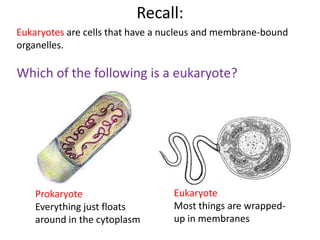
Eukaryotes are cells that have a nucleus and membrane-bound
organelles.
Which of the following is a eukaryote?
Prokaryote
Everything just floats
around in the cytoplasm
Eukaryote
Most things are wrapped-
up in membranes
Prokaryotes vs Eukaryotes
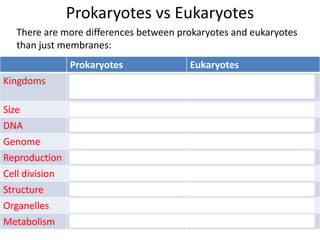
There are more differences between prokaryotes and eukaryotes
than just membranes:
Prokaryotes Eukaryotes
Kingdoms Eubacteria and Archaea Protista, Fungi, Plantae, Ani
malia
Size Small (1-100 m) Larger (100-1000 m)
DNA Free-floating nucleoid In nucleus
Genome One circular chromosome More than one chromosome
Reproduction Mostly asexual Mostly sexual
Cell division Binary fission Mitosis or meiosis
Structure Mostly unicellular Mostly multicellular
Organelles Absent Present
Metabolism Many are anaerobic Most are aerobic
Origin of Modern Eukaryotes
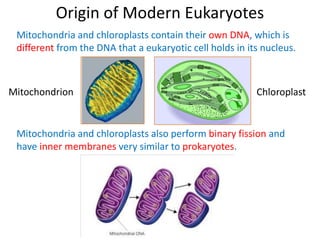
Mitochondria and chloroplasts contain their own DNA, which is
different from the DNA that a eukaryotic cell holds in its nucleus.
Mitochondria and chloroplasts also perform binary fission and
have inner membranes very similar to prokaryotes.
Mitochondrion Chloroplast
Origin of Modern Eukaryotes
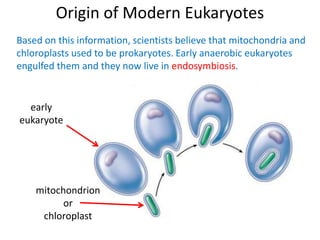
Based on this information, scientists believe that mitochondria and
chloroplasts used to be prokaryotes. Early anaerobic eukaryotes
engulfed them and they now live in endosymbiosis.
mitochondrion
or
chloroplast
early
eukaryote
Origin of Modern Eukaryotes
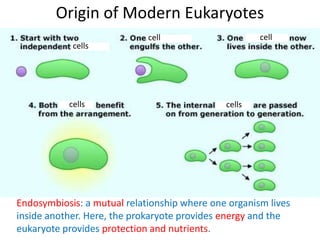
Endosymbiosis: a mutual relationship where one organism lives
inside another. Here, the prokaryote provides energy and the
eukaryote provides protection and nutrients.
cells
cell
cells cells
cell
Protista
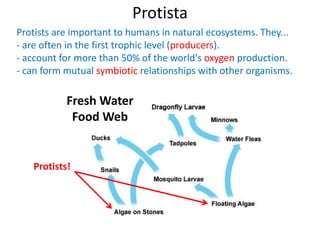
Protists are important to humans in natural ecosystems. They...
- are often in the first trophic level (producers).
- account for more than 50% of the world's oxygen production.
- can form mutual symbiotic relationships with other organisms.
Fresh Water
Food Web
Protists!
Protista
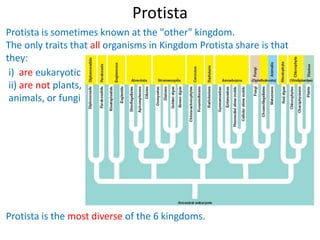
Protista is sometimes known at the "other" kingdom.
The only traits that all organisms in Kingdom Protista share is that
they:
Protista is the most diverse of the 6 kingdoms.
i) are eukaryotic
ii) are not plants,
animals, or fungi
Protista
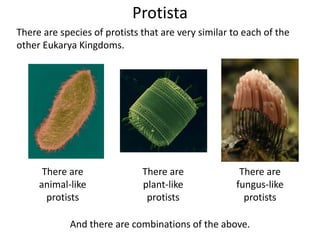
There are species of protists that are very similar to each of the
other Eukarya Kingdoms.
There are
animal-like
protists
There are
plant-like
protists
There are
fungus-like
protists
And there are combinations of the above.
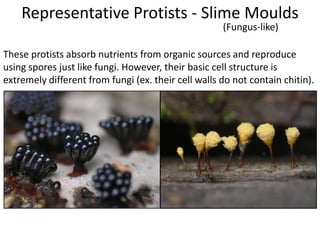
Representative Protists - Slime Moulds
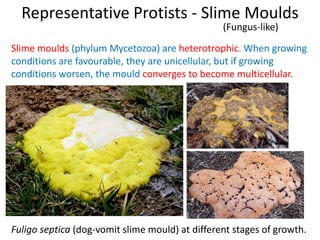
Slime moulds (phylum Mycetozoa) are heterotrophic. When growing
conditions are favourable, they are unicellular, but if growing
conditions worsen, the mould converges to become multicellular.
Fuligo septica (dog-vomit slime mould) at different stages of growth.
(Fungus-like)
Representative Protists - Slime Moulds
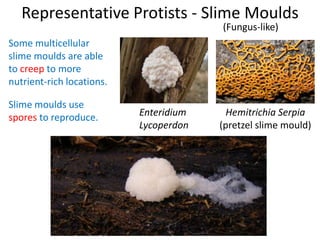
Slime moulds use
spores to reproduce.
(Fungus-like)
Enteridium
Lycoperdon
Hemitrichia Serpia
(pretzel slime mould)
Some multicellular
slime moulds are able
to creep to more
nutrient-rich locations.
Representative Protists - Slime Moulds
(Fungus-like)
These protists absorb nutrients from organic sources and reproduce
using spores just like fungi. However, their basic cell structure is
extremely different from fungi (ex. their cell walls do not contain chitin).
Representative Protists – Red Algae
(Plant-like)
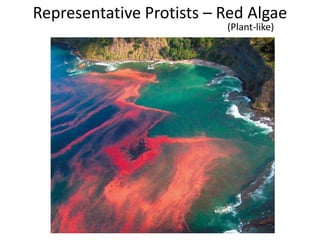
Red algae (Rhodophyta) is often red in colour. Many of them
are seaweeds.
Nori (edible seaweed) is the red algae Prophyra
Algae are usually multicellular, aquatic, photosynthetic
protists.
Representative Protists – Red Algae
(Plant-like)
Representative Protists – Red Algae
(Plant-like)
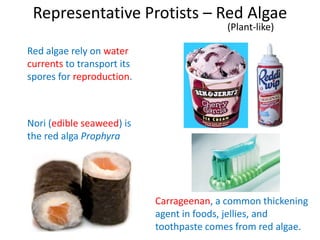
Red algae rely on water
currents to transport its
spores for reproduction.
Nori (edible seaweed) is
the red alga Prophyra
Carrageenan, a common thickening
agent in foods, jellies, and
toothpaste comes from red algae.
Representative Protists – Brown Algae
(Plant-like)
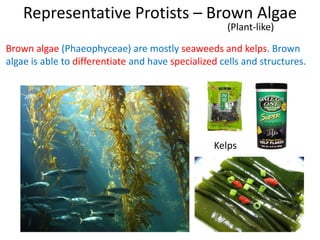
Brown algae (Phaeophyceae) are mostly seaweeds and kelps. Brown
algae is able to differentiate and have specialized cells and structures.
Kelps
Representative Protists – Brown Algae
(Plant-like)
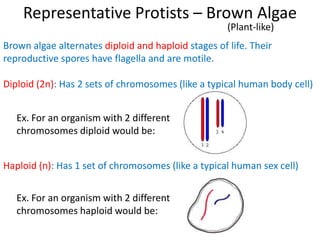
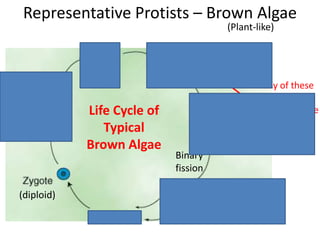
Brown algae alternates diploid and haploid stages of life. Their
reproductive spores have flagella and are motile.
Diploid (2n): Has 2 sets of chromosomes (like a typical human body cell)
Haploid (n): Has 1 set of chromosomes (like a typical human sex cell)
Ex. For an organism with 2 different
chromosomes diploid would be:
Ex. For an organism with 2 different
chromosomes haploid would be:
Representative Protists – Brown Algae
(Plant-like)
(haploid)
(diploid)
(haploid)
(cell
division)
produced
Binary
fission
Male and Female
Life Cycle of
Typical
Brown Algae
Many of these
are made, both
male and female
algae
algae
Representative Protists – Protozoa
(Animal-like)
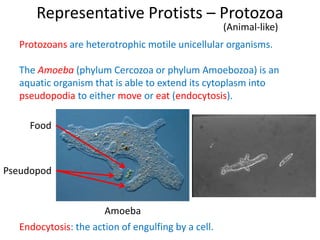
Protozoans are heterotrophic motile unicellular organisms.
The Amoeba (phylum Cercozoa or phylum Amoebozoa) is an
aquatic organism that is able to extend its cytoplasm into
pseudopodia to either move or eat (endocytosis).
Pseudopod
Amoeba
Food
Endocytosis: the action of engulfing by a cell.
Representative Protists – Protozoa
(Animal-like)
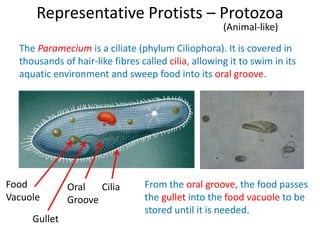
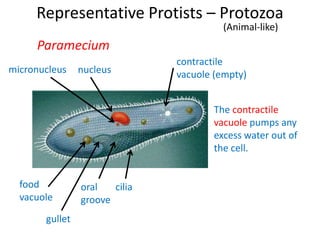
The Paramecium is a ciliate (phylum Ciliophora). It is covered in
thousands of hair-like fibres called cilia, allowing it to swim in its
aquatic environment and sweep food into its oral groove.
CiliaOral
Groove
Gullet
Food
Vacuole
From the oral groove, the food passes
the gullet into the food vacuole to be
stored until it is needed.
Representative Protists – Protozoa
(Animal-like)
ciliaoral
groove
gullet
food
vacuole
micronucleus
contractile
vacuole (empty)nucleus
The contractile
vacuole pumps any
excess water out of
the cell.
Paramecium
Representative Protists – Protozoa
(Animal-like)
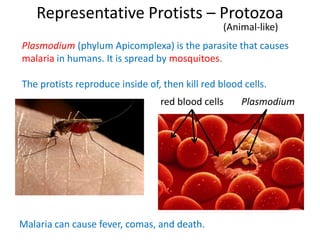
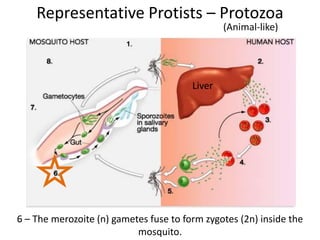
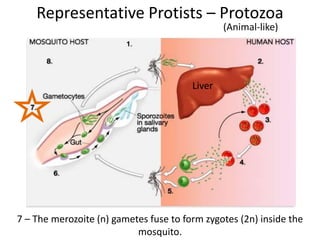
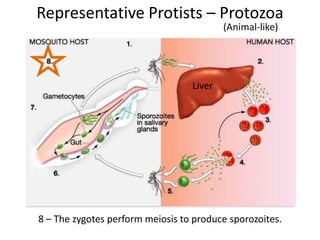
Plasmodium (phylum Apicomplexa) is the parasite that causes
malaria in humans. It is spread by mosquitoes.
The protists reproduce inside of, then kill red blood cells.
Malaria can cause fever, comas, and death.
red blood cells Plasmodium
Representative Protists – Protozoa
(Animal-like)
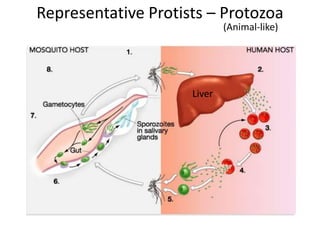
Liver
Representative Protists – Protozoa
(Animal-like)
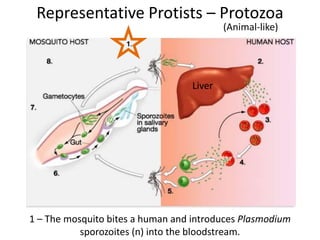
1 – The mosquito bites a human and introduces Plasmodium
sporozoites (n) into the bloodstream.
Liver
Representative Protists – Protozoa
(Animal-like)
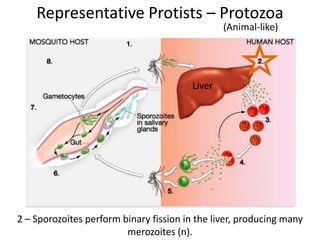
2 – Sporozoites perform binary fission in the liver, producing many
merozoites (n).
Liver
Representative Protists – Protozoa
(Animal-like)
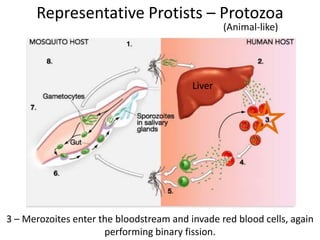
3 – Merozoites enter the bloodstream and invade red blood cells, again
performing binary fission.
Liver
Representative Protists – Protozoa
(Animal-like)
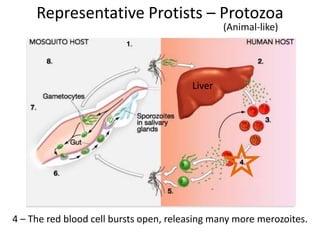
4 – The red blood cell bursts open, releasing many more merozoites.
Liver
Representative Protists – Protozoa
(Animal-like)
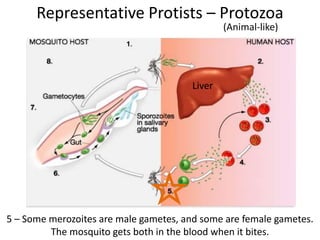
5 – Some merozoites are male gametes, and some are female gametes.
The mosquito gets both in the blood when it bites.
Liver
Representative Protists – Protozoa
(Animal-like)
6 – The merozoite (n) gametes fuse to form zygotes (2n) inside the
mosquito.
Liver
Representative Protists – Protozoa
(Animal-like)
7 – The merozoite (n) gametes fuse to form zygotes (2n) inside the
mosquito.
Liver
Representative Protists – Protozoa
(Animal-like)
8 – The zygotes perform meiosis to produce sporozoites.
Liver
Representative Protists – Euglenoids
(Plant-like and Animal-like)
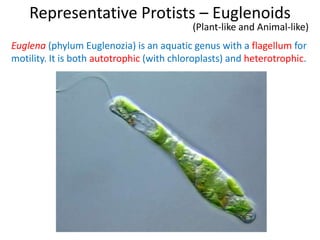
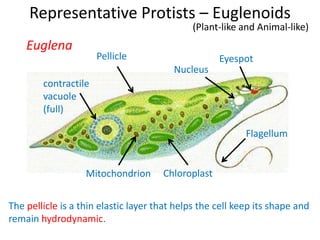
Euglena (phylum Euglenozia) is an aquatic genus with a flagellum for
motility. It is both autotrophic (with chloroplasts) and heterotrophic.
Representative Protists – Euglenoids
(Plant-like and Animal-like)
Eyespot
Flagellum
ChloroplastMitochondrion
contractile
vacuole
(full)
Pellicle
The pellicle is a thin elastic layer that helps the cell keep its shape and
remain hydrodynamic.
Nucleus
Euglena

09 protista

  • 1.
    1) The Prokaryotes: Eubacteriaand Archaea 2) Protista 3) Fungi 4) Plants 5) Animals 6) ??? The Kingdoms of Life: A 6-part Series
  • 2.
    Recall: Eukaryotes are cellsthat have a nucleus and membrane-bound organelles. Which of the following is a eukaryote? Prokaryote Everything just floats around in the cytoplasm Eukaryote Most things are wrapped- up in membranes
  • 3.
    Prokaryotes vs Eukaryotes Thereare more differences between prokaryotes and eukaryotes than just membranes: Prokaryotes Eukaryotes Kingdoms Eubacteria and Archaea Protista, Fungi, Plantae, Ani malia Size Small (1-100 m) Larger (100-1000 m) DNA Free-floating nucleoid In nucleus Genome One circular chromosome More than one chromosome Reproduction Mostly asexual Mostly sexual Cell division Binary fission Mitosis or meiosis Structure Mostly unicellular Mostly multicellular Organelles Absent Present Metabolism Many are anaerobic Most are aerobic
  • 4.
    Origin of ModernEukaryotes Mitochondria and chloroplasts contain their own DNA, which is different from the DNA that a eukaryotic cell holds in its nucleus. Mitochondria and chloroplasts also perform binary fission and have inner membranes very similar to prokaryotes. Mitochondrion Chloroplast
  • 5.
    Origin of ModernEukaryotes Based on this information, scientists believe that mitochondria and chloroplasts used to be prokaryotes. Early anaerobic eukaryotes engulfed them and they now live in endosymbiosis. mitochondrion or chloroplast early eukaryote
  • 6.
    Origin of ModernEukaryotes Endosymbiosis: a mutual relationship where one organism lives inside another. Here, the prokaryote provides energy and the eukaryote provides protection and nutrients. cells cell cells cells cell
  • 7.
    Protista Protists are importantto humans in natural ecosystems. They... - are often in the first trophic level (producers). - account for more than 50% of the world's oxygen production. - can form mutual symbiotic relationships with other organisms. Fresh Water Food Web Protists!
  • 8.
    Protista Protista is sometimesknown at the "other" kingdom. The only traits that all organisms in Kingdom Protista share is that they: Protista is the most diverse of the 6 kingdoms. i) are eukaryotic ii) are not plants, animals, or fungi
  • 9.
    Protista There are speciesof protists that are very similar to each of the other Eukarya Kingdoms. There are animal-like protists There are plant-like protists There are fungus-like protists And there are combinations of the above.
  • 10.
    Representative Protists -Slime Moulds Slime moulds (phylum Mycetozoa) are heterotrophic. When growing conditions are favourable, they are unicellular, but if growing conditions worsen, the mould converges to become multicellular. Fuligo septica (dog-vomit slime mould) at different stages of growth. (Fungus-like)
  • 11.
    Representative Protists -Slime Moulds Slime moulds use spores to reproduce. (Fungus-like) Enteridium Lycoperdon Hemitrichia Serpia (pretzel slime mould) Some multicellular slime moulds are able to creep to more nutrient-rich locations.
  • 12.
    Representative Protists -Slime Moulds (Fungus-like) These protists absorb nutrients from organic sources and reproduce using spores just like fungi. However, their basic cell structure is extremely different from fungi (ex. their cell walls do not contain chitin).
  • 13.
    Representative Protists –Red Algae (Plant-like) Red algae (Rhodophyta) is often red in colour. Many of them are seaweeds. Nori (edible seaweed) is the red algae Prophyra Algae are usually multicellular, aquatic, photosynthetic protists.
  • 14.
    Representative Protists –Red Algae (Plant-like)
  • 15.
    Representative Protists –Red Algae (Plant-like) Red algae rely on water currents to transport its spores for reproduction. Nori (edible seaweed) is the red alga Prophyra Carrageenan, a common thickening agent in foods, jellies, and toothpaste comes from red algae.
  • 16.
    Representative Protists –Brown Algae (Plant-like) Brown algae (Phaeophyceae) are mostly seaweeds and kelps. Brown algae is able to differentiate and have specialized cells and structures. Kelps
  • 17.
    Representative Protists –Brown Algae (Plant-like) Brown algae alternates diploid and haploid stages of life. Their reproductive spores have flagella and are motile. Diploid (2n): Has 2 sets of chromosomes (like a typical human body cell) Haploid (n): Has 1 set of chromosomes (like a typical human sex cell) Ex. For an organism with 2 different chromosomes diploid would be: Ex. For an organism with 2 different chromosomes haploid would be:
  • 18.
    Representative Protists –Brown Algae (Plant-like) (haploid) (diploid) (haploid) (cell division) produced Binary fission Male and Female Life Cycle of Typical Brown Algae Many of these are made, both male and female algae algae
  • 19.
    Representative Protists –Protozoa (Animal-like) Protozoans are heterotrophic motile unicellular organisms. The Amoeba (phylum Cercozoa or phylum Amoebozoa) is an aquatic organism that is able to extend its cytoplasm into pseudopodia to either move or eat (endocytosis). Pseudopod Amoeba Food Endocytosis: the action of engulfing by a cell.
  • 20.
    Representative Protists –Protozoa (Animal-like) The Paramecium is a ciliate (phylum Ciliophora). It is covered in thousands of hair-like fibres called cilia, allowing it to swim in its aquatic environment and sweep food into its oral groove. CiliaOral Groove Gullet Food Vacuole From the oral groove, the food passes the gullet into the food vacuole to be stored until it is needed.
  • 21.
    Representative Protists –Protozoa (Animal-like) ciliaoral groove gullet food vacuole micronucleus contractile vacuole (empty)nucleus The contractile vacuole pumps any excess water out of the cell. Paramecium
  • 22.
    Representative Protists –Protozoa (Animal-like) Plasmodium (phylum Apicomplexa) is the parasite that causes malaria in humans. It is spread by mosquitoes. The protists reproduce inside of, then kill red blood cells. Malaria can cause fever, comas, and death. red blood cells Plasmodium
  • 23.
    Representative Protists –Protozoa (Animal-like) Liver
  • 24.
    Representative Protists –Protozoa (Animal-like) 1 – The mosquito bites a human and introduces Plasmodium sporozoites (n) into the bloodstream. Liver
  • 25.
    Representative Protists –Protozoa (Animal-like) 2 – Sporozoites perform binary fission in the liver, producing many merozoites (n). Liver
  • 26.
    Representative Protists –Protozoa (Animal-like) 3 – Merozoites enter the bloodstream and invade red blood cells, again performing binary fission. Liver
  • 27.
    Representative Protists –Protozoa (Animal-like) 4 – The red blood cell bursts open, releasing many more merozoites. Liver
  • 28.
    Representative Protists –Protozoa (Animal-like) 5 – Some merozoites are male gametes, and some are female gametes. The mosquito gets both in the blood when it bites. Liver
  • 29.
    Representative Protists –Protozoa (Animal-like) 6 – The merozoite (n) gametes fuse to form zygotes (2n) inside the mosquito. Liver
  • 30.
    Representative Protists –Protozoa (Animal-like) 7 – The merozoite (n) gametes fuse to form zygotes (2n) inside the mosquito. Liver
  • 31.
    Representative Protists –Protozoa (Animal-like) 8 – The zygotes perform meiosis to produce sporozoites. Liver
  • 32.
    Representative Protists –Euglenoids (Plant-like and Animal-like) Euglena (phylum Euglenozia) is an aquatic genus with a flagellum for motility. It is both autotrophic (with chloroplasts) and heterotrophic.
  • 33.
    Representative Protists –Euglenoids (Plant-like and Animal-like) Eyespot Flagellum ChloroplastMitochondrion contractile vacuole (full) Pellicle The pellicle is a thin elastic layer that helps the cell keep its shape and remain hydrodynamic. Nucleus Euglena