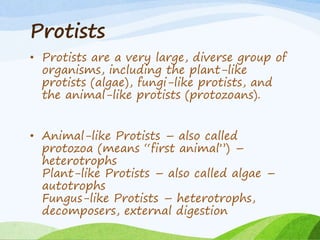
Kingdom Protista /
Protoctista
“Protists”
Presenters:
Dayna Bignal
Hortense Hassan
Protists
• Protists are a very large, diverse group of
organisms, including the plant-like
protists (algae), fungi-like protists, and
the animal-like protists (protozoans).
• Animal-like Protists – also called
protozoa (means “first animal”) –
heterotrophs
Plant-like Protists – also called algae –
autotrophs
Fungus-like Protists – heterotrophs,
decomposers, external digestion
Definition
Protists are eukaryotic organisms that aren’t
plants, animals or fungi, which mainly live in
water.
Differences between plant-like and
animal-like protists
Plant-like Animal-like
can photosynthesise Do not
maybe unicellular or
*multicellular
unicellular
Feed on the sun Must feed on other living
organisms
*The multicellular types have no real roots, stems, or
leaves, just a simple body called a thallus
Characteristics of Protists
• mostly unicellular, some are multicellular
(algae)
• can be heterotrophic or autotrophic
• most live in water (though some live in
moist soil or even the human body)
• ALL are eukaryotic (have a nucleus)
• No tissue
Protists “phylogeny”
• Biological junk drawer
Classification of Protists
• how they obtain nutrition
• how they move
Locomotion
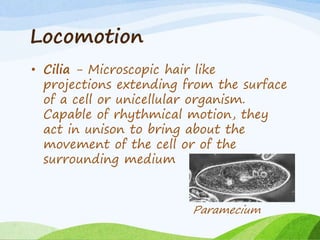
• Cilia - Microscopic hair like
projections extending from the surface
of a cell or unicellular organism.
Capable of rhythmical motion, they
act in unison to bring about the
movement of the cell or of the
surrounding medium
Paramecium
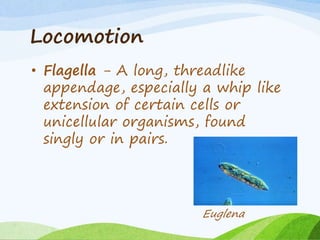
• Flagella - A long, threadlike
appendage, especially a whip like
extension of certain cells or
unicellular organisms, found
singly or in pairs.
Euglena
Locomotion
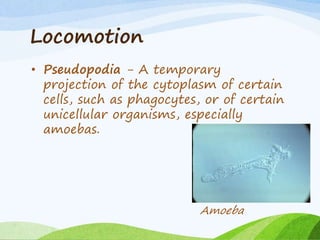
• Pseudopodia - A temporary
projection of the cytoplasm of certain
cells, such as phagocytes, or of certain
unicellular organisms, especially
amoebas.
Amoeba
Locomotion
Metabolism
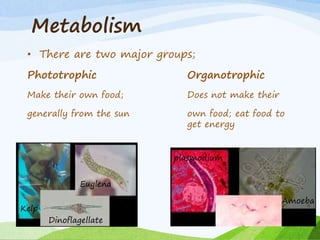
• There are two major groups;
Phototrophic Organotrophic
Make their own food; Does not make their
generally from the sun own food; eat food to
get energy
Kelp
Euglena
Dinoflagellate
plasmodium
Amoeba
Reproduction
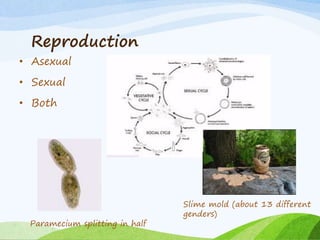
• Asexual
• Sexual
• Both
Paramecium splitting in half
Slime mold (about 13 different
genders)
Diversity
•
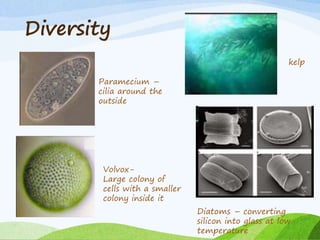
Paramecium –
cilia around the
outside
Volvox-
Large colony of
cells with a smaller
colony inside it
kelp
Diatoms – converting
silicon into glass at low
temperature

Protists

  • 1.
  • 2.
    Protists • Protists area very large, diverse group of organisms, including the plant-like protists (algae), fungi-like protists, and the animal-like protists (protozoans). • Animal-like Protists – also called protozoa (means “first animal”) – heterotrophs Plant-like Protists – also called algae – autotrophs Fungus-like Protists – heterotrophs, decomposers, external digestion
  • 3.
    Definition Protists are eukaryoticorganisms that aren’t plants, animals or fungi, which mainly live in water. Differences between plant-like and animal-like protists Plant-like Animal-like can photosynthesise Do not maybe unicellular or *multicellular unicellular Feed on the sun Must feed on other living organisms *The multicellular types have no real roots, stems, or leaves, just a simple body called a thallus
  • 4.
    Characteristics of Protists •mostly unicellular, some are multicellular (algae) • can be heterotrophic or autotrophic • most live in water (though some live in moist soil or even the human body) • ALL are eukaryotic (have a nucleus) • No tissue
  • 5.
    Protists “phylogeny” • Biologicaljunk drawer Classification of Protists • how they obtain nutrition • how they move
  • 6.
    Locomotion • Cilia -Microscopic hair like projections extending from the surface of a cell or unicellular organism. Capable of rhythmical motion, they act in unison to bring about the movement of the cell or of the surrounding medium Paramecium
  • 7.
    • Flagella -A long, threadlike appendage, especially a whip like extension of certain cells or unicellular organisms, found singly or in pairs. Euglena Locomotion
  • 8.
    • Pseudopodia -A temporary projection of the cytoplasm of certain cells, such as phagocytes, or of certain unicellular organisms, especially amoebas. Amoeba Locomotion
  • 9.
    Metabolism • There aretwo major groups; Phototrophic Organotrophic Make their own food; Does not make their generally from the sun own food; eat food to get energy Kelp Euglena Dinoflagellate plasmodium Amoeba
  • 10.
    Reproduction • Asexual • Sexual •Both Paramecium splitting in half Slime mold (about 13 different genders)
  • 11.
    Diversity • Paramecium – cilia aroundthe outside Volvox- Large colony of cells with a smaller colony inside it kelp Diatoms – converting silicon into glass at low temperature