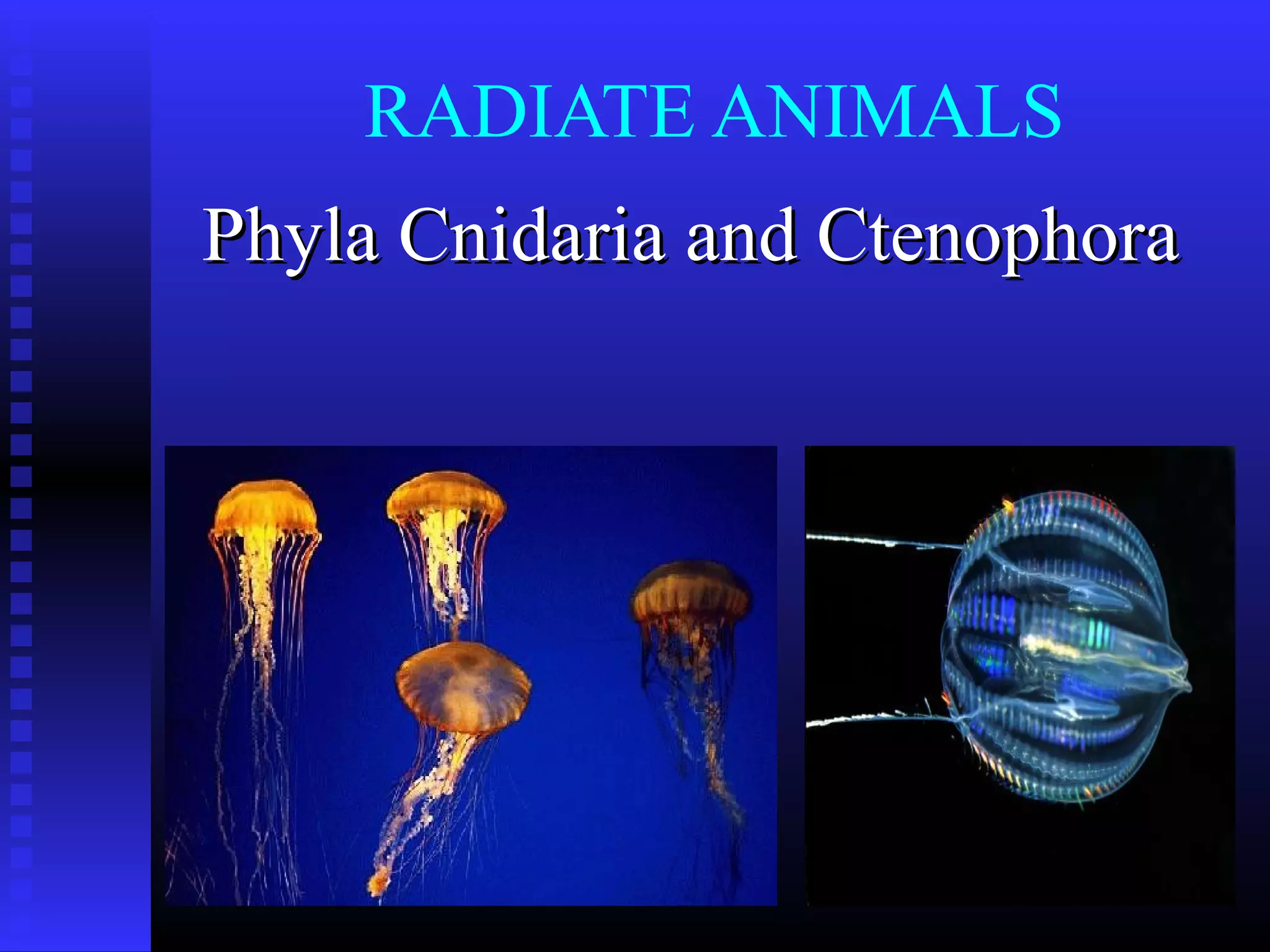
RADIATE ANIMALS
Phyla Cnidaria and CtenophoraPhyla Cnidaria and Ctenophora
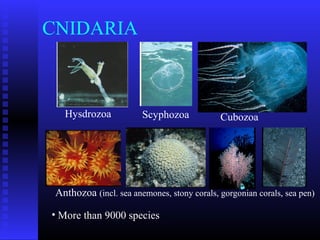
Hysdrozoa Scyphozoa Cubozoa
Anthozoa (incl. sea anemones, stony corals, gorgonian corals, sea pen)
CNIDARIA
• More than 9000 species
Cnidaria
 A Fearsome Tiny WeaponA Fearsome Tiny Weapon
 More highly organized than sponges;More highly organized than sponges;
most are sessile.most are sessile.
 Many are effective predators.Many are effective predators.
 Nematocysts are deadly weaponsNematocysts are deadly weapons
requiring only a small stimulus to fire.requiring only a small stimulus to fire.
 Can kill even very large prey.Can kill even very large prey.
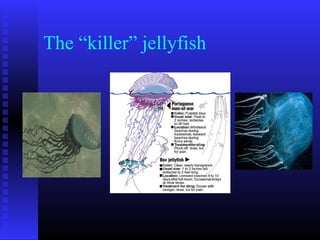
The “killer” jellyfish
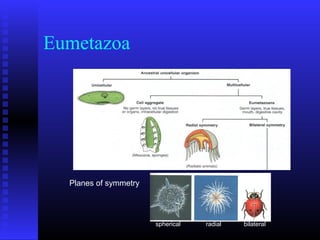
Eumetazoa
Planes of symmetry
spherical radial bilateral
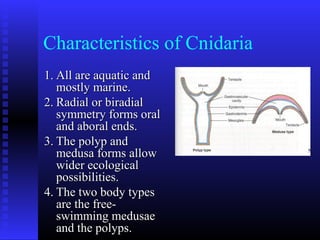
Characteristics of Cnidaria
1.1. All are aquatic andAll are aquatic and
mostly marine.mostly marine.
2.2. Radial or biradialRadial or biradial
symmetry forms oralsymmetry forms oral
and aboral ends.and aboral ends.
3.3. The polyp andThe polyp and
medusa forms allowmedusa forms allow
wider ecologicalwider ecological
possibilities.possibilities.
4.4. The two body typesThe two body types
are the free-are the free-
swimming medusaeswimming medusae
and the polyps.and the polyps.
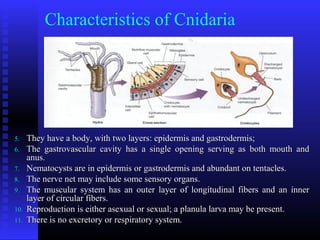
Characteristics of Cnidaria
5.5. They have a body, with two layers: epidermis and gastrodermis;They have a body, with two layers: epidermis and gastrodermis;
6.6. The gastrovascular cavity has a single opening serving as both mouth andThe gastrovascular cavity has a single opening serving as both mouth and
anus.anus.
7.7. Nematocysts are in epidermis or gastrodermis and abundant on tentacles.Nematocysts are in epidermis or gastrodermis and abundant on tentacles.
8.8. The nerve net may include some sensory organs.The nerve net may include some sensory organs.
9.9. The muscular system has an outer layer of longitudinal fibers and an innerThe muscular system has an outer layer of longitudinal fibers and an inner
layer of circular fibers.layer of circular fibers.
10.10. Reproduction is either asexual or sexual; a planula larva may be present.Reproduction is either asexual or sexual; a planula larva may be present.
11.11. There is no excretory or respiratory system.There is no excretory or respiratory system.
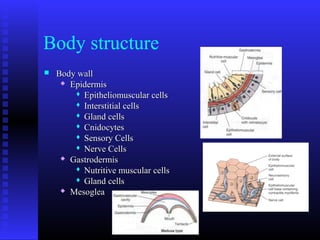
Body structure
 Body wallBody wall
 EpidermisEpidermis
 Epitheliomuscular cellsEpitheliomuscular cells
 Interstitial cellsInterstitial cells
 Gland cellsGland cells
 CnidocytesCnidocytes
 Sensory CellsSensory Cells
 Nerve CellsNerve Cells
 GastrodermisGastrodermis
 Nutritive muscular cellsNutritive muscular cells
 Gland cellsGland cells
 MesogleaMesoglea
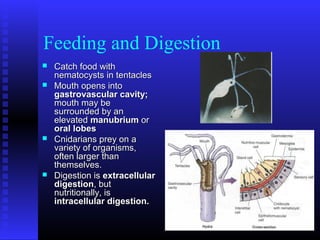
Feeding and Digestion
 Catch food withCatch food with
nematocysts in tentaclesnematocysts in tentacles
 Mouth opens intoMouth opens into
gastrovascular cavity;gastrovascular cavity;
mouth may bemouth may be
surrounded by ansurrounded by an
elevatedelevated manubriummanubrium oror
oral lobesoral lobes
 Cnidarians prey on aCnidarians prey on a
variety of organisms,variety of organisms,
often larger thanoften larger than
themselves.themselves.
 Digestion isDigestion is extracellularextracellular
digestiondigestion, but, but
nutritionally, isnutritionally, is
intracellular digestion.intracellular digestion.
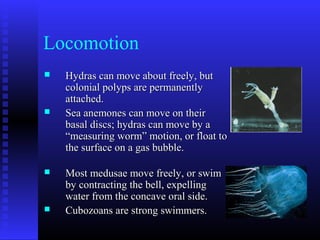
Locomotion
 Hydras can move about freely, butHydras can move about freely, but
colonial polyps are permanentlycolonial polyps are permanently
attached.attached.
 Sea anemones can move on theirSea anemones can move on their
basal discs; hydras can move by abasal discs; hydras can move by a
“measuring worm” motion, or float to“measuring worm” motion, or float to
the surface on a gas bubble.the surface on a gas bubble.
 Most medusae move freely, or swimMost medusae move freely, or swim
by contracting the bell, expellingby contracting the bell, expelling
water from the concave oral side.water from the concave oral side.
 Cubozoans are strong swimmers.Cubozoans are strong swimmers.
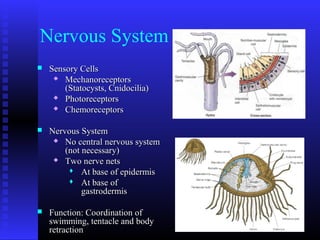
Nervous System
 Sensory CellsSensory Cells
 MechanoreceptorsMechanoreceptors
(Statocysts, Cnidocilia)(Statocysts, Cnidocilia)
 PhotoreceptorsPhotoreceptors
 ChemoreceptorsChemoreceptors
 Nervous SystemNervous System
 No central nervous systemNo central nervous system
(not necessary)(not necessary)
 Two nerve netsTwo nerve nets
 At base of epidermisAt base of epidermis
 At base ofAt base of
gastrodermisgastrodermis
 Function: Coordination ofFunction: Coordination of
swimming, tentacle and bodyswimming, tentacle and body
retractionretraction
Reproduction
 Asexual reproduction by buddingAsexual reproduction by budding
 Sexual reproductionSexual reproduction
 in hermaphrodite formsin hermaphrodite forms
 in separate male female formsin separate male female forms
Gametes are shed directly into theGametes are shed directly into the
waterwater
Embryo develops into a free-Embryo develops into a free-
swimming planula larvaswimming planula larva
Cnidaria
 Class HydrozoaClass Hydrozoa
 Class ScyphozoaClass Scyphozoa
 Class CubozoaClass Cubozoa
 Class AnthozoaClass Anthozoa
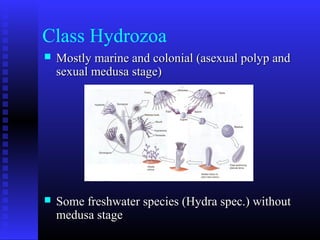
Class Hydrozoa
 Mostly marine and colonial (asexual polyp andMostly marine and colonial (asexual polyp and
sexual medusa stage)sexual medusa stage)
 Some freshwater species (Hydra spec.) withoutSome freshwater species (Hydra spec.) without
medusa stagemedusa stage
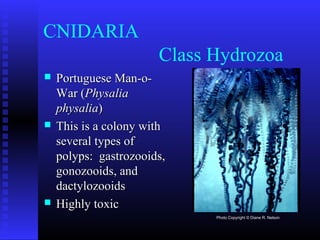
CNIDARIA
Class Hydrozoa
 Portuguese Man-o-Portuguese Man-o-
War (War (PhysaliaPhysalia
physaliaphysalia))
 This is a colony withThis is a colony with
several types ofseveral types of
polyps: gastrozooids,polyps: gastrozooids,
gonozooids, andgonozooids, and
dactylozooidsdactylozooids
 Highly toxicHighly toxic
Photo Copyright © Diane R. Nelson
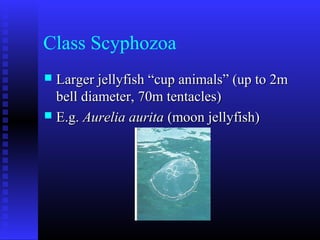
Class Scyphozoa
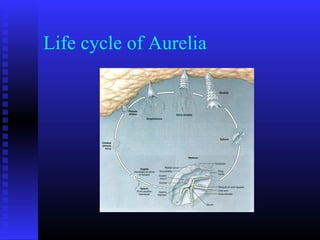
 Larger jellyfish “cup animals” (up to 2mLarger jellyfish “cup animals” (up to 2m
bell diameter, 70m tentacles)bell diameter, 70m tentacles)
 E.g.E.g. Aurelia auritaAurelia aurita (moon jellyfish)(moon jellyfish)
Life cycle of Aurelia
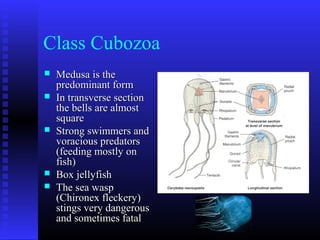
Class Cubozoa
 Medusa is theMedusa is the
predominant formpredominant form
 In transverse sectionIn transverse section
the bells are almostthe bells are almost
squaresquare
 Strong swimmers andStrong swimmers and
voracious predatorsvoracious predators
(feeding mostly on(feeding mostly on
fish)fish)
 Box jellyfishBox jellyfish
 The sea waspThe sea wasp
(Chironex fleckery)(Chironex fleckery)
stings very dangerousstings very dangerous
and sometimes fataland sometimes fatal
Class Anthozoa
 Polyps with a flower like appearancePolyps with a flower like appearance
“Flower animals”, no medusa stage“Flower animals”, no medusa stage
 Vary greatly in sizeVary greatly in size
 All marineAll marine
 Many are supported by skeletonsMany are supported by skeletons
 Includes sea anemones, corals (hard corals,Includes sea anemones, corals (hard corals,
soft corals and horny corals such as seasoft corals and horny corals such as sea
fans, sea pens and others)fans, sea pens and others)
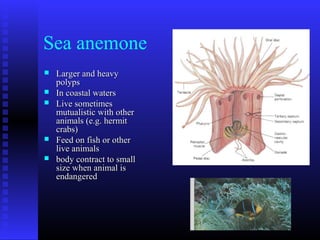
Sea anemone
 Larger and heavyLarger and heavy
polypspolyps
 In coastal watersIn coastal waters
 Live sometimesLive sometimes
mutualistic with othermutualistic with other
animals (e.g. hermitanimals (e.g. hermit
crabs)crabs)
 Feed on fish or otherFeed on fish or other
live animalslive animals
 body contract to smallbody contract to small
size when animal issize when animal is
endangeredendangered
CNIDARIA
Class Anthozoa
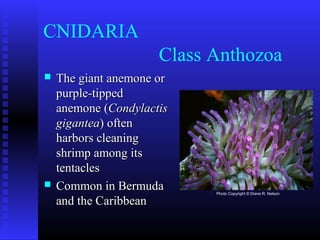
 The giant anemone orThe giant anemone or
purple-tippedpurple-tipped
anemone (anemone (CondylactisCondylactis
giganteagigantea) often) often
harbors cleaningharbors cleaning
shrimp among itsshrimp among its
tentaclestentacles
 Common in BermudaCommon in Bermuda
and the Caribbeanand the Caribbean
Photo Copyright © Diane R. Nelson
Stony corals
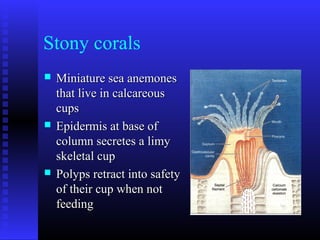
 Miniature sea anemonesMiniature sea anemones
that live in calcareousthat live in calcareous
cupscups
 Epidermis at base ofEpidermis at base of
column secretes a limycolumn secretes a limy
skeletal cupskeletal cup
 Polyps retract into safetyPolyps retract into safety
of their cup when notof their cup when not
feedingfeeding
CNIDARIA
Class Anthozoa
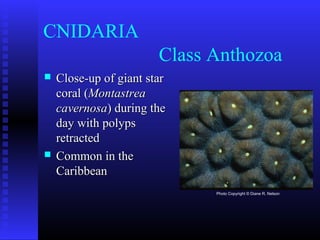
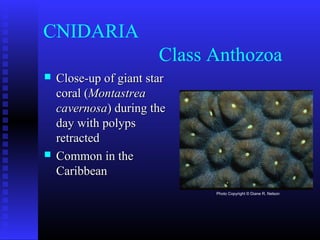
 Close-up of giant starClose-up of giant star
coral (coral (MontastreaMontastrea
cavernosacavernosa) during the) during the
day with polypsday with polyps
retractedretracted
 Common in theCommon in the
CaribbeanCaribbean
Photo Copyright © Diane R. Nelson
CNIDARIA
Class Anthozoa
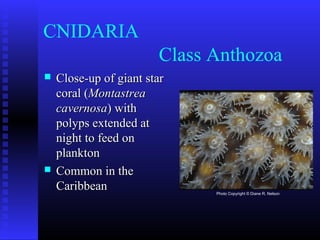
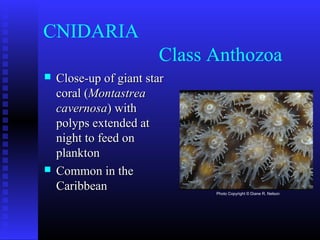
 Close-up of giant starClose-up of giant star
coral (coral (MontastreaMontastrea
cavernosacavernosa) with) with
polyps extended atpolyps extended at
night to feed onnight to feed on
planktonplankton
 Common in theCommon in the
CaribbeanCaribbean Photo Copyright © Diane R. Nelson
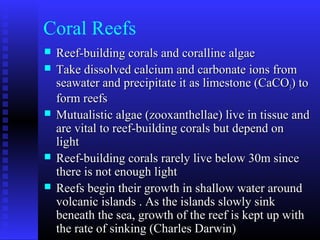
Coral Reefs
 Reef-building corals and coralline algaeReef-building corals and coralline algae
 Take dissolved calcium and carbonate ions fromTake dissolved calcium and carbonate ions from
seawater and precipitate it as limestone (CaCOseawater and precipitate it as limestone (CaCO33) to) to
form reefsform reefs
 Mutualistic algae (zooxanthellae) live in tissue andMutualistic algae (zooxanthellae) live in tissue and
are vital to reef-building corals but depend onare vital to reef-building corals but depend on
lightlight
 Reef-building corals rarely live below 30m sinceReef-building corals rarely live below 30m since
there is not enough lightthere is not enough light
 Reefs begin their growth in shallow water aroundReefs begin their growth in shallow water around
volcanic islands . As the islands slowly sinkvolcanic islands . As the islands slowly sink
beneath the sea, growth of the reef is kept up withbeneath the sea, growth of the reef is kept up with
the rate of sinking (Charles Darwin)the rate of sinking (Charles Darwin)
CNIDARIA
Class Anthozoa
 Close-up of giant starClose-up of giant star
coral (coral (MontastreaMontastrea
cavernosacavernosa) during the) during the
day with polypsday with polyps
retractedretracted
 Common in theCommon in the
CaribbeanCaribbean
Photo Copyright © Diane R. Nelson
CNIDARIA
Class Anthozoa
 Close-up of giant starClose-up of giant star
coral (coral (MontastreaMontastrea
cavernosacavernosa) with) with
polyps extended atpolyps extended at
night to feed onnight to feed on
planktonplankton
 Common in theCommon in the
CaribbeanCaribbean Photo Copyright © Diane R. Nelson
CNIDARIA
Class Anthozoa
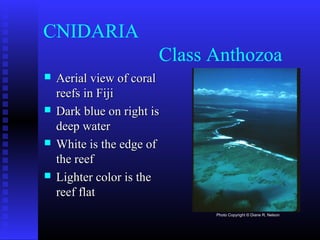
 Aerial view of coralAerial view of coral
reefs in Fijireefs in Fiji
 Dark blue on right isDark blue on right is
deep waterdeep water
 White is the edge ofWhite is the edge of
the reefthe reef
 Lighter color is theLighter color is the
reef flatreef flat
Photo Copyright © Diane R. Nelson
CNIDARIA
Class Anthozoa
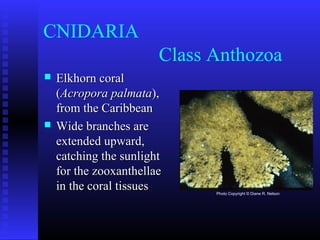
 Elkhorn coralElkhorn coral
((Acropora palmataAcropora palmata),),
from the Caribbeanfrom the Caribbean
 Wide branches areWide branches are
extended upward,extended upward,
catching the sunlightcatching the sunlight
for the zooxanthellaefor the zooxanthellae
in the coral tissuesin the coral tissues Photo Copyright © Diane R. Nelson
CNIDARIA
Class Anthozoa
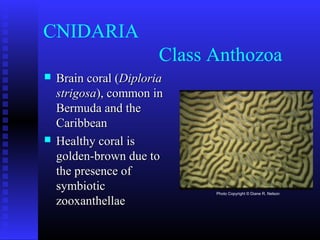
 Brain coral (Brain coral (DiploriaDiploria
strigosastrigosa), common in), common in
Bermuda and theBermuda and the
CaribbeanCaribbean
 Healthy coral isHealthy coral is
golden-brown due togolden-brown due to
the presence ofthe presence of
symbioticsymbiotic
zooxanthellaezooxanthellae
Photo Copyright © Diane R. Nelson
CNIDARIA
Class Anthozoa
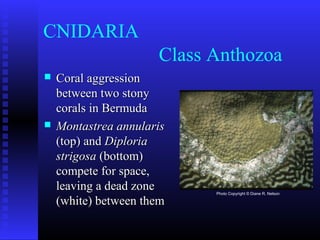
 Coral aggressionCoral aggression
between two stonybetween two stony
corals in Bermudacorals in Bermuda
 Montastrea annularisMontastrea annularis
(top) and(top) and DiploriaDiploria
strigosastrigosa (bottom)(bottom)
compete for space,compete for space,
leaving a dead zoneleaving a dead zone
(white) between them(white) between them
Photo Copyright © Diane R. Nelson
CNIDARIA
Class Anthozoa
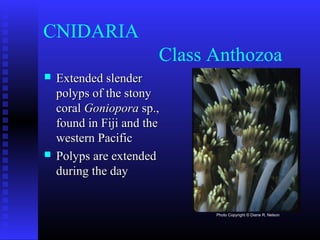
 Extended slenderExtended slender
polyps of the stonypolyps of the stony
coralcoral GonioporaGoniopora sp.,sp.,
found in Fiji and thefound in Fiji and the
western Pacificwestern Pacific
 Polyps are extendedPolyps are extended
during the dayduring the day
Photo Copyright © Diane R. Nelson
CNIDARIA
Class Anthozoa
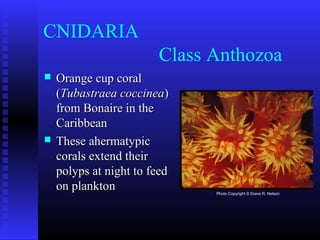
 Orange cup coralOrange cup coral
((Tubastraea coccineaTubastraea coccinea))
from Bonaire in thefrom Bonaire in the
CaribbeanCaribbean
 These ahermatypicThese ahermatypic
corals extend theircorals extend their
polyps at night to feedpolyps at night to feed
on planktonon plankton Photo Copyright © Diane R. Nelson
CNIDARIA
Class Anthozoa
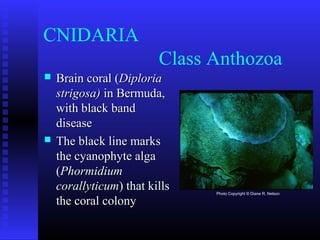
 Brain coral (Brain coral (DiploriaDiploria
strigosa)strigosa) in Bermuda,in Bermuda,
with black bandwith black band
diseasedisease
 The black line marksThe black line marks
the cyanophyte algathe cyanophyte alga
((PhormidiumPhormidium
corallyticumcorallyticum) that kills) that kills
the coral colonythe coral colony
Photo Copyright © Diane R. Nelson
CNIDARIA
Class Anthozoa
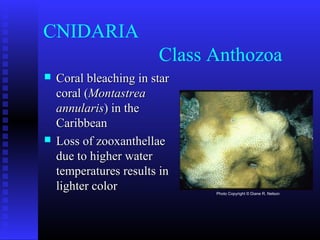
 Coral bleaching in starCoral bleaching in star
coral (coral (MontastreaMontastrea
annularisannularis) in the) in the
CaribbeanCaribbean
 Loss of zooxanthellaeLoss of zooxanthellae
due to higher waterdue to higher water
temperatures results intemperatures results in
lighter colorlighter color Photo Copyright © Diane R. Nelson
PHYLUM CTENOPHORA
1.1. This phylum has fewer than 100 species.This phylum has fewer than 100 species.
2.2. All are marine species; most prefer warm waters.All are marine species; most prefer warm waters.
3.3. Ctenophores have eight rows of comblike plates forCtenophores have eight rows of comblike plates for
locomotionlocomotion
4.4. Like cnidarians, they have primary radial symmetry.Like cnidarians, they have primary radial symmetry.
5.5. No nematocysts!No nematocysts!
6.6. Nearly all are free-swimming; only a few creep or areNearly all are free-swimming; only a few creep or are
sessile.sessile.
7.7. They use the ciliated combs to propel themselves forwardThey use the ciliated combs to propel themselves forward
8.8. Many are bioluminescent.Many are bioluminescent.
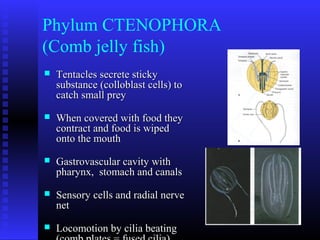
Phylum CTENOPHORA
(Comb jelly fish)
 Tentacles secrete stickyTentacles secrete sticky
substance (colloblast cells) tosubstance (colloblast cells) to
catch small preycatch small prey
 When covered with food theyWhen covered with food they
contract and food is wipedcontract and food is wiped
onto the mouthonto the mouth
 Gastrovascular cavity withGastrovascular cavity with
pharynx, stomach and canalspharynx, stomach and canals
 Sensory cells and radial nerveSensory cells and radial nerve
netnet
 Locomotion by cilia beatingLocomotion by cilia beating
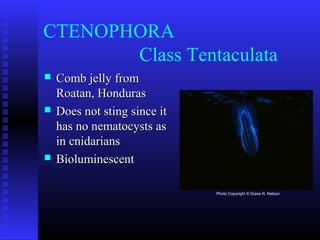
CTENOPHORA
Class Tentaculata
 Comb jelly fromComb jelly from
Roatan, HondurasRoatan, Honduras
 Does not sting since itDoes not sting since it
has no nematocysts ashas no nematocysts as
in cnidariansin cnidarians
 BioluminescentBioluminescent
Photo Copyright © Diane R. Nelson
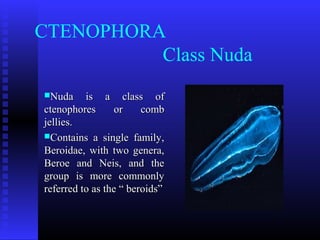
CTENOPHORA
Class Nuda
Nuda is a class ofNuda is a class of
ctenophores or combctenophores or comb
jellies.jellies.
Contains a single family,Contains a single family,
Beroidae, with two genera,Beroidae, with two genera,
Beroe and Neis, and theBeroe and Neis, and the
group is more commonlygroup is more commonly
referred to as the “ beroids”referred to as the “ beroids”

Zoology

  • 1.
    RADIATE ANIMALS Phyla Cnidariaand CtenophoraPhyla Cnidaria and Ctenophora
  • 2.
    Hysdrozoa Scyphozoa Cubozoa Anthozoa(incl. sea anemones, stony corals, gorgonian corals, sea pen) CNIDARIA • More than 9000 species
  • 3.
    Cnidaria  A FearsomeTiny WeaponA Fearsome Tiny Weapon  More highly organized than sponges;More highly organized than sponges; most are sessile.most are sessile.  Many are effective predators.Many are effective predators.  Nematocysts are deadly weaponsNematocysts are deadly weapons requiring only a small stimulus to fire.requiring only a small stimulus to fire.  Can kill even very large prey.Can kill even very large prey.
  • 4.
  • 5.
  • 6.
    Characteristics of Cnidaria 1.1.All are aquatic andAll are aquatic and mostly marine.mostly marine. 2.2. Radial or biradialRadial or biradial symmetry forms oralsymmetry forms oral and aboral ends.and aboral ends. 3.3. The polyp andThe polyp and medusa forms allowmedusa forms allow wider ecologicalwider ecological possibilities.possibilities. 4.4. The two body typesThe two body types are the free-are the free- swimming medusaeswimming medusae and the polyps.and the polyps.
  • 7.
    Characteristics of Cnidaria 5.5.They have a body, with two layers: epidermis and gastrodermis;They have a body, with two layers: epidermis and gastrodermis; 6.6. The gastrovascular cavity has a single opening serving as both mouth andThe gastrovascular cavity has a single opening serving as both mouth and anus.anus. 7.7. Nematocysts are in epidermis or gastrodermis and abundant on tentacles.Nematocysts are in epidermis or gastrodermis and abundant on tentacles. 8.8. The nerve net may include some sensory organs.The nerve net may include some sensory organs. 9.9. The muscular system has an outer layer of longitudinal fibers and an innerThe muscular system has an outer layer of longitudinal fibers and an inner layer of circular fibers.layer of circular fibers. 10.10. Reproduction is either asexual or sexual; a planula larva may be present.Reproduction is either asexual or sexual; a planula larva may be present. 11.11. There is no excretory or respiratory system.There is no excretory or respiratory system.
  • 8.
    Body structure  BodywallBody wall  EpidermisEpidermis  Epitheliomuscular cellsEpitheliomuscular cells  Interstitial cellsInterstitial cells  Gland cellsGland cells  CnidocytesCnidocytes  Sensory CellsSensory Cells  Nerve CellsNerve Cells  GastrodermisGastrodermis  Nutritive muscular cellsNutritive muscular cells  Gland cellsGland cells  MesogleaMesoglea
  • 9.
    Feeding and Digestion Catch food withCatch food with nematocysts in tentaclesnematocysts in tentacles  Mouth opens intoMouth opens into gastrovascular cavity;gastrovascular cavity; mouth may bemouth may be surrounded by ansurrounded by an elevatedelevated manubriummanubrium oror oral lobesoral lobes  Cnidarians prey on aCnidarians prey on a variety of organisms,variety of organisms, often larger thanoften larger than themselves.themselves.  Digestion isDigestion is extracellularextracellular digestiondigestion, but, but nutritionally, isnutritionally, is intracellular digestion.intracellular digestion.
  • 10.
    Locomotion  Hydras canmove about freely, butHydras can move about freely, but colonial polyps are permanentlycolonial polyps are permanently attached.attached.  Sea anemones can move on theirSea anemones can move on their basal discs; hydras can move by abasal discs; hydras can move by a “measuring worm” motion, or float to“measuring worm” motion, or float to the surface on a gas bubble.the surface on a gas bubble.  Most medusae move freely, or swimMost medusae move freely, or swim by contracting the bell, expellingby contracting the bell, expelling water from the concave oral side.water from the concave oral side.  Cubozoans are strong swimmers.Cubozoans are strong swimmers.
  • 11.
    Nervous System  SensoryCellsSensory Cells  MechanoreceptorsMechanoreceptors (Statocysts, Cnidocilia)(Statocysts, Cnidocilia)  PhotoreceptorsPhotoreceptors  ChemoreceptorsChemoreceptors  Nervous SystemNervous System  No central nervous systemNo central nervous system (not necessary)(not necessary)  Two nerve netsTwo nerve nets  At base of epidermisAt base of epidermis  At base ofAt base of gastrodermisgastrodermis  Function: Coordination ofFunction: Coordination of swimming, tentacle and bodyswimming, tentacle and body retractionretraction
  • 12.
    Reproduction  Asexual reproductionby buddingAsexual reproduction by budding  Sexual reproductionSexual reproduction  in hermaphrodite formsin hermaphrodite forms  in separate male female formsin separate male female forms Gametes are shed directly into theGametes are shed directly into the waterwater Embryo develops into a free-Embryo develops into a free- swimming planula larvaswimming planula larva
  • 13.
    Cnidaria  Class HydrozoaClassHydrozoa  Class ScyphozoaClass Scyphozoa  Class CubozoaClass Cubozoa  Class AnthozoaClass Anthozoa
  • 14.
    Class Hydrozoa  Mostlymarine and colonial (asexual polyp andMostly marine and colonial (asexual polyp and sexual medusa stage)sexual medusa stage)  Some freshwater species (Hydra spec.) withoutSome freshwater species (Hydra spec.) without medusa stagemedusa stage
  • 15.
    CNIDARIA Class Hydrozoa  PortugueseMan-o-Portuguese Man-o- War (War (PhysaliaPhysalia physaliaphysalia))  This is a colony withThis is a colony with several types ofseveral types of polyps: gastrozooids,polyps: gastrozooids, gonozooids, andgonozooids, and dactylozooidsdactylozooids  Highly toxicHighly toxic Photo Copyright © Diane R. Nelson
  • 16.
    Class Scyphozoa  Largerjellyfish “cup animals” (up to 2mLarger jellyfish “cup animals” (up to 2m bell diameter, 70m tentacles)bell diameter, 70m tentacles)  E.g.E.g. Aurelia auritaAurelia aurita (moon jellyfish)(moon jellyfish)
  • 17.
  • 18.
    Class Cubozoa  Medusais theMedusa is the predominant formpredominant form  In transverse sectionIn transverse section the bells are almostthe bells are almost squaresquare  Strong swimmers andStrong swimmers and voracious predatorsvoracious predators (feeding mostly on(feeding mostly on fish)fish)  Box jellyfishBox jellyfish  The sea waspThe sea wasp (Chironex fleckery)(Chironex fleckery) stings very dangerousstings very dangerous and sometimes fataland sometimes fatal
  • 19.
    Class Anthozoa  Polypswith a flower like appearancePolyps with a flower like appearance “Flower animals”, no medusa stage“Flower animals”, no medusa stage  Vary greatly in sizeVary greatly in size  All marineAll marine  Many are supported by skeletonsMany are supported by skeletons  Includes sea anemones, corals (hard corals,Includes sea anemones, corals (hard corals, soft corals and horny corals such as seasoft corals and horny corals such as sea fans, sea pens and others)fans, sea pens and others)
  • 20.
    Sea anemone  Largerand heavyLarger and heavy polypspolyps  In coastal watersIn coastal waters  Live sometimesLive sometimes mutualistic with othermutualistic with other animals (e.g. hermitanimals (e.g. hermit crabs)crabs)  Feed on fish or otherFeed on fish or other live animalslive animals  body contract to smallbody contract to small size when animal issize when animal is endangeredendangered
  • 21.
    CNIDARIA Class Anthozoa  Thegiant anemone orThe giant anemone or purple-tippedpurple-tipped anemone (anemone (CondylactisCondylactis giganteagigantea) often) often harbors cleaningharbors cleaning shrimp among itsshrimp among its tentaclestentacles  Common in BermudaCommon in Bermuda and the Caribbeanand the Caribbean Photo Copyright © Diane R. Nelson
  • 22.
    Stony corals  Miniaturesea anemonesMiniature sea anemones that live in calcareousthat live in calcareous cupscups  Epidermis at base ofEpidermis at base of column secretes a limycolumn secretes a limy skeletal cupskeletal cup  Polyps retract into safetyPolyps retract into safety of their cup when notof their cup when not feedingfeeding
  • 23.
    CNIDARIA Class Anthozoa  Close-upof giant starClose-up of giant star coral (coral (MontastreaMontastrea cavernosacavernosa) during the) during the day with polypsday with polyps retractedretracted  Common in theCommon in the CaribbeanCaribbean Photo Copyright © Diane R. Nelson
  • 24.
    CNIDARIA Class Anthozoa  Close-upof giant starClose-up of giant star coral (coral (MontastreaMontastrea cavernosacavernosa) with) with polyps extended atpolyps extended at night to feed onnight to feed on planktonplankton  Common in theCommon in the CaribbeanCaribbean Photo Copyright © Diane R. Nelson
  • 25.
    Coral Reefs  Reef-buildingcorals and coralline algaeReef-building corals and coralline algae  Take dissolved calcium and carbonate ions fromTake dissolved calcium and carbonate ions from seawater and precipitate it as limestone (CaCOseawater and precipitate it as limestone (CaCO33) to) to form reefsform reefs  Mutualistic algae (zooxanthellae) live in tissue andMutualistic algae (zooxanthellae) live in tissue and are vital to reef-building corals but depend onare vital to reef-building corals but depend on lightlight  Reef-building corals rarely live below 30m sinceReef-building corals rarely live below 30m since there is not enough lightthere is not enough light  Reefs begin their growth in shallow water aroundReefs begin their growth in shallow water around volcanic islands . As the islands slowly sinkvolcanic islands . As the islands slowly sink beneath the sea, growth of the reef is kept up withbeneath the sea, growth of the reef is kept up with the rate of sinking (Charles Darwin)the rate of sinking (Charles Darwin)
  • 26.
    CNIDARIA Class Anthozoa  Close-upof giant starClose-up of giant star coral (coral (MontastreaMontastrea cavernosacavernosa) during the) during the day with polypsday with polyps retractedretracted  Common in theCommon in the CaribbeanCaribbean Photo Copyright © Diane R. Nelson
  • 27.
    CNIDARIA Class Anthozoa  Close-upof giant starClose-up of giant star coral (coral (MontastreaMontastrea cavernosacavernosa) with) with polyps extended atpolyps extended at night to feed onnight to feed on planktonplankton  Common in theCommon in the CaribbeanCaribbean Photo Copyright © Diane R. Nelson
  • 28.
    CNIDARIA Class Anthozoa  Aerialview of coralAerial view of coral reefs in Fijireefs in Fiji  Dark blue on right isDark blue on right is deep waterdeep water  White is the edge ofWhite is the edge of the reefthe reef  Lighter color is theLighter color is the reef flatreef flat Photo Copyright © Diane R. Nelson
  • 29.
    CNIDARIA Class Anthozoa  ElkhorncoralElkhorn coral ((Acropora palmataAcropora palmata),), from the Caribbeanfrom the Caribbean  Wide branches areWide branches are extended upward,extended upward, catching the sunlightcatching the sunlight for the zooxanthellaefor the zooxanthellae in the coral tissuesin the coral tissues Photo Copyright © Diane R. Nelson
  • 30.
    CNIDARIA Class Anthozoa  Braincoral (Brain coral (DiploriaDiploria strigosastrigosa), common in), common in Bermuda and theBermuda and the CaribbeanCaribbean  Healthy coral isHealthy coral is golden-brown due togolden-brown due to the presence ofthe presence of symbioticsymbiotic zooxanthellaezooxanthellae Photo Copyright © Diane R. Nelson
  • 31.
    CNIDARIA Class Anthozoa  CoralaggressionCoral aggression between two stonybetween two stony corals in Bermudacorals in Bermuda  Montastrea annularisMontastrea annularis (top) and(top) and DiploriaDiploria strigosastrigosa (bottom)(bottom) compete for space,compete for space, leaving a dead zoneleaving a dead zone (white) between them(white) between them Photo Copyright © Diane R. Nelson
  • 32.
    CNIDARIA Class Anthozoa  ExtendedslenderExtended slender polyps of the stonypolyps of the stony coralcoral GonioporaGoniopora sp.,sp., found in Fiji and thefound in Fiji and the western Pacificwestern Pacific  Polyps are extendedPolyps are extended during the dayduring the day Photo Copyright © Diane R. Nelson
  • 33.
    CNIDARIA Class Anthozoa  Orangecup coralOrange cup coral ((Tubastraea coccineaTubastraea coccinea)) from Bonaire in thefrom Bonaire in the CaribbeanCaribbean  These ahermatypicThese ahermatypic corals extend theircorals extend their polyps at night to feedpolyps at night to feed on planktonon plankton Photo Copyright © Diane R. Nelson
  • 34.
    CNIDARIA Class Anthozoa  Braincoral (Brain coral (DiploriaDiploria strigosa)strigosa) in Bermuda,in Bermuda, with black bandwith black band diseasedisease  The black line marksThe black line marks the cyanophyte algathe cyanophyte alga ((PhormidiumPhormidium corallyticumcorallyticum) that kills) that kills the coral colonythe coral colony Photo Copyright © Diane R. Nelson
  • 35.
    CNIDARIA Class Anthozoa  Coralbleaching in starCoral bleaching in star coral (coral (MontastreaMontastrea annularisannularis) in the) in the CaribbeanCaribbean  Loss of zooxanthellaeLoss of zooxanthellae due to higher waterdue to higher water temperatures results intemperatures results in lighter colorlighter color Photo Copyright © Diane R. Nelson
  • 36.
    PHYLUM CTENOPHORA 1.1. Thisphylum has fewer than 100 species.This phylum has fewer than 100 species. 2.2. All are marine species; most prefer warm waters.All are marine species; most prefer warm waters. 3.3. Ctenophores have eight rows of comblike plates forCtenophores have eight rows of comblike plates for locomotionlocomotion 4.4. Like cnidarians, they have primary radial symmetry.Like cnidarians, they have primary radial symmetry. 5.5. No nematocysts!No nematocysts! 6.6. Nearly all are free-swimming; only a few creep or areNearly all are free-swimming; only a few creep or are sessile.sessile. 7.7. They use the ciliated combs to propel themselves forwardThey use the ciliated combs to propel themselves forward 8.8. Many are bioluminescent.Many are bioluminescent.
  • 37.
    Phylum CTENOPHORA (Comb jellyfish)  Tentacles secrete stickyTentacles secrete sticky substance (colloblast cells) tosubstance (colloblast cells) to catch small preycatch small prey  When covered with food theyWhen covered with food they contract and food is wipedcontract and food is wiped onto the mouthonto the mouth  Gastrovascular cavity withGastrovascular cavity with pharynx, stomach and canalspharynx, stomach and canals  Sensory cells and radial nerveSensory cells and radial nerve netnet  Locomotion by cilia beatingLocomotion by cilia beating
  • 38.
    CTENOPHORA Class Tentaculata  Combjelly fromComb jelly from Roatan, HondurasRoatan, Honduras  Does not sting since itDoes not sting since it has no nematocysts ashas no nematocysts as in cnidariansin cnidarians  BioluminescentBioluminescent Photo Copyright © Diane R. Nelson
  • 39.
    CTENOPHORA Class Nuda Nuda isa class ofNuda is a class of ctenophores or combctenophores or comb jellies.jellies. Contains a single family,Contains a single family, Beroidae, with two genera,Beroidae, with two genera, Beroe and Neis, and theBeroe and Neis, and the group is more commonlygroup is more commonly referred to as the “ beroids”referred to as the “ beroids”