What is measurement?
• The process of comparing the
quantity of an observable relative to
a standard.
Example:
– Measuring the length of pencil using a
ruler
– Determining how heavy you are using a
weighing scale
How should measurements
be reported?

• All measurements must be given
with the correct units.
• All measurements must be given
with the correct number of
significant figures (sf’s).
English System of Measurement
• This system grew out of the creative
ways that people measured for
themselves. Familiar objects and
parts of the body were used as
measuring devices.
English System of Measurement
• This system grew out of the creative
ways that people measured for
themselves. Familiar objects and
parts of the body were used as
measuring devices.
English System of Measurement
• Unfortunately, these creative
measuring devices allowed for
different measurements to be
obtained when different people
measured the same items.
• Eventually, a standard was set so
that all measurements represented
the same amount for everyone.
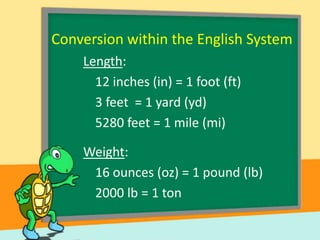
Conversion within the English System
Length:
12 inches (in) = 1 foot (ft)
3 feet = 1 yard (yd)
5280 feet = 1 mile (mi)
Weight:
16 ounces (oz) = 1 pound (lb)
2000 lb = 1 ton
Conversion within the English System
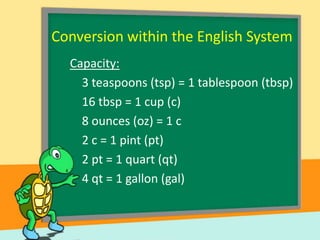
Capacity:
3 teaspoons (tsp) = 1 tablespoon (tbsp)
16 tbsp = 1 cup (c)
8 ounces (oz) = 1 c
2 c = 1 pint (pt)
2 pt = 1 quart (qt)
4 qt = 1 gallon (gal)
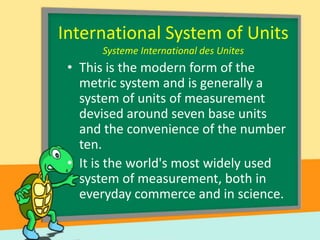
International System of Units
Systeme International des Unites

• This is the modern form of the
metric system and is generally a
system of units of measurement
devised around seven base units
and the convenience of the number
ten.
• It is the world's most widely used
system of measurement, both in
everyday commerce and in science.
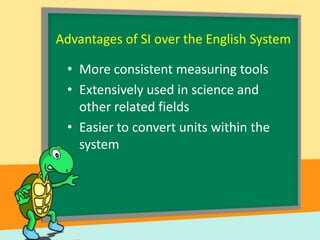
Advantages of SI over the English System
• More consistent measuring tools
• Extensively used in science and
other related fields
• Easier to convert units within the
system
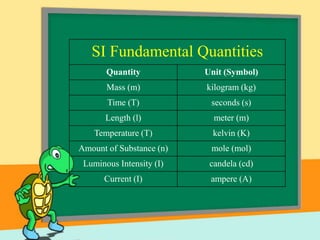
SI Fundamental Quantities
Quantity

Unit (Symbol)

Mass (m)

kilogram (kg)

Time (T)

seconds (s)

Length (l)

meter (m)

Temperature (T)

kelvin (K)

Amount of Substance (n)

mole (mol)

Luminous Intensity (I)

candela (cd)

Current (I)

ampere (A)
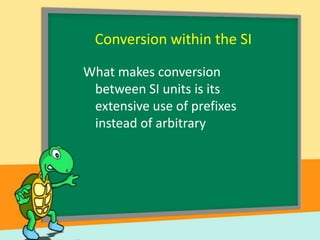
Conversion within the SI
What makes conversion
between SI units is its
extensive use of prefixes
instead of arbitrary
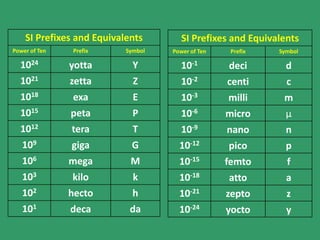
SI Prefixes and Equivalents

SI Prefixes and Equivalents

Power of Ten

Prefix

Symbol

Power of Ten

Prefix

Symbol

1024

yotta
zetta
exa

Y
Z
E

10-1

deci
centi
milli

d
c
m

peta
tera
giga

P
T
G

micro
nano
pico

μ
n
p

mega
kilo
hecto
deca

M
k
h
da

femto
atto
zepto

f
a
z

yocto

y

1021
1018
1015
1012
109
106
103
102
101

10-2
10-3
10-6
10-9
10-12
10-15
10-18
10-21
10-24
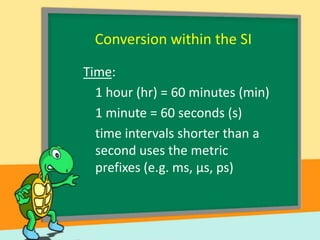
Conversion within the SI
Time:
1 hour (hr) = 60 minutes (min)
1 minute = 60 seconds (s)
time intervals shorter than a
second uses the metric
prefixes (e.g. ms, μs, ps)
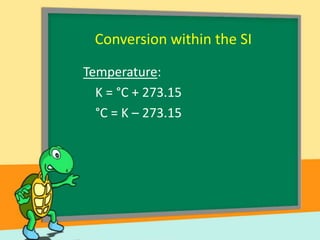
Conversion within the SI
Temperature:
K = °C + 273.15
°C = K – 273.15
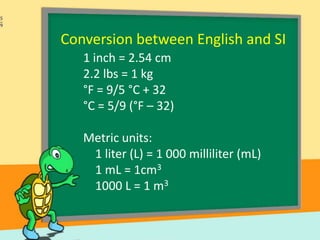
Conversion between English and SI
1 inch = 2.54 cm
2.2 lbs = 1 kg
°F = 9/5 °C + 32
°C = 5/9 (°F – 32)

Metric units:
1 liter (L) = 1 000 milliliter (mL)
1 mL = 1cm3
1000 L = 1 m3
fin
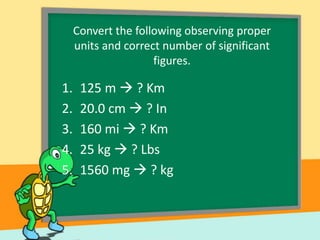
Convert the following observing proper
units and correct number of significant
figures.

1.
2.
3.
4.
5.

125 m  ? Km
20.0 cm  ? In
160 mi  ? Km
25 kg  ? Lbs
1560 mg  ? kg
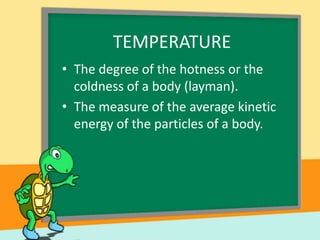
TEMPERATURE
• The degree of the hotness or the
coldness of a body (layman).
• The measure of the average kinetic
energy of the particles of a body.
The Temperature Scales
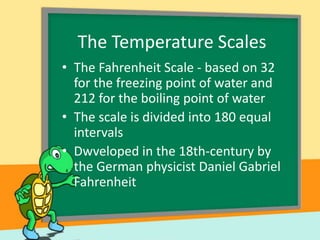
• The Fahrenheit Scale - based on 32
for the freezing point of water and
212 for the boiling point of water
• The scale is divided into 180 equal
intervals
• Dwveloped in the 18th-century by
the German physicist Daniel Gabriel
Fahrenheit
The Temperature Scales
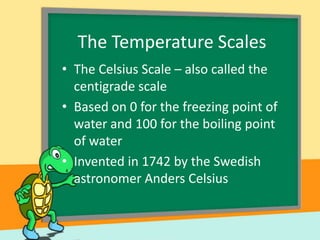
• The Celsius Scale – also called the
centigrade scale
• Based on 0 for the freezing point of
water and 100 for the boiling point
of water
• Invented in 1742 by the Swedish
astronomer Anders Celsius
The Temperature Scales
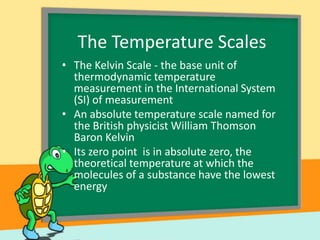
• The Kelvin Scale - the base unit of
thermodynamic temperature
measurement in the International System
(SI) of measurement
• An absolute temperature scale named for
the British physicist William Thomson
Baron Kelvin
• Its zero point is in absolute zero, the
theoretical temperature at which the
molecules of a substance have the lowest
energy
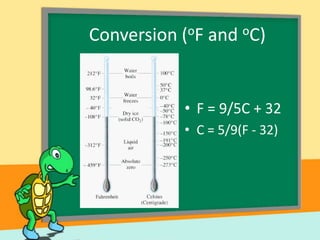
Conversion (oF and oC)

• F = 9/5C + 32
• C = 5/9(F - 32)
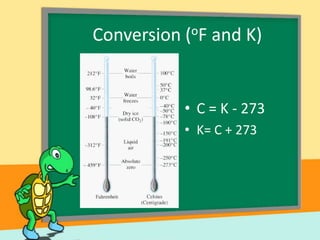
Conversion (oF and K)

• C = K - 273
• K= C + 273
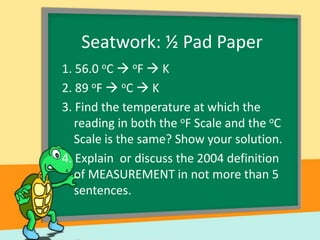
Seatwork: ½ Pad Paper
1. 56.0 oC  oF  K
2. 89 oF  oC  K
3. Find the temperature at which the
reading in both the oF Scale and the oC
Scale is the same? Show your solution.
4. Explain or discuss the 2004 definition
of MEASUREMENT in not more than 5
sentences.

05 measurement

  • 2.
    What is measurement? •The process of comparing the quantity of an observable relative to a standard. Example: – Measuring the length of pencil using a ruler – Determining how heavy you are using a weighing scale
  • 3.
    How should measurements bereported? • All measurements must be given with the correct units. • All measurements must be given with the correct number of significant figures (sf’s).
  • 4.
    English System ofMeasurement • This system grew out of the creative ways that people measured for themselves. Familiar objects and parts of the body were used as measuring devices.
  • 5.
    English System ofMeasurement • This system grew out of the creative ways that people measured for themselves. Familiar objects and parts of the body were used as measuring devices.
  • 6.
    English System ofMeasurement • Unfortunately, these creative measuring devices allowed for different measurements to be obtained when different people measured the same items. • Eventually, a standard was set so that all measurements represented the same amount for everyone.
  • 7.
    Conversion within theEnglish System Length: 12 inches (in) = 1 foot (ft) 3 feet = 1 yard (yd) 5280 feet = 1 mile (mi) Weight: 16 ounces (oz) = 1 pound (lb) 2000 lb = 1 ton
  • 8.
    Conversion within theEnglish System Capacity: 3 teaspoons (tsp) = 1 tablespoon (tbsp) 16 tbsp = 1 cup (c) 8 ounces (oz) = 1 c 2 c = 1 pint (pt) 2 pt = 1 quart (qt) 4 qt = 1 gallon (gal)
  • 9.
    International System ofUnits Systeme International des Unites • This is the modern form of the metric system and is generally a system of units of measurement devised around seven base units and the convenience of the number ten. • It is the world's most widely used system of measurement, both in everyday commerce and in science.
  • 10.
    Advantages of SIover the English System • More consistent measuring tools • Extensively used in science and other related fields • Easier to convert units within the system
  • 11.
    SI Fundamental Quantities Quantity Unit(Symbol) Mass (m) kilogram (kg) Time (T) seconds (s) Length (l) meter (m) Temperature (T) kelvin (K) Amount of Substance (n) mole (mol) Luminous Intensity (I) candela (cd) Current (I) ampere (A)
  • 12.
    Conversion within theSI What makes conversion between SI units is its extensive use of prefixes instead of arbitrary
  • 13.
    SI Prefixes andEquivalents SI Prefixes and Equivalents Power of Ten Prefix Symbol Power of Ten Prefix Symbol 1024 yotta zetta exa Y Z E 10-1 deci centi milli d c m peta tera giga P T G micro nano pico μ n p mega kilo hecto deca M k h da femto atto zepto f a z yocto y 1021 1018 1015 1012 109 106 103 102 101 10-2 10-3 10-6 10-9 10-12 10-15 10-18 10-21 10-24
  • 14.
    Conversion within theSI Time: 1 hour (hr) = 60 minutes (min) 1 minute = 60 seconds (s) time intervals shorter than a second uses the metric prefixes (e.g. ms, μs, ps)
  • 15.
    Conversion within theSI Temperature: K = °C + 273.15 °C = K – 273.15
  • 16.
    Conversion between Englishand SI 1 inch = 2.54 cm 2.2 lbs = 1 kg °F = 9/5 °C + 32 °C = 5/9 (°F – 32) Metric units: 1 liter (L) = 1 000 milliliter (mL) 1 mL = 1cm3 1000 L = 1 m3
  • 17.
  • 18.
    Convert the followingobserving proper units and correct number of significant figures. 1. 2. 3. 4. 5. 125 m  ? Km 20.0 cm  ? In 160 mi  ? Km 25 kg  ? Lbs 1560 mg  ? kg
  • 19.
    TEMPERATURE • The degreeof the hotness or the coldness of a body (layman). • The measure of the average kinetic energy of the particles of a body.
  • 20.
    The Temperature Scales •The Fahrenheit Scale - based on 32 for the freezing point of water and 212 for the boiling point of water • The scale is divided into 180 equal intervals • Dwveloped in the 18th-century by the German physicist Daniel Gabriel Fahrenheit
  • 21.
    The Temperature Scales •The Celsius Scale – also called the centigrade scale • Based on 0 for the freezing point of water and 100 for the boiling point of water • Invented in 1742 by the Swedish astronomer Anders Celsius
  • 22.
    The Temperature Scales •The Kelvin Scale - the base unit of thermodynamic temperature measurement in the International System (SI) of measurement • An absolute temperature scale named for the British physicist William Thomson Baron Kelvin • Its zero point is in absolute zero, the theoretical temperature at which the molecules of a substance have the lowest energy
  • 23.
    Conversion (oF andoC) • F = 9/5C + 32 • C = 5/9(F - 32)
  • 24.
    Conversion (oF andK) • C = K - 273 • K= C + 273
  • 25.
    Seatwork: ½ PadPaper 1. 56.0 oC  oF  K 2. 89 oF  oC  K 3. Find the temperature at which the reading in both the oF Scale and the oC Scale is the same? Show your solution. 4. Explain or discuss the 2004 definition of MEASUREMENT in not more than 5 sentences.