EFFECTS OF HEAT
EFFECTS OF HEAT
Thermal Expansion
 Change in Temperature
 Phase Change

THERMAL EXPANSION
1st Effect of Heat
THERMAL EXPANSION
Addition of heat to a body may cause it to
expand and shrinks when heat is removed.
The expansion of objects can be observed in
solids, liquids and gases.
It is affected by several other factors.
THERMAL EXPANSION: SOLID
SOLIDS: LINEAR EXPANSION
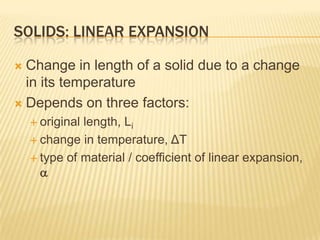
Change in length of a solid due to a change
in its temperature
 Depends on three factors:


 original

length, Li
 change in temperature, ΔT
 type of material / coefficient of linear expansion,

SOLIDS: LINEAR EXPANSION
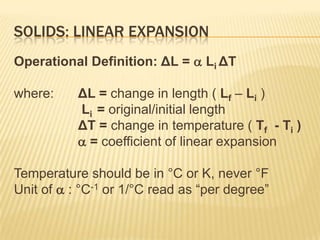
Operational Definition: ΔL =  Li ΔT
where:

ΔL = change in length ( Lf – Li )
Li = original/initial length
ΔT = change in temperature ( Tf - Ti )
 = coefficient of linear expansion

Temperature should be in °C or K, never °F
Unit of  : °C-1 or 1/°C read as “per degree”
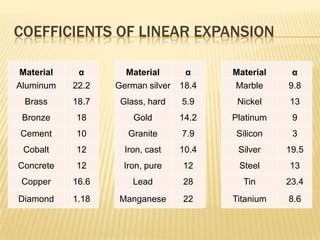
COEFFICIENTS OF LINEAR EXPANSION
Material
Aluminum

α
22.2

Material
German silver

α
18.4

Material
Marble

α
9.8

Brass

18.7

Glass, hard

5.9

Nickel

13

Bronze

18

Gold

14.2

Platinum

9

Cement

10

Granite

7.9

Silicon

3

Cobalt

12

Iron, cast

10.4

Silver

19.5

Concrete

12

Iron, pure

12

Steel

13

Copper

16.6

Lead

28

Tin

23.4

Diamond

1.18

Manganese

22

Titanium

8.6
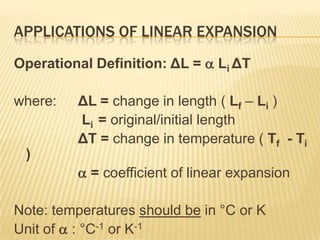
APPLICATIONS OF LINEAR EXPANSION
Operational Definition: ΔL =  Li ΔT
where:

)

ΔL = change in length ( Lf – Li )
Li = original/initial length
ΔT = change in temperature ( Tf - Ti
 = coefficient of linear expansion

Note: temperatures should be in °C or K
Unit of  : °C-1 or K-1
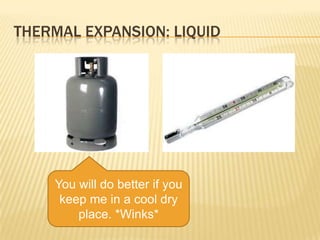
THERMAL EXPANSION: LIQUID

You will do better if you
keep me in a cool dry
place. *Winks*
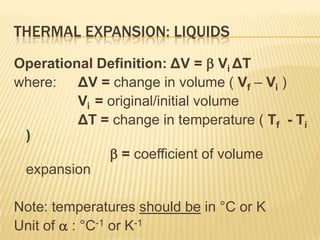
THERMAL EXPANSION: LIQUIDS
Operational Definition: ΔV =  Vi ΔT
where: ΔV = change in volume ( Vf – Vi )
Vi = original/initial volume
ΔT = change in temperature ( Tf - Ti
)
 = coefficient of volume
expansion
Note: temperatures should be in °C or K
Unit of  : °C-1 or K-1
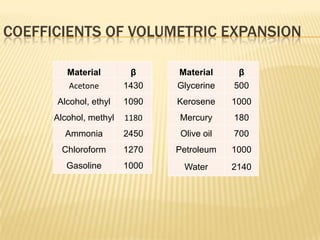
COEFFICIENTS OF VOLUMETRIC EXPANSION
Material
Acetone

β
1430

Material
Glycerine

β
500

Alcohol, ethyl

1090

Kerosene

1000

Alcohol, methyl

1180

Mercury

180

Ammonia

2450

Olive oil

700

Chloroform

1270

Petroleum

1000

Gasoline

1000

Water

2140
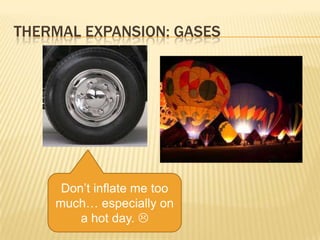
THERMAL EXPANSION: GASES

Don’t inflate me too
much… especially on
a hot day. 
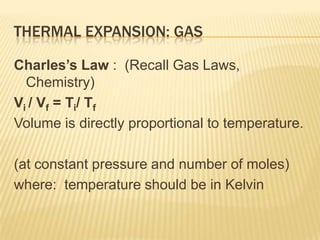
THERMAL EXPANSION: GAS
Charles’s Law : (Recall Gas Laws,
Chemistry)
Vi / Vf = Ti/ Tf
Volume is directly proportional to temperature.
(at constant pressure and number of moles)
where: temperature should be in Kelvin
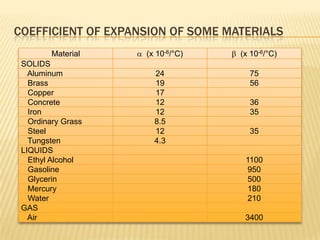
COEFFICIENT OF EXPANSION OF SOME MATERIALS
Material

SOLIDS
Aluminum
Brass
Copper
Concrete
Iron
Ordinary Grass
Steel
Tungsten
LIQUIDS
Ethyl Alcohol
Gasoline
Glycerin
Mercury
Water
GAS
Air

 (x 10-6/°C)

 (x 10-6/°C)

24
19
17
12
12
8.5
12
4.3

75
56
36
35
35

1100
950
500
180
210
3400
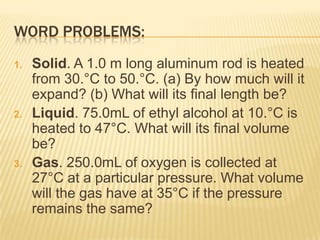
WORD PROBLEMS:
1.

2.

3.

Solid. A 1.0 m long aluminum rod is heated
from 30.°C to 50.°C. (a) By how much will it
expand? (b) What will its final length be?
Liquid. 75.0mL of ethyl alcohol at 10.°C is
heated to 47°C. What will its final volume
be?
Gas. 250.0mL of oxygen is collected at
27°C at a particular pressure. What volume
will the gas have at 35°C if the pressure
remains the same?
TEMPERATURE
CHANGE
2nd Effect of Heat
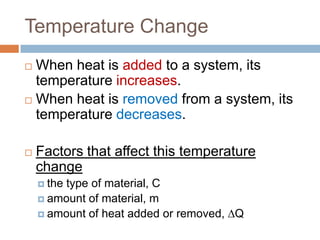
Temperature Change
When heat is added to a system, its
temperature increases.
 When heat is removed from a system, its
temperature decreases.




Factors that affect this temperature
change
 the

type of material, C
 amount of material, m
 amount of heat added or removed, ∆Q
Temperature Change


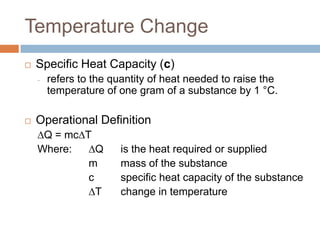
Specific Heat Capacity (c)
-



refers to the quantity of heat needed to raise the
temperature of one gram of a substance by 1 °C.

Operational Definition
∆Q = mc∆T
Where:
∆Q
m
c
∆T

is the heat required or supplied
mass of the substance
specific heat capacity of the substance
change in temperature
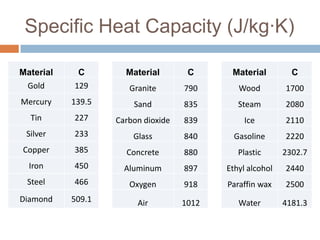
Specific Heat Capacity (J/kg·K)
Material
Gold

C
129

Material

C

Material

C

Granite

790

Wood

1700

Mercury

139.5

Sand

835

Steam

2080

Tin

227

Carbon dioxide

839

Ice

2110

Silver

233

Glass

840

Gasoline

2220

Copper

385

Concrete

880

Plastic

2302.7

Iron

450

Aluminum

897

Ethyl alcohol

2440

Steel

466

Oxygen

918

Paraffin wax

2500

Diamond

509.1

Air

1012

Water

4181.3
REVIEW


What is heat?
 Heat is the transfer of energy.



What are the different modes of heat transfer?
 conduction, convection and radiation



Heat transfers from _______ to _______.
 from an area of higher temperature
EXTENDING


What happens when two objects of different
temperature are made into contact?
 Heat will transfer from the hotter to colder object.



What happens to the hotter object?
 It gets colder because it loses energy when heat
transfers from it to the colder object.



What happens to the colder object?
 It gets hotter because it gains energy when heat
transfers from the hotter object to itself.
EXTENDING


Will the heat transfer continue forever or will it
eventually stop? If it will stop, when?
 Heat transfer will stop when they reach the same
temperature. This temperature is called
equilibrium temperature.



At what temperature will they have thermal
equilibrium?
 At a temperature between the initial temperatures
(not necessarily the average though)
EXTENDING


What happens when two objects of same
temperature are made into contact with each other?
 No heat transfer will occur.
Thermal Equilibrium


When two objects of different temperature
are made into contact, heat transfer will
occur.



Heat transfer will continue until both have
the same temperature. When this happens,
the two objects are now in thermal
equilibrium.



The final temperature at which heat transfer
stops is called the equilibrium
PHASE CHANGE
3rd Effect of Heat
Phase Change


Latent Heat - Addition of heat does not always
results to a change in temperature; this heat
could instead be used in changing the phase
of some materials. This heat, which cannot be
measured by thermometers, is called hidden
or latent heat.



There are two types of latent heat:
 Latent

heat of Fusion
 Latent heat of Vaporization
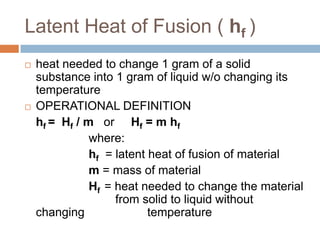
Latent Heat of Fusion ( hf )




heat needed to change 1 gram of a solid
substance into 1 gram of liquid w/o changing its
temperature
OPERATIONAL DEFINITION
hf = Hf / m or Hf = m hf
where:
hf = latent heat of fusion of material
m = mass of material
Hf = heat needed to change the material
from solid to liquid without
changing
temperature
Latent Heat of Vaporization ( hv
)
heat needed to change 1 gram of a liquid
substance into 1 gram of gas w/o changing its
temperature
 OPERATIONAL DEFINITION
hv = Hv / m or Hv = m hv
where:
hv = latent heat of vaporization of
material
m = mass of material
Hv = heat needed to change the
material
from liquid to gas without
changing
temperature

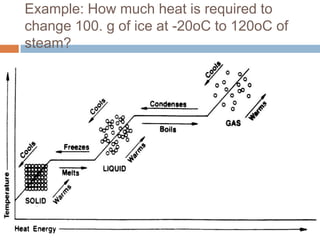
Example: How much heat is required to
change 100. g of ice at -20oC to 120oC of
steam?

23 effects of heat

  • 1.
  • 2.
    EFFECTS OF HEAT ThermalExpansion  Change in Temperature  Phase Change 
  • 3.
  • 4.
    THERMAL EXPANSION Addition ofheat to a body may cause it to expand and shrinks when heat is removed. The expansion of objects can be observed in solids, liquids and gases. It is affected by several other factors.
  • 5.
  • 6.
    SOLIDS: LINEAR EXPANSION Changein length of a solid due to a change in its temperature  Depends on three factors:   original length, Li  change in temperature, ΔT  type of material / coefficient of linear expansion, 
  • 7.
    SOLIDS: LINEAR EXPANSION OperationalDefinition: ΔL =  Li ΔT where: ΔL = change in length ( Lf – Li ) Li = original/initial length ΔT = change in temperature ( Tf - Ti )  = coefficient of linear expansion Temperature should be in °C or K, never °F Unit of  : °C-1 or 1/°C read as “per degree”
  • 8.
    COEFFICIENTS OF LINEAREXPANSION Material Aluminum α 22.2 Material German silver α 18.4 Material Marble α 9.8 Brass 18.7 Glass, hard 5.9 Nickel 13 Bronze 18 Gold 14.2 Platinum 9 Cement 10 Granite 7.9 Silicon 3 Cobalt 12 Iron, cast 10.4 Silver 19.5 Concrete 12 Iron, pure 12 Steel 13 Copper 16.6 Lead 28 Tin 23.4 Diamond 1.18 Manganese 22 Titanium 8.6
  • 9.
    APPLICATIONS OF LINEAREXPANSION Operational Definition: ΔL =  Li ΔT where: ) ΔL = change in length ( Lf – Li ) Li = original/initial length ΔT = change in temperature ( Tf - Ti  = coefficient of linear expansion Note: temperatures should be in °C or K Unit of  : °C-1 or K-1
  • 10.
    THERMAL EXPANSION: LIQUID Youwill do better if you keep me in a cool dry place. *Winks*
  • 11.
    THERMAL EXPANSION: LIQUIDS OperationalDefinition: ΔV =  Vi ΔT where: ΔV = change in volume ( Vf – Vi ) Vi = original/initial volume ΔT = change in temperature ( Tf - Ti )  = coefficient of volume expansion Note: temperatures should be in °C or K Unit of  : °C-1 or K-1
  • 12.
    COEFFICIENTS OF VOLUMETRICEXPANSION Material Acetone β 1430 Material Glycerine β 500 Alcohol, ethyl 1090 Kerosene 1000 Alcohol, methyl 1180 Mercury 180 Ammonia 2450 Olive oil 700 Chloroform 1270 Petroleum 1000 Gasoline 1000 Water 2140
  • 13.
    THERMAL EXPANSION: GASES Don’tinflate me too much… especially on a hot day. 
  • 14.
    THERMAL EXPANSION: GAS Charles’sLaw : (Recall Gas Laws, Chemistry) Vi / Vf = Ti/ Tf Volume is directly proportional to temperature. (at constant pressure and number of moles) where: temperature should be in Kelvin
  • 15.
    COEFFICIENT OF EXPANSIONOF SOME MATERIALS Material SOLIDS Aluminum Brass Copper Concrete Iron Ordinary Grass Steel Tungsten LIQUIDS Ethyl Alcohol Gasoline Glycerin Mercury Water GAS Air  (x 10-6/°C)  (x 10-6/°C) 24 19 17 12 12 8.5 12 4.3 75 56 36 35 35 1100 950 500 180 210 3400
  • 16.
    WORD PROBLEMS: 1. 2. 3. Solid. A1.0 m long aluminum rod is heated from 30.°C to 50.°C. (a) By how much will it expand? (b) What will its final length be? Liquid. 75.0mL of ethyl alcohol at 10.°C is heated to 47°C. What will its final volume be? Gas. 250.0mL of oxygen is collected at 27°C at a particular pressure. What volume will the gas have at 35°C if the pressure remains the same?
  • 17.
  • 18.
    Temperature Change When heatis added to a system, its temperature increases.  When heat is removed from a system, its temperature decreases.   Factors that affect this temperature change  the type of material, C  amount of material, m  amount of heat added or removed, ∆Q
  • 19.
    Temperature Change  Specific HeatCapacity (c) -  refers to the quantity of heat needed to raise the temperature of one gram of a substance by 1 °C. Operational Definition ∆Q = mc∆T Where: ∆Q m c ∆T is the heat required or supplied mass of the substance specific heat capacity of the substance change in temperature
  • 20.
    Specific Heat Capacity(J/kg·K) Material Gold C 129 Material C Material C Granite 790 Wood 1700 Mercury 139.5 Sand 835 Steam 2080 Tin 227 Carbon dioxide 839 Ice 2110 Silver 233 Glass 840 Gasoline 2220 Copper 385 Concrete 880 Plastic 2302.7 Iron 450 Aluminum 897 Ethyl alcohol 2440 Steel 466 Oxygen 918 Paraffin wax 2500 Diamond 509.1 Air 1012 Water 4181.3
  • 21.
    REVIEW  What is heat? Heat is the transfer of energy.  What are the different modes of heat transfer?  conduction, convection and radiation  Heat transfers from _______ to _______.  from an area of higher temperature
  • 22.
    EXTENDING  What happens whentwo objects of different temperature are made into contact?  Heat will transfer from the hotter to colder object.  What happens to the hotter object?  It gets colder because it loses energy when heat transfers from it to the colder object.  What happens to the colder object?  It gets hotter because it gains energy when heat transfers from the hotter object to itself.
  • 23.
    EXTENDING  Will the heattransfer continue forever or will it eventually stop? If it will stop, when?  Heat transfer will stop when they reach the same temperature. This temperature is called equilibrium temperature.  At what temperature will they have thermal equilibrium?  At a temperature between the initial temperatures (not necessarily the average though)
  • 24.
    EXTENDING  What happens whentwo objects of same temperature are made into contact with each other?  No heat transfer will occur.
  • 25.
    Thermal Equilibrium  When twoobjects of different temperature are made into contact, heat transfer will occur.  Heat transfer will continue until both have the same temperature. When this happens, the two objects are now in thermal equilibrium.  The final temperature at which heat transfer stops is called the equilibrium
  • 26.
  • 27.
    Phase Change  Latent Heat- Addition of heat does not always results to a change in temperature; this heat could instead be used in changing the phase of some materials. This heat, which cannot be measured by thermometers, is called hidden or latent heat.  There are two types of latent heat:  Latent heat of Fusion  Latent heat of Vaporization
  • 28.
    Latent Heat ofFusion ( hf )   heat needed to change 1 gram of a solid substance into 1 gram of liquid w/o changing its temperature OPERATIONAL DEFINITION hf = Hf / m or Hf = m hf where: hf = latent heat of fusion of material m = mass of material Hf = heat needed to change the material from solid to liquid without changing temperature
  • 29.
    Latent Heat ofVaporization ( hv ) heat needed to change 1 gram of a liquid substance into 1 gram of gas w/o changing its temperature  OPERATIONAL DEFINITION hv = Hv / m or Hv = m hv where: hv = latent heat of vaporization of material m = mass of material Hv = heat needed to change the material from liquid to gas without changing temperature 
  • 30.
    Example: How muchheat is required to change 100. g of ice at -20oC to 120oC of steam?