Optics
Theories
Wave-Particle Duality
Propagation
Wave Speed
Luminosity
Illumination
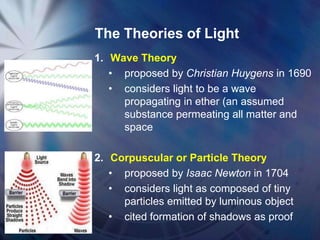
The Theories of Light
1. Wave Theory
• proposed by Christian Huygens in 1690
• considers light to be a wave
propagating in ether (an assumed
substance permeating all matter and
space
2. Corpuscular or Particle Theory
• proposed by Isaac Newton in 1704
• considers light as composed of tiny
particles emitted by luminous object
• cited formation of shadows as proof
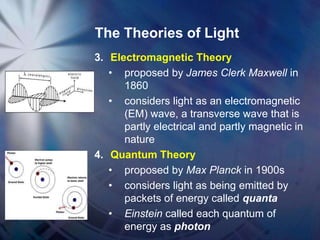
The Theories of Light
3. Electromagnetic Theory
• proposed by James Clerk Maxwell in
1860
• considers light as an electromagnetic
(EM) wave, a transverse wave that is
partly electrical and partly magnetic in
nature
4. Quantum Theory
• proposed by Max Planck in 1900s
• considers light as being emitted by
packets of energy called quanta
• Einstein called each quantum of
energy as photon
The Dual Nature of Light:
A PARTICLE AND A WAVE
• Since light has a dual nature, then it has two models or it
can be presented and analyzed in two ways: as a ray
and as a wave.
• Ray Model of light is used to describe light as a particle
and its behavior as a particle, and such is under the
study of GEOMETRIC / RAY OPTICS.
• Wave Model of light is used to describe light as a wave
and its behavior as a wave, and such is under the study
of WAVE OPTICS.
Measuring the Speed of Light
1.
2.
3.
4.
5.

Olaus Roemer – 300 000 000 m/s
Christian Huygens – 230 000 000 m/s
Armand Louis Fizeau – 313 000 000 m/s
Jean Bernard Leon Foucault – 299 796 000 m/s
Albert Michelson – 299 799 600 m/s
Accepted Value:
299 792 458 m/s ~ 300 000 000 m/s
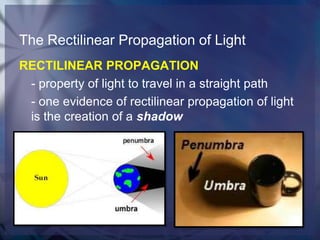
The Rectilinear Propagation of Light
RECTILINEAR PROPAGATION
- property of light to travel in a straight path
- one evidence of rectilinear propagation of light
is the creation of a shadow
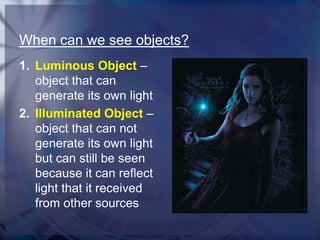
When can we see objects?
1. Luminous Object –
object that can
generate its own light
2. Illuminated Object –
object that can not
generate its own light
but can still be seen
because it can reflect
light that it received
from other sources
Types of Luminosity
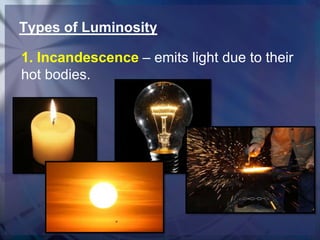
1. Incandescence – emits light due to their
hot bodies.
Types of Luminosity
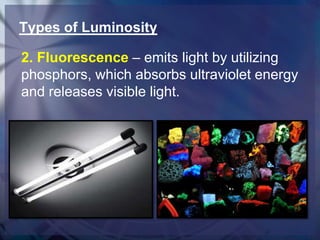
2. Fluorescence – emits light by utilizing
phosphors, which absorbs ultraviolet energy
and releases visible light.
Types of Luminosity
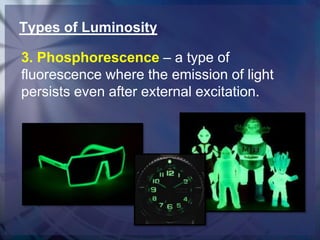
3. Phosphorescence – a type of
fluorescence where the emission of light
persists even after external excitation.
Types of Luminosity
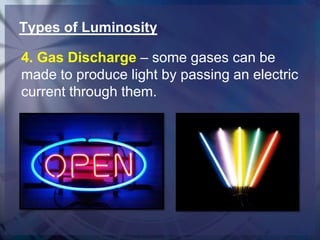
4. Gas Discharge – some gases can be
made to produce light by passing an electric
current through them.
Types of Luminosity
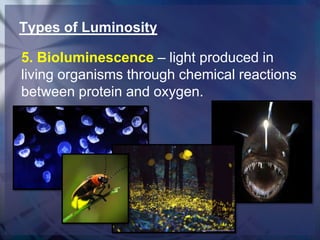
5. Bioluminescence – light produced in
living organisms through chemical reactions
between protein and oxygen.
MEASURING LIGHT
Luminous Intensity (I)
– strength or brightness of a source of light;
measured in candela (cd)
Luminous Flux (F)
– rate at which light is emitted from a source and
strikes the surface of a whole sphere; measured
in lumens (lm)
Illumination (E)
– the amount of luminous flux falling on a unit
area of a surface; measured in lux (lx)
Illumination and Distance:
THE INVERSE SQUARE LAW
• Illumination of light is inversely proportional to
the square of the distance from the source
• This means that the farther an object is from a
light source, the lesser light falls on it.
Examples:
• If you move 2× away from a light source, you’ll
receive only 1/4 of the original illuminance.
• If you move 3× away from a light source, you’ll
receive only 1/9 of the original illuminance.

09 light in focus

  • 1.
  • 2.
    The Theories ofLight 1. Wave Theory • proposed by Christian Huygens in 1690 • considers light to be a wave propagating in ether (an assumed substance permeating all matter and space 2. Corpuscular or Particle Theory • proposed by Isaac Newton in 1704 • considers light as composed of tiny particles emitted by luminous object • cited formation of shadows as proof
  • 3.
    The Theories ofLight 3. Electromagnetic Theory • proposed by James Clerk Maxwell in 1860 • considers light as an electromagnetic (EM) wave, a transverse wave that is partly electrical and partly magnetic in nature 4. Quantum Theory • proposed by Max Planck in 1900s • considers light as being emitted by packets of energy called quanta • Einstein called each quantum of energy as photon
  • 4.
    The Dual Natureof Light: A PARTICLE AND A WAVE • Since light has a dual nature, then it has two models or it can be presented and analyzed in two ways: as a ray and as a wave. • Ray Model of light is used to describe light as a particle and its behavior as a particle, and such is under the study of GEOMETRIC / RAY OPTICS. • Wave Model of light is used to describe light as a wave and its behavior as a wave, and such is under the study of WAVE OPTICS.
  • 5.
    Measuring the Speedof Light 1. 2. 3. 4. 5. Olaus Roemer – 300 000 000 m/s Christian Huygens – 230 000 000 m/s Armand Louis Fizeau – 313 000 000 m/s Jean Bernard Leon Foucault – 299 796 000 m/s Albert Michelson – 299 799 600 m/s Accepted Value: 299 792 458 m/s ~ 300 000 000 m/s
  • 6.
    The Rectilinear Propagationof Light RECTILINEAR PROPAGATION - property of light to travel in a straight path - one evidence of rectilinear propagation of light is the creation of a shadow
  • 7.
    When can wesee objects? 1. Luminous Object – object that can generate its own light 2. Illuminated Object – object that can not generate its own light but can still be seen because it can reflect light that it received from other sources
  • 8.
    Types of Luminosity 1.Incandescence – emits light due to their hot bodies.
  • 9.
    Types of Luminosity 2.Fluorescence – emits light by utilizing phosphors, which absorbs ultraviolet energy and releases visible light.
  • 10.
    Types of Luminosity 3.Phosphorescence – a type of fluorescence where the emission of light persists even after external excitation.
  • 11.
    Types of Luminosity 4.Gas Discharge – some gases can be made to produce light by passing an electric current through them.
  • 12.
    Types of Luminosity 5.Bioluminescence – light produced in living organisms through chemical reactions between protein and oxygen.
  • 13.
    MEASURING LIGHT Luminous Intensity(I) – strength or brightness of a source of light; measured in candela (cd) Luminous Flux (F) – rate at which light is emitted from a source and strikes the surface of a whole sphere; measured in lumens (lm) Illumination (E) – the amount of luminous flux falling on a unit area of a surface; measured in lux (lx)
  • 14.
    Illumination and Distance: THEINVERSE SQUARE LAW • Illumination of light is inversely proportional to the square of the distance from the source • This means that the farther an object is from a light source, the lesser light falls on it. Examples: • If you move 2× away from a light source, you’ll receive only 1/4 of the original illuminance. • If you move 3× away from a light source, you’ll receive only 1/9 of the original illuminance.