Reflection, Refraction,
and Diffraction
Reflection
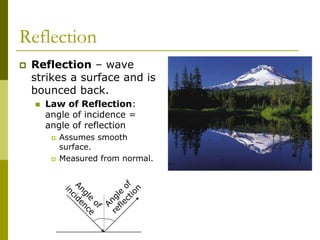
 Reflection – wave
strikes a surface and is
bounced back.
 Law of Reflection:
angle of incidence =
angle of reflection
 Assumes smooth
surface.
 Measured from normal.
Specular vs. Diffuse Reflection
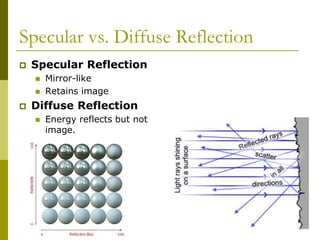
 Specular Reflection
 Mirror-like
 Retains image
 Diffuse Reflection
 Energy reflects but not
image.
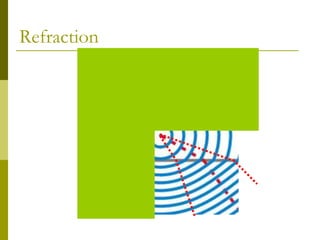
Refraction
 Refraction – change in wave’s direction as it
passes from one medium to another.
 Due to differences in speed of wave.
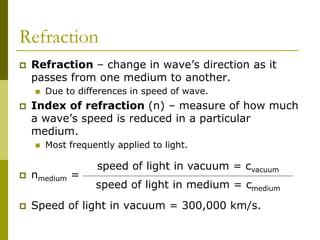
 Index of refraction (n) – measure of how much
a wave’s speed is reduced in a particular
medium.
 Most frequently applied to light.
 nmedium =
 Speed of light in vacuum = 300,000 km/s.
speed of light in vacuum = cvacuum
speed of light in medium = cmedium
Refraction
Refraction
 The refractive index of glass is 1.50.
What is the speed of light in glass?
 n = cvacuum / cmedium
 1.50 = (300,000 km/s) / (cmedium)
 cmedium = (300,000 km/s) / 1.50
 cmedium = 200,000 km/s
Refraction
 The refractive indices of several materials
are:
 water = 1.33
 air = 1.00
 diamond = 2.42
 glycerin = 1.47
 Through which material does light travel
the fastest? The slowest?
Snell’s Law
 As light waves pass from one medium to
another, they also change direction.
 Snell’s Law:
 n1sin1 = n2sin2 Angle of
Incidence
Angle of
Reflection
Angle of
Refraction
1
2
n1
n2
Snell’s Law
 As a wave passes from low n to high n, it
bends toward the normal.
 As a wave passes from high n to low n, it
bends away from the normal.
 If n is the same for both media, the wave
does not bend.
Snell’s Law
 A light wave passes from air (n = 1) to
water (n = 1.33). If the angle of
incidence is 30º, what is the angle of
refraction?
 n1sin1 = n2sin2
 (1)(sin30º) = (1.33)(sin2)
 0.5 = (1.33)(sin2)
 sin2 = 0.376
 2 = 22.1º
30º
?
Snell’s Law
 A light beam passes from water (n =
1.33) into diamond (n = 2.42). The beam
is incident upon the interface at an angle
56º from the normal. What is the
refracted angle of the light?
 n1sin1 = n2sin2
 (1.33)(sin56º) = (2.42)(sin2)
 1.10 = (2.42)(sin2)
 sin 2 = 0.455
 2 = 27.1º
Snell’s Law
 A light beam exits a fiber optic cable (n =
1.42) at an incident angle of 22.5º. At
what angle does the light beam enter the
air (n = 1)?
 n1sin1 = n2sin2
 (1.42)(sin22.5º) = (1)(sin2)
 0.543 = sin2
 2 = 32.9º
Total Reflection
 When a wave passes from a low n to a
high n, the angle increases.
 At a certain incident angle, the refractive angle
= 90º.
 Critical angle (c)
 For light passing from low n to high n, the
incident angle above which there is no
refraction.
 Above c all light is reflected back into the
incident medium.
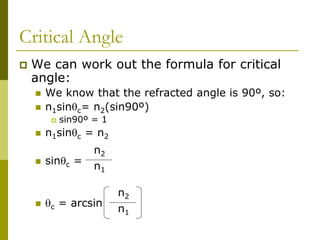
Critical Angle
 We can work out the formula for critical
angle:
 We know that the refracted angle is 90º, so:
 n1sinc= n2(sin90º)
 sin90º = 1
 n1sinc = n2
 sinc =
 c = arcsin
n2
n1
n2
n1
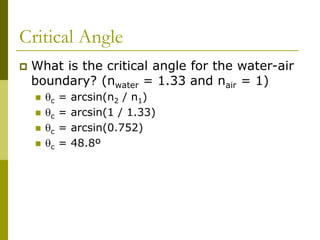
Critical Angle
 What is the critical angle for the water-air
boundary? (nwater = 1.33 and nair = 1)
 c = arcsin(n2 / n1)
 c = arcsin(1 / 1.33)
 c = arcsin(0.752)
 c = 48.8º
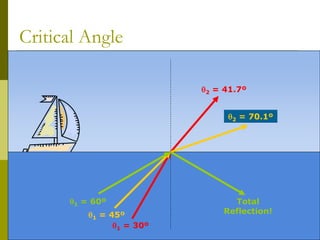
Critical Angle
1 = 30º
2 = 41.7º
1 = 45º
2 = 70.1º
1 = 60º Total
Reflection!
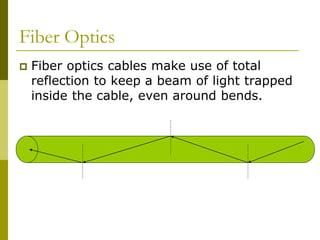
Fiber Optics
 Fiber optics cables make use of total
reflection to keep a beam of light trapped
inside the cable, even around bends.
Diffraction
 Diffraction – The bending of waves
around an obstacle.
 Can let you hear sounds the originate behind
an obstacle.
 Explains how waves can shape coastlines.
 Explains the diffraction pattern produced in the
double-slit experiment.

Reflection__Refraction__and_Diffraction.ppt

  • 1.
  • 2.
    Reflection  Reflection –wave strikes a surface and is bounced back.  Law of Reflection: angle of incidence = angle of reflection  Assumes smooth surface.  Measured from normal.
  • 3.
    Specular vs. DiffuseReflection  Specular Reflection  Mirror-like  Retains image  Diffuse Reflection  Energy reflects but not image.
  • 4.
    Refraction  Refraction –change in wave’s direction as it passes from one medium to another.  Due to differences in speed of wave.  Index of refraction (n) – measure of how much a wave’s speed is reduced in a particular medium.  Most frequently applied to light.  nmedium =  Speed of light in vacuum = 300,000 km/s. speed of light in vacuum = cvacuum speed of light in medium = cmedium
  • 5.
  • 6.
    Refraction  The refractiveindex of glass is 1.50. What is the speed of light in glass?  n = cvacuum / cmedium  1.50 = (300,000 km/s) / (cmedium)  cmedium = (300,000 km/s) / 1.50  cmedium = 200,000 km/s
  • 7.
    Refraction  The refractiveindices of several materials are:  water = 1.33  air = 1.00  diamond = 2.42  glycerin = 1.47  Through which material does light travel the fastest? The slowest?
  • 8.
    Snell’s Law  Aslight waves pass from one medium to another, they also change direction.  Snell’s Law:  n1sin1 = n2sin2 Angle of Incidence Angle of Reflection Angle of Refraction 1 2 n1 n2
  • 9.
    Snell’s Law  Asa wave passes from low n to high n, it bends toward the normal.  As a wave passes from high n to low n, it bends away from the normal.  If n is the same for both media, the wave does not bend.
  • 10.
    Snell’s Law  Alight wave passes from air (n = 1) to water (n = 1.33). If the angle of incidence is 30º, what is the angle of refraction?  n1sin1 = n2sin2  (1)(sin30º) = (1.33)(sin2)  0.5 = (1.33)(sin2)  sin2 = 0.376  2 = 22.1º 30º ?
  • 11.
    Snell’s Law  Alight beam passes from water (n = 1.33) into diamond (n = 2.42). The beam is incident upon the interface at an angle 56º from the normal. What is the refracted angle of the light?  n1sin1 = n2sin2  (1.33)(sin56º) = (2.42)(sin2)  1.10 = (2.42)(sin2)  sin 2 = 0.455  2 = 27.1º
  • 12.
    Snell’s Law  Alight beam exits a fiber optic cable (n = 1.42) at an incident angle of 22.5º. At what angle does the light beam enter the air (n = 1)?  n1sin1 = n2sin2  (1.42)(sin22.5º) = (1)(sin2)  0.543 = sin2  2 = 32.9º
  • 13.
    Total Reflection  Whena wave passes from a low n to a high n, the angle increases.  At a certain incident angle, the refractive angle = 90º.  Critical angle (c)  For light passing from low n to high n, the incident angle above which there is no refraction.  Above c all light is reflected back into the incident medium.
  • 14.
    Critical Angle  Wecan work out the formula for critical angle:  We know that the refracted angle is 90º, so:  n1sinc= n2(sin90º)  sin90º = 1  n1sinc = n2  sinc =  c = arcsin n2 n1 n2 n1
  • 15.
    Critical Angle  Whatis the critical angle for the water-air boundary? (nwater = 1.33 and nair = 1)  c = arcsin(n2 / n1)  c = arcsin(1 / 1.33)  c = arcsin(0.752)  c = 48.8º
  • 16.
    Critical Angle 1 =30º 2 = 41.7º 1 = 45º 2 = 70.1º 1 = 60º Total Reflection!
  • 17.
    Fiber Optics  Fiberoptics cables make use of total reflection to keep a beam of light trapped inside the cable, even around bends.
  • 18.
    Diffraction  Diffraction –The bending of waves around an obstacle.  Can let you hear sounds the originate behind an obstacle.  Explains how waves can shape coastlines.  Explains the diffraction pattern produced in the double-slit experiment.