Slide 1
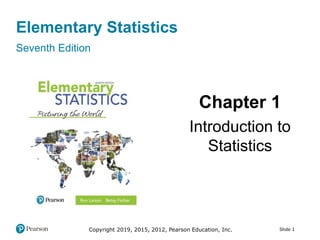
Elementary Statistics
Seventh Edition
Chapter 1
Introduction to
Statistics
Copyright 2019, 2015, 2012, Pearson Education, Inc.
Copyright 2019, 2015, 2012, Pearson Education, Inc. Slide 2
Chapter Outline
• 1.1 An Overview of Statistics
• 1.2 Data Classification
• 1.3 Data Collection and Experimental Design
Copyright 2019, 2015, 2012, Pearson Education, Inc. Slide 3
Section 1.1
An Overview of Statistics
Copyright 2019, 2015, 2012, Pearson Education, Inc. Slide 4
Section 1.1 Objectives
• A definition of statistics
• How to distinguish between a population and a
sample and between a parameter and a statistic
• How to distinguish between descriptive statistics
and inferential statistics
Copyright 2019, 2015, 2012, Pearson Education, Inc. Slide 5
What is Data?
Data
Consist of information coming from observations,
counts, measurements, or responses.
• According to a survey, more than 7 in 10 Americans
say a nursing career is a prestigious occupation.
(Source: The Harris Poll)
• “Social media consumes kids today as well, as more
score their first social media accounts at an average
age of 11.4 years old.” (Source: Influence Central’s
2016 Digital Trends Study)
Copyright 2019, 2015, 2012, Pearson Education, Inc. Slide 6
What is Statistics?
Statistics
The science of collecting,
organizing, analyzing, and
interpreting data in order to
make decisions.
Copyright 2019, 2015, 2012, Pearson Education, Inc. Slide 7
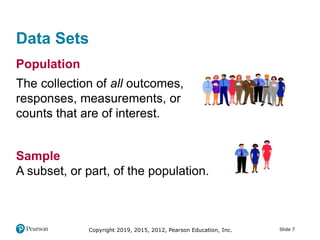
Data Sets
Population
The collection of all outcomes,
responses, measurements, or
counts that are of interest.
Sample
A subset, or part, of the population.
Copyright 2019, 2015, 2012, Pearson Education, Inc. Slide 8
Example: Identifying Data Sets
In a recent survey, 834 employees in the United States
were asked if they thought there jobs were highly
stressful. Of the 834 respondents, 517 said yes.
Identify the population and the sample. Describe the
sample data set. (Source: CareerCast Job Stress
Report)
Copyright 2019, 2015, 2012, Pearson Education, Inc. Slide 9
Solution: Identifying Data Sets
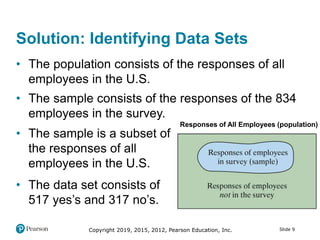
• The population consists of the responses of all
employees in the U.S.
• The sample consists of the responses of the 834
employees in the survey.
• The sample is a subset of
the responses of all
employees in the U.S.
• The data set consists of
517 yes’s and 317 no’s.
Responses of All Employees (population)
Copyright 2019, 2015, 2012, Pearson Education, Inc. Slide 10
Parameter and Statistic
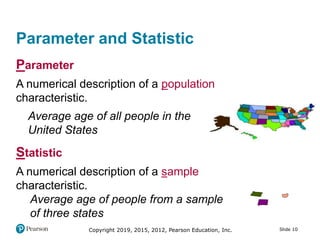
Parameter
A numerical description of a population
characteristic.
Average age of all people in the
United States
Statistic
A numerical description of a sample
characteristic.
Average age of people from a sample
of three states
Copyright 2019, 2015, 2012, Pearson Education, Inc. Slide 11
Example: Distinguish Parameter and
Statistic (1 of 3)
Decide whether each number describes a population
parameter or a sample statistic.
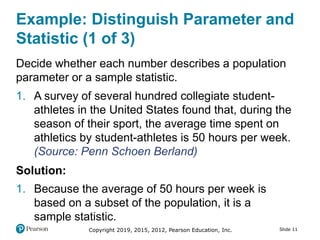
1. A survey of several hundred collegiate student-
athletes in the United States found that, during the
season of their sport, the average time spent on
athletics by student-athletes is 50 hours per week.
(Source: Penn Schoen Berland)
Solution:
1. Because the average of 50 hours per week is
based on a subset of the population, it is a
sample statistic.
Copyright 2019, 2015, 2012, Pearson Education, Inc. Slide 12
Example: Distinguish Parameter and
Statistic (2 of 3)
Decide whether the numerical value describes a
population parameter or a sample statistic.
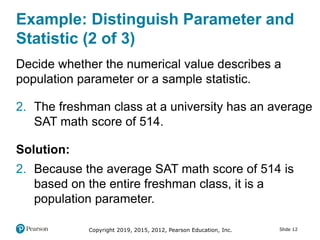
2. The freshman class at a university has an average
SAT math score of 514.
Solution:
2. Because the average SAT math score of 514 is
based on the entire freshman class, it is a
population parameter.
Copyright 2019, 2015, 2012, Pearson Education, Inc. Slide 13
Example: Distinguish Parameter and
Statistic (3 of 3)
Decide whether the numerical value describes a
population parameter or a sample statistic.
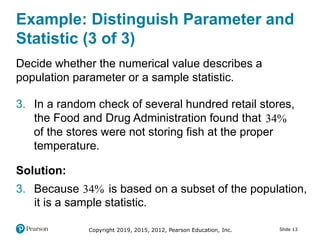
3. In a random check of several hundred retail stores,
the Food and Drug Administration found that 34
of the stores were not storing fish at the proper
temperature.
Solution:
3. Because 34 is based on a subset of the population,
it is a sample statistic.
Copyright 2019, 2015, 2012, Pearson Education, Inc. Slide 14
Branches of Statistics
Descriptive Statistics
Involves organizing,
summarizing, and
displaying data.
e.g. Tables, charts,
averages
Inferential Statistics
Involves using sample
data to draw
conclusions about a
population.
Copyright 2019, 2015, 2012, Pearson Education, Inc. Slide 15
Example: Descriptive and Inferential
Statistics (1 of 2)
For each study, identify the population and the sample.
Then determine which part of the study represents the
descriptive branch of statistics. What conclusions might
be drawn from the study using inferential statistics?
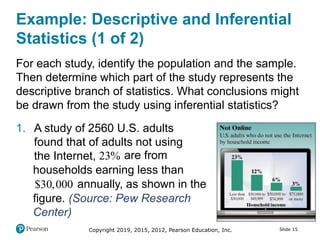
1. A study of 2560 U.S. adults
found that of adults not using
the Internet, 23 are from
households earning less than
$30 000 annually, as shown in the
figure. (Source: Pew Research
Center)
Copyright 2019, 2015, 2012, Pearson Education, Inc. Slide 16
Solution: Descriptive and Inferential
Statistics (1 of 2)
Solution:
1. The population consists of the responses of all U.S.
adults, and the sample consists of the responses of
the 2560 U.S. adults in the study. The descriptive
branch of statistics involves the statement “23 [of
U.S. adults not using the Internet]
are from households earning less
than$30 000 annually.” A possible
inference drawn from the study is
that lower-income households
cannot afford access to the Internet.
Copyright 2019, 2015, 2012, Pearson Education, Inc. Slide 17
Example: Descriptive and Inferential
Statistics (2 of 2)
For each study, identify the population and the sample.
Then determine which part of the study represents the
descriptive branch of statistics. What conclusions
might be drawn from the study using inferential
statistics?
2. A study of 300 Wall Street analysts found that the
percentage who incorrectly forecasted high-tech
earnings in a recent year was 44. (Adapted from
Bloomberg News)
Copyright 2019, 2015, 2012, Pearson Education, Inc. Slide 18
Solution: Descriptive and Inferential
Statistics (2 of 2)
Solution:
2. The population consists of the high-tech earnings
forecasts of all Wall Street analysts, and the sample
consists of the forecasts of the 300 Wall Street
analysts in the study. The part of this study that
represents the descriptive branch of statistics
involves the statement “the percentage [of Wall
Street analysts] who incorrectly forecasted high-tech
earnings in a recent year was 44.” A possible
inference drawn from the study is that the stock
market is difficult to forecast, even for professionals.

Les7e ppt ada_0101

  • 1.
    Slide 1 Elementary Statistics SeventhEdition Chapter 1 Introduction to Statistics Copyright 2019, 2015, 2012, Pearson Education, Inc.
  • 2.
    Copyright 2019, 2015,2012, Pearson Education, Inc. Slide 2 Chapter Outline • 1.1 An Overview of Statistics • 1.2 Data Classification • 1.3 Data Collection and Experimental Design
  • 3.
    Copyright 2019, 2015,2012, Pearson Education, Inc. Slide 3 Section 1.1 An Overview of Statistics
  • 4.
    Copyright 2019, 2015,2012, Pearson Education, Inc. Slide 4 Section 1.1 Objectives • A definition of statistics • How to distinguish between a population and a sample and between a parameter and a statistic • How to distinguish between descriptive statistics and inferential statistics
  • 5.
    Copyright 2019, 2015,2012, Pearson Education, Inc. Slide 5 What is Data? Data Consist of information coming from observations, counts, measurements, or responses. • According to a survey, more than 7 in 10 Americans say a nursing career is a prestigious occupation. (Source: The Harris Poll) • “Social media consumes kids today as well, as more score their first social media accounts at an average age of 11.4 years old.” (Source: Influence Central’s 2016 Digital Trends Study)
  • 6.
    Copyright 2019, 2015,2012, Pearson Education, Inc. Slide 6 What is Statistics? Statistics The science of collecting, organizing, analyzing, and interpreting data in order to make decisions.
  • 7.
    Copyright 2019, 2015,2012, Pearson Education, Inc. Slide 7 Data Sets Population The collection of all outcomes, responses, measurements, or counts that are of interest. Sample A subset, or part, of the population.
  • 8.
    Copyright 2019, 2015,2012, Pearson Education, Inc. Slide 8 Example: Identifying Data Sets In a recent survey, 834 employees in the United States were asked if they thought there jobs were highly stressful. Of the 834 respondents, 517 said yes. Identify the population and the sample. Describe the sample data set. (Source: CareerCast Job Stress Report)
  • 9.
    Copyright 2019, 2015,2012, Pearson Education, Inc. Slide 9 Solution: Identifying Data Sets • The population consists of the responses of all employees in the U.S. • The sample consists of the responses of the 834 employees in the survey. • The sample is a subset of the responses of all employees in the U.S. • The data set consists of 517 yes’s and 317 no’s. Responses of All Employees (population)
  • 10.
    Copyright 2019, 2015,2012, Pearson Education, Inc. Slide 10 Parameter and Statistic Parameter A numerical description of a population characteristic. Average age of all people in the United States Statistic A numerical description of a sample characteristic. Average age of people from a sample of three states
  • 11.
    Copyright 2019, 2015,2012, Pearson Education, Inc. Slide 11 Example: Distinguish Parameter and Statistic (1 of 3) Decide whether each number describes a population parameter or a sample statistic. 1. A survey of several hundred collegiate student- athletes in the United States found that, during the season of their sport, the average time spent on athletics by student-athletes is 50 hours per week. (Source: Penn Schoen Berland) Solution: 1. Because the average of 50 hours per week is based on a subset of the population, it is a sample statistic.
  • 12.
    Copyright 2019, 2015,2012, Pearson Education, Inc. Slide 12 Example: Distinguish Parameter and Statistic (2 of 3) Decide whether the numerical value describes a population parameter or a sample statistic. 2. The freshman class at a university has an average SAT math score of 514. Solution: 2. Because the average SAT math score of 514 is based on the entire freshman class, it is a population parameter.
  • 13.
    Copyright 2019, 2015,2012, Pearson Education, Inc. Slide 13 Example: Distinguish Parameter and Statistic (3 of 3) Decide whether the numerical value describes a population parameter or a sample statistic. 3. In a random check of several hundred retail stores, the Food and Drug Administration found that 34 of the stores were not storing fish at the proper temperature. Solution: 3. Because 34 is based on a subset of the population, it is a sample statistic.
  • 14.
    Copyright 2019, 2015,2012, Pearson Education, Inc. Slide 14 Branches of Statistics Descriptive Statistics Involves organizing, summarizing, and displaying data. e.g. Tables, charts, averages Inferential Statistics Involves using sample data to draw conclusions about a population.
  • 15.
    Copyright 2019, 2015,2012, Pearson Education, Inc. Slide 15 Example: Descriptive and Inferential Statistics (1 of 2) For each study, identify the population and the sample. Then determine which part of the study represents the descriptive branch of statistics. What conclusions might be drawn from the study using inferential statistics? 1. A study of 2560 U.S. adults found that of adults not using the Internet, 23 are from households earning less than $30 000 annually, as shown in the figure. (Source: Pew Research Center)
  • 16.
    Copyright 2019, 2015,2012, Pearson Education, Inc. Slide 16 Solution: Descriptive and Inferential Statistics (1 of 2) Solution: 1. The population consists of the responses of all U.S. adults, and the sample consists of the responses of the 2560 U.S. adults in the study. The descriptive branch of statistics involves the statement “23 [of U.S. adults not using the Internet] are from households earning less than$30 000 annually.” A possible inference drawn from the study is that lower-income households cannot afford access to the Internet.
  • 17.
    Copyright 2019, 2015,2012, Pearson Education, Inc. Slide 17 Example: Descriptive and Inferential Statistics (2 of 2) For each study, identify the population and the sample. Then determine which part of the study represents the descriptive branch of statistics. What conclusions might be drawn from the study using inferential statistics? 2. A study of 300 Wall Street analysts found that the percentage who incorrectly forecasted high-tech earnings in a recent year was 44. (Adapted from Bloomberg News)
  • 18.
    Copyright 2019, 2015,2012, Pearson Education, Inc. Slide 18 Solution: Descriptive and Inferential Statistics (2 of 2) Solution: 2. The population consists of the high-tech earnings forecasts of all Wall Street analysts, and the sample consists of the forecasts of the 300 Wall Street analysts in the study. The part of this study that represents the descriptive branch of statistics involves the statement “the percentage [of Wall Street analysts] who incorrectly forecasted high-tech earnings in a recent year was 44.” A possible inference drawn from the study is that the stock market is difficult to forecast, even for professionals.

Editor's Notes

  • #2 If this PowerPoint presentation contains mathematical equations, you may need to check that your computer has the following installed: 1) MathType Plugin 2) Math Player (free versions available) 3) NVDA Reader (free versions available)