Today:  Notes about quiz;    Oscillations, Waves, Doppler effect Quiz #2 due Thursday Exercises due Tuesday (To be assigned for this week’s material) Waves by hb19 on flickr
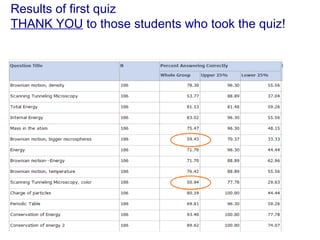
Results of first quiz THANK YOU  to those students who took the quiz!
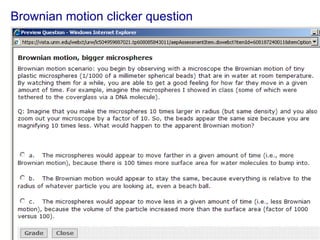
Brownian motion clicker question
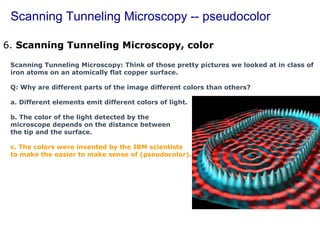
Scanning Tunneling Microscopy -- pseudocolor 6.  Scanning Tunneling Microscopy, color        Scanning Tunneling Microscopy: Think of those pretty pictures we looked at in class of iron atoms on an atomically flat copper surface.  Q: Why are different parts of the image different colors than others? a. Different elements emit different colors of light. b. The color of the light detected by the  microscope depends on the distance between  the tip and the surface. c. The colors were invented by the IBM scientists  to make the easier to make sense of (pseudocolor).
Self-sustaining  oscillations  are usually  energy  flowing from one form to another, back and forth What are some common oscillations we can think of? Students 2008: Electromagnetic; vibration of vocal cords or speaker; water surface; pendulum; mass on a spring; motion of a piston in an engine; atom oscillating Are there two forms of energy that you can identify?
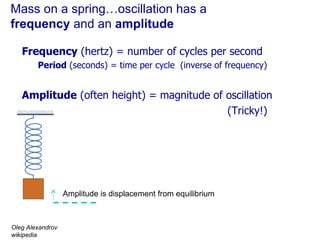
Mass on a spring…oscillation has a  frequency  and an  amplitude Frequency  (hertz) = number of cycles per second Period  (seconds) = time per cycle  (inverse of frequency) Amplitude  (often height) = magnitude of oscillation (Tricky!)  Oleg Alexandrov wikipedia Amplitude is displacement from equilibrium
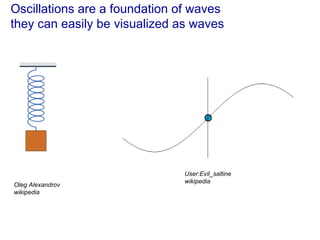
Oscillations are a foundation of waves they can easily be visualized as waves User:Evil_saltine wikipedia Oleg Alexandrov wikipedia
A wave is a disturbance that  propagates  through space…it  carries energy  from one place to another. The author of the book says: “ The source of all waves—sound, light or whatever—is something that is vibrating.” (“Oscillating”) This is a pretty good definition, but sometimes it’s not obvious or evident what source is “oscillating” For our purposes, the waves we care about must  propagate through space  and  carry energy We also think about waves that don’t carry energy…examples?
Let’s brainstorm on waves that carry energy … Microwaves, sound waves, light waves, radio waves, ocean waves, heat waves (infrared), gamma rays, x-rays, earthquake waves (seismic), gravitational waves,
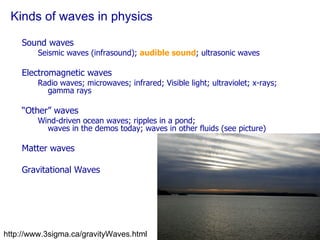
Kinds of waves in physics Sound waves Seismic waves (infrasound);  audible sound ; ultrasonic waves Electromagnetic waves Radio waves; microwaves; infrared; Visible light; ultraviolet; x-rays; gamma rays “ Other” waves Wind-driven ocean waves; ripples in a pond; waves in the demos today; waves in other fluids (see picture)  Matter waves Gravitational Waves http://www.3sigma.ca/gravityWaves.html
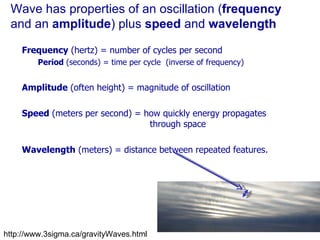
Wave has properties of an oscillation ( frequency  and an  amplitude ) plus  speed  and  wavelength Frequency  (hertz) = number of cycles per second Period  (seconds) = time per cycle  (inverse of frequency) Amplitude  (often height) = magnitude of oscillation Speed  (meters per second) = how quickly energy propagates  through space Wavelength  (meters) = distance between repeated features. http://www.3sigma.ca/gravityWaves.html
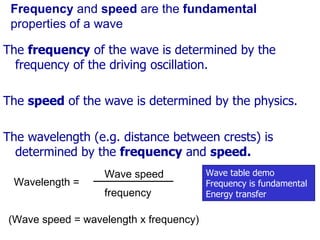
Frequency  and  speed  are the  fundamental  properties of a wave The  frequency  of the wave is determined by the frequency of the driving oscillation. The  speed  of the wave is determined by the physics. The wavelength (e.g. distance between crests) is determined by the  frequency  and  speed. (Wave speed = wavelength x frequency) Wave table demo Frequency is fundamental Energy transfer Wavelength = Wave speed frequency
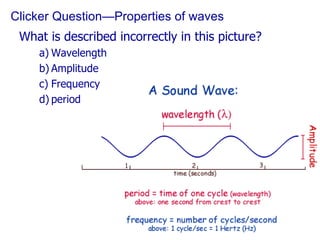
Clicker Question—Properties of waves What is described incorrectly in this picture? Wavelength Amplitude Frequency period
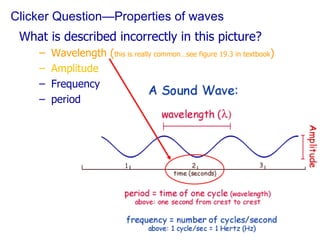
Clicker Question—Properties of waves What is described incorrectly in this picture? Wavelength ( this is really common…see figure 19.3 in textbook ) Amplitude Frequency period
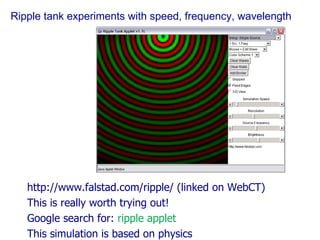
Ripple tank experiments with speed, frequency, wavelength http://www.falstad.com/ripple/ (linked on WebCT) This is really worth trying out! Google search for:  ripple applet This simulation is based on physics
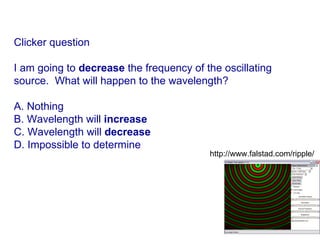
Clicker question I am going to  decrease  the frequency of the oscillating source.  What will happen to the wavelength? A. Nothing B. Wavelength will  increase C. Wavelength will  decrease D. Impossible to determine http://www.falstad.com/ripple/
Clicker Question—Wavelength, frequency, speed Suppose the wave speed is fixed for all frequencies and wavelengths.  Which has a longer wavelength? Frequency = 770,000 Hertz Frequency = 97,300,000 Hertz Both are the same, since speed is fixed
Clicker Question—Wavelength, frequency, speed Suppose the wave speed is fixed for all frequencies and wavelengths.  Which has a longer wavelength? Frequency = 770,000 Hertz Frequency = 97,300,000 Hertz Both are the same, since speed is fixed Wave speed = wavelength x frequency Wavelength = Wave speed frequency
Transverse Waves and Longitudinal Waves Transverse waves : “ Motion of the medium” is  perpendicular  to the direction of wave propagation E.g. Ocean waves Longitudinal waves: “ Motion of the medium” is in  same direction  as direction of wave propagation E.g. compression waves in slinky;  SOUND Transverse wave demo From Zhang Jiang (our TA): The speed of longitudinal waves and transversal waves differ If there is an earthquake you will feel the vertical shake before the horizontal shake
Key concepts: 1. Waves transmit energy, not the material that is waving If a transmitter and receiver are not moving relative to each other then: Frequency observed = frequency transmitted
Doppler effect Frequency observed NOT equal to frequency transmitted! Because source and receiver are moving relative to each other Ripple tank Doppler Doppler demo
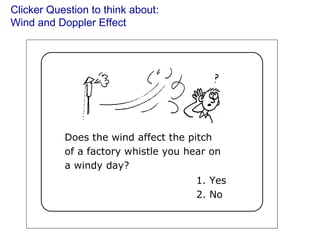
Clicker Question to think about: Wind and Doppler Effect

04 Oscillations, Waves After Class

  • 1.
    Today: Notesabout quiz; Oscillations, Waves, Doppler effect Quiz #2 due Thursday Exercises due Tuesday (To be assigned for this week’s material) Waves by hb19 on flickr
  • 2.
    Results of firstquiz THANK YOU to those students who took the quiz!
  • 3.
  • 4.
    Scanning Tunneling Microscopy-- pseudocolor 6. Scanning Tunneling Microscopy, color     Scanning Tunneling Microscopy: Think of those pretty pictures we looked at in class of iron atoms on an atomically flat copper surface. Q: Why are different parts of the image different colors than others? a. Different elements emit different colors of light. b. The color of the light detected by the microscope depends on the distance between the tip and the surface. c. The colors were invented by the IBM scientists to make the easier to make sense of (pseudocolor).
  • 5.
    Self-sustaining oscillations are usually energy flowing from one form to another, back and forth What are some common oscillations we can think of? Students 2008: Electromagnetic; vibration of vocal cords or speaker; water surface; pendulum; mass on a spring; motion of a piston in an engine; atom oscillating Are there two forms of energy that you can identify?
  • 6.
    Mass on aspring…oscillation has a frequency and an amplitude Frequency (hertz) = number of cycles per second Period (seconds) = time per cycle (inverse of frequency) Amplitude (often height) = magnitude of oscillation (Tricky!) Oleg Alexandrov wikipedia Amplitude is displacement from equilibrium
  • 7.
    Oscillations are afoundation of waves they can easily be visualized as waves User:Evil_saltine wikipedia Oleg Alexandrov wikipedia
  • 8.
    A wave isa disturbance that propagates through space…it carries energy from one place to another. The author of the book says: “ The source of all waves—sound, light or whatever—is something that is vibrating.” (“Oscillating”) This is a pretty good definition, but sometimes it’s not obvious or evident what source is “oscillating” For our purposes, the waves we care about must propagate through space and carry energy We also think about waves that don’t carry energy…examples?
  • 9.
    Let’s brainstorm onwaves that carry energy … Microwaves, sound waves, light waves, radio waves, ocean waves, heat waves (infrared), gamma rays, x-rays, earthquake waves (seismic), gravitational waves,
  • 10.
    Kinds of wavesin physics Sound waves Seismic waves (infrasound); audible sound ; ultrasonic waves Electromagnetic waves Radio waves; microwaves; infrared; Visible light; ultraviolet; x-rays; gamma rays “ Other” waves Wind-driven ocean waves; ripples in a pond; waves in the demos today; waves in other fluids (see picture) Matter waves Gravitational Waves http://www.3sigma.ca/gravityWaves.html
  • 11.
    Wave has propertiesof an oscillation ( frequency and an amplitude ) plus speed and wavelength Frequency (hertz) = number of cycles per second Period (seconds) = time per cycle (inverse of frequency) Amplitude (often height) = magnitude of oscillation Speed (meters per second) = how quickly energy propagates through space Wavelength (meters) = distance between repeated features. http://www.3sigma.ca/gravityWaves.html
  • 12.
    Frequency and speed are the fundamental properties of a wave The frequency of the wave is determined by the frequency of the driving oscillation. The speed of the wave is determined by the physics. The wavelength (e.g. distance between crests) is determined by the frequency and speed. (Wave speed = wavelength x frequency) Wave table demo Frequency is fundamental Energy transfer Wavelength = Wave speed frequency
  • 13.
    Clicker Question—Properties ofwaves What is described incorrectly in this picture? Wavelength Amplitude Frequency period
  • 14.
    Clicker Question—Properties ofwaves What is described incorrectly in this picture? Wavelength ( this is really common…see figure 19.3 in textbook ) Amplitude Frequency period
  • 15.
    Ripple tank experimentswith speed, frequency, wavelength http://www.falstad.com/ripple/ (linked on WebCT) This is really worth trying out! Google search for: ripple applet This simulation is based on physics
  • 16.
    Clicker question Iam going to decrease the frequency of the oscillating source. What will happen to the wavelength? A. Nothing B. Wavelength will increase C. Wavelength will decrease D. Impossible to determine http://www.falstad.com/ripple/
  • 17.
    Clicker Question—Wavelength, frequency,speed Suppose the wave speed is fixed for all frequencies and wavelengths. Which has a longer wavelength? Frequency = 770,000 Hertz Frequency = 97,300,000 Hertz Both are the same, since speed is fixed
  • 18.
    Clicker Question—Wavelength, frequency,speed Suppose the wave speed is fixed for all frequencies and wavelengths. Which has a longer wavelength? Frequency = 770,000 Hertz Frequency = 97,300,000 Hertz Both are the same, since speed is fixed Wave speed = wavelength x frequency Wavelength = Wave speed frequency
  • 19.
    Transverse Waves andLongitudinal Waves Transverse waves : “ Motion of the medium” is perpendicular to the direction of wave propagation E.g. Ocean waves Longitudinal waves: “ Motion of the medium” is in same direction as direction of wave propagation E.g. compression waves in slinky; SOUND Transverse wave demo From Zhang Jiang (our TA): The speed of longitudinal waves and transversal waves differ If there is an earthquake you will feel the vertical shake before the horizontal shake
  • 20.
    Key concepts: 1.Waves transmit energy, not the material that is waving If a transmitter and receiver are not moving relative to each other then: Frequency observed = frequency transmitted
  • 21.
    Doppler effect Frequencyobserved NOT equal to frequency transmitted! Because source and receiver are moving relative to each other Ripple tank Doppler Doppler demo
  • 22.
    Clicker Question tothink about: Wind and Doppler Effect