PHY 110, Introduction to Physics
Dr. Henry
SC 453, 572-6164 (alt 572-5309)
E-Mail: henryh1@nku.edu
Web Site: www.nku.edu/~henryh1/
© Hugh Henry, 2008
If you are Tardy
Initial beside Your Name on the
Sheet on the Front Table
3
The rest of the semester . . .
• Chapter 6, Waves and Sound (6.1-6.3)
• Chapter 7, Electricity (except Static
Electricity)
• Chapter 8, Electromagnetism and EM
Waves (8.1-8.6)
• Skip Chapter 9
• Chapter 10, Atomic Physics (10.1-10.2,
10.4-10.6)
• Chapter 11, Nuclear Physics (11.1-11.4)
• Chapter 12, Special Relativity and
Cosmology (12.1)
Chapter 6
(Sections 6.1-6.3)
Waves
A wave is a traveling disturbance consisting of
coordinate vibrations that transmit energy with
no net movement of matter.
5
Waves — types and properties
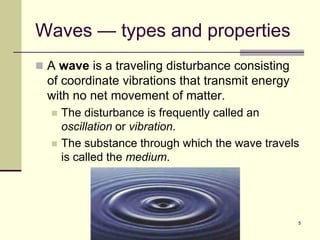
 A wave is a traveling disturbance consisting
of coordinate vibrations that transmit energy
with no net movement of matter.
 The disturbance is frequently called an
oscillation or vibration.
 The substance through which the wave travels
is called the medium.
6
Waves — types and properties,
cont’d
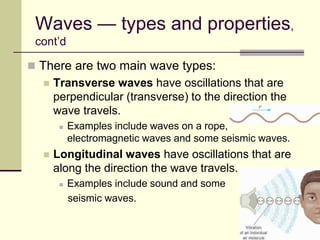
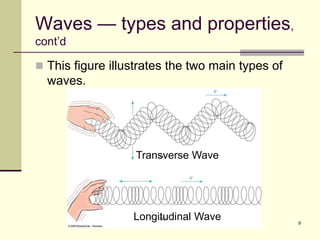
 There are two main wave types:
 Transverse waves have oscillations that are
perpendicular (transverse) to the direction the
wave travels.
 Examples include waves on a rope,
electromagnetic waves and some seismic waves.
 Longitudinal waves have oscillations that are
along the direction the wave travels.
 Examples include sound and some
seismic waves.
7
Sound
© Hugh Henry, 2008
Transverse Waves
The_Nature_of_Waves
8
Longitudinal Waves
(Sound and Ultrasound)
Sound_Waves
9
Waves — types and properties,
cont’d
 This figure illustrates the two main types of
waves.
Longitudinal Wave
Transverse Wave
10
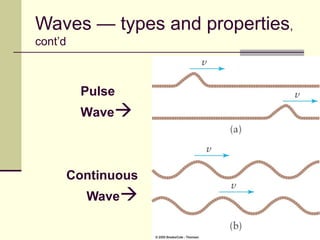
Pulse
Wave
Continuous
Wave
Waves — types and properties,
cont’d
11
Waves — types and properties,
cont’d
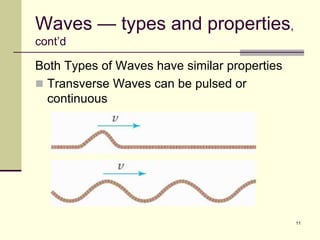
Both Types of Waves have similar properties
 Transverse Waves can be pulsed or
continuous
12
Waves — types and properties,
cont’d
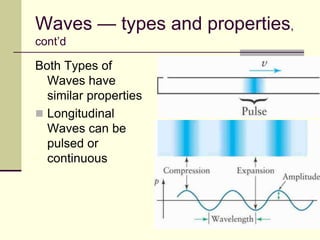
Both Types of
Waves have
similar properties
 Longitudinal
Waves can be
pulsed or
continuous
13
Waves — types and properties:
Amplitude
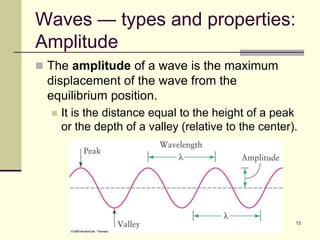
 The amplitude of a wave is the maximum
displacement of the wave from the
equilibrium position.
 It is the distance equal to the height of a peak
or the depth of a valley (relative to the center).
14
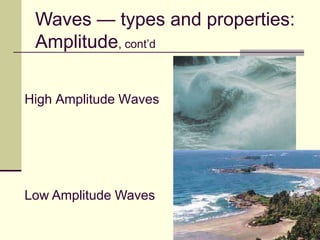
High Amplitude Waves
Low Amplitude Waves
Waves — types and properties:
Amplitude, cont’d
15
Waves — types and properties:
Wavelength
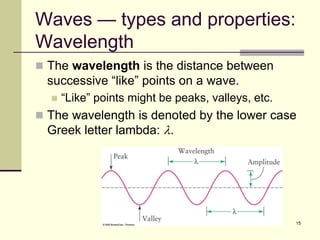
 The wavelength is the distance between
successive “like” points on a wave.
 “Like” points might be peaks, valleys, etc.
 The wavelength is denoted by the lower case
Greek letter lambda: l.
16
Waves — types and properties :
Wavelength, cont’d
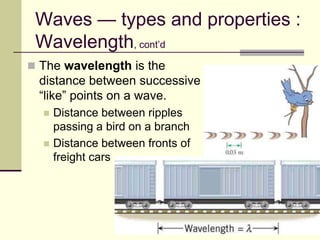
 The wavelength is the
distance between successive
“like” points on a wave.
 Distance between ripples
passing a bird on a branch
 Distance between fronts of
freight cars
17
Waves — types and properties:
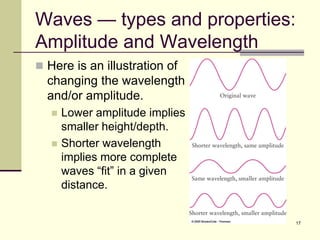
Amplitude and Wavelength
 Here is an illustration of
changing the wavelength
and/or amplitude.
 Lower amplitude implies
smaller height/depth.
 Shorter wavelength
implies more complete
waves “fit” in a given
distance.
18
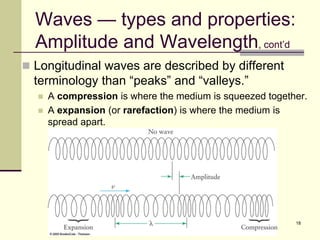
Waves — types and properties:
Amplitude and Wavelength, cont’d
 Longitudinal waves are described by different
terminology than “peaks” and “valleys.”
 A compression is where the medium is squeezed together.
 A expansion (or rarefaction) is where the medium is
spread apart.
19
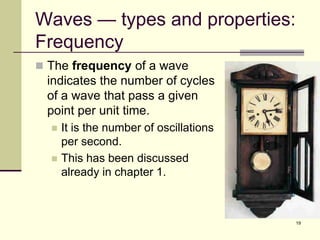
Waves — types and properties:
Frequency
 The frequency of a wave
indicates the number of cycles
of a wave that pass a given
point per unit time.
 It is the number of oscillations
per second.
 This has been discussed
already in chapter 1.
20
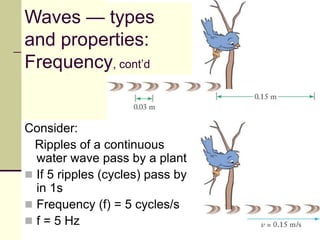
Consider:
Ripples of a continuous
water wave pass by a plant
 If 5 ripples (cycles) pass by
in 1s
 Frequency (f) = 5 cycles/s
 f = 5 Hz
as
Waves — types
and properties:
Frequency, cont’d
Waves — types and properties:
Velocity, cont’d
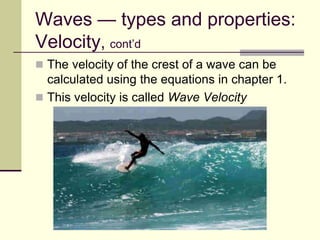
 The velocity of the crest of a wave can be
calculated using the equations in chapter 1.
 This velocity is called Wave Velocity
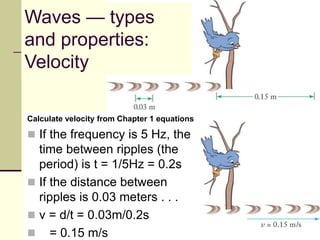
Calculate velocity from Chapter 1 equations
 If the frequency is 5 Hz, the
time between ripples (the
period) is t = 1/5Hz = 0.2s
 If the distance between
ripples is 0.03 meters . . .
 v = d/t = 0.03m/0.2s
 = 0.15 m/s
Waves — types
and properties:
Velocity
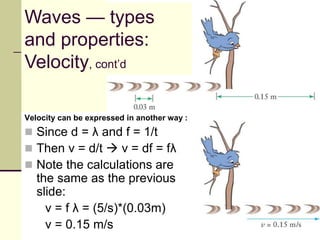
Velocity can be expressed in another way :
 Since d = λ and f = 1/t
 Then v = d/t  v = df = fλ
 Note the calculations are
the same as the previous
slide:
v = f λ = (5/s)*(0.03m)
v = 0.15 m/s
Waves — types
and properties:
Velocity, cont’d
24
Waves — types and properties:
Velocity, cont’d
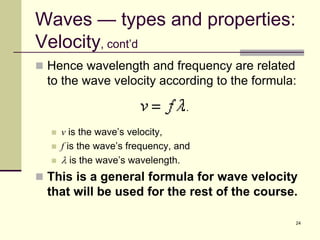
 Hence wavelength and frequency are related
to the wave velocity according to the formula:
 v is the wave’s velocity,
 f is the wave’s frequency, and
 l is the wave’s wavelength.
 This is a general formula for wave velocity
that will be used for the rest of the course.
25
Waves — types and properties:
Velocity, cont’d
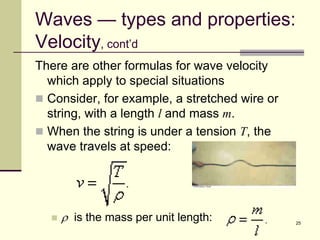
There are other formulas for wave velocity
which apply to special situations
 Consider, for example, a stretched wire or
string, with a length l and mass m.
 When the string is under a tension T, the
wave travels at speed:
 r is the mass per unit length:
26
Waves — types and properties,
Velocity, cont’d
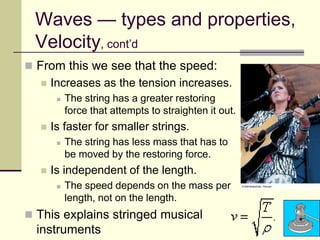
 From this we see that the speed:
 Increases as the tension increases.
 The string has a greater restoring
force that attempts to straighten it out.
 Is faster for smaller strings.
 The string has less mass that has to
be moved by the restoring force.
 Is independent of the length.
 The speed depends on the mass per
length, not on the length.
 This explains stringed musical
instruments
27
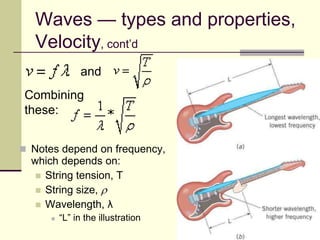
Waves — types and properties,
Velocity, cont’d
 Notes depend on frequency,
which depends on:
 String tension, T
 String size, r
 Wavelength, λ
 “L” in the illustration
and
Combining
these:
28
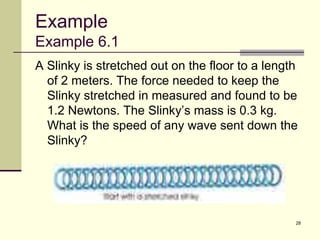
Example
Example 6.1
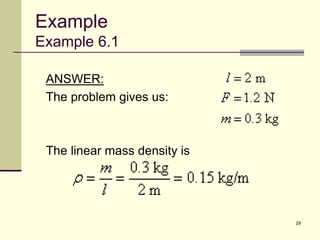
A Slinky is stretched out on the floor to a length
of 2 meters. The force needed to keep the
Slinky stretched in measured and found to be
1.2 Newtons. The Slinky’s mass is 0.3 kg.
What is the speed of any wave sent down the
Slinky?
29
ANSWER:
The problem gives us:
The linear mass density is
Example
Example 6.1
30
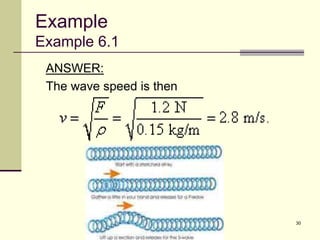
ANSWER:
The wave speed is then
Example
Example 6.1
31
Sound
Sound_Waves
32
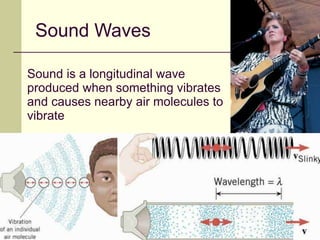
Sound is a longitudinal wave
produced when something vibrates
and causes nearby air molecules to
vibrate
Longitudinal Wave
Sound Waves
33
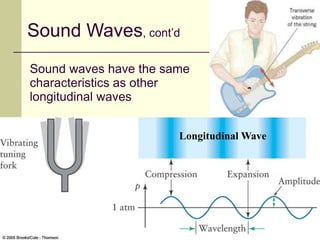
Sound waves have the same
characteristics as other
longitudinal waves
Longitudinal Wave
Sound Waves, cont’d
34
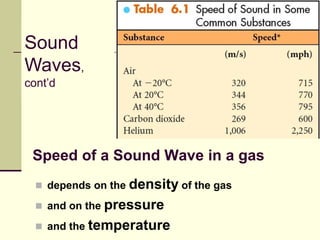
Speed of a Sound Wave in a gas
 depends on the density of the gas
 and on the pressure
 and the temperature
Sound
Waves,
cont’d
35
Sound Waves, cont’d
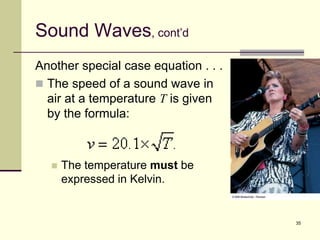
Another special case equation . . .
 The speed of a sound wave in
air at a temperature T is given
by the formula:
 The temperature must be
expressed in Kelvin.
36
Example
Example 6.2
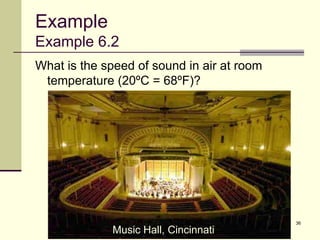
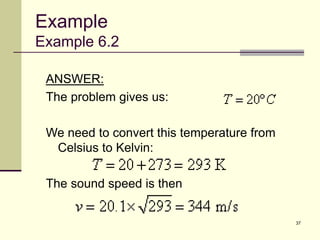
What is the speed of sound in air at room
temperature (20ºC = 68ºF)?
Music Hall, Cincinnati
37
ANSWER:
The problem gives us:
We need to convert this temperature from
Celsius to Kelvin:
The sound speed is then
Example
Example 6.2
38
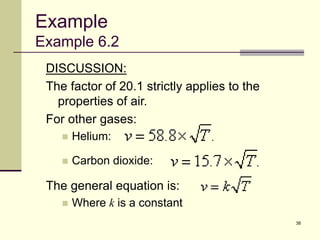
DISCUSSION:
The factor of 20.1 strictly applies to the
properties of air.
For other gases:
 Helium:
 Carbon dioxide:
The general equation is:
 Where k is a constant
Example
Example 6.2
39
Example
Example 6.3
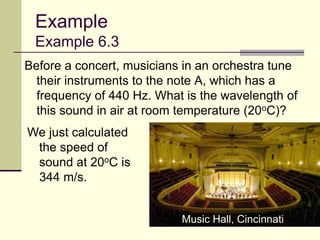
Before a concert, musicians in an orchestra tune
their instruments to the note A, which has a
frequency of 440 Hz. What is the wavelength of
this sound in air at room temperature (20oC)?
We just calculated
the speed of
sound at 20oC is
344 m/s.
Music Hall, Cincinnati
40
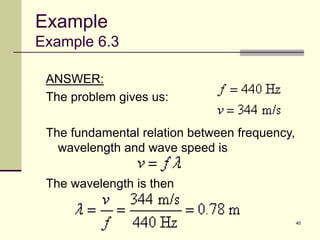
ANSWER:
The problem gives us:
The fundamental relation between frequency,
wavelength and wave speed is
The wavelength is then
Example
Example 6.3
Aspects of Wave
Propagation
Wave_Interference
42
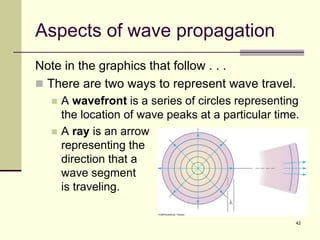
Aspects of wave propagation
Note in the graphics that follow . . .
 There are two ways to represent wave travel.
 A wavefront is a series of circles representing
the location of wave peaks at a particular time.
 A ray is an arrow
representing the
direction that a
wave segment
is traveling.
43
Aspects of wave propagation:
Reflection
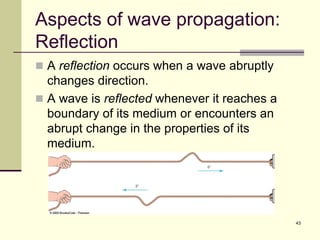
 A reflection occurs when a wave abruptly
changes direction.
 A wave is reflected whenever it reaches a
boundary of its medium or encounters an
abrupt change in the properties of its
medium.
44
Aspects of wave propagation:
Reflection, cont’d
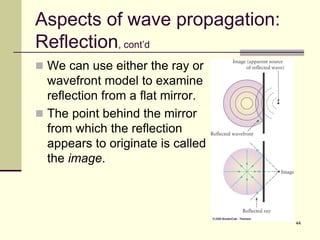
 We can use either the ray or
wavefront model to examine
reflection from a flat mirror.
 The point behind the mirror
from which the reflection
appears to originate is called
the image.
45
Aspects of wave propagation:
Reflection, cont’d
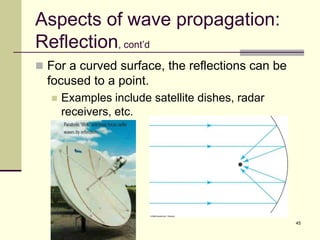
 For a curved surface, the reflections can be
focused to a point.
 Examples include satellite dishes, radar
receivers, etc.
46
Aspects of wave propagation:
Reflection, cont’d
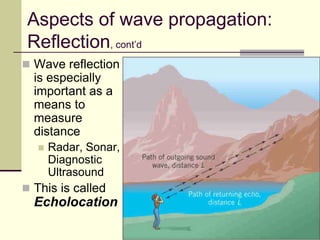
 Wave reflection
is especially
important as a
means to
measure
distance
 Radar, Sonar,
Diagnostic
Ultrasound
 This is called
Echolocation
47
Aspects of wave propagation:
Reflection, cont’d
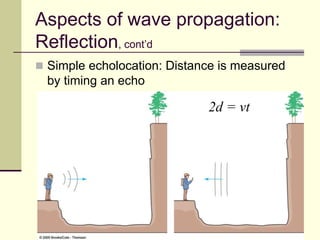
 Simple echolocation: Distance is measured
by timing an echo
2d = vt
48
Aspects of wave propagation:
Reflection, cont’d
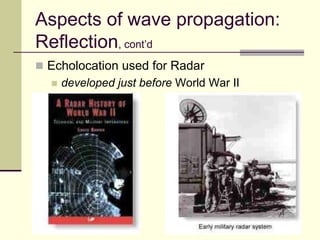
 Echolocation used for Radar
 developed just before World War II
49
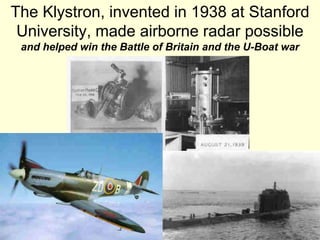
The Klystron, invented in 1938 at Stanford
University, made airborne radar possible
and helped win the Battle of Britain and the U-Boat war
50
Aspects of wave propagation:
Reflection, cont’d
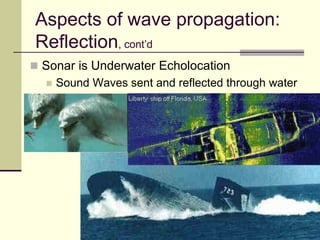
 Sonar is Underwater Echolocation
 Sound Waves sent and reflected through water
51
Aspects of wave propagation:
Doppler Effect
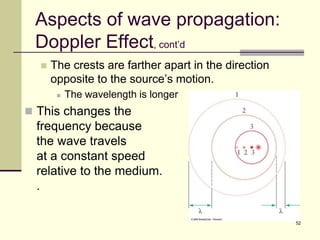
 The Doppler effect is a change in a wave’s
wavelength due to the relative motion between
the source and receiver.
 Consider a source
emitting waves and
moving to the right.
 The crests are closer
together in the direction
the source moves.
 The wavelength is shorter
52
Aspects of wave propagation:
Doppler Effect, cont’d
 The crests are farther apart in the direction
opposite to the source’s motion.
 The wavelength is longer
 This changes the
frequency because
the wave travels
at a constant speed
relative to the medium.
.
53
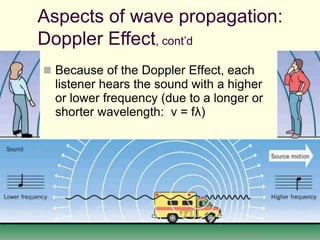
 Because of the Doppler Effect, each
listener hears the sound with a higher
or lower frequency (due to a longer or
shorter wavelength: v = fλ)
Aspects of wave propagation:
Doppler Effect, cont’d
54
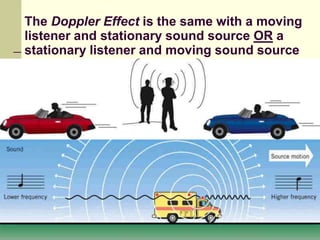
The Doppler Effect is the same with a moving
listener and stationary sound source OR a
stationary listener and moving sound source
55
Aspects of wave propagation:
Doppler Effect, cont’d
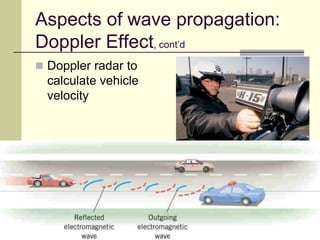
 Doppler radar to
calculate vehicle
velocity
56
Aspects of wave propagation:
Doppler Effect, cont’d
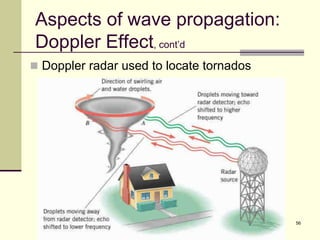
 Doppler radar used to locate tornados
57
Aspects of wave propagation:
Doppler Effect, cont’d
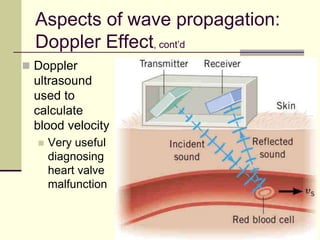
 Doppler
ultrasound
used to
calculate
blood velocity
 Very useful
diagnosing
heart valve
malfunction
58
Aspects of wave propagation:
Shock Wave
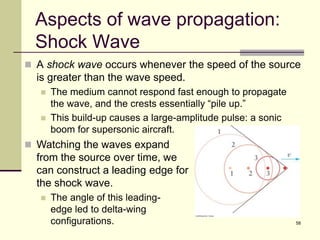
 A shock wave occurs whenever the speed of the source
is greater than the wave speed.
 The medium cannot respond fast enough to propagate
the wave, and the crests essentially “pile up.”
 This build-up causes a large-amplitude pulse: a sonic
boom for supersonic aircraft.
 Watching the waves expand
from the source over time, we
can construct a leading edge for
the shock wave.
 The angle of this leading-
edge led to delta-wing
configurations.
59
Aspects of wave propagation:
Diffraction
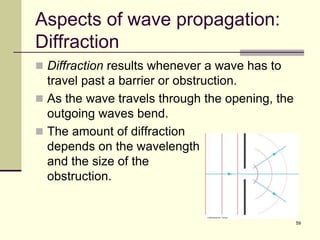
 Diffraction results whenever a wave has to
travel past a barrier or obstruction.
 As the wave travels through the opening, the
outgoing waves bend.
 The amount of diffraction
depends on the wavelength
and the size of the
obstruction.
60
Aspects of wave propagation:
Diffraction, cont’d
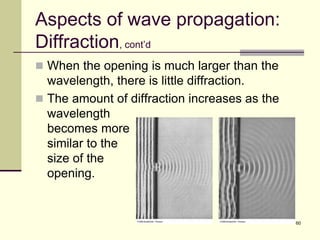
 When the opening is much larger than the
wavelength, there is little diffraction.
 The amount of diffraction increases as the
wavelength
becomes more
similar to the
size of the
opening.
61
Aspects of wave propagation:
Diffraction, cont’d
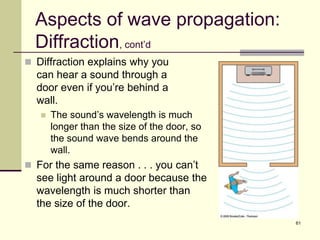
 Diffraction explains why you
can hear a sound through a
door even if you’re behind a
wall.
 The sound’s wavelength is much
longer than the size of the door, so
the sound wave bends around the
wall.
 For the same reason . . . you can’t
see light around a door because the
wavelength is much shorter than
the size of the door.
62
Aspects of wave propagation:
Diffraction, cont’d
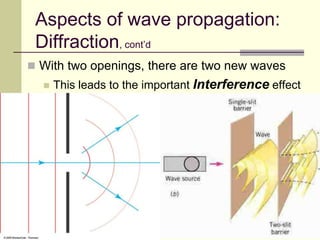
 With two openings, there are two new waves
 This leads to the important Interference effect
63
Aspects of wave propagation:
Interference
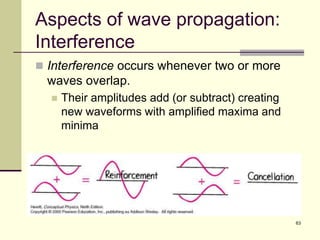
 Interference occurs whenever two or more
waves overlap.
 Their amplitudes add (or subtract) creating
new waveforms with amplified maxima and
minima
64
Aspects of wave propagation:
Interference, cont’d
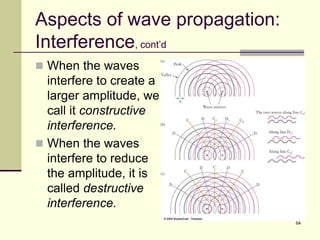
 When the waves
interfere to create a
larger amplitude, we
call it constructive
interference.
 When the waves
interfere to reduce
the amplitude, it is
called destructive
interference.
65
Aspects of wave propagation:
Interference, cont’d
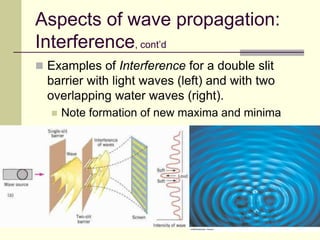
 Examples of Interference for a double slit
barrier with light waves (left) and with two
overlapping water waves (right).
 Note formation of new maxima and minima
66
Aspects of wave propagation:
Interference, cont’d
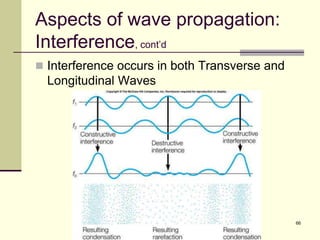
 Interference occurs in both Transverse and
Longitudinal Waves
67
Aspects of wave propagation:
Reflection and Interference
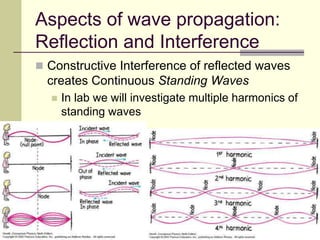
 Constructive Interference of reflected waves
creates Continuous Standing Waves
 In lab we will investigate multiple harmonics of
standing waves
68
Aspects of wave propagation:
Reflection and Interference, cont’d
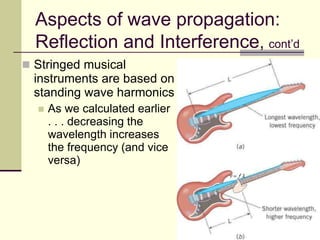
 Stringed musical
instruments are based on
standing wave harmonics
 As we calculated earlier
. . . decreasing the
wavelength increases
the frequency (and vice
versa)
Sound and Ultrasound
 The human hear can typically “hear” sounds
with frequencies in the range 20-20,000 Hz.
 Sound with frequencies below our audible
range is called infrasound.
 Below about 20 Hz.
 Sound with frequencies above our audible
range is called ultrasound.
 Above about 20,000 Hz.
Ultrasound
High Frequency Sound
71
Ultrasound, cont’d
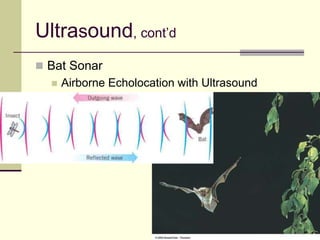
 Bat Sonar
 Airborne Echolocation with Ultrasound
72
Ultrasound, cont’d
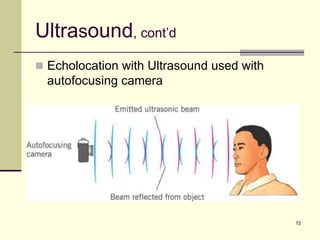
 Echolocation with Ultrasound used with
autofocusing camera
73
Ultrasound Velocity
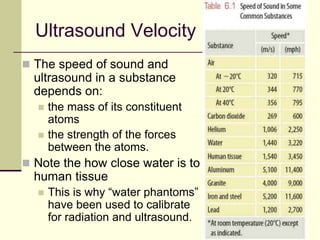
 The speed of sound and
ultrasound in a substance
depends on:
 the mass of its constituent
atoms
 the strength of the forces
between the atoms.
 Note the how close water is to
human tissue
 This is why “water phantoms”
have been used to calibrate
for radiation and ultrasound.
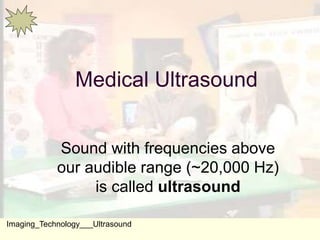
Medical Ultrasound
Sound with frequencies above
our audible range (~20,000 Hz)
is called ultrasound
Imaging_Technology___Ultrasound
75
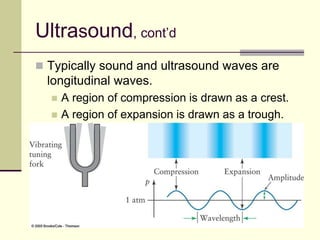
Ultrasound, cont’d
 Typically sound and ultrasound waves are
longitudinal waves.
 A region of compression is drawn as a crest.
 A region of expansion is drawn as a trough.
76
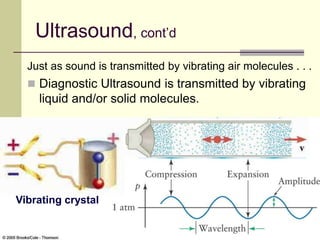
Ultrasound, cont’d
Just as sound is transmitted by vibrating air molecules . . .
 Diagnostic Ultrasound is transmitted by vibrating
liquid and/or solid molecules.
Vibrating crystal
77
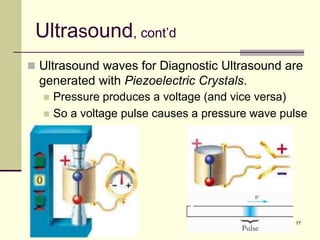
Ultrasound, cont’d
 Ultrasound waves for Diagnostic Ultrasound are
generated with Piezoelectric Crystals.
 Pressure produces a voltage (and vice versa)
 So a voltage pulse causes a pressure wave pulse
78
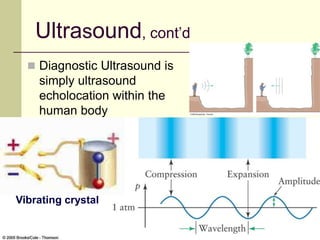
Ultrasound, cont’d
 Diagnostic Ultrasound is
simply ultrasound
echolocation within the
human body
Vibrating crystal
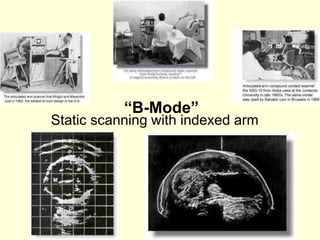
“B-Mode”
Static scanning with indexed arm
80
Ultrasound, cont’d
“Real Time” Ultrasound
Linear Array
Rotating Transducer
Phased Array
with or without Doppler
81
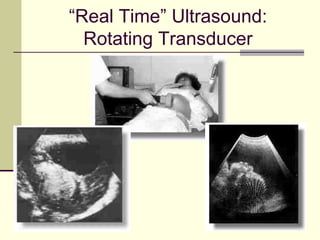
“Real Time” Ultrasound:
Rotating Transducer
82
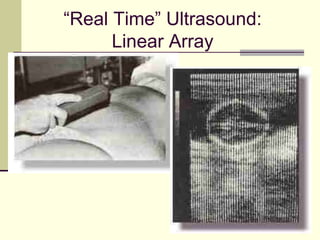
“Real Time” Ultrasound:
Linear Array
83
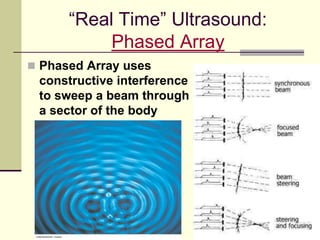
“Real Time” Ultrasound:
Phased Array
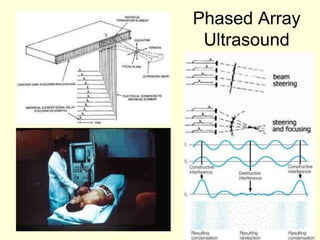
 Phased Array uses
constructive interference
to sweep a beam through
a sector of the body
84
Phased Array
Ultrasound
85
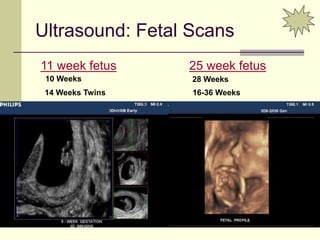
Ultrasound: Fetal Scans
11 week fetus 25 week fetus
10 Weeks
14 Weeks Twins
28 Weeks
16-36 Weeks
86
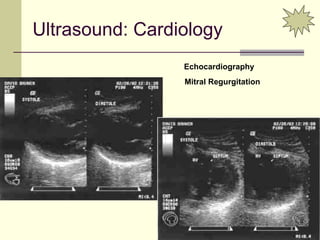
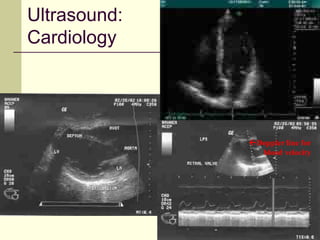
Ultrasound: Cardiology
Echocardiography
Mitral Regurgitation
87
Ultrasound:
Cardiology
Doppler line for
blood velocity
88
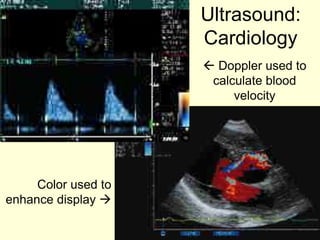
 Doppler used to
calculate blood
velocity
Color used to
enhance display 
Ultrasound:
Cardiology
89
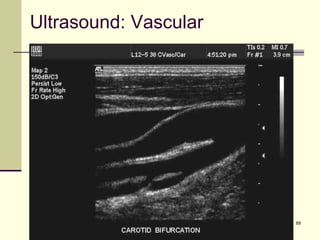
Ultrasound: Vascular
90
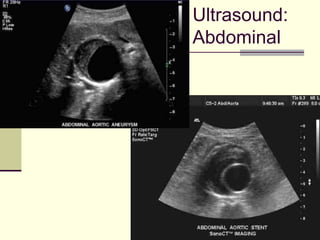
Ultrasound:
Abdominal
91
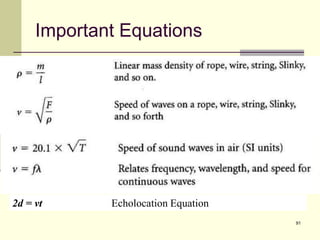
Important Equations
2d = vt Echolocation Equation
END

dr henry .ppt

  • 1.
    PHY 110, Introductionto Physics Dr. Henry SC 453, 572-6164 (alt 572-5309) E-Mail: henryh1@nku.edu Web Site: www.nku.edu/~henryh1/ © Hugh Henry, 2008
  • 2.
    If you areTardy Initial beside Your Name on the Sheet on the Front Table
  • 3.
    3 The rest ofthe semester . . . • Chapter 6, Waves and Sound (6.1-6.3) • Chapter 7, Electricity (except Static Electricity) • Chapter 8, Electromagnetism and EM Waves (8.1-8.6) • Skip Chapter 9 • Chapter 10, Atomic Physics (10.1-10.2, 10.4-10.6) • Chapter 11, Nuclear Physics (11.1-11.4) • Chapter 12, Special Relativity and Cosmology (12.1)
  • 4.
    Chapter 6 (Sections 6.1-6.3) Waves Awave is a traveling disturbance consisting of coordinate vibrations that transmit energy with no net movement of matter.
  • 5.
    5 Waves — typesand properties  A wave is a traveling disturbance consisting of coordinate vibrations that transmit energy with no net movement of matter.  The disturbance is frequently called an oscillation or vibration.  The substance through which the wave travels is called the medium.
  • 6.
    6 Waves — typesand properties, cont’d  There are two main wave types:  Transverse waves have oscillations that are perpendicular (transverse) to the direction the wave travels.  Examples include waves on a rope, electromagnetic waves and some seismic waves.  Longitudinal waves have oscillations that are along the direction the wave travels.  Examples include sound and some seismic waves.
  • 7.
    7 Sound © Hugh Henry,2008 Transverse Waves The_Nature_of_Waves
  • 8.
    8 Longitudinal Waves (Sound andUltrasound) Sound_Waves
  • 9.
    9 Waves — typesand properties, cont’d  This figure illustrates the two main types of waves. Longitudinal Wave Transverse Wave
  • 10.
  • 11.
    11 Waves — typesand properties, cont’d Both Types of Waves have similar properties  Transverse Waves can be pulsed or continuous
  • 12.
    12 Waves — typesand properties, cont’d Both Types of Waves have similar properties  Longitudinal Waves can be pulsed or continuous
  • 13.
    13 Waves — typesand properties: Amplitude  The amplitude of a wave is the maximum displacement of the wave from the equilibrium position.  It is the distance equal to the height of a peak or the depth of a valley (relative to the center).
  • 14.
    14 High Amplitude Waves LowAmplitude Waves Waves — types and properties: Amplitude, cont’d
  • 15.
    15 Waves — typesand properties: Wavelength  The wavelength is the distance between successive “like” points on a wave.  “Like” points might be peaks, valleys, etc.  The wavelength is denoted by the lower case Greek letter lambda: l.
  • 16.
    16 Waves — typesand properties : Wavelength, cont’d  The wavelength is the distance between successive “like” points on a wave.  Distance between ripples passing a bird on a branch  Distance between fronts of freight cars
  • 17.
    17 Waves — typesand properties: Amplitude and Wavelength  Here is an illustration of changing the wavelength and/or amplitude.  Lower amplitude implies smaller height/depth.  Shorter wavelength implies more complete waves “fit” in a given distance.
  • 18.
    18 Waves — typesand properties: Amplitude and Wavelength, cont’d  Longitudinal waves are described by different terminology than “peaks” and “valleys.”  A compression is where the medium is squeezed together.  A expansion (or rarefaction) is where the medium is spread apart.
  • 19.
    19 Waves — typesand properties: Frequency  The frequency of a wave indicates the number of cycles of a wave that pass a given point per unit time.  It is the number of oscillations per second.  This has been discussed already in chapter 1.
  • 20.
    20 Consider: Ripples of acontinuous water wave pass by a plant  If 5 ripples (cycles) pass by in 1s  Frequency (f) = 5 cycles/s  f = 5 Hz as Waves — types and properties: Frequency, cont’d
  • 21.
    Waves — typesand properties: Velocity, cont’d  The velocity of the crest of a wave can be calculated using the equations in chapter 1.  This velocity is called Wave Velocity
  • 22.
    Calculate velocity fromChapter 1 equations  If the frequency is 5 Hz, the time between ripples (the period) is t = 1/5Hz = 0.2s  If the distance between ripples is 0.03 meters . . .  v = d/t = 0.03m/0.2s  = 0.15 m/s Waves — types and properties: Velocity
  • 23.
    Velocity can beexpressed in another way :  Since d = λ and f = 1/t  Then v = d/t  v = df = fλ  Note the calculations are the same as the previous slide: v = f λ = (5/s)*(0.03m) v = 0.15 m/s Waves — types and properties: Velocity, cont’d
  • 24.
    24 Waves — typesand properties: Velocity, cont’d  Hence wavelength and frequency are related to the wave velocity according to the formula:  v is the wave’s velocity,  f is the wave’s frequency, and  l is the wave’s wavelength.  This is a general formula for wave velocity that will be used for the rest of the course.
  • 25.
    25 Waves — typesand properties: Velocity, cont’d There are other formulas for wave velocity which apply to special situations  Consider, for example, a stretched wire or string, with a length l and mass m.  When the string is under a tension T, the wave travels at speed:  r is the mass per unit length:
  • 26.
    26 Waves — typesand properties, Velocity, cont’d  From this we see that the speed:  Increases as the tension increases.  The string has a greater restoring force that attempts to straighten it out.  Is faster for smaller strings.  The string has less mass that has to be moved by the restoring force.  Is independent of the length.  The speed depends on the mass per length, not on the length.  This explains stringed musical instruments
  • 27.
    27 Waves — typesand properties, Velocity, cont’d  Notes depend on frequency, which depends on:  String tension, T  String size, r  Wavelength, λ  “L” in the illustration and Combining these:
  • 28.
    28 Example Example 6.1 A Slinkyis stretched out on the floor to a length of 2 meters. The force needed to keep the Slinky stretched in measured and found to be 1.2 Newtons. The Slinky’s mass is 0.3 kg. What is the speed of any wave sent down the Slinky?
  • 29.
    29 ANSWER: The problem givesus: The linear mass density is Example Example 6.1
  • 30.
    30 ANSWER: The wave speedis then Example Example 6.1
  • 31.
  • 32.
    32 Sound is alongitudinal wave produced when something vibrates and causes nearby air molecules to vibrate Longitudinal Wave Sound Waves
  • 33.
    33 Sound waves havethe same characteristics as other longitudinal waves Longitudinal Wave Sound Waves, cont’d
  • 34.
    34 Speed of aSound Wave in a gas  depends on the density of the gas  and on the pressure  and the temperature Sound Waves, cont’d
  • 35.
    35 Sound Waves, cont’d Anotherspecial case equation . . .  The speed of a sound wave in air at a temperature T is given by the formula:  The temperature must be expressed in Kelvin.
  • 36.
    36 Example Example 6.2 What isthe speed of sound in air at room temperature (20ºC = 68ºF)? Music Hall, Cincinnati
  • 37.
    37 ANSWER: The problem givesus: We need to convert this temperature from Celsius to Kelvin: The sound speed is then Example Example 6.2
  • 38.
    38 DISCUSSION: The factor of20.1 strictly applies to the properties of air. For other gases:  Helium:  Carbon dioxide: The general equation is:  Where k is a constant Example Example 6.2
  • 39.
    39 Example Example 6.3 Before aconcert, musicians in an orchestra tune their instruments to the note A, which has a frequency of 440 Hz. What is the wavelength of this sound in air at room temperature (20oC)? We just calculated the speed of sound at 20oC is 344 m/s. Music Hall, Cincinnati
  • 40.
    40 ANSWER: The problem givesus: The fundamental relation between frequency, wavelength and wave speed is The wavelength is then Example Example 6.3
  • 41.
  • 42.
    42 Aspects of wavepropagation Note in the graphics that follow . . .  There are two ways to represent wave travel.  A wavefront is a series of circles representing the location of wave peaks at a particular time.  A ray is an arrow representing the direction that a wave segment is traveling.
  • 43.
    43 Aspects of wavepropagation: Reflection  A reflection occurs when a wave abruptly changes direction.  A wave is reflected whenever it reaches a boundary of its medium or encounters an abrupt change in the properties of its medium.
  • 44.
    44 Aspects of wavepropagation: Reflection, cont’d  We can use either the ray or wavefront model to examine reflection from a flat mirror.  The point behind the mirror from which the reflection appears to originate is called the image.
  • 45.
    45 Aspects of wavepropagation: Reflection, cont’d  For a curved surface, the reflections can be focused to a point.  Examples include satellite dishes, radar receivers, etc.
  • 46.
    46 Aspects of wavepropagation: Reflection, cont’d  Wave reflection is especially important as a means to measure distance  Radar, Sonar, Diagnostic Ultrasound  This is called Echolocation
  • 47.
    47 Aspects of wavepropagation: Reflection, cont’d  Simple echolocation: Distance is measured by timing an echo 2d = vt
  • 48.
    48 Aspects of wavepropagation: Reflection, cont’d  Echolocation used for Radar  developed just before World War II
  • 49.
    49 The Klystron, inventedin 1938 at Stanford University, made airborne radar possible and helped win the Battle of Britain and the U-Boat war
  • 50.
    50 Aspects of wavepropagation: Reflection, cont’d  Sonar is Underwater Echolocation  Sound Waves sent and reflected through water
  • 51.
    51 Aspects of wavepropagation: Doppler Effect  The Doppler effect is a change in a wave’s wavelength due to the relative motion between the source and receiver.  Consider a source emitting waves and moving to the right.  The crests are closer together in the direction the source moves.  The wavelength is shorter
  • 52.
    52 Aspects of wavepropagation: Doppler Effect, cont’d  The crests are farther apart in the direction opposite to the source’s motion.  The wavelength is longer  This changes the frequency because the wave travels at a constant speed relative to the medium. .
  • 53.
    53  Because ofthe Doppler Effect, each listener hears the sound with a higher or lower frequency (due to a longer or shorter wavelength: v = fλ) Aspects of wave propagation: Doppler Effect, cont’d
  • 54.
    54 The Doppler Effectis the same with a moving listener and stationary sound source OR a stationary listener and moving sound source
  • 55.
    55 Aspects of wavepropagation: Doppler Effect, cont’d  Doppler radar to calculate vehicle velocity
  • 56.
    56 Aspects of wavepropagation: Doppler Effect, cont’d  Doppler radar used to locate tornados
  • 57.
    57 Aspects of wavepropagation: Doppler Effect, cont’d  Doppler ultrasound used to calculate blood velocity  Very useful diagnosing heart valve malfunction
  • 58.
    58 Aspects of wavepropagation: Shock Wave  A shock wave occurs whenever the speed of the source is greater than the wave speed.  The medium cannot respond fast enough to propagate the wave, and the crests essentially “pile up.”  This build-up causes a large-amplitude pulse: a sonic boom for supersonic aircraft.  Watching the waves expand from the source over time, we can construct a leading edge for the shock wave.  The angle of this leading- edge led to delta-wing configurations.
  • 59.
    59 Aspects of wavepropagation: Diffraction  Diffraction results whenever a wave has to travel past a barrier or obstruction.  As the wave travels through the opening, the outgoing waves bend.  The amount of diffraction depends on the wavelength and the size of the obstruction.
  • 60.
    60 Aspects of wavepropagation: Diffraction, cont’d  When the opening is much larger than the wavelength, there is little diffraction.  The amount of diffraction increases as the wavelength becomes more similar to the size of the opening.
  • 61.
    61 Aspects of wavepropagation: Diffraction, cont’d  Diffraction explains why you can hear a sound through a door even if you’re behind a wall.  The sound’s wavelength is much longer than the size of the door, so the sound wave bends around the wall.  For the same reason . . . you can’t see light around a door because the wavelength is much shorter than the size of the door.
  • 62.
    62 Aspects of wavepropagation: Diffraction, cont’d  With two openings, there are two new waves  This leads to the important Interference effect
  • 63.
    63 Aspects of wavepropagation: Interference  Interference occurs whenever two or more waves overlap.  Their amplitudes add (or subtract) creating new waveforms with amplified maxima and minima
  • 64.
    64 Aspects of wavepropagation: Interference, cont’d  When the waves interfere to create a larger amplitude, we call it constructive interference.  When the waves interfere to reduce the amplitude, it is called destructive interference.
  • 65.
    65 Aspects of wavepropagation: Interference, cont’d  Examples of Interference for a double slit barrier with light waves (left) and with two overlapping water waves (right).  Note formation of new maxima and minima
  • 66.
    66 Aspects of wavepropagation: Interference, cont’d  Interference occurs in both Transverse and Longitudinal Waves
  • 67.
    67 Aspects of wavepropagation: Reflection and Interference  Constructive Interference of reflected waves creates Continuous Standing Waves  In lab we will investigate multiple harmonics of standing waves
  • 68.
    68 Aspects of wavepropagation: Reflection and Interference, cont’d  Stringed musical instruments are based on standing wave harmonics  As we calculated earlier . . . decreasing the wavelength increases the frequency (and vice versa)
  • 69.
    Sound and Ultrasound The human hear can typically “hear” sounds with frequencies in the range 20-20,000 Hz.  Sound with frequencies below our audible range is called infrasound.  Below about 20 Hz.  Sound with frequencies above our audible range is called ultrasound.  Above about 20,000 Hz.
  • 70.
  • 71.
    71 Ultrasound, cont’d  BatSonar  Airborne Echolocation with Ultrasound
  • 72.
    72 Ultrasound, cont’d  Echolocationwith Ultrasound used with autofocusing camera
  • 73.
    73 Ultrasound Velocity  Thespeed of sound and ultrasound in a substance depends on:  the mass of its constituent atoms  the strength of the forces between the atoms.  Note the how close water is to human tissue  This is why “water phantoms” have been used to calibrate for radiation and ultrasound.
  • 74.
    Medical Ultrasound Sound withfrequencies above our audible range (~20,000 Hz) is called ultrasound Imaging_Technology___Ultrasound
  • 75.
    75 Ultrasound, cont’d  Typicallysound and ultrasound waves are longitudinal waves.  A region of compression is drawn as a crest.  A region of expansion is drawn as a trough.
  • 76.
    76 Ultrasound, cont’d Just assound is transmitted by vibrating air molecules . . .  Diagnostic Ultrasound is transmitted by vibrating liquid and/or solid molecules. Vibrating crystal
  • 77.
    77 Ultrasound, cont’d  Ultrasoundwaves for Diagnostic Ultrasound are generated with Piezoelectric Crystals.  Pressure produces a voltage (and vice versa)  So a voltage pulse causes a pressure wave pulse
  • 78.
    78 Ultrasound, cont’d  DiagnosticUltrasound is simply ultrasound echolocation within the human body Vibrating crystal
  • 79.
  • 80.
    80 Ultrasound, cont’d “Real Time”Ultrasound Linear Array Rotating Transducer Phased Array with or without Doppler
  • 81.
  • 82.
  • 83.
    83 “Real Time” Ultrasound: PhasedArray  Phased Array uses constructive interference to sweep a beam through a sector of the body
  • 84.
  • 85.
    85 Ultrasound: Fetal Scans 11week fetus 25 week fetus 10 Weeks 14 Weeks Twins 28 Weeks 16-36 Weeks
  • 86.
  • 87.
  • 88.
    88  Doppler usedto calculate blood velocity Color used to enhance display  Ultrasound: Cardiology
  • 89.
  • 90.
  • 91.
    91 Important Equations 2d =vt Echolocation Equation
  • 92.