Programmed Learning
Material
Name:Divya Jaiswal
ID NO.:14162083
Method: Science
B.Ed Programme
Navrachna University
Instructional Objective
The students will be able to define
wave,motion and Sound.
Students will be able to identify units of all
the three Quantity.
Students will be able to distinguish between
wave and motion.
Students will be able to calculate wavelength
of sound.
Students will be able to explain the
structure of internal ear.
Students will be able to define intensity
and loudness of sound.
Students will be able to describe the
characteristic of wave.
Students will be able to differentiate 3
types of sound.
Content Instruction
Students have to follow the given task and
after that they have to test their progress
just given after every task.And check their
progress also by clicking the option given
in each answer.
and any answer goes wrong then repeat
the task again.And solve questions again.
Lets read about
wave,motion and
sound
WAVE
MOTIONS AND
SOUND
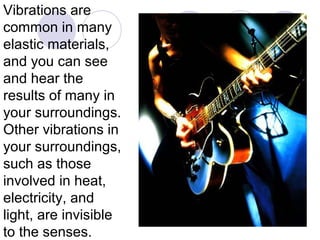
Vibrations are
common in many
elastic materials,
and you can see
and hear the
results of many in
your surroundings.
Other vibrations in
your surroundings,
such as those
involved in heat,
electricity, and
light, are invisible
to the senses.
Forces and Elastic
Materials.
Forces and Vibrations:
A vibration is a repeating motion that moves back and
forth.
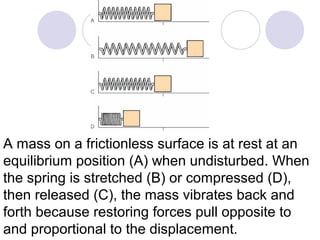
A mass on a frictionless surface is at rest at an
equilibrium position (A) when undisturbed. When
the spring is stretched (B) or compressed (D),
then released (C), the mass vibrates back and
forth because restoring forces pull opposite to
and proportional to the displacement.
Describing Vibrations.
A vibrating mass is described by measuring several
variables.
The extent of displacement from the equilibrium
position.
A cycle is the movement from some point, to
another point and back again.
A period (T) is the time required for one
complete cycle.
Frequency (f) is the number of cycles per
second.
• Frequency is measured in Hertz (Hz)
• The period is the time for one cycle and the
frequency is the cycles per second, the
relationship is: T=1/f
 F = 1/T
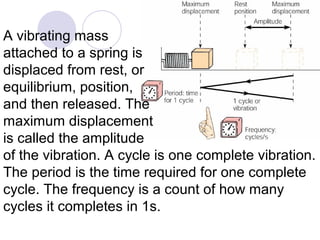
A vibrating mass
attached to a spring is
displaced from rest, or
equilibrium, position,
and then released. The
maximum displacement
is called the amplitude
of the vibration. A cycle is one complete vibration.
The period is the time required for one complete
cycle. The frequency is a count of how many
cycles it completes in 1s.
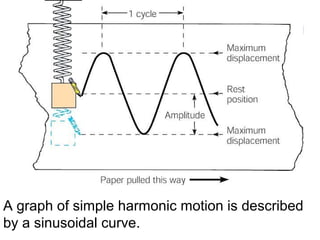
A graph of simple harmonic motion is described
by a sinusoidal curve.
Waves.
Kinds of Waves.
Longitudinal Wave
A wave that travels in a back and forth movement
Transverse Wave
A wave that disturbs particles in a perpendicular motion in
the direction of the wave.
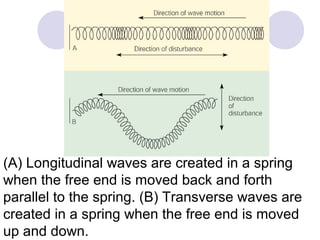
(A) Longitudinal waves are created in a spring
when the free end is moved back and forth
parallel to the spring. (B) Transverse waves are
created in a spring when the free end is moved
up and down.
Hearing Waves in Air:
Infrasonic
Longitudinal waves with frequencies below 20 Hz
Ultrasonic
Longitudinal waves with frequencies greater that 20,000 Hz
Since humans can only hear waves in the 20 –
20,000 Hz range, they hear neither infrasonic nor
ultrasonic waves.
Waves move the eardrum in and out with the same
frequency as the wave, which the brain interprets as
sound.
Wave Terms.
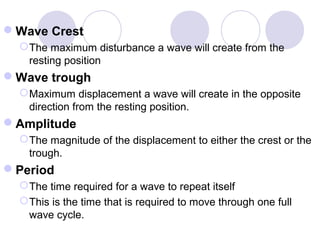
Wave Crest
The maximum disturbance a wave will create from the
resting position
Wave trough
Maximum displacement a wave will create in the opposite
direction from the resting position.
Amplitude
The magnitude of the displacement to either the crest or the
trough.
Period
The time required for a wave to repeat itself
This is the time that is required to move through one full
wave cycle.
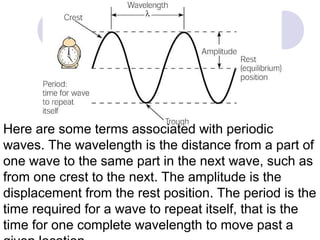
Here are some terms associated with periodic
waves. The wavelength is the distance from a part of
one wave to the same part in the next wave, such as
from one crest to the next. The amplitude is the
displacement from the rest position. The period is the
time required for a wave to repeat itself, that is the
time for one complete wavelength to move past a
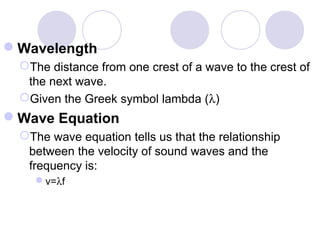
Wavelength
The distance from one crest of a wave to the crest of
the next wave.
Given the Greek symbol lambda (λ)
Wave Equation
The wave equation tells us that the relationship
between the velocity of sound waves and the
frequency is:
v=λf
Sound Waves.
Introduction
The movement of sound waves requires a medium
through which the waves can travel.
The nature of the medium determines the velocity of
the sound through the medium
This is due to the fact that the waves are propagated
through molecular interactions and is determined by:
Inertia of the molecules
Strength of the interactions between molecules
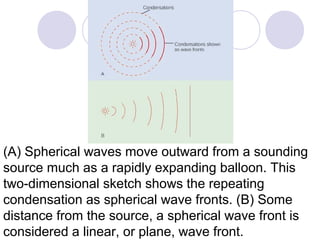
(A) Spherical waves move outward from a sounding
source much as a rapidly expanding balloon. This
two-dimensional sketch shows the repeating
condensation as spherical wave fronts. (B) Some
distance from the source, a spherical wave front is
considered a linear, or plane, wave front.
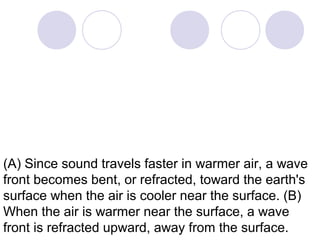
(A) Since sound travels faster in warmer air, a wave
front becomes bent, or refracted, toward the earth's
surface when the air is cooler near the surface. (B)
When the air is warmer near the surface, a wave
front is refracted upward, away from the surface.
Energy and
Sound.
Loudness.
The energy of a sound wave is called the wave
intensity and is measured in Watts per square meter.
The intensity of wound is expressed on the decibel
scale, which relates to changes in loudness as
perceived by the human ear.
Resonance
All elastic objects have natural frequencies of
vibration that are determined by the materials they
are made of and their shapes.
When energy is transferred at the natural
frequencies, there is a dramatic increase of amplitude
called resonance.
The natural frequencies are also called resonant
frequencies.
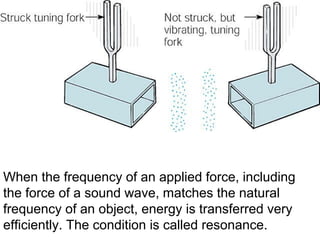
When the frequency of an applied force, including
the force of a sound wave, matches the natural
frequency of an object, energy is transferred very
efficiently. The condition is called resonance.
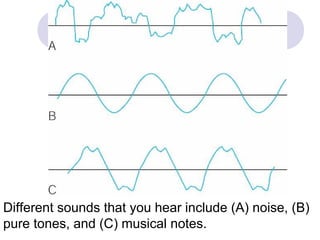
Different sounds that you hear include (A) noise, (B)
pure tones, and (C) musical notes.
Sources of
Sounds.
Vibrating Strings.
Standing Waves
When reflected waves interfere with incoming waves
Created by a patter on nodes and antinodes
Nodes
Places of destructive interference, which show no
disturbance
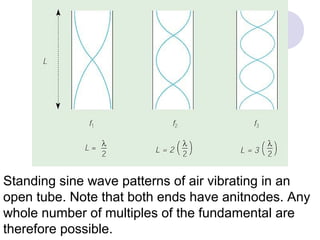
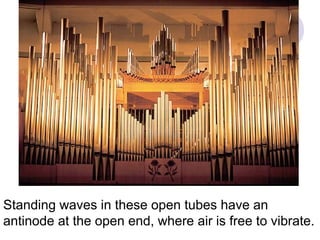
Standing waves in these open tubes have an
antinode at the open end, where air is free to vibrate.
Standing sine wave patterns of air vibrating in an
open tube. Note that both ends have anitnodes. Any
whole number of multiples of the fundamental are
therefore possible.
Sounds from Moving Sources.
A moving source of sound or a moving observer
experiences an apparent shift of frequency called the
Doppler Effect.
If the source is moving as fast or faster than the
speed of sound, the sound waves pile up into a shock
wave called a sonic boom.
A sonic boom sound very much like the pressure
wave from an explosion
Now let us start checking our
understanding about wave
motion and sound:
1.What is the type of sound waves
propogating in air?
a.Longitudinal only
b.transverse only
c.it can be either longitudinal or transverse
d.Non mechanical
2.What is the type of sound
waves propogating in a solid?
a.Longitudinal waves
b.transverse waves
c.it can be either longitudinal or transverse
d.Non mehanical
3.Which waves don’t need a medium for
propogation?
a.Sound waves
b.Light waves
c.earthquake waves
d.Wave on water surface
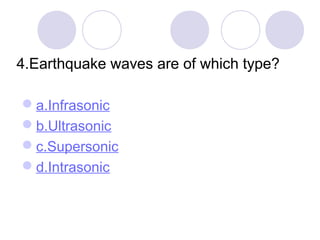
4.Earthquake waves are of which type?
a.Infrasonic
b.Ultrasonic
c.Supersonic
d.Intrasonic
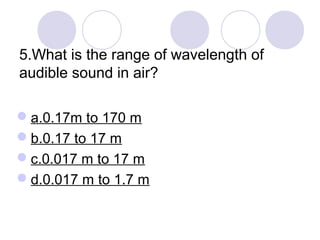
5.What is the range of wavelength of
audible sound in air?
a.0.17m to 170 m
b.0.17 to 17 m
c.0.017 m to 17 m
d.0.017 m to 1.7 m
Lets read about oscillation
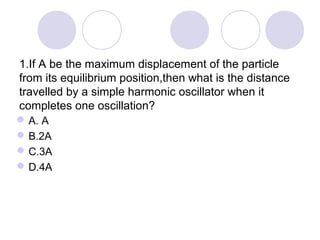
1.If A be the maximum displacement of the particle
from its equilibrium position,then what is the distance
travelled by a simple harmonic oscillator when it
completes one oscillation?
A. A
B.2A
C.3A
D.4A
2.Propogation of wave transfers:
A.energy only
B.matter only
C.both energy and matter
D.none of these
3.The period of a vibrating body of
frequency 100Hz is
A.100 sec
B.10 sec
C.0.1 sec
D.0.01 sec
4.The SI unit of wavelength is
A.meter
B.s
C.meter/sec
D.Hertz
5.The time taken to complete one
oscillation is called
A.time period
B.velocity
C.frequency
D.wavelength
Lets Read about SOUND
1.Sound corresponding to which
frequency is ultrasonic sound?
A.30 Hz
B.300 Hz
C.3000 Hz
D.30,000 Hz
2.What is full form of SONAR?
A.System of Navigation and research
B.Sound Navigation and Ranging
C.Sound of Natural Agriculture
Research
D.Sound of Navigation and Research
3.Sound Travels faster in which medium?
A.Solid
B.Liquid
C.Gas
D.Both A and B
4.A medium transmits a sound wave by
virtue of its?
A.elasticity
B.inertia
C.density
D.both inertia and elasticity
5.If the time interval between original sound and
reflected sound is more then 0.1 sec then originally
sound and reflected can be heard clearly. This
reflected sound is known as
A.Reflection
B.Echo
C.Reverberation
D.Both A and B
NEXT
READ THE CONTENT AGAIN
Sorry bad luck..Try again
Well done.. Next
Oops..wrong answer!
Sorry..!wrong answer..!
Go To Content Again..
Wrong answer my friend!
Well done!!!!! Next
Read the content again
Sorry friend!
Try again!

Programmed learning material

  • 1.
    Programmed Learning Material Name:Divya Jaiswal IDNO.:14162083 Method: Science B.Ed Programme Navrachna University
  • 2.
    Instructional Objective The studentswill be able to define wave,motion and Sound. Students will be able to identify units of all the three Quantity. Students will be able to distinguish between wave and motion. Students will be able to calculate wavelength of sound.
  • 3.
    Students will beable to explain the structure of internal ear. Students will be able to define intensity and loudness of sound. Students will be able to describe the characteristic of wave. Students will be able to differentiate 3 types of sound.
  • 4.
    Content Instruction Students haveto follow the given task and after that they have to test their progress just given after every task.And check their progress also by clicking the option given in each answer. and any answer goes wrong then repeat the task again.And solve questions again.
  • 5.
  • 6.
  • 7.
    Vibrations are common inmany elastic materials, and you can see and hear the results of many in your surroundings. Other vibrations in your surroundings, such as those involved in heat, electricity, and light, are invisible to the senses.
  • 8.
  • 9.
    Forces and Vibrations: Avibration is a repeating motion that moves back and forth.
  • 10.
    A mass ona frictionless surface is at rest at an equilibrium position (A) when undisturbed. When the spring is stretched (B) or compressed (D), then released (C), the mass vibrates back and forth because restoring forces pull opposite to and proportional to the displacement.
  • 11.
    Describing Vibrations. A vibratingmass is described by measuring several variables. The extent of displacement from the equilibrium position. A cycle is the movement from some point, to another point and back again. A period (T) is the time required for one complete cycle. Frequency (f) is the number of cycles per second. • Frequency is measured in Hertz (Hz) • The period is the time for one cycle and the frequency is the cycles per second, the relationship is: T=1/f  F = 1/T
  • 12.
    A vibrating mass attachedto a spring is displaced from rest, or equilibrium, position, and then released. The maximum displacement is called the amplitude of the vibration. A cycle is one complete vibration. The period is the time required for one complete cycle. The frequency is a count of how many cycles it completes in 1s.
  • 13.
    A graph ofsimple harmonic motion is described by a sinusoidal curve.
  • 14.
  • 15.
    Kinds of Waves. LongitudinalWave A wave that travels in a back and forth movement Transverse Wave A wave that disturbs particles in a perpendicular motion in the direction of the wave.
  • 16.
    (A) Longitudinal wavesare created in a spring when the free end is moved back and forth parallel to the spring. (B) Transverse waves are created in a spring when the free end is moved up and down.
  • 17.
    Hearing Waves inAir: Infrasonic Longitudinal waves with frequencies below 20 Hz Ultrasonic Longitudinal waves with frequencies greater that 20,000 Hz Since humans can only hear waves in the 20 – 20,000 Hz range, they hear neither infrasonic nor ultrasonic waves. Waves move the eardrum in and out with the same frequency as the wave, which the brain interprets as sound.
  • 18.
  • 19.
    Wave Crest The maximumdisturbance a wave will create from the resting position Wave trough Maximum displacement a wave will create in the opposite direction from the resting position. Amplitude The magnitude of the displacement to either the crest or the trough. Period The time required for a wave to repeat itself This is the time that is required to move through one full wave cycle.
  • 20.
    Here are someterms associated with periodic waves. The wavelength is the distance from a part of one wave to the same part in the next wave, such as from one crest to the next. The amplitude is the displacement from the rest position. The period is the time required for a wave to repeat itself, that is the time for one complete wavelength to move past a
  • 21.
    Wavelength The distance fromone crest of a wave to the crest of the next wave. Given the Greek symbol lambda (λ) Wave Equation The wave equation tells us that the relationship between the velocity of sound waves and the frequency is: v=λf
  • 22.
  • 23.
    Introduction The movement ofsound waves requires a medium through which the waves can travel. The nature of the medium determines the velocity of the sound through the medium This is due to the fact that the waves are propagated through molecular interactions and is determined by: Inertia of the molecules Strength of the interactions between molecules
  • 24.
    (A) Spherical wavesmove outward from a sounding source much as a rapidly expanding balloon. This two-dimensional sketch shows the repeating condensation as spherical wave fronts. (B) Some distance from the source, a spherical wave front is considered a linear, or plane, wave front.
  • 25.
    (A) Since soundtravels faster in warmer air, a wave front becomes bent, or refracted, toward the earth's surface when the air is cooler near the surface. (B) When the air is warmer near the surface, a wave front is refracted upward, away from the surface.
  • 26.
  • 27.
    Loudness. The energy ofa sound wave is called the wave intensity and is measured in Watts per square meter. The intensity of wound is expressed on the decibel scale, which relates to changes in loudness as perceived by the human ear.
  • 28.
    Resonance All elastic objectshave natural frequencies of vibration that are determined by the materials they are made of and their shapes. When energy is transferred at the natural frequencies, there is a dramatic increase of amplitude called resonance. The natural frequencies are also called resonant frequencies.
  • 29.
    When the frequencyof an applied force, including the force of a sound wave, matches the natural frequency of an object, energy is transferred very efficiently. The condition is called resonance.
  • 30.
    Different sounds thatyou hear include (A) noise, (B) pure tones, and (C) musical notes.
  • 31.
  • 32.
    Vibrating Strings. Standing Waves Whenreflected waves interfere with incoming waves Created by a patter on nodes and antinodes Nodes Places of destructive interference, which show no disturbance
  • 33.
    Standing waves inthese open tubes have an antinode at the open end, where air is free to vibrate.
  • 34.
    Standing sine wavepatterns of air vibrating in an open tube. Note that both ends have anitnodes. Any whole number of multiples of the fundamental are therefore possible.
  • 35.
    Sounds from MovingSources. A moving source of sound or a moving observer experiences an apparent shift of frequency called the Doppler Effect. If the source is moving as fast or faster than the speed of sound, the sound waves pile up into a shock wave called a sonic boom. A sonic boom sound very much like the pressure wave from an explosion
  • 36.
    Now let usstart checking our understanding about wave motion and sound:
  • 37.
    1.What is thetype of sound waves propogating in air? a.Longitudinal only b.transverse only c.it can be either longitudinal or transverse d.Non mechanical
  • 38.
    2.What is thetype of sound waves propogating in a solid? a.Longitudinal waves b.transverse waves c.it can be either longitudinal or transverse d.Non mehanical
  • 39.
    3.Which waves don’tneed a medium for propogation? a.Sound waves b.Light waves c.earthquake waves d.Wave on water surface
  • 40.
    4.Earthquake waves areof which type? a.Infrasonic b.Ultrasonic c.Supersonic d.Intrasonic
  • 41.
    5.What is therange of wavelength of audible sound in air? a.0.17m to 170 m b.0.17 to 17 m c.0.017 m to 17 m d.0.017 m to 1.7 m
  • 42.
    Lets read aboutoscillation
  • 43.
    1.If A bethe maximum displacement of the particle from its equilibrium position,then what is the distance travelled by a simple harmonic oscillator when it completes one oscillation? A. A B.2A C.3A D.4A
  • 44.
    2.Propogation of wavetransfers: A.energy only B.matter only C.both energy and matter D.none of these
  • 45.
    3.The period ofa vibrating body of frequency 100Hz is A.100 sec B.10 sec C.0.1 sec D.0.01 sec
  • 46.
    4.The SI unitof wavelength is A.meter B.s C.meter/sec D.Hertz
  • 47.
    5.The time takento complete one oscillation is called A.time period B.velocity C.frequency D.wavelength
  • 48.
  • 49.
    1.Sound corresponding towhich frequency is ultrasonic sound? A.30 Hz B.300 Hz C.3000 Hz D.30,000 Hz
  • 50.
    2.What is fullform of SONAR? A.System of Navigation and research B.Sound Navigation and Ranging C.Sound of Natural Agriculture Research D.Sound of Navigation and Research
  • 51.
    3.Sound Travels fasterin which medium? A.Solid B.Liquid C.Gas D.Both A and B
  • 52.
    4.A medium transmitsa sound wave by virtue of its? A.elasticity B.inertia C.density D.both inertia and elasticity
  • 53.
    5.If the timeinterval between original sound and reflected sound is more then 0.1 sec then originally sound and reflected can be heard clearly. This reflected sound is known as A.Reflection B.Echo C.Reverberation D.Both A and B
  • 54.
  • 55.
  • 56.
  • 57.
  • 58.
  • 59.
  • 60.
  • 61.
  • 62.
  • 63.
  • 64.
  • 65.