
Simple Harmonic Motion
Dr. Vinod Kumar Ade
Assistant professor ,
Govt.JSTPG College Balaghat
MP
Objectives:
 Defination of simple Harmonic motion.
 Describe the conditions of Simple Harmonic Motion.
 Displacement of simple harmonic oscillation
(pendulum).
 Time period and frequency of SHO.
 Describe the Velocity and acceleration of SHO.
 equations and graphs which represent the variation of
displacement, velocity and acceleration with time.
 Conversation of energy of SHO
 Potential energy and kinetic energy of SHO and
it's graphical representation.
Definition: Simple Harmonic Motion
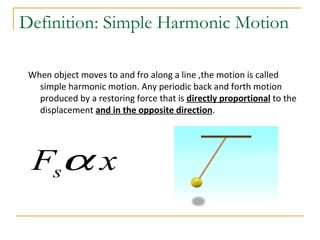
When object moves to and fro along a line ,the motion is called
simple harmonic motion. Any periodic back and forth motion
produced by a restoring force that is directly proportional to the
displacement and in the opposite direction.
xFsα
4
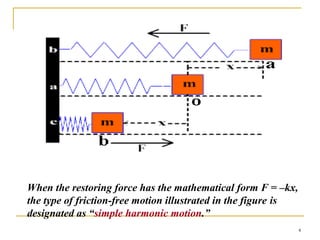
When the restoring force has the mathematical form F = –kx,
the type of friction-free motion illustrated in the figure is
designated as “simple harmonic motion.”
5
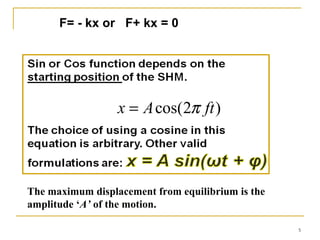
The maximum displacement from equilibrium is the
amplitude ‘A’ of the motion.
cos(2 )x A ftπ=
F= - kx or F+ kx = 0
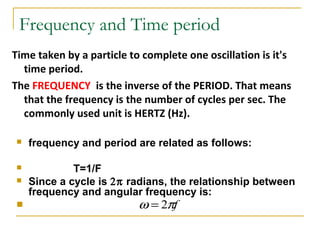
Frequency and Time period
Time taken by a particle to complete one oscillation is it's
time period.
The FREQUENCY is the inverse of the PERIOD. That means
that the frequency is the number of cycles per sec. The
commonly used unit is HERTZ (Hz).
 frequency and period are related as follows:
 T=1/F
 Since a cycle is 2π radians, the relationship between
frequency and angular frequency is:
 fπω 2=
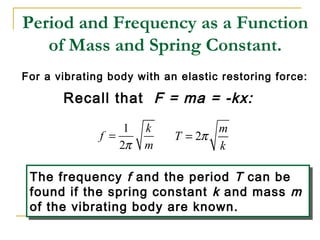
Period and Frequency as a Function
of Mass and Spring Constant.
For a vibrating body with an elastic restoring force:
Recall that F = ma = -kx:
1
2
k
f
mπ
= 2
m
T
k
π=
The frequency f and the period T can be
found if the spring constant k and mass m
of the vibrating body are known.
The frequency f and the period T can be
found if the spring constant k and mass m
of the vibrating body are known.
8
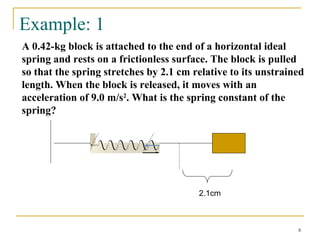
Example: 1
A 0.42-kg block is attached to the end of a horizontal ideal
spring and rests on a frictionless surface. The block is pulled
so that the spring stretches by 2.1 cm relative to its unstrained
length. When the block is released, it moves with an
acceleration of 9.0 m/s2
. What is the spring constant of the
spring?
2.1cm
2.1cm
9
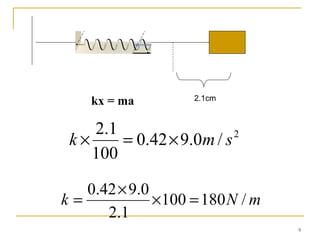
kx = ma
2
/0.942.0
100
1.2
smk ×=×
mNk /180100
1.2
0.942.0
=×
×
=
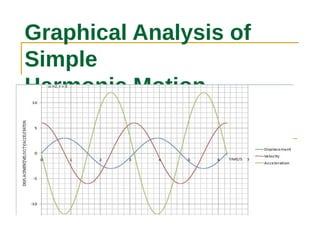
Graphical Analysis of
Simple
Harmonic Motion
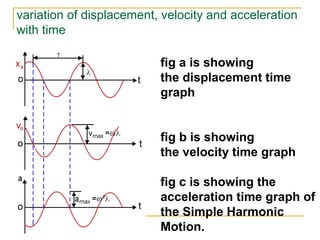
variation of displacement, velocity and acceleration
with time
fig a is showing
the displacement time
graph
fig b is showing
the velocity time graph
fig c is showing the
acceleration time graph of
the Simple Harmonic
Motion.
13
Energy and Simple Harmonic
Motion
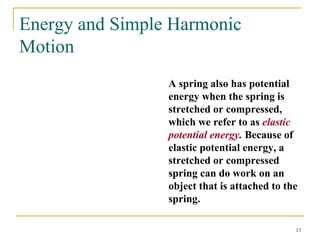
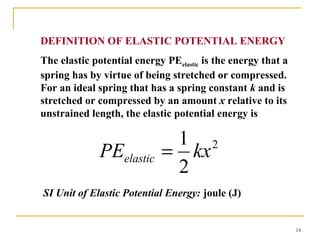
A spring also has potential
energy when the spring is
stretched or compressed,
which we refer to as elastic
potential energy. Because of
elastic potential energy, a
stretched or compressed
spring can do work on an
object that is attached to the
spring.
14
DEFINITION OF ELASTIC POTENTIAL ENERGY
The elastic potential energy PEelastic is the energy that a
spring has by virtue of being stretched or compressed.
For an ideal spring that has a spring constant k and is
stretched or compressed by an amount x relative to its
unstrained length, the elastic potential energy is
SI Unit of Elastic Potential Energy: joule (J)
2
2
1
kxPEelastic =
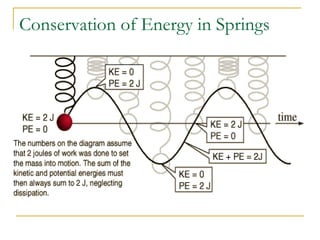
Conservation of Energy in Springs
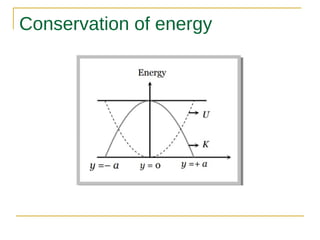
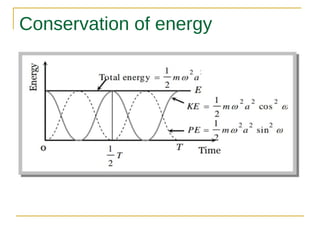
Conservation of energy
Simple harmonic motion

Simple harmonic motion

  • 1.
    Simple Harmonic Motion Dr.Vinod Kumar Ade Assistant professor , Govt.JSTPG College Balaghat MP
  • 2.
    Objectives:  Defination ofsimple Harmonic motion.  Describe the conditions of Simple Harmonic Motion.  Displacement of simple harmonic oscillation (pendulum).  Time period and frequency of SHO.  Describe the Velocity and acceleration of SHO.  equations and graphs which represent the variation of displacement, velocity and acceleration with time.  Conversation of energy of SHO  Potential energy and kinetic energy of SHO and it's graphical representation.
  • 3.
    Definition: Simple HarmonicMotion When object moves to and fro along a line ,the motion is called simple harmonic motion. Any periodic back and forth motion produced by a restoring force that is directly proportional to the displacement and in the opposite direction. xFsα
  • 4.
    4 When the restoringforce has the mathematical form F = –kx, the type of friction-free motion illustrated in the figure is designated as “simple harmonic motion.”
  • 5.
    5 The maximum displacementfrom equilibrium is the amplitude ‘A’ of the motion. cos(2 )x A ftπ= F= - kx or F+ kx = 0
  • 6.
    Frequency and Timeperiod Time taken by a particle to complete one oscillation is it's time period. The FREQUENCY is the inverse of the PERIOD. That means that the frequency is the number of cycles per sec. The commonly used unit is HERTZ (Hz).  frequency and period are related as follows:  T=1/F  Since a cycle is 2π radians, the relationship between frequency and angular frequency is:  fπω 2=
  • 7.
    Period and Frequencyas a Function of Mass and Spring Constant. For a vibrating body with an elastic restoring force: Recall that F = ma = -kx: 1 2 k f mπ = 2 m T k π= The frequency f and the period T can be found if the spring constant k and mass m of the vibrating body are known. The frequency f and the period T can be found if the spring constant k and mass m of the vibrating body are known.
  • 8.
    8 Example: 1 A 0.42-kg blockis attached to the end of a horizontal ideal spring and rests on a frictionless surface. The block is pulled so that the spring stretches by 2.1 cm relative to its unstrained length. When the block is released, it moves with an acceleration of 9.0 m/s2 . What is the spring constant of the spring? 2.1cm
  • 9.
    2.1cm 9 kx = ma 2 /0.942.0 100 1.2 smk×=× mNk /180100 1.2 0.942.0 =× × =
  • 11.
  • 12.
    variation of displacement,velocity and acceleration with time fig a is showing the displacement time graph fig b is showing the velocity time graph fig c is showing the acceleration time graph of the Simple Harmonic Motion.
  • 13.
    13 Energy and SimpleHarmonic Motion A spring also has potential energy when the spring is stretched or compressed, which we refer to as elastic potential energy. Because of elastic potential energy, a stretched or compressed spring can do work on an object that is attached to the spring.
  • 14.
    14 DEFINITION OF ELASTICPOTENTIAL ENERGY The elastic potential energy PEelastic is the energy that a spring has by virtue of being stretched or compressed. For an ideal spring that has a spring constant k and is stretched or compressed by an amount x relative to its unstrained length, the elastic potential energy is SI Unit of Elastic Potential Energy: joule (J) 2 2 1 kxPEelastic =
  • 15.
  • 16.
  • 17.

Editor's Notes

  • #8 from Paul E.Tippens, Professor of Physics, Southern Polytechnic State University