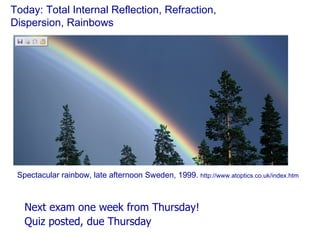
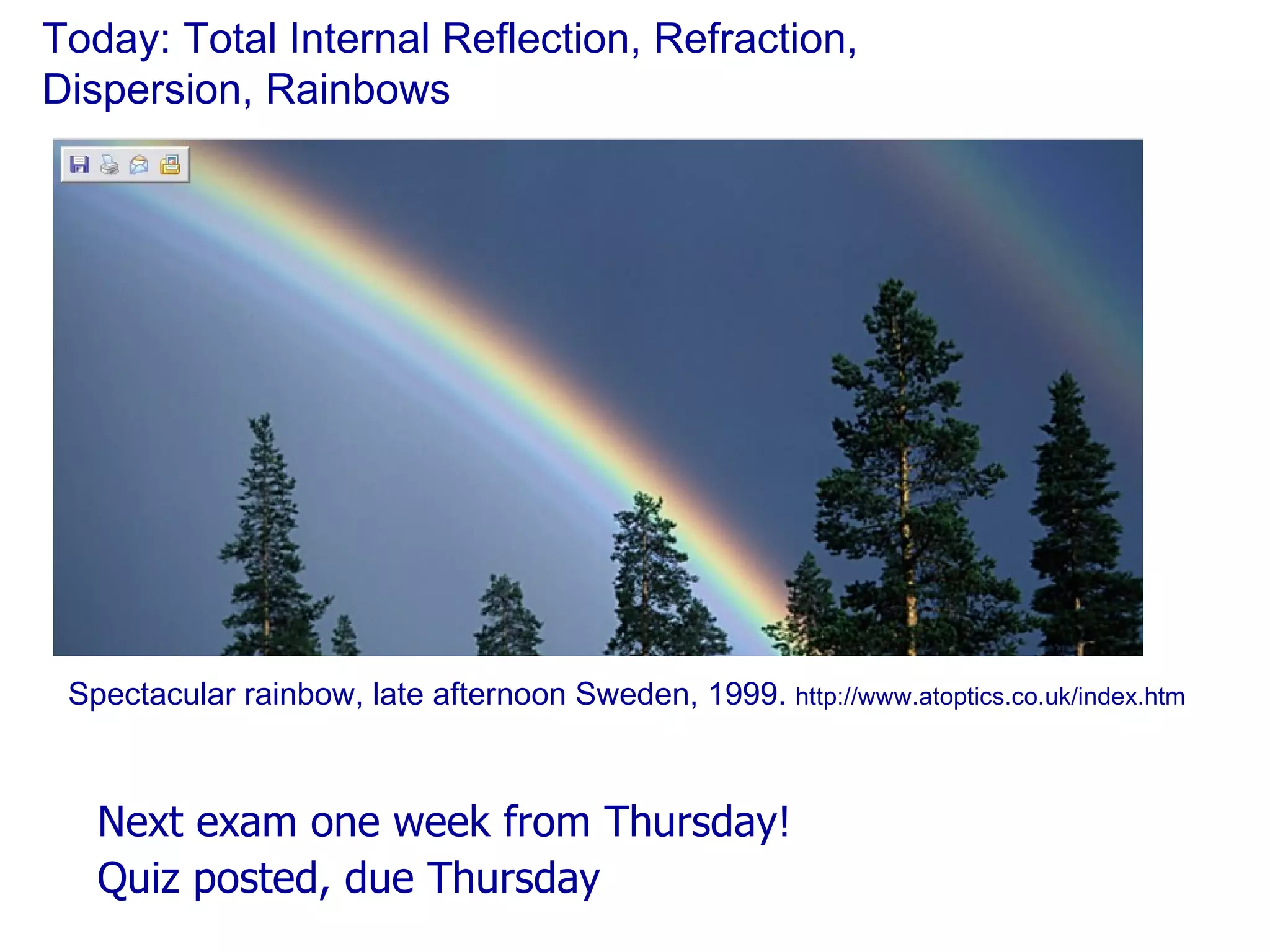
Today: Total Internal Reflection, Refraction,  Dispersion, Rainbows Next exam one week from Thursday! Quiz posted, due Thursday Spectacular rainbow, late afternoon Sweden, 1999.  http://www.atoptics.co.uk/index.htm
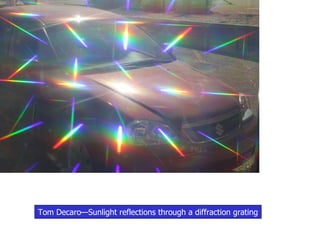
HW Question Tom Decaro—Sunlight reflections through a diffraction grating
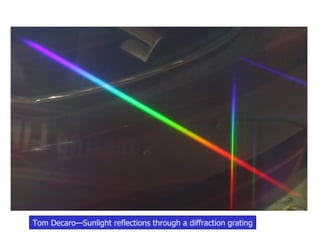
Tom Decaro—Sunlight reflections through a diffraction grating
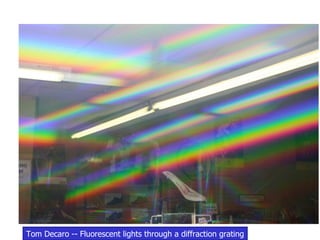
Tom Decaro -- Fluorescent lights through a diffraction grating
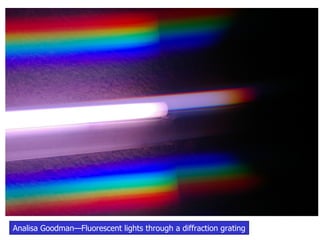
Analisa Goodman—Fluorescent lights through a diffraction grating
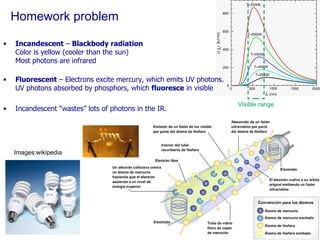
Homework problem Incandescent  –  Blackbody radiation Color is yellow (cooler than the sun) Most photons are infrared Fluorescent  – Electrons excite mercury, which emits UV photons. UV photons absorbed by phosphors, which  fluoresce  in visible Incandescent “wastes” lots of photons in the IR. Visible range Images:wikipedia
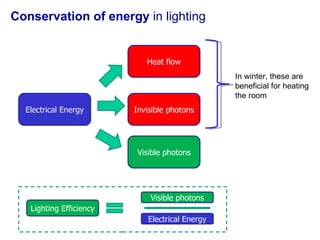
Conservation of energy  in lighting Electrical Energy Heat flow Invisible photons Visible photons In winter, these are beneficial for heating the room Lighting Efficiency Visible photons Electrical Energy
First off, let’s experiment with refraction Key Concept Compared with speed in a vacuum  (300 million meters per second) Light travels SLOWER inside matter
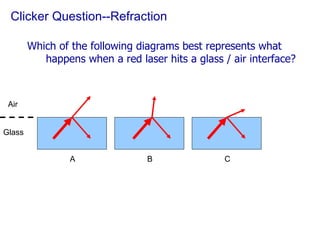
Clicker Question--Refraction Which of the following diagrams best represents what happens when a red laser hits a glass / air interface? A B C Air Glass
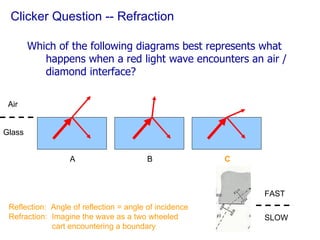
Clicker Question -- Refraction Which of the following diagrams best represents what happens when a red light wave encounters an air / diamond interface? Reflection:  Angle of reflection = angle of incidence Refraction:  Imagine the wave as a two wheeled   cart encountering a boundary A B C Air Glass FAST SLOW
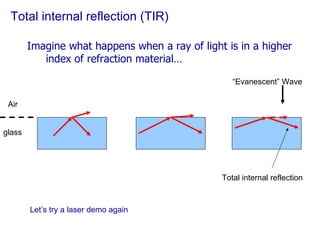
Total internal reflection (TIR) Imagine what happens when a ray of light is in a higher index of refraction material… Air glass “ Evanescent” Wave Total internal reflection Let’s try a laser demo again
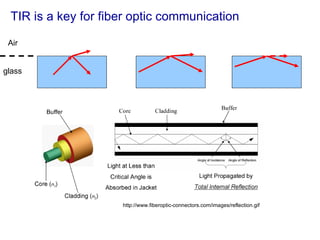
TIR is a key for fiber optic communication Air glass http://www.fiberoptic-connectors.com/images/reflection.gif
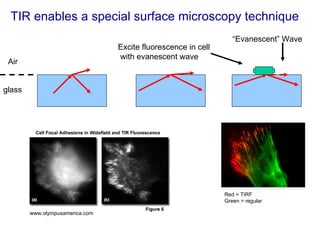
TIR enables a special surface microscopy technique Air glass “ Evanescent” Wave Excite fluorescence in cell  with evanescent wave www.olympusamerica.com Red = TIRF Green = regular
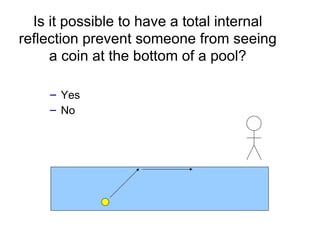
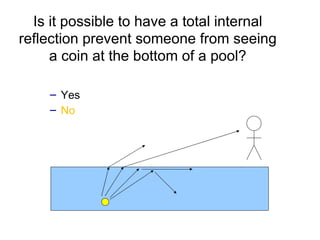
Yes No Is it possible to have a total internal reflection prevent someone from seeing a coin at the bottom of a pool?
Clicker Question—Speed of light Do all colors of light travel at the same speed inside of glass? Yes No
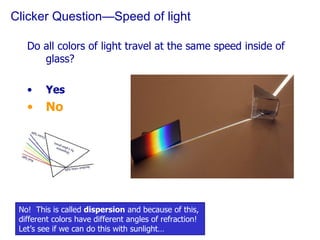
Clicker Question—Speed of light Do all colors of light travel at the same speed inside of glass? Yes No No!  This is called  dispersion  and because of this,  different colors have different angles of refraction! Let’s see if we can do this with sunlight…
Demos Prisms Acrylic sphere rainbow http://www.youtube.com/watch?v=rQukmSPctks&feature=related
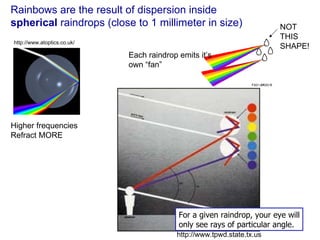
Rainbows are the result of dispersion inside spherical  raindrops (close to 1 millimeter in size) NOT THIS SHAPE! Higher frequencies Refract MORE Each raindrop emits it’s own “fan” For a given raindrop, your eye will only see rays of particular angle. http://www.atoptics.co.uk/ http://www.tpwd.state.tx.us
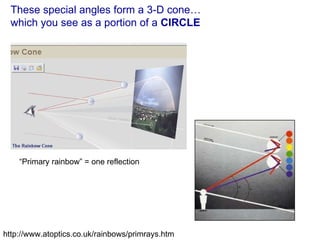
These special angles form a 3-D cone… which you see as a portion of a  CIRCLE “ Primary rainbow” = one reflection http://www.atoptics.co.uk/rainbows/primrays.htm
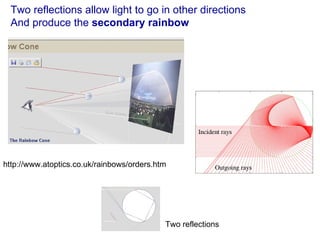
Two reflections allow light to go in other directions And produce the  secondary rainbow Two reflections http://www.atoptics.co.uk/rainbows/orders.htm
 
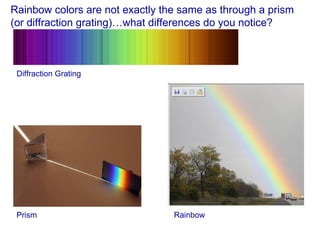
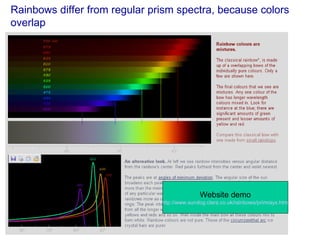
Rainbow facts Rainbows are perceived as circular The center of the circle is on a line continuing the sun through your eyes (antisolar point) Rainbows result from large, but spherical raindrops Refraction, dispersion, and reflection are the keys to raindrops. Rainbows are  not quite  the same colors as light from a prism Bright inside primary bow, dark between
Rainbow colors are not exactly the same as through a prism (or diffraction grating)…what differences do you notice? Rainbow Prism Diffraction Grating
Rainbows differ from regular prism spectra, because colors overlap Website demo http://www.sundog.clara.co.uk/rainbows/primrays.htm
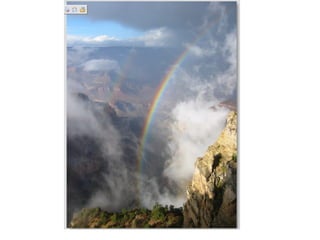
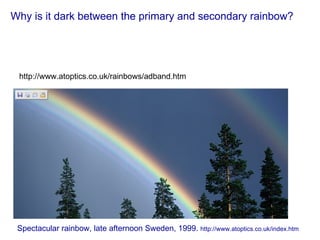
Why is it dark between the primary and secondary rainbow? http://www.atoptics.co.uk/rainbows/adband.htm Alexander’s dark band Spectacular rainbow, late afternoon Sweden, 1999.  http://www.atoptics.co.uk/index.htm
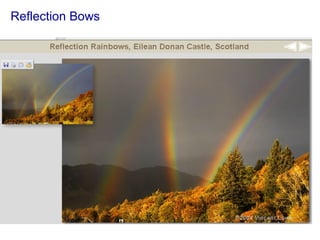
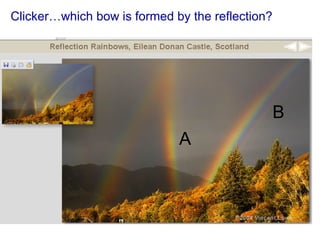
Reflection Bows
Clicker…which bow is formed by the reflection? A B
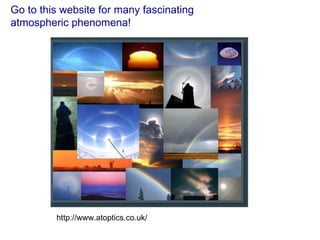
Go to this website for many fascinating atmospheric phenomena! http://www.atoptics.co.uk/

12 Mar 3 Rainbows Etc Actual Presented

  • 1.
    Today: Total InternalReflection, Refraction, Dispersion, Rainbows Next exam one week from Thursday! Quiz posted, due Thursday Spectacular rainbow, late afternoon Sweden, 1999. http://www.atoptics.co.uk/index.htm
  • 2.
    HW Question TomDecaro—Sunlight reflections through a diffraction grating
  • 3.
    Tom Decaro—Sunlight reflectionsthrough a diffraction grating
  • 4.
    Tom Decaro --Fluorescent lights through a diffraction grating
  • 5.
    Analisa Goodman—Fluorescent lightsthrough a diffraction grating
  • 6.
    Homework problem Incandescent – Blackbody radiation Color is yellow (cooler than the sun) Most photons are infrared Fluorescent – Electrons excite mercury, which emits UV photons. UV photons absorbed by phosphors, which fluoresce in visible Incandescent “wastes” lots of photons in the IR. Visible range Images:wikipedia
  • 7.
    Conservation of energy in lighting Electrical Energy Heat flow Invisible photons Visible photons In winter, these are beneficial for heating the room Lighting Efficiency Visible photons Electrical Energy
  • 8.
    First off, let’sexperiment with refraction Key Concept Compared with speed in a vacuum (300 million meters per second) Light travels SLOWER inside matter
  • 9.
    Clicker Question--Refraction Whichof the following diagrams best represents what happens when a red laser hits a glass / air interface? A B C Air Glass
  • 10.
    Clicker Question --Refraction Which of the following diagrams best represents what happens when a red light wave encounters an air / diamond interface? Reflection: Angle of reflection = angle of incidence Refraction: Imagine the wave as a two wheeled cart encountering a boundary A B C Air Glass FAST SLOW
  • 11.
    Total internal reflection(TIR) Imagine what happens when a ray of light is in a higher index of refraction material… Air glass “ Evanescent” Wave Total internal reflection Let’s try a laser demo again
  • 12.
    TIR is akey for fiber optic communication Air glass http://www.fiberoptic-connectors.com/images/reflection.gif
  • 13.
    TIR enables aspecial surface microscopy technique Air glass “ Evanescent” Wave Excite fluorescence in cell with evanescent wave www.olympusamerica.com Red = TIRF Green = regular
  • 14.
    Yes No Isit possible to have a total internal reflection prevent someone from seeing a coin at the bottom of a pool?
  • 15.
    Yes No Isit possible to have a total internal reflection prevent someone from seeing a coin at the bottom of a pool?
  • 16.
    Clicker Question—Speed oflight Do all colors of light travel at the same speed inside of glass? Yes No
  • 17.
    Clicker Question—Speed oflight Do all colors of light travel at the same speed inside of glass? Yes No No! This is called dispersion and because of this, different colors have different angles of refraction! Let’s see if we can do this with sunlight…
  • 18.
    Demos Prisms Acrylicsphere rainbow http://www.youtube.com/watch?v=rQukmSPctks&feature=related
  • 19.
    Rainbows are theresult of dispersion inside spherical raindrops (close to 1 millimeter in size) NOT THIS SHAPE! Higher frequencies Refract MORE Each raindrop emits it’s own “fan” For a given raindrop, your eye will only see rays of particular angle. http://www.atoptics.co.uk/ http://www.tpwd.state.tx.us
  • 20.
    These special anglesform a 3-D cone… which you see as a portion of a CIRCLE “ Primary rainbow” = one reflection http://www.atoptics.co.uk/rainbows/primrays.htm
  • 21.
    Two reflections allowlight to go in other directions And produce the secondary rainbow Two reflections http://www.atoptics.co.uk/rainbows/orders.htm
  • 22.
  • 23.
    Rainbow facts Rainbowsare perceived as circular The center of the circle is on a line continuing the sun through your eyes (antisolar point) Rainbows result from large, but spherical raindrops Refraction, dispersion, and reflection are the keys to raindrops. Rainbows are not quite the same colors as light from a prism Bright inside primary bow, dark between
  • 24.
    Rainbow colors arenot exactly the same as through a prism (or diffraction grating)…what differences do you notice? Rainbow Prism Diffraction Grating
  • 25.
    Rainbows differ fromregular prism spectra, because colors overlap Website demo http://www.sundog.clara.co.uk/rainbows/primrays.htm
  • 26.
    Why is itdark between the primary and secondary rainbow? http://www.atoptics.co.uk/rainbows/adband.htm Alexander’s dark band Spectacular rainbow, late afternoon Sweden, 1999. http://www.atoptics.co.uk/index.htm
  • 27.
  • 28.
    Clicker…which bow isformed by the reflection? A B
  • 29.
    Go to thiswebsite for many fascinating atmospheric phenomena! http://www.atoptics.co.uk/