Chapter 31 Nuclear Physics and Radioactivity
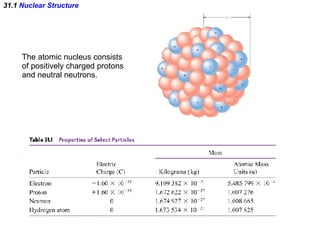
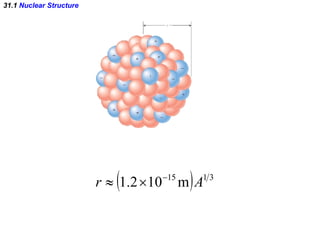
31.1  Nuclear Structure The atomic nucleus consists of positively charged protons and neutral neutrons.
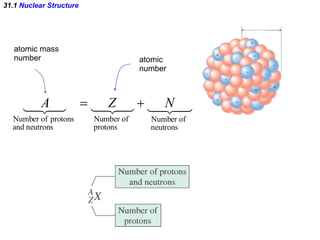
31.1  Nuclear Structure atomic number atomic mass number
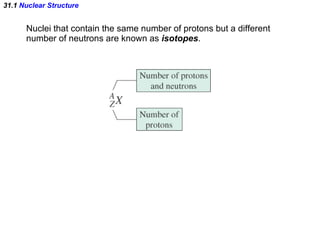
31.1  Nuclear Structure Nuclei that contain the same number of protons but a different number of neutrons are known as  isotopes .
31.1  Nuclear Structure
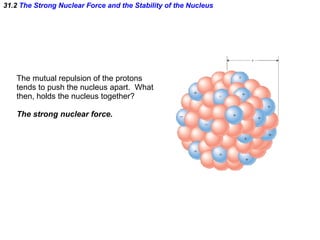
31.2  The Strong Nuclear Force and the Stability of the Nucleus The mutual repulsion of the protons tends to push the nucleus apart.  What then, holds the nucleus together? The strong nuclear force.
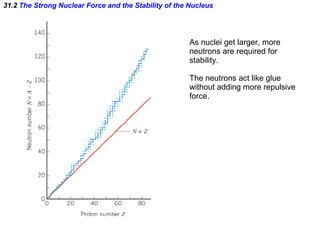
31.2  The Strong Nuclear Force and the Stability of the Nucleus As nuclei get larger, more  neutrons are required for  stability. The neutrons act like glue without adding more repulsive force.
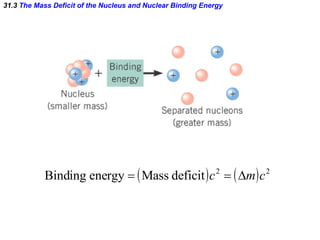
31.3  The Mass Deficit of the Nucleus and Nuclear Binding Energy
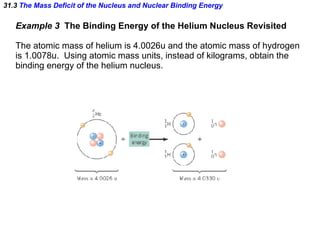
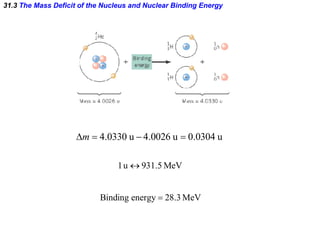
31.3  The Mass Deficit of the Nucleus and Nuclear Binding Energy Example 3  The Binding Energy of the Helium Nucleus Revisited The atomic mass of helium is 4.0026u and the atomic mass of hydrogen is 1.0078u.  Using atomic mass units, instead of kilograms, obtain the binding energy of the helium nucleus.
31.3  The Mass Deficit of the Nucleus and Nuclear Binding Energy
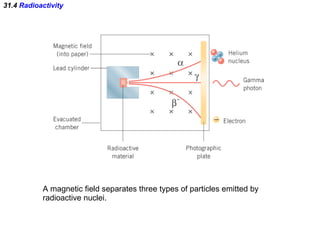
31.4  Radioactivity A magnetic field separates three types of particles emitted by radioactive nuclei.
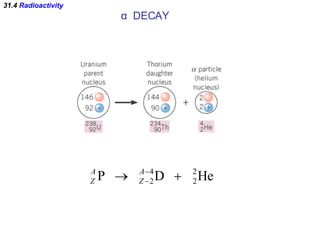
31.4  Radioactivity α   DECAY
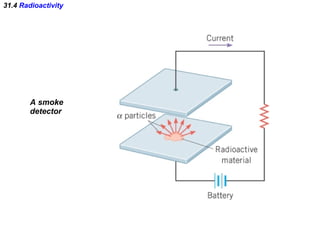
31.4  Radioactivity A smoke detector
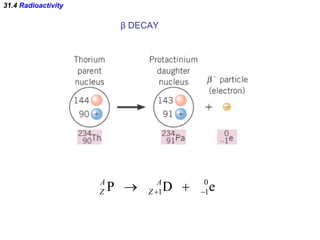
31.4  Radioactivity β  DECAY
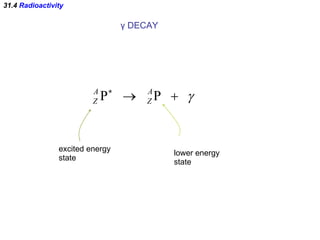
31.4  Radioactivity γ  DECAY excited energy state lower energy state

Chapter 31 Powerpoint

  • 1.
    Chapter 31 NuclearPhysics and Radioactivity
  • 2.
    31.1 NuclearStructure The atomic nucleus consists of positively charged protons and neutral neutrons.
  • 3.
    31.1 NuclearStructure atomic number atomic mass number
  • 4.
    31.1 NuclearStructure Nuclei that contain the same number of protons but a different number of neutrons are known as isotopes .
  • 5.
    31.1 NuclearStructure
  • 6.
    31.2 TheStrong Nuclear Force and the Stability of the Nucleus The mutual repulsion of the protons tends to push the nucleus apart. What then, holds the nucleus together? The strong nuclear force.
  • 7.
    31.2 TheStrong Nuclear Force and the Stability of the Nucleus As nuclei get larger, more neutrons are required for stability. The neutrons act like glue without adding more repulsive force.
  • 8.
    31.3 TheMass Deficit of the Nucleus and Nuclear Binding Energy
  • 9.
    31.3 TheMass Deficit of the Nucleus and Nuclear Binding Energy Example 3 The Binding Energy of the Helium Nucleus Revisited The atomic mass of helium is 4.0026u and the atomic mass of hydrogen is 1.0078u. Using atomic mass units, instead of kilograms, obtain the binding energy of the helium nucleus.
  • 10.
    31.3 TheMass Deficit of the Nucleus and Nuclear Binding Energy
  • 11.
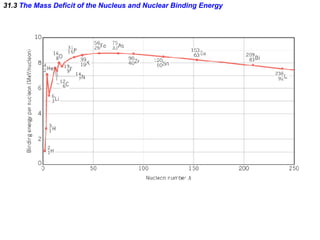
    31.3 TheMass Deficit of the Nucleus and Nuclear Binding Energy
  • 12.
    31.4 RadioactivityA magnetic field separates three types of particles emitted by radioactive nuclei.
  • 13.
  • 14.
    31.4 RadioactivityA smoke detector
  • 15.
  • 16.
    31.4 Radioactivityγ DECAY excited energy state lower energy state