Scientific Thinking
   Brian J. Piper, Ph.D., M.S.
Objectives
• What is this course?
• Why take this course?
• Ways of knowing:
  – Authority
  – Logic
  – Empiricism
• Characteristics of Science (versus pseudoscience)
  – Answerable questions
  – Tentative
  – Falsification
Why a course on research methods?
• Required?
   – Undergrad
   – Graduate (Basic or Clinical)
• Foundation for later courses (process versus content)
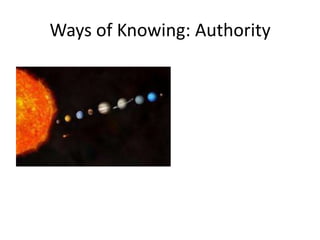
Ways of Knowing: Authority
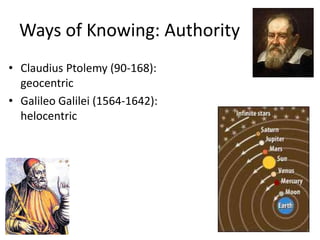
• Claudius Ptolemy (90-168):
  geocentric
• Galileo Galilei (1564-1642):
  helocentric
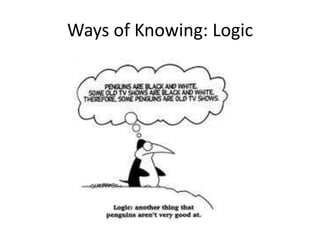
Ways of Knowing: Logic
Ways of Knowing: Empiricism
• Empiric: Greek (empiric), Latin root
  (experientia) of experience & experiment
• Knowledge comes from personal experience.
Scientific Characteristics: Tentative
  • Science is never 100.0% certain.
  • Evolution & punctuated equilibrium
  • Medicine
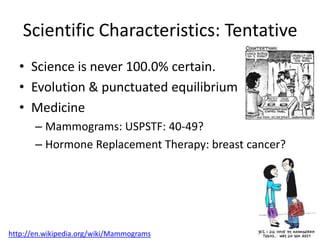
       – Mammograms: USPSTF: 40-49?
       – Hormone Replacement Therapy: breast cancer?


http://en.wikipedia.org/wiki/Mammograms
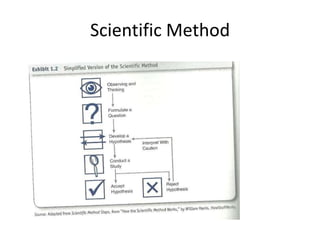
Scientific Method
Scientific Method
• Observation: my
  nephew has problems
• Question: Why?
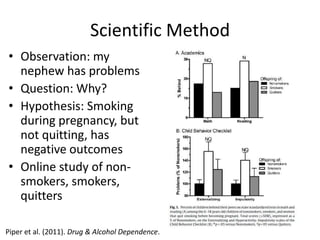
• Hypothesis: Smoking
  during pregnancy, but
  not quitting, has
  negative outcomes
• Online study of non-
  smokers, smokers,
  quitters

Piper et al. (2011). Drug & Alcohol Dependence.
Scientific Characteristics: Falsification
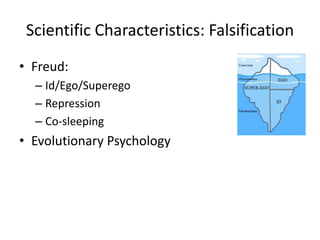
• Freud:
  – Id/Ego/Superego
  – Repression
  – Co-sleeping
• Evolutionary Psychology
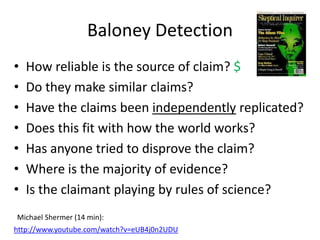
Baloney Detection
•   How reliable is the source of claim? $
•   Do they make similar claims?
•   Have the claims been independently replicated?
•   Does this fit with how the world works?
•   Has anyone tried to disprove the claim?
•   Where is the majority of evidence?
•   Is the claimant playing by rules of science?
Michael Shermer (14 min):
http://www.youtube.com/watch?v=eUB4j0n2UDU
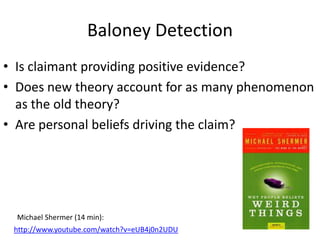
Baloney Detection
• Is claimant providing positive evidence?
• Does new theory account for as many phenomenon
  as the old theory?
• Are personal beliefs driving the claim?


  Michael Shermer (14 min):
 http://www.youtube.com/watch?v=eUB4j0n2UDU
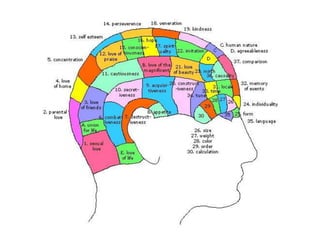
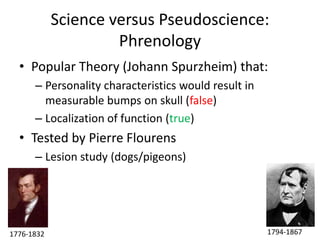
Science versus Pseudoscience:
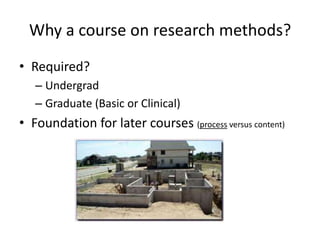
                     Phrenology
  • Popular Theory (Johann Spurzheim) that:
      – Personality characteristics would result in
        measurable bumps on skull (false)
      – Localization of function (true)
  • Tested by Pierre Flourens
      – Lesion study (dogs/pigeons)


1776-1832                                             1794-1867
Science versus Pseudoscience:
                  Subliminal Messages
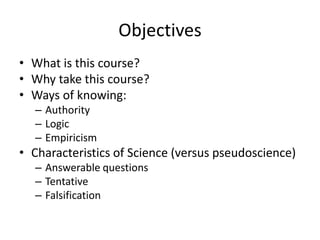
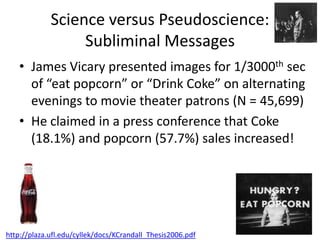
    • James Vicary presented images for 1/3000th sec
      of “eat popcorn” or “Drink Coke” on alternating
      evenings to movie theater patrons (N = 45,699)
    • He claimed in a press conference that Coke
      (18.1%) and popcorn (57.7%) sales increased!


http://plaza.ufl.edu/cyllek/docs/KCrandall_Thesis2006.pdf
Science versus Pseudoscience:
              Accupunture
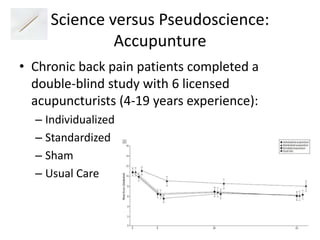
• Chronic back pain patients completed a
  double-blind study with 6 licensed
  acupuncturists (4-19 years experience):
  – Individualized
  – Standardized
  – Sham
  – Usual Care
Science versus Pseudoscience:
             Homeopathy

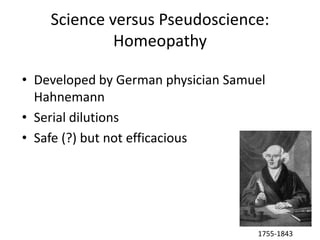
• Developed by German physician Samuel
  Hahnemann
• Serial dilutions
• Safe (?) but not efficacious


                                    1755-1843
Science versus Pseudoscience:
                Crime Scene Profiling
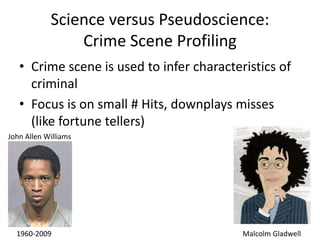
   • Crime scene is used to infer characteristics of
     criminal
   • Focus is on small # Hits, downplays misses
     (like fortune tellers)
John Allen Williams


  1960-2009                                Malcolm Gladwell
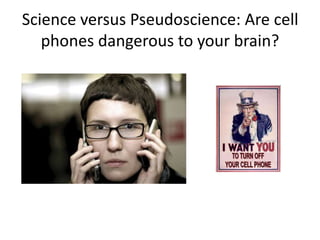
Science versus Pseudoscience: Are cell
   phones dangerous to your brain?
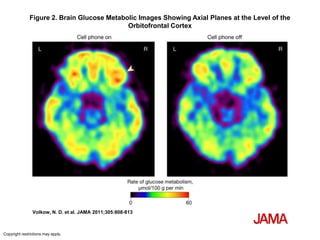
Figure 2. Brain Glucose Metabolic Images Showing Axial Planes at the Level of the
                                            Orbitofrontal Cortex


                Volkow, N. D. et al. JAMA 2011;305:808-813


Copyright restrictions may apply.
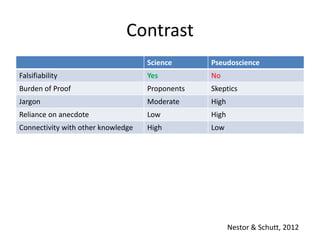
Contrast
                                    Science      Pseudoscience
Falsifiability                      Yes          No
Burden of Proof                     Proponents   Skeptics
Jargon                              Moderate     High
Reliance on anecdote                Low          High
Connectivity with other knowledge   High         Low


                                                        Nestor & Schutt, 2012
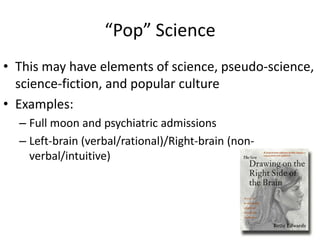
“Pop” Science
• This may have elements of science, pseudo-science,
  science-fiction, and popular culture
• Examples:
  – Full moon and psychiatric admissions
  – Left-brain (verbal/rational)/Right-brain (non-
    verbal/intuitive)

Research Methods: Scientific Thinking

  • 1.
    Scientific Thinking Brian J. Piper, Ph.D., M.S.
  • 2.
    Objectives • What isthis course? • Why take this course? • Ways of knowing: – Authority – Logic – Empiricism • Characteristics of Science (versus pseudoscience) – Answerable questions – Tentative – Falsification
  • 3.
    Why a courseon research methods? • Required? – Undergrad – Graduate (Basic or Clinical) • Foundation for later courses (process versus content)
  • 4.
  • 5.
    Ways of Knowing:Authority • Claudius Ptolemy (90-168): geocentric • Galileo Galilei (1564-1642): helocentric
  • 6.
  • 7.
    Ways of Knowing:Empiricism • Empiric: Greek (empiric), Latin root (experientia) of experience & experiment • Knowledge comes from personal experience.
  • 8.
    Scientific Characteristics: Tentative • Science is never 100.0% certain. • Evolution & punctuated equilibrium • Medicine – Mammograms: USPSTF: 40-49? – Hormone Replacement Therapy: breast cancer? http://en.wikipedia.org/wiki/Mammograms
  • 9.
  • 10.
    Scientific Method • Observation:my nephew has problems • Question: Why? • Hypothesis: Smoking during pregnancy, but not quitting, has negative outcomes • Online study of non- smokers, smokers, quitters Piper et al. (2011). Drug & Alcohol Dependence.
  • 11.
    Scientific Characteristics: Falsification •Freud: – Id/Ego/Superego – Repression – Co-sleeping • Evolutionary Psychology
  • 12.
    Baloney Detection • How reliable is the source of claim? $ • Do they make similar claims? • Have the claims been independently replicated? • Does this fit with how the world works? • Has anyone tried to disprove the claim? • Where is the majority of evidence? • Is the claimant playing by rules of science? Michael Shermer (14 min): http://www.youtube.com/watch?v=eUB4j0n2UDU
  • 13.
    Baloney Detection • Isclaimant providing positive evidence? • Does new theory account for as many phenomenon as the old theory? • Are personal beliefs driving the claim? Michael Shermer (14 min): http://www.youtube.com/watch?v=eUB4j0n2UDU
  • 15.
    Science versus Pseudoscience: Phrenology • Popular Theory (Johann Spurzheim) that: – Personality characteristics would result in measurable bumps on skull (false) – Localization of function (true) • Tested by Pierre Flourens – Lesion study (dogs/pigeons) 1776-1832 1794-1867
  • 16.
    Science versus Pseudoscience: Subliminal Messages • James Vicary presented images for 1/3000th sec of “eat popcorn” or “Drink Coke” on alternating evenings to movie theater patrons (N = 45,699) • He claimed in a press conference that Coke (18.1%) and popcorn (57.7%) sales increased! http://plaza.ufl.edu/cyllek/docs/KCrandall_Thesis2006.pdf
  • 17.
    Science versus Pseudoscience: Accupunture • Chronic back pain patients completed a double-blind study with 6 licensed acupuncturists (4-19 years experience): – Individualized – Standardized – Sham – Usual Care
  • 18.
    Science versus Pseudoscience: Homeopathy • Developed by German physician Samuel Hahnemann • Serial dilutions • Safe (?) but not efficacious 1755-1843
  • 19.
    Science versus Pseudoscience: Crime Scene Profiling • Crime scene is used to infer characteristics of criminal • Focus is on small # Hits, downplays misses (like fortune tellers) John Allen Williams 1960-2009 Malcolm Gladwell
  • 20.
    Science versus Pseudoscience:Are cell phones dangerous to your brain?
  • 21.
    Figure 2. BrainGlucose Metabolic Images Showing Axial Planes at the Level of the Orbitofrontal Cortex Volkow, N. D. et al. JAMA 2011;305:808-813 Copyright restrictions may apply.
  • 22.
    Contrast Science Pseudoscience Falsifiability Yes No Burden of Proof Proponents Skeptics Jargon Moderate High Reliance on anecdote Low High Connectivity with other knowledge High Low Nestor & Schutt, 2012
  • 23.
    “Pop” Science • Thismay have elements of science, pseudo-science, science-fiction, and popular culture • Examples: – Full moon and psychiatric admissions – Left-brain (verbal/rational)/Right-brain (non- verbal/intuitive)