Chapter 1
Introduction to Scientific Research
             9/4/2012
Roadmap
• Taking a course in research methods is like
  _______ .
• Course roster verification
• Blackboard: Keep checking for materials
  – PPT slides
• Chapter 1
Introduction to Scientific Research
•   What is Science?
•   What is scientific research?
•   What are the goals of scientific research?
•   What are the assumptions of scientific research?
•   What is the role of the researcher and theory?
•   What is Pseudoscience and how do we recognize it?
How do we Acquire Knowledge?
• Multiple ways to acquire knowledge
Knowledge Acquisition
• Intuition: a way to acquire knowledge not
  based on reasoning or inferring


• Authority: accepting information as fact
  because it comes from a highly respected
  source
Knowledge Acquisition
• Rationalism- acquire knowledge through
  reasoning

• Empiricism- acquisition of knowledge through
  experience
Science
• A way of acquiring information that is designed
  to systematically produce reliable and valid
  information about the world

• Different “scientific methods” throughout history
• So what is science and how do we do it?

• First, understand the basic assumptions
  underlying scientific research.
Basic Assumptions Underlying
           Scientific Research
• Uniformity/Regularity in Nature

• Determinism- the belief that there are causes
  of behavior and mental processes.
Basic assumptions cont.
• Reality in Nature


• Discoverability
  – Assumption that it is possible to discover the
    uniformities that exist in nature.
Characteristics of Scientific Research
• We rely on these to produce reliable
  knowledge:

• Control
• Operationalism
• Replication
Control
• Control refers to eliminating any extraneous
  variables that could affect observations.

• Impacts ability to draw causal inferences
Operationalism
• In science we must be specific with regard to what
  we are talking about.


• An operational definition is the definition of a
  concept by the operations or measures used to
  measure them.
   – Example: Anxiety
Replication
• Ability to reproduce the findings from another
  study.

• If the findings are “real” then I should be able
  to replicate someone else’s study.
  – What might affect this?

• What if we can’t replicate results?
Replication, cont.
• Problem: the importance of replication in
  science ≠ commitment to carrying out
  replication studies

• Meta-analysis: Quantitative technique for
  describing the relationship between variables
  across multiple research studies.
Goals of Scientific Research
• Ultimately, science seeks to understand the
  world around us.
• Description
• Explanation
• Prediction
• Control
Description
• Typically where science starts.

• Describe the phenomenon.
Explanation
• Determine WHY something happens
  – Identify antecedent conditions


• Most things are not caused by only one factor
  but rather multiple factors.
Prediction
• After we know what something is and why it
  occurs, we want to be able to predict it.

• Prediction is the ability to anticipate the
  occurrence of an event before it occurs.
Control
• Control in this case refers to the manipulation
  of antecedent conditions to produce a change
  in outcome.

*Note: multiple uses of the word “control”
  – See p. 22 in text for discussion
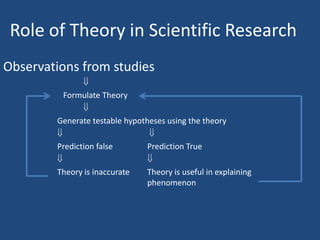
Role of Theory in Scientific Research
Observations from studies
         Formulate Theory

        Generate testable hypotheses using the theory

        Prediction false       Prediction True

        Theory is inaccurate   Theory is useful in explaining
                               phenomenon
Role of the Scientist             (read in text)

• Curiosity
  – “Serendipity- the art of finding one thing while
    looking for another” (Skinner, 1956)
  – “Chance favors the prepared mind”
    (Pasteur, 1854)
• Patience
• Objectivity
• Change
Pseudoscience
• Pseudoscience is an approach that claims to
  be scientific but is not based on scientific
  methods

• Based on methods and practices that violate
  many tenets of science
Ways to identify Pseudoscience
• Creating new (ad hoc) hypotheses to explain
  away negative findings

• Emphasis on Confirmation rather than
  Refutation- reinterpret negative findings as
  support.
Ways to identify Pseudoscience
• Absence of Self- Correction

• Reversed Burden of Proof

• Overreliance on Testimonials and Anecdotal Evidence
Ways to identify Pseudoscience
• Use of Obscure language to make a claim
  sound like it has survived scientific scrutiny

• Absence of a connection with other disciplines
  that study related issues
Suggestion:
To help you get in the psychological scientist
  mindframe, check out:

  www.psychologicalscience.org

        APS on facebook

      Follow PsychScience on Twitter
Questions?

Chapter 1 class version(2)

  • 1.
    Chapter 1 Introduction toScientific Research 9/4/2012
  • 2.
    Roadmap • Taking acourse in research methods is like _______ . • Course roster verification • Blackboard: Keep checking for materials – PPT slides • Chapter 1
  • 3.
    Introduction to ScientificResearch • What is Science? • What is scientific research? • What are the goals of scientific research? • What are the assumptions of scientific research? • What is the role of the researcher and theory? • What is Pseudoscience and how do we recognize it?
  • 4.
    How do weAcquire Knowledge? • Multiple ways to acquire knowledge
  • 5.
    Knowledge Acquisition • Intuition:a way to acquire knowledge not based on reasoning or inferring • Authority: accepting information as fact because it comes from a highly respected source
  • 6.
    Knowledge Acquisition • Rationalism-acquire knowledge through reasoning • Empiricism- acquisition of knowledge through experience
  • 7.
    Science • A wayof acquiring information that is designed to systematically produce reliable and valid information about the world • Different “scientific methods” throughout history
  • 8.
    • So whatis science and how do we do it? • First, understand the basic assumptions underlying scientific research.
  • 9.
    Basic Assumptions Underlying Scientific Research • Uniformity/Regularity in Nature • Determinism- the belief that there are causes of behavior and mental processes.
  • 10.
    Basic assumptions cont. •Reality in Nature • Discoverability – Assumption that it is possible to discover the uniformities that exist in nature.
  • 11.
    Characteristics of ScientificResearch • We rely on these to produce reliable knowledge: • Control • Operationalism • Replication
  • 12.
    Control • Control refersto eliminating any extraneous variables that could affect observations. • Impacts ability to draw causal inferences
  • 13.
    Operationalism • In sciencewe must be specific with regard to what we are talking about. • An operational definition is the definition of a concept by the operations or measures used to measure them. – Example: Anxiety
  • 14.
    Replication • Ability toreproduce the findings from another study. • If the findings are “real” then I should be able to replicate someone else’s study. – What might affect this? • What if we can’t replicate results?
  • 15.
    Replication, cont. • Problem:the importance of replication in science ≠ commitment to carrying out replication studies • Meta-analysis: Quantitative technique for describing the relationship between variables across multiple research studies.
  • 16.
    Goals of ScientificResearch • Ultimately, science seeks to understand the world around us. • Description • Explanation • Prediction • Control
  • 17.
    Description • Typically wherescience starts. • Describe the phenomenon.
  • 18.
    Explanation • Determine WHYsomething happens – Identify antecedent conditions • Most things are not caused by only one factor but rather multiple factors.
  • 19.
    Prediction • After weknow what something is and why it occurs, we want to be able to predict it. • Prediction is the ability to anticipate the occurrence of an event before it occurs.
  • 20.
    Control • Control inthis case refers to the manipulation of antecedent conditions to produce a change in outcome. *Note: multiple uses of the word “control” – See p. 22 in text for discussion
  • 21.
    Role of Theoryin Scientific Research Observations from studies Formulate Theory Generate testable hypotheses using the theory Prediction false Prediction True Theory is inaccurate Theory is useful in explaining phenomenon
  • 22.
    Role of theScientist (read in text) • Curiosity – “Serendipity- the art of finding one thing while looking for another” (Skinner, 1956) – “Chance favors the prepared mind” (Pasteur, 1854) • Patience • Objectivity • Change
  • 23.
    Pseudoscience • Pseudoscience isan approach that claims to be scientific but is not based on scientific methods • Based on methods and practices that violate many tenets of science
  • 24.
    Ways to identifyPseudoscience • Creating new (ad hoc) hypotheses to explain away negative findings • Emphasis on Confirmation rather than Refutation- reinterpret negative findings as support.
  • 25.
    Ways to identifyPseudoscience • Absence of Self- Correction • Reversed Burden of Proof • Overreliance on Testimonials and Anecdotal Evidence
  • 26.
    Ways to identifyPseudoscience • Use of Obscure language to make a claim sound like it has survived scientific scrutiny • Absence of a connection with other disciplines that study related issues
  • 27.
    Suggestion: To help youget in the psychological scientist mindframe, check out: www.psychologicalscience.org APS on facebook Follow PsychScience on Twitter
  • 28.