Anticonvulsants I
Brian J. Piper, Ph.D., M.S.
   piperbj@husson.edu


                February 6, 2013
Objectives
• At the end of this lecture, pharmacy students
  should be able to:
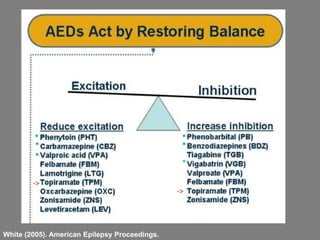
  – describe the overall neurochemistry of seizures
    (AED targets).
  – list the procedures to induce seizures.
  – contrast by PD and AE the different 1st generation
    AED.
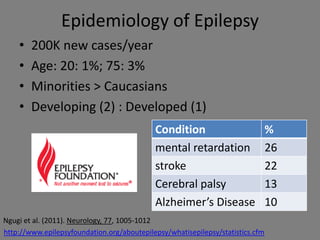
Epidemiology of Epilepsy
    •   200K new cases/year
    •   Age: 20: 1%; 75: 3%
    •   Minorities > Caucasians
    •   Developing (2) : Developed (1)
                                            Condition                           %
                                            mental retardation                  26
                                            stroke                              22
                                            Cerebral palsy                      13
                                            Alzheimer’s Disease                 10
Ngugi et al. (2011). Neurology, 77, 1005-1012
http://www.epilepsyfoundation.org/aboutepilepsy/whatisepilepsy/statistics.cfm
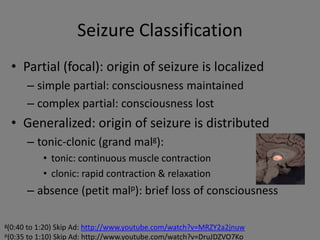
Seizure Classification
  • Partial (focal): origin of seizure is localized
         – simple partial: consciousness maintained
         – complex partial: consciousness lost
  • Generalized: origin of seizure is distributed
         – tonic-clonic (grand malg):
            • tonic: continuous muscle contraction
            • clonic: rapid contraction & relaxation
         – absence (petit malp): brief loss of consciousness

g(0:40 to 1:20) Skip Ad: http://www.youtube.com/watch?v=MRZY2a2jnuw
p(0:35 to 1:10) Skip Ad: http://www.youtube.com/watch?v=DruJDZVO7Ko
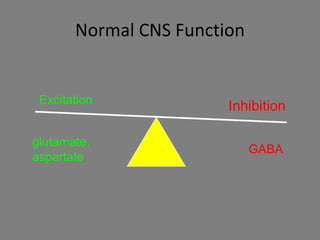
Normal CNS Function
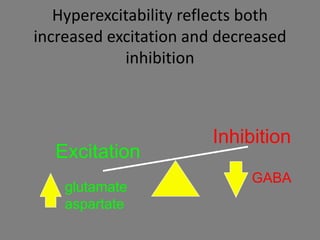
Hyperexcitability reflects both
increased excitation and decreased
            inhibition


                        Inhibition
  Excitation
                             GABA
    glutamate
    aspartate
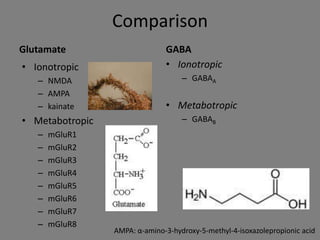
Comparison
Glutamate                      GABA
• Ionotropic                   • Ionotropic
   – NMDA                           – GABAA
   – AMPA
   – kainate                   • Metabotropic
• Metabotropic                      – GABAB
   –   mGluR1
   –   mGluR2
   –   mGluR3
   –   mGluR4                        GABA
   –   mGluR5
   –   mGluR6
   –   mGluR7
   –   mGluR8
                 AMPA: α-amino-3-hydroxy-5-methyl-4-isoxazolepropionic acid
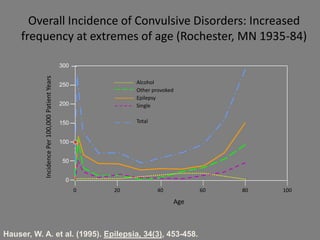
Overall Incidence of Convulsive Disorders: Increased
     frequency at extremes of age (Rochester, MN 1935-84)

                                                 300
           Incidence Per 100,000 Patient Years


                                                 250            Alcohol
                                                                Other provoked
                                                                Epilepsy
                                                 200            Single


                                                 150            Total


                                                 100


                                                 50


                                                  0
                                                       0   20           40         60   80   100

                                                                             Age


Hauser, W. A. et al. (1995). Epilepsia, 34(3), 453-458.
*                                       *
        *                                       *
        *
                                                *

        ->
                                               ->


White (2005). American Epilepsy Proceedings.
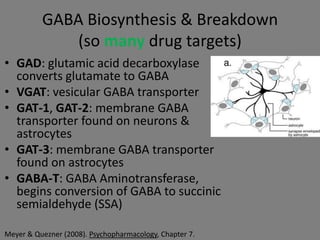
GABA Biosynthesis & Breakdown
              (so many drug targets)
• GAD: glutamic acid decarboxylase
  converts glutamate to GABA
• VGAT: vesicular GABA transporter
• GAT-1, GAT-2: membrane GABA
  transporter found on neurons &
  astrocytes
• GAT-3: membrane GABA transporter
  found on astrocytes
• GABA-T: GABA Aminotransferase,
  begins conversion of GABA to succinic
  semialdehyde (SSA)

Meyer & Quezner (2008). Psychopharmacology, Chapter 7.
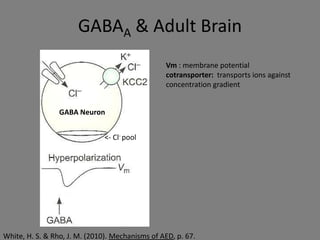
GABAA & Adult Brain
                                                 Vm : membrane potential
                                                 cotransporter: transports ions against
                                                 concentration gradient


                 GABA Neuron


                               <- Cl- pool


White, H. S. & Rho, J. M. (2010). Mechanisms of AED, p. 67.
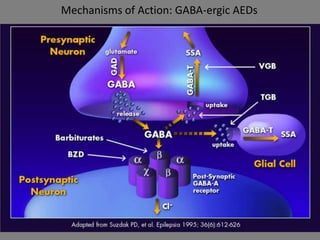
Mechanisms of Action: GABA-ergic AEDs
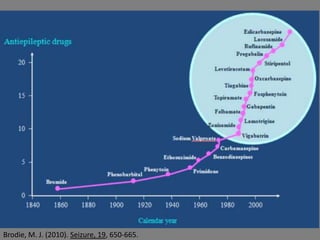
History of AEDs
   •    1857: Sir Charles Locock reports on KBr for hysterical epilepsy
   •    1912: Alfred Hauptmann’s sleep problems lead to phenobarbital
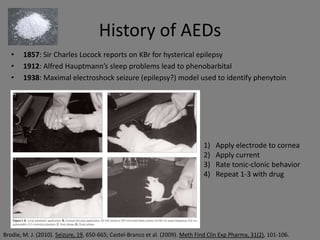
   •    1938: Maximal electroshock seizure (epilepsy?) model used to identify phenytoin


                                                                                1)   Apply electrode to cornea
                                                                                2)   Apply current
                                                                                3)   Rate tonic-clonic behavior
                                                                                4)   Repeat 1-3 with drug


Brodie, M. J. (2010). Seizure, 19, 650-665; Castel-Branco et al. (2009). Meth Find Clin Exp Pharma, 31(2), 101-106.
Phenytoin (1938)

    • History: less sedative than
      phenobarbital
    • MOA: decreased recovery of
      voltage gated Na+ channels from
      inactivation
    • PK: 3A4 inducer
    • Adverse Events: lethargy
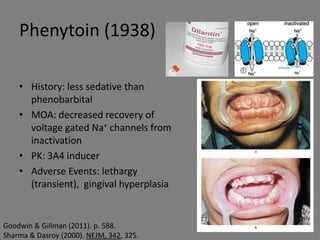
      (transient), gingival hyperplasia


Goodwin & Gillman (2011). p. 588.
Sharma & Dasroy (2000). NEJM, 342, 325.
Phenytoin & Category D
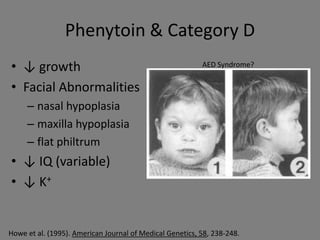
• ↓ growth                                                AED Syndrome?


• Facial Abnormalities
     – nasal hypoplasia
     – maxilla hypoplasia
     – flat philtrum
• ↓ IQ (variable)
• ↓ K+


Howe et al. (1995). American Journal of Medical Genetics, 58, 238-248.
Pentylenetetrazol (1938)
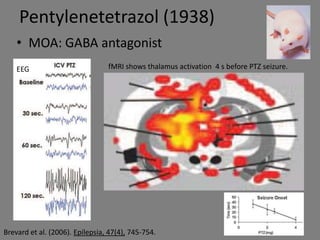
    • MOA: GABA antagonist
    EEG                          fMRI shows thalamus activation 4 s before PTZ seizure.


Brevard et al. (2006). Epilepsia, 47(4), 745-754.
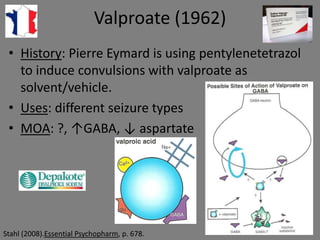
Valproate (1962)
 • History: Pierre Eymard is using pentylenetetrazol
   to induce convulsions with valproate as
   solvent/vehicle.
 • Uses: different seizure types
 • MOA: ?, ↑GABA, ↓ aspartate


Stahl (2008).Essential Psychopharm, p. 678.
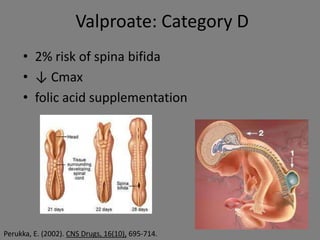
Valproate: Category D
     • 2% risk of spina bifida
     • ↓ Cmax
     • folic acid supplementation


Perukka, E. (2002). CNS Drugs, 16(10), 695-714.
Status Epilecticus (SE)
    • continuous, unremitting seizure lasting > 5
      min
    • convulsive > non-convulsive
    • mortality = 20%
    • medical emergency


Trinka et al. (2012). Epilepsia, 53(4), 127-138.
Lorazepam (1977)
• MOA: GABAA α1,2,3,5
• Dose: 2 mg/ml per min x 2
• Adverse Effects: heavy sedation, especially
  with alcohol
• t1/2 : 12 hours
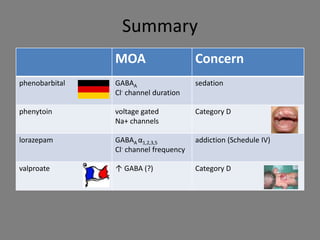
Summary
                MOA                     Concern
phenobarbital   GABAA                   sedation
                Cl- channel duration

phenytoin       voltage gated           Category D
                Na+ channels

lorazepam       GABAA α1,2,3,5          addiction (Schedule IV)
                Cl- channel frequency

valproate       ↑ GABA (?)              Category D
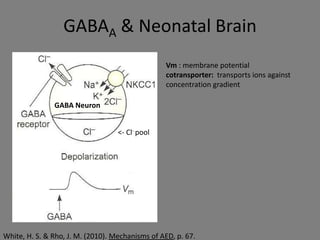
GABAA & Neonatal Brain
                                                 Vm : membrane potential
                                                 cotransporter: transports ions against
                                                 concentration gradient

               GABA Neuron


                                   <- Cl- pool


White, H. S. & Rho, J. M. (2010). Mechanisms of AED, p. 67.
Brodie, M. J. (2010). Seizure, 19, 650-665.
Summary
• MES and PTZ have been used to identify many
  AED.
• Pharmacotherapy for epilepsy is complex and
  polypharmacy is common.
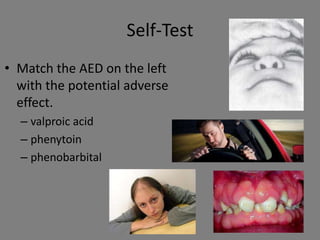
Self-Test
• Match the AED on the left
  with the potential adverse
  effect.
  – valproic acid
  – phenytoin
  – phenobarbital

Anticonvulsants Part I

  • 1.
    Anticonvulsants I Brian J.Piper, Ph.D., M.S. piperbj@husson.edu February 6, 2013
  • 2.
    Objectives • At theend of this lecture, pharmacy students should be able to: – describe the overall neurochemistry of seizures (AED targets). – list the procedures to induce seizures. – contrast by PD and AE the different 1st generation AED.
  • 3.
    Epidemiology of Epilepsy • 200K new cases/year • Age: 20: 1%; 75: 3% • Minorities > Caucasians • Developing (2) : Developed (1) Condition % mental retardation 26 stroke 22 Cerebral palsy 13 Alzheimer’s Disease 10 Ngugi et al. (2011). Neurology, 77, 1005-1012 http://www.epilepsyfoundation.org/aboutepilepsy/whatisepilepsy/statistics.cfm
  • 4.
    Seizure Classification • Partial (focal): origin of seizure is localized – simple partial: consciousness maintained – complex partial: consciousness lost • Generalized: origin of seizure is distributed – tonic-clonic (grand malg): • tonic: continuous muscle contraction • clonic: rapid contraction & relaxation – absence (petit malp): brief loss of consciousness g(0:40 to 1:20) Skip Ad: http://www.youtube.com/watch?v=MRZY2a2jnuw p(0:35 to 1:10) Skip Ad: http://www.youtube.com/watch?v=DruJDZVO7Ko
  • 5.
  • 6.
    Hyperexcitability reflects both increasedexcitation and decreased inhibition Inhibition Excitation GABA glutamate aspartate
  • 7.
    Comparison Glutamate GABA • Ionotropic • Ionotropic – NMDA – GABAA – AMPA – kainate • Metabotropic • Metabotropic – GABAB – mGluR1 – mGluR2 – mGluR3 – mGluR4 GABA – mGluR5 – mGluR6 – mGluR7 – mGluR8 AMPA: α-amino-3-hydroxy-5-methyl-4-isoxazolepropionic acid
  • 8.
    Overall Incidence ofConvulsive Disorders: Increased frequency at extremes of age (Rochester, MN 1935-84) 300 Incidence Per 100,000 Patient Years 250 Alcohol Other provoked Epilepsy 200 Single 150 Total 100 50 0 0 20 40 60 80 100 Age Hauser, W. A. et al. (1995). Epilepsia, 34(3), 453-458.
  • 9.
    * * * * * * -> -> White (2005). American Epilepsy Proceedings.
  • 10.
    GABA Biosynthesis &Breakdown (so many drug targets) • GAD: glutamic acid decarboxylase converts glutamate to GABA • VGAT: vesicular GABA transporter • GAT-1, GAT-2: membrane GABA transporter found on neurons & astrocytes • GAT-3: membrane GABA transporter found on astrocytes • GABA-T: GABA Aminotransferase, begins conversion of GABA to succinic semialdehyde (SSA) Meyer & Quezner (2008). Psychopharmacology, Chapter 7.
  • 11.
    GABAA & AdultBrain Vm : membrane potential cotransporter: transports ions against concentration gradient GABA Neuron <- Cl- pool White, H. S. & Rho, J. M. (2010). Mechanisms of AED, p. 67.
  • 12.
    Mechanisms of Action:GABA-ergic AEDs
  • 13.
    History of AEDs • 1857: Sir Charles Locock reports on KBr for hysterical epilepsy • 1912: Alfred Hauptmann’s sleep problems lead to phenobarbital • 1938: Maximal electroshock seizure (epilepsy?) model used to identify phenytoin 1) Apply electrode to cornea 2) Apply current 3) Rate tonic-clonic behavior 4) Repeat 1-3 with drug Brodie, M. J. (2010). Seizure, 19, 650-665; Castel-Branco et al. (2009). Meth Find Clin Exp Pharma, 31(2), 101-106.
  • 14.
    Phenytoin (1938) • History: less sedative than phenobarbital • MOA: decreased recovery of voltage gated Na+ channels from inactivation • PK: 3A4 inducer • Adverse Events: lethargy (transient), gingival hyperplasia Goodwin & Gillman (2011). p. 588. Sharma & Dasroy (2000). NEJM, 342, 325.
  • 15.
    Phenytoin & CategoryD • ↓ growth AED Syndrome? • Facial Abnormalities – nasal hypoplasia – maxilla hypoplasia – flat philtrum • ↓ IQ (variable) • ↓ K+ Howe et al. (1995). American Journal of Medical Genetics, 58, 238-248.
  • 16.
    Pentylenetetrazol (1938) • MOA: GABA antagonist EEG fMRI shows thalamus activation 4 s before PTZ seizure. Brevard et al. (2006). Epilepsia, 47(4), 745-754.
  • 17.
    Valproate (1962) •History: Pierre Eymard is using pentylenetetrazol to induce convulsions with valproate as solvent/vehicle. • Uses: different seizure types • MOA: ?, ↑GABA, ↓ aspartate Stahl (2008).Essential Psychopharm, p. 678.
  • 18.
    Valproate: Category D • 2% risk of spina bifida • ↓ Cmax • folic acid supplementation Perukka, E. (2002). CNS Drugs, 16(10), 695-714.
  • 19.
    Status Epilecticus (SE) • continuous, unremitting seizure lasting > 5 min • convulsive > non-convulsive • mortality = 20% • medical emergency Trinka et al. (2012). Epilepsia, 53(4), 127-138.
  • 20.
    Lorazepam (1977) • MOA:GABAA α1,2,3,5 • Dose: 2 mg/ml per min x 2 • Adverse Effects: heavy sedation, especially with alcohol • t1/2 : 12 hours
  • 21.
    Summary MOA Concern phenobarbital GABAA sedation Cl- channel duration phenytoin voltage gated Category D Na+ channels lorazepam GABAA α1,2,3,5 addiction (Schedule IV) Cl- channel frequency valproate ↑ GABA (?) Category D
  • 22.
    GABAA & NeonatalBrain Vm : membrane potential cotransporter: transports ions against concentration gradient GABA Neuron <- Cl- pool White, H. S. & Rho, J. M. (2010). Mechanisms of AED, p. 67.
  • 23.
    Brodie, M. J.(2010). Seizure, 19, 650-665.
  • 24.
    Summary • MES andPTZ have been used to identify many AED. • Pharmacotherapy for epilepsy is complex and polypharmacy is common.
  • 25.
    Self-Test • Match theAED on the left with the potential adverse effect. – valproic acid – phenytoin – phenobarbital

Editor's Notes

  • #2 Prequel: 0:10 to 2:00 (Skip Ad) Funny but technically accurate: http://www.youtube.com/watch?v=xPoAQaVy-7s
  • #4 By 20 years of age, one percent of the population can be expected to have developed epilepsy, 3% by age 75. High-Income countries: 45/100K versus Low/Middle income 82/100K!
  • #5 Complex partial may also involve hallucinations, chewing movements, and urination. Onset of petit mal seizures is typically between ages 3-5. The staring and rapid eye blinking are common. http://www.howjsay.com/index.php?word=petit+mal&amp;submit=Submit
  • #8 N-methyl-D-aspartate; Kay ah nay t or http://www.howjsay.com/index.php?word=kainate&amp;submit=Submit
  • #10 AED: Anti-Epileptic Drug, Phenytoin (fen i toe en) or http://www.howjsay.com/index.php?word=phenytoin&amp;submit=Submit
  • #12 A cotransporter is an integral membrane protein that is involved in secondary active transport. It works by binding to two molecules or ions at a time and using the gradient of one solute&apos;s concentration to force the other molecule or ion against its gradient.Membrane potential is the difference in electrical potential between the interior and the exterior of a cell (typically –70 mV for neurons).During adult life, the activity of the KCC2 cotransporter is high resulting in a low volume of intracellular Cl. Application of GABA results in the Cl channel opening which decreases the membrane potential.
  • #14 Charles Locock was an obstetrician to Queen Victoria. He comments that potassium bromide produced satisfactory results in a series of 52 woman whose seizures corresponded with their menstrual cycles. KBr is still a 3rd AED for children in Europe (removed from market in US in 1975). At the time of writing, the speculated causes of epilepsy were the uterus, kidney, teeth, and, especially, masterbation (KBr calmed sexual excitement).Hauptmann is a psychiatry resident living over a psychiatric ward. Phenobarbital is still the #1 AED in developing countries.
  • #15 “A 17-year-old boy had generalized tonic–clonic seizures for four years…Treatment with 300 mg of phenytoin per day was subsequently begun and continued unsupervised for a period of two years. Examination revealed … severe gingival hyperplasia (Panel A) … withdrawal of phenytoin was followed by marked regression of the gingival hyperplasia within three months” (Panel B).
  • #16 Phenytoin leads to increased potassium degradation which results in a K deficiency.
  • #17 Pentylenetetrazol is also known as PTZCardiazol. This was used to induce seizures in people prior to the development of Electroconvulsive Therapy. Systemic PTZ causes significant decreases in blood pressure and increases in heart rate so the ICV route was used instead. Authors note “subcutaneous electrodes were placed over the anterior and posterior cortex”.
  • #18 Reported to be most widely used AED in the world as of 2002. Valproate MOA may involve increasing GABA release, inhibiting GABA reuptake, or inhibiting GABA transaminase, decreasing the opening of Ca/Na channels, as a NMDA antagonist, and modulates 5-HT and dopamine (whew)!
  • #19 Spina bifida (Latin: &quot;split spine&quot;) is a developmental congenital disorder caused by the incomplete closing of the embryonic neural tube. Some vertebrae overlying the spinal cord are not fully formed and remain unfused and open. If the opening is large enough, this allows a portion of the spinal cord to protrude through the opening in the bones. There may or may not be a fluid-filled sac surrounding the spinal cord.
  • #21 Prevents seizures for 2-8 hours. This is much longer than diazepam (30 minutes). Since its introduction, Lorazepam has been marketed under 70 (!) brand names!
  • #23 A cotransporter is an integral membrane protein that is involved in secondary active transport. It works by binding to two molecules or ions at a time and using the gradient of one solute&apos;s concentration to force the other molecule or ion against its gradient.Membrane potential is the difference in electrical potential between the interior and the exterior of a cell (typically –70 mV for neurons).During adult life, the activity of the KCC2 cotransporter is high resulting in a low volume of intracellular Cl. Application of GABA results in the Cl channel opening which decreases the membrane potential.
  • #26 Philtrum:the vertical groove on the surface of the upper lip, below the septum of the nose.Phenytoin is associated with both gingival hypertrophy and facial dysmorphology. Valproic acid causes hair loss (uncommon) and weight gain (common).