Agents for Traumatic Brain
          Injury
    Brian J. Piper, Ph.D., M.S.
       piperbj@husson.edu


                   February 15, 2013
Objective
• Pharmacy students should be familiar with
  different pharmacotherapies used with brain
  injury including their:
  – mechanisms of action
  – relative efficacy
  – adverse effects
falls     motor-vehicle/assaults     falls/motor-vehicle


Burns & Hauser (2003) Epilepsia, 44(S10), 2-10.
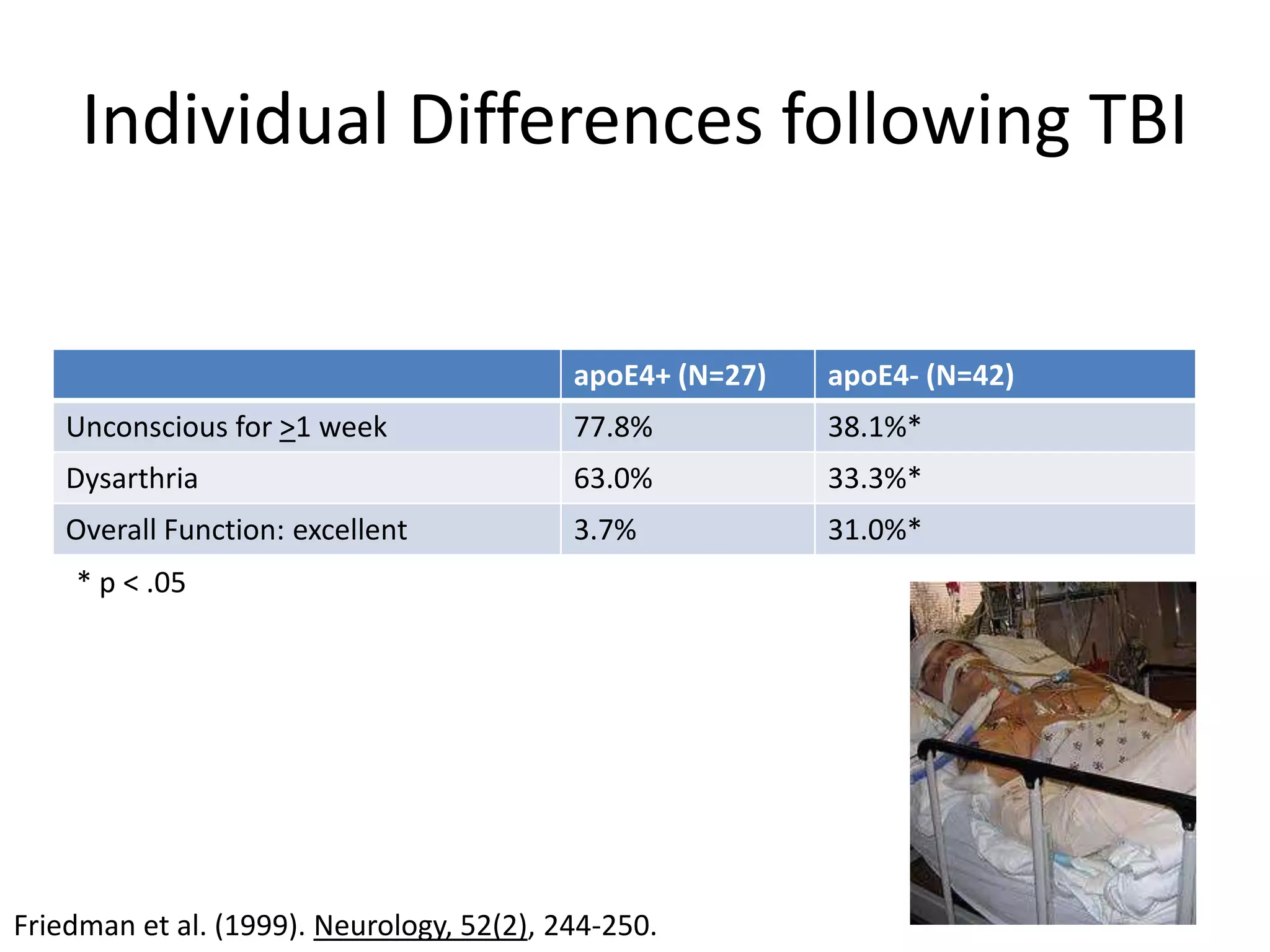
Individual Differences following TBI


                                           apoE4+ (N=27)   apoE4- (N=42)
    Unconscious for >1 week                77.8%           38.1%*
    Dysarthria                             63.0%           33.3%*
    Overall Function: excellent            3.7%            31.0%*
    * p < .05


Friedman et al. (1999). Neurology, 52(2), 244-250.
Secondary Injury
• All brain damage does not occur at the
  moment of impact (primary injury) but
  evolves over the ensuing hours and days
  (secondary injury).

• The injured brain is extremely vulnerable to
  hypotension, hypoxia, and increased
  intracranial pressure which are causes of
  secondary injury.
↓ Blood Pressure: Tx-Dopamine
• MOA: D1 > α1
• Effects: ↑ systolic bp
Intra-Cranial Pressure
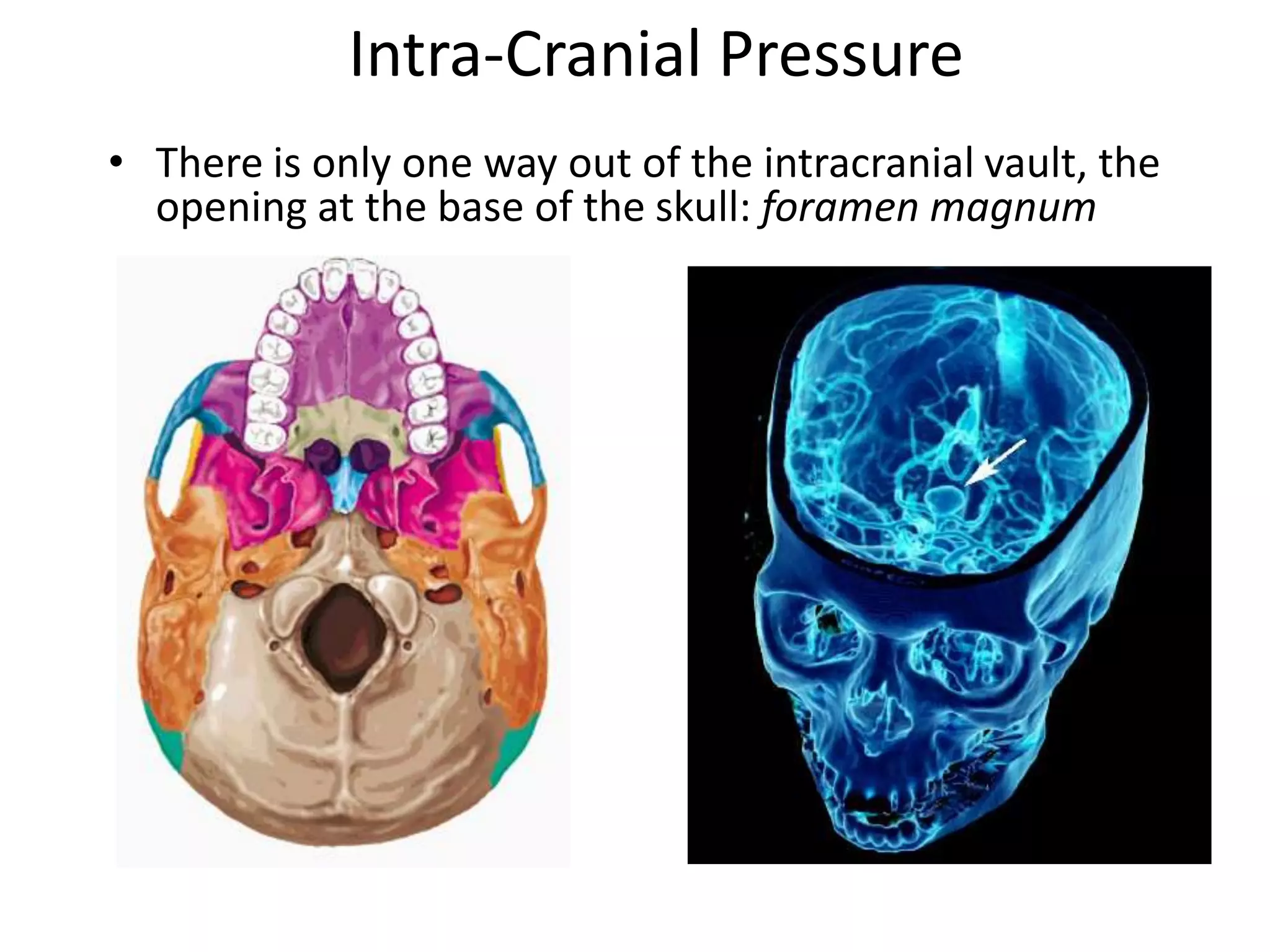
• There is only one way out of the intracranial vault, the
  opening at the base of the skull: foramen magnum
↑ Intracranial Pressure: Tx-Mannitol
   • History: sugar derivative of mannose-1961
   • Frequency: majority of trauma centers
   • Effect:
       – immediate ↓ ICP; withdrawal ↑ ICP
       – renal failure


Grande & Romner (2012). J Neurosurg, 24(4), 407-412.
Mannitol versus Hypertonic Saline


   ->


Vialet et al. (2003). Critical Care Medicine, 36, 795-800.
Mannitol versus Hypertonic Saline


Vialet et al. (2003). Critical Care Medicine, 36, 795-800.
↑ Intracranial Pressure: Tx-
                         Barbiturates
 • Indications:
      – ↑ ICP refractory to other treatments
 • Frequency: minority of trauma centers
 • Rationale:
      – ↓ neuron activity ↓ metabolic demands
      – ↓ free radical formation
 • Effect:
      – immediate ↓ ICP; hypotension (25%)

Roberts & Sydenham (2012). Cochrane Database of Systematic Reviews, 10.1002/14651858.CD000033.pub2.
Absence of evidence ≠
     Evidence of absence

     • “There is insufficient reliable evidence to
       make recommendations on the use of
       mannitol in the management of patients with
       traumatic brain injury.”
     • “There is no evidence that barbiturates
       improve outcomes in people with acute brain
       injury.”

Wakai et al. (2008). Cochrane Database of Systematic Reviews, 10.1002/14651858.CD001049.pub4.
Roberts & Sydenham (2012). Cochrane Database of Systematic Reviews, 10.1002/14651858.CD000033.pub2.
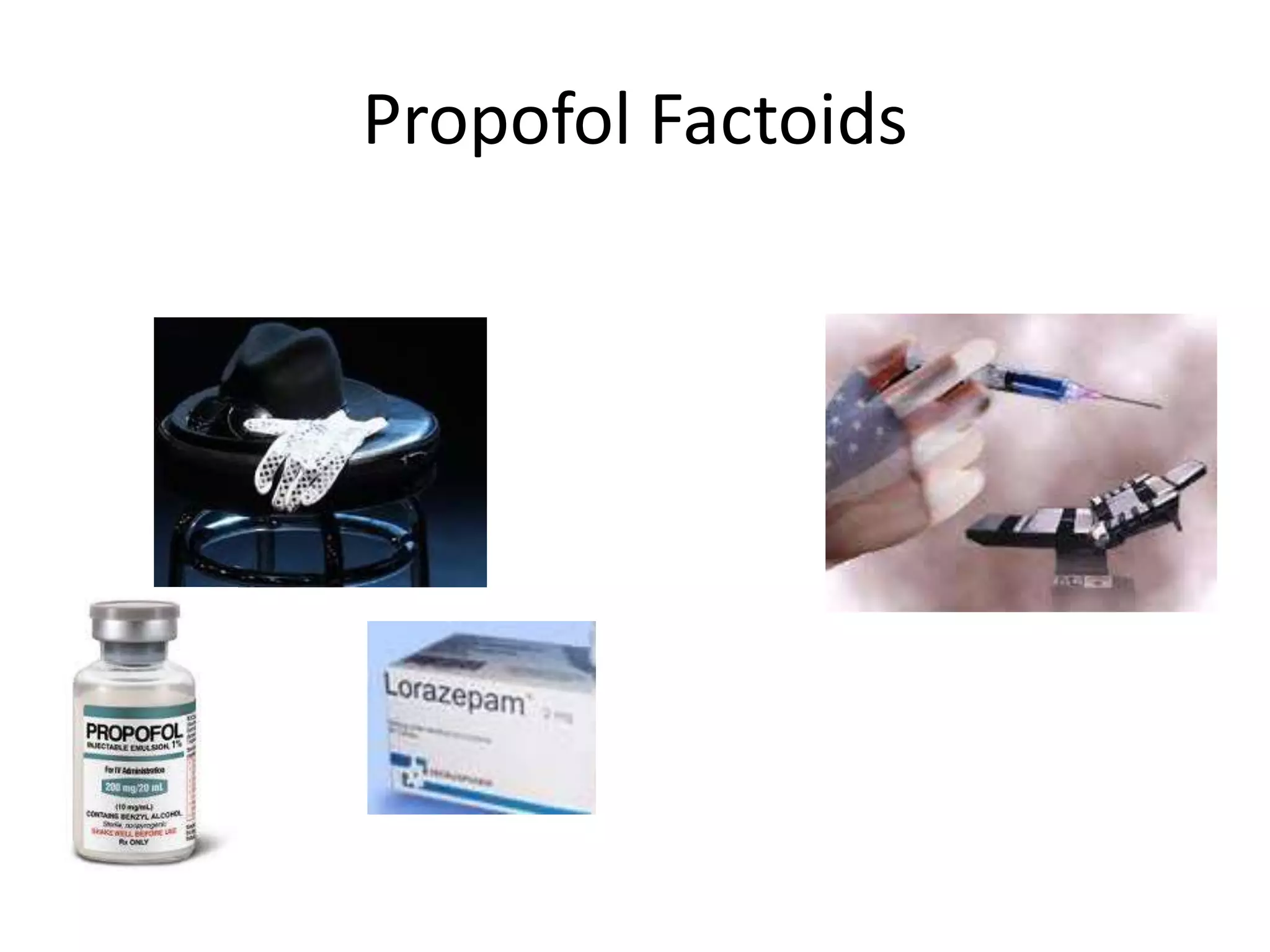
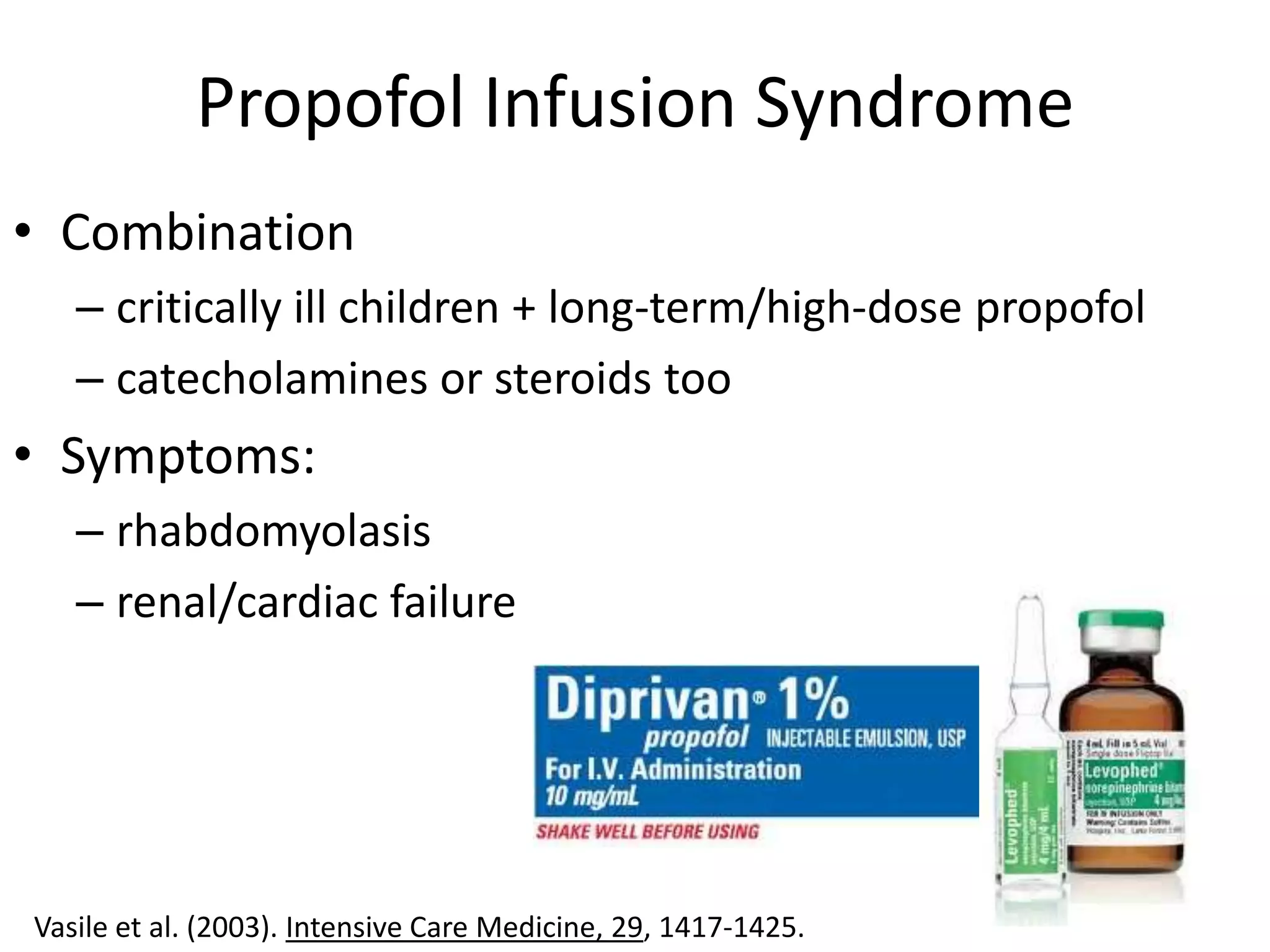
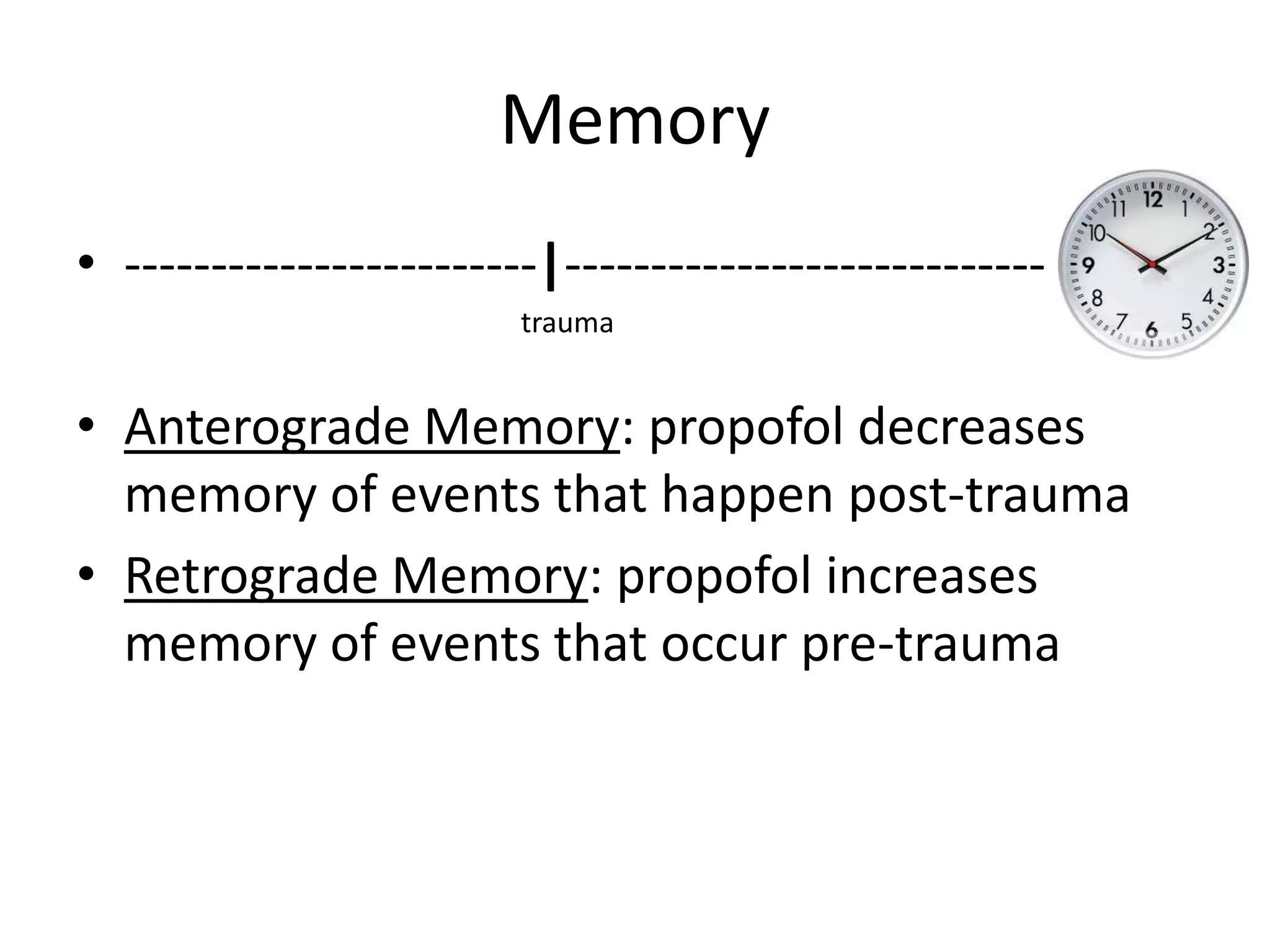
Propofol Factoids
Propofol
• Indication: hypnotic (not analgesic)
• MOA:
    –   GABAA agonist
    –   NMDA antagonist
    –   ↓ glutamate release
    –   ↓ excitotoxicity/antioxidant
• General: consistent, rapid loss (& recovery) of
  consciousness, amnesic, excellent safety margin
• Other ingredients: egg phosphatate & edetate
  disodium (EDTA)

 Example 0:35 to 1:20: http://www.youtube.com/watch?v=kmMFLOXLD-Q

 Kotani et al. (2008). CNS Neuroscience & Therapeutics, 10.1111/j.1527-3458.2008.00043.x
Propofol Infusion Syndrome
• Combination
   – critically ill children + long-term/high-dose propofol
   – catecholamines or steroids too
• Symptoms:
   – rhabdomyolasis
   – renal/cardiac failure


Vasile et al. (2003). Intensive Care Medicine, 29, 1417-1425.
Memory
• ------------------------|----------------------------
                         trauma


• Anterograde Memory: propofol decreases
  memory of events that happen post-trauma
• Retrograde Memory: propofol increases
  memory of events that occur pre-trauma
Passive Avoidance


         Day 1: Training
                 Drug
         Day 3: Test


Hauer et al. (2011). Anesthesiology, 114(6), 1380 – 1388.

Agents for Brain Injury

  • 1.
    Agents for TraumaticBrain Injury Brian J. Piper, Ph.D., M.S. piperbj@husson.edu February 15, 2013
  • 2.
    Objective • Pharmacy studentsshould be familiar with different pharmacotherapies used with brain injury including their: – mechanisms of action – relative efficacy – adverse effects
  • 3.
    falls motor-vehicle/assaults falls/motor-vehicle Burns & Hauser (2003) Epilepsia, 44(S10), 2-10.
  • 4.
    Individual Differences followingTBI apoE4+ (N=27) apoE4- (N=42) Unconscious for >1 week 77.8% 38.1%* Dysarthria 63.0% 33.3%* Overall Function: excellent 3.7% 31.0%* * p < .05 Friedman et al. (1999). Neurology, 52(2), 244-250.
  • 5.
    Secondary Injury • Allbrain damage does not occur at the moment of impact (primary injury) but evolves over the ensuing hours and days (secondary injury). • The injured brain is extremely vulnerable to hypotension, hypoxia, and increased intracranial pressure which are causes of secondary injury.
  • 6.
    ↓ Blood Pressure:Tx-Dopamine • MOA: D1 > α1 • Effects: ↑ systolic bp
  • 7.
    Intra-Cranial Pressure • Thereis only one way out of the intracranial vault, the opening at the base of the skull: foramen magnum
  • 8.
    ↑ Intracranial Pressure:Tx-Mannitol • History: sugar derivative of mannose-1961 • Frequency: majority of trauma centers • Effect: – immediate ↓ ICP; withdrawal ↑ ICP – renal failure Grande & Romner (2012). J Neurosurg, 24(4), 407-412.
  • 9.
    Mannitol versus HypertonicSaline -> Vialet et al. (2003). Critical Care Medicine, 36, 795-800.
  • 10.
    Mannitol versus HypertonicSaline Vialet et al. (2003). Critical Care Medicine, 36, 795-800.
  • 11.
    ↑ Intracranial Pressure:Tx- Barbiturates • Indications: – ↑ ICP refractory to other treatments • Frequency: minority of trauma centers • Rationale: – ↓ neuron activity ↓ metabolic demands – ↓ free radical formation • Effect: – immediate ↓ ICP; hypotension (25%) Roberts & Sydenham (2012). Cochrane Database of Systematic Reviews, 10.1002/14651858.CD000033.pub2.
  • 12.
    Absence of evidence≠ Evidence of absence • “There is insufficient reliable evidence to make recommendations on the use of mannitol in the management of patients with traumatic brain injury.” • “There is no evidence that barbiturates improve outcomes in people with acute brain injury.” Wakai et al. (2008). Cochrane Database of Systematic Reviews, 10.1002/14651858.CD001049.pub4. Roberts & Sydenham (2012). Cochrane Database of Systematic Reviews, 10.1002/14651858.CD000033.pub2.
  • 13.
  • 14.
    Propofol • Indication: hypnotic(not analgesic) • MOA: – GABAA agonist – NMDA antagonist – ↓ glutamate release – ↓ excitotoxicity/antioxidant • General: consistent, rapid loss (& recovery) of consciousness, amnesic, excellent safety margin • Other ingredients: egg phosphatate & edetate disodium (EDTA) Example 0:35 to 1:20: http://www.youtube.com/watch?v=kmMFLOXLD-Q Kotani et al. (2008). CNS Neuroscience & Therapeutics, 10.1111/j.1527-3458.2008.00043.x
  • 15.
    Propofol Infusion Syndrome •Combination – critically ill children + long-term/high-dose propofol – catecholamines or steroids too • Symptoms: – rhabdomyolasis – renal/cardiac failure Vasile et al. (2003). Intensive Care Medicine, 29, 1417-1425.
  • 16.
    Memory • ------------------------|---------------------------- trauma • Anterograde Memory: propofol decreases memory of events that happen post-trauma • Retrograde Memory: propofol increases memory of events that occur pre-trauma
  • 17.
    Passive Avoidance Day 1: Training Drug Day 3: Test Hauer et al. (2011). Anesthesiology, 114(6), 1380 – 1388.

Editor's Notes

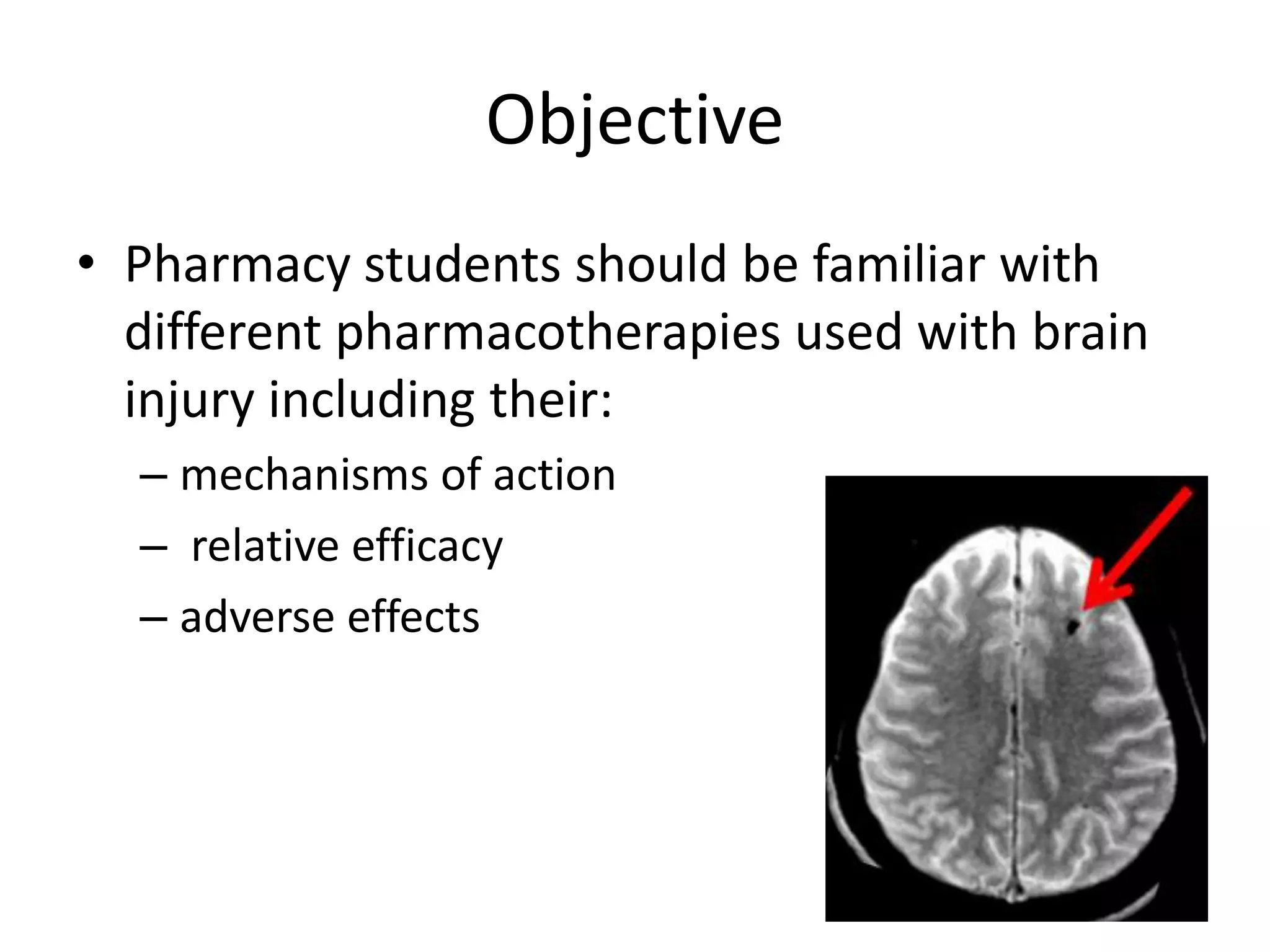
  • #2 Post-mortem CT of bullet through brain (note bone fragments, white, and gas build-up, black).
  • #3 T2 MRI showing micro-hemorage (black).
  • #4 Age distribution is tri-modal with peaks in infancy, adolescence/young-adulthood, and elderly. TBIs are most likely to be fatal among the elderly.
  • #5 APOE is an attractive target because it is thought to play an important role in synaptic repair, remodeling,and neuron protection.After a follow-up period of 6 to 8 months, a functional assessment regarding mobility and independence in activities of daily living was performed. Residual communicative disorders, either dysphasia or dysarthria (difficulty with articulation), were determined by speech pathologists. Note that this finding has not been consistently replicated.
  • #7 Dopamine has less prominent effects on adrenergic receptors. Higher doses can elevate diastolic and heart rate.
  • #9 Manitol is a sugar alcohol. The root of both &quot;mannose&quot; and &quot;mannitol&quot; is manna, which the Bible records as the food supplied to the Israelites during their journey in the region of Sinai. There are case reports of renal failure.
  • #11 Failure was defined as the persistence of intracranial hypertension despite two successive infusions of the same osmotic agent.
  • #13 Interesting ethics regarding mannitol research: http://europepmc.org/articles/PMC1804156
  • #14 Dr. Conrad Murray was convicted of involuntary manslaughter in 2011 and sentenced to 4 years. 3/5 of people receiving Propofol will report pain upon initial administration and 1/5 will report severe pain. A common solution is to co-administer with lidocaine.
  • #15 This agent has a moderate effect on somatodendritic GABAB receptors too. Due to white color, this agent is also know as “milk of amnesia”. This agents can put people to sleep in 30 seconds. Edetate disodium is used to inhibit bacteria &amp; fungal growth but likely contributes to the antioxidant effect.
  • #16 Rhabdomyloysis:An acute, sudden, potentially fatal disease that destroys skeletalmuscle and is often accompanied by the excretion of myoglobin in the urine.