Factorial Designs
 Brian J. Piper, Ph.D.
Goals
• Main Effect(s)
• Interaction
• graph & statistics comparison
Terminology
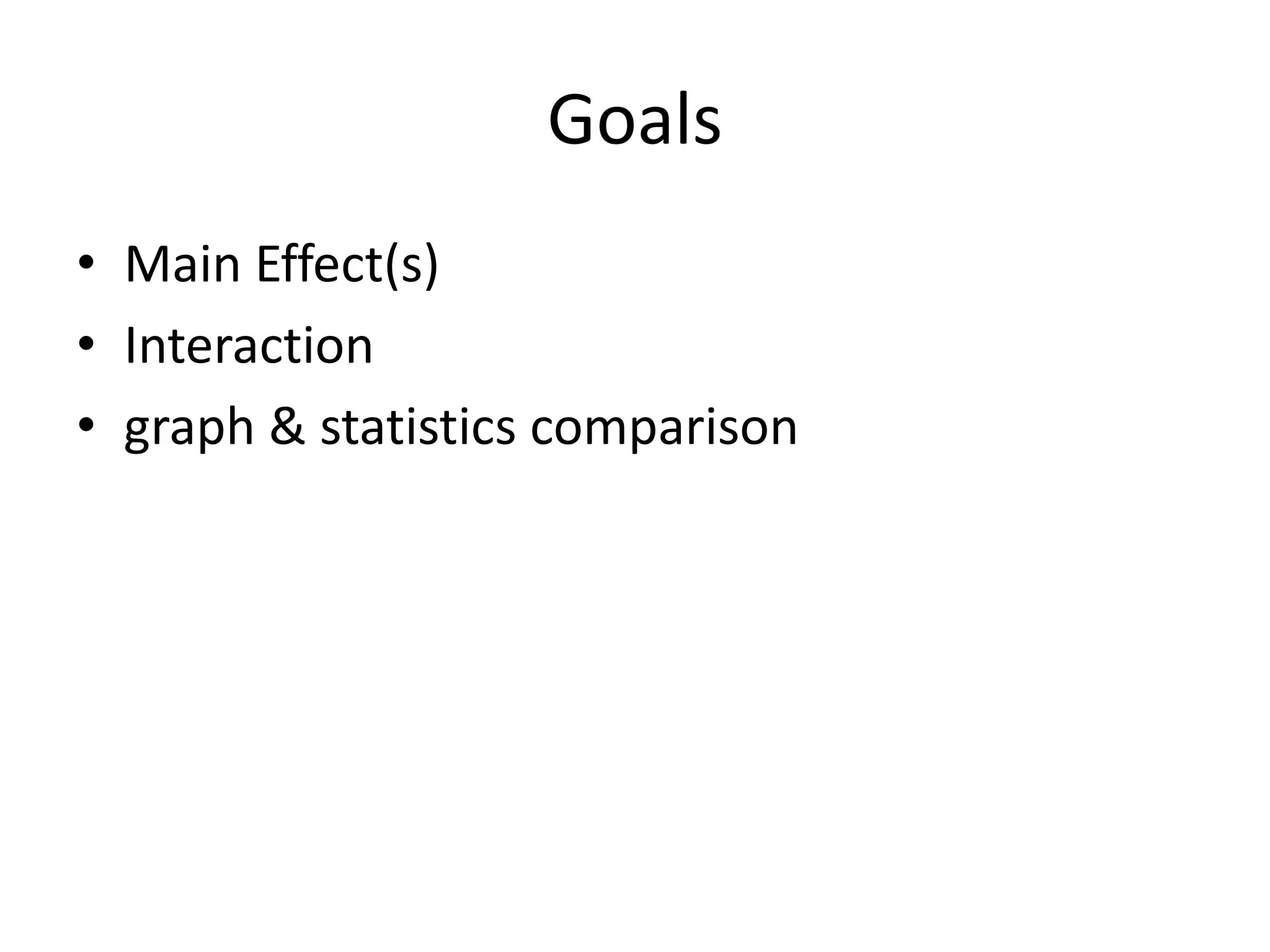
• ceiling effects:
• floor effects:
• factorial design: more than 1 independent variable
  –2x3
  –3x4
  – 2 x 5 mixed (2 between group, 5 within groups)
• factorial matrix (2 x 2) with 4 cells (conditions)
                     Males         Females
        Drug         1st           2nd
        Placebo      4th           3rd


• main effect: overall effect of an IV (sex or drug)
Terminology
• Ceiling effects: mean score near maximum
• Floor effects: mean score near minimum
• factorial design: more than 1 independent variable
  –2x3
  –3x4
  – 2 x 5 mixed (2 between group, 5 within groups)
• factorial matrix (2 x 2) with 4 cells (conditions)
                        Males (A1)   Females (A2)
        Drug (B1)       1st          2nd
        Placebo (B2)    4th          3rd


• main effect: overall effect of an IV (sex or drug)
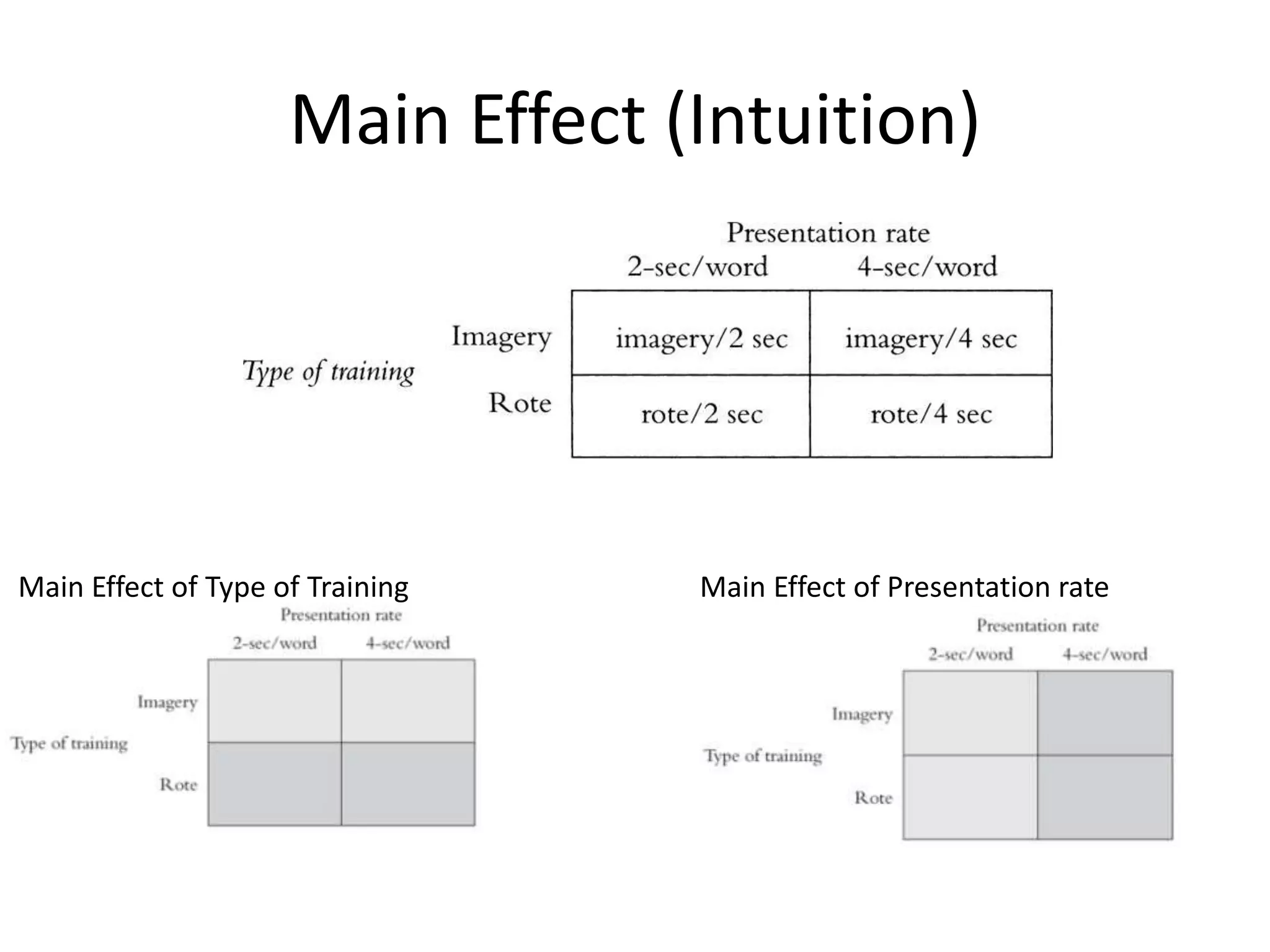
Main Effect (Intuition)


Main Effect of Type of Training   Main Effect of Presentation rate
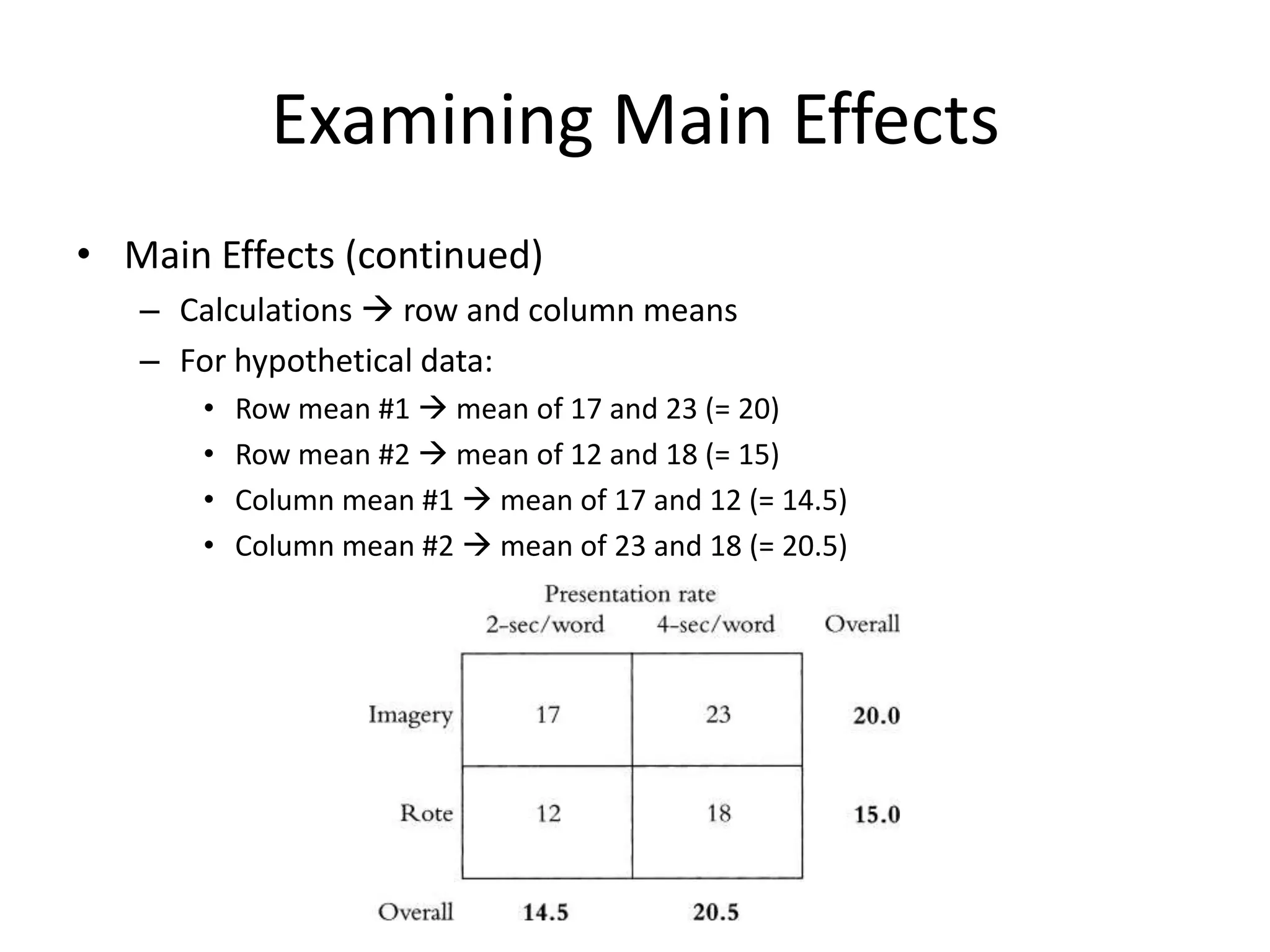
Examining Main Effects
• Main Effects (continued)
   – Calculations  row and column means
   – For hypothetical data:
       •   Row mean #1  mean of 17 and 23 (= 20)
       •   Row mean #2  mean of 12 and 18 (= 15)
       •   Column mean #1  mean of 17 and 12 (= 14.5)
       •   Column mean #2  mean of 23 and 18 (= 20.5)
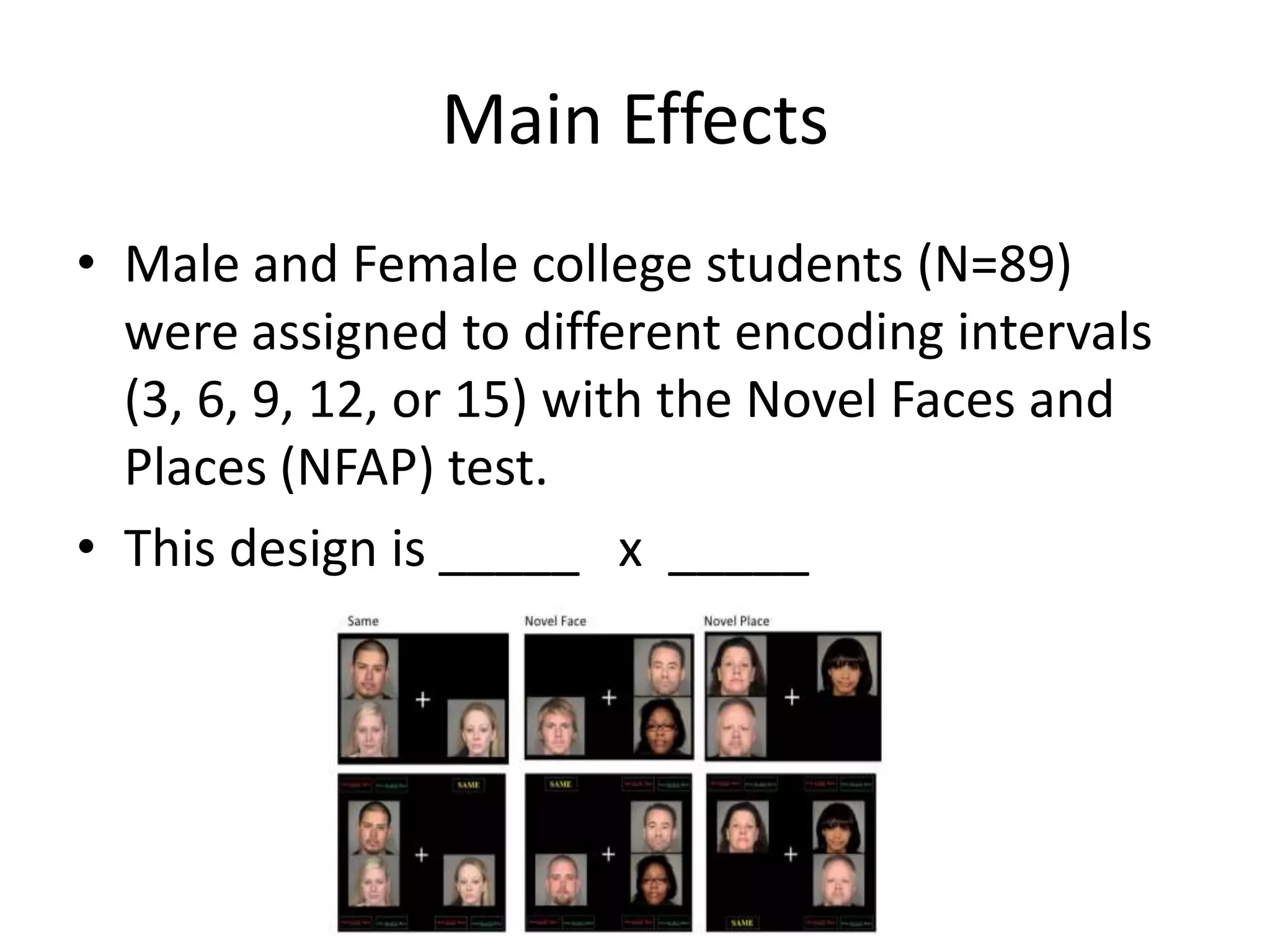
Main Effects
• Male and Female college students (N=89)
  were assigned to different encoding intervals
  (3, 6, 9, 12, or 15) with the Novel Faces and
  Places (NFAP) test.
• This design is _____ x _____
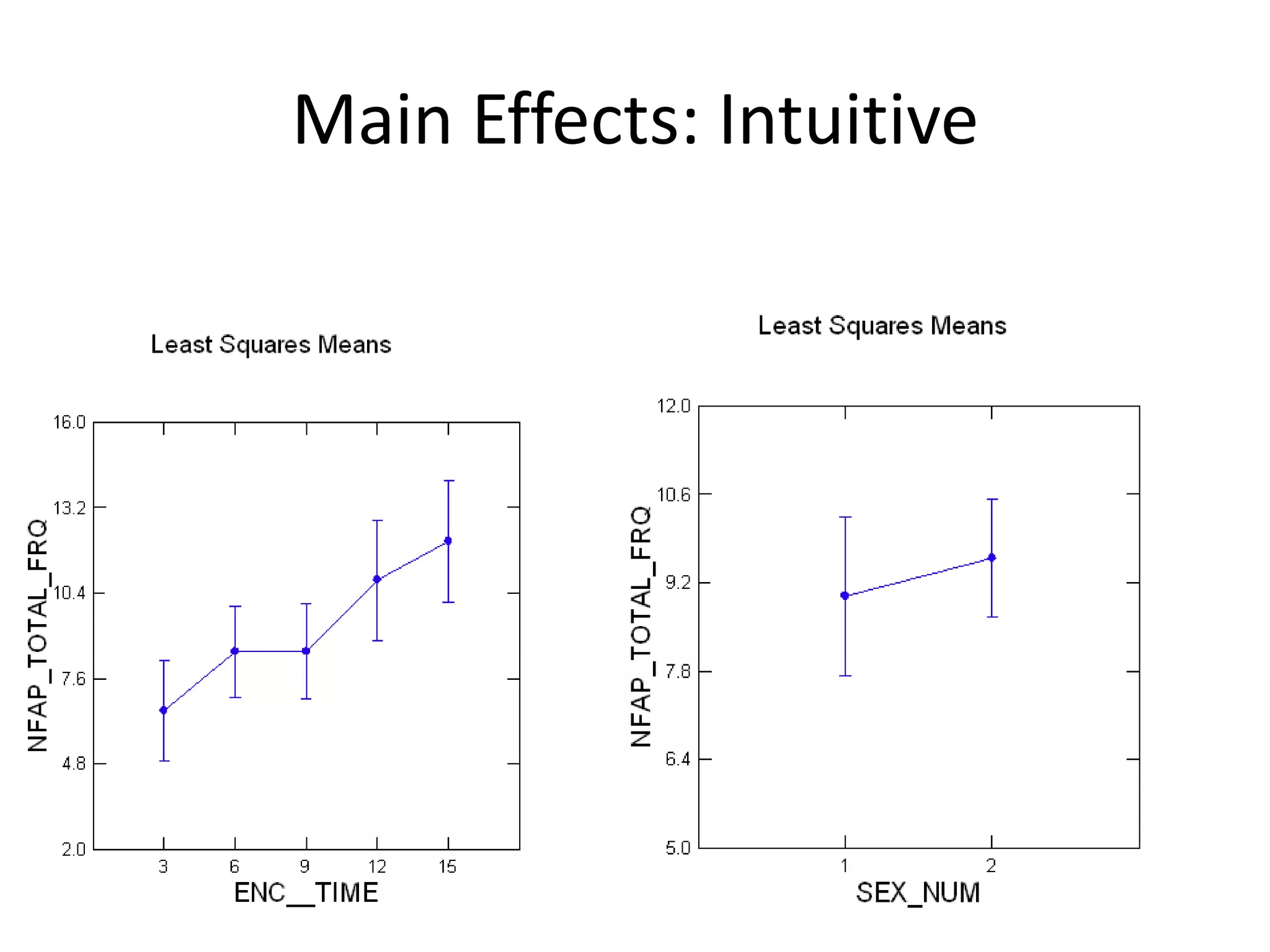
Main Effects: Intuitive
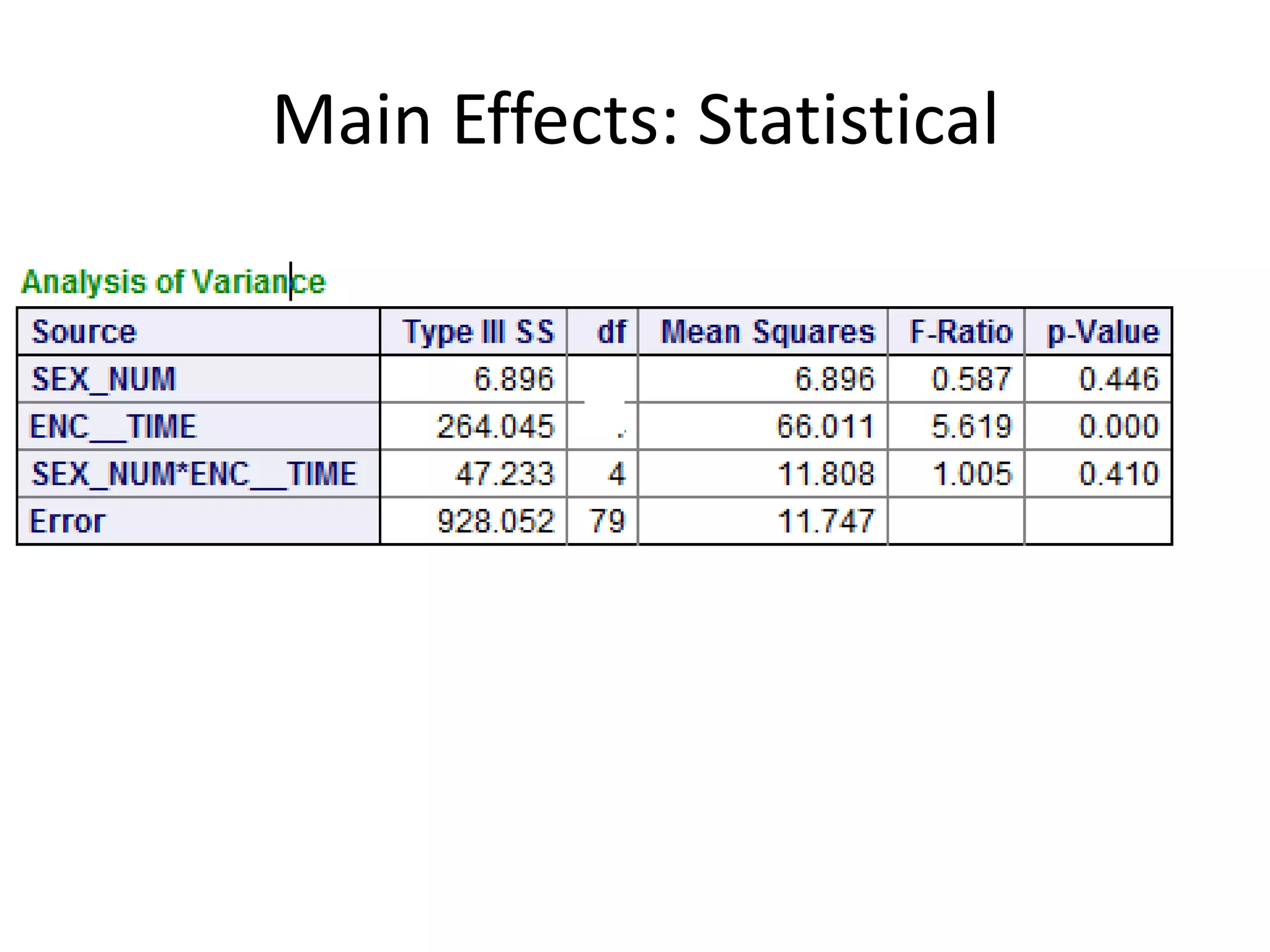
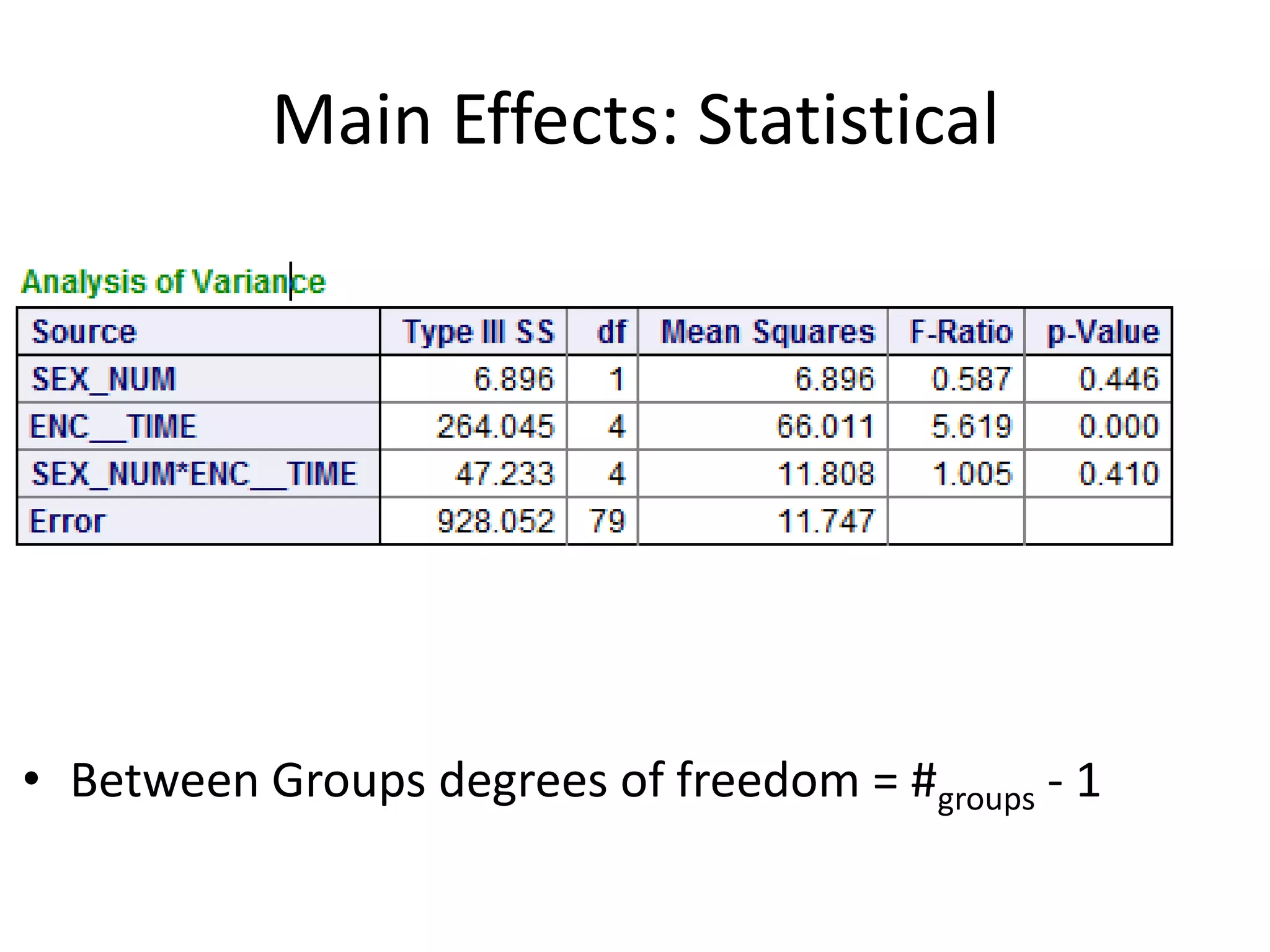
Main Effects: Statistical


• Between Groups degrees of freedom = #groups - 1
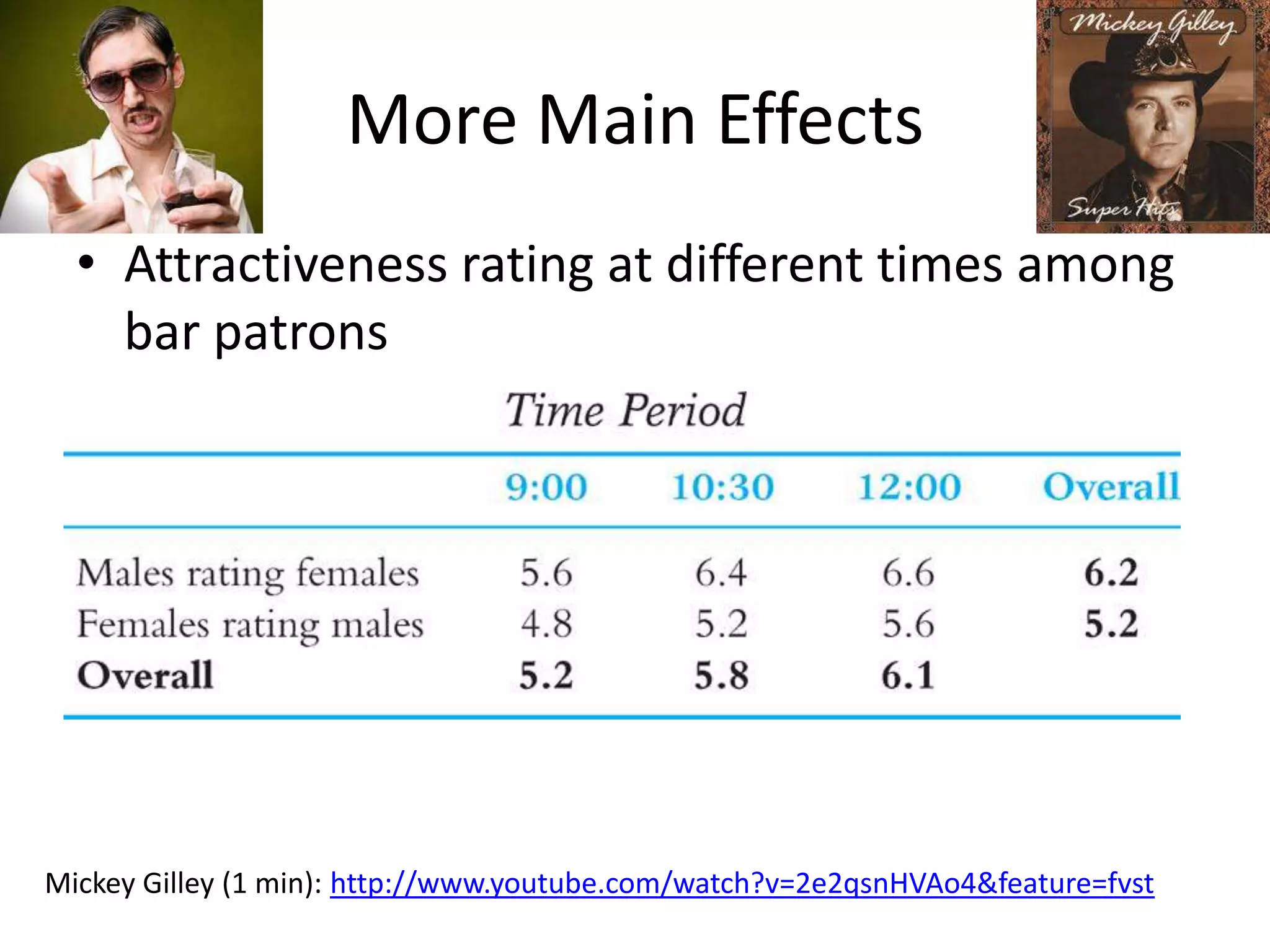
More Main Effects
  • Attractiveness rating at different times among
    bar patrons


Mickey Gilley (1 min): http://www.youtube.com/watch?v=2e2qsnHVAo4&feature=fvst
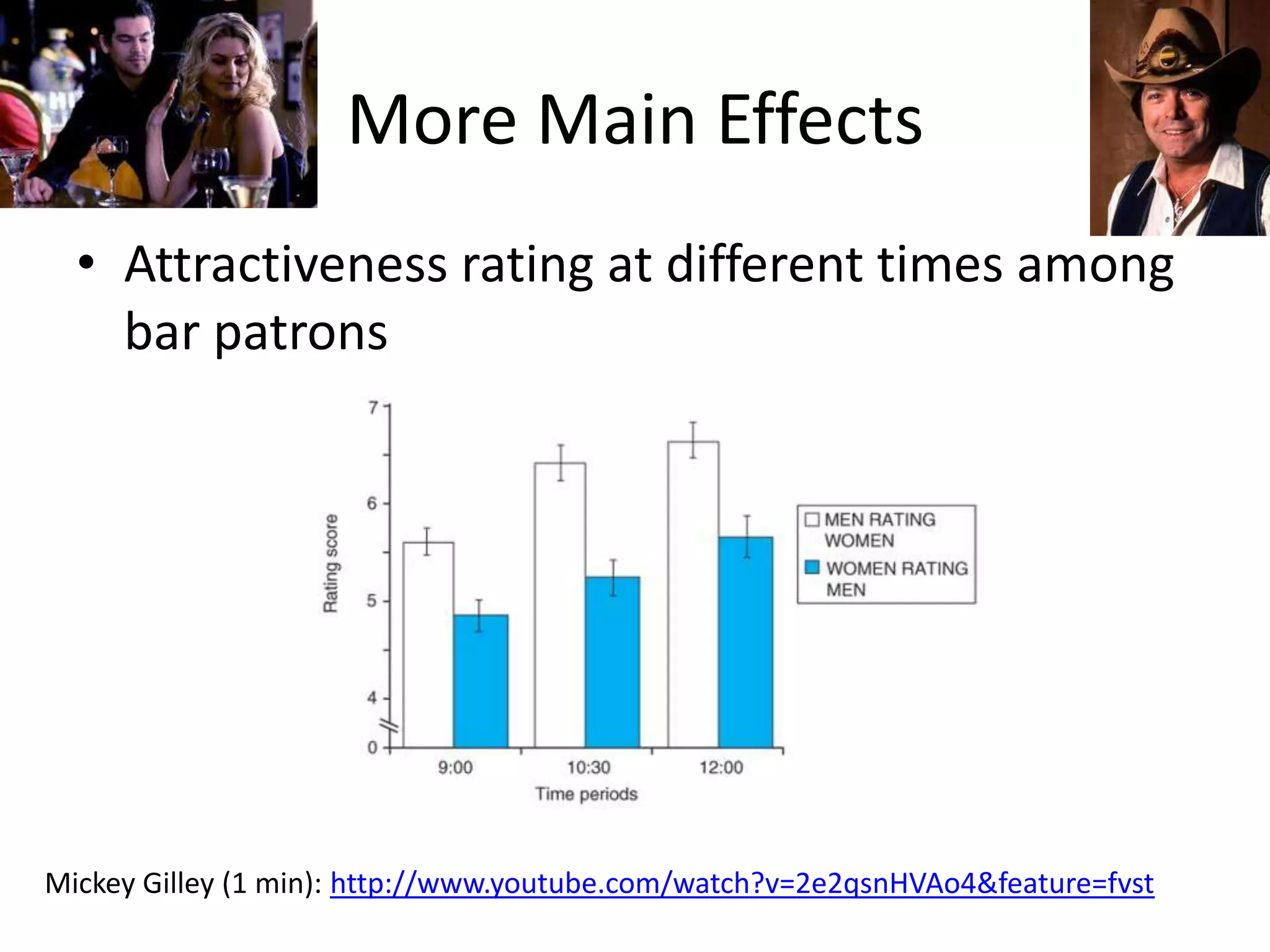
More Main Effects
  • Attractiveness rating at different times among
    bar patrons


Mickey Gilley (1 min): http://www.youtube.com/watch?v=2e2qsnHVAo4&feature=fvst
Interaction
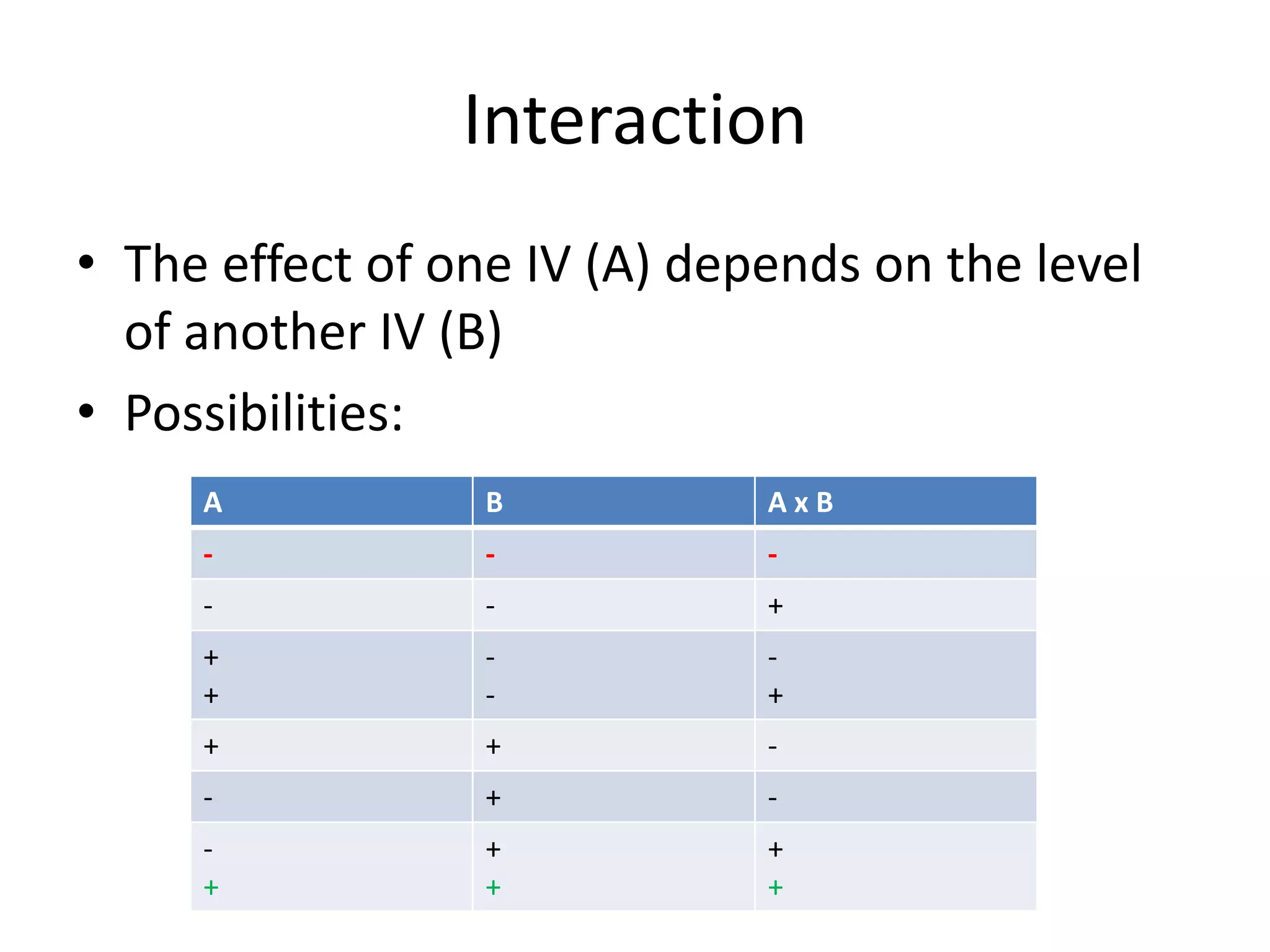
• The effect of one IV (A) depends on the level
  of another IV (B)
• Possibilities:
     A            B           AxB
     -            -           -
     -            -           +
     +            -           -
     +            -           +
     +            +           -
     -            +           -
     -            +           +
     +            +           +
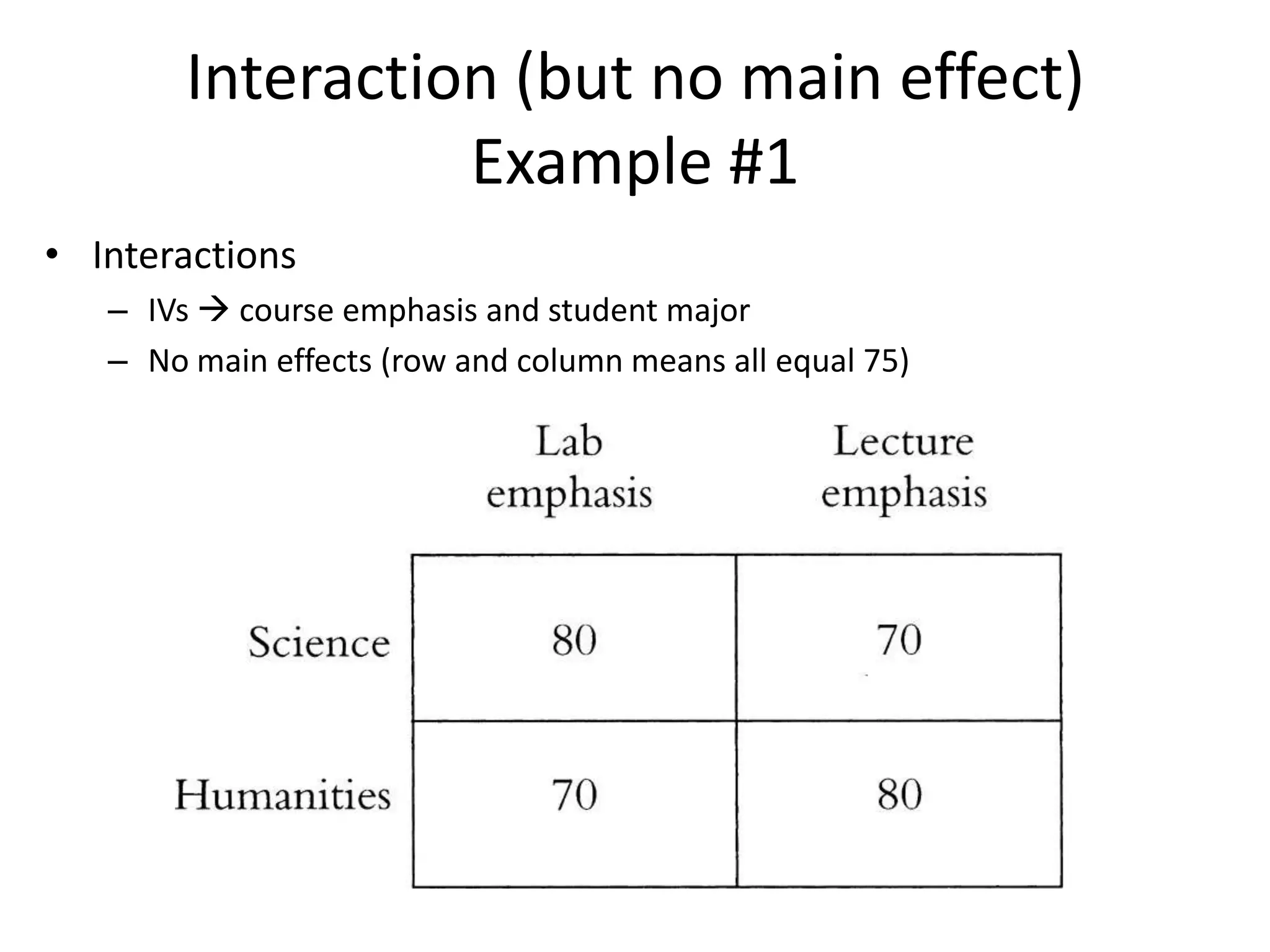
Interaction (but no main effect)
                  Example #1
• Interactions
   – IVs  course emphasis and student major
   – No main effects (row and column means all equal 75)
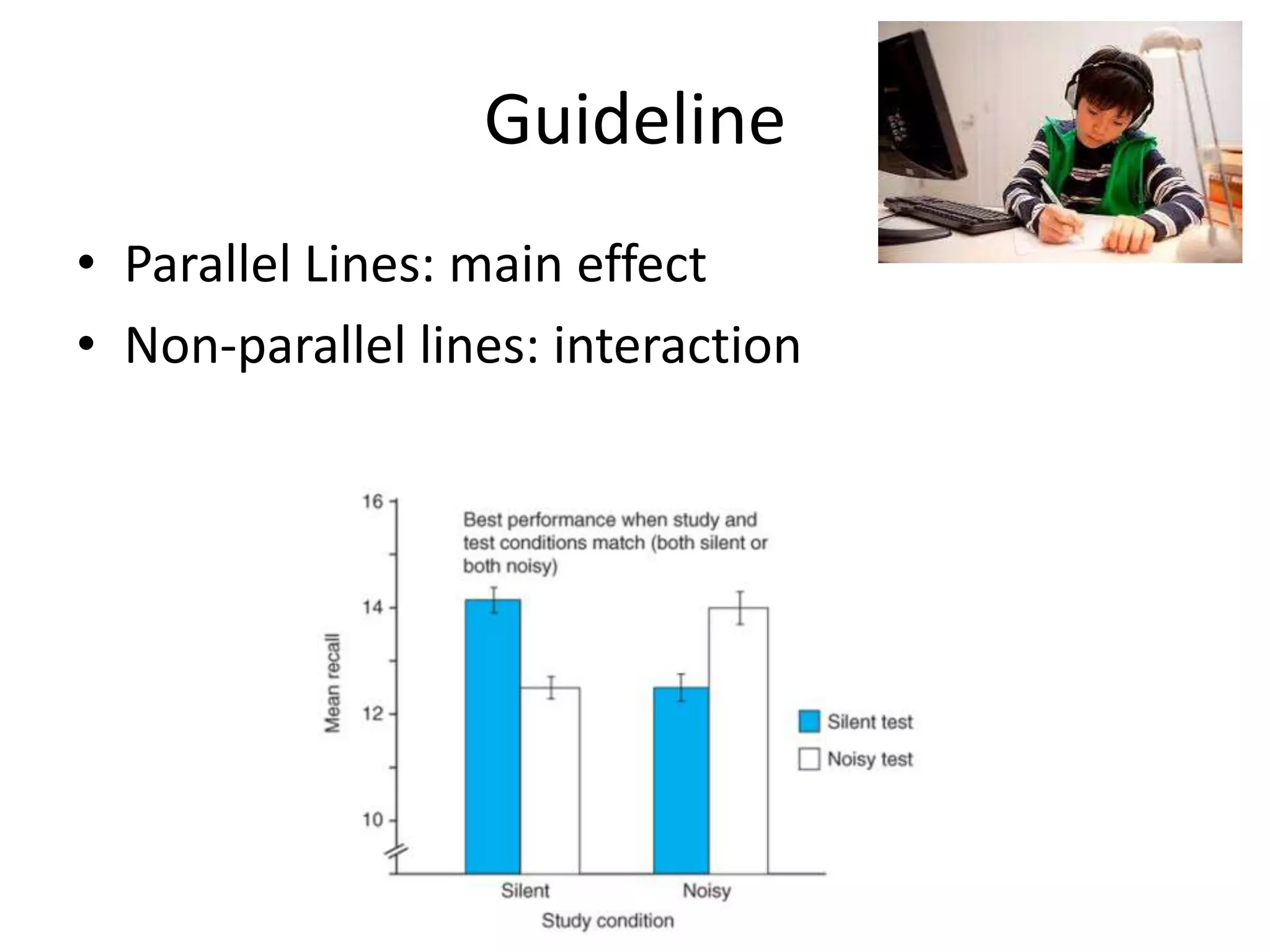
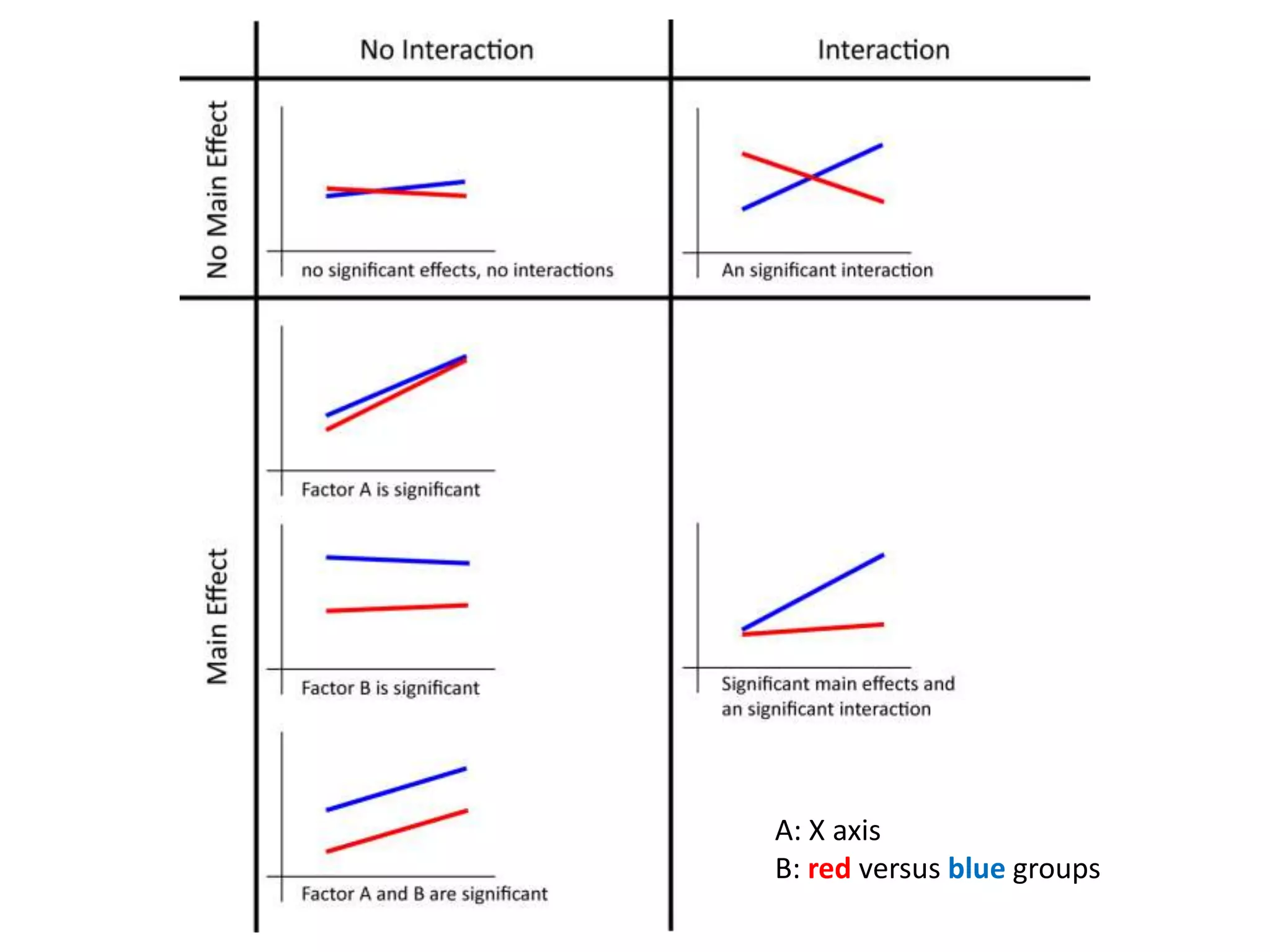
Guideline
• Parallel Lines: main effect
• Non-parallel lines: interaction
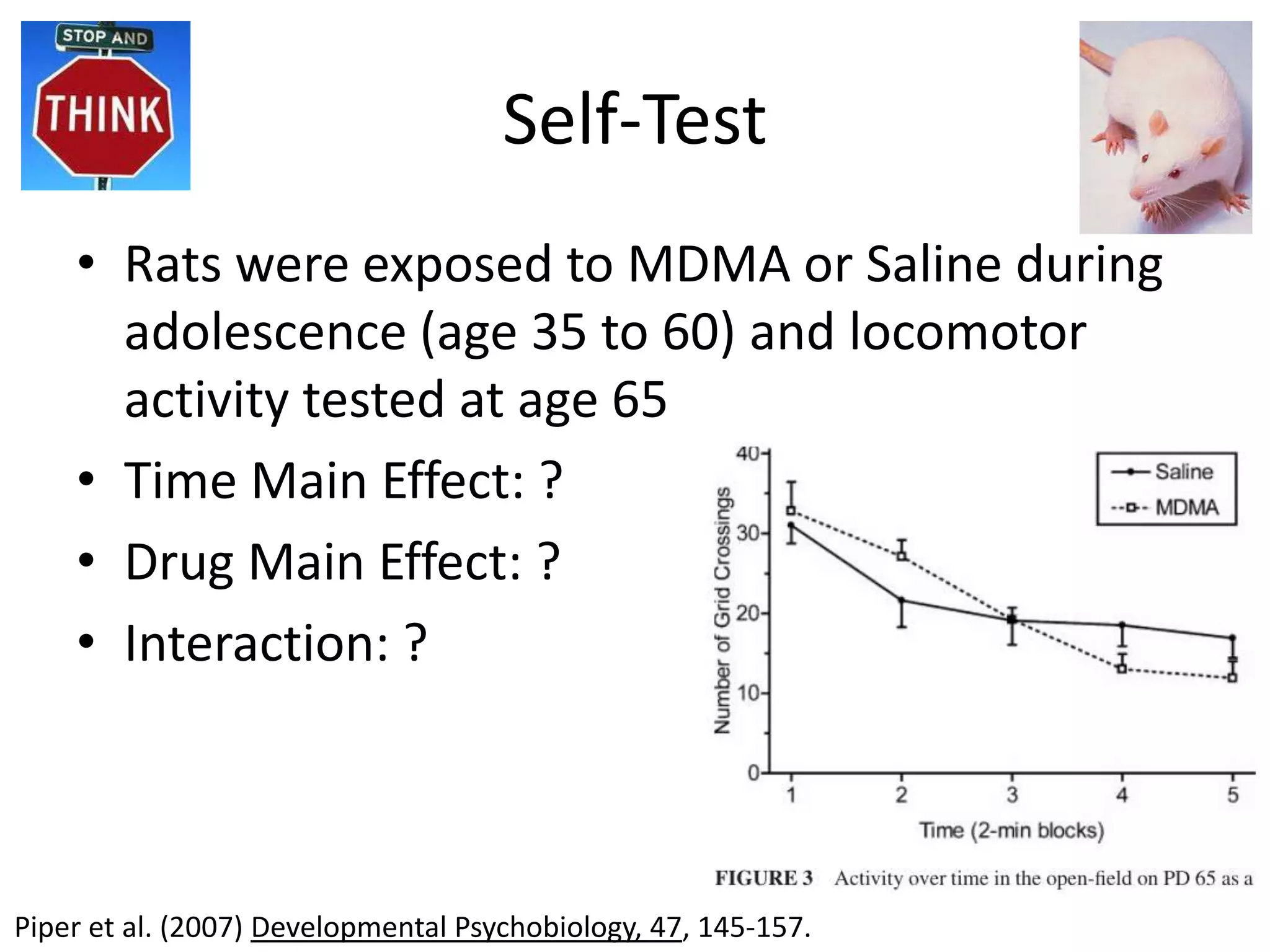
Self-Test
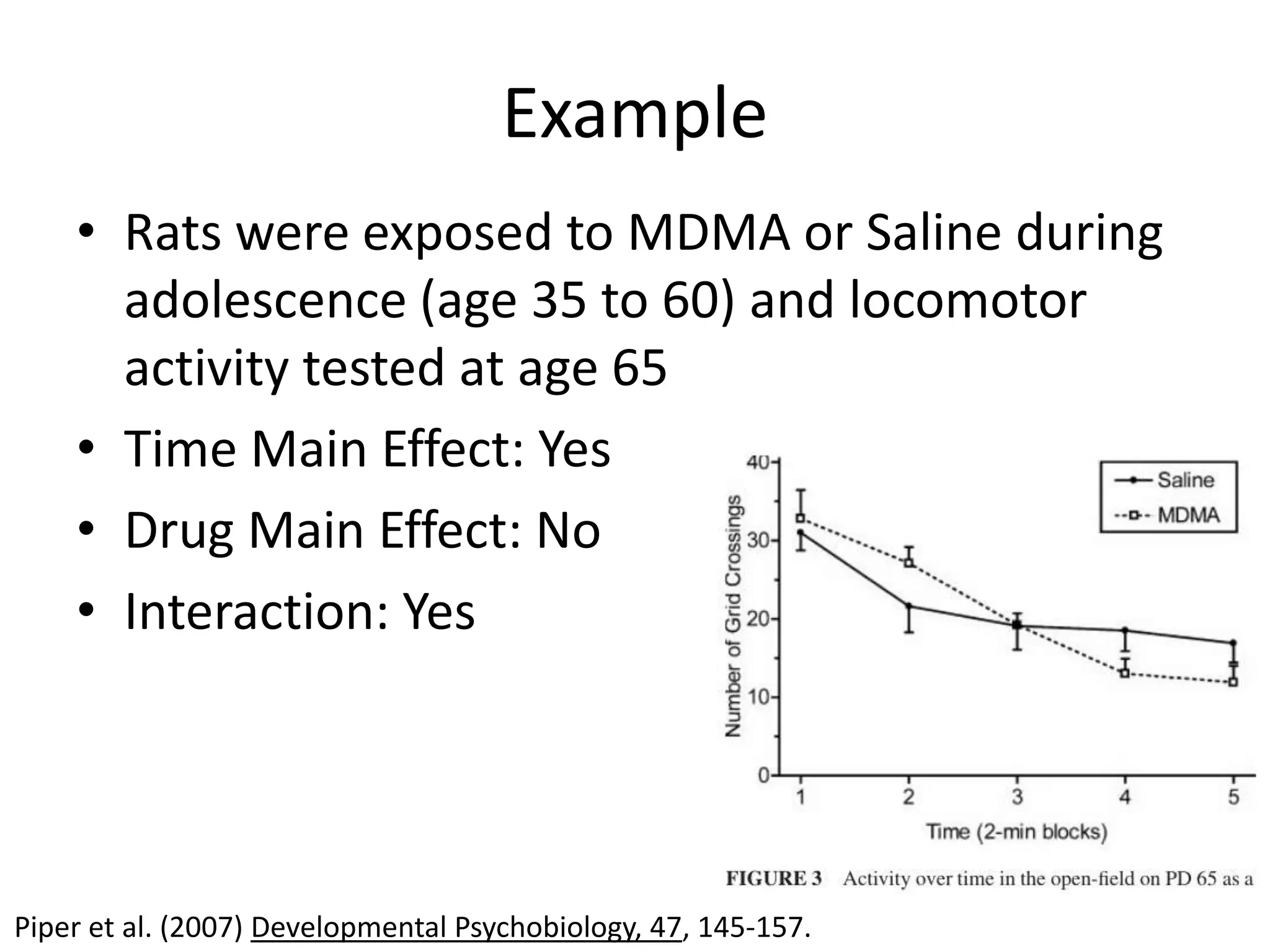
    • Rats were exposed to MDMA or Saline during
      adolescence (age 35 to 60) and locomotor
      activity tested at age 65
    • Time Main Effect: ?
    • Drug Main Effect: ?
    • Interaction: ?


Piper et al. (2007) Developmental Psychobiology, 47, 145-157.
Example
    • Rats were exposed to MDMA or Saline during
      adolescence (age 35 to 60) and locomotor
      activity tested at age 65
    • Time Main Effect: Yes
    • Drug Main Effect: No
    • Interaction: Yes


Piper et al. (2007) Developmental Psychobiology, 47, 145-157.
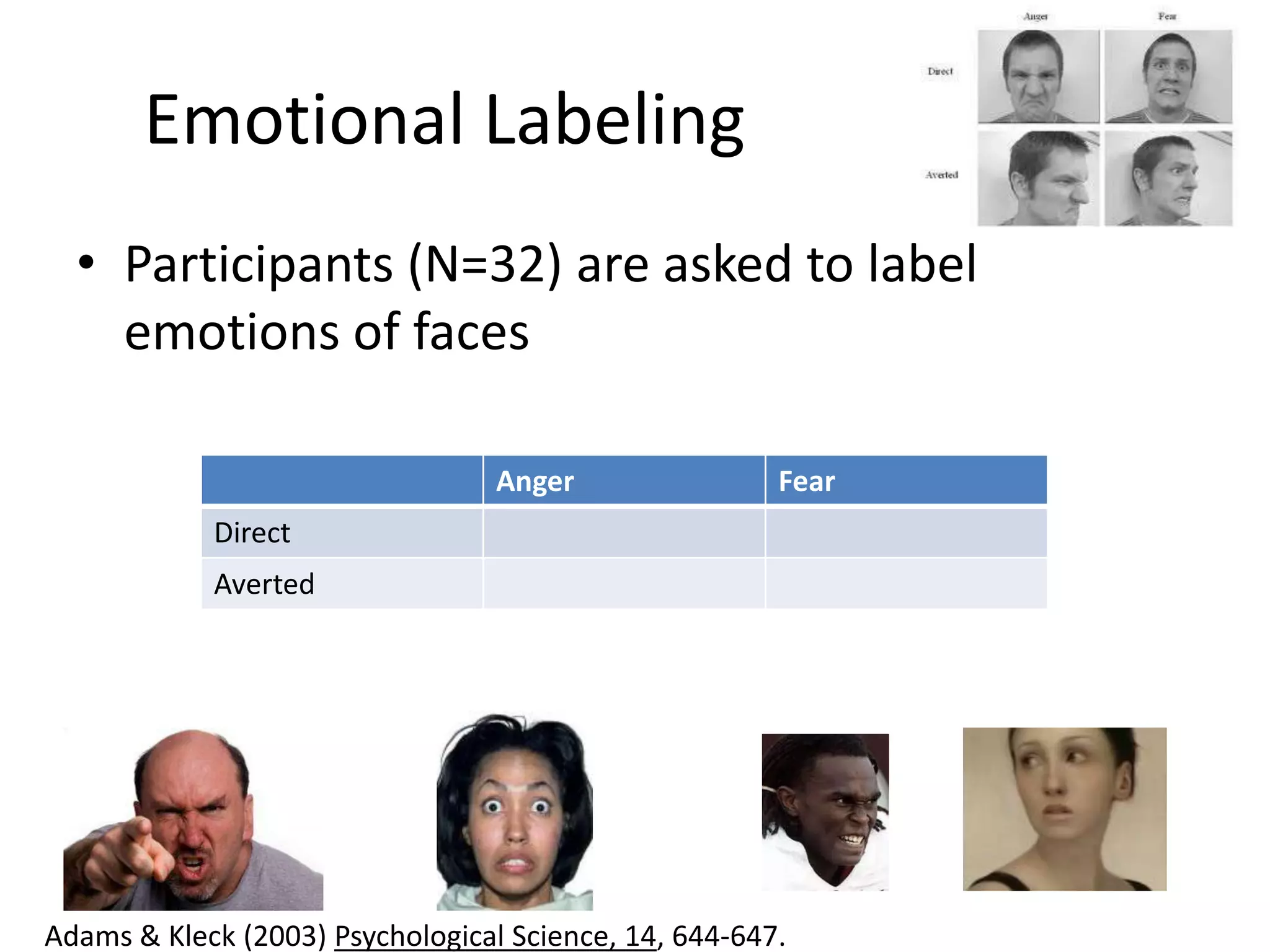
Emotional Labeling
  • Participants (N=32) are asked to label
    emotions of faces

                                  Anger                Fear
            Direct
            Averted


Adams & Kleck (2003) Psychological Science, 14, 644-647.
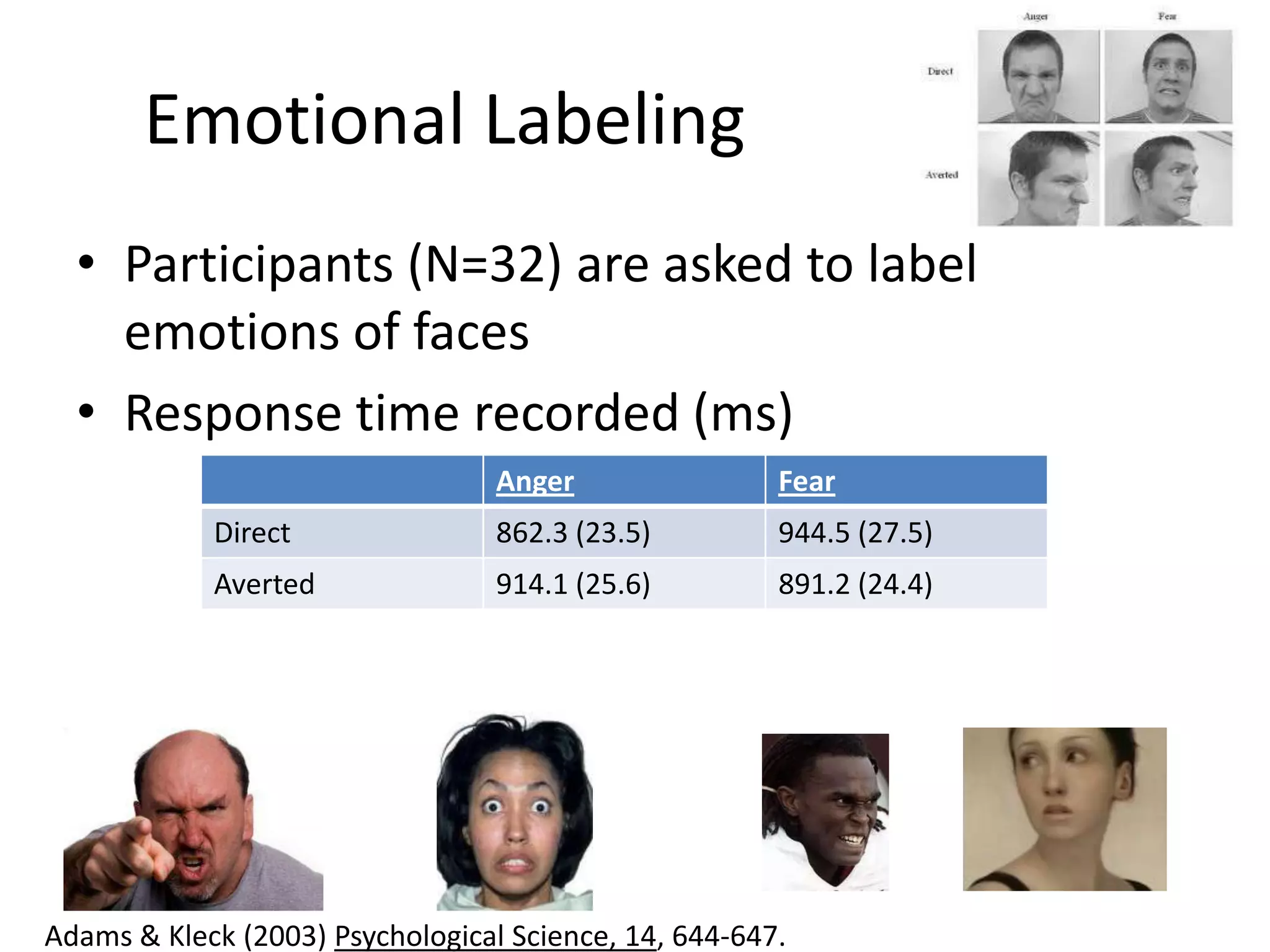
Emotional Labeling
  • Participants (N=32) are asked to label
    emotions of faces
  • Response time recorded (ms)
                                  Anger                Fear
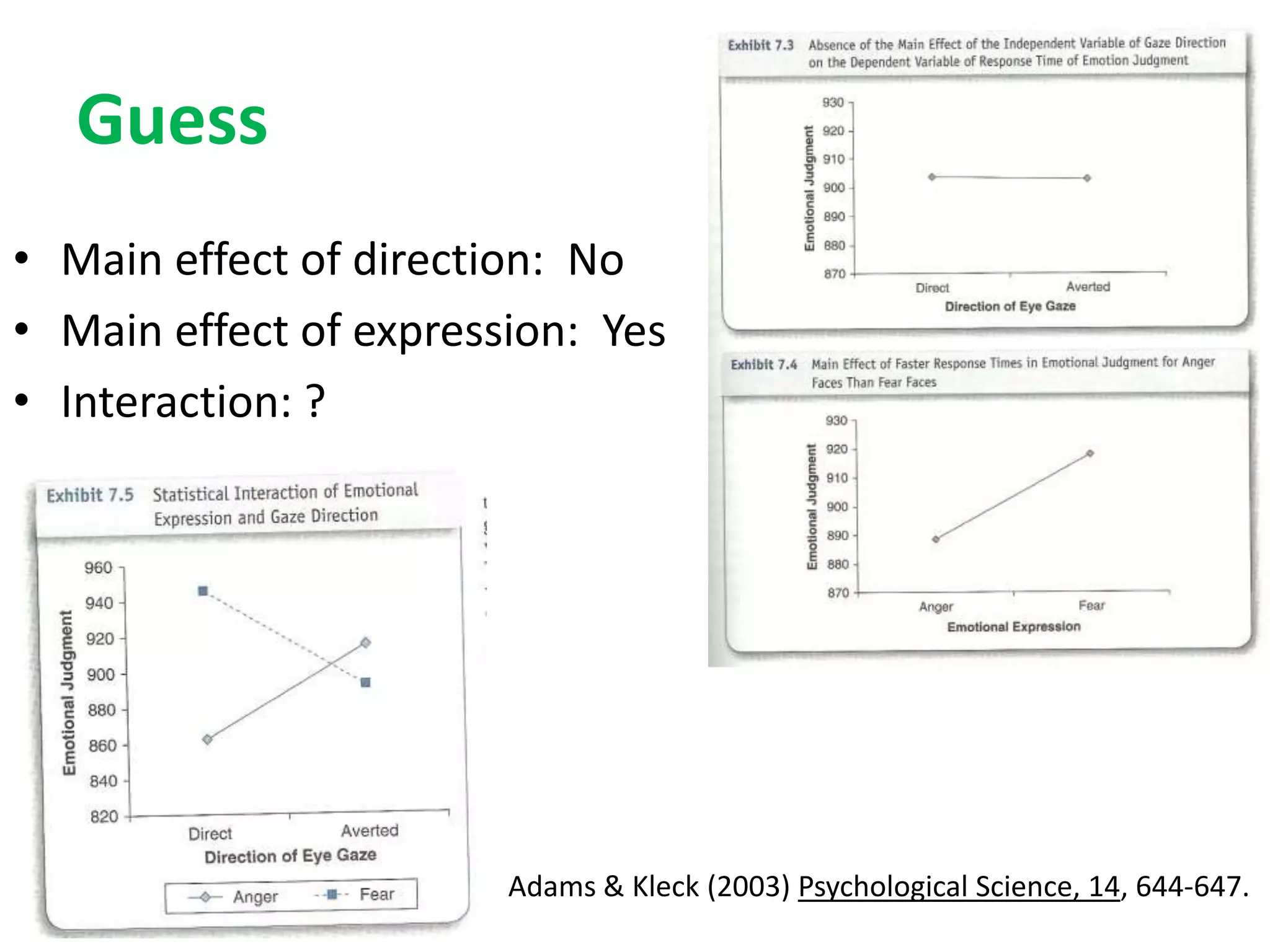
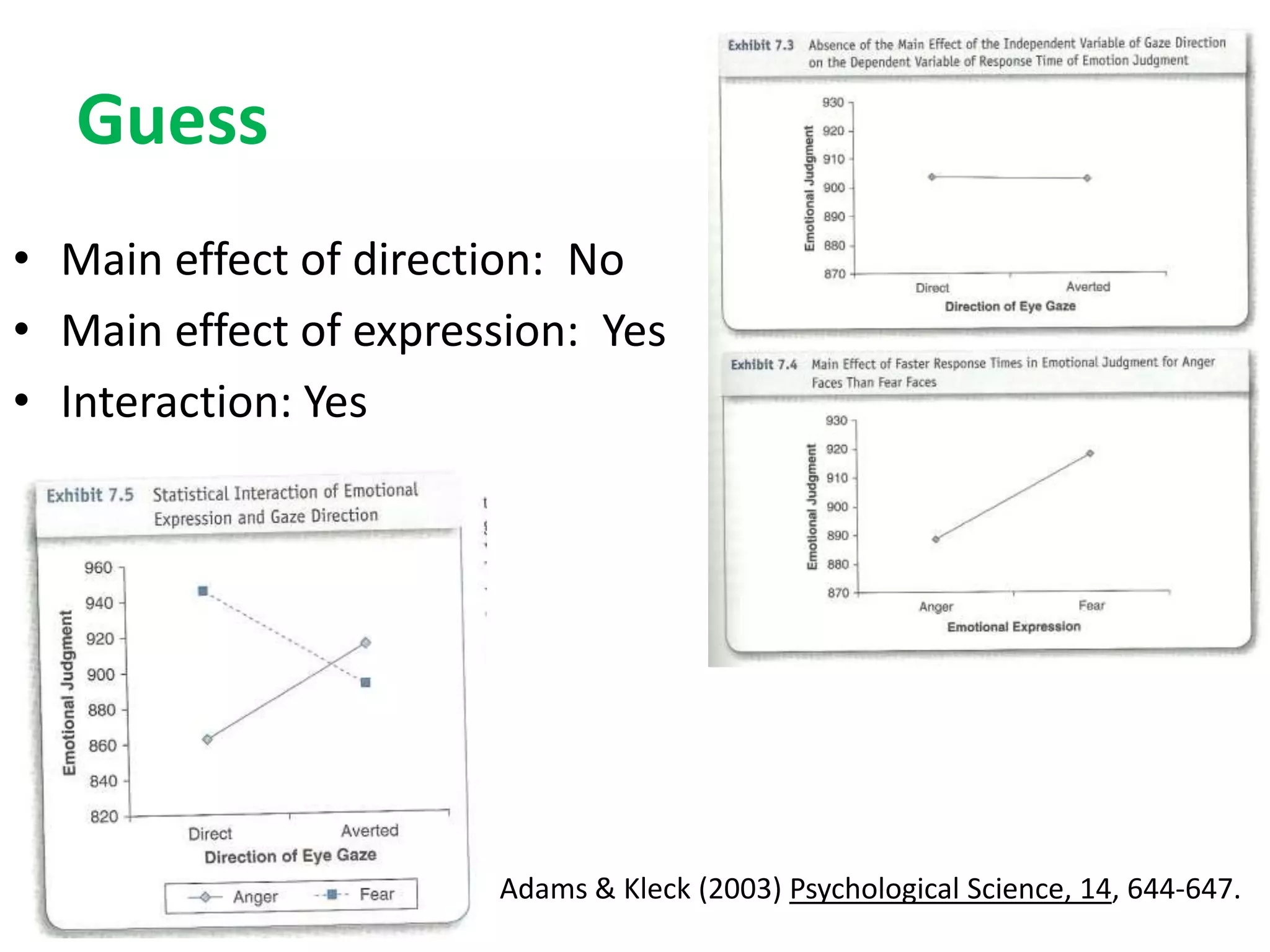
            Direct                862.3 (23.5)         944.5 (27.5)
            Averted               914.1 (25.6)         891.2 (24.4)


Adams & Kleck (2003) Psychological Science, 14, 644-647.
Guess
• Main effect of direction: ?
• Main effect of expression: ?
• Interaction: ?
Guess
• Main effect of direction: No
• Main effect of expression: Yes
• Interaction: ?


                        Adams & Kleck (2003) Psychological Science, 14, 644-647.
Guess
• Main effect of direction: No
• Main effect of expression: Yes
• Interaction: Yes


                       Adams & Kleck (2003) Psychological Science, 14, 644-647.
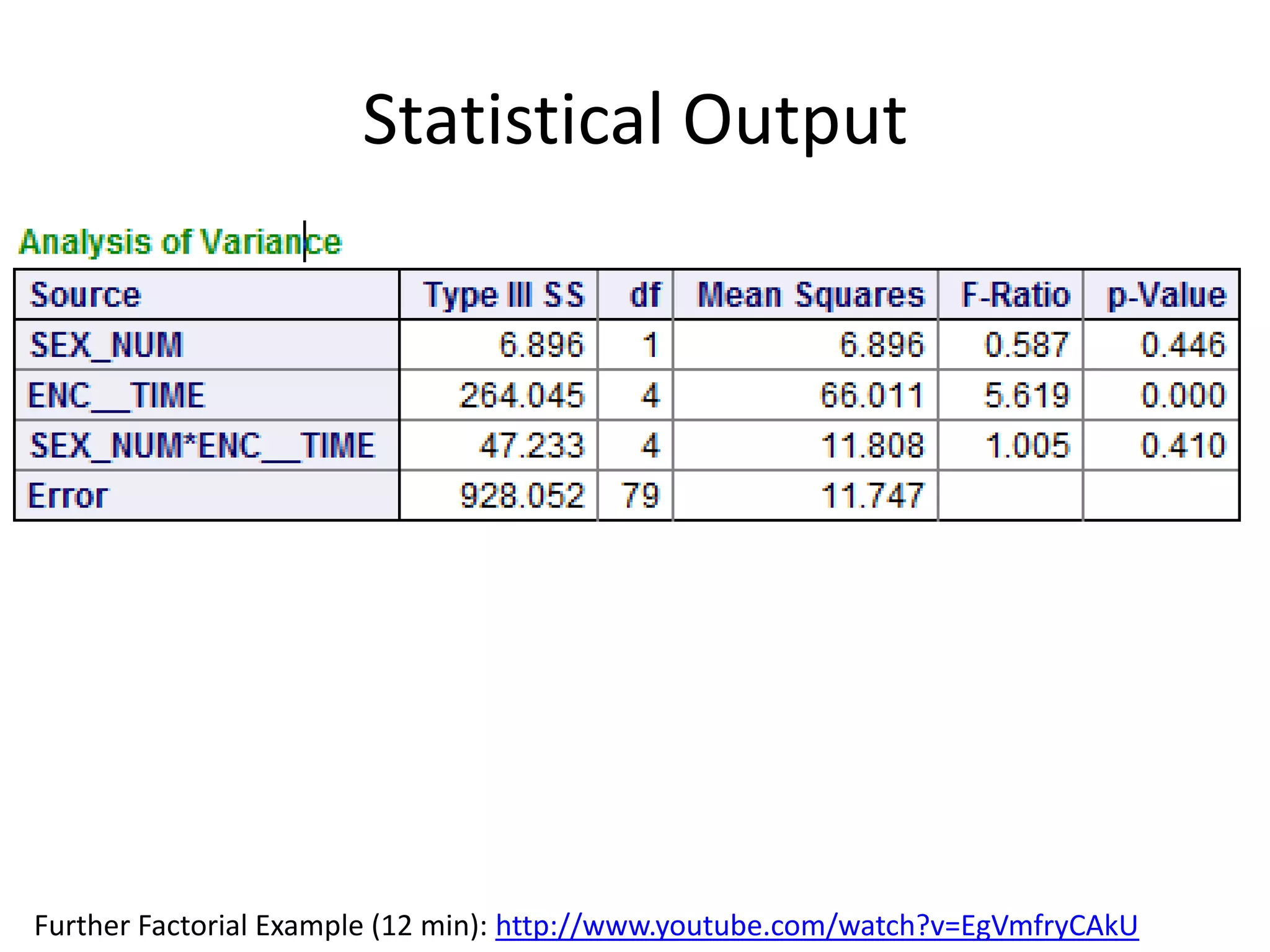
Statistical Output


Further Factorial Example (12 min): http://www.youtube.com/watch?v=EgVmfryCAkU
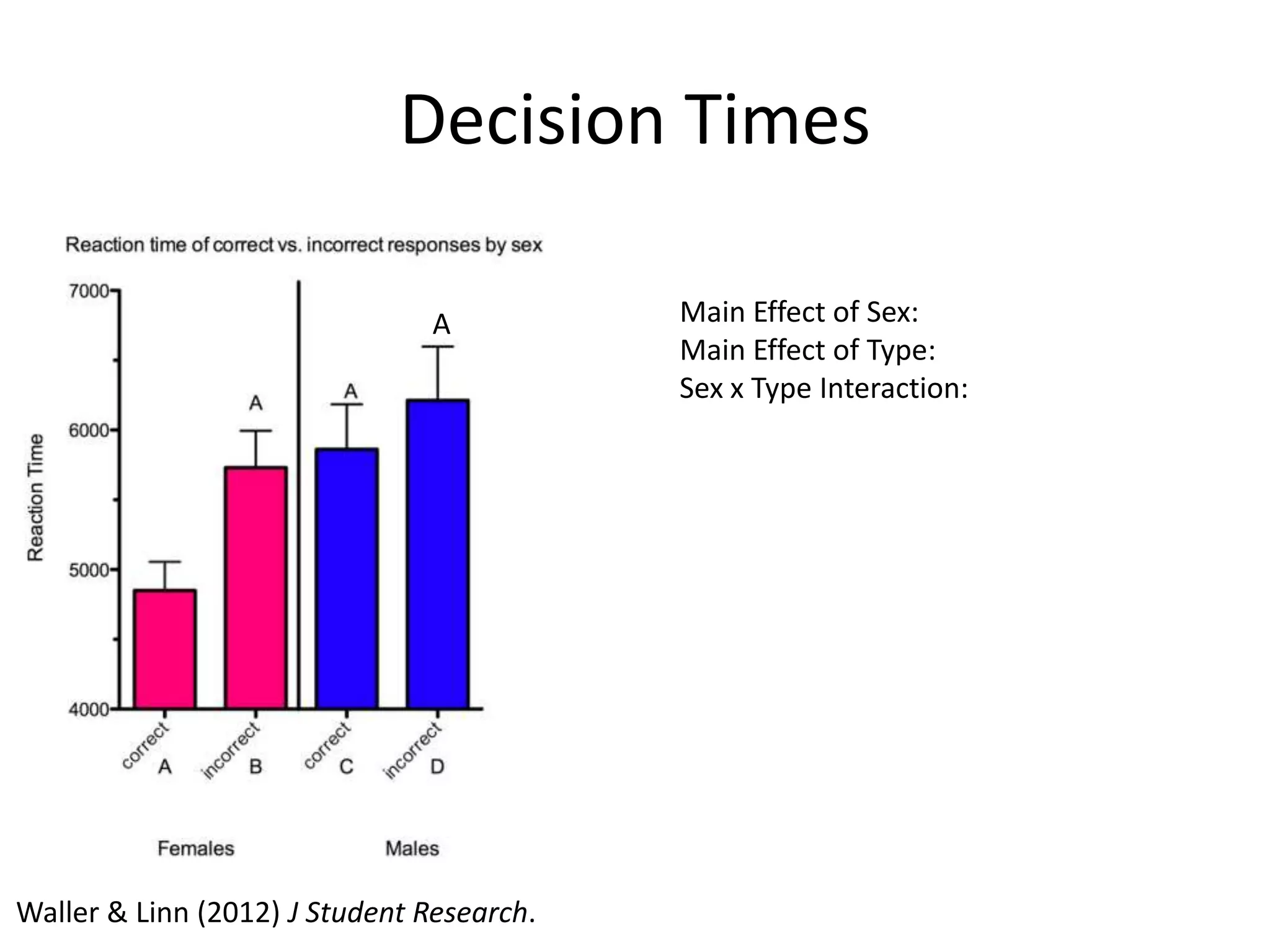
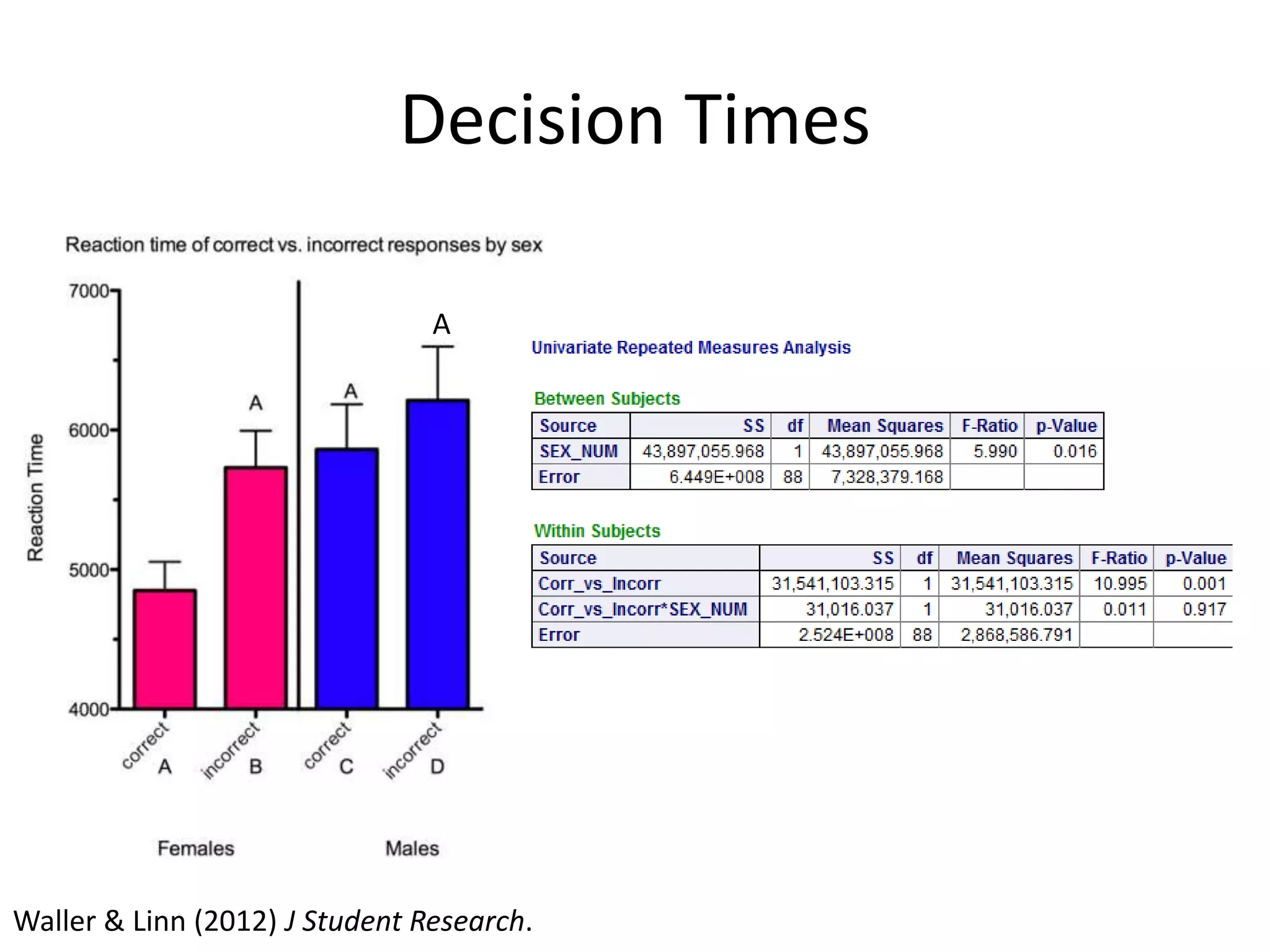
Decision Times

                                A          Main Effect of Sex:
                                           Main Effect of Type:
                                           Sex x Type Interaction:


Waller & Linn (2012) J Student Research.
Decision Times

                                A


Waller & Linn (2012) J Student Research.
A: X axis
B: red versus blue groups
Data Collection Guidelines
•   Be early
•   Be organized
•   Pilot (including coding data)
•   Be consistent
•   Be appreciative
•   Be conservative

Research Methods: Multifactorial Design

  • 1.
    Factorial Designs BrianJ. Piper, Ph.D.
  • 2.
    Goals • Main Effect(s) •Interaction • graph & statistics comparison
  • 3.
    Terminology • ceiling effects: •floor effects: • factorial design: more than 1 independent variable –2x3 –3x4 – 2 x 5 mixed (2 between group, 5 within groups) • factorial matrix (2 x 2) with 4 cells (conditions) Males Females Drug 1st 2nd Placebo 4th 3rd • main effect: overall effect of an IV (sex or drug)
  • 4.
    Terminology • Ceiling effects:mean score near maximum • Floor effects: mean score near minimum • factorial design: more than 1 independent variable –2x3 –3x4 – 2 x 5 mixed (2 between group, 5 within groups) • factorial matrix (2 x 2) with 4 cells (conditions) Males (A1) Females (A2) Drug (B1) 1st 2nd Placebo (B2) 4th 3rd • main effect: overall effect of an IV (sex or drug)
  • 5.
    Main Effect (Intuition) MainEffect of Type of Training Main Effect of Presentation rate
  • 6.
    Examining Main Effects •Main Effects (continued) – Calculations  row and column means – For hypothetical data: • Row mean #1  mean of 17 and 23 (= 20) • Row mean #2  mean of 12 and 18 (= 15) • Column mean #1  mean of 17 and 12 (= 14.5) • Column mean #2  mean of 23 and 18 (= 20.5)
  • 7.
    Main Effects • Maleand Female college students (N=89) were assigned to different encoding intervals (3, 6, 9, 12, or 15) with the Novel Faces and Places (NFAP) test. • This design is _____ x _____
  • 8.
  • 9.
  • 10.
    Main Effects: Statistical •Between Groups degrees of freedom = #groups - 1
  • 11.
    More Main Effects • Attractiveness rating at different times among bar patrons Mickey Gilley (1 min): http://www.youtube.com/watch?v=2e2qsnHVAo4&feature=fvst
  • 12.
    More Main Effects • Attractiveness rating at different times among bar patrons Mickey Gilley (1 min): http://www.youtube.com/watch?v=2e2qsnHVAo4&feature=fvst
  • 13.
    Interaction • The effectof one IV (A) depends on the level of another IV (B) • Possibilities: A B AxB - - - - - + + - - + - + + + - - + - - + + + + +
  • 14.
    Interaction (but nomain effect) Example #1 • Interactions – IVs  course emphasis and student major – No main effects (row and column means all equal 75)
  • 15.
    Guideline • Parallel Lines:main effect • Non-parallel lines: interaction
  • 16.
    Self-Test • Rats were exposed to MDMA or Saline during adolescence (age 35 to 60) and locomotor activity tested at age 65 • Time Main Effect: ? • Drug Main Effect: ? • Interaction: ? Piper et al. (2007) Developmental Psychobiology, 47, 145-157.
  • 17.
    Example • Rats were exposed to MDMA or Saline during adolescence (age 35 to 60) and locomotor activity tested at age 65 • Time Main Effect: Yes • Drug Main Effect: No • Interaction: Yes Piper et al. (2007) Developmental Psychobiology, 47, 145-157.
  • 18.
    Emotional Labeling • Participants (N=32) are asked to label emotions of faces Anger Fear Direct Averted Adams & Kleck (2003) Psychological Science, 14, 644-647.
  • 19.
    Emotional Labeling • Participants (N=32) are asked to label emotions of faces • Response time recorded (ms) Anger Fear Direct 862.3 (23.5) 944.5 (27.5) Averted 914.1 (25.6) 891.2 (24.4) Adams & Kleck (2003) Psychological Science, 14, 644-647.
  • 20.
    Guess • Main effectof direction: ? • Main effect of expression: ? • Interaction: ?
  • 21.
    Guess • Main effectof direction: No • Main effect of expression: Yes • Interaction: ? Adams & Kleck (2003) Psychological Science, 14, 644-647.
  • 22.
    Guess • Main effectof direction: No • Main effect of expression: Yes • Interaction: Yes Adams & Kleck (2003) Psychological Science, 14, 644-647.
  • 23.
    Statistical Output Further FactorialExample (12 min): http://www.youtube.com/watch?v=EgVmfryCAkU
  • 24.
    Decision Times A Main Effect of Sex: Main Effect of Type: Sex x Type Interaction: Waller & Linn (2012) J Student Research.
  • 25.
    Decision Times A Waller & Linn (2012) J Student Research.
  • 26.
    A: X axis B:red versus blue groups
  • 27.
    Data Collection Guidelines • Be early • Be organized • Pilot (including coding data) • Be consistent • Be appreciative • Be conservative