Research MethodologyResearch Methodology
Chapter 1:Chapter 1:
Introduction of researchIntroduction of research
MythologyMythology
Dr. Babasaheb Ambedkar Marathwada University
Presented byPresented by: Researcher: Researcher
ALI MANSOUR ALMADANI
Email:Email: abounazek2012@gmail.comabounazek2012@gmail.com
Meaning Of Research:Meaning Of Research:
 Research in common parlance refers to a
search for knowledge.
 Once can also define research as a scientific &
systematic search for pertinent information on
a specific topic.
 In fact, research is an art of scientific
investigation.
 Research is an academic activity and as such
the term should be used in a technical sense.
 According to Clifford Woody research
comprises defining and redefining problems,
formulating hypothesis or suggested
solutions; collecting, organizing and
evaluating data; making deductions and
reaching conclusions; and at last carefully
testing the conclusions to determine whether
they fit the formulating hypothesis.
Objectives of ResearchObjectives of Research
 To gain familiarity with a phenomenon or to
achieve new insights into it (studies with this
object in view are termed as exploratory or
formulative research studies);
 To portray accurately the characteristics of a
particular individual, situation or a
group(studies with this object in view are
known as descriptive research studies);
Objectives of ResearchObjectives of Research
 To determine the frequency with which
something occurs or with which it is
associated with something else (studies
with this object in view are known as
diagnostic research studies);
 To test a hypothesis of a causal
relationship between variables (such
studies are known as hypothesis-testing
research studies).
Types of researchTypes of research
 (i) descriptive vs. Analytical:
 Descriptive research includes surveys and
fact-finding enquiries of different kinds.
 in social science and business research we
quite often use the term Ex post facto
research for descriptive research studies.
 The main characteristic of this method is that
the researcher has no control over the
variables; he can only report what has
happened or what is happening.
 The methods of research utilized in
descriptive research are survey methods of
all kinds, including comparative and
correlation methods.
 In analytical research, on the other hand, the
researcher has to use facts or information
already available, and analyse these to make
a critical evaluation of the material.
 (ii) applied vs. fundamental:
 Applied (or action) research aims at
finding a solution for an immediate
problem facing a society or an
industrial/ business organization.
 Fundamental (to basic or pure)
researcher is mainly concerned with
generalizations and with the formulation
of a theory.
 (iii) quantitative vs. qualitative:
 Quantitative research is based on the
measurement of quantity or amount.
 Qualitative research, on the other hand,
is concerned with qualitative
phenomenon.
(iv) conceptual vs. Empirical:(iv) conceptual vs. Empirical:
Conceptual research:
 is that related to some abstract idea(s) or
theory.
Empirical research: (experimental)
 Its data-based research, coming up with
conclusions which are capable of being
verified by observation or experiment.
(V) Some other Types of Research(V) Some other Types of Research
 One-time research or longitudinal
research. IN the former case the research
is confined to a single time-period,
whereas in the latter case the research is
carried on over several time-periods.
 Field-setting research or laboratory research or
simulation research, depending upon the
environment in which it is to be carried out.
 Clinical or diagnostic research. Such research follow
case-study methods or in-depth approaches to reach
the basic causal relations.
 Conclusion-oriented and decision-oriented. While
doing conclusion-oriented research, a researcher is
free to pick up a problem, redesign the enquiry as he
proceeds and is prepared to conceptualize as he
wishes.
 The exploratory research or it may be formalized.
 The objective of exploratory research is the
development of hypotheses rather than their testing,
whereas formalized research studies are those with
substantial structure and with specific hypotheses to
be tested.
 Historical research is that which utilizes
historical sources like documents,
remains, etc. to study events or ideas of
the past, including the philosophy of
persons and groups at any remote point
of time.
Research ApproachesResearch Approaches
 Two basic approaches to research, viz.,
quantitative approach and the
qualitative approach .
 Quantitative approach sub-classified
into inferential , experimental and
simulation approaches to research.
 Qualitative approach to research is
concerned with subjective assessment
of attitudes, opinions and behavior.
Research Methods versusResearch Methods versus
MethodologyMethodology
 Research methods or techniques, thus,
refer to the methods the researchers
use in performing research operations.
 Thus, when we talk of research methodology we not
only talk of the research methods but also consider
the logic behind the methods we use in the context of
our research study and explain why we are using a
particular method or technique and why we are not
using others so that research results are capable of
being evaluated either by the researcher himself or
by others.
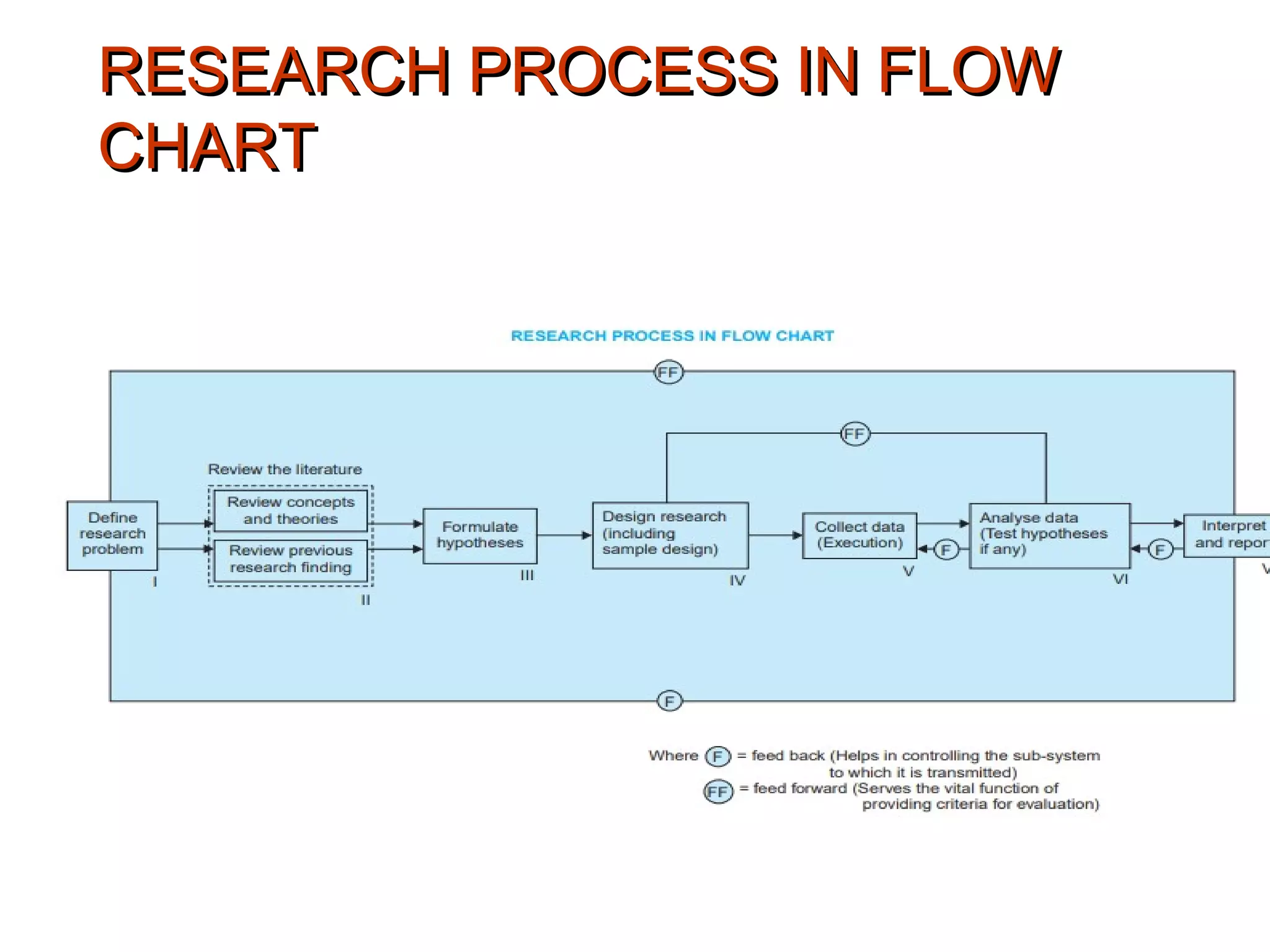
research process guideline:research process guideline:
(1) formulating the research problem;
(2) extensive literature survey;
(3) developing the hypothesis;
(4) preparing the research design;
(5) determining sample design;
(6) collecting the data;
(7) execution of the project;
(8) analysis of data;
(9) hypothesis testing;
(10) generalisations and interpretation,
(11) preparation of the report or presentation of the
results ,i. e., formal write-up of conclusions reached.
RESEARCH PROCESS IN FLOWRESEARCH PROCESS IN FLOW
CHARTCHART
1. Formulating the research1. Formulating the research
problem:problem:
 There are two types of research
problems, viz., those which relate to
states of nature and those which relate
to relationships between variables.
2. Extensive literature survey:2. Extensive literature survey:
 Once the problem is formulated, a
brief summary of it should be
written down. It is compulsory for
a research worker writing a thesis
for a Ph.D. degree to write a
synopsis of the topic and submit
it to the necessary Committee or
the Research Board for approval.
3. Development of working3. Development of working
hypotheses:hypotheses:
 After extensive literature survey,
researcher should state in clear terms
the working hypothesis or hypotheses.
 Working hypothesis is tentative
assumption made in order to draw out
and test its logical or empirical
consequences.
4. Preparing the research4. Preparing the research
design:design:
 The research problem having been
formulated in clear cut terms, the researcher
will be required to prepare a research design,
i.e., he will have to state the conceptual
structure within which research would be
conducted.
 Research purposes may be grouped into four
categories, viz., (i) Exploration, (ii)
Description, (iii) Diagnosis, and (iv)
Experimentation.
5. Determining sample design:5. Determining sample design:
 All the items under consideration in any field of
inquiry constitute a ‘universe’ or ‘population’.
 A complete enumeration of all the items in the
‘population’ is known as a census inquiry.
 A brief mention of the important sample designs is
as follows:
 (i) Deliberate sampling: Deliberate sampling is
also known as purposive or non-probability
sampling.
 (ii) Simple random sampling:
This type of sampling is also known as
chance sampling or probability sampling
where each and every item in the population
has an equal chance of inclusion in the
sample and each one of the possible
samples, in case of finite universe, has the
same probability of being selected.
 (iii) Systematic sampling: In some instances
the most practical way of sampling is to select
every 15th name on a list, every 10th house
on one side of a street and so on.
 (iv) Stratified sampling: If the population from
which a sample is to be drawn does not
constitute a homogeneous group, then
stratified sampling technique is applied so as
to obtain a representative sample.
 (vii) Multi-stage sampling:
This is a further development of the idea of cluster
sampling.
 (viii) Sequential sampling:
This is somewhat a complex sample design where the
ultimate size of the sample is not fixed in advance but
is determined according to mathematical decisions
on the basis of information yielded as survey
progresses.
6. Collecting the data:6. Collecting the data:
 Data can be collected by any one or
more of the following ways:
(i) By observation
(ii) Through personal interview
(iii) Through telephone interviews
(iv) By mailing of questionnaires
(v) Through schedules
7. Execution of the project:7. Execution of the project:
8. Analysis of data:
Requires a number of closely related operations such
as establishment of
 Categories
 Coding
 Editing
 Tabulation
 Analysis work after tabulation is generally based on
the computation of various percentages, coefficients,
etc., by applying various well defined statistical
formulae.
9. Hypothesis-testing:9. Hypothesis-testing:
 Various tests, such as Chi square test,
t-test, F-test, have been developed by
statisticians for the purpose.
 Hypothesis-testing will result in either
accepting the hypothesis or in rejecting
it.
 10. Generalizations and
interpretation
11. Preparation of the report or
the thesis
Research methodology introduction ch1

Research methodology introduction ch1

  • 1.
    Research MethodologyResearch Methodology Chapter1:Chapter 1: Introduction of researchIntroduction of research MythologyMythology Dr. Babasaheb Ambedkar Marathwada University Presented byPresented by: Researcher: Researcher ALI MANSOUR ALMADANI Email:Email: abounazek2012@gmail.comabounazek2012@gmail.com
  • 2.
    Meaning Of Research:MeaningOf Research:  Research in common parlance refers to a search for knowledge.  Once can also define research as a scientific & systematic search for pertinent information on a specific topic.  In fact, research is an art of scientific investigation.  Research is an academic activity and as such the term should be used in a technical sense.
  • 3.
     According toClifford Woody research comprises defining and redefining problems, formulating hypothesis or suggested solutions; collecting, organizing and evaluating data; making deductions and reaching conclusions; and at last carefully testing the conclusions to determine whether they fit the formulating hypothesis.
  • 4.
    Objectives of ResearchObjectivesof Research  To gain familiarity with a phenomenon or to achieve new insights into it (studies with this object in view are termed as exploratory or formulative research studies);  To portray accurately the characteristics of a particular individual, situation or a group(studies with this object in view are known as descriptive research studies);
  • 5.
    Objectives of ResearchObjectivesof Research  To determine the frequency with which something occurs or with which it is associated with something else (studies with this object in view are known as diagnostic research studies);  To test a hypothesis of a causal relationship between variables (such studies are known as hypothesis-testing research studies).
  • 6.
    Types of researchTypesof research  (i) descriptive vs. Analytical:  Descriptive research includes surveys and fact-finding enquiries of different kinds.  in social science and business research we quite often use the term Ex post facto research for descriptive research studies.  The main characteristic of this method is that the researcher has no control over the variables; he can only report what has happened or what is happening.
  • 7.
     The methodsof research utilized in descriptive research are survey methods of all kinds, including comparative and correlation methods.  In analytical research, on the other hand, the researcher has to use facts or information already available, and analyse these to make a critical evaluation of the material.
  • 8.
     (ii) appliedvs. fundamental:  Applied (or action) research aims at finding a solution for an immediate problem facing a society or an industrial/ business organization.  Fundamental (to basic or pure) researcher is mainly concerned with generalizations and with the formulation of a theory.
  • 9.
     (iii) quantitativevs. qualitative:  Quantitative research is based on the measurement of quantity or amount.  Qualitative research, on the other hand, is concerned with qualitative phenomenon.
  • 10.
    (iv) conceptual vs.Empirical:(iv) conceptual vs. Empirical: Conceptual research:  is that related to some abstract idea(s) or theory. Empirical research: (experimental)  Its data-based research, coming up with conclusions which are capable of being verified by observation or experiment.
  • 11.
    (V) Some otherTypes of Research(V) Some other Types of Research  One-time research or longitudinal research. IN the former case the research is confined to a single time-period, whereas in the latter case the research is carried on over several time-periods.  Field-setting research or laboratory research or simulation research, depending upon the environment in which it is to be carried out.  Clinical or diagnostic research. Such research follow case-study methods or in-depth approaches to reach the basic causal relations.
  • 12.
     Conclusion-oriented anddecision-oriented. While doing conclusion-oriented research, a researcher is free to pick up a problem, redesign the enquiry as he proceeds and is prepared to conceptualize as he wishes.  The exploratory research or it may be formalized.  The objective of exploratory research is the development of hypotheses rather than their testing, whereas formalized research studies are those with substantial structure and with specific hypotheses to be tested.
  • 13.
     Historical researchis that which utilizes historical sources like documents, remains, etc. to study events or ideas of the past, including the philosophy of persons and groups at any remote point of time.
  • 14.
    Research ApproachesResearch Approaches Two basic approaches to research, viz., quantitative approach and the qualitative approach .  Quantitative approach sub-classified into inferential , experimental and simulation approaches to research.  Qualitative approach to research is concerned with subjective assessment of attitudes, opinions and behavior.
  • 15.
    Research Methods versusResearchMethods versus MethodologyMethodology  Research methods or techniques, thus, refer to the methods the researchers use in performing research operations.  Thus, when we talk of research methodology we not only talk of the research methods but also consider the logic behind the methods we use in the context of our research study and explain why we are using a particular method or technique and why we are not using others so that research results are capable of being evaluated either by the researcher himself or by others.
  • 16.
    research process guideline:researchprocess guideline: (1) formulating the research problem; (2) extensive literature survey; (3) developing the hypothesis; (4) preparing the research design; (5) determining sample design; (6) collecting the data; (7) execution of the project; (8) analysis of data; (9) hypothesis testing; (10) generalisations and interpretation, (11) preparation of the report or presentation of the results ,i. e., formal write-up of conclusions reached.
  • 17.
    RESEARCH PROCESS INFLOWRESEARCH PROCESS IN FLOW CHARTCHART
  • 18.
    1. Formulating theresearch1. Formulating the research problem:problem:  There are two types of research problems, viz., those which relate to states of nature and those which relate to relationships between variables.
  • 19.
    2. Extensive literaturesurvey:2. Extensive literature survey:  Once the problem is formulated, a brief summary of it should be written down. It is compulsory for a research worker writing a thesis for a Ph.D. degree to write a synopsis of the topic and submit it to the necessary Committee or the Research Board for approval.
  • 20.
    3. Development ofworking3. Development of working hypotheses:hypotheses:  After extensive literature survey, researcher should state in clear terms the working hypothesis or hypotheses.  Working hypothesis is tentative assumption made in order to draw out and test its logical or empirical consequences.
  • 21.
    4. Preparing theresearch4. Preparing the research design:design:  The research problem having been formulated in clear cut terms, the researcher will be required to prepare a research design, i.e., he will have to state the conceptual structure within which research would be conducted.  Research purposes may be grouped into four categories, viz., (i) Exploration, (ii) Description, (iii) Diagnosis, and (iv) Experimentation.
  • 22.
    5. Determining sampledesign:5. Determining sample design:  All the items under consideration in any field of inquiry constitute a ‘universe’ or ‘population’.  A complete enumeration of all the items in the ‘population’ is known as a census inquiry.  A brief mention of the important sample designs is as follows:  (i) Deliberate sampling: Deliberate sampling is also known as purposive or non-probability sampling.
  • 23.
     (ii) Simplerandom sampling: This type of sampling is also known as chance sampling or probability sampling where each and every item in the population has an equal chance of inclusion in the sample and each one of the possible samples, in case of finite universe, has the same probability of being selected.
  • 24.
     (iii) Systematicsampling: In some instances the most practical way of sampling is to select every 15th name on a list, every 10th house on one side of a street and so on.  (iv) Stratified sampling: If the population from which a sample is to be drawn does not constitute a homogeneous group, then stratified sampling technique is applied so as to obtain a representative sample.
  • 25.
     (vii) Multi-stagesampling: This is a further development of the idea of cluster sampling.  (viii) Sequential sampling: This is somewhat a complex sample design where the ultimate size of the sample is not fixed in advance but is determined according to mathematical decisions on the basis of information yielded as survey progresses.
  • 26.
    6. Collecting thedata:6. Collecting the data:  Data can be collected by any one or more of the following ways: (i) By observation (ii) Through personal interview (iii) Through telephone interviews (iv) By mailing of questionnaires (v) Through schedules
  • 27.
    7. Execution ofthe project:7. Execution of the project: 8. Analysis of data: Requires a number of closely related operations such as establishment of  Categories  Coding  Editing  Tabulation  Analysis work after tabulation is generally based on the computation of various percentages, coefficients, etc., by applying various well defined statistical formulae.
  • 28.
    9. Hypothesis-testing:9. Hypothesis-testing: Various tests, such as Chi square test, t-test, F-test, have been developed by statisticians for the purpose.  Hypothesis-testing will result in either accepting the hypothesis or in rejecting it.
  • 29.
     10. Generalizationsand interpretation 11. Preparation of the report or the thesis