Ontology, Epistemology, &
MethodologyAdapted from Guba, E.G. (1990). The Paradigm Dialog. Newbury Park, CA: Sage.
Adapted from Guba, E.G. (1990). The Paradigm Dialog. Newbury Park, CA: Sage.
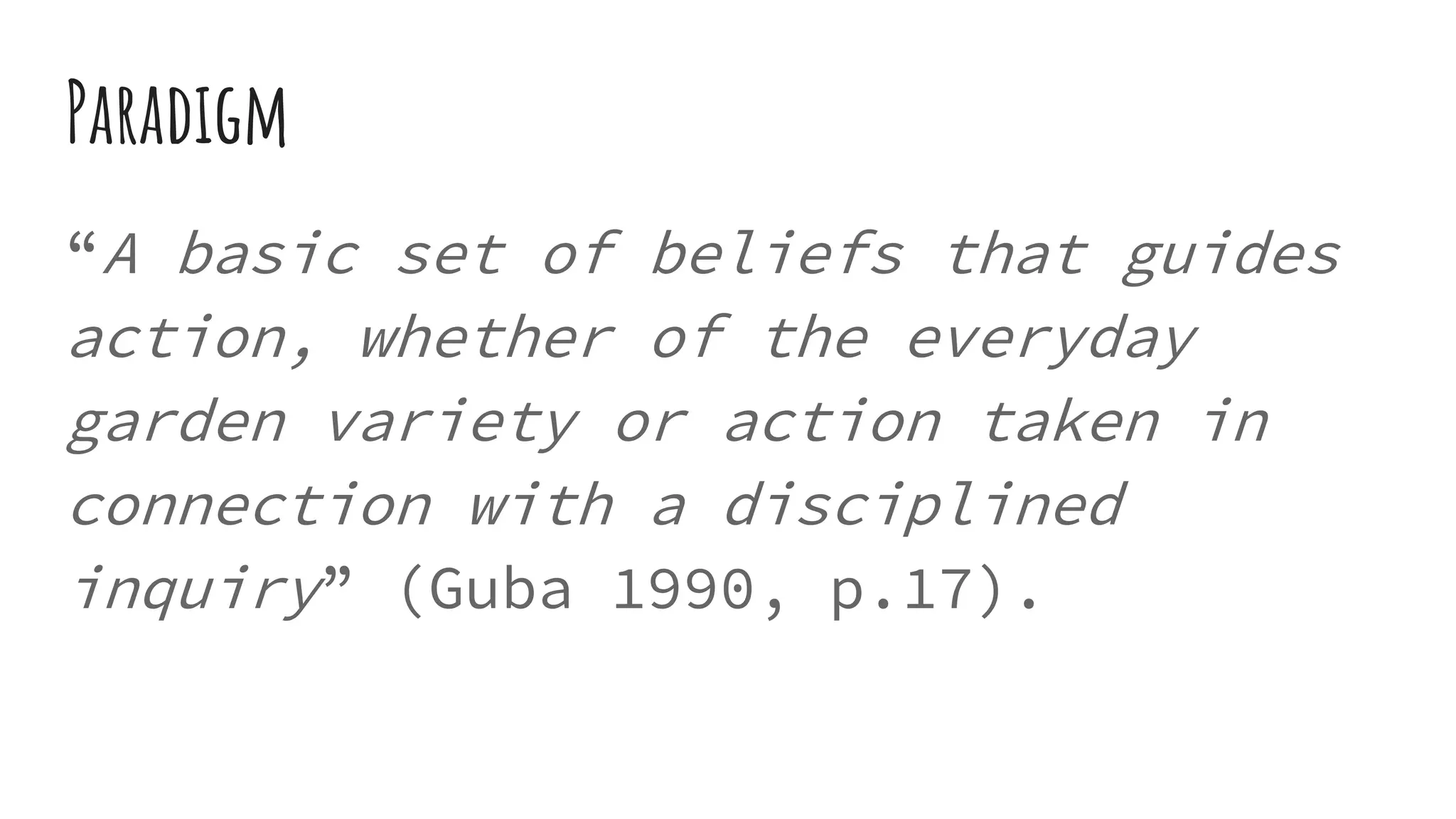
Paradigm
“A basic set of beliefs that guides
action, whether of the everyday
garden variety or action taken in
connection with a disciplined
inquiry” (Guba 1990, p.17).
Paradigms
Positivism Post-positivism Critical
Theory
Constructivism
Guba (1990)
Paradigm: Characteristics
Ontology What is the nature of the “knowable”?
Or
What is the nature of reality?
Epistemology
What is the relationship between the knower (the inquirer) and
the known (or knowable)?
Methodology How should the inquirer go about finding out knowledge?
Guba (1990)
Positivism: Stance
Ontology Epistemology Methodology
Realist
Reality exists “out there”, and is driven by
immutable natural laws, and mechanisms is
conventionally summarized in the form of
time - and context-free generalizations.
Some of these latter generalizations take
the form of cause-effect laws.
Dualist/ Objectivist
It is both possible and
essential for the inquirer to
adopt a distant,
noninteractive posture.
Values and other biasing
and confounding factors are
thereby automatically
excluded from influencing
the outcome
Experimental/ Manipulative
Questions and/ or
hypothesis are stated in
advance in propositional
form and subjected to
empirical tests (falsification)
under carefully controlled
conditions
Guba (1990, p.20)
Post Positivism: Stance
Ontology Epistemology Methodology
Critical Realist
Reality exists but can never be fully
apprehended. It is driven by natural
laws that can be only incompletely
understood.
Modified Objectivist
Objectivity remains a
regulatory ideal, but it can only
be approximated, with special
emphasis placed on external
guardians such as the critical
tradition and the critical
community
Modified experimental/
Manipulative
Emphasize critical
multiplism. Redress
imbalances by doing inquiry
in more natural settings,
using more qualitative
methods, depending more
on grounded theory, and
reintroducing discovery into
the inquiry process.
Guba (1990)
Critical Theory: Stance
Ontology Epistemology Methodology
Critical Realist
As in the case of postpositivism
Subjectivist
In the sense that values mediate
inquiry
Dialogic, transformative
Eliminate false consciousness
and energize and facilitate
transformation
Guba (1990)
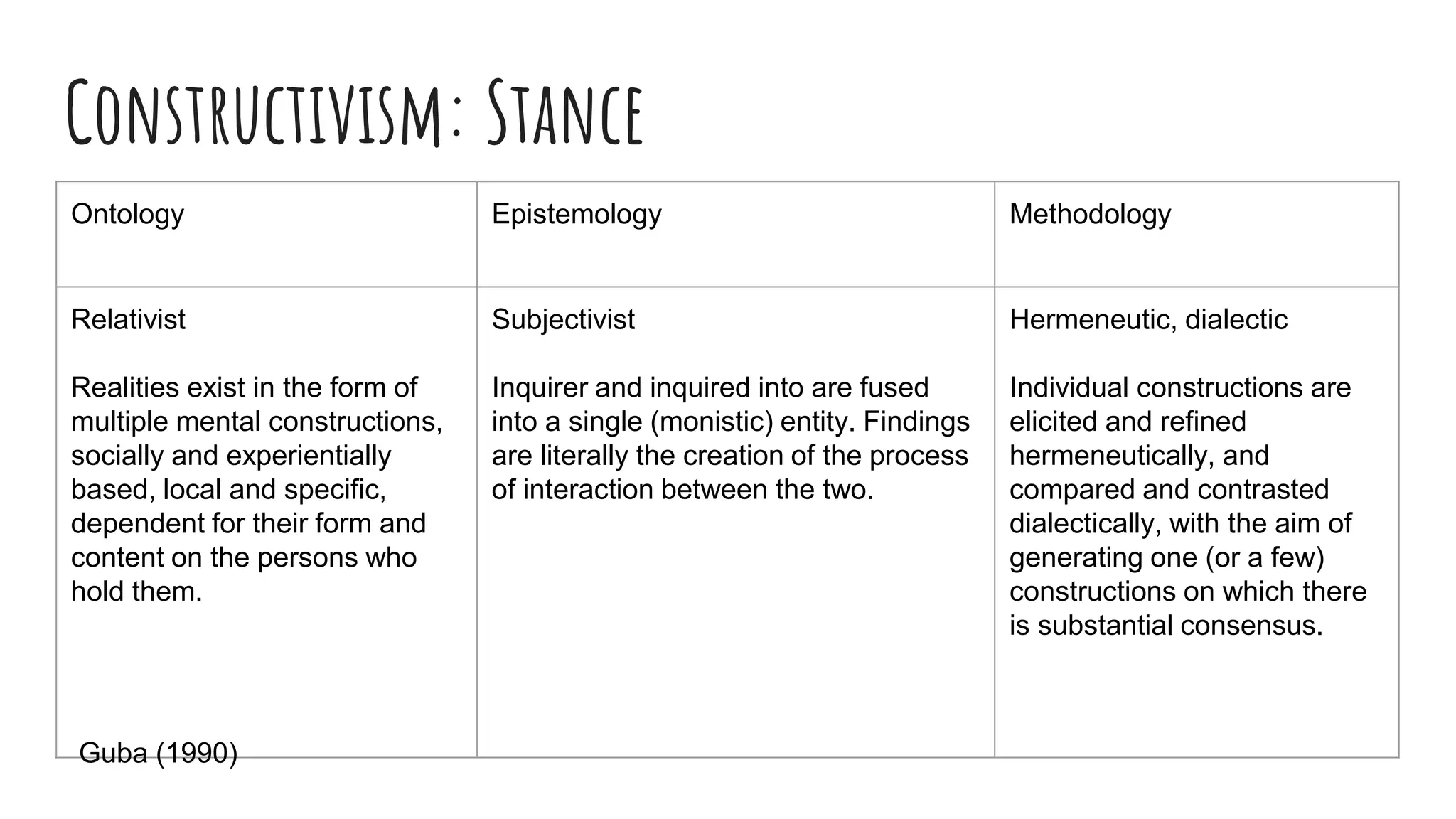
Constructivism: Stance
Ontology Epistemology Methodology
Relativist
Realities exist in the form of
multiple mental constructions,
socially and experientially
based, local and specific,
dependent for their form and
content on the persons who
hold them.
Subjectivist
Inquirer and inquired into are fused
into a single (monistic) entity. Findings
are literally the creation of the process
of interaction between the two.
Hermeneutic, dialectic
Individual constructions are
elicited and refined
hermeneutically, and
compared and contrasted
dialectically, with the aim of
generating one (or a few)
constructions on which there
is substantial consensus.
Guba (1990)
Thanks
SPH

Ontology, Epistemology, and Methodology

  • 1.
    Ontology, Epistemology, & MethodologyAdaptedfrom Guba, E.G. (1990). The Paradigm Dialog. Newbury Park, CA: Sage. Adapted from Guba, E.G. (1990). The Paradigm Dialog. Newbury Park, CA: Sage.
  • 2.
    Paradigm “A basic setof beliefs that guides action, whether of the everyday garden variety or action taken in connection with a disciplined inquiry” (Guba 1990, p.17).
  • 3.
  • 4.
    Paradigm: Characteristics Ontology Whatis the nature of the “knowable”? Or What is the nature of reality? Epistemology What is the relationship between the knower (the inquirer) and the known (or knowable)? Methodology How should the inquirer go about finding out knowledge? Guba (1990)
  • 5.
    Positivism: Stance Ontology EpistemologyMethodology Realist Reality exists “out there”, and is driven by immutable natural laws, and mechanisms is conventionally summarized in the form of time - and context-free generalizations. Some of these latter generalizations take the form of cause-effect laws. Dualist/ Objectivist It is both possible and essential for the inquirer to adopt a distant, noninteractive posture. Values and other biasing and confounding factors are thereby automatically excluded from influencing the outcome Experimental/ Manipulative Questions and/ or hypothesis are stated in advance in propositional form and subjected to empirical tests (falsification) under carefully controlled conditions Guba (1990, p.20)
  • 6.
    Post Positivism: Stance OntologyEpistemology Methodology Critical Realist Reality exists but can never be fully apprehended. It is driven by natural laws that can be only incompletely understood. Modified Objectivist Objectivity remains a regulatory ideal, but it can only be approximated, with special emphasis placed on external guardians such as the critical tradition and the critical community Modified experimental/ Manipulative Emphasize critical multiplism. Redress imbalances by doing inquiry in more natural settings, using more qualitative methods, depending more on grounded theory, and reintroducing discovery into the inquiry process. Guba (1990)
  • 7.
    Critical Theory: Stance OntologyEpistemology Methodology Critical Realist As in the case of postpositivism Subjectivist In the sense that values mediate inquiry Dialogic, transformative Eliminate false consciousness and energize and facilitate transformation Guba (1990)
  • 8.
    Constructivism: Stance Ontology EpistemologyMethodology Relativist Realities exist in the form of multiple mental constructions, socially and experientially based, local and specific, dependent for their form and content on the persons who hold them. Subjectivist Inquirer and inquired into are fused into a single (monistic) entity. Findings are literally the creation of the process of interaction between the two. Hermeneutic, dialectic Individual constructions are elicited and refined hermeneutically, and compared and contrasted dialectically, with the aim of generating one (or a few) constructions on which there is substantial consensus. Guba (1990)
  • 9.