UNIT-I
Research Methodology:-Basics
 What is Research ?
 What is Research Methodology?
 What are Research Methods & Techniques?
 Research in Management : Why & Where & what
Research:-
information
knowledge
solution
RESEARCH……….
 Research can be defined as a
Systematic & Scientific
Search or investigation
for pertinent information/knowledge/solution
on a specific topic/subject/problem.
Research is a scientific and systematic search for
pertinent information on a specific topic. It is a careful
investigation or enquiry specially through search for
knowledge. It is a movement from known to unknown
Research:- (Diagram)
on a
Topic
Research menans
Research means finding answers to the questions.
It is a systematic search for truth.
Through research, new and original information, ideas
about the world we live in, are obtained.
Research is search for knowledge.
Research is defined as a scientific and systematic
search for information on a specific topic.
RESEARCH PROCESS
Define
Research
Problem
Review
Concepts
And
theories
Review
Previous
Research
findings
Formulate
hypothesis
Design
Research
(Including
Sample
Design)
Collect
Data
Analyse
Data
Interpret
and
report
FF
F
F F
FF
I
II
III IV V VI VII
F
FF
Feed Back
Feed Forward
Review the literature
Research compared
The differences between knowledge arrived at through
common sense and intuition on the one hand, and
scientific research on the other, can be expressed by
concepts such as “organized”, “structured”, “methodical”,
“systematic”, “testable” and specifically by the notion of
disciplinary inquiry.
Selinger and shohamy (1989)
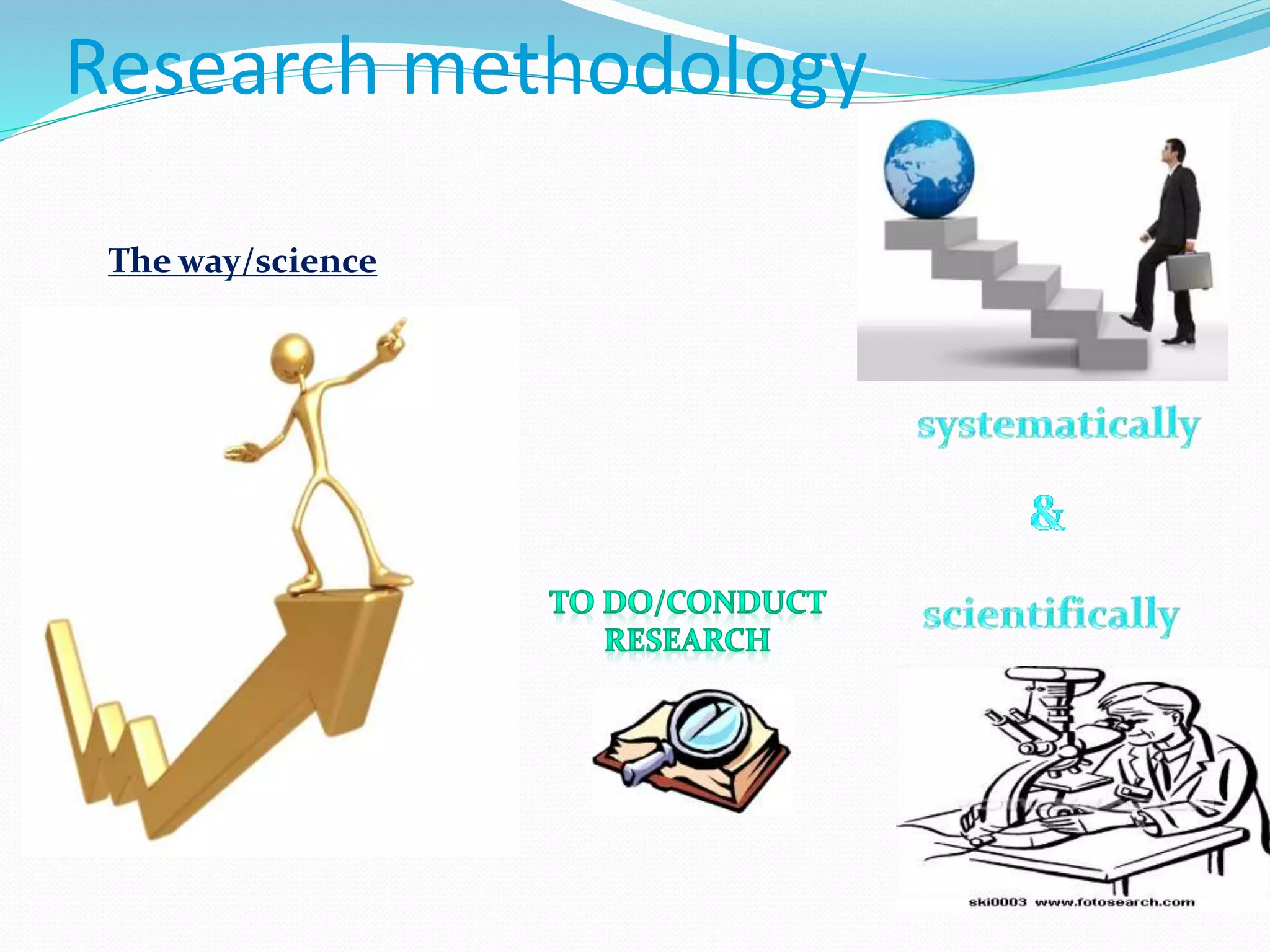
Research methodology
The way/science
Research methodology..
 Research Methodology says that
how
to do/conduct research
systematically & scientifically.
 Research methodology
not only provides
the knowledge of various types of methods & techniques
for Sampling , data collection, data analysis & report writing
etc.
but also guides
that which particular method or technique
for sampling/data collection/data analysis should be used or
not
& why should /shouldn't do so.
Research methodology diagram
Nature of Business Research
 Nature of Business Research involves: academics
policy-makers practitioners
trans-disciplinarily related to context not easily
replicated more emphasis on dissemination &
exploitation
Ways of business research..
Research is a systematic inquiry whose objective
is to provide information to solve managerial
problems.
Business Research Methods can be employed in each
of the following four stages:
1. Identification of problems and/or opportunities.
2. Diagnosing and Assessment of problems and/or
opportunities.
3. Selection and Implementation of Courses of Action.
4. Evaluating the Course of Action.
Selected Examples of Real-Life Situations in Which
Business Research Methods are Used
 A firm wants to produce and market a new product but first
wants to ascertain if there is a potential consumer demand for
this product in markets x,y and z
 A multinational firm wants to establish a production facility in
another country after determining its technical and economic
feasibility
 A government agency wants to ascertain the satisfaction level of
its employees, the causes for any possible discontent, and
propose a scheme for enhancing this level
 A financial institution wants to invest in commodities and
commissions a study to determine the past trends and forecast
future returns in a portfolio of commodities
 MNC wants to find out the trends in retail and wholesale sector
Defined….
 Business research is defined as the systematic and
objective process of generating information for aid in
making business decisions
Social Research
 M.H. Gopal defined it as “it is scientific analysis of the
nature and trends of social phenomena of groups or in
general of human behavior so as to formulate broad
principles and scientific concepts”.
Applied research
 Is carried on to find solution to a real life problem
requiring an action or policy decision.
 It is thus problem oriented and action directed.
 It seeks an immediate and practical resulet.
 E.g; market research carried on for developing a new
market for studying the post purchage experience of
customers.
Pure research
 Pure research is undertaken for the sake of knowledge
without any intention to apply it in practice.
 E.g : einstein’s theory of relativity,newtom’s
contribution,galileo’s contribution
 pure research is also known as basic of fundamental
research . It is undertaken out of intellectual curiosity
or inquisitiveness.
 It is necessarily problem oriented.
 It aims extension of knowledge.
Steps in Social Research
 Although different methods are used in social science
research, the common goal of a social research is one
the same, i.e. furthering our understanding of society
and thus all share certain basic stages such as:
 Choosing the research problems and stating the
hypothesis.
 Formulating the Research Design.
 Gathering the Data.
 Coding and Analysis the Data.
 Interpreting the results so as to test the hypothesis
Qualitative& Quantitative
As sometimes it goes for collect qualitative
information like attitude, satisfaction level,
perception etc. of consumers, retailers, employees
,hence it is qualitative & sometimes it collects &
present information in numerical forms too like
number of people, percentage of
consumers/retailers/employees, etc. so it is
quantitative too.
APPLIED RESEARCH
 Applied research refers to scientific study and research
that seeks to solve practical problems. Applied research is
used to find solutions to everyday problems, cure illness,
and develop innovative technologies, rather than to acquire
knowledge for knowledge's sake.
 For example, applied researchers may investigate ways to:
• Improve agricultural crop production
• Treat or cure a specific disease
• Improve the energy efficiency of homes, offices, or modes
of transportation
DESCRIPTIVE RESEARCH
 Descriptive research refers to research that provides
an accurate portrayal of characteristics of a particular
individual, situation, or group. Descriptive research,
also known as statistical research.
 These studies are a means of discovering new meaning,
describing what exists, determining the frequency with
which something occurs, and categorizing information.
Cont….
 In short descriptive research deals with
everything that can be counted and studied,
which has an impact of the lives of the people it
deals with.
 For example,
• finding the most frequent disease that affects the
children of a town. The reader of the research will
know what to do to prevent that disease thus, more
people will live a healthy life.
Cont…
 Advantages:
• The people individual studied are unaware so they act naturally or as they
usually do in everyday situation;
• It is less expensive and time consuming than quantitative experiments;
• Collects a large amount of notes for detailed studying;
• As it is used to describe and not make any conclusions it is to start the research
with it;
 Disadvantages
• Descriptive research requires more skills.
• Does not identify cause behind a phenomenon
• Response rate is low in this research.
• Results of this research can change over the period of time.
EXPERIMENTAL RESEARCH
 Experimental research is an objective, systematic, controlled
investigation for the purpose of predicting and controlling
phenomena and examining probability and causality among
selected variables.
 Advantages
• Best establishes cause-and-effect relationships
 Disadvantages
• Artificiality
• Feasibility
• Unethical
 The simplest experimental design includes two variables and two
groups of participants.
 The two variables(Independent versus Dependent variables).
• The IV is the predictor variable whereas the DV is the outcome
variable.
• Researchers manipulate and control the IV to study it's effect on the
DV.
 The two groups of participants (Control versus Experimental
group).
• Before beginning the experiment, the researcher (randomly) assigns
his/her sample to two different groups: the control group and the
experimental (treatment group or clinical group).
• The control group receives no manipulation of the IV (no treatment),
whereas the experimental group receives the manipulation of the IV
What is Hypothesis
 A Hypothesis is the statement or an assumption about
relationships between variables.
or
 A Hypothesis is a tentative explanation for certain
behaviors, phenomenon or events that have occurred
or will occur.
Hypothesis Construction
 It should be empirically testable, whether it is right or
wrong.
 It should be specific and precise.
 The statements in the hypothesis should not be
contradictory.
 It should specify variables between which the
relationship is to be established.
 It should describe one issue only.
A Hypothesis
 must make a prediction
 must identify at least two variables
 should have an elucidating power
 should strive to furnish an acceptable explanation or
accounting of a fact
 must be falsifiable meaning hypotheses must be capable of
being refuted based on the results of the study
 must be formulated in simple, understandable terms
 should correspond with existing knowledge
 In general, a hypothesis needs to be unambiguous,
specific, quantifiable, testable and generalizable.
Characteristics of a Testable Hypothesis
1. A Hypothesis must be conceptually clear
- concepts should be clearly defined
- the definitions should be commonly accepted
- the definitions should be easily communicable
2. The hypothesis should have empirical reference
- Variables in the hypothesis should be empirical
realities
- If they are not it would not be possible to make the
observation and ultimately the test
3. The Hypothesis must be specific
- Place, situation and operation
4. A hypothesis should be related to available techniques of research
- Either the techniques are already available or
- The researcher should be in a position to develop suitable
techniques
5. The hypothesis should be related to a body of theory
- Hypothesis has to be supported by theoretical argumentation
- It should depend on the existing body of knowledge
In this way
- the study could benefit from the existing knowledge and
- later on through testing the hypothesis could contribute to
the reservoir of knowledge
Categorizing Hypotheses
. Null Hypotheses and Alternate Hypotheses
 Null hypothesis always predicts that
 no differences between the groups being studied (e.g.,
experimental vs. control group) or
 no relationship between the variables being studied
 By contrast, the alternate hypothesis always
predicts that there will be a difference between the
groups being studied (or a relationship between
the variables being studied)
Steps in Hypothesis Testing
Types of Hypothesis
 Null Hypothesis (H0)
 Alternative Hypothesis (Ha or H1)
Each of the following statements is an example of a null
hypothesis and alternative hypothesis.
Establish Critical or Rejection region
Select the Suitable Test of
significance or Test Statistic
 Whether the test involves one sample, two samples, or
samples?
 Whether two or more samples used are independent
or related?
 Is the measurement scale nominal, ordinal, interval,
or ratio?
The choice of a probability distribution of a sample statistics is
guided but the sample size n and the value of population standard
deviation  as shown in the table.
Rule to Accept Null Hypothesis
 Accept H0 if the test statistic value falls within the area
of acceptance.
 Reject otherwise
ERRORS IN HYPOTHESIS TESTING
introduction Research methodology

introduction Research methodology

  • 1.
  • 2.
    Research Methodology:-Basics  Whatis Research ?  What is Research Methodology?  What are Research Methods & Techniques?  Research in Management : Why & Where & what
  • 3.
  • 4.
    RESEARCH……….  Research canbe defined as a Systematic & Scientific Search or investigation for pertinent information/knowledge/solution on a specific topic/subject/problem. Research is a scientific and systematic search for pertinent information on a specific topic. It is a careful investigation or enquiry specially through search for knowledge. It is a movement from known to unknown
  • 5.
  • 6.
    Research menans Research meansfinding answers to the questions. It is a systematic search for truth. Through research, new and original information, ideas about the world we live in, are obtained. Research is search for knowledge. Research is defined as a scientific and systematic search for information on a specific topic.
  • 7.
  • 8.
    Research compared The differencesbetween knowledge arrived at through common sense and intuition on the one hand, and scientific research on the other, can be expressed by concepts such as “organized”, “structured”, “methodical”, “systematic”, “testable” and specifically by the notion of disciplinary inquiry. Selinger and shohamy (1989)
  • 9.
  • 10.
    Research methodology..  ResearchMethodology says that how to do/conduct research systematically & scientifically.  Research methodology not only provides the knowledge of various types of methods & techniques for Sampling , data collection, data analysis & report writing etc. but also guides that which particular method or technique for sampling/data collection/data analysis should be used or not & why should /shouldn't do so.
  • 11.
  • 12.
    Nature of BusinessResearch  Nature of Business Research involves: academics policy-makers practitioners trans-disciplinarily related to context not easily replicated more emphasis on dissemination & exploitation
  • 13.
    Ways of businessresearch.. Research is a systematic inquiry whose objective is to provide information to solve managerial problems. Business Research Methods can be employed in each of the following four stages: 1. Identification of problems and/or opportunities. 2. Diagnosing and Assessment of problems and/or opportunities. 3. Selection and Implementation of Courses of Action. 4. Evaluating the Course of Action.
  • 14.
    Selected Examples ofReal-Life Situations in Which Business Research Methods are Used  A firm wants to produce and market a new product but first wants to ascertain if there is a potential consumer demand for this product in markets x,y and z  A multinational firm wants to establish a production facility in another country after determining its technical and economic feasibility  A government agency wants to ascertain the satisfaction level of its employees, the causes for any possible discontent, and propose a scheme for enhancing this level  A financial institution wants to invest in commodities and commissions a study to determine the past trends and forecast future returns in a portfolio of commodities  MNC wants to find out the trends in retail and wholesale sector
  • 15.
    Defined….  Business researchis defined as the systematic and objective process of generating information for aid in making business decisions
  • 16.
    Social Research  M.H.Gopal defined it as “it is scientific analysis of the nature and trends of social phenomena of groups or in general of human behavior so as to formulate broad principles and scientific concepts”.
  • 17.
    Applied research  Iscarried on to find solution to a real life problem requiring an action or policy decision.  It is thus problem oriented and action directed.  It seeks an immediate and practical resulet.  E.g; market research carried on for developing a new market for studying the post purchage experience of customers.
  • 18.
    Pure research  Pureresearch is undertaken for the sake of knowledge without any intention to apply it in practice.  E.g : einstein’s theory of relativity,newtom’s contribution,galileo’s contribution  pure research is also known as basic of fundamental research . It is undertaken out of intellectual curiosity or inquisitiveness.  It is necessarily problem oriented.  It aims extension of knowledge.
  • 19.
    Steps in SocialResearch  Although different methods are used in social science research, the common goal of a social research is one the same, i.e. furthering our understanding of society and thus all share certain basic stages such as:  Choosing the research problems and stating the hypothesis.  Formulating the Research Design.  Gathering the Data.  Coding and Analysis the Data.  Interpreting the results so as to test the hypothesis
  • 20.
    Qualitative& Quantitative As sometimesit goes for collect qualitative information like attitude, satisfaction level, perception etc. of consumers, retailers, employees ,hence it is qualitative & sometimes it collects & present information in numerical forms too like number of people, percentage of consumers/retailers/employees, etc. so it is quantitative too.
  • 21.
    APPLIED RESEARCH  Appliedresearch refers to scientific study and research that seeks to solve practical problems. Applied research is used to find solutions to everyday problems, cure illness, and develop innovative technologies, rather than to acquire knowledge for knowledge's sake.  For example, applied researchers may investigate ways to: • Improve agricultural crop production • Treat or cure a specific disease • Improve the energy efficiency of homes, offices, or modes of transportation
  • 22.
    DESCRIPTIVE RESEARCH  Descriptiveresearch refers to research that provides an accurate portrayal of characteristics of a particular individual, situation, or group. Descriptive research, also known as statistical research.  These studies are a means of discovering new meaning, describing what exists, determining the frequency with which something occurs, and categorizing information.
  • 23.
    Cont….  In shortdescriptive research deals with everything that can be counted and studied, which has an impact of the lives of the people it deals with.  For example, • finding the most frequent disease that affects the children of a town. The reader of the research will know what to do to prevent that disease thus, more people will live a healthy life.
  • 24.
    Cont…  Advantages: • Thepeople individual studied are unaware so they act naturally or as they usually do in everyday situation; • It is less expensive and time consuming than quantitative experiments; • Collects a large amount of notes for detailed studying; • As it is used to describe and not make any conclusions it is to start the research with it;  Disadvantages • Descriptive research requires more skills. • Does not identify cause behind a phenomenon • Response rate is low in this research. • Results of this research can change over the period of time.
  • 25.
    EXPERIMENTAL RESEARCH  Experimentalresearch is an objective, systematic, controlled investigation for the purpose of predicting and controlling phenomena and examining probability and causality among selected variables.  Advantages • Best establishes cause-and-effect relationships  Disadvantages • Artificiality • Feasibility • Unethical
  • 26.
     The simplestexperimental design includes two variables and two groups of participants.  The two variables(Independent versus Dependent variables). • The IV is the predictor variable whereas the DV is the outcome variable. • Researchers manipulate and control the IV to study it's effect on the DV.  The two groups of participants (Control versus Experimental group). • Before beginning the experiment, the researcher (randomly) assigns his/her sample to two different groups: the control group and the experimental (treatment group or clinical group). • The control group receives no manipulation of the IV (no treatment), whereas the experimental group receives the manipulation of the IV
  • 27.
    What is Hypothesis A Hypothesis is the statement or an assumption about relationships between variables. or  A Hypothesis is a tentative explanation for certain behaviors, phenomenon or events that have occurred or will occur.
  • 28.
    Hypothesis Construction  Itshould be empirically testable, whether it is right or wrong.  It should be specific and precise.  The statements in the hypothesis should not be contradictory.  It should specify variables between which the relationship is to be established.  It should describe one issue only.
  • 29.
    A Hypothesis  mustmake a prediction  must identify at least two variables  should have an elucidating power  should strive to furnish an acceptable explanation or accounting of a fact  must be falsifiable meaning hypotheses must be capable of being refuted based on the results of the study  must be formulated in simple, understandable terms  should correspond with existing knowledge  In general, a hypothesis needs to be unambiguous, specific, quantifiable, testable and generalizable.
  • 30.
    Characteristics of aTestable Hypothesis 1. A Hypothesis must be conceptually clear - concepts should be clearly defined - the definitions should be commonly accepted - the definitions should be easily communicable 2. The hypothesis should have empirical reference - Variables in the hypothesis should be empirical realities - If they are not it would not be possible to make the observation and ultimately the test 3. The Hypothesis must be specific - Place, situation and operation
  • 31.
    4. A hypothesisshould be related to available techniques of research - Either the techniques are already available or - The researcher should be in a position to develop suitable techniques 5. The hypothesis should be related to a body of theory - Hypothesis has to be supported by theoretical argumentation - It should depend on the existing body of knowledge In this way - the study could benefit from the existing knowledge and - later on through testing the hypothesis could contribute to the reservoir of knowledge
  • 32.
    Categorizing Hypotheses . NullHypotheses and Alternate Hypotheses  Null hypothesis always predicts that  no differences between the groups being studied (e.g., experimental vs. control group) or  no relationship between the variables being studied  By contrast, the alternate hypothesis always predicts that there will be a difference between the groups being studied (or a relationship between the variables being studied)
  • 33.
  • 34.
    Types of Hypothesis Null Hypothesis (H0)  Alternative Hypothesis (Ha or H1) Each of the following statements is an example of a null hypothesis and alternative hypothesis.
  • 35.
    Establish Critical orRejection region
  • 36.
    Select the SuitableTest of significance or Test Statistic  Whether the test involves one sample, two samples, or samples?  Whether two or more samples used are independent or related?  Is the measurement scale nominal, ordinal, interval, or ratio?
  • 37.
    The choice ofa probability distribution of a sample statistics is guided but the sample size n and the value of population standard deviation  as shown in the table.
  • 39.
    Rule to AcceptNull Hypothesis  Accept H0 if the test statistic value falls within the area of acceptance.  Reject otherwise
  • 40.