SCIENCE
The aim of this tutorial is to help you learn to
identify and evaluate scientific methods and
assumptions.
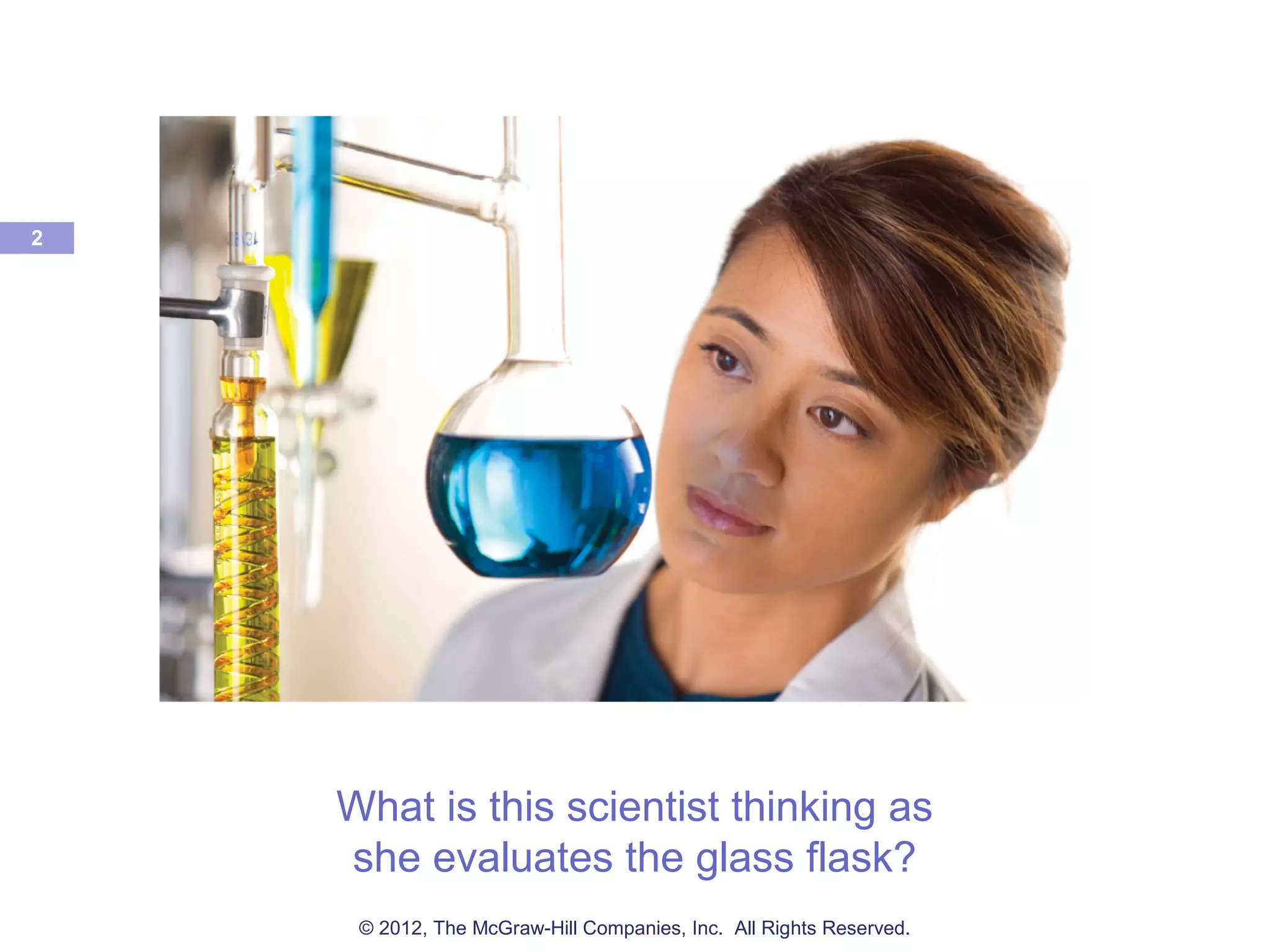
What is this scientist thinking as
she evaluates the glass flask?
2
© 2012, The McGraw-Hill Companies, Inc. All Rights Reserved.
What is science?
Science rests upon reasoning that moves from
observable, measurable facts, usually called data, to
testable explanations for these facts. Scientists discover,
observe, and collect facts in a systematic manner to
explain data relationships. They then link these
relationships through explanatory devices such as
hypotheses. Modern science has a profound impact on our
lives, and because it is so pervasive, we tend to perceive it
as the natural method for obtaining knowledge about the
world. However, we must recognize and evaluate the
assumptions underlying science to ensure what we are
learning is accurate and credible.
3
© 2012, The McGraw-Hill Companies, Inc. All Rights Reserved.
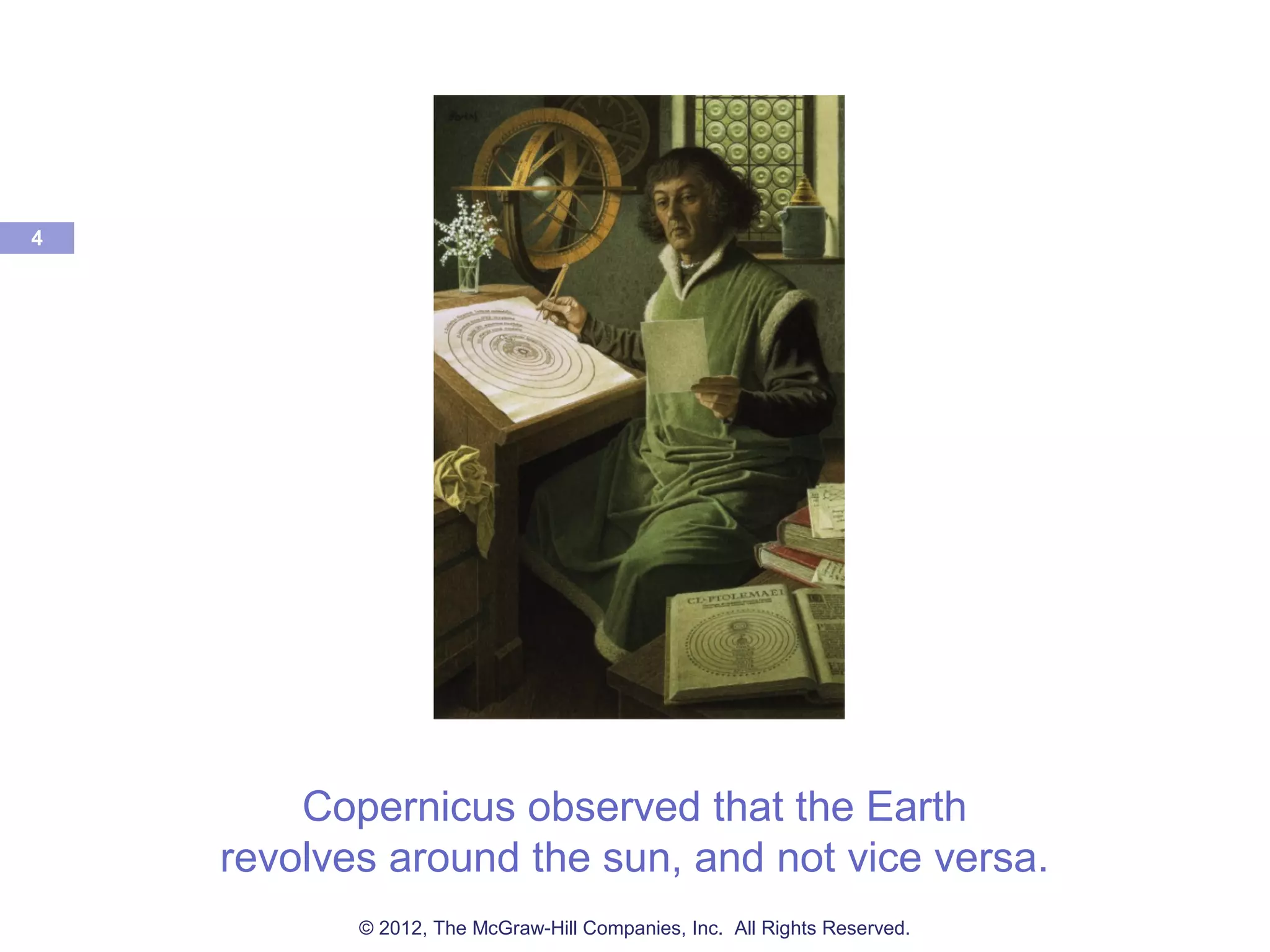
Copernicus observed that the Earth
revolves around the sun, and not vice versa.
4
© 2012, The McGraw-Hill Companies, Inc. All Rights Reserved.
Assumptions underlying science
Science is the primary way Western culture perceives and
interprets reality. However, it is important to keep in mind
that science is a system created by humans and, as such,
is based on a particular set of assumptions. These
assumptions include empiricism, objectivity, materialism,
predictability, and unity.
5
© 2012, The McGraw-Hill Companies, Inc. All Rights Reserved.
Empiricism, objectivity, materialism,
predictability, and unity
 Empiricism—Sense experience is the source of truth.
 Objectivity—We can study the physical world without
bias.
 Materialism—Everything in the universe is made up of
physical matter.
 Predictability—The universe is composed of
interconnected causal relationships.
 Unity—The universe has an underlying, unified dynamic
structure.
6
© 2012, The McGraw-Hill Companies, Inc. All Rights Reserved.
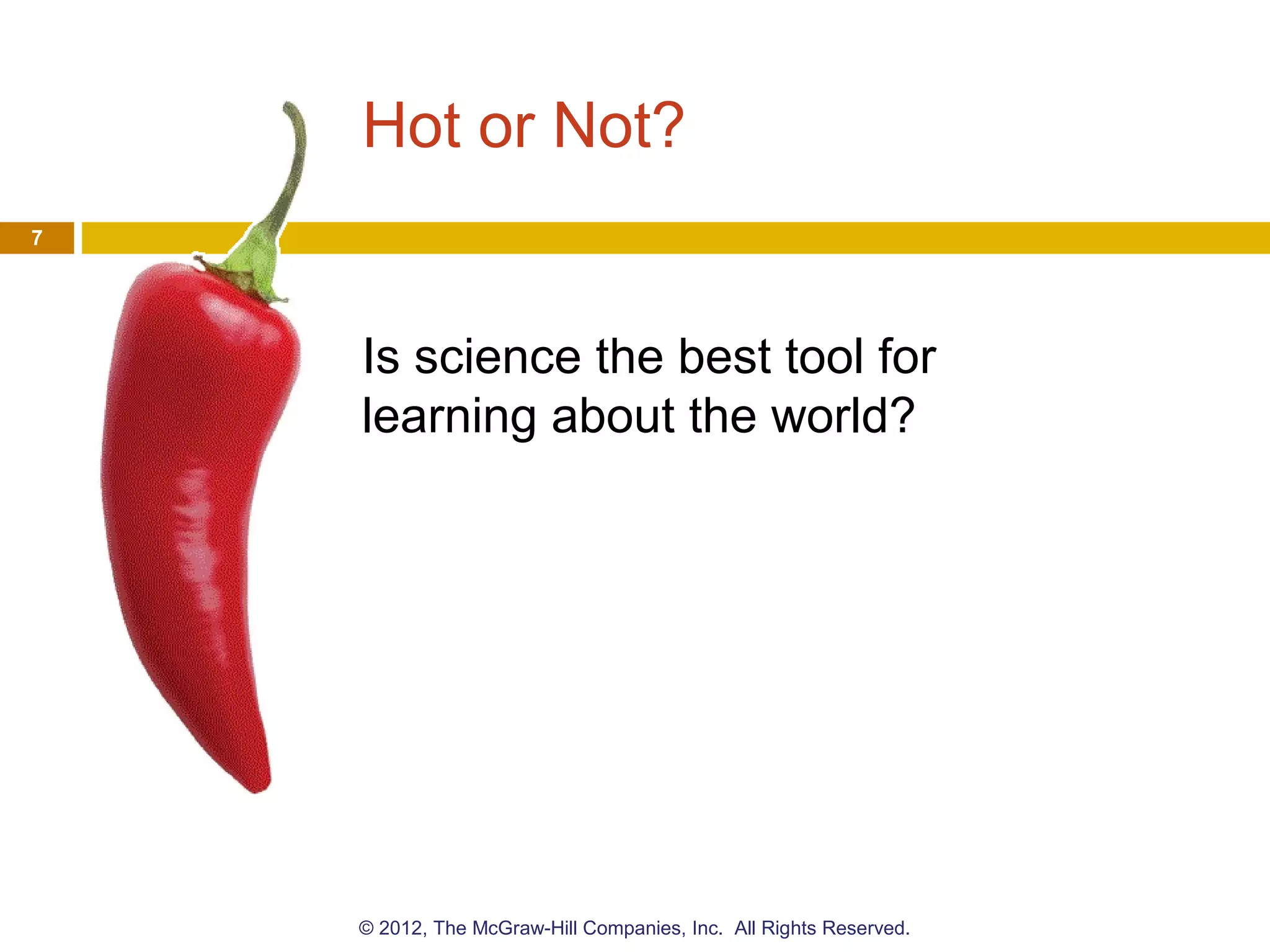
Hot or Not?
Is science the best tool for
learning about the world?
7
© 2012, The McGraw-Hill Companies, Inc. All Rights Reserved.
Limitations of science
 Despite its obvious strengths, scientific reasoning has
some limitations. Empiricism and the use of sense
experience limits science to observable, shared
phenomena. Additionally, the basis of science, the
existence of the physical world, cannot be empirically
proven. Furthermore, quantum physics challenges the
idea that reality is ultimately predictable and material,
and that objective observation is even possible.
 As critical thinkers, it is important to keep both the
strengths and limitations of scientific reasoning in mind.
8
© 2012, The McGraw-Hill Companies, Inc. All Rights Reserved.
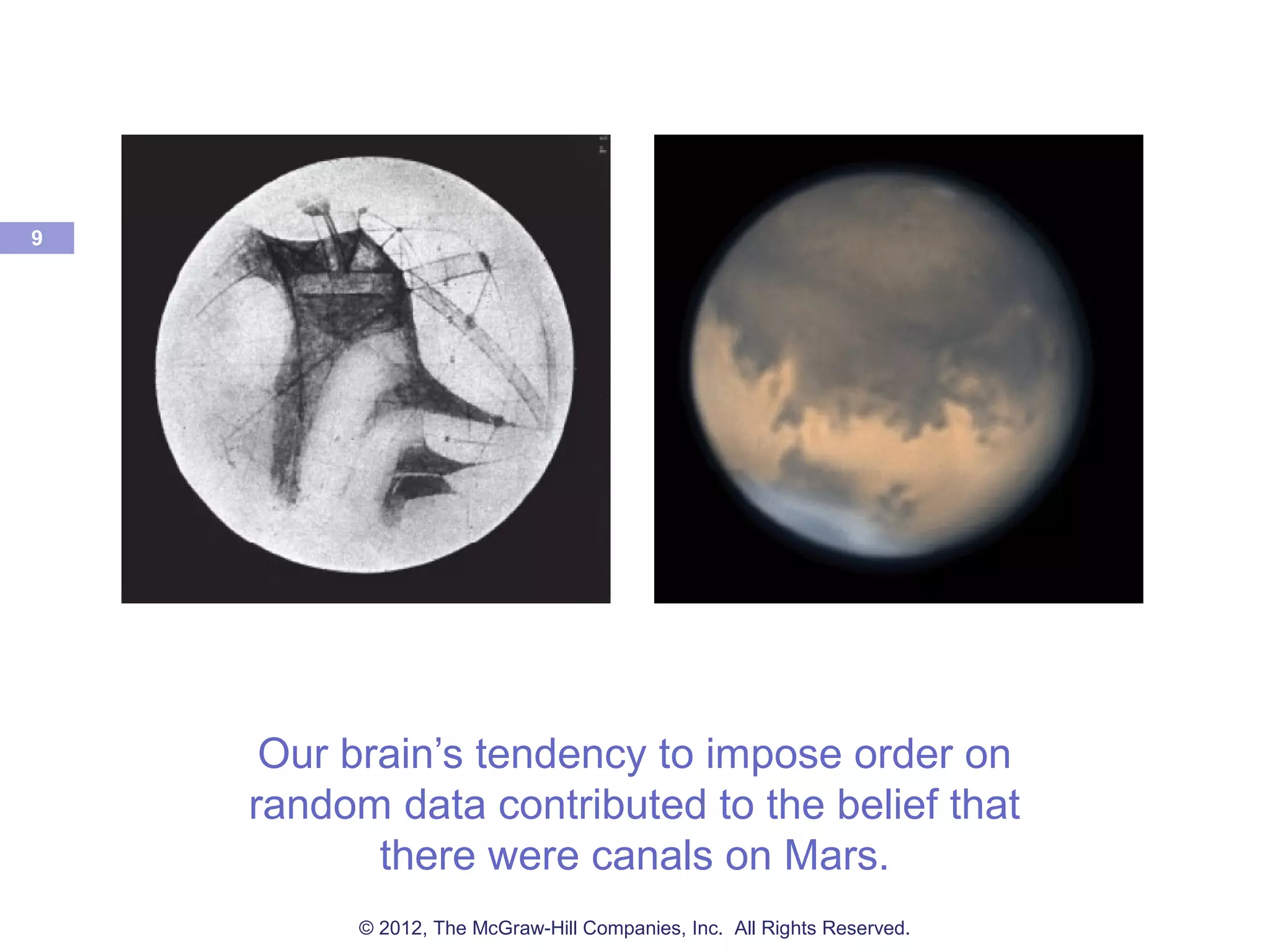
Our brain’s tendency to impose order on
random data contributed to the belief that
there were canals on Mars.
9
© 2012, The McGraw-Hill Companies, Inc. All Rights Reserved.
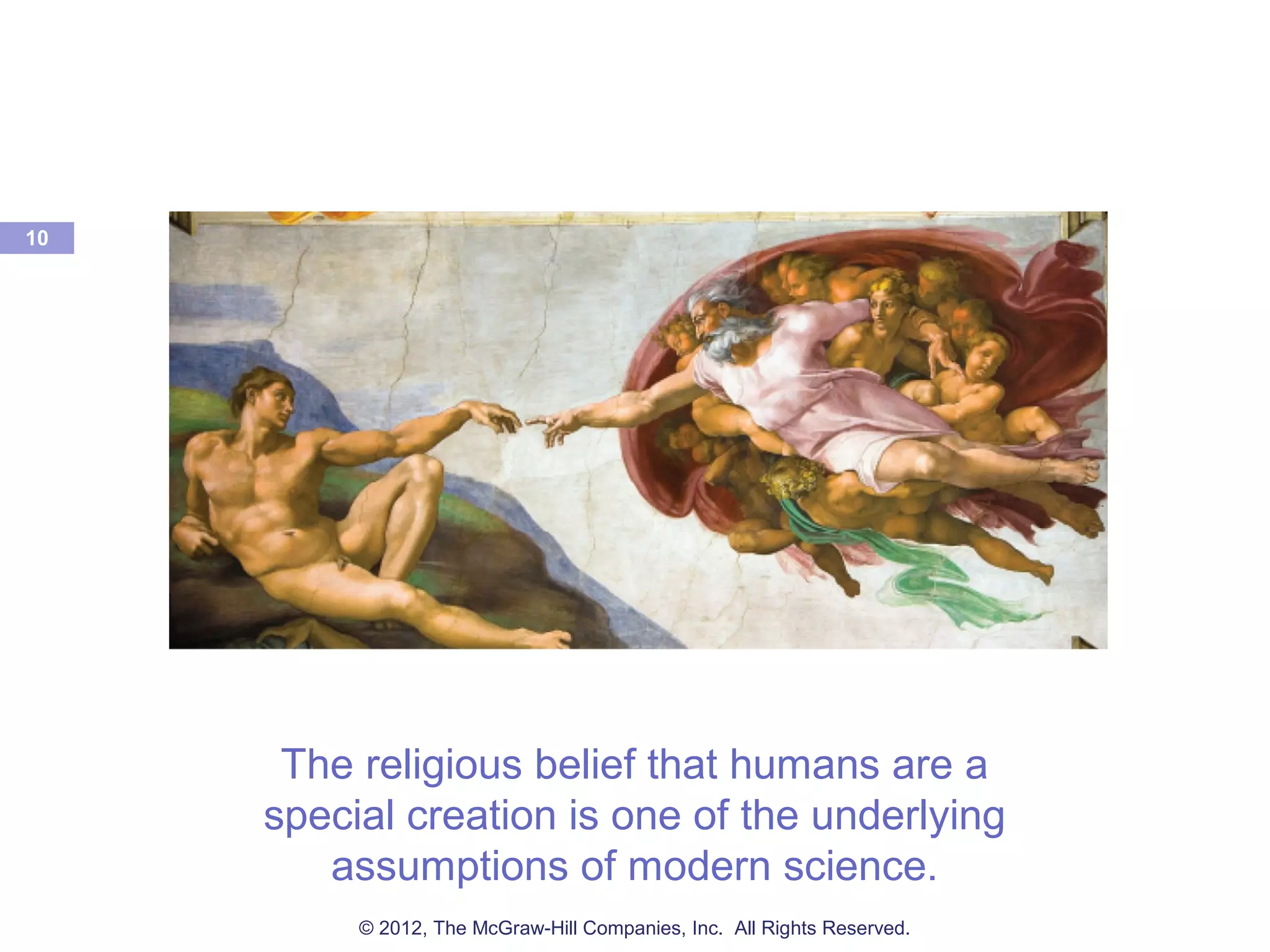
The religious belief that humans are a
special creation is one of the underlying
assumptions of modern science.
10
© 2012, The McGraw-Hill Companies, Inc. All Rights Reserved.
The scientific method
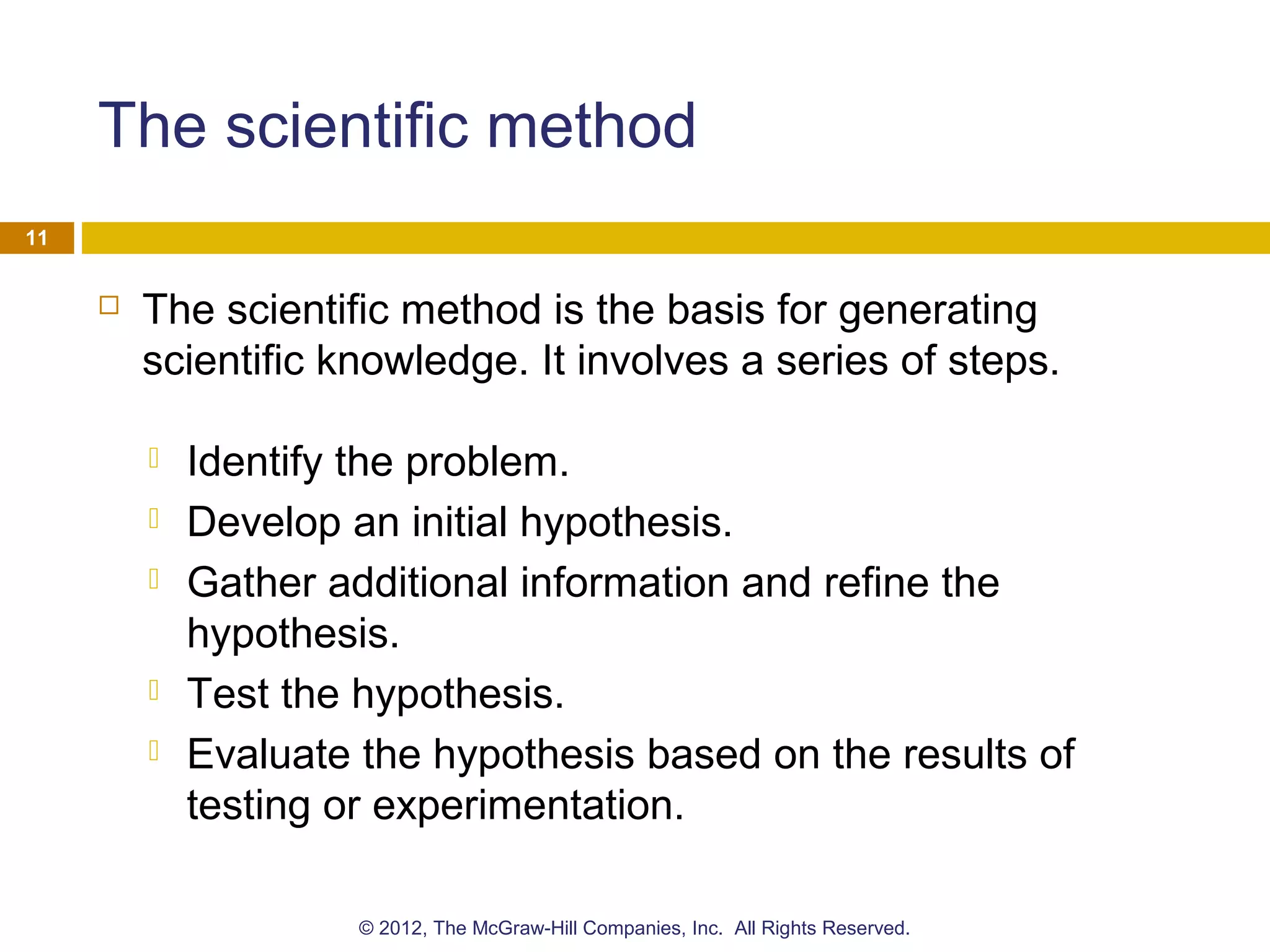
 The scientific method is the basis for generating
scientific knowledge. It involves a series of steps.
 Identify the problem.
 Develop an initial hypothesis.
 Gather additional information and refine the
hypothesis.
 Test the hypothesis.
 Evaluate the hypothesis based on the results of
testing or experimentation.
11
© 2012, The McGraw-Hill Companies, Inc. All Rights Reserved.
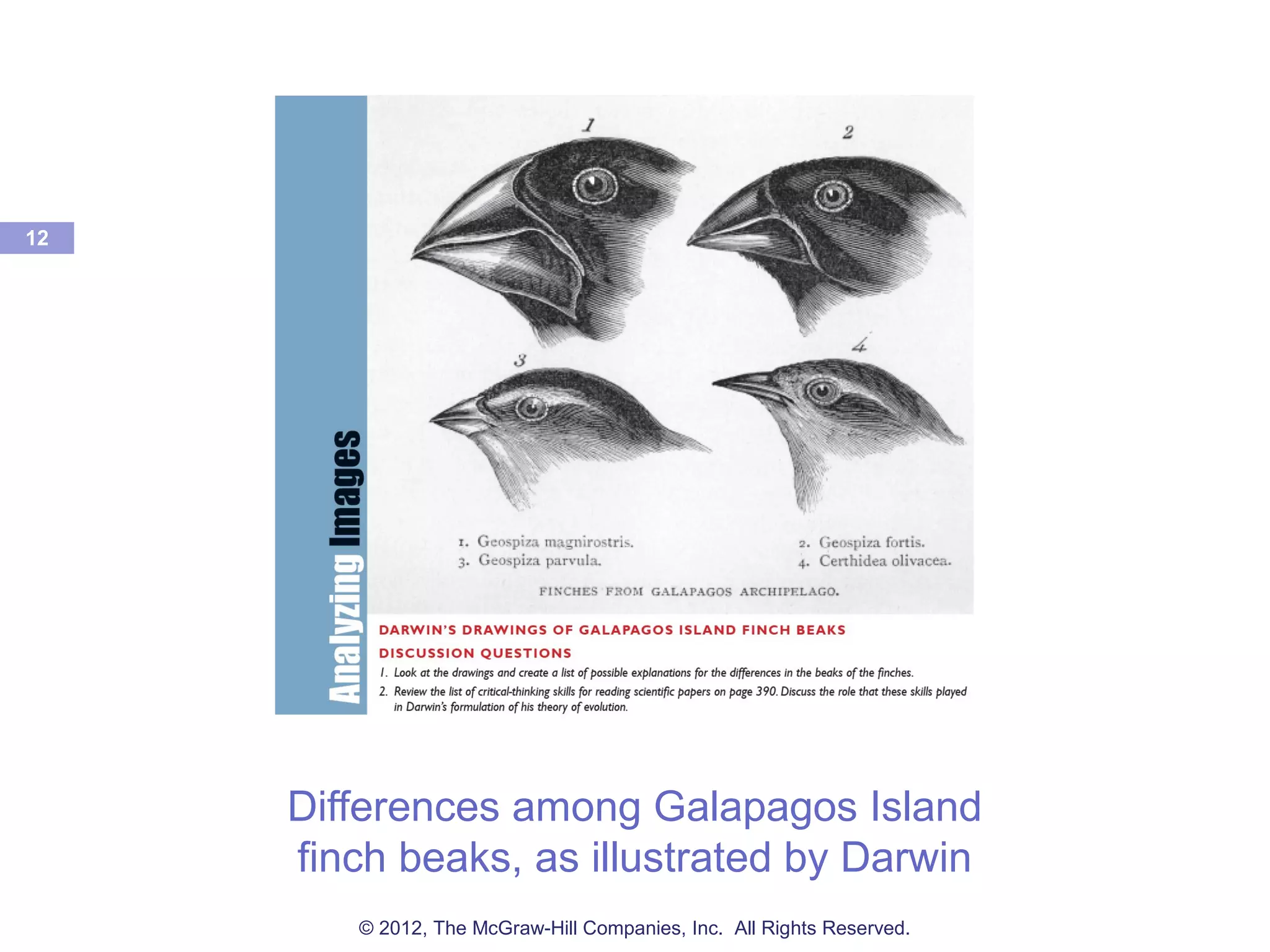
Differences among Galapagos Island
finch beaks, as illustrated by Darwin
12
© 2012, The McGraw-Hill Companies, Inc. All Rights Reserved.
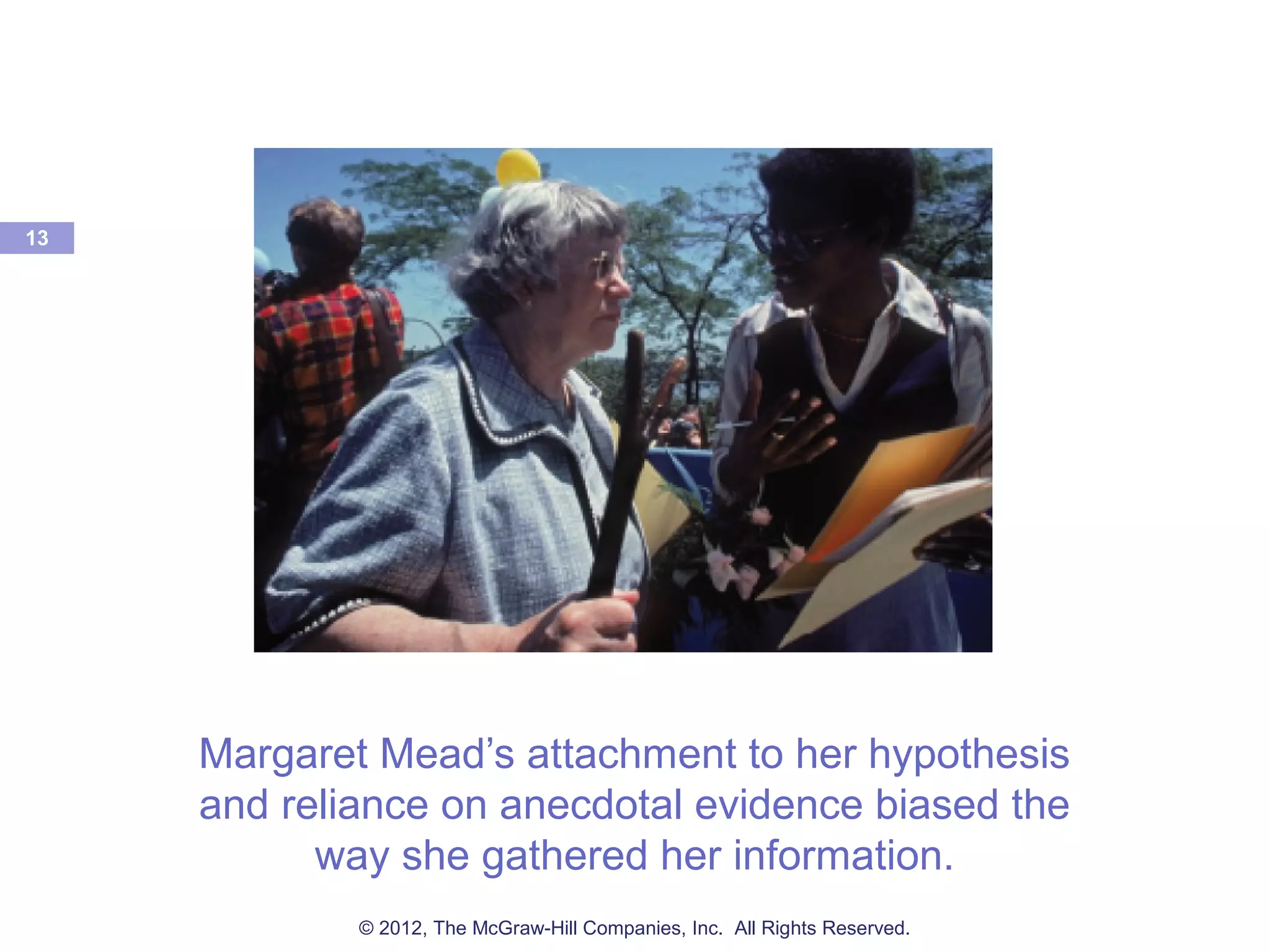
Margaret Mead’s attachment to her hypothesis
and reliance on anecdotal evidence biased the
way she gathered her information.
13
© 2012, The McGraw-Hill Companies, Inc. All Rights Reserved.
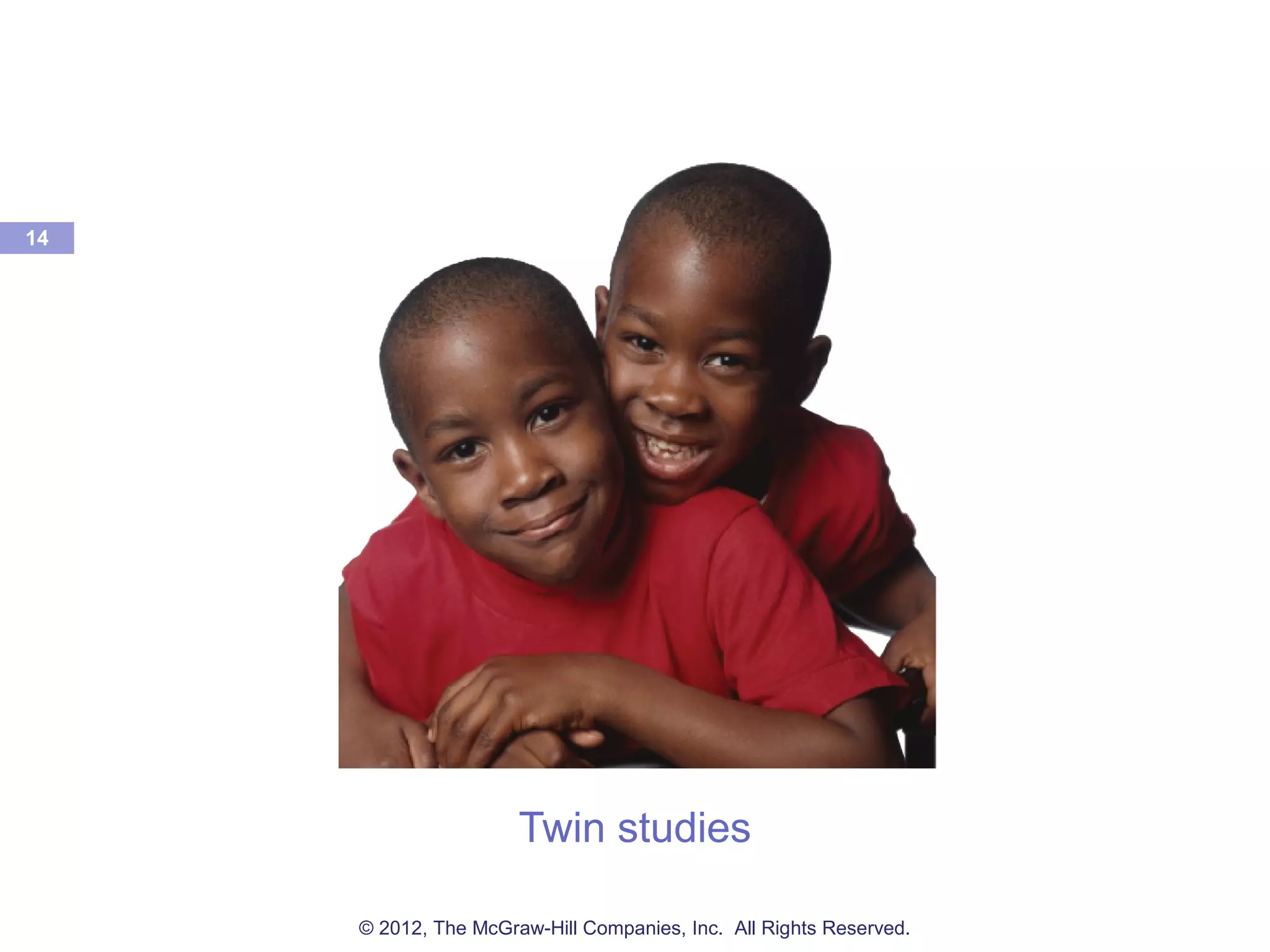
Twin studies
14
© 2012, The McGraw-Hill Companies, Inc. All Rights Reserved.
Evaluating a scientific hypothesis
 When evaluating a scientific hypothesis, the following
criteria are appropriate:
 Is it relevant to the problem under investigation?
 Is it consistent with well-established theories?
 Is it the simplest explanation for the problem?
 Does it provide a testable and falsifiable explanation
of the problem?
 Can it be used to predict the outcome of similar
events?
15
© 2012, The McGraw-Hill Companies, Inc. All Rights Reserved.
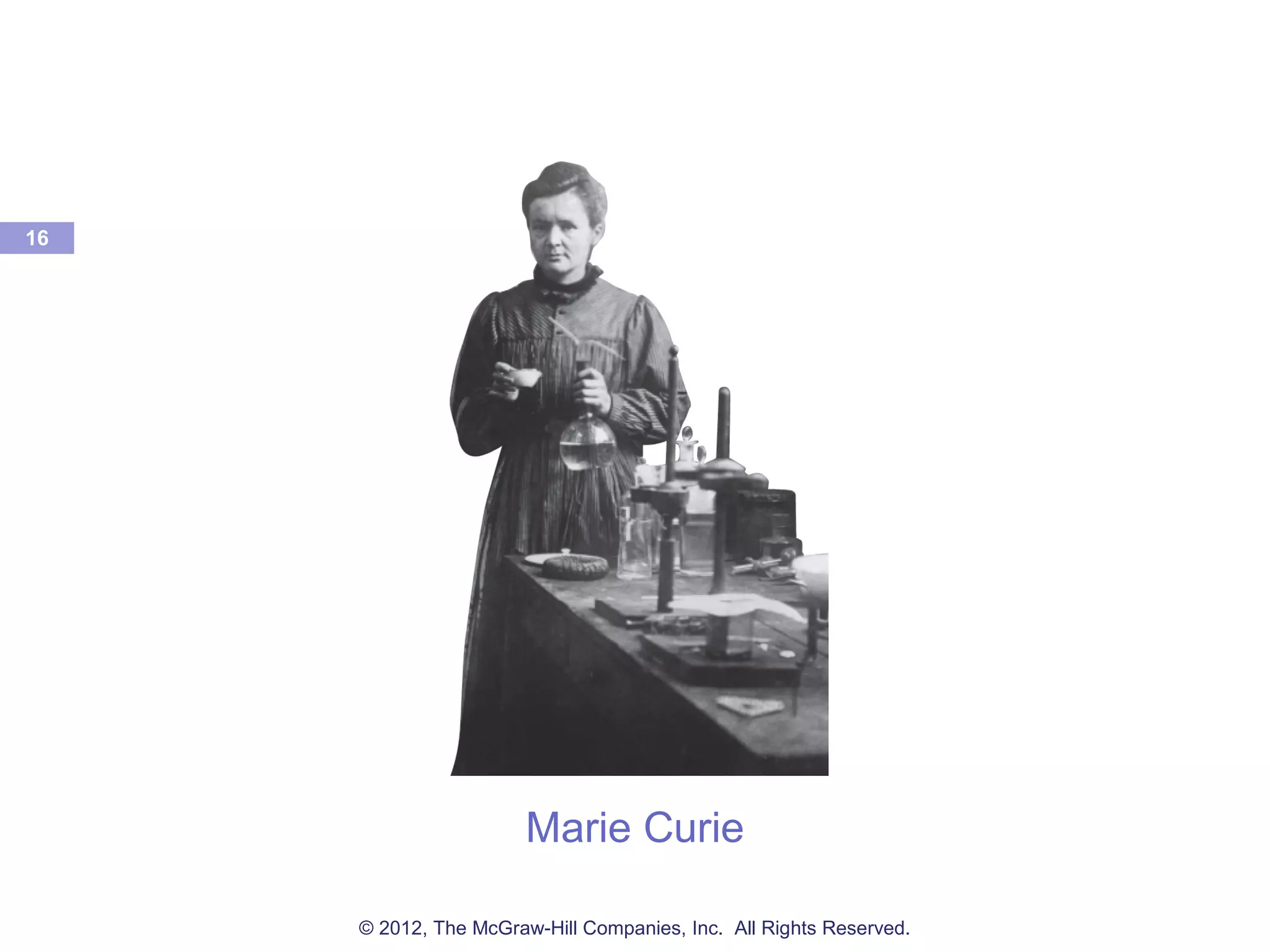
Marie Curie
16
© 2012, The McGraw-Hill Companies, Inc. All Rights Reserved.
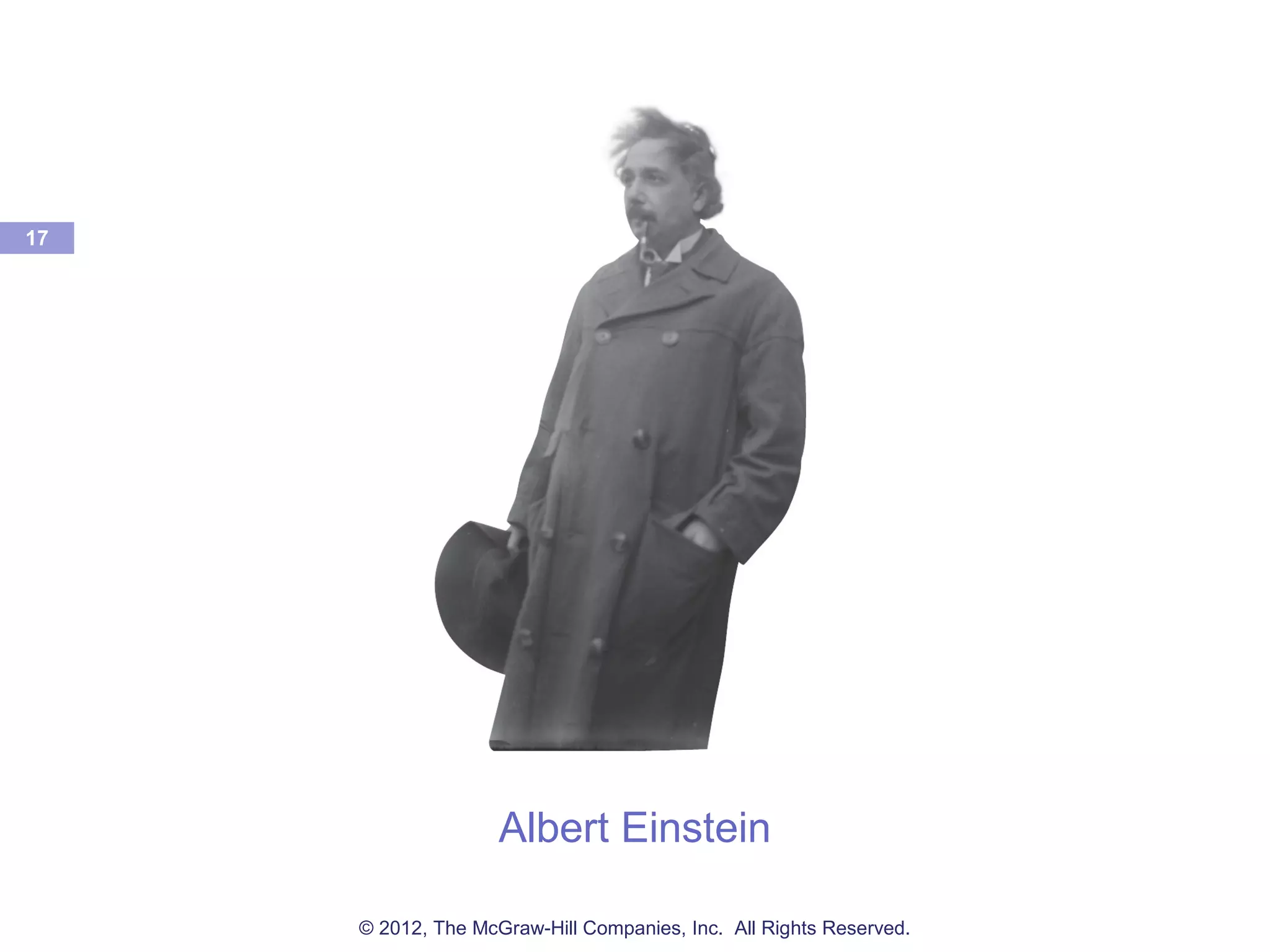
Albert Einstein
17
© 2012, The McGraw-Hill Companies, Inc. All Rights Reserved.
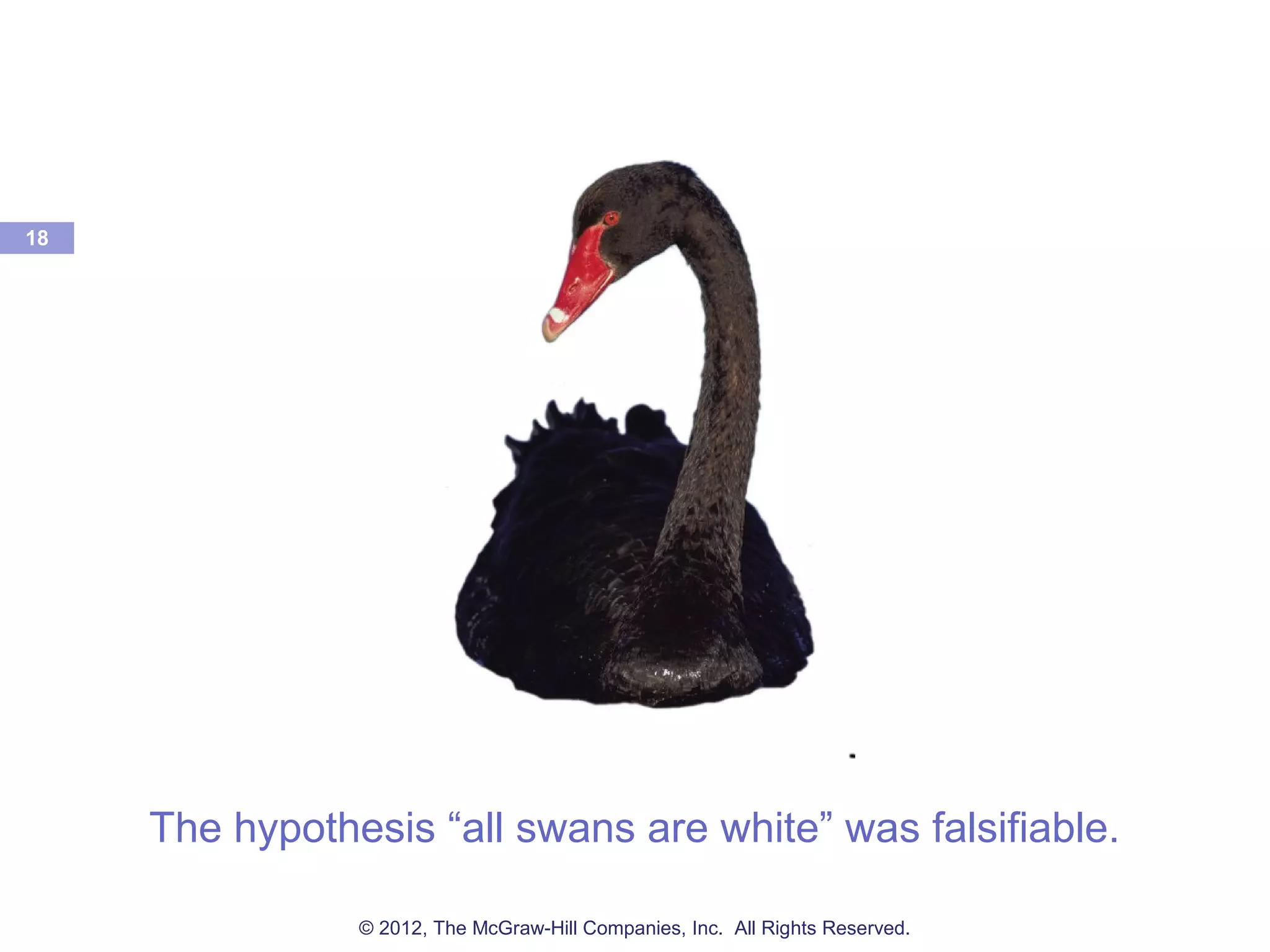
The hypothesis “all swans are white” was falsifiable.
18
© 2012, The McGraw-Hill Companies, Inc. All Rights Reserved.
Distinguishing between science and
pseudoscience
Pseudoscience is a body of explanations or hypotheses
that, in an attempt to gain legitimacy, masquerades as
science. Unlike science, which uses systematic
observation, reasoning, and testing, pseudoscience is
based on emotional appeals, superstition, and rhetoric.
Astrology is an example of pseudoscience. Pseudoscience
takes advantage of cognitive errors in our thinking, and is
often used to persuade people, particularly the young, as a
means to gain money or political support.
19
© 2012, The McGraw-Hill Companies, Inc. All Rights Reserved.
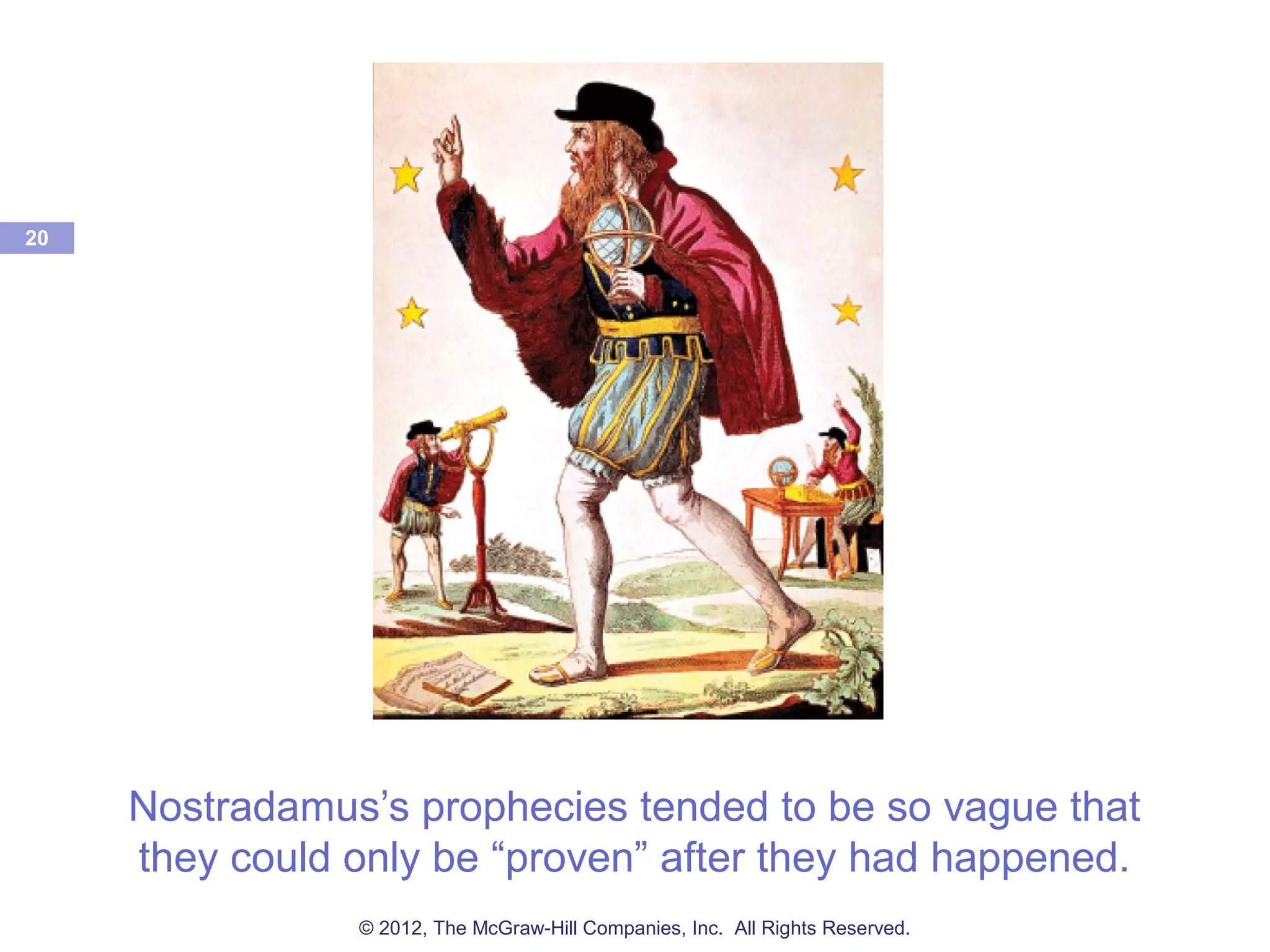
Nostradamus’s prophecies tended to be so vague that
they could only be “proven” after they had happened.
20
© 2012, The McGraw-Hill Companies, Inc. All Rights Reserved.
Research methodology
Research methodology is a systematic approach to
gathering and analyzing information based on established
scientific procedures and techniques. One of these
methodologies is experimentation. Three common types of
experimentation are field experiments, controlled
experiments, and single group (pretest-posttest)
experiments. These experiments include elements such as
independent variables, dependent variables, and
confounding variables, and all use experimental material,
the group or class of objects or subjects under study.
21
© 2012, The McGraw-Hill Companies, Inc. All Rights Reserved.
Hot or Not?
Are field experiments real scientific
experiments?
22
© 2012, The McGraw-Hill Companies, Inc. All Rights Reserved.
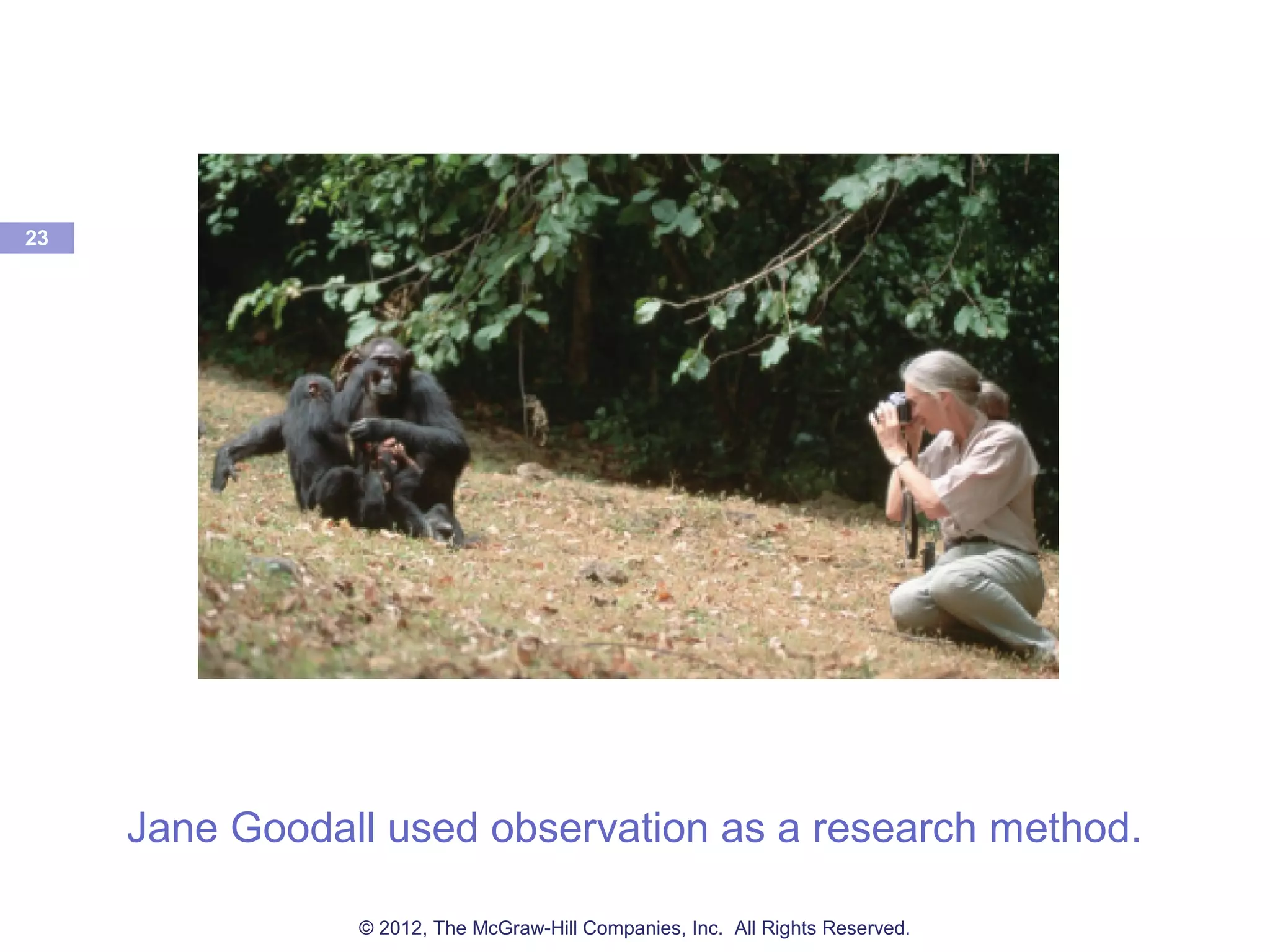
Jane Goodall used observation as a research method.
23
© 2012, The McGraw-Hill Companies, Inc. All Rights Reserved.
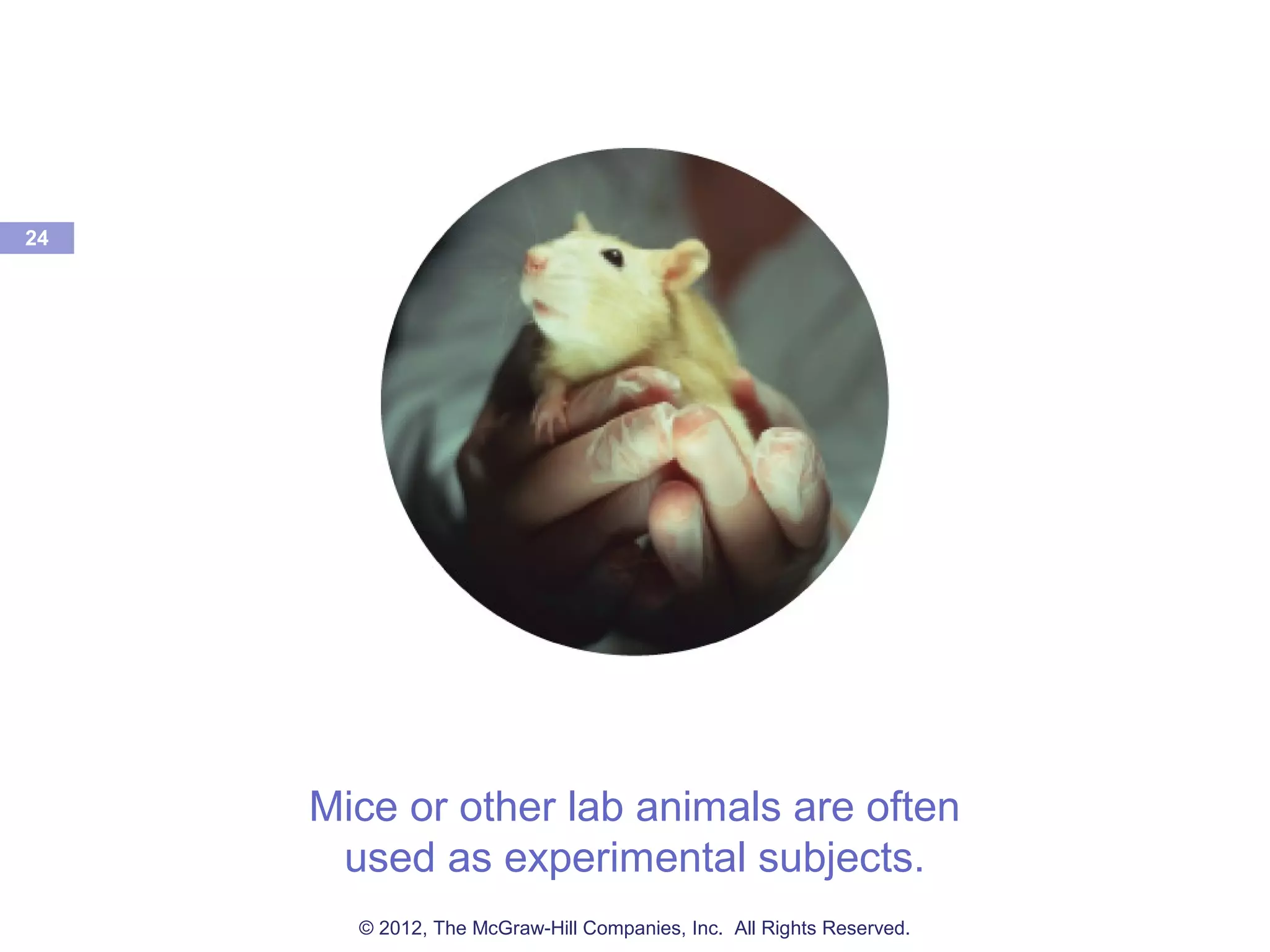
Mice or other lab animals are often
used as experimental subjects.
24
© 2012, The McGraw-Hill Companies, Inc. All Rights Reserved.
Evaluating experimental designs
 Regardless of which type of experiment design is used,
common evaluation criteria can be applied to test the validity
of the experiment and its results. Well-designed experiments
use the following criteria:
 Unbiased—The experiment has checks or controls to eliminate both
subject and experimenter bias.
 Measurement—The measurements used are appropriate and
reliable as well as accurate and precise.
 Replicable—The experiment can be reproduced by other scientists.
 Generality—The experimental results can be generalized to the
population under study.
25
© 2012, The McGraw-Hill Companies, Inc. All Rights Reserved.
Ethical concerns in science
Although scientific experiments may be well designed
and produce significant results, they may be inappropriate
due to their violation of moral and ethical principles and
guidelines. Ethical considerations of informed consent,
rights, and nonmaleficence (no harm) are particularly
important when dealing with human subjects. During World
War II, Nazi doctors performed unethical experiments on
Jews, prisoners of war, and other prisoners. These
activities have also occurred in the United States, such
as in the Tuskegee study.
26
© 2012, The McGraw-Hill Companies, Inc. All Rights Reserved.
Hot or Not?
Should pregnant women, or
women who might become
pregnant, be allowed to participate
in drug tests?
27
© 2012, The McGraw-Hill Companies, Inc. All Rights Reserved.
Hot or Not?
Is it desirable, or even possible, for
science to become value-neutral?
28
© 2012, The McGraw-Hill Companies, Inc. All Rights Reserved.
Thomas Kuhn and scientific paradigms
In his work The Structure of Scientific Revolutions (1962),
American physicist and science historian Thomas Kuhn
(1922-1996) challenged the idea that science is
progressive and objective. Instead he argued that science,
like other human enterprises, is a social construct—
a product of its society. As such, it is biased by social
expectations and professional norms that determine what
is acceptable in terms of hypotheses and experimentation.
29
© 2012, The McGraw-Hill Companies, Inc. All Rights Reserved.
Scientific revolutions and paradigm
shifts
Kuhn argued in favor of three key concepts: normal
science, paradigms, and scientific revolutions. Normal
science refers to “research based upon one or more past
achievements,” while paradigms, building on normal
science, provide an accepted view of the world. A
scientific revolution, or paradigm shift, occurs when a
new scientific theory is developed to replace a problematic
paradigm. Einstein’s theory of relativity is an example of a
paradigm shift.
30
© 2012, The McGraw-Hill Companies, Inc. All Rights Reserved.
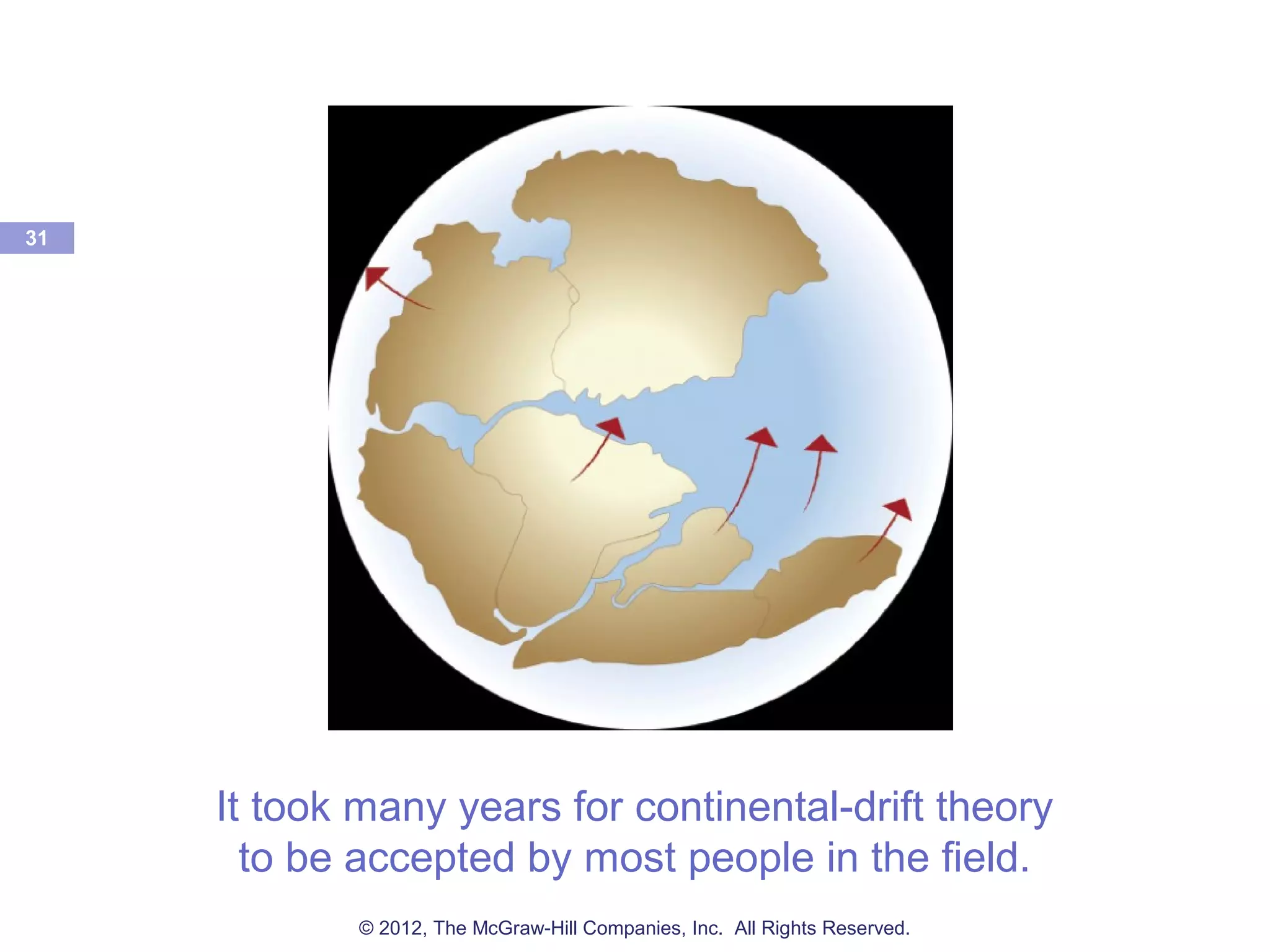
It took many years for continental-drift theory
to be accepted by most people in the field.
31
© 2012, The McGraw-Hill Companies, Inc. All Rights Reserved.
Conclusions
Science and scientific thinking has generated enormous
benefit to humanity. However, as critical thinkers we must
be aware of its limitations, the temptations of
pseudoscience, and the possibilities of other explanations
for phenomena. We must use evaluative criteria when
considering scientific reasoning, and recognize that new
ideas may hold answers to questions that existing
paradigms cannot resolve.
32
© 2012, The McGraw-Hill Companies, Inc. All Rights Reserved.
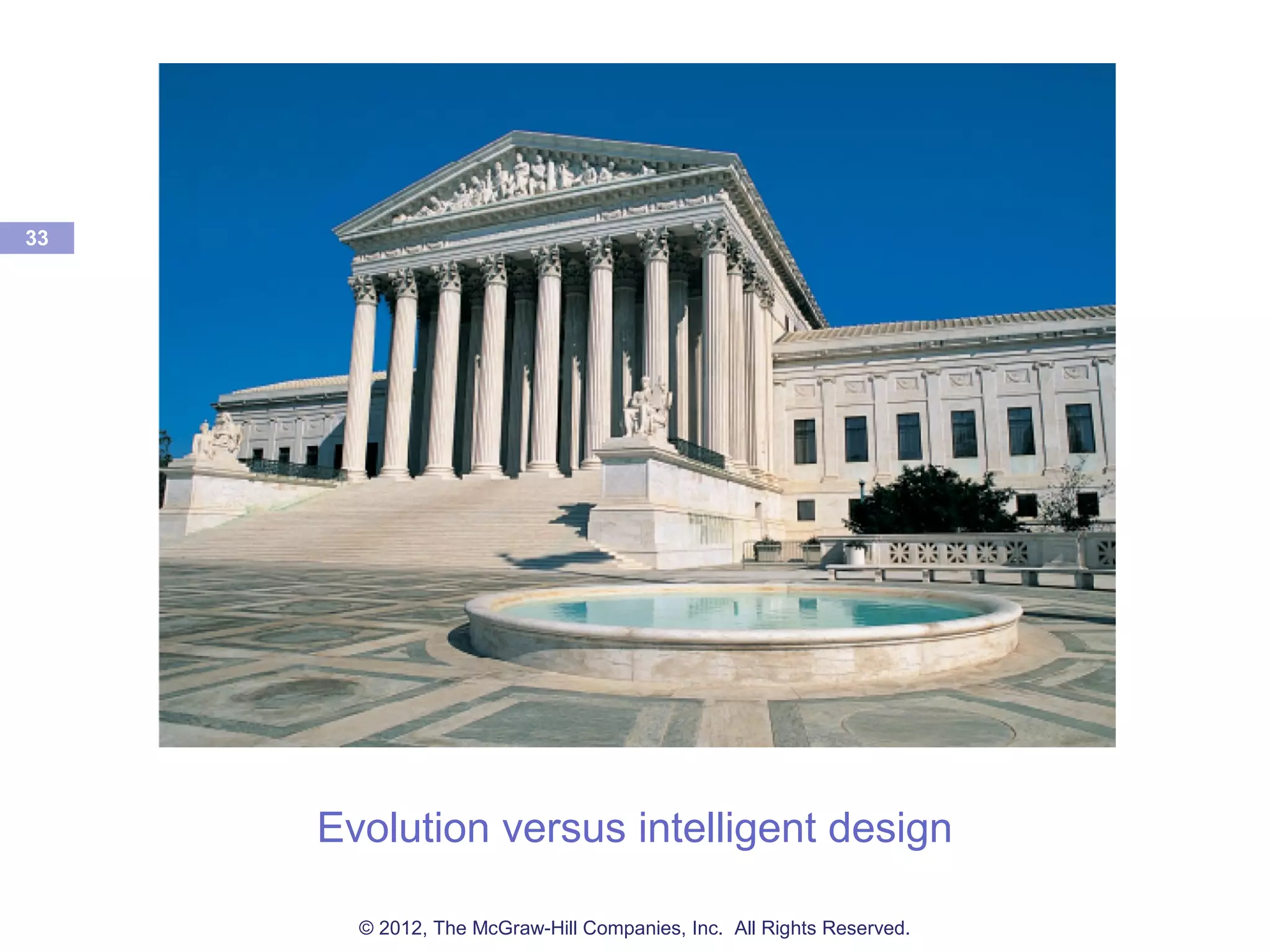
Evolution versus intelligent design
33
© 2012, The McGraw-Hill Companies, Inc. All Rights Reserved.

Boss2 ppt ch12

  • 1.
    SCIENCE The aim ofthis tutorial is to help you learn to identify and evaluate scientific methods and assumptions.
  • 2.
    What is thisscientist thinking as she evaluates the glass flask? 2 © 2012, The McGraw-Hill Companies, Inc. All Rights Reserved.
  • 3.
    What is science? Sciencerests upon reasoning that moves from observable, measurable facts, usually called data, to testable explanations for these facts. Scientists discover, observe, and collect facts in a systematic manner to explain data relationships. They then link these relationships through explanatory devices such as hypotheses. Modern science has a profound impact on our lives, and because it is so pervasive, we tend to perceive it as the natural method for obtaining knowledge about the world. However, we must recognize and evaluate the assumptions underlying science to ensure what we are learning is accurate and credible. 3 © 2012, The McGraw-Hill Companies, Inc. All Rights Reserved.
  • 4.
    Copernicus observed thatthe Earth revolves around the sun, and not vice versa. 4 © 2012, The McGraw-Hill Companies, Inc. All Rights Reserved.
  • 5.
    Assumptions underlying science Scienceis the primary way Western culture perceives and interprets reality. However, it is important to keep in mind that science is a system created by humans and, as such, is based on a particular set of assumptions. These assumptions include empiricism, objectivity, materialism, predictability, and unity. 5 © 2012, The McGraw-Hill Companies, Inc. All Rights Reserved.
  • 6.
    Empiricism, objectivity, materialism, predictability,and unity  Empiricism—Sense experience is the source of truth.  Objectivity—We can study the physical world without bias.  Materialism—Everything in the universe is made up of physical matter.  Predictability—The universe is composed of interconnected causal relationships.  Unity—The universe has an underlying, unified dynamic structure. 6 © 2012, The McGraw-Hill Companies, Inc. All Rights Reserved.
  • 7.
    Hot or Not? Isscience the best tool for learning about the world? 7 © 2012, The McGraw-Hill Companies, Inc. All Rights Reserved.
  • 8.
    Limitations of science Despite its obvious strengths, scientific reasoning has some limitations. Empiricism and the use of sense experience limits science to observable, shared phenomena. Additionally, the basis of science, the existence of the physical world, cannot be empirically proven. Furthermore, quantum physics challenges the idea that reality is ultimately predictable and material, and that objective observation is even possible.  As critical thinkers, it is important to keep both the strengths and limitations of scientific reasoning in mind. 8 © 2012, The McGraw-Hill Companies, Inc. All Rights Reserved.
  • 9.
    Our brain’s tendencyto impose order on random data contributed to the belief that there were canals on Mars. 9 © 2012, The McGraw-Hill Companies, Inc. All Rights Reserved.
  • 10.
    The religious beliefthat humans are a special creation is one of the underlying assumptions of modern science. 10 © 2012, The McGraw-Hill Companies, Inc. All Rights Reserved.
  • 11.
    The scientific method The scientific method is the basis for generating scientific knowledge. It involves a series of steps.  Identify the problem.  Develop an initial hypothesis.  Gather additional information and refine the hypothesis.  Test the hypothesis.  Evaluate the hypothesis based on the results of testing or experimentation. 11 © 2012, The McGraw-Hill Companies, Inc. All Rights Reserved.
  • 12.
    Differences among GalapagosIsland finch beaks, as illustrated by Darwin 12 © 2012, The McGraw-Hill Companies, Inc. All Rights Reserved.
  • 13.
    Margaret Mead’s attachmentto her hypothesis and reliance on anecdotal evidence biased the way she gathered her information. 13 © 2012, The McGraw-Hill Companies, Inc. All Rights Reserved.
  • 14.
    Twin studies 14 © 2012,The McGraw-Hill Companies, Inc. All Rights Reserved.
  • 15.
    Evaluating a scientifichypothesis  When evaluating a scientific hypothesis, the following criteria are appropriate:  Is it relevant to the problem under investigation?  Is it consistent with well-established theories?  Is it the simplest explanation for the problem?  Does it provide a testable and falsifiable explanation of the problem?  Can it be used to predict the outcome of similar events? 15 © 2012, The McGraw-Hill Companies, Inc. All Rights Reserved.
  • 16.
    Marie Curie 16 © 2012,The McGraw-Hill Companies, Inc. All Rights Reserved.
  • 17.
    Albert Einstein 17 © 2012,The McGraw-Hill Companies, Inc. All Rights Reserved.
  • 18.
    The hypothesis “allswans are white” was falsifiable. 18 © 2012, The McGraw-Hill Companies, Inc. All Rights Reserved.
  • 19.
    Distinguishing between scienceand pseudoscience Pseudoscience is a body of explanations or hypotheses that, in an attempt to gain legitimacy, masquerades as science. Unlike science, which uses systematic observation, reasoning, and testing, pseudoscience is based on emotional appeals, superstition, and rhetoric. Astrology is an example of pseudoscience. Pseudoscience takes advantage of cognitive errors in our thinking, and is often used to persuade people, particularly the young, as a means to gain money or political support. 19 © 2012, The McGraw-Hill Companies, Inc. All Rights Reserved.
  • 20.
    Nostradamus’s prophecies tendedto be so vague that they could only be “proven” after they had happened. 20 © 2012, The McGraw-Hill Companies, Inc. All Rights Reserved.
  • 21.
    Research methodology Research methodologyis a systematic approach to gathering and analyzing information based on established scientific procedures and techniques. One of these methodologies is experimentation. Three common types of experimentation are field experiments, controlled experiments, and single group (pretest-posttest) experiments. These experiments include elements such as independent variables, dependent variables, and confounding variables, and all use experimental material, the group or class of objects or subjects under study. 21 © 2012, The McGraw-Hill Companies, Inc. All Rights Reserved.
  • 22.
    Hot or Not? Arefield experiments real scientific experiments? 22 © 2012, The McGraw-Hill Companies, Inc. All Rights Reserved.
  • 23.
    Jane Goodall usedobservation as a research method. 23 © 2012, The McGraw-Hill Companies, Inc. All Rights Reserved.
  • 24.
    Mice or otherlab animals are often used as experimental subjects. 24 © 2012, The McGraw-Hill Companies, Inc. All Rights Reserved.
  • 25.
    Evaluating experimental designs Regardless of which type of experiment design is used, common evaluation criteria can be applied to test the validity of the experiment and its results. Well-designed experiments use the following criteria:  Unbiased—The experiment has checks or controls to eliminate both subject and experimenter bias.  Measurement—The measurements used are appropriate and reliable as well as accurate and precise.  Replicable—The experiment can be reproduced by other scientists.  Generality—The experimental results can be generalized to the population under study. 25 © 2012, The McGraw-Hill Companies, Inc. All Rights Reserved.
  • 26.
    Ethical concerns inscience Although scientific experiments may be well designed and produce significant results, they may be inappropriate due to their violation of moral and ethical principles and guidelines. Ethical considerations of informed consent, rights, and nonmaleficence (no harm) are particularly important when dealing with human subjects. During World War II, Nazi doctors performed unethical experiments on Jews, prisoners of war, and other prisoners. These activities have also occurred in the United States, such as in the Tuskegee study. 26 © 2012, The McGraw-Hill Companies, Inc. All Rights Reserved.
  • 27.
    Hot or Not? Shouldpregnant women, or women who might become pregnant, be allowed to participate in drug tests? 27 © 2012, The McGraw-Hill Companies, Inc. All Rights Reserved.
  • 28.
    Hot or Not? Isit desirable, or even possible, for science to become value-neutral? 28 © 2012, The McGraw-Hill Companies, Inc. All Rights Reserved.
  • 29.
    Thomas Kuhn andscientific paradigms In his work The Structure of Scientific Revolutions (1962), American physicist and science historian Thomas Kuhn (1922-1996) challenged the idea that science is progressive and objective. Instead he argued that science, like other human enterprises, is a social construct— a product of its society. As such, it is biased by social expectations and professional norms that determine what is acceptable in terms of hypotheses and experimentation. 29 © 2012, The McGraw-Hill Companies, Inc. All Rights Reserved.
  • 30.
    Scientific revolutions andparadigm shifts Kuhn argued in favor of three key concepts: normal science, paradigms, and scientific revolutions. Normal science refers to “research based upon one or more past achievements,” while paradigms, building on normal science, provide an accepted view of the world. A scientific revolution, or paradigm shift, occurs when a new scientific theory is developed to replace a problematic paradigm. Einstein’s theory of relativity is an example of a paradigm shift. 30 © 2012, The McGraw-Hill Companies, Inc. All Rights Reserved.
  • 31.
    It took manyyears for continental-drift theory to be accepted by most people in the field. 31 © 2012, The McGraw-Hill Companies, Inc. All Rights Reserved.
  • 32.
    Conclusions Science and scientificthinking has generated enormous benefit to humanity. However, as critical thinkers we must be aware of its limitations, the temptations of pseudoscience, and the possibilities of other explanations for phenomena. We must use evaluative criteria when considering scientific reasoning, and recognize that new ideas may hold answers to questions that existing paradigms cannot resolve. 32 © 2012, The McGraw-Hill Companies, Inc. All Rights Reserved.
  • 33.
    Evolution versus intelligentdesign 33 © 2012, The McGraw-Hill Companies, Inc. All Rights Reserved.