
Anticonvulsants II
Brian J. Piper, Ph.D., M.S.
   piperbj@husson.edu


                February 8, 2013
Objectives
• Pharmacy students will be able to:
  – describe the MOA of recently developed AEDs.
  – identify and contrast the relative frequency of
    adverse events for AEDs.
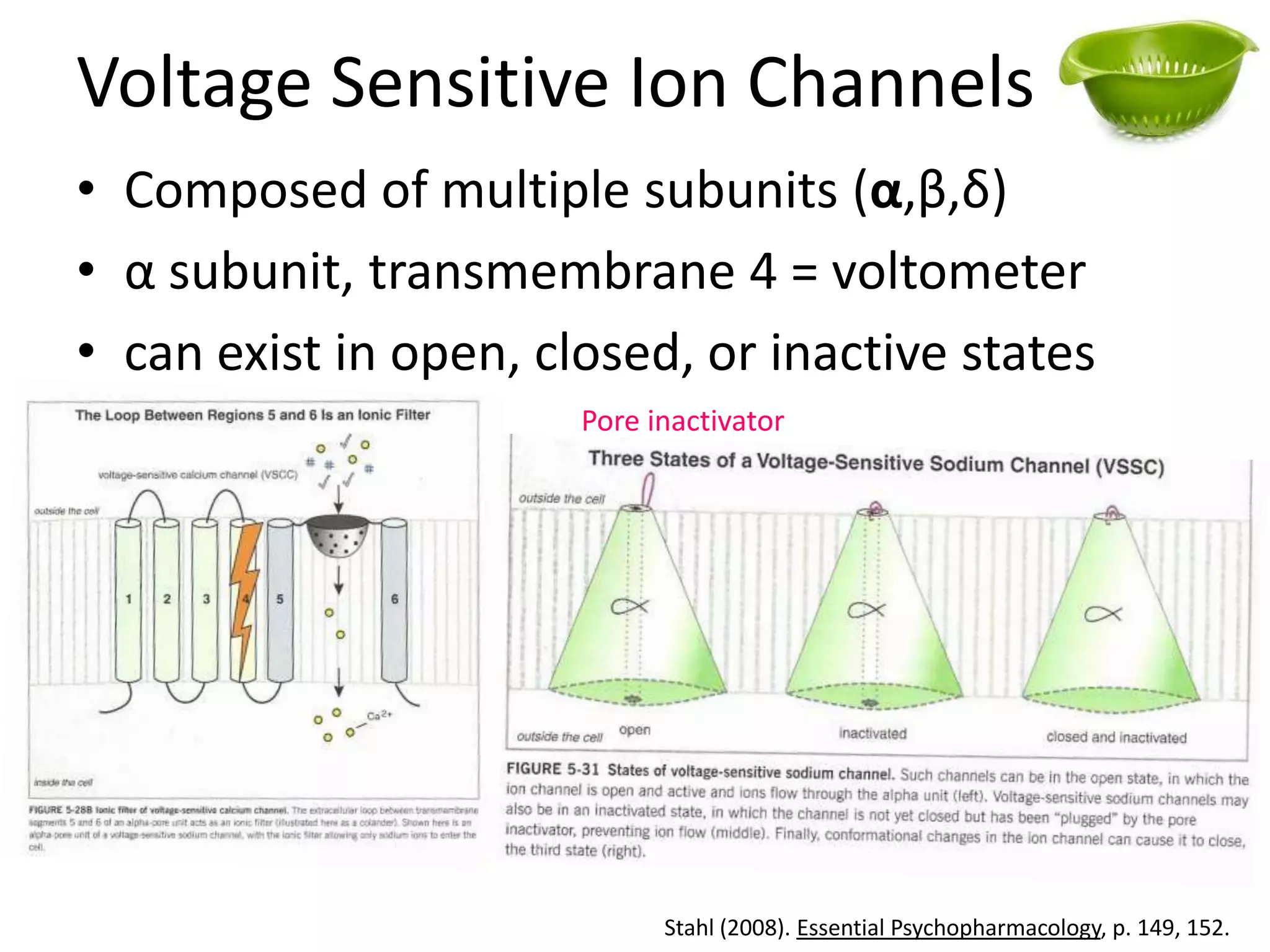
Voltage Sensitive Ion Channels
• Composed of multiple subunits (α,β,δ)
• α subunit, transmembrane 4 = voltometer
• can exist in open, closed, or inactive states
                       Pore inactivator


                             Stahl (2008). Essential Psychopharmacology, p. 149, 152.
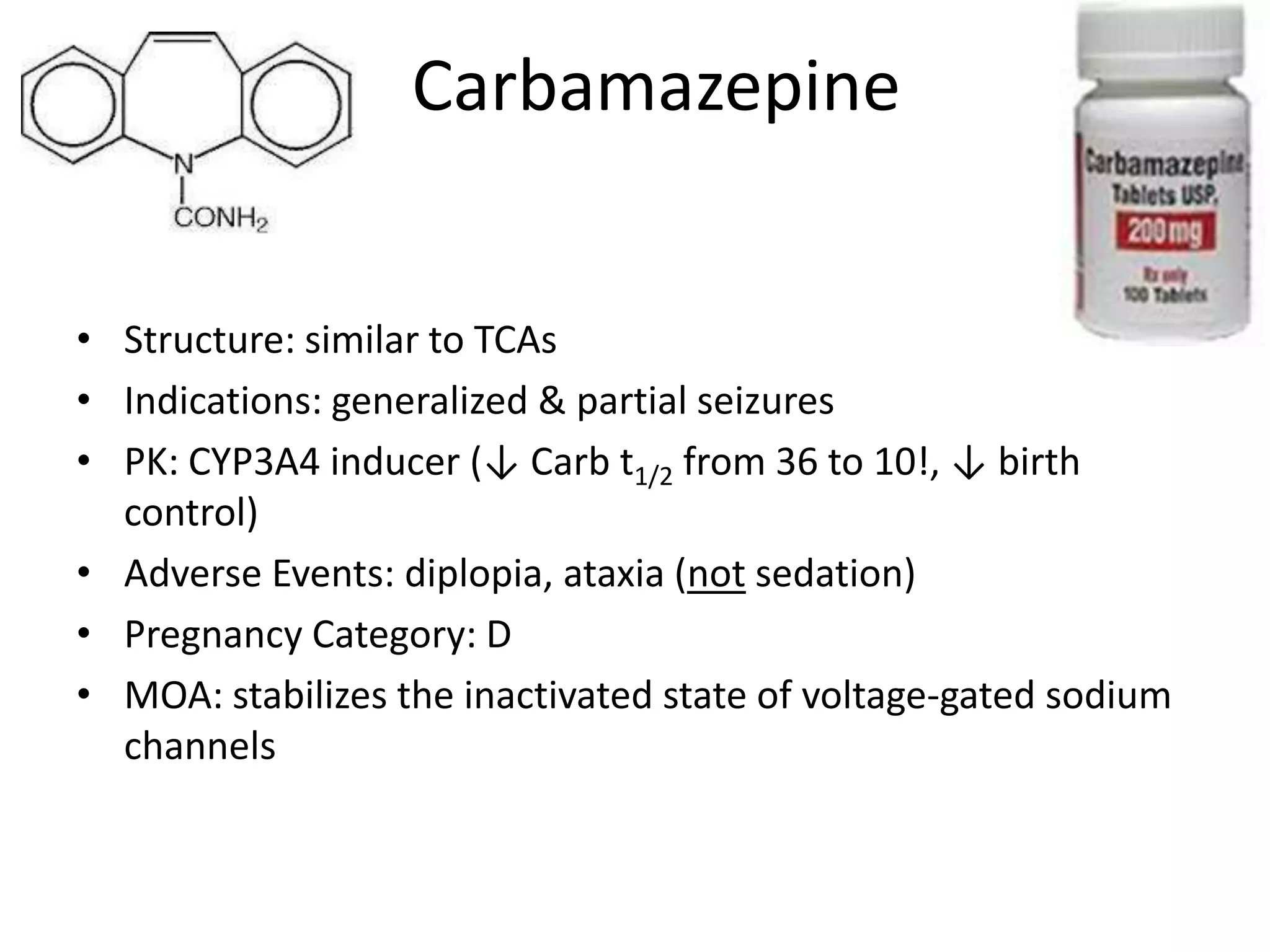
Carbamazepine


• Structure: similar to TCAs
• Indications: generalized & partial seizures
• PK: CYP3A4 inducer (↓ Carb t1/2 from 36 to 10!, ↓ birth
  control)
• Adverse Events: diplopia, ataxia (not sedation)
• Pregnancy Category: D
• MOA: stabilizes the inactivated state of voltage-gated sodium
  channels
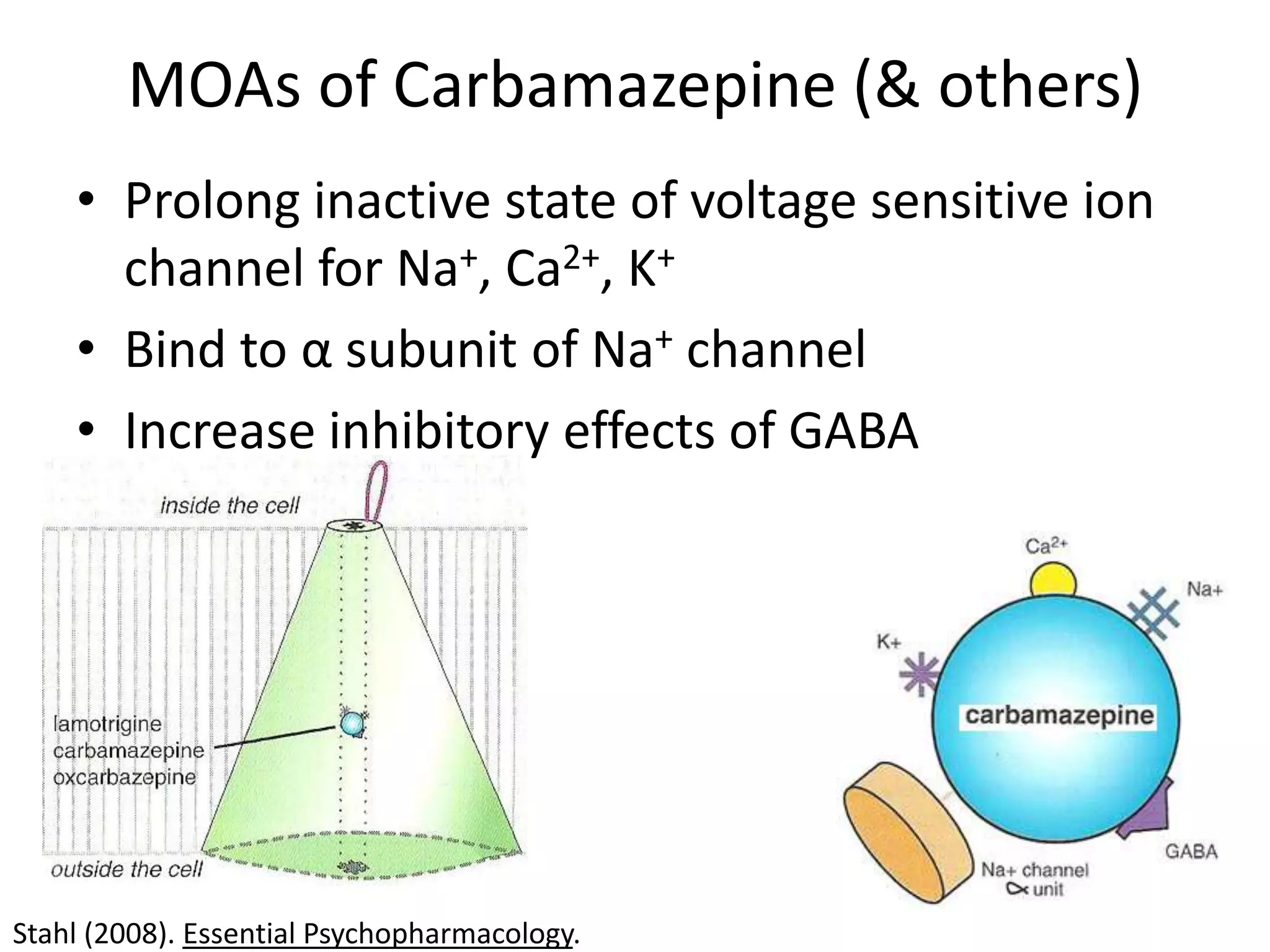
MOAs of Carbamazepine (& others)
    • Prolong inactive state of voltage sensitive ion
      channel for Na+, Ca2+, K+
    • Bind to α subunit of Na+ channel
    • Increase inhibitory effects of GABA


Stahl (2008). Essential Psychopharmacology.
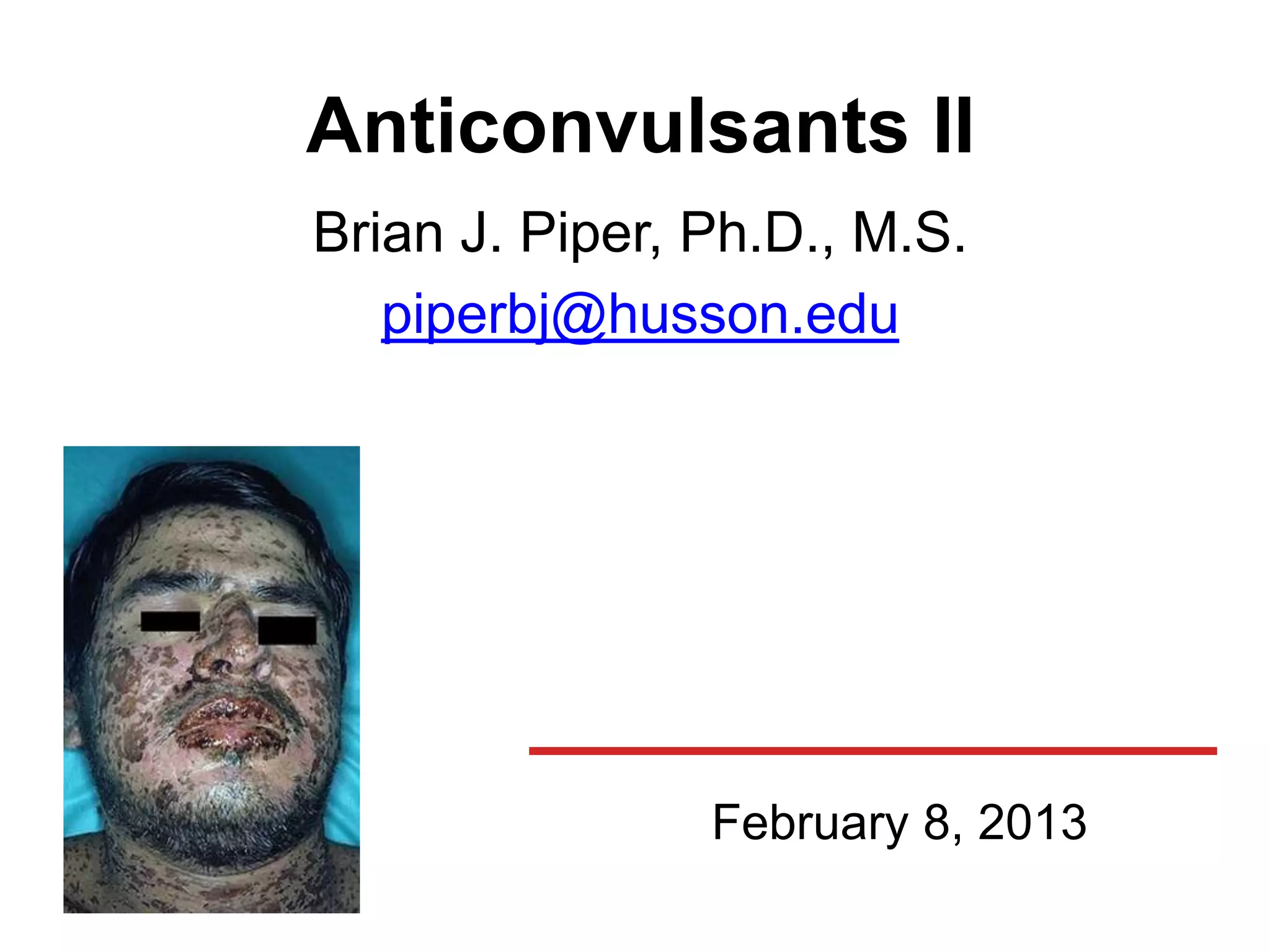
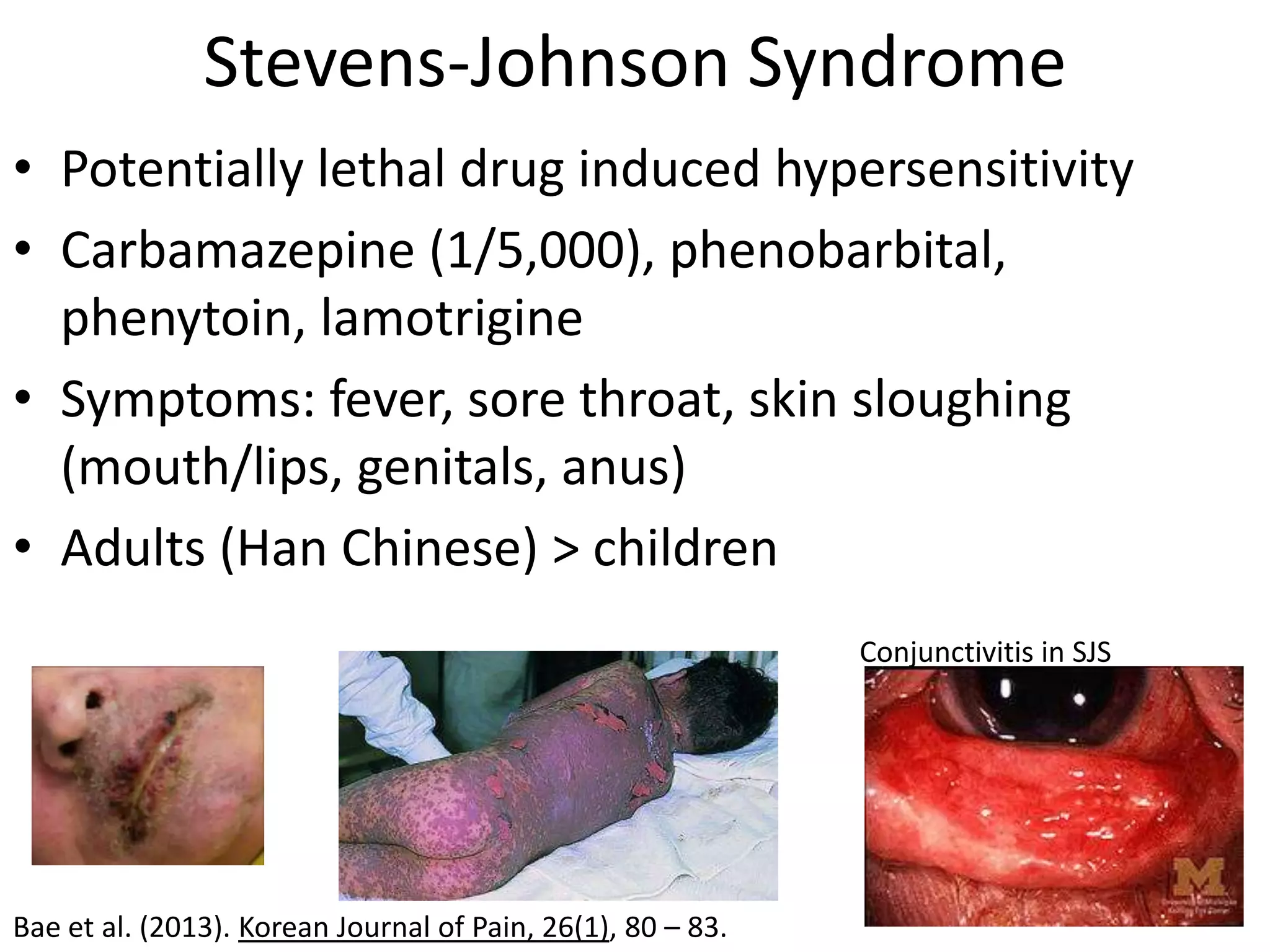
Stevens-Johnson Syndrome
• Potentially lethal drug induced hypersensitivity
• Carbamazepine (1/5,000), phenobarbital,
  phenytoin, lamotrigine
• Symptoms: fever, sore throat, skin sloughing
  (mouth/lips, genitals, anus)
• Adults (Han Chinese) > children
                                                             Conjunctivitis in SJS


Bae et al. (2013). Korean Journal of Pain, 26(1), 80 – 83.
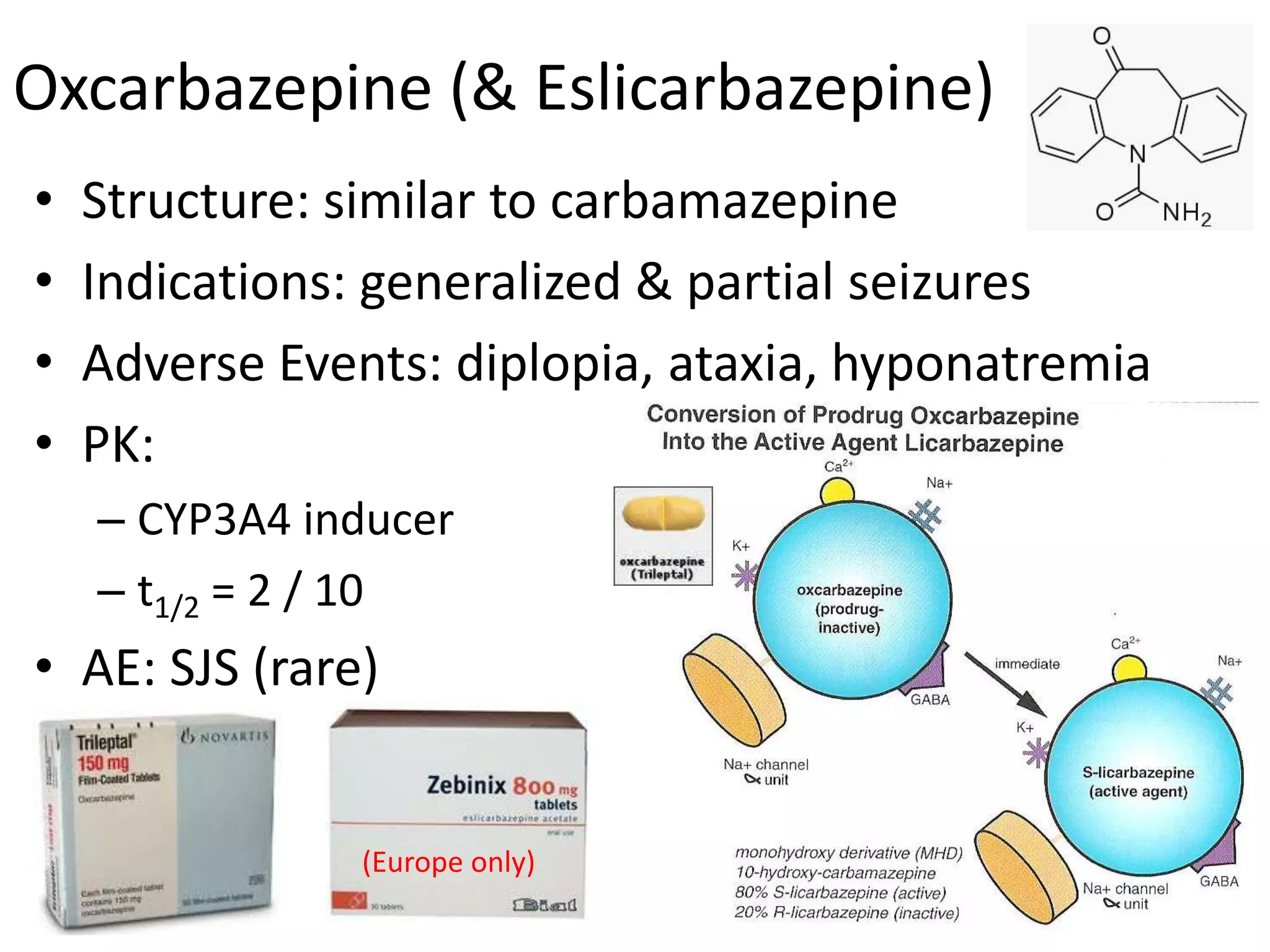
Oxcarbazepine (& Eslicarbazepine)
•   Structure: similar to carbamazepine
•   Indications: generalized & partial seizures
•   Adverse Events: diplopia, ataxia, hyponatremia
•   PK:
    – CYP3A4 inducer
    – t1/2 = 2 / 10
• AE: SJS (rare)


                (Europe only)
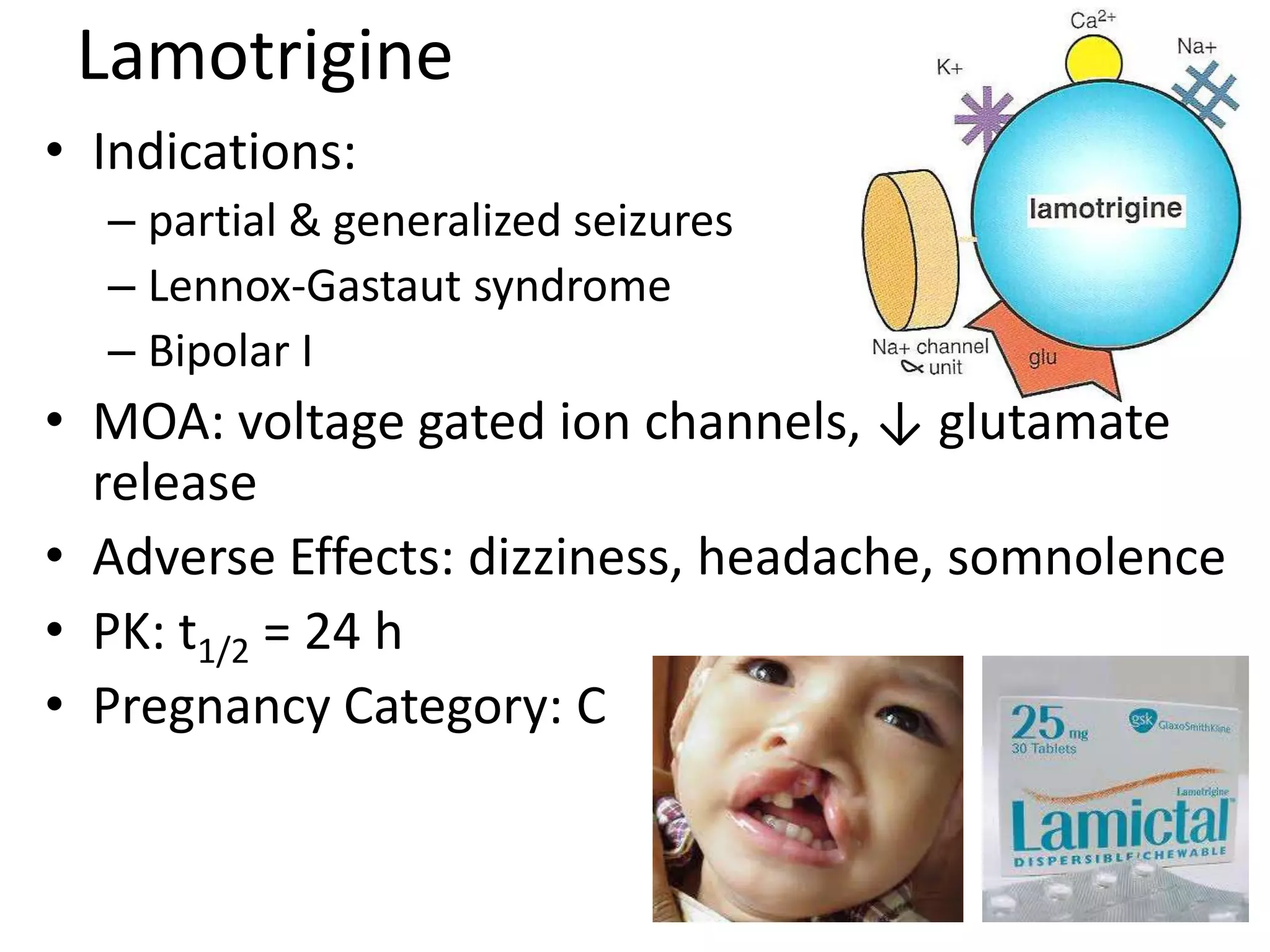
Lamotrigine
• Indications:
  – partial & generalized seizures
  – Lennox-Gastaut syndrome
  – Bipolar I
• MOA: voltage gated ion channels, ↓ glutamate
  release
• Adverse Effects: dizziness, headache, somnolence
• PK: t1/2 = 24 h
• Pregnancy Category: C
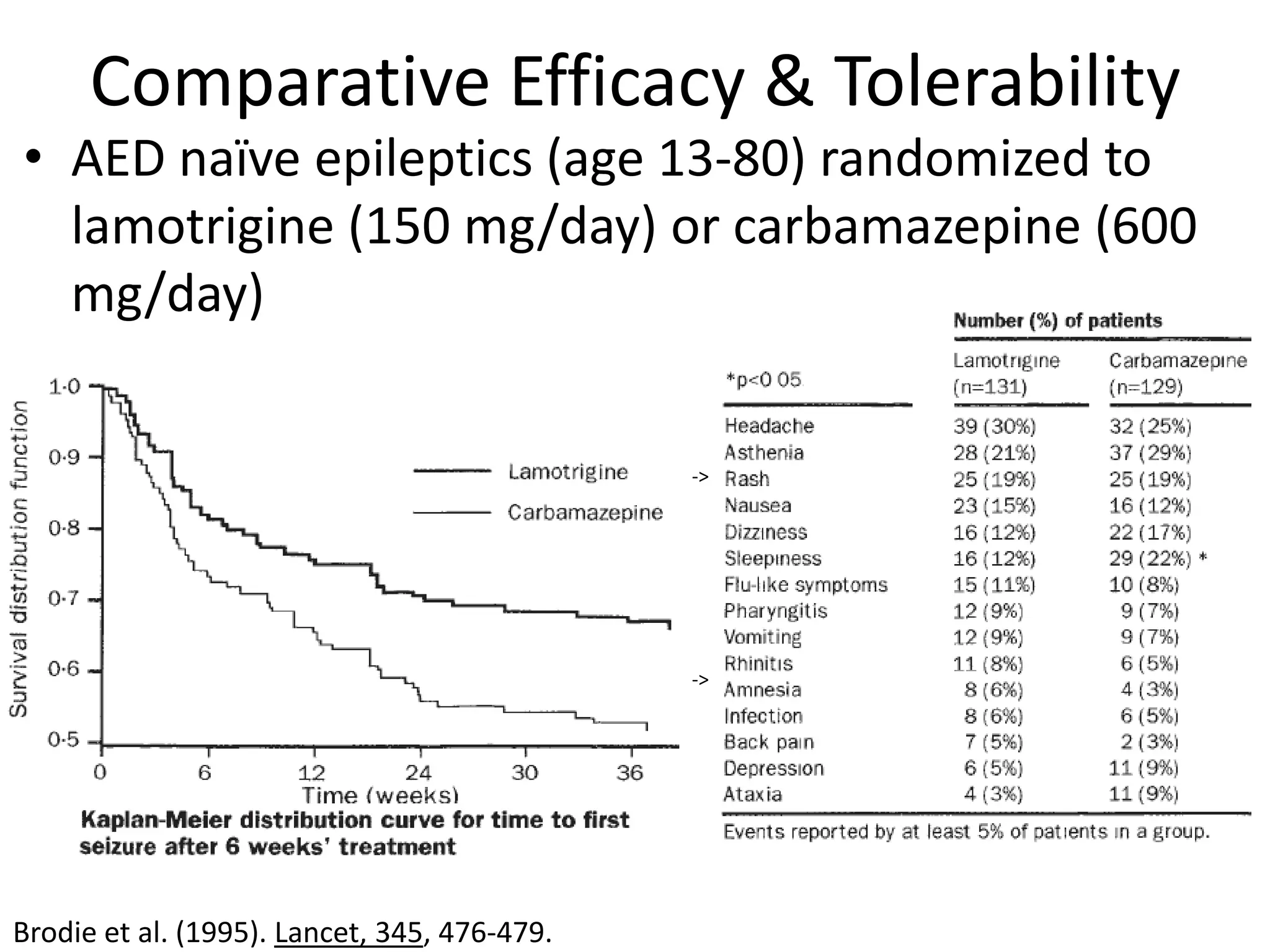
Comparative Efficacy & Tolerability
• AED naïve epileptics (age 13-80) randomized to
  lamotrigine (150 mg/day) or carbamazepine (600
  mg/day)


                                              ->


                                              ->


Brodie et al. (1995). Lancet, 345, 476-479.
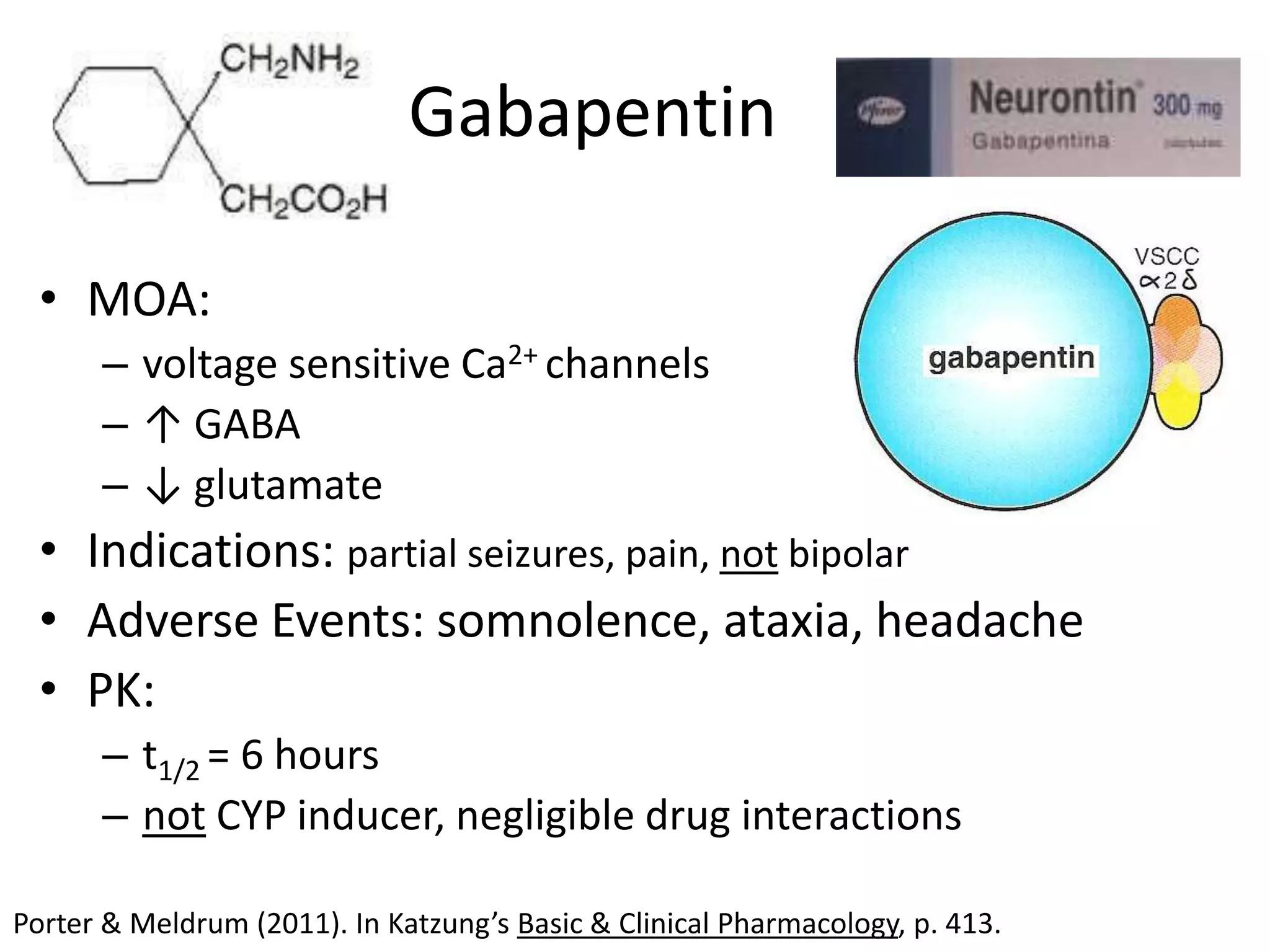
Gabapentin

  • MOA:
      – voltage sensitive Ca2+ channels
      – ↑ GABA
      – ↓ glutamate
  • Indications: partial seizures, pain, not bipolar
  • Adverse Events: somnolence, ataxia, headache
  • PK:
      – t1/2 = 6 hours
      – not CYP inducer, negligible drug interactions

Porter & Meldrum (2011). In Katzung’s Basic & Clinical Pharmacology, p. 413.
AED Rash
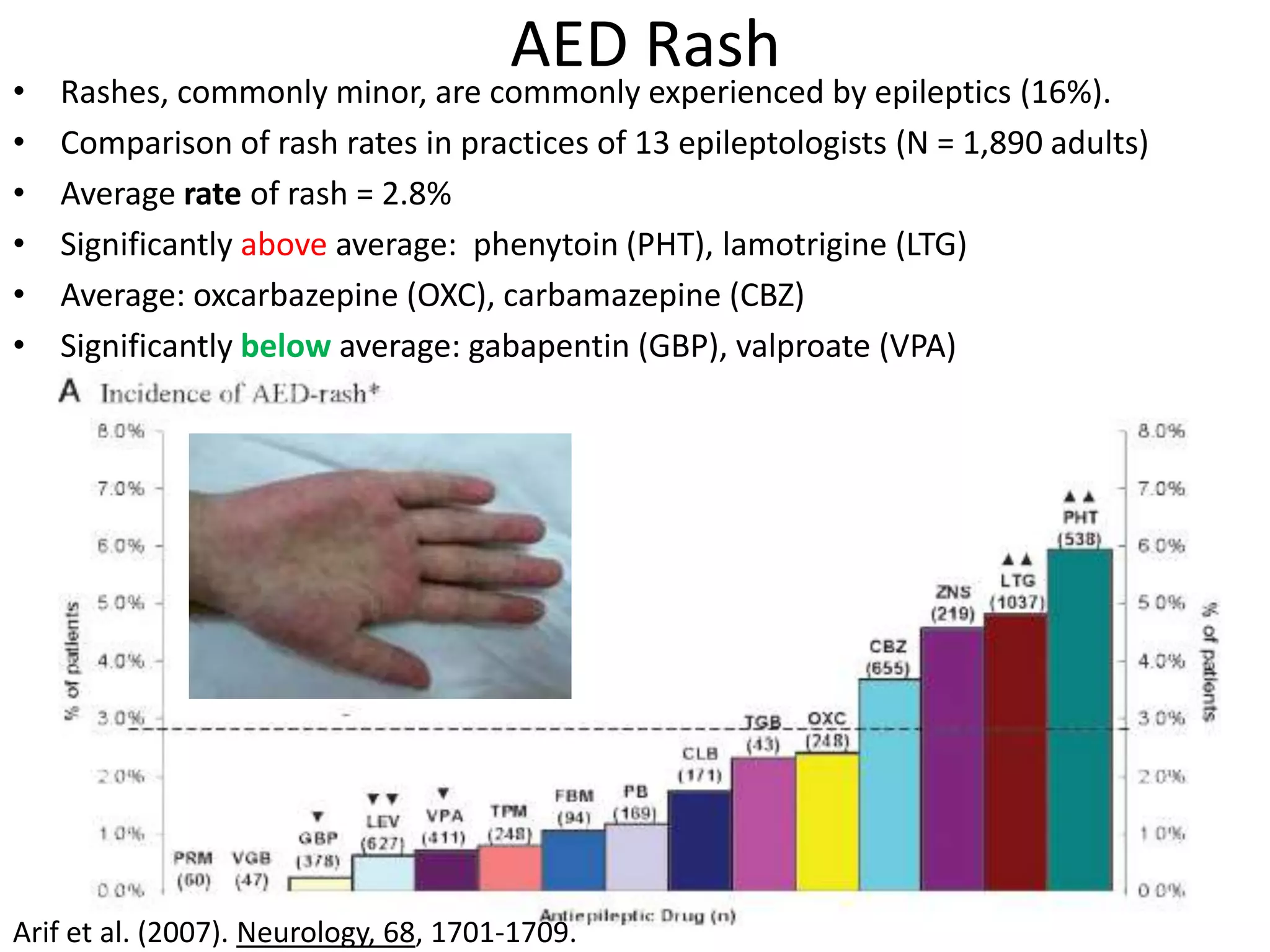
•   Rashes, commonly minor, are commonly experienced by epileptics (16%).
•   Comparison of rash rates in practices of 13 epileptologists (N = 1,890 adults)
•   Average rate of rash = 2.8%
•   Significantly above average: phenytoin (PHT), lamotrigine (LTG)
•   Average: oxcarbazepine (OXC), carbamazepine (CBZ)
•   Significantly below average: gabapentin (GBP), valproate (VPA)


Arif et al. (2007). Neurology, 68, 1701-1709.
AED Rash
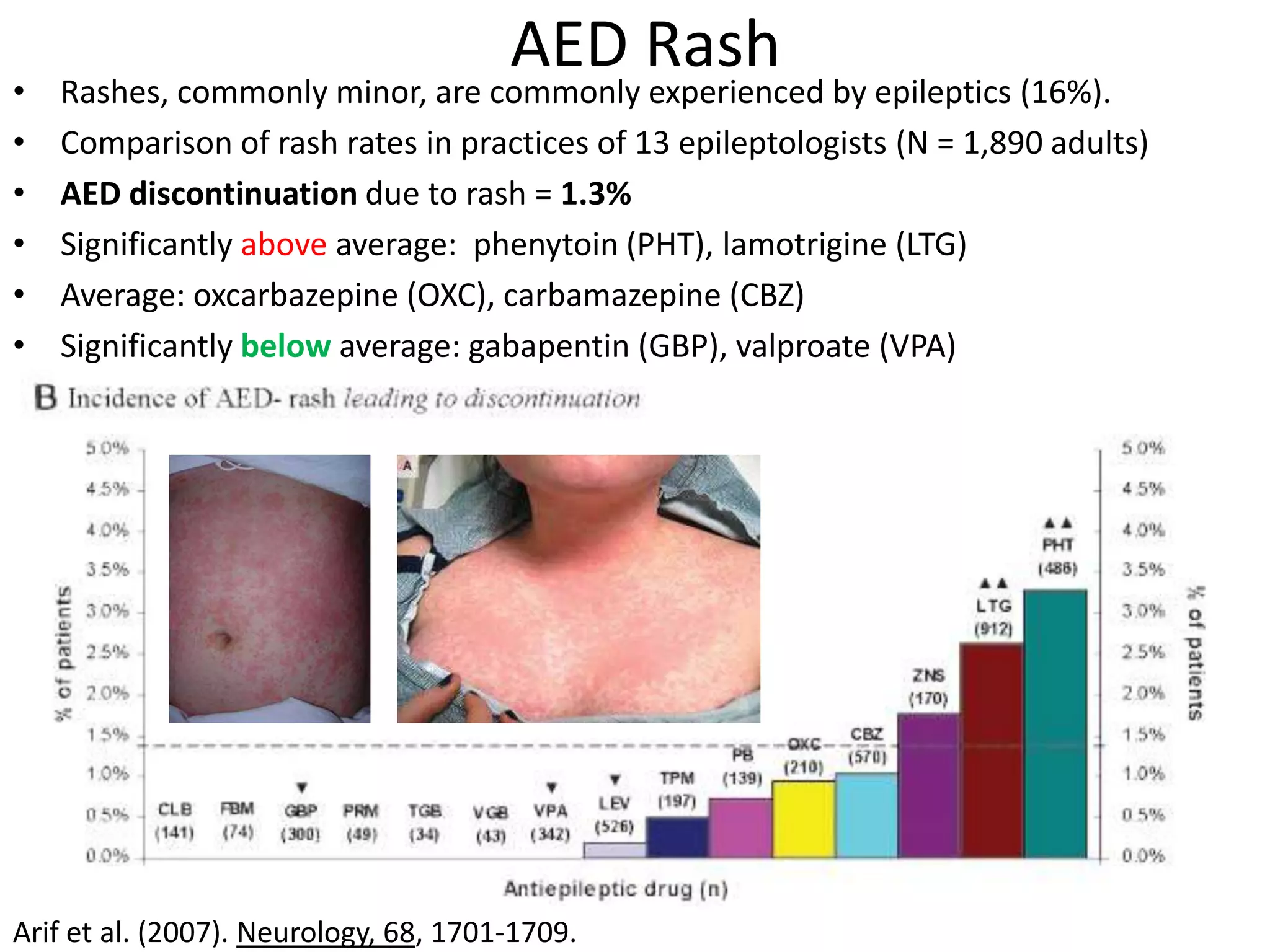
•   Rashes, commonly minor, are commonly experienced by epileptics (16%).
•   Comparison of rash rates in practices of 13 epileptologists (N = 1,890 adults)
•   AED discontinuation due to rash = 1.3%
•   Significantly above average: phenytoin (PHT), lamotrigine (LTG)
•   Average: oxcarbazepine (OXC), carbamazepine (CBZ)
•   Significantly below average: gabapentin (GBP), valproate (VPA)


Arif et al. (2007). Neurology, 68, 1701-1709.
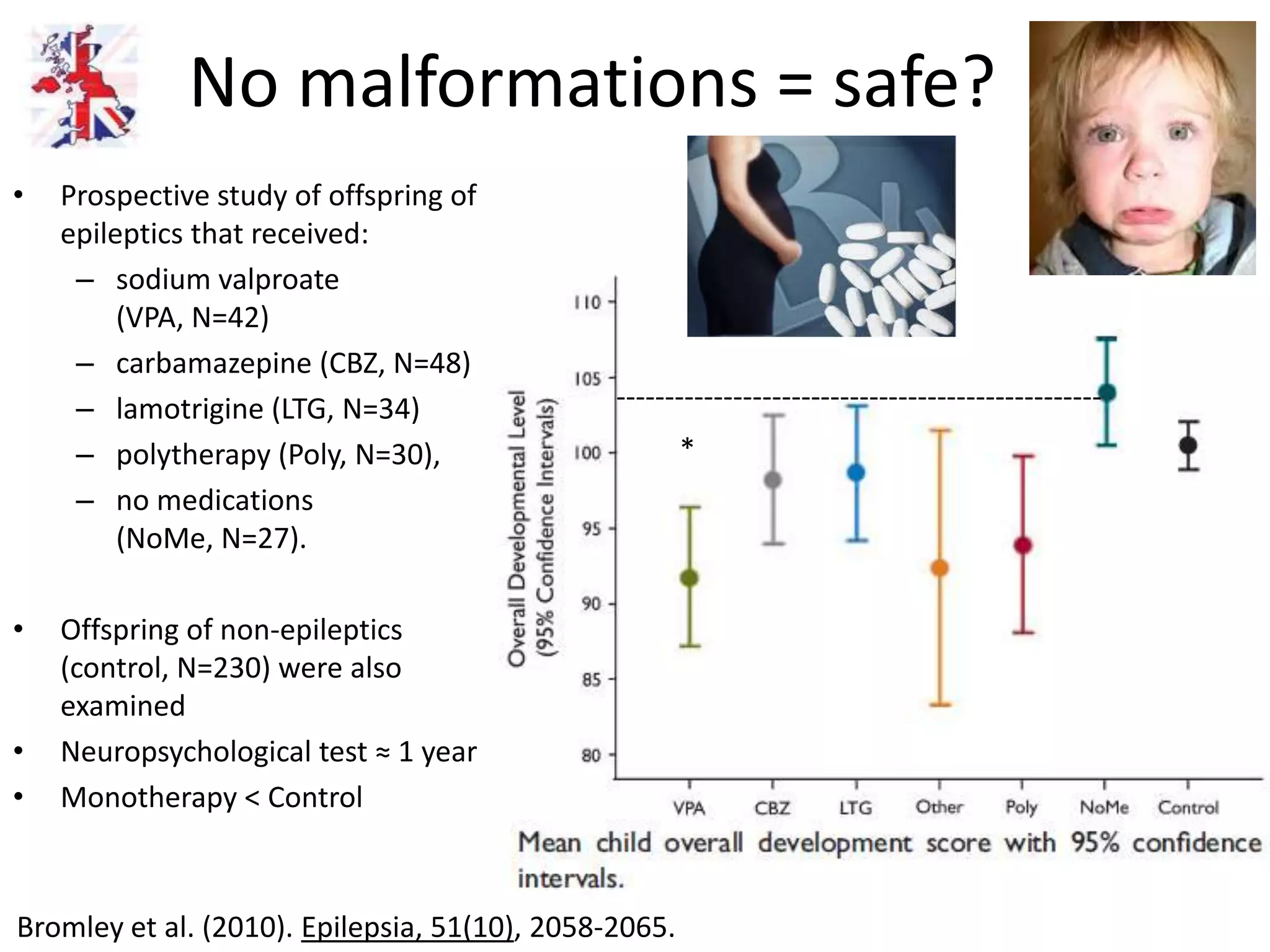
No malformations = safe?
•   Prospective study of offspring of
    epileptics that received:
     – sodium valproate
         (VPA, N=42)
     – carbamazepine (CBZ, N=48)
     – lamotrigine (LTG, N=34)                 --------------------------------------------------
     – polytherapy (Poly, N=30),                       *
     – no medications
         (NoMe, N=27).

•   Offspring of non-epileptics
    (control, N=230) were also
    examined
•   Neuropsychological test ≈ 1 year
•   Monotherapy < Control


Bromley et al. (2010). Epilepsia, 51(10), 2058-2065.
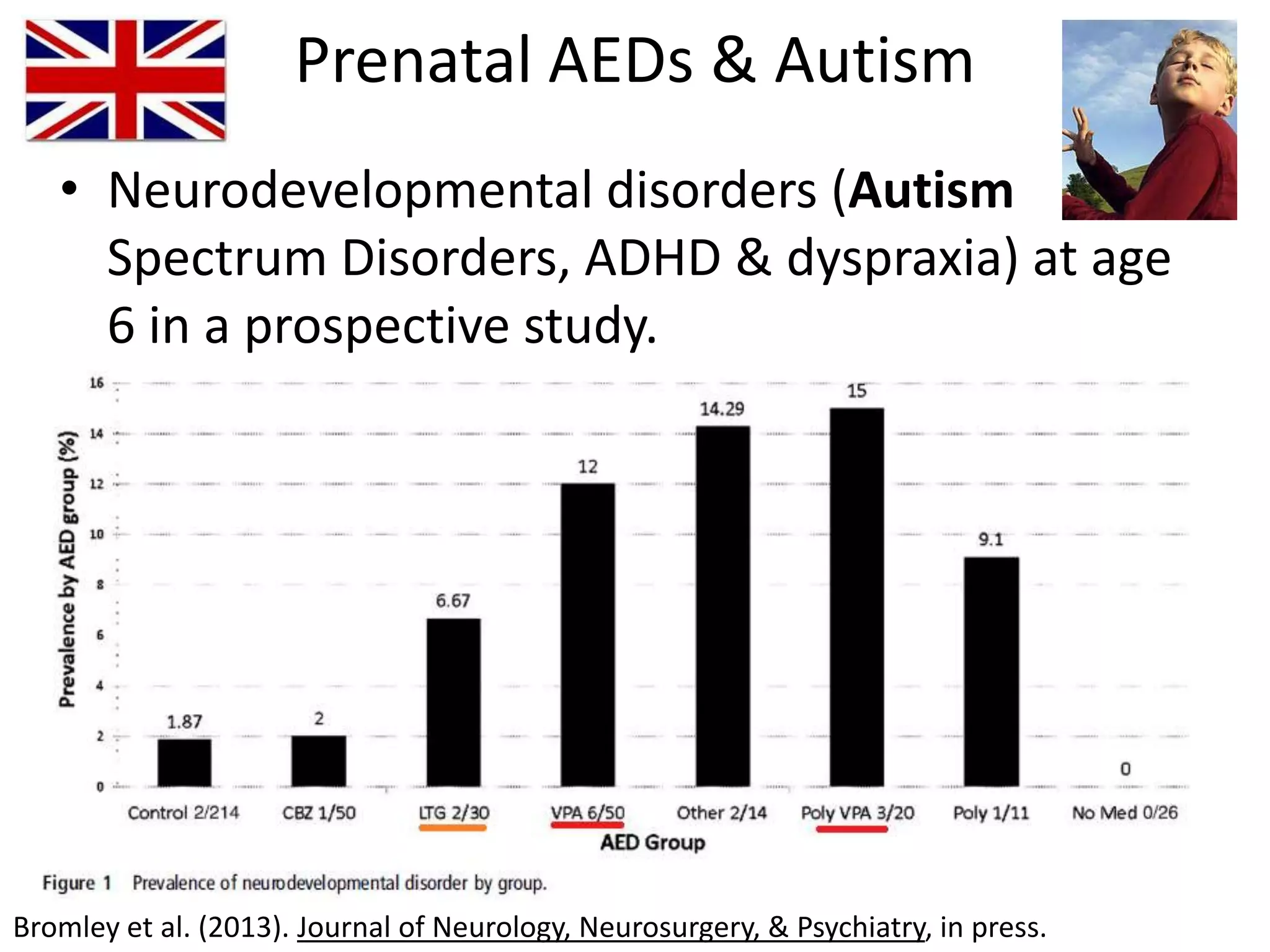
Prenatal AEDs & Autism
   • Neurodevelopmental disorders (Autism
     Spectrum Disorders, ADHD & dyspraxia) at age
     6 in a prospective study.


Bromley et al. (2013). Journal of Neurology, Neurosurgery, & Psychiatry, in press.
Future Pipeline

              15
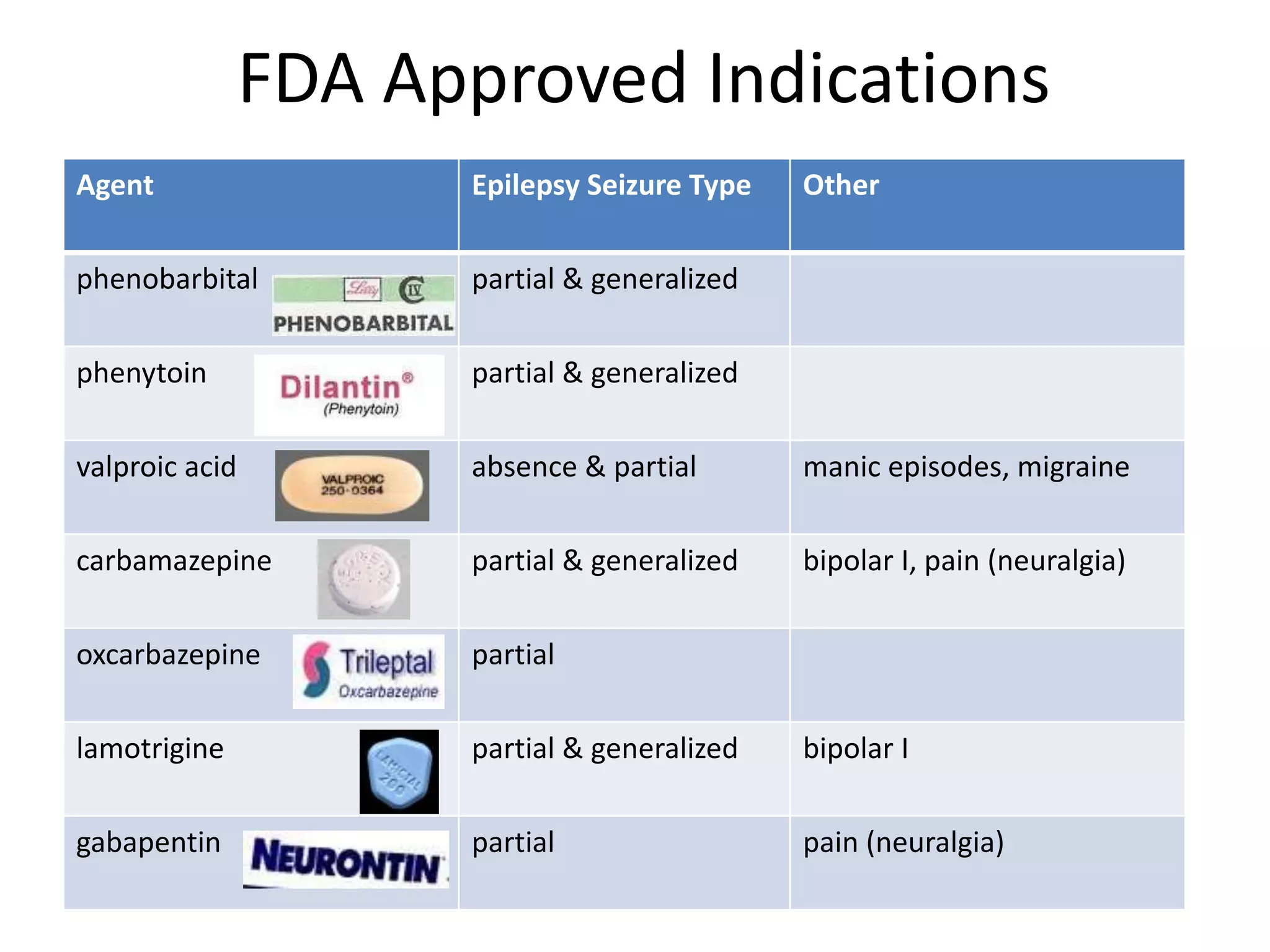
FDA Approved Indications
Agent                 Epilepsy Seizure Type   Other

phenobarbital         partial & generalized

phenytoin             partial & generalized

valproic acid         absence & partial       manic episodes, migraine

carbamazepine         partial & generalized   bipolar I, pain (neuralgia)

oxcarbazepine         partial

lamotrigine           partial & generalized   bipolar I

gabapentin            partial                 pain (neuralgia)
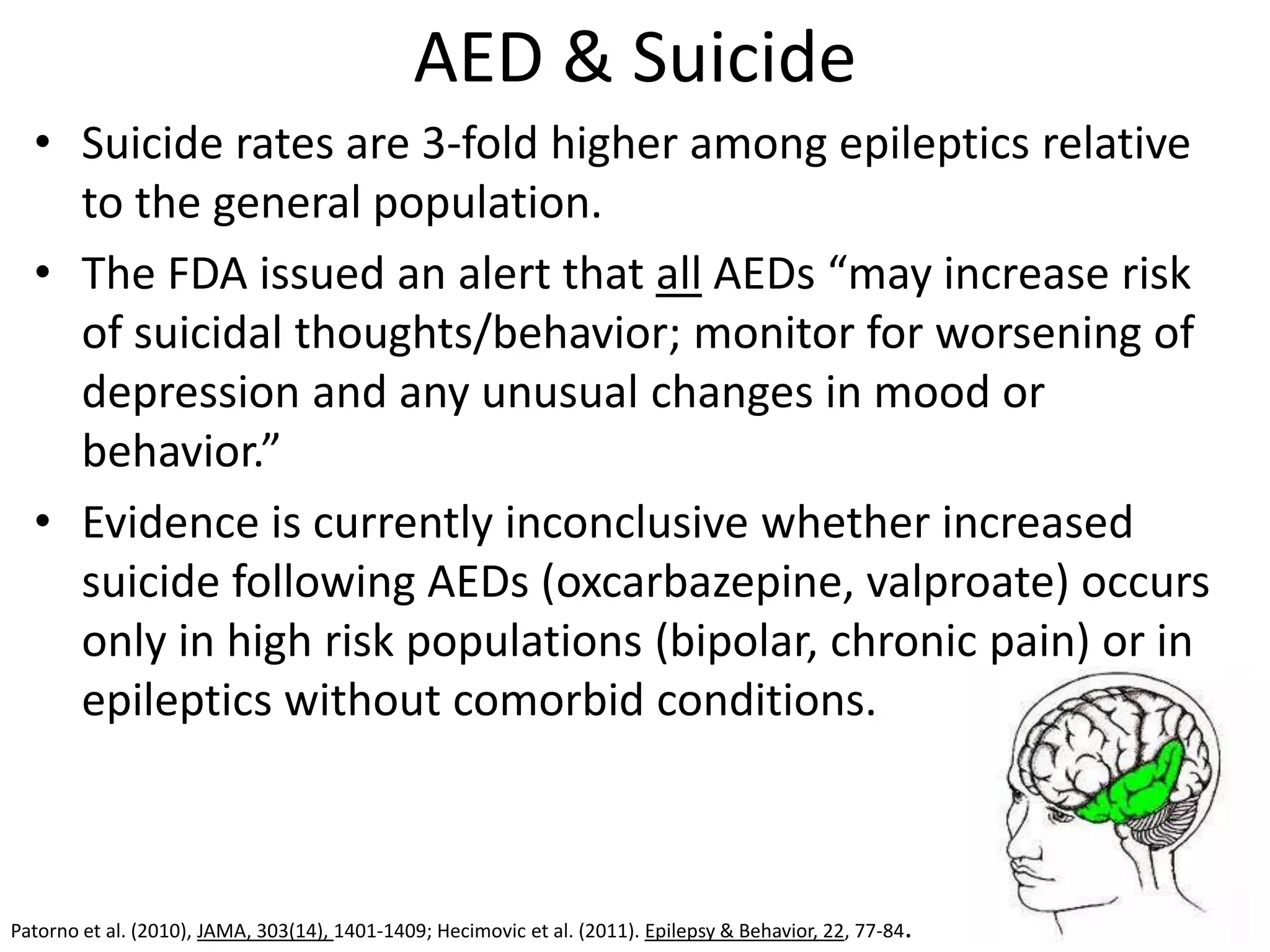
AED & Suicide
  • Suicide rates are 3-fold higher among epileptics relative
    to the general population.
  • The FDA issued an alert that all AEDs “may increase risk
    of suicidal thoughts/behavior; monitor for worsening of
    depression and any unusual changes in mood or
    behavior.”
  • Evidence is currently inconclusive whether increased
    suicide following AEDs (oxcarbazepine, valproate) occurs
    only in high risk populations (bipolar, chronic pain) or in
    epileptics without comorbid conditions.


Patorno et al. (2010), JAMA, 303(14), 1401-1409; Hecimovic et al. (2011). Epilepsy & Behavior, 22, 77-84.
General AED Principles

   • At least 50% of epileptics have a substantial
     reduction in seizure frequency with AEDs.
   • If one AED doesn’t work, the likelihood that a
     second won’t work is greater.
   • Seizures are intractable in 30% of epileptics.


Brodie, M. J. (2010). Seizure, 19, 650-655,
Summary
• AEDs target voltage gated channels & GABA.
• 2nd generation AED are better tolerated than
  older agents but offer limited improvements
  in efficacy.
• Polytherapy is very common for seizure
  control which presents opportunities to
  manage drug interactions.

Anticonvulsants Part II

  • 1.
    Anticonvulsants II Brian J.Piper, Ph.D., M.S. piperbj@husson.edu February 8, 2013
  • 2.
    Objectives • Pharmacy studentswill be able to: – describe the MOA of recently developed AEDs. – identify and contrast the relative frequency of adverse events for AEDs.
  • 3.
    Voltage Sensitive IonChannels • Composed of multiple subunits (α,β,δ) • α subunit, transmembrane 4 = voltometer • can exist in open, closed, or inactive states Pore inactivator Stahl (2008). Essential Psychopharmacology, p. 149, 152.
  • 4.
    Carbamazepine • Structure: similarto TCAs • Indications: generalized & partial seizures • PK: CYP3A4 inducer (↓ Carb t1/2 from 36 to 10!, ↓ birth control) • Adverse Events: diplopia, ataxia (not sedation) • Pregnancy Category: D • MOA: stabilizes the inactivated state of voltage-gated sodium channels
  • 5.
    MOAs of Carbamazepine(& others) • Prolong inactive state of voltage sensitive ion channel for Na+, Ca2+, K+ • Bind to α subunit of Na+ channel • Increase inhibitory effects of GABA Stahl (2008). Essential Psychopharmacology.
  • 6.
    Stevens-Johnson Syndrome • Potentiallylethal drug induced hypersensitivity • Carbamazepine (1/5,000), phenobarbital, phenytoin, lamotrigine • Symptoms: fever, sore throat, skin sloughing (mouth/lips, genitals, anus) • Adults (Han Chinese) > children Conjunctivitis in SJS Bae et al. (2013). Korean Journal of Pain, 26(1), 80 – 83.
  • 7.
    Oxcarbazepine (& Eslicarbazepine) • Structure: similar to carbamazepine • Indications: generalized & partial seizures • Adverse Events: diplopia, ataxia, hyponatremia • PK: – CYP3A4 inducer – t1/2 = 2 / 10 • AE: SJS (rare) (Europe only)
  • 8.
    Lamotrigine • Indications: – partial & generalized seizures – Lennox-Gastaut syndrome – Bipolar I • MOA: voltage gated ion channels, ↓ glutamate release • Adverse Effects: dizziness, headache, somnolence • PK: t1/2 = 24 h • Pregnancy Category: C
  • 9.
    Comparative Efficacy &Tolerability • AED naïve epileptics (age 13-80) randomized to lamotrigine (150 mg/day) or carbamazepine (600 mg/day) -> -> Brodie et al. (1995). Lancet, 345, 476-479.
  • 10.
    Gabapentin •MOA: – voltage sensitive Ca2+ channels – ↑ GABA – ↓ glutamate • Indications: partial seizures, pain, not bipolar • Adverse Events: somnolence, ataxia, headache • PK: – t1/2 = 6 hours – not CYP inducer, negligible drug interactions Porter & Meldrum (2011). In Katzung’s Basic & Clinical Pharmacology, p. 413.
  • 11.
    AED Rash • Rashes, commonly minor, are commonly experienced by epileptics (16%). • Comparison of rash rates in practices of 13 epileptologists (N = 1,890 adults) • Average rate of rash = 2.8% • Significantly above average: phenytoin (PHT), lamotrigine (LTG) • Average: oxcarbazepine (OXC), carbamazepine (CBZ) • Significantly below average: gabapentin (GBP), valproate (VPA) Arif et al. (2007). Neurology, 68, 1701-1709.
  • 12.
    AED Rash • Rashes, commonly minor, are commonly experienced by epileptics (16%). • Comparison of rash rates in practices of 13 epileptologists (N = 1,890 adults) • AED discontinuation due to rash = 1.3% • Significantly above average: phenytoin (PHT), lamotrigine (LTG) • Average: oxcarbazepine (OXC), carbamazepine (CBZ) • Significantly below average: gabapentin (GBP), valproate (VPA) Arif et al. (2007). Neurology, 68, 1701-1709.
  • 13.
    No malformations =safe? • Prospective study of offspring of epileptics that received: – sodium valproate (VPA, N=42) – carbamazepine (CBZ, N=48) – lamotrigine (LTG, N=34) -------------------------------------------------- – polytherapy (Poly, N=30), * – no medications (NoMe, N=27). • Offspring of non-epileptics (control, N=230) were also examined • Neuropsychological test ≈ 1 year • Monotherapy < Control Bromley et al. (2010). Epilepsia, 51(10), 2058-2065.
  • 14.
    Prenatal AEDs &Autism • Neurodevelopmental disorders (Autism Spectrum Disorders, ADHD & dyspraxia) at age 6 in a prospective study. Bromley et al. (2013). Journal of Neurology, Neurosurgery, & Psychiatry, in press.
  • 15.
  • 16.
    FDA Approved Indications Agent Epilepsy Seizure Type Other phenobarbital partial & generalized phenytoin partial & generalized valproic acid absence & partial manic episodes, migraine carbamazepine partial & generalized bipolar I, pain (neuralgia) oxcarbazepine partial lamotrigine partial & generalized bipolar I gabapentin partial pain (neuralgia)
  • 17.
    AED & Suicide • Suicide rates are 3-fold higher among epileptics relative to the general population. • The FDA issued an alert that all AEDs “may increase risk of suicidal thoughts/behavior; monitor for worsening of depression and any unusual changes in mood or behavior.” • Evidence is currently inconclusive whether increased suicide following AEDs (oxcarbazepine, valproate) occurs only in high risk populations (bipolar, chronic pain) or in epileptics without comorbid conditions. Patorno et al. (2010), JAMA, 303(14), 1401-1409; Hecimovic et al. (2011). Epilepsy & Behavior, 22, 77-84.
  • 18.
    General AED Principles • At least 50% of epileptics have a substantial reduction in seizure frequency with AEDs. • If one AED doesn’t work, the likelihood that a second won’t work is greater. • Seizures are intractable in 30% of epileptics. Brodie, M. J. (2010). Seizure, 19, 650-655,
  • 19.
    Summary • AEDs targetvoltage gated channels & GABA. • 2nd generation AED are better tolerated than older agents but offer limited improvements in efficacy. • Polytherapy is very common for seizure control which presents opportunities to manage drug interactions.

Editor's Notes

  • #2 Stevens-Johnson syndrome
  • #5 Carbamazapine levels, if the same dose is given over 1 week, will gradually decrease. http://www.howjsay.com/index.php?word=carbamazepine&amp;submit=Submit
  • #6 Carbamazepine keeps the cations on the outside.
  • #7 Stevens Johnson syndrome (SJS) is an acute life-threatening dermatoses characterized by extensive epidermal sloughing at the dermoepidermal junction resulting from keratinocyte apoptosis. Lower-Left: Stevens-Johnson syndrome in a patient that received Carbamazepine (had a reaction but didn’t tell health care providers!) and was later treated with Carbamazepineagain!
  • #8 Oxcarbazepine is a structural derivative of carbamazepine, with a ketone in place of the carbon-carbon double bond on the dibenzazepine ring.
  • #9 Approved as an adjunctive therapy for epilepsy gut generally used as a monotherapy.Lamotrigine was first drug approved for BPI since lithium (30 years earlier!). Pronounced Lenox Gesto. Half-life can be reduced to 14 hours with other enzyme inducing drugs. Nice overview (6 min): http://www.youtube.com/watch?v=wiHcSj1k-yA8.9/1000 babies have cleft-lip/palate, 24 times higher risk than normal of cleft-lip/palate.
  • #10 PDR.net suggests that the carbamazepine dose is on the low side with typical doses being 800 – 1200 with max being 1600.
  • #11 Gabapentin blocks voltage sensitive calcium channels, increases release of GABA (but does not bind to GABAA or GABAB receptors). Short-half life requires multiple dosing times/day. As polypharmacy is very common, the lack of bioactive metabolites and drug interactions is key here.
  • #12 Other AEDs: PRM: primidone; VGB: vigabatrin; LEV: levetiracetam; TPM: topiramate; CLB: clobazam.
  • #13 Other AEDs: PRM: primidone; VGB: vigabatrin; LEV: levetiracetam; TPM: topiramate; CLB: clobazam.
  • #14 Neuropsychological testing completed between 4 months and 2 years of age. As a group, monotherapy did significantly less well than NoMe. Neuropsych test included items about locomotor, social skills, hearing &amp; language, nonverbal performance, and hand-eye coordination.
  • #15 Only valproate (single/poly) was statistically significant although others (LTG) are concerning.
  • #16 There are now 24 antiepileptic drugs (AEDs) approved for use in epilepsy by the U.S. Food and DrugAdministration!
  • #17 0.7% of the U.S. population has been diagnosed with epilepsy.
  • #18 Suicide rates of epileptics with mood disorders are 12 times higher than the general public. Suicide rates are elevated 3-4 fold in oxcarbazepine and sodium valproate relative to other AEDs.