How to spot Fake Science!
Or
Pseudoscience
1
What is Pseudoscience?
Definition:
Pseudoscience is a claim, belief, or practice which is presented as
scientific, which does not adhere to a valid scientific method, lacks
supporting evidence, cannot be reliably tested, or otherwise lacks
scientific status.
2
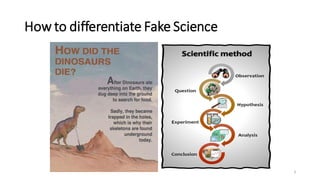
How to differentiate Fake Science
3
PseudoscienceVs Scientific Method
• Pseudoscience When junk science is presented as fact
• The Scientific Method is a method of research in which a hypothesis
is tested by means of a carefully documented control experiment that
can be repeated. This yields observable, repeatable results that can
be verified by a variety of experts.
4
When is it Pseudoscience?
• True science is distinguishable from revelation, theology, or
spirituality in that it offers insight into the physical world obtained by
empirical research and testing. If it contains these elements, it is
pseudoscience.
5
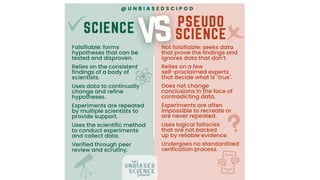
Key Characteristics of Pseudoscience
6
1. Lack of Empirical Evidence
Pseudoscientific claims are typically not supported by empirical
evidence obtained through controlled experiments or systematic
observations. Instead, they may rely on anecdotal stories, personal
experiences, or testimonials.
7
2. Absenceof Peer Review
Pseudoscientific ideas are not subjected to rigorous peer review
processes, as genuine scientific research typically is. In peer review,
experts in the field critically assess the quality and validity of research
before it is published.
8
3. Non-Falsifiability
Pseudoscientific claims often lack the ability to be falsified, meaning
there is no clear way to prove them wrong. In contrast, scientific
hypotheses and theories are formulated in ways that allow for testing
and potential falsification.
9
4. ExaggeratedClaims
Pseudoscientific ideas tend to make extravagant or exaggerated claims,
often promising miraculous or extraordinary results without adequate
evidence.
10
5. Use of Jargon
Pseudoscientific explanations may use scientific-sounding language and
terminology to create an illusion of scientific credibility, even if the
concepts are not well-defined or coherent.
11
6. Resistanceto Criticism
Pseudoscientific beliefs are often resistant to criticism and skeptical
inquiry. Proponents may reject valid challenges to their claims and
rely on confirmation bias to reinforce their beliefs.
12
Conspiracy Theories
• A subtype of Pseudoscience Usually based on an event or series of
events which does not adhere to a valid scientific method, lacks
supporting evidence, cannot be reliably tested, or otherwise lacks
scientific status.
13
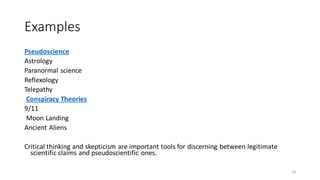
Examples
Pseudoscience
Astrology
Paranormal science
Reflexology
Telepathy
Conspiracy Theories
9/11
Moon Landing
Ancient Aliens
Critical thinking and skepticism are important tools for discerning between legitimate
scientific claims and pseudoscientific ones.
14
Pseudoscience Case
Studies
16
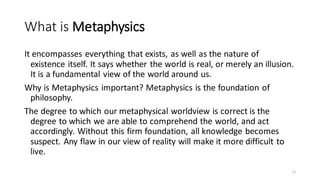
What is Metaphysics
It encompasses everything that exists, as well as the nature of
existence itself. It says whether the world is real, or merely an illusion.
It is a fundamental view of the world around us.
Why is Metaphysics important? Metaphysics is the foundation of
philosophy.
The degree to which our metaphysical worldview is correct is the
degree to which we are able to comprehend the world, and act
accordingly. Without this firm foundation, all knowledge becomes
suspect. Any flaw in our view of reality will make it more difficult to
live.
17
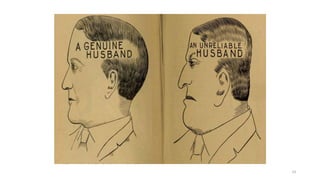
Phrenology
Phrenology was a popular pseudoscience in the 19th century that
claimed to determine a person's personality and mental traits by
examining the shape and bumps on their skull. Phrenologists believed
that different areas of the brain were responsible for different
character traits. However, this theory lacked scientific evidence and
was based on subjective observations, making it a classic example of
pseudoscience.
18
19
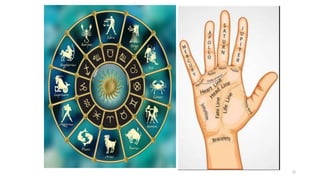
Astrology
Astrology is the belief that the positions and movements of celestial
bodies, such as stars and planets, can influence human behavior and
personality. It claims that a person's personality and future can be
determined by their astrological sign. Despite its widespread
popularity, astrology lacks empirical support and scientific validity.
20
21
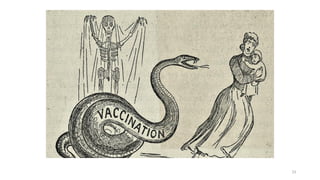
Anti-VaccinationMovement
The anti-vaccination movement is rooted in the belief that vaccines,
despite overwhelming scientific evidence to the contrary, cause
various health problems, including autism. This belief has led to a
decline in vaccination rates in some communities, leading to
preventable outbreaks of vaccine-preventable diseases.
22
23
Flat Earth Belief
Some individuals still subscribe to the pseudoscientific belief that the
Earth is flat, despite centuries of scientific evidence confirming that
the Earth is an oblate spheroid. Proponents often rely on anecdotal
observations that can be easily debunked with established scientific
knowledge.
24
These case studies illustrate the persistence of
pseudoscientific beliefs despite overwhelming
scientific evidence to the contrary. Pseudoscientific
ideas can have far-reaching consequences, including
public health risks and the spread of misinformation.
Critical thinking, scientific literacy, and skepticism are
crucial for evaluating and distinguishing between
genuine science and pseudoscience.
25

06-07 Fake Science or////////////////// Pseudoscience.pdf

  • 1.
    How to spotFake Science! Or Pseudoscience 1
  • 2.
    What is Pseudoscience? Definition: Pseudoscienceis a claim, belief, or practice which is presented as scientific, which does not adhere to a valid scientific method, lacks supporting evidence, cannot be reliably tested, or otherwise lacks scientific status. 2
  • 3.
    How to differentiateFake Science 3
  • 4.
    PseudoscienceVs Scientific Method •Pseudoscience When junk science is presented as fact • The Scientific Method is a method of research in which a hypothesis is tested by means of a carefully documented control experiment that can be repeated. This yields observable, repeatable results that can be verified by a variety of experts. 4
  • 5.
    When is itPseudoscience? • True science is distinguishable from revelation, theology, or spirituality in that it offers insight into the physical world obtained by empirical research and testing. If it contains these elements, it is pseudoscience. 5
  • 6.
    Key Characteristics ofPseudoscience 6
  • 7.
    1. Lack ofEmpirical Evidence Pseudoscientific claims are typically not supported by empirical evidence obtained through controlled experiments or systematic observations. Instead, they may rely on anecdotal stories, personal experiences, or testimonials. 7
  • 8.
    2. Absenceof PeerReview Pseudoscientific ideas are not subjected to rigorous peer review processes, as genuine scientific research typically is. In peer review, experts in the field critically assess the quality and validity of research before it is published. 8
  • 9.
    3. Non-Falsifiability Pseudoscientific claimsoften lack the ability to be falsified, meaning there is no clear way to prove them wrong. In contrast, scientific hypotheses and theories are formulated in ways that allow for testing and potential falsification. 9
  • 10.
    4. ExaggeratedClaims Pseudoscientific ideastend to make extravagant or exaggerated claims, often promising miraculous or extraordinary results without adequate evidence. 10
  • 11.
    5. Use ofJargon Pseudoscientific explanations may use scientific-sounding language and terminology to create an illusion of scientific credibility, even if the concepts are not well-defined or coherent. 11
  • 12.
    6. Resistanceto Criticism Pseudoscientificbeliefs are often resistant to criticism and skeptical inquiry. Proponents may reject valid challenges to their claims and rely on confirmation bias to reinforce their beliefs. 12
  • 13.
    Conspiracy Theories • Asubtype of Pseudoscience Usually based on an event or series of events which does not adhere to a valid scientific method, lacks supporting evidence, cannot be reliably tested, or otherwise lacks scientific status. 13
  • 14.
    Examples Pseudoscience Astrology Paranormal science Reflexology Telepathy Conspiracy Theories 9/11 MoonLanding Ancient Aliens Critical thinking and skepticism are important tools for discerning between legitimate scientific claims and pseudoscientific ones. 14
  • 16.
  • 17.
    What is Metaphysics Itencompasses everything that exists, as well as the nature of existence itself. It says whether the world is real, or merely an illusion. It is a fundamental view of the world around us. Why is Metaphysics important? Metaphysics is the foundation of philosophy. The degree to which our metaphysical worldview is correct is the degree to which we are able to comprehend the world, and act accordingly. Without this firm foundation, all knowledge becomes suspect. Any flaw in our view of reality will make it more difficult to live. 17
  • 18.
    Phrenology Phrenology was apopular pseudoscience in the 19th century that claimed to determine a person's personality and mental traits by examining the shape and bumps on their skull. Phrenologists believed that different areas of the brain were responsible for different character traits. However, this theory lacked scientific evidence and was based on subjective observations, making it a classic example of pseudoscience. 18
  • 19.
  • 20.
    Astrology Astrology is thebelief that the positions and movements of celestial bodies, such as stars and planets, can influence human behavior and personality. It claims that a person's personality and future can be determined by their astrological sign. Despite its widespread popularity, astrology lacks empirical support and scientific validity. 20
  • 21.
  • 22.
    Anti-VaccinationMovement The anti-vaccination movementis rooted in the belief that vaccines, despite overwhelming scientific evidence to the contrary, cause various health problems, including autism. This belief has led to a decline in vaccination rates in some communities, leading to preventable outbreaks of vaccine-preventable diseases. 22
  • 23.
  • 24.
    Flat Earth Belief Someindividuals still subscribe to the pseudoscientific belief that the Earth is flat, despite centuries of scientific evidence confirming that the Earth is an oblate spheroid. Proponents often rely on anecdotal observations that can be easily debunked with established scientific knowledge. 24
  • 25.
    These case studiesillustrate the persistence of pseudoscientific beliefs despite overwhelming scientific evidence to the contrary. Pseudoscientific ideas can have far-reaching consequences, including public health risks and the spread of misinformation. Critical thinking, scientific literacy, and skepticism are crucial for evaluating and distinguishing between genuine science and pseudoscience. 25