
Reactive Flows
Dr. Mohammad Jadidi
(Ph.D. in Mechanical Engineering)
Combustion modeling in HRSG boiler
Presented by: Mohammad Jadidi 2
Equations governing reacting flowsReactive Flows
 Conservation equations
 Continuity equation (conservation of mass)
 Transport of momentum
 Transport of molecular species
 Transport of Energy
 Equation of State
 Turbulence Transport
Current lecture
See next lecture
 Favre averaging (density weighted averaging)
Presented by: Mohammad Jadidi 3
Governing equations for combusting flows (1)Reactive Flows
Continuity
It should be noted that density in combusting flows is a
variable, and depends on pressure, temperature and
species concentration.
Momentum equations
𝜏𝑖𝑗 is the viscous stress tensor and 𝐹𝑖 is
the body force (which includes gravity)
Presented by: Mohammad Jadidi 4
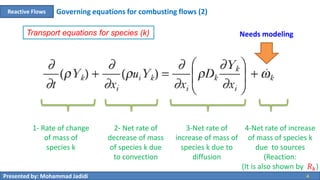
Governing equations for combusting flows (2)Reactive Flows
Transport equations for species (k)
1- Rate of change
of mass of
species k
2- Net rate of
decrease of mass
of species k due
to convection
3-Net rate of
increase of mass of
species k due to
diffusion
4-Net rate of increase
of mass of species k
due to sources
(Reaction:
(It is also shown by 𝑅 𝑘)
Needs modeling
Presented by: Mohammad Jadidi 5
Governing equations for combusting flows (3)Reactive Flows
Transport equations for species (k)
It is common practice to assume a single diffusion coefficient for all species
Whilst the single D assumption is not always accurate (and may in fact be quite
inaccurate) it is very attractive, since it enables far-reaching simplification of
combustion calculations.
Presented by: Mohammad Jadidi 6
Governing equations for combusting flows (4)Reactive Flows
Energy equation
Rate of
change of
enthalpy
Net rate of
decrease of
enthalpy due
to convection
Net rate of increase of
enthalpy due to diffusion
a along gradients of
enthalpy
Net rate of increase of enthalpy
due to mass diffusion a along
gradients of species concentration
Net rate of increase
of enthalpy due to
pressure work
Net rate of increase
of enthalpy due to
radiative heat
transfer
 ℎ is the mixture enthalpy per unit mass
 ℎ 𝑘 is the specific enthalpy of species 𝑘, and the summation is carried out over all 𝑁
species considered in the chosen reaction mechanism
species Schmidt number (𝑆𝑐 𝑘 )
Presented by: Mohammad Jadidi 7
Governing equations for combusting flows (5)Reactive Flows
Prandtl number (𝜎ℎ )
Lewis number (𝐿𝑒 𝑘 )
Energy equation
Presented by: Mohammad Jadidi 8
Reactive Flows
If a single diffusion coefficient is used( i.e. 𝐷 𝑘= 𝐷 for 𝑘 = 1, 2, … 𝑁)
If Lewis number is unity ( 𝐿𝑒 𝑘 = 1)
For low-speed flows ( Τ𝜕𝑝 𝜕𝑡 = 0)
If the radiation source term is also small ( 𝑆𝑟𝑎𝑑~0)
The enthalpy is a conserved or passive scalar
Why is it
important?
Energy equation
Governing equations for combusting flows (6)
Presented by: Mohammad Jadidi 9
Governing equations for combusting flows (7)Reactive Flows
Some combustion models do not require
a transport equation for enthalpy: for example,
in the laminar flamelet model the temperature
is obtained from the laminar flamelet library
curves. Other combustion submodels,
however, require the solution of the transport
equation for enthalpy.
The temperature can be calculated from
the enthalpy by means of
where ∆ℎ 𝑓𝑘 is the enthalpy of formation.
Presented by: Mohammad Jadidi 10
Governing equations for combusting flows (8)Reactive Flows Other relationships
The total of mass fractions of fuel, oxidant
and inert species is equal to 1
The average value of the specific heat
𝑐 𝑝 is defined as follows
local density of the mixture
where 𝑀𝑊𝑘is the molecular weight of species k and
𝑅 𝑢 is the universal gas constant (8.314 kJ/kmol.K).
11
Thanks
Next part:
Reactive Flows
https://ir.linkedin.com/in/moammad-jadidi-03ab8399
Jadidi.cfd@gmail.com
Dr. Mohammad Jadidi
(Ph.D. in Mechanical Engineering)
https://www.researchgate.net/profile/Mohammad_Jadidi
https://www.slideshare.net/MohammadJadidi

00 reactive flows - governing equations

  • 1.
    Reactive Flows Dr. MohammadJadidi (Ph.D. in Mechanical Engineering) Combustion modeling in HRSG boiler
  • 2.
    Presented by: MohammadJadidi 2 Equations governing reacting flowsReactive Flows  Conservation equations  Continuity equation (conservation of mass)  Transport of momentum  Transport of molecular species  Transport of Energy  Equation of State  Turbulence Transport Current lecture See next lecture  Favre averaging (density weighted averaging)
  • 3.
    Presented by: MohammadJadidi 3 Governing equations for combusting flows (1)Reactive Flows Continuity It should be noted that density in combusting flows is a variable, and depends on pressure, temperature and species concentration. Momentum equations 𝜏𝑖𝑗 is the viscous stress tensor and 𝐹𝑖 is the body force (which includes gravity)
  • 4.
    Presented by: MohammadJadidi 4 Governing equations for combusting flows (2)Reactive Flows Transport equations for species (k) 1- Rate of change of mass of species k 2- Net rate of decrease of mass of species k due to convection 3-Net rate of increase of mass of species k due to diffusion 4-Net rate of increase of mass of species k due to sources (Reaction: (It is also shown by 𝑅 𝑘) Needs modeling
  • 5.
    Presented by: MohammadJadidi 5 Governing equations for combusting flows (3)Reactive Flows Transport equations for species (k) It is common practice to assume a single diffusion coefficient for all species Whilst the single D assumption is not always accurate (and may in fact be quite inaccurate) it is very attractive, since it enables far-reaching simplification of combustion calculations.
  • 6.
    Presented by: MohammadJadidi 6 Governing equations for combusting flows (4)Reactive Flows Energy equation Rate of change of enthalpy Net rate of decrease of enthalpy due to convection Net rate of increase of enthalpy due to diffusion a along gradients of enthalpy Net rate of increase of enthalpy due to mass diffusion a along gradients of species concentration Net rate of increase of enthalpy due to pressure work Net rate of increase of enthalpy due to radiative heat transfer  ℎ is the mixture enthalpy per unit mass  ℎ 𝑘 is the specific enthalpy of species 𝑘, and the summation is carried out over all 𝑁 species considered in the chosen reaction mechanism
  • 7.
    species Schmidt number(𝑆𝑐 𝑘 ) Presented by: Mohammad Jadidi 7 Governing equations for combusting flows (5)Reactive Flows Prandtl number (𝜎ℎ ) Lewis number (𝐿𝑒 𝑘 ) Energy equation
  • 8.
    Presented by: MohammadJadidi 8 Reactive Flows If a single diffusion coefficient is used( i.e. 𝐷 𝑘= 𝐷 for 𝑘 = 1, 2, … 𝑁) If Lewis number is unity ( 𝐿𝑒 𝑘 = 1) For low-speed flows ( Τ𝜕𝑝 𝜕𝑡 = 0) If the radiation source term is also small ( 𝑆𝑟𝑎𝑑~0) The enthalpy is a conserved or passive scalar Why is it important? Energy equation Governing equations for combusting flows (6)
  • 9.
    Presented by: MohammadJadidi 9 Governing equations for combusting flows (7)Reactive Flows Some combustion models do not require a transport equation for enthalpy: for example, in the laminar flamelet model the temperature is obtained from the laminar flamelet library curves. Other combustion submodels, however, require the solution of the transport equation for enthalpy.
  • 10.
    The temperature canbe calculated from the enthalpy by means of where ∆ℎ 𝑓𝑘 is the enthalpy of formation. Presented by: Mohammad Jadidi 10 Governing equations for combusting flows (8)Reactive Flows Other relationships The total of mass fractions of fuel, oxidant and inert species is equal to 1 The average value of the specific heat 𝑐 𝑝 is defined as follows local density of the mixture where 𝑀𝑊𝑘is the molecular weight of species k and 𝑅 𝑢 is the universal gas constant (8.314 kJ/kmol.K).
  • 11.
    11 Thanks Next part: Reactive Flows https://ir.linkedin.com/in/moammad-jadidi-03ab8399 Jadidi.cfd@gmail.com Dr.Mohammad Jadidi (Ph.D. in Mechanical Engineering) https://www.researchgate.net/profile/Mohammad_Jadidi https://www.slideshare.net/MohammadJadidi