© 2011 ANSYS, Inc. June 18, 20141
Ask The Expert - Everything You
Always Wanted To Know About
Combustion Simulation
ANSYS Technical Engineers Team
© 2011 ANSYS, Inc. June 18, 20142
Welcome!
1st Presentation of 5 on Simulation of Combustion
1) Fundamental concepts of reacting flows and models in ANSYS CFD
2) Modeling fast chemistry
– Premixed, non-premixed and partially premixed models
3) Modeling detailed chemistry
– Concepts, applications and best practices
4) Modeling pollutants and surface chemistry
5) Modeling heterogeneous reactions
– Solid and liquid fuels
Find all “Ask the Experts” Webinars on ANSYS.COM
Follow SUPPORT -> RESOURCE LIBRARY
© 2011 ANSYS, Inc. June 18, 20143
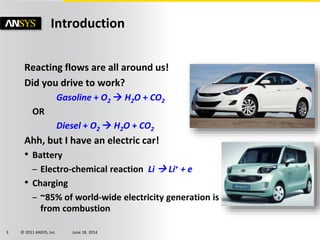
Reacting flows are all around us!
Did you drive to work?
Gasoline + O2  H2O + CO2
OR
Diesel + O2  H2O + CO2
Ahh, but I have an electric car!
• Battery
– Electro-chemical reaction Li  Li+ + e
• Charging
– ~85% of world-wide electricity generation is
from combustion
Introduction
© 2011 ANSYS, Inc. June 18, 20144
Introduction
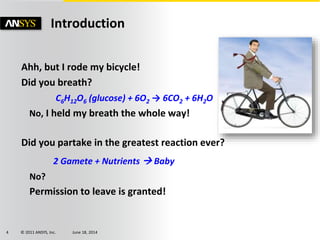
Ahh, but I rode my bicycle!
Did you breath?
C6H12O6 (glucose) + 6O2 → 6CO2 + 6H2O
No, I held my breath the whole way!
Did you partake in the greatest reaction ever?
2 Gamete + Nutrients  Baby
No?
Permission to leave is granted!
© 2011 ANSYS, Inc. June 18, 20145
• Basic definitions and concepts
• Gas mixtures
• Reacting gas mixtures
• Types of flames and related phenomenon
• Solid and liquid burning and other reactions
• Role of turbulence in reacting flows
• Reacting flow modeling
Outline
© 2011 ANSYS, Inc. June 18, 20146
• Basic definitions and concepts
• Gas mixtures
• Reacting gas mixtures
• Types of flames and related phenomenon
• Solid and liquid burning and other reactions
• Role of turbulence in reacting flows
• Reacting flow modeling
Outline
© 2011 ANSYS, Inc. June 18, 20147
Basic definitions
• Chemical reaction
– A process involving changes in the structure and energy content of
atoms, molecules, or ions
• Exothermic reaction
– Chemical reaction that releases energy in the form of light or heat
• Endothermic reaction
– Chemical reaction that absorbs energy from its surroundings
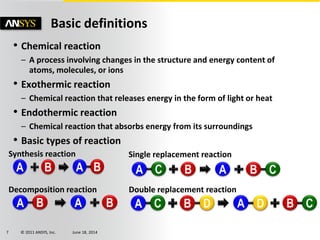
• Basic types of reaction
A B A B
A BA B
BA C A B C
BA C A B CD D
Synthesis reaction
Decomposition reaction
Single replacement reaction
Double replacement reaction
© 2011 ANSYS, Inc. June 18, 20148
Basic definitions (cont…)
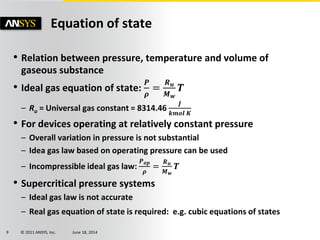
• Combustion reaction
– Sequence of exothermic chemical reactions between a fuel and an oxidizer
accompanied by the production of heat and conversion of chemical species
– Combustion dominated flows form main part of reacting flows
• Stoichiometry
– Amount of oxidizer needed to completely burn a given quantity of fuel
– CH4 + O2  CO2 + H2O
• Stoichiometric fuel-air ratio
– Ratio of mass of fuel to the mass of air at stoichiometry
• Excess air
– Fraction of air (oxidizer) supplied in excess of stoichiometric requirement
• Equivalence ratio ()
– Ratio of actual fuel-air ratio to stoichiometric fuel-air ratio
–  > 1  Rich mixture in fuel;  < 1  lean mixture in fuel
CH4 + 2O2  CO2 + 2H2O
© 2011 ANSYS, Inc. June 18, 20149
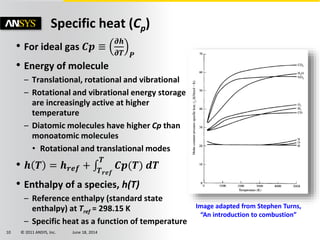
Equation of state
• Relation between pressure, temperature and volume of
gaseous substance
• Ideal gas equation of state:
𝑷
𝝆
=
𝑹 𝒖
𝑴 𝒘
𝑻
– Ru = Universal gas constant = 8314.46
𝑱
𝒌𝒎𝒐𝒍 𝑲
• For devices operating at relatively constant pressure
– Overall variation in pressure is not substantial
– Idea gas law based on operating pressure can be used
– Incompressible ideal gas law:
𝑷 𝒐𝒑
𝝆
=
𝑹 𝒖
𝑴 𝒘
𝑻
• Supercritical pressure systems
– Ideal gas law is not accurate
– Real gas equation of state is required: e.g. cubic equations of states
© 2011 ANSYS, Inc. June 18, 201410
• For ideal gas 𝑪𝒑 ≡
𝝏𝒉
𝝏𝑻 𝑷
• Energy of molecule
– Translational, rotational and vibrational
– Rotational and vibrational energy storage
are increasingly active at higher
temperature
– Diatomic molecules have higher Cp than
monoatomic molecules
• Rotational and translational modes
• 𝒉 𝑻 = 𝒉 𝒓𝒆𝒇 + 𝑻 𝒓𝒆𝒇
𝑻
𝑪𝒑(𝑻) 𝒅𝑻
• Enthalpy of a species, h(T)
– Reference enthalpy (standard state
enthalpy) at Tref = 298.15 K
– Specific heat as a function of temperature
Specific heat (Cp)
Image adapted from Stephen Turns,
“An introduction to combustion”
© 2011 ANSYS, Inc. June 18, 201411
• Basic definitions and concepts
• Gas mixtures
• Reacting gas mixtures
• Types of flames and related phenomenon
• Solid and liquid burning and other reactions
• Role of turbulence in reacting flows
• Reacting flow modeling
Outline
© 2011 ANSYS, Inc. June 18, 201412
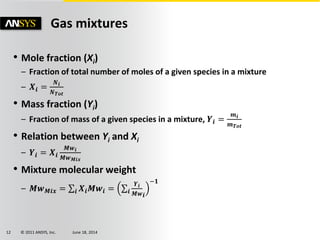
Gas mixtures
• Mole fraction (Xi)
– Fraction of total number of moles of a given species in a mixture
– 𝑿𝒊 =
𝑵 𝒊
𝑵 𝑻𝒐𝒕
• Mass fraction (Yi)
– Fraction of mass of a given species in a mixture, 𝒀𝒊 =
𝒎 𝒊
𝒎 𝑻𝒐𝒕
• Relation between Yi and Xi
– 𝒀𝒊 = 𝑿𝒊
𝑴𝒘 𝒊
𝑴𝒘 𝑴𝒊𝒙
• Mixture molecular weight
– 𝑴𝒘 𝑴𝒊𝒙 = 𝒊 𝑿𝒊 𝑴𝒘𝒊 = 𝒊
𝒀𝒊
𝑴𝒘 𝒊
−𝟏
© 2011 ANSYS, Inc. June 18, 201413
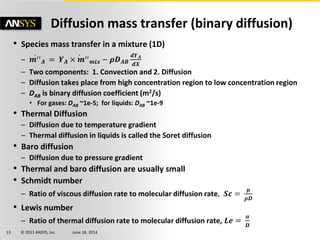
Diffusion mass transfer (binary diffusion)
• Species mass transfer in a mixture (1D)
– 𝒎′′
𝑨 = 𝒀 𝑨 × 𝒎′′
𝒎𝒊𝒙 − 𝝆𝑫 𝑨𝑩
𝒅𝒀 𝑨
𝒅𝑿
– Two components: 1. Convection and 2. Diffusion
– Diffusion takes place from high concentration region to low concentration region
– DAB is binary diffusion coefficient (m2/s)
• For gases: DAB ~1e-5; for liquids: DAB ~1e-9
• Thermal Diffusion
– Diffusion due to temperature gradient
– Thermal diffusion in liquids is called the Soret diffusion
• Baro diffusion
– Diffusion due to pressure gradient
• Thermal and baro diffusion are usually small
• Schmidt number
– Ratio of viscous diffusion rate to molecular diffusion rate, 𝑺𝒄 =
𝝁
𝝆𝑫
• Lewis number
– Ratio of thermal diffusion rate to molecular diffusion rate, 𝑳𝒆 =
𝜶
𝑫
© 2011 ANSYS, Inc. June 18, 201414
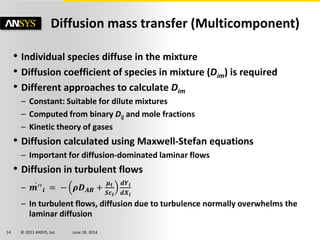
Diffusion mass transfer (Multicomponent)
• Individual species diffuse in the mixture
• Diffusion coefficient of species in mixture (Dim) is required
• Different approaches to calculate Dim
– Constant: Suitable for dilute mixtures
– Computed from binary Dij and mole fractions
– Kinetic theory of gases
• Diffusion calculated using Maxwell-Stefan equations
– Important for diffusion-dominated laminar flows
• Diffusion in turbulent flows
– 𝒎′′
𝒊 = − 𝝆𝑫 𝑨𝑩 +
𝝁 𝒕
𝑺𝒄 𝒕
𝒅𝒀𝒊
𝒅𝑿𝒊
– In turbulent flows, diffusion due to turbulence normally overwhelms the
laminar diffusion
© 2011 ANSYS, Inc. June 18, 201415
• Basic definitions and concepts
• Gas mixtures
• Reacting gas mixtures
• Types of flames and related phenomenon
• Solid and liquid burning and other reactions
• Role of turbulence in reacting flows
• Reacting flow modeling
Outline: part-I
© 2011 ANSYS, Inc. June 18, 201416
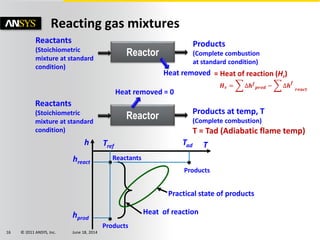
Reacting gas mixtures
Reactor
Reactants
(Stoichiometric
mixture at standard
condition)
Products at temp, T
(Complete combustion)
Heat removed = 0
T = Tad (Adiabatic flame temp)
h T
hreact
Tref
hprod
Heat of reaction
Reactants
Products
Products
Tad
Reactor
Reactants
(Stoichiometric
mixture at standard
condition)
Products
(Complete combustion
at standard condition)
Heat removed
Practical state of products
𝑯 𝒓 = ∆𝒉 𝒇
𝒑𝒓𝒐𝒅 − ∆𝒉
𝒇
𝒓𝒆𝒂𝒄𝒕
= Heat of reaction (Hr)
© 2011 ANSYS, Inc. June 18, 201417
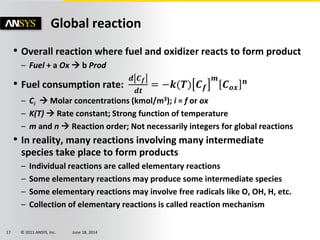
Global reaction
• Overall reaction where fuel and oxidizer reacts to form product
– Fuel + a Ox  b Prod
• Fuel consumption rate:
𝒅 𝑪 𝒇
𝒅𝒕
= −𝒌(𝑻) 𝑪 𝒇
𝒎
𝑪 𝒐𝒙
𝒏
– Ci  Molar concentrations (kmol/m3); i = f or ox
– K(T)  Rate constant; Strong function of temperature
– m and n  Reaction order; Not necessarily integers for global reactions
• In reality, many reactions involving many intermediate
species take place to form products
– Individual reactions are called elementary reactions
– Some elementary reactions may produce some intermediate species
– Some elementary reactions may involve free radicals like O, OH, H, etc.
– Collection of elementary reactions is called reaction mechanism
© 2011 ANSYS, Inc. June 18, 201418
Reaction mechanism
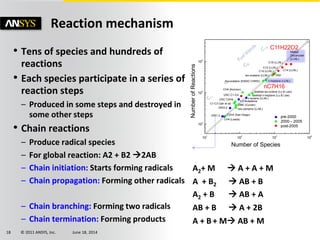
• Tens of species and hundreds of
reactions
• Each species participate in a series of
reaction steps
– Produced in some steps and destroyed in
some other steps
• Chain reactions
– Produce radical species
– For global reaction: A2 + B2 2AB
– Chain initiation: Starts forming radicals
– Chain propagation: Forming other radicals
– Chain branching: Forming two radicals
– Chain termination: Forming products
A2+ M  A + A + M
A + B2  AB + B
A2 + B  AB + A
AB + B  A + 2B
A + B + M AB + M
10
1
10
2
10
3
10
4
10
2
10
3
10
4
before 2000
2000 to 2005
after 2005
iso-ocatane (LLNL)
iso-ocatane (ENSIC-CNRS)
n-butane (LLNL)
CH4 (Konnov)
neo-pentane (LLNL)
C2H4 (San Diego)
CH4 (Leeds)
Methyl
Decanoate
(LLNL)
C16 (LLNL)
C14 (LLNL)
C12 (LLNL)
C10 (LLNL)
USC C1-C4
USC C2H4
PRF
n-heptane (LLNL)
skeletal iso-octane (Lu & Law)
skeletal n-heptane (Lu & Law)
1,3-Butadiene
DME (Curran)C1-C3 (Qin et al)
GRI3.0
Numberofreactions
Number of species
GRI1.2
pre-2000
2000 – 2005
post-2005
Number of Species
NumberofReactions
nC7H16
C11H22O2
© 2011 ANSYS, Inc. June 18, 201419
Arrhenius reaction rate
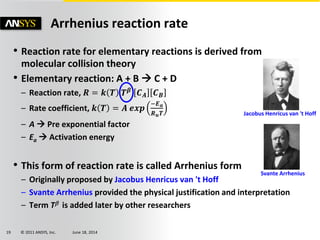
• Reaction rate for elementary reactions is derived from
molecular collision theory
• Elementary reaction: A + B  C + D
– Reaction rate, 𝑹 = 𝒌 𝑻 𝑻 𝜷 𝑪 𝑨 𝑪 𝑩
– Rate coefficient, 𝒌 𝑻 = 𝑨 𝒆𝒙𝒑
−𝑬 𝒂
𝑹 𝒖 𝑻
– A  Pre exponential factor
– Ea  Activation energy
• This form of reaction rate is called Arrhenius form
– Originally proposed by Jacobus Henricus van 't Hoff
– Svante Arrhenius provided the physical justification and interpretation
– Term T is added later by other researchers
Jacobus Henricus van 't Hoff
Svante Arrhenius
© 2011 ANSYS, Inc. June 18, 201420
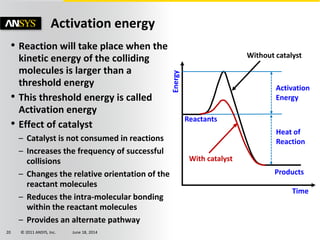
• Reaction will take place when the
kinetic energy of the colliding
molecules is larger than a
threshold energy
• This threshold energy is called
Activation energy
• Effect of catalyst
– Catalyst is not consumed in reactions
– Increases the frequency of successful
collisions
– Changes the relative orientation of the
reactant molecules
– Reduces the intra-molecular bonding
within the reactant molecules
– Provides an alternate pathway
Activation energy
Activation
Energy
ProductsEnergy
Time
Heat of
Reaction
Without catalyst
With catalyst
Reactants
© 2011 ANSYS, Inc. June 18, 201421
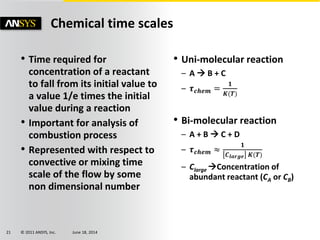
• Time required for
concentration of a reactant
to fall from its initial value to
a value 1/e times the initial
value during a reaction
• Important for analysis of
combustion process
• Represented with respect to
convective or mixing time
scale of the flow by some
non dimensional number
• Uni-molecular reaction
– A  B + C
– 𝝉 𝒄𝒉𝒆𝒎 =
𝟏
𝑲(𝑻)
• Bi-molecular reaction
– A + B  C + D
– 𝝉 𝒄𝒉𝒆𝒎 ≈
𝟏
𝑪 𝒍𝒂𝒓𝒈𝒆 𝑲(𝑻)
– Clarge Concentration of
abundant reactant (CA or CB)
Chemical time scales
© 2011 ANSYS, Inc. June 18, 201422
Chemical equilibrium
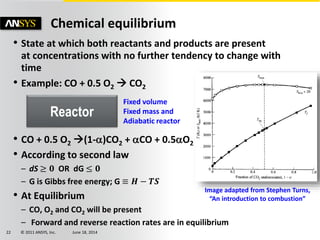
• State at which both reactants and products are present
at concentrations with no further tendency to change with
time
• Example: CO + 0.5 O2  CO2
• CO + 0.5 O2 (1-)CO2 + CO + 0.5O2
• According to second law
– dS ≥ 𝟎 OR dG ≤ 𝟎
– G is Gibbs free energy; G ≡ 𝑯 − 𝑻𝑺
• At Equilibrium
– CO, O2 and CO2 will be present
– Forward and reverse reaction rates are in equilibrium
Reactor
Fixed volume
Fixed mass and
Adiabatic reactor
Image adapted from Stephen Turns,
“An introduction to combustion”
© 2011 ANSYS, Inc. June 18, 201423
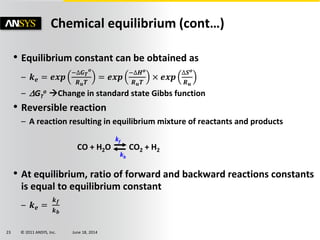
• Equilibrium constant can be obtained as
– 𝒌 𝒆 = 𝒆𝒙𝒑
−∆𝑮 𝑻
𝒐
𝑹 𝒖 𝑻
= 𝒆𝒙𝒑
−∆𝑯 𝒐
𝑹 𝒖 𝑻
× 𝒆𝒙𝒑
∆𝑺 𝒐
𝑹 𝒖
– GT
o Change in standard state Gibbs function
• Reversible reaction
– A reaction resulting in equilibrium mixture of reactants and products
CO + H2O CO2 + H2
• At equilibrium, ratio of forward and backward reactions constants
is equal to equilibrium constant
– 𝒌 𝒆 =
𝒌 𝒇
𝒌 𝒃
Chemical equilibrium (cont…)
kf
kb
© 2011 ANSYS, Inc. June 18, 201424
• Basic definitions and concepts
• Gas mixtures
• Reacting gas mixtures
• Types of flames and related phenomenon
• Solid and liquid burning and other reactions
• Role of turbulence in reacting flows
• Reacting flow modeling
Outline
© 2011 ANSYS, Inc. June 18, 201425
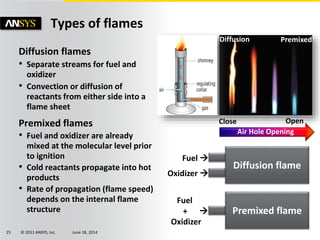
Types of flames
Air Hole Opening
Close Open
Diffusion Premixed
Diffusion flames
• Separate streams for fuel and
oxidizer
• Convection or diffusion of
reactants from either side into a
flame sheet
Premixed flames
• Fuel and oxidizer are already
mixed at the molecular level prior
to ignition
• Cold reactants propagate into hot
products
• Rate of propagation (flame speed)
depends on the internal flame
structure
Fuel 
Diffusion flame
Oxidizer 
Premixed flame
Fuel
+ 
Oxidizer
© 2011 ANSYS, Inc. June 18, 201426
Tad
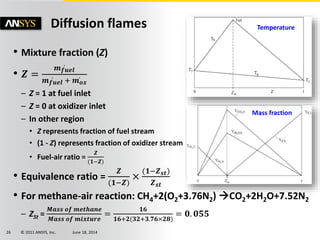
Diffusion flames
• Mixture fraction (Z)
• 𝒁 =
𝒎 𝒇𝒖𝒆𝒍
𝒎 𝒇𝒖𝒆𝒍 + 𝒎 𝒐𝒙
– Z = 1 at fuel inlet
– Z = 0 at oxidizer inlet
– In other region
• Z represents fraction of fuel stream
• (1 - Z) represents fraction of oxidizer stream
• Fuel-air ratio =
𝒁
(𝟏−𝒁)
• Equivalence ratio =
𝒁
(𝟏−𝒁)
×
(𝟏−𝒁 𝒔𝒕)
𝒁 𝒔𝒕
• For methane-air reaction: CH4+2(O2+3.76N2) CO2+2H2O+7.52N2
– ZSt =
𝑴𝒂𝒔𝒔 𝒐𝒇 𝒎𝒆𝒕𝒉𝒂𝒏𝒆
𝑴𝒂𝒔𝒔 𝒐𝒇 𝒎𝒊𝒙𝒕𝒖𝒓𝒆
=
𝟏𝟔
𝟏𝟔+𝟐(𝟑𝟐+𝟑.𝟕𝟔×𝟐𝟖)
= 𝟎. 𝟎𝟓𝟓
Mass fraction
Temperature
© 2011 ANSYS, Inc. June 18, 201427
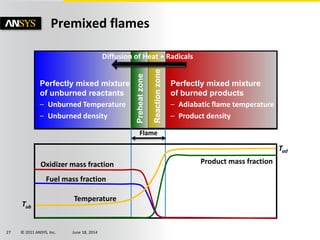
Premixed flames
Flame
Preheatzone
Perfectly mixed mixture
of unburned reactants
– Unburned Temperature
– Unburned density
Perfectly mixed mixture
of burned products
– Adiabatic flame temperature
– Product density
Reactionzone
Diffusion of Heat + Radicals
Temperature
Fuel mass fraction
Oxidizer mass fraction Product mass fraction
Tub
Tad
© 2011 ANSYS, Inc. June 18, 201428
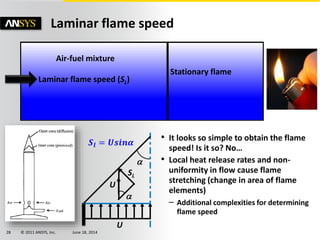
Laminar flame speed
Laminar flame speed (SL)
Stationary flame
Air-fuel mixture
U
SL

U

𝑺𝒍 = 𝑼𝒔𝒊𝒏𝜶
• It looks so simple to obtain the flame
speed! Is it so? No…
• Local heat release rates and non-
uniformity in flow cause flame
stretching (change in area of flame
elements)
– Additional complexities for determining
flame speed
© 2011 ANSYS, Inc. June 18, 201429
Flame extinction
Temperature
Tub
TadWithout heat loss
With heat loss
Flame
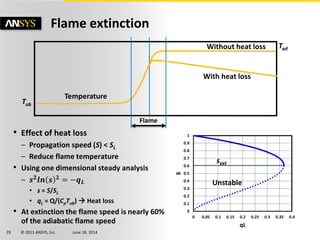
• Effect of heat loss
– Propagation speed (S) < SL
– Reduce flame temperature
• Using one dimensional steady analysis
– 𝒔 𝟐 𝒍𝒏 𝒔 𝟐 = −𝒒 𝑳
• s = S/SL
• qL = Q/(CpTub)  Heat loss
• At extinction the flame speed is nearly 60%
of the adiabatic flame speed
0
0.1
0.2
0.3
0.4
0.5
0.6
0.7
0.8
0.9
1
0 0.05 0.1 0.15 0.2 0.25 0.3 0.35 0.4
s
qL
Unstable
sext
© 2011 ANSYS, Inc. June 18, 201430
Ignition
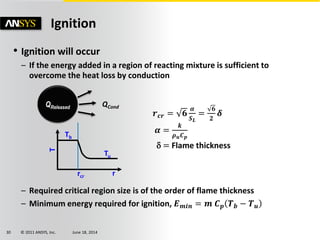
• Ignition will occur
– If the energy added in a region of reacting mixture is sufficient to
overcome the heat loss by conduction
– Required critical region size is of the order of flame thickness
– Minimum energy required for ignition, 𝑬 𝒎𝒊𝒏 = 𝒎 𝑪 𝒑 𝑻 𝒃 − 𝑻 𝒖
𝒓 𝒄𝒓 = 𝟔
𝜶
𝑺 𝑳
=
𝟔
𝟐
𝜹
𝜶 =
𝒌
𝝆 𝒖 𝑪 𝒑
 = Flame thickness
QReleased QCond
T
r
Tb
rcr
Tu
© 2011 ANSYS, Inc. June 18, 201431
Detonation and deflagration
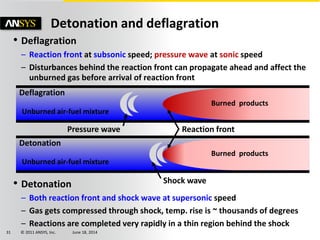
• Deflagration
– Reaction front at subsonic speed; pressure wave at sonic speed
– Disturbances behind the reaction front can propagate ahead and affect the
unburned gas before arrival of reaction front
• Detonation
– Both reaction front and shock wave at supersonic speed
– Gas gets compressed through shock, temp. rise is ~ thousands of degrees
– Reactions are completed very rapidly in a thin region behind the shock
Unburned air-fuel mixture
Burned products
Unburned air-fuel mixture
Burned products
Pressure wave Reaction front
Detonation
Deflagration
Shock wave
© 2011 ANSYS, Inc. June 18, 201432
• Basic definitions and concepts
• Gas mixtures
• Reacting gas mixtures
• Types of flames and related phenomenon
• Solid and liquid burning and other reactions
• Role of turbulence in reacting flows
• Reacting flow modeling
Outline
© 2011 ANSYS, Inc. June 18, 201433
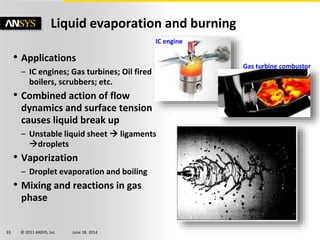
Liquid evaporation and burning
• Applications
– IC engines; Gas turbines; Oil fired
boilers, scrubbers; etc.
• Combined action of flow
dynamics and surface tension
causes liquid break up
– Unstable liquid sheet  ligaments
droplets
• Vaporization
– Droplet evaporation and boiling
• Mixing and reactions in gas
phase
IC engine
Gas turbine combustor
© 2011 ANSYS, Inc. June 18, 201434
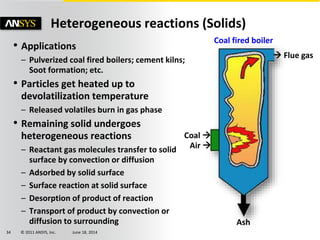
Heterogeneous reactions (Solids)
• Applications
– Pulverized coal fired boilers; cement kilns;
Soot formation; etc.
• Particles get heated up to
devolatilization temperature
– Released volatiles burn in gas phase
• Remaining solid undergoes
heterogeneous reactions
– Reactant gas molecules transfer to solid
surface by convection or diffusion
– Adsorbed by solid surface
– Surface reaction at solid surface
– Desorption of product of reaction
– Transport of product by convection or
diffusion to surrounding
Coal 
Air 
Ash
 Flue gas
Coal fired boiler
© 2011 ANSYS, Inc. June 18, 201435
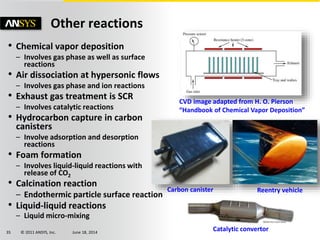
Other reactions
• Chemical vapor deposition
– Involves gas phase as well as surface
reactions
• Air dissociation at hypersonic flows
– Involves gas phase and ion reactions
• Exhaust gas treatment is SCR
– Involves catalytic reactions
• Hydrocarbon capture in carbon
canisters
– Involve adsorption and desorption
reactions
• Foam formation
– Involves liquid-liquid reactions with
release of CO2
• Calcination reaction
– Endothermic particle surface reaction
• Liquid-liquid reactions
– Liquid micro-mixing
CVD image adapted from H. O. Pierson
“Handbook of Chemical Vapor Deposition”
Reentry vehicle
Catalytic convertor
Carbon canister
© 2011 ANSYS, Inc. June 18, 201436
• Basic definitions and concepts
• Gas mixtures
• Reacting gas mixtures
• Types of flames and related phenomenon
• Solid and liquid burning and other reactions
• Role of turbulence in reacting flows
• Reacting flow modeling
Outline
© 2011 ANSYS, Inc. June 18, 201437
Role of turbulence in reacting system
• Flows encountered in most of the practical reacting systems
are turbulent
• Reactions and turbulence affect each other
– Turbulence-chemistry interaction
• Turbulence is modified by flames
– Through flow acceleration, modified kinematic viscosity
• Modified turbulence alters the flame structure
– Enhanced mixing and chemical reactions (through temp fluctuations)
• Mixing time scale (F) relative to chemical time scale (chem)
– An important parameter to decide whether the reaction is mixing limited
or chemically limited
– Mixing time scale in turbulent flows =
𝒌
𝝐
– Damkohlar Number (Da) =
𝝉 𝑭
𝝉 𝑪𝒉𝒆𝒎
– If Da > 1  Fast chemistry and Da ≤ 1  Finite rate chemistry
© 2011 ANSYS, Inc. June 18, 201438
• Basic definitions and concepts
• Gas mixtures
• Reacting gas mixtures
• Types of flames and related phenomenon
• Solid and liquid burning and other reactions
• Role of turbulence in reacting flows
• Reacting flow modeling
Outline
© 2011 ANSYS, Inc. June 18, 201439
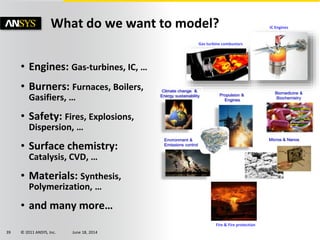
• Engines: Gas-turbines, IC, …
• Burners: Furnaces, Boilers,
Gasifiers, …
• Safety: Fires, Explosions,
Dispersion, …
• Surface chemistry:
Catalysis, CVD, …
• Materials: Synthesis,
Polymerization, …
• and many more…
What do we want to model?
Environment &
Emissions control
Propulsion &
Engines
Micros & Nanos
Biomedicine &
Biochemistry
Climate change &
Energy sustainability
Fire & Fire protection
Gas turbine combustors
IC Engines
© 2011 ANSYS, Inc. June 18, 201440
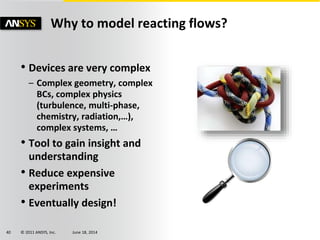
• Devices are very complex
– Complex geometry, complex
BCs, complex physics
(turbulence, multi-phase,
chemistry, radiation,…),
complex systems, …
• Tool to gain insight and
understanding
• Reduce expensive
experiments
• Eventually design!
Why to model reacting flows?
© 2011 ANSYS, Inc. June 18, 201441
Overview of combustion modeling
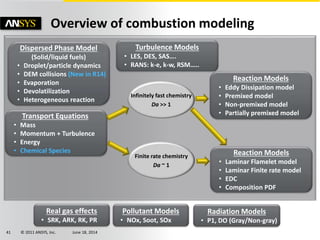
Transport Equations
• Mass
• Momentum + Turbulence
• Energy
• Chemical Species
Reaction Models
• Eddy Dissipation model
• Premixed model
• Non-premixed model
• Partially premixed model
Reaction Models
• Laminar Flamelet model
• Laminar Finite rate model
• EDC
• Composition PDF
Infinitely fast chemistry
Da >> 1
Finite rate chemistry
Da ~ 1
Dispersed Phase Model
(Solid/liquid fuels)
• Droplet/particle dynamics
• DEM collisions (New in R14)
• Evaporation
• Devolatilization
• Heterogeneous reaction
Turbulence Models
• LES, DES, SAS….
• RANS: k-e, k-w, RSM…..
Pollutant Models
• NOx, Soot, SOx
Radiation Models
• P1, DO (Gray/Non-gray)
Real gas effects
• SRK, ARK, RK, PR
© 2011 ANSYS, Inc. June 18, 201442
Combustion models in Fluent
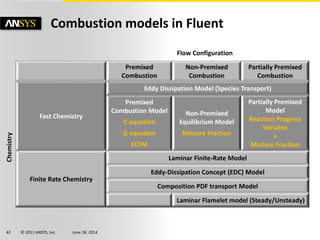
Premixed
Combustion
Non-Premixed
Combustion
Partially Premixed
Combustion
Fast Chemistry
Eddy Dissipation Model (Species Transport)
Premixed
Combustion Model
C equation
G equation
ECFM
Non-Premixed
Equilibrium Model
Mixture Fraction
Partially Premixed
Model
Reaction Progress
Variable
+
Mixture Fraction
Finite Rate Chemistry
Laminar Finite-Rate Model
Eddy-Dissipation Concept (EDC) Model
Composition PDF transport Model
Laminar Flamelet model (Steady/Unsteady)
Flow Configuration
Chemistry

Ask the Experts: Combustion Simulation

  • 1.
    © 2011 ANSYS,Inc. June 18, 20141 Ask The Expert - Everything You Always Wanted To Know About Combustion Simulation ANSYS Technical Engineers Team
  • 2.
    © 2011 ANSYS,Inc. June 18, 20142 Welcome! 1st Presentation of 5 on Simulation of Combustion 1) Fundamental concepts of reacting flows and models in ANSYS CFD 2) Modeling fast chemistry – Premixed, non-premixed and partially premixed models 3) Modeling detailed chemistry – Concepts, applications and best practices 4) Modeling pollutants and surface chemistry 5) Modeling heterogeneous reactions – Solid and liquid fuels Find all “Ask the Experts” Webinars on ANSYS.COM Follow SUPPORT -> RESOURCE LIBRARY
  • 3.
    © 2011 ANSYS,Inc. June 18, 20143 Reacting flows are all around us! Did you drive to work? Gasoline + O2  H2O + CO2 OR Diesel + O2  H2O + CO2 Ahh, but I have an electric car! • Battery – Electro-chemical reaction Li  Li+ + e • Charging – ~85% of world-wide electricity generation is from combustion Introduction
  • 4.
    © 2011 ANSYS,Inc. June 18, 20144 Introduction Ahh, but I rode my bicycle! Did you breath? C6H12O6 (glucose) + 6O2 → 6CO2 + 6H2O No, I held my breath the whole way! Did you partake in the greatest reaction ever? 2 Gamete + Nutrients  Baby No? Permission to leave is granted!
  • 5.
    © 2011 ANSYS,Inc. June 18, 20145 • Basic definitions and concepts • Gas mixtures • Reacting gas mixtures • Types of flames and related phenomenon • Solid and liquid burning and other reactions • Role of turbulence in reacting flows • Reacting flow modeling Outline
  • 6.
    © 2011 ANSYS,Inc. June 18, 20146 • Basic definitions and concepts • Gas mixtures • Reacting gas mixtures • Types of flames and related phenomenon • Solid and liquid burning and other reactions • Role of turbulence in reacting flows • Reacting flow modeling Outline
  • 7.
    © 2011 ANSYS,Inc. June 18, 20147 Basic definitions • Chemical reaction – A process involving changes in the structure and energy content of atoms, molecules, or ions • Exothermic reaction – Chemical reaction that releases energy in the form of light or heat • Endothermic reaction – Chemical reaction that absorbs energy from its surroundings • Basic types of reaction A B A B A BA B BA C A B C BA C A B CD D Synthesis reaction Decomposition reaction Single replacement reaction Double replacement reaction
  • 8.
    © 2011 ANSYS,Inc. June 18, 20148 Basic definitions (cont…) • Combustion reaction – Sequence of exothermic chemical reactions between a fuel and an oxidizer accompanied by the production of heat and conversion of chemical species – Combustion dominated flows form main part of reacting flows • Stoichiometry – Amount of oxidizer needed to completely burn a given quantity of fuel – CH4 + O2  CO2 + H2O • Stoichiometric fuel-air ratio – Ratio of mass of fuel to the mass of air at stoichiometry • Excess air – Fraction of air (oxidizer) supplied in excess of stoichiometric requirement • Equivalence ratio () – Ratio of actual fuel-air ratio to stoichiometric fuel-air ratio –  > 1  Rich mixture in fuel;  < 1  lean mixture in fuel CH4 + 2O2  CO2 + 2H2O
  • 9.
    © 2011 ANSYS,Inc. June 18, 20149 Equation of state • Relation between pressure, temperature and volume of gaseous substance • Ideal gas equation of state: 𝑷 𝝆 = 𝑹 𝒖 𝑴 𝒘 𝑻 – Ru = Universal gas constant = 8314.46 𝑱 𝒌𝒎𝒐𝒍 𝑲 • For devices operating at relatively constant pressure – Overall variation in pressure is not substantial – Idea gas law based on operating pressure can be used – Incompressible ideal gas law: 𝑷 𝒐𝒑 𝝆 = 𝑹 𝒖 𝑴 𝒘 𝑻 • Supercritical pressure systems – Ideal gas law is not accurate – Real gas equation of state is required: e.g. cubic equations of states
  • 10.
    © 2011 ANSYS,Inc. June 18, 201410 • For ideal gas 𝑪𝒑 ≡ 𝝏𝒉 𝝏𝑻 𝑷 • Energy of molecule – Translational, rotational and vibrational – Rotational and vibrational energy storage are increasingly active at higher temperature – Diatomic molecules have higher Cp than monoatomic molecules • Rotational and translational modes • 𝒉 𝑻 = 𝒉 𝒓𝒆𝒇 + 𝑻 𝒓𝒆𝒇 𝑻 𝑪𝒑(𝑻) 𝒅𝑻 • Enthalpy of a species, h(T) – Reference enthalpy (standard state enthalpy) at Tref = 298.15 K – Specific heat as a function of temperature Specific heat (Cp) Image adapted from Stephen Turns, “An introduction to combustion”
  • 11.
    © 2011 ANSYS,Inc. June 18, 201411 • Basic definitions and concepts • Gas mixtures • Reacting gas mixtures • Types of flames and related phenomenon • Solid and liquid burning and other reactions • Role of turbulence in reacting flows • Reacting flow modeling Outline
  • 12.
    © 2011 ANSYS,Inc. June 18, 201412 Gas mixtures • Mole fraction (Xi) – Fraction of total number of moles of a given species in a mixture – 𝑿𝒊 = 𝑵 𝒊 𝑵 𝑻𝒐𝒕 • Mass fraction (Yi) – Fraction of mass of a given species in a mixture, 𝒀𝒊 = 𝒎 𝒊 𝒎 𝑻𝒐𝒕 • Relation between Yi and Xi – 𝒀𝒊 = 𝑿𝒊 𝑴𝒘 𝒊 𝑴𝒘 𝑴𝒊𝒙 • Mixture molecular weight – 𝑴𝒘 𝑴𝒊𝒙 = 𝒊 𝑿𝒊 𝑴𝒘𝒊 = 𝒊 𝒀𝒊 𝑴𝒘 𝒊 −𝟏
  • 13.
    © 2011 ANSYS,Inc. June 18, 201413 Diffusion mass transfer (binary diffusion) • Species mass transfer in a mixture (1D) – 𝒎′′ 𝑨 = 𝒀 𝑨 × 𝒎′′ 𝒎𝒊𝒙 − 𝝆𝑫 𝑨𝑩 𝒅𝒀 𝑨 𝒅𝑿 – Two components: 1. Convection and 2. Diffusion – Diffusion takes place from high concentration region to low concentration region – DAB is binary diffusion coefficient (m2/s) • For gases: DAB ~1e-5; for liquids: DAB ~1e-9 • Thermal Diffusion – Diffusion due to temperature gradient – Thermal diffusion in liquids is called the Soret diffusion • Baro diffusion – Diffusion due to pressure gradient • Thermal and baro diffusion are usually small • Schmidt number – Ratio of viscous diffusion rate to molecular diffusion rate, 𝑺𝒄 = 𝝁 𝝆𝑫 • Lewis number – Ratio of thermal diffusion rate to molecular diffusion rate, 𝑳𝒆 = 𝜶 𝑫
  • 14.
    © 2011 ANSYS,Inc. June 18, 201414 Diffusion mass transfer (Multicomponent) • Individual species diffuse in the mixture • Diffusion coefficient of species in mixture (Dim) is required • Different approaches to calculate Dim – Constant: Suitable for dilute mixtures – Computed from binary Dij and mole fractions – Kinetic theory of gases • Diffusion calculated using Maxwell-Stefan equations – Important for diffusion-dominated laminar flows • Diffusion in turbulent flows – 𝒎′′ 𝒊 = − 𝝆𝑫 𝑨𝑩 + 𝝁 𝒕 𝑺𝒄 𝒕 𝒅𝒀𝒊 𝒅𝑿𝒊 – In turbulent flows, diffusion due to turbulence normally overwhelms the laminar diffusion
  • 15.
    © 2011 ANSYS,Inc. June 18, 201415 • Basic definitions and concepts • Gas mixtures • Reacting gas mixtures • Types of flames and related phenomenon • Solid and liquid burning and other reactions • Role of turbulence in reacting flows • Reacting flow modeling Outline: part-I
  • 16.
    © 2011 ANSYS,Inc. June 18, 201416 Reacting gas mixtures Reactor Reactants (Stoichiometric mixture at standard condition) Products at temp, T (Complete combustion) Heat removed = 0 T = Tad (Adiabatic flame temp) h T hreact Tref hprod Heat of reaction Reactants Products Products Tad Reactor Reactants (Stoichiometric mixture at standard condition) Products (Complete combustion at standard condition) Heat removed Practical state of products 𝑯 𝒓 = ∆𝒉 𝒇 𝒑𝒓𝒐𝒅 − ∆𝒉 𝒇 𝒓𝒆𝒂𝒄𝒕 = Heat of reaction (Hr)
  • 17.
    © 2011 ANSYS,Inc. June 18, 201417 Global reaction • Overall reaction where fuel and oxidizer reacts to form product – Fuel + a Ox  b Prod • Fuel consumption rate: 𝒅 𝑪 𝒇 𝒅𝒕 = −𝒌(𝑻) 𝑪 𝒇 𝒎 𝑪 𝒐𝒙 𝒏 – Ci  Molar concentrations (kmol/m3); i = f or ox – K(T)  Rate constant; Strong function of temperature – m and n  Reaction order; Not necessarily integers for global reactions • In reality, many reactions involving many intermediate species take place to form products – Individual reactions are called elementary reactions – Some elementary reactions may produce some intermediate species – Some elementary reactions may involve free radicals like O, OH, H, etc. – Collection of elementary reactions is called reaction mechanism
  • 18.
    © 2011 ANSYS,Inc. June 18, 201418 Reaction mechanism • Tens of species and hundreds of reactions • Each species participate in a series of reaction steps – Produced in some steps and destroyed in some other steps • Chain reactions – Produce radical species – For global reaction: A2 + B2 2AB – Chain initiation: Starts forming radicals – Chain propagation: Forming other radicals – Chain branching: Forming two radicals – Chain termination: Forming products A2+ M  A + A + M A + B2  AB + B A2 + B  AB + A AB + B  A + 2B A + B + M AB + M 10 1 10 2 10 3 10 4 10 2 10 3 10 4 before 2000 2000 to 2005 after 2005 iso-ocatane (LLNL) iso-ocatane (ENSIC-CNRS) n-butane (LLNL) CH4 (Konnov) neo-pentane (LLNL) C2H4 (San Diego) CH4 (Leeds) Methyl Decanoate (LLNL) C16 (LLNL) C14 (LLNL) C12 (LLNL) C10 (LLNL) USC C1-C4 USC C2H4 PRF n-heptane (LLNL) skeletal iso-octane (Lu & Law) skeletal n-heptane (Lu & Law) 1,3-Butadiene DME (Curran)C1-C3 (Qin et al) GRI3.0 Numberofreactions Number of species GRI1.2 pre-2000 2000 – 2005 post-2005 Number of Species NumberofReactions nC7H16 C11H22O2
  • 19.
    © 2011 ANSYS,Inc. June 18, 201419 Arrhenius reaction rate • Reaction rate for elementary reactions is derived from molecular collision theory • Elementary reaction: A + B  C + D – Reaction rate, 𝑹 = 𝒌 𝑻 𝑻 𝜷 𝑪 𝑨 𝑪 𝑩 – Rate coefficient, 𝒌 𝑻 = 𝑨 𝒆𝒙𝒑 −𝑬 𝒂 𝑹 𝒖 𝑻 – A  Pre exponential factor – Ea  Activation energy • This form of reaction rate is called Arrhenius form – Originally proposed by Jacobus Henricus van 't Hoff – Svante Arrhenius provided the physical justification and interpretation – Term T is added later by other researchers Jacobus Henricus van 't Hoff Svante Arrhenius
  • 20.
    © 2011 ANSYS,Inc. June 18, 201420 • Reaction will take place when the kinetic energy of the colliding molecules is larger than a threshold energy • This threshold energy is called Activation energy • Effect of catalyst – Catalyst is not consumed in reactions – Increases the frequency of successful collisions – Changes the relative orientation of the reactant molecules – Reduces the intra-molecular bonding within the reactant molecules – Provides an alternate pathway Activation energy Activation Energy ProductsEnergy Time Heat of Reaction Without catalyst With catalyst Reactants
  • 21.
    © 2011 ANSYS,Inc. June 18, 201421 • Time required for concentration of a reactant to fall from its initial value to a value 1/e times the initial value during a reaction • Important for analysis of combustion process • Represented with respect to convective or mixing time scale of the flow by some non dimensional number • Uni-molecular reaction – A  B + C – 𝝉 𝒄𝒉𝒆𝒎 = 𝟏 𝑲(𝑻) • Bi-molecular reaction – A + B  C + D – 𝝉 𝒄𝒉𝒆𝒎 ≈ 𝟏 𝑪 𝒍𝒂𝒓𝒈𝒆 𝑲(𝑻) – Clarge Concentration of abundant reactant (CA or CB) Chemical time scales
  • 22.
    © 2011 ANSYS,Inc. June 18, 201422 Chemical equilibrium • State at which both reactants and products are present at concentrations with no further tendency to change with time • Example: CO + 0.5 O2  CO2 • CO + 0.5 O2 (1-)CO2 + CO + 0.5O2 • According to second law – dS ≥ 𝟎 OR dG ≤ 𝟎 – G is Gibbs free energy; G ≡ 𝑯 − 𝑻𝑺 • At Equilibrium – CO, O2 and CO2 will be present – Forward and reverse reaction rates are in equilibrium Reactor Fixed volume Fixed mass and Adiabatic reactor Image adapted from Stephen Turns, “An introduction to combustion”
  • 23.
    © 2011 ANSYS,Inc. June 18, 201423 • Equilibrium constant can be obtained as – 𝒌 𝒆 = 𝒆𝒙𝒑 −∆𝑮 𝑻 𝒐 𝑹 𝒖 𝑻 = 𝒆𝒙𝒑 −∆𝑯 𝒐 𝑹 𝒖 𝑻 × 𝒆𝒙𝒑 ∆𝑺 𝒐 𝑹 𝒖 – GT o Change in standard state Gibbs function • Reversible reaction – A reaction resulting in equilibrium mixture of reactants and products CO + H2O CO2 + H2 • At equilibrium, ratio of forward and backward reactions constants is equal to equilibrium constant – 𝒌 𝒆 = 𝒌 𝒇 𝒌 𝒃 Chemical equilibrium (cont…) kf kb
  • 24.
    © 2011 ANSYS,Inc. June 18, 201424 • Basic definitions and concepts • Gas mixtures • Reacting gas mixtures • Types of flames and related phenomenon • Solid and liquid burning and other reactions • Role of turbulence in reacting flows • Reacting flow modeling Outline
  • 25.
    © 2011 ANSYS,Inc. June 18, 201425 Types of flames Air Hole Opening Close Open Diffusion Premixed Diffusion flames • Separate streams for fuel and oxidizer • Convection or diffusion of reactants from either side into a flame sheet Premixed flames • Fuel and oxidizer are already mixed at the molecular level prior to ignition • Cold reactants propagate into hot products • Rate of propagation (flame speed) depends on the internal flame structure Fuel  Diffusion flame Oxidizer  Premixed flame Fuel +  Oxidizer
  • 26.
    © 2011 ANSYS,Inc. June 18, 201426 Tad Diffusion flames • Mixture fraction (Z) • 𝒁 = 𝒎 𝒇𝒖𝒆𝒍 𝒎 𝒇𝒖𝒆𝒍 + 𝒎 𝒐𝒙 – Z = 1 at fuel inlet – Z = 0 at oxidizer inlet – In other region • Z represents fraction of fuel stream • (1 - Z) represents fraction of oxidizer stream • Fuel-air ratio = 𝒁 (𝟏−𝒁) • Equivalence ratio = 𝒁 (𝟏−𝒁) × (𝟏−𝒁 𝒔𝒕) 𝒁 𝒔𝒕 • For methane-air reaction: CH4+2(O2+3.76N2) CO2+2H2O+7.52N2 – ZSt = 𝑴𝒂𝒔𝒔 𝒐𝒇 𝒎𝒆𝒕𝒉𝒂𝒏𝒆 𝑴𝒂𝒔𝒔 𝒐𝒇 𝒎𝒊𝒙𝒕𝒖𝒓𝒆 = 𝟏𝟔 𝟏𝟔+𝟐(𝟑𝟐+𝟑.𝟕𝟔×𝟐𝟖) = 𝟎. 𝟎𝟓𝟓 Mass fraction Temperature
  • 27.
    © 2011 ANSYS,Inc. June 18, 201427 Premixed flames Flame Preheatzone Perfectly mixed mixture of unburned reactants – Unburned Temperature – Unburned density Perfectly mixed mixture of burned products – Adiabatic flame temperature – Product density Reactionzone Diffusion of Heat + Radicals Temperature Fuel mass fraction Oxidizer mass fraction Product mass fraction Tub Tad
  • 28.
    © 2011 ANSYS,Inc. June 18, 201428 Laminar flame speed Laminar flame speed (SL) Stationary flame Air-fuel mixture U SL  U  𝑺𝒍 = 𝑼𝒔𝒊𝒏𝜶 • It looks so simple to obtain the flame speed! Is it so? No… • Local heat release rates and non- uniformity in flow cause flame stretching (change in area of flame elements) – Additional complexities for determining flame speed
  • 29.
    © 2011 ANSYS,Inc. June 18, 201429 Flame extinction Temperature Tub TadWithout heat loss With heat loss Flame • Effect of heat loss – Propagation speed (S) < SL – Reduce flame temperature • Using one dimensional steady analysis – 𝒔 𝟐 𝒍𝒏 𝒔 𝟐 = −𝒒 𝑳 • s = S/SL • qL = Q/(CpTub)  Heat loss • At extinction the flame speed is nearly 60% of the adiabatic flame speed 0 0.1 0.2 0.3 0.4 0.5 0.6 0.7 0.8 0.9 1 0 0.05 0.1 0.15 0.2 0.25 0.3 0.35 0.4 s qL Unstable sext
  • 30.
    © 2011 ANSYS,Inc. June 18, 201430 Ignition • Ignition will occur – If the energy added in a region of reacting mixture is sufficient to overcome the heat loss by conduction – Required critical region size is of the order of flame thickness – Minimum energy required for ignition, 𝑬 𝒎𝒊𝒏 = 𝒎 𝑪 𝒑 𝑻 𝒃 − 𝑻 𝒖 𝒓 𝒄𝒓 = 𝟔 𝜶 𝑺 𝑳 = 𝟔 𝟐 𝜹 𝜶 = 𝒌 𝝆 𝒖 𝑪 𝒑  = Flame thickness QReleased QCond T r Tb rcr Tu
  • 31.
    © 2011 ANSYS,Inc. June 18, 201431 Detonation and deflagration • Deflagration – Reaction front at subsonic speed; pressure wave at sonic speed – Disturbances behind the reaction front can propagate ahead and affect the unburned gas before arrival of reaction front • Detonation – Both reaction front and shock wave at supersonic speed – Gas gets compressed through shock, temp. rise is ~ thousands of degrees – Reactions are completed very rapidly in a thin region behind the shock Unburned air-fuel mixture Burned products Unburned air-fuel mixture Burned products Pressure wave Reaction front Detonation Deflagration Shock wave
  • 32.
    © 2011 ANSYS,Inc. June 18, 201432 • Basic definitions and concepts • Gas mixtures • Reacting gas mixtures • Types of flames and related phenomenon • Solid and liquid burning and other reactions • Role of turbulence in reacting flows • Reacting flow modeling Outline
  • 33.
    © 2011 ANSYS,Inc. June 18, 201433 Liquid evaporation and burning • Applications – IC engines; Gas turbines; Oil fired boilers, scrubbers; etc. • Combined action of flow dynamics and surface tension causes liquid break up – Unstable liquid sheet  ligaments droplets • Vaporization – Droplet evaporation and boiling • Mixing and reactions in gas phase IC engine Gas turbine combustor
  • 34.
    © 2011 ANSYS,Inc. June 18, 201434 Heterogeneous reactions (Solids) • Applications – Pulverized coal fired boilers; cement kilns; Soot formation; etc. • Particles get heated up to devolatilization temperature – Released volatiles burn in gas phase • Remaining solid undergoes heterogeneous reactions – Reactant gas molecules transfer to solid surface by convection or diffusion – Adsorbed by solid surface – Surface reaction at solid surface – Desorption of product of reaction – Transport of product by convection or diffusion to surrounding Coal  Air  Ash  Flue gas Coal fired boiler
  • 35.
    © 2011 ANSYS,Inc. June 18, 201435 Other reactions • Chemical vapor deposition – Involves gas phase as well as surface reactions • Air dissociation at hypersonic flows – Involves gas phase and ion reactions • Exhaust gas treatment is SCR – Involves catalytic reactions • Hydrocarbon capture in carbon canisters – Involve adsorption and desorption reactions • Foam formation – Involves liquid-liquid reactions with release of CO2 • Calcination reaction – Endothermic particle surface reaction • Liquid-liquid reactions – Liquid micro-mixing CVD image adapted from H. O. Pierson “Handbook of Chemical Vapor Deposition” Reentry vehicle Catalytic convertor Carbon canister
  • 36.
    © 2011 ANSYS,Inc. June 18, 201436 • Basic definitions and concepts • Gas mixtures • Reacting gas mixtures • Types of flames and related phenomenon • Solid and liquid burning and other reactions • Role of turbulence in reacting flows • Reacting flow modeling Outline
  • 37.
    © 2011 ANSYS,Inc. June 18, 201437 Role of turbulence in reacting system • Flows encountered in most of the practical reacting systems are turbulent • Reactions and turbulence affect each other – Turbulence-chemistry interaction • Turbulence is modified by flames – Through flow acceleration, modified kinematic viscosity • Modified turbulence alters the flame structure – Enhanced mixing and chemical reactions (through temp fluctuations) • Mixing time scale (F) relative to chemical time scale (chem) – An important parameter to decide whether the reaction is mixing limited or chemically limited – Mixing time scale in turbulent flows = 𝒌 𝝐 – Damkohlar Number (Da) = 𝝉 𝑭 𝝉 𝑪𝒉𝒆𝒎 – If Da > 1  Fast chemistry and Da ≤ 1  Finite rate chemistry
  • 38.
    © 2011 ANSYS,Inc. June 18, 201438 • Basic definitions and concepts • Gas mixtures • Reacting gas mixtures • Types of flames and related phenomenon • Solid and liquid burning and other reactions • Role of turbulence in reacting flows • Reacting flow modeling Outline
  • 39.
    © 2011 ANSYS,Inc. June 18, 201439 • Engines: Gas-turbines, IC, … • Burners: Furnaces, Boilers, Gasifiers, … • Safety: Fires, Explosions, Dispersion, … • Surface chemistry: Catalysis, CVD, … • Materials: Synthesis, Polymerization, … • and many more… What do we want to model? Environment & Emissions control Propulsion & Engines Micros & Nanos Biomedicine & Biochemistry Climate change & Energy sustainability Fire & Fire protection Gas turbine combustors IC Engines
  • 40.
    © 2011 ANSYS,Inc. June 18, 201440 • Devices are very complex – Complex geometry, complex BCs, complex physics (turbulence, multi-phase, chemistry, radiation,…), complex systems, … • Tool to gain insight and understanding • Reduce expensive experiments • Eventually design! Why to model reacting flows?
  • 41.
    © 2011 ANSYS,Inc. June 18, 201441 Overview of combustion modeling Transport Equations • Mass • Momentum + Turbulence • Energy • Chemical Species Reaction Models • Eddy Dissipation model • Premixed model • Non-premixed model • Partially premixed model Reaction Models • Laminar Flamelet model • Laminar Finite rate model • EDC • Composition PDF Infinitely fast chemistry Da >> 1 Finite rate chemistry Da ~ 1 Dispersed Phase Model (Solid/liquid fuels) • Droplet/particle dynamics • DEM collisions (New in R14) • Evaporation • Devolatilization • Heterogeneous reaction Turbulence Models • LES, DES, SAS…. • RANS: k-e, k-w, RSM….. Pollutant Models • NOx, Soot, SOx Radiation Models • P1, DO (Gray/Non-gray) Real gas effects • SRK, ARK, RK, PR
  • 42.
    © 2011 ANSYS,Inc. June 18, 201442 Combustion models in Fluent Premixed Combustion Non-Premixed Combustion Partially Premixed Combustion Fast Chemistry Eddy Dissipation Model (Species Transport) Premixed Combustion Model C equation G equation ECFM Non-Premixed Equilibrium Model Mixture Fraction Partially Premixed Model Reaction Progress Variable + Mixture Fraction Finite Rate Chemistry Laminar Finite-Rate Model Eddy-Dissipation Concept (EDC) Model Composition PDF transport Model Laminar Flamelet model (Steady/Unsteady) Flow Configuration Chemistry