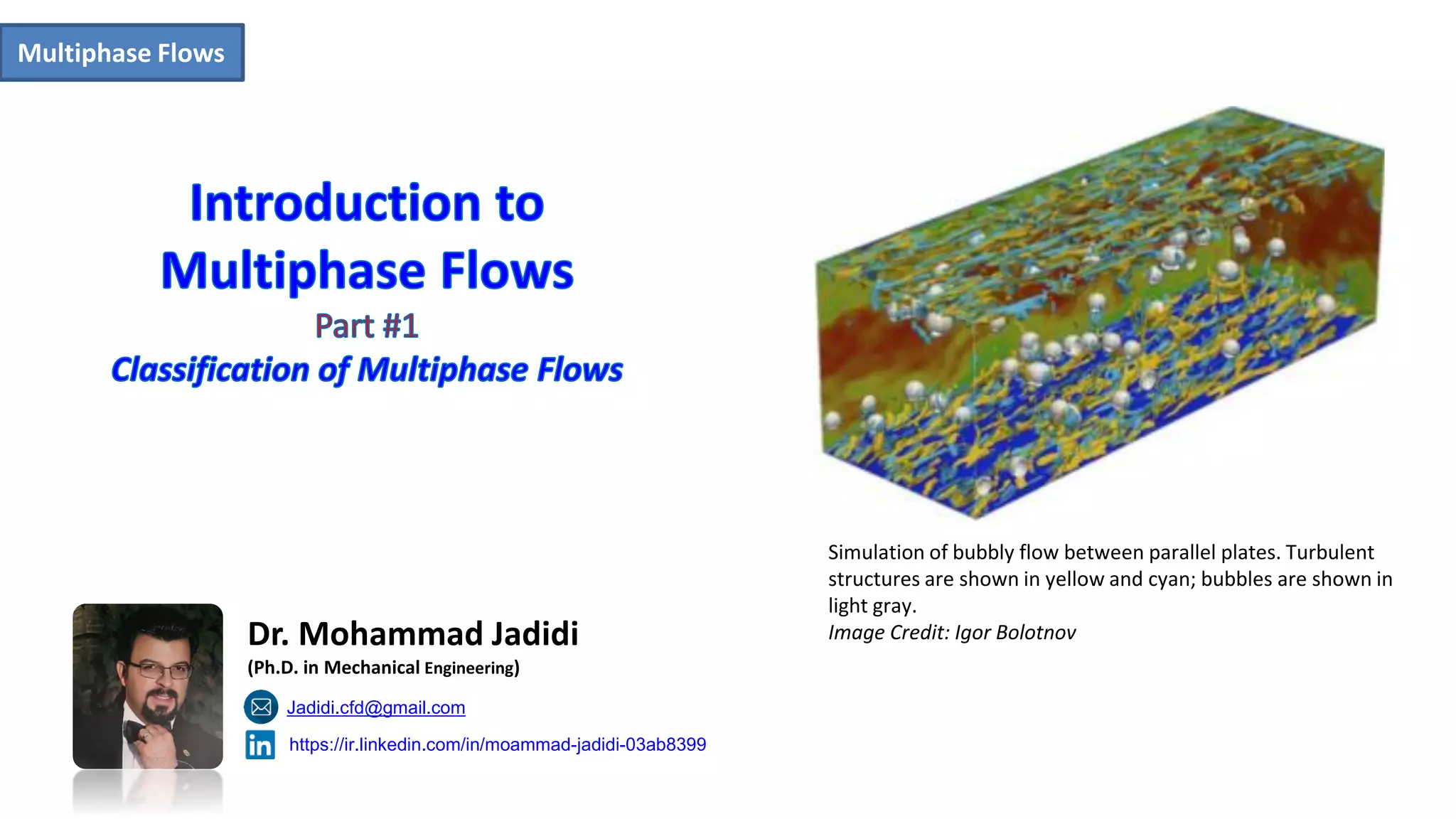
Simulation of bubbly flow between parallel plates. Turbulent
structures are shown in yellow and cyan; bubbles are shown in
light gray.
Image Credit: Igor Bolotnov
Multiphase Flows
https://ir.linkedin.com/in/moammad-jadidi-03ab8399
Jadidi.cfd@gmail.com
Dr. Mohammad Jadidi
(Ph.D. in Mechanical Engineering)
Presented by: Mohammad Jadidi 2
For example, different-sized solid particles
of the same material can be treated as
different phases because each collection of
particles with the same size will have a
similar dynamical response to the flow field
In multiphase flow, a phase can be defined
as an identifiable class of material that has a
particular inertial response to and
interaction with the flow and the potential
field in which it is immersed.
Note:
What is Multiphase Flows?
 Two or more distinct phases flowing simultaneously in
mixture, and
 Have some level of phase separation at a scale well above the
molecular level
Multi-phase flows is simply any fluid flow
system consisting of:
Multiphase Flows
Presented by: Mohammad Jadidi 3
Multiphase Flows
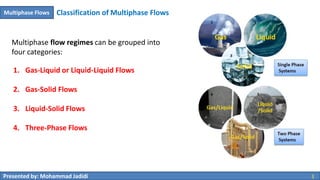
Multiphase flow regimes can be grouped into
four categories:
1. Gas-Liquid or Liquid-Liquid Flows
2. Gas-Solid Flows
3. Liquid-Solid Flows
4. Three-Phase Flows
Classification of Multiphase Flows
Presented by: Mohammad Jadidi 4
Classification of Multiphase Flows: Gas-Liquid or Liquid-Liquid Flows
 Bubbly flow: discrete gaseous or fluid bubbles in a continuous fluid.
 Droplet flow: discrete fluid droplets in a continuous gas.
 Slug flow: large bubbles in a continuous fluid.
 Stratified/free-surface flow: immiscible fluids separated by a clearly-defined
interface.
Bubbly flow Droplet flow Slug flow Stratified/free-surface flow
Multiphase Flows
Black color: liquid phase , White color: gas phase
Presented by: Mohammad Jadidi 5
Classification of Multiphase Flows: Gas-Liquid Flows
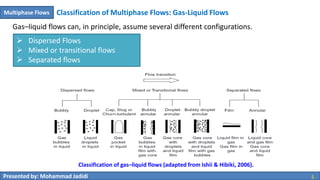
Gas–liquid flows can, in principle, assume several different configurations.
Classification of gas–liquid flows (adapted from Ishii & Hibiki, 2006).
 Dispersed Flows
 Mixed or transitional flows
 Separated flows
Multiphase Flows
Presented by: Mohammad Jadidi 6
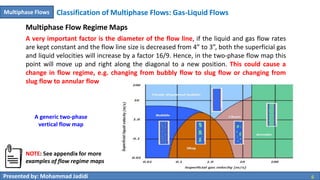
A generic two-phase
vertical flow map
A very important factor is the diameter of the flow line, if the liquid and gas flow rates
are kept constant and the flow line size is decreased from 4” to 3”, both the superficial gas
and liquid velocities will increase by a factor 16/9. Hence, in the two-phase flow map this
point will move up and right along the diagonal to a new position. This could cause a
change in flow regime, e.g. changing from bubbly flow to slug flow or changing from
slug flow to annular flow
Multiphase Flows
Multiphase Flow Regime Maps
Classification of Multiphase Flows: Gas-Liquid Flows
NOTE: See appendix for more
examples of flow regime maps
Presented by: Mohammad Jadidi 7
Classification of Multiphase Flows: Gas-Liquid Flows
Flow Regimes in Vertical Pipe Configuration
Multiphase Flows
Presented by: Mohammad Jadidi 8
Multiphase Flows Classification of Multiphase Flows: Gas-Solid Flows
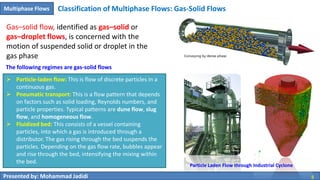
 Particle-laden flow: This is flow of discrete particles in a
continuous gas.
 Pneumatic transport: This is a flow pattern that depends
on factors such as solid loading, Reynolds numbers, and
particle properties. Typical patterns are dune flow, slug
flow, and homogeneous flow.
 Fluidized bed: This consists of a vessel containing
particles, into which a gas is introduced through a
distributor. The gas rising through the bed suspends the
particles. Depending on the gas flow rate, bubbles appear
and rise through the bed, intensifying the mixing within
the bed.
Particle Laden Flow through Industrial Cyclone
Gas–solid flow, identified as gas–solid or
gas–droplet flows, is concerned with the
motion of suspended solid or droplet in the
gas phase
The following regimes are gas-solid flows
Presented by: Mohammad Jadidi 9
Multiphase Flows
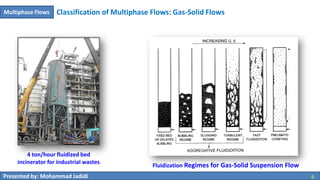
Fluidization Regimes for Gas-Solid Suspension Flow
4 ton/hour fluidized bed
incinerator for industrial wastes
Classification of Multiphase Flows: Gas-Solid Flows
Presented by: Mohammad Jadidi 10
Multiphase Flows Classification of Multiphase Flows: Gas-Solid Flows
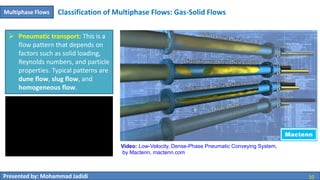
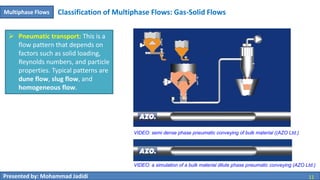
 Pneumatic transport: This is a
flow pattern that depends on
factors such as solid loading,
Reynolds numbers, and particle
properties. Typical patterns are
dune flow, slug flow, and
homogeneous flow.
Video: Low-Velocity, Dense-Phase Pneumatic Conveying System,
by Mactenn, mactenn.com
Presented by: Mohammad Jadidi 11
Multiphase Flows Classification of Multiphase Flows: Gas-Solid Flows
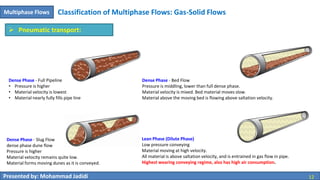
 Pneumatic transport: This is a
flow pattern that depends on
factors such as solid loading,
Reynolds numbers, and particle
properties. Typical patterns are
dune flow, slug flow, and
homogeneous flow.
VIDEO: semi dense phase pneumatic conveying of bulk material ((AZO Ltd.)
VIDEO: a simulation of a bulk material dilute phase pneumatic conveying (AZO Ltd.)
Presented by: Mohammad Jadidi 12
Multiphase Flows Classification of Multiphase Flows: Gas-Solid Flows
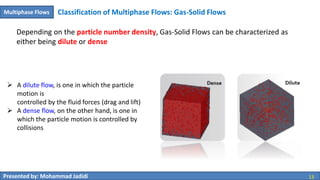
 Pneumatic transport:
Dense Phase - Full Pipeline
• Pressure is higher
• Material velocity is lowest
• Material nearly fully fills pipe line
Dense Phase - Slug Flow
dense phase dune flow
Pressure is higher
Material velocity remains quite low.
Material forms moving dunes as it is conveyed.
Dense Phase - Bed Flow
Pressure is middling, lower than full dense phase.
Material velocity is mixed. Bed material moves slow.
Material above the moving bed is flowing above saltation velocity.
Lean Phase (Dilute Phase)
Low pressure conveying
Material moving at high velocity.
All material is above saltation velocity, and is entrained in gas flow in pipe.
Highest wearing conveying regime, also has high air consumption.
Presented by: Mohammad Jadidi 13
Multiphase Flows
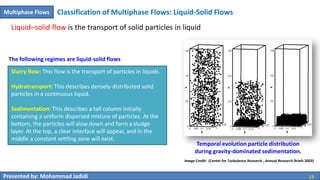
Depending on the particle number density, Gas-Solid Flows can be characterized as
either being dilute or dense
Classification of Multiphase Flows: Gas-Solid Flows
 A dilute flow, is one in which the particle
motion is
controlled by the fluid forces (drag and lift)
 A dense flow, on the other hand, is one in
which the particle motion is controlled by
collisions
Presented by: Mohammad Jadidi 14
Multiphase Flows Classification of Multiphase Flows: Liquid-Solid Flows
Liquid–solid flow is the transport of solid particles in liquid
The following regimes are liquid-solid flows
Slurry flow: This flow is the transport of particles in liquids.
Hydrotransport: This describes densely-distributed solid
particles in a continuous liquid.
Sedimentation: This describes a tall column initially
containing a uniform dispersed mixture of particles. At the
bottom, the particles will slow down and form a sludge
layer. At the top, a clear interface will appear, and in the
middle a constant settling zone will exist.
Temporal evolution particle distribution
during gravity-dominated sedimentation.
Image Credit: (Center for Turbulence Research , Annual Research Briefs 2003)
The Stokes number gives a
measure of temporal correlation
between particle velocity and the
fluid velocity and is defined as
𝑺𝒕 = 𝝉 𝒑 / 𝝉 𝑭
 If St <<1, the particle response time is much
less than the characteristic time associated
with the flow field. In this case the particles will
have ample time to respond to changes in flow
velocity and, the particle and fluid velocities
will be nearly equal
 If St>>1, then the particle will have essentially
no time to respond to the fluid velocity changes
and the particle velocity will be little affected
by fluid velocity change
Presented by: Mohammad Jadidi 15
Multiphase Flows
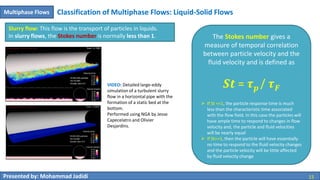
Slurry flow: This flow is the transport of particles in liquids.
In slurry flows, the Stokes number is normally less than 1.
VIDEO: Detailed large-eddy
simulation of a turbulent slurry
flow in a horizontal pipe with the
formation of a static bed at the
bottom.
Performed using NGA by Jesse
Capecelatro and Olivier
Desjardins.
Classification of Multiphase Flows: Liquid-Solid Flows
Presented by: Mohammad Jadidi 16
Multiphase Flows
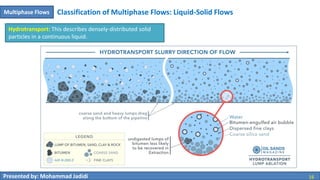
Hydrotransport: This describes densely-distributed solid
particles in a continuous liquid.
Classification of Multiphase Flows: Liquid-Solid Flows
Presented by: Mohammad Jadidi 17
Multiphase Flows
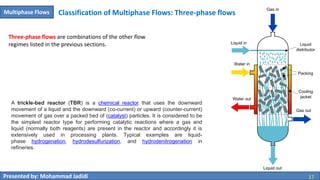
Three-phase flows are combinations of the other flow
regimes listed in the previous sections.
Classification of Multiphase Flows: Three-phase flows
A trickle-bed reactor (TBR) is a chemical reactor that uses the downward
movement of a liquid and the downward (co-current) or upward (counter-current)
movement of gas over a packed bed of (catalyst) particles. It is considered to be
the simplest reactor type for performing catalytic reactions where a gas and
liquid (normally both reagents) are present in the reactor and accordingly it is
extensively used in processing plants. Typical examples are liquid-
phase hydrogenation, hydrodesulfurization, and hydrodenitrogenation in
refineries.
Presented by: Mohammad Jadidi 18
Appendix
Multiphase Flows
Presented by: Mohammad Jadidi 19
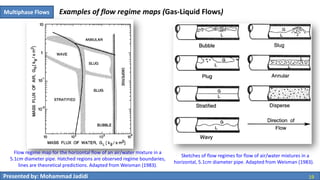
Multiphase Flows Examples of flow regime maps (Gas-Liquid Flows)
Flow regime map for the horizontal flow of an air/water mixture in a
5.1cm diameter pipe. Hatched regions are observed regime boundaries,
lines are theoretical predictions. Adapted from Weisman (1983).
Sketches of flow regimes for flow of air/water mixtures in a
horizontal, 5.1cm diameter pipe. Adapted from Weisman (1983).
Presented by: Mohammad Jadidi 20
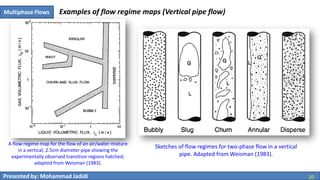
Multiphase Flows Examples of flow regime maps (Vertical pipe flow)
Sketches of flow regimes for two-phase flow in a vertical
pipe. Adapted from Weisman (1983).
A flow regime map for the flow of an air/water mixture
in a vertical, 2.5cm diameter pipe showing the
experimentally observed transition regions hatched;
adapted from Weisman (1983).
21
Multiphase Flows
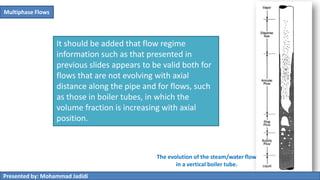
The evolution of the steam/water flow
in a vertical boiler tube.
Presented by: Mohammad Jadidi
It should be added that flow regime
information such as that presented in
previous slides appears to be valid both for
flows that are not evolving with axial
distance along the pipe and for flows, such
as those in boiler tubes, in which the
volume fraction is increasing with axial
position.
Presented by: Mohammad Jadidi 22
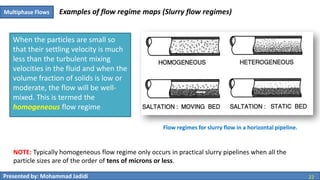
Multiphase Flows Examples of flow regime maps (Slurry flow regimes)
When the particles are small so
that their settling velocity is much
less than the turbulent mixing
velocities in the fluid and when the
volume fraction of solids is low or
moderate, the flow will be well-
mixed. This is termed the
homogeneous flow regime
Flow regimes for slurry flow in a horizontal pipeline.
NOTE: Typically homogeneous flow regime only occurs in practical slurry pipelines when all the
particle sizes are of the order of tens of microns or less.
Presented by: Mohammad Jadidi 23
Multiphase Flows Examples of flow regime maps (Slurry flow regimes)
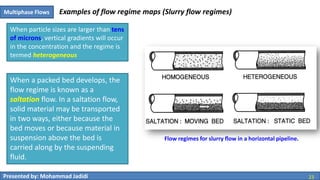
Flow regimes for slurry flow in a horizontal pipeline.
When particle sizes are larger than tens
of microns, vertical gradients will occur
in the concentration and the regime is
termed heterogeneous
When a packed bed develops, the
flow regime is known as a
saltation flow. In a saltation flow,
solid material may be transported
in two ways, either because the
bed moves or because material in
suspension above the bed is
carried along by the suspending
fluid.
24
Multiphase Flows
Thanks
https://ir.linkedin.com/in/moammad-jadidi-03ab8399
Jadidi.cfd@gmail.com
Dr. Mohammad Jadidi
(Ph.D. in Mechanical Engineering)
End of part #1 Next part:

00 multiphase flows - intorduction

  • 1.
    Simulation of bubblyflow between parallel plates. Turbulent structures are shown in yellow and cyan; bubbles are shown in light gray. Image Credit: Igor Bolotnov Multiphase Flows https://ir.linkedin.com/in/moammad-jadidi-03ab8399 Jadidi.cfd@gmail.com Dr. Mohammad Jadidi (Ph.D. in Mechanical Engineering)
  • 2.
    Presented by: MohammadJadidi 2 For example, different-sized solid particles of the same material can be treated as different phases because each collection of particles with the same size will have a similar dynamical response to the flow field In multiphase flow, a phase can be defined as an identifiable class of material that has a particular inertial response to and interaction with the flow and the potential field in which it is immersed. Note: What is Multiphase Flows?  Two or more distinct phases flowing simultaneously in mixture, and  Have some level of phase separation at a scale well above the molecular level Multi-phase flows is simply any fluid flow system consisting of: Multiphase Flows
  • 3.
    Presented by: MohammadJadidi 3 Multiphase Flows Multiphase flow regimes can be grouped into four categories: 1. Gas-Liquid or Liquid-Liquid Flows 2. Gas-Solid Flows 3. Liquid-Solid Flows 4. Three-Phase Flows Classification of Multiphase Flows
  • 4.
    Presented by: MohammadJadidi 4 Classification of Multiphase Flows: Gas-Liquid or Liquid-Liquid Flows  Bubbly flow: discrete gaseous or fluid bubbles in a continuous fluid.  Droplet flow: discrete fluid droplets in a continuous gas.  Slug flow: large bubbles in a continuous fluid.  Stratified/free-surface flow: immiscible fluids separated by a clearly-defined interface. Bubbly flow Droplet flow Slug flow Stratified/free-surface flow Multiphase Flows Black color: liquid phase , White color: gas phase
  • 5.
    Presented by: MohammadJadidi 5 Classification of Multiphase Flows: Gas-Liquid Flows Gas–liquid flows can, in principle, assume several different configurations. Classification of gas–liquid flows (adapted from Ishii & Hibiki, 2006).  Dispersed Flows  Mixed or transitional flows  Separated flows Multiphase Flows
  • 6.
    Presented by: MohammadJadidi 6 A generic two-phase vertical flow map A very important factor is the diameter of the flow line, if the liquid and gas flow rates are kept constant and the flow line size is decreased from 4” to 3”, both the superficial gas and liquid velocities will increase by a factor 16/9. Hence, in the two-phase flow map this point will move up and right along the diagonal to a new position. This could cause a change in flow regime, e.g. changing from bubbly flow to slug flow or changing from slug flow to annular flow Multiphase Flows Multiphase Flow Regime Maps Classification of Multiphase Flows: Gas-Liquid Flows NOTE: See appendix for more examples of flow regime maps
  • 7.
    Presented by: MohammadJadidi 7 Classification of Multiphase Flows: Gas-Liquid Flows Flow Regimes in Vertical Pipe Configuration Multiphase Flows
  • 8.
    Presented by: MohammadJadidi 8 Multiphase Flows Classification of Multiphase Flows: Gas-Solid Flows  Particle-laden flow: This is flow of discrete particles in a continuous gas.  Pneumatic transport: This is a flow pattern that depends on factors such as solid loading, Reynolds numbers, and particle properties. Typical patterns are dune flow, slug flow, and homogeneous flow.  Fluidized bed: This consists of a vessel containing particles, into which a gas is introduced through a distributor. The gas rising through the bed suspends the particles. Depending on the gas flow rate, bubbles appear and rise through the bed, intensifying the mixing within the bed. Particle Laden Flow through Industrial Cyclone Gas–solid flow, identified as gas–solid or gas–droplet flows, is concerned with the motion of suspended solid or droplet in the gas phase The following regimes are gas-solid flows
  • 9.
    Presented by: MohammadJadidi 9 Multiphase Flows Fluidization Regimes for Gas-Solid Suspension Flow 4 ton/hour fluidized bed incinerator for industrial wastes Classification of Multiphase Flows: Gas-Solid Flows
  • 10.
    Presented by: MohammadJadidi 10 Multiphase Flows Classification of Multiphase Flows: Gas-Solid Flows  Pneumatic transport: This is a flow pattern that depends on factors such as solid loading, Reynolds numbers, and particle properties. Typical patterns are dune flow, slug flow, and homogeneous flow. Video: Low-Velocity, Dense-Phase Pneumatic Conveying System, by Mactenn, mactenn.com
  • 11.
    Presented by: MohammadJadidi 11 Multiphase Flows Classification of Multiphase Flows: Gas-Solid Flows  Pneumatic transport: This is a flow pattern that depends on factors such as solid loading, Reynolds numbers, and particle properties. Typical patterns are dune flow, slug flow, and homogeneous flow. VIDEO: semi dense phase pneumatic conveying of bulk material ((AZO Ltd.) VIDEO: a simulation of a bulk material dilute phase pneumatic conveying (AZO Ltd.)
  • 12.
    Presented by: MohammadJadidi 12 Multiphase Flows Classification of Multiphase Flows: Gas-Solid Flows  Pneumatic transport: Dense Phase - Full Pipeline • Pressure is higher • Material velocity is lowest • Material nearly fully fills pipe line Dense Phase - Slug Flow dense phase dune flow Pressure is higher Material velocity remains quite low. Material forms moving dunes as it is conveyed. Dense Phase - Bed Flow Pressure is middling, lower than full dense phase. Material velocity is mixed. Bed material moves slow. Material above the moving bed is flowing above saltation velocity. Lean Phase (Dilute Phase) Low pressure conveying Material moving at high velocity. All material is above saltation velocity, and is entrained in gas flow in pipe. Highest wearing conveying regime, also has high air consumption.
  • 13.
    Presented by: MohammadJadidi 13 Multiphase Flows Depending on the particle number density, Gas-Solid Flows can be characterized as either being dilute or dense Classification of Multiphase Flows: Gas-Solid Flows  A dilute flow, is one in which the particle motion is controlled by the fluid forces (drag and lift)  A dense flow, on the other hand, is one in which the particle motion is controlled by collisions
  • 14.
    Presented by: MohammadJadidi 14 Multiphase Flows Classification of Multiphase Flows: Liquid-Solid Flows Liquid–solid flow is the transport of solid particles in liquid The following regimes are liquid-solid flows Slurry flow: This flow is the transport of particles in liquids. Hydrotransport: This describes densely-distributed solid particles in a continuous liquid. Sedimentation: This describes a tall column initially containing a uniform dispersed mixture of particles. At the bottom, the particles will slow down and form a sludge layer. At the top, a clear interface will appear, and in the middle a constant settling zone will exist. Temporal evolution particle distribution during gravity-dominated sedimentation. Image Credit: (Center for Turbulence Research , Annual Research Briefs 2003)
  • 15.
    The Stokes numbergives a measure of temporal correlation between particle velocity and the fluid velocity and is defined as 𝑺𝒕 = 𝝉 𝒑 / 𝝉 𝑭  If St <<1, the particle response time is much less than the characteristic time associated with the flow field. In this case the particles will have ample time to respond to changes in flow velocity and, the particle and fluid velocities will be nearly equal  If St>>1, then the particle will have essentially no time to respond to the fluid velocity changes and the particle velocity will be little affected by fluid velocity change Presented by: Mohammad Jadidi 15 Multiphase Flows Slurry flow: This flow is the transport of particles in liquids. In slurry flows, the Stokes number is normally less than 1. VIDEO: Detailed large-eddy simulation of a turbulent slurry flow in a horizontal pipe with the formation of a static bed at the bottom. Performed using NGA by Jesse Capecelatro and Olivier Desjardins. Classification of Multiphase Flows: Liquid-Solid Flows
  • 16.
    Presented by: MohammadJadidi 16 Multiphase Flows Hydrotransport: This describes densely-distributed solid particles in a continuous liquid. Classification of Multiphase Flows: Liquid-Solid Flows
  • 17.
    Presented by: MohammadJadidi 17 Multiphase Flows Three-phase flows are combinations of the other flow regimes listed in the previous sections. Classification of Multiphase Flows: Three-phase flows A trickle-bed reactor (TBR) is a chemical reactor that uses the downward movement of a liquid and the downward (co-current) or upward (counter-current) movement of gas over a packed bed of (catalyst) particles. It is considered to be the simplest reactor type for performing catalytic reactions where a gas and liquid (normally both reagents) are present in the reactor and accordingly it is extensively used in processing plants. Typical examples are liquid- phase hydrogenation, hydrodesulfurization, and hydrodenitrogenation in refineries.
  • 18.
    Presented by: MohammadJadidi 18 Appendix Multiphase Flows
  • 19.
    Presented by: MohammadJadidi 19 Multiphase Flows Examples of flow regime maps (Gas-Liquid Flows) Flow regime map for the horizontal flow of an air/water mixture in a 5.1cm diameter pipe. Hatched regions are observed regime boundaries, lines are theoretical predictions. Adapted from Weisman (1983). Sketches of flow regimes for flow of air/water mixtures in a horizontal, 5.1cm diameter pipe. Adapted from Weisman (1983).
  • 20.
    Presented by: MohammadJadidi 20 Multiphase Flows Examples of flow regime maps (Vertical pipe flow) Sketches of flow regimes for two-phase flow in a vertical pipe. Adapted from Weisman (1983). A flow regime map for the flow of an air/water mixture in a vertical, 2.5cm diameter pipe showing the experimentally observed transition regions hatched; adapted from Weisman (1983).
  • 21.
    21 Multiphase Flows The evolutionof the steam/water flow in a vertical boiler tube. Presented by: Mohammad Jadidi It should be added that flow regime information such as that presented in previous slides appears to be valid both for flows that are not evolving with axial distance along the pipe and for flows, such as those in boiler tubes, in which the volume fraction is increasing with axial position.
  • 22.
    Presented by: MohammadJadidi 22 Multiphase Flows Examples of flow regime maps (Slurry flow regimes) When the particles are small so that their settling velocity is much less than the turbulent mixing velocities in the fluid and when the volume fraction of solids is low or moderate, the flow will be well- mixed. This is termed the homogeneous flow regime Flow regimes for slurry flow in a horizontal pipeline. NOTE: Typically homogeneous flow regime only occurs in practical slurry pipelines when all the particle sizes are of the order of tens of microns or less.
  • 23.
    Presented by: MohammadJadidi 23 Multiphase Flows Examples of flow regime maps (Slurry flow regimes) Flow regimes for slurry flow in a horizontal pipeline. When particle sizes are larger than tens of microns, vertical gradients will occur in the concentration and the regime is termed heterogeneous When a packed bed develops, the flow regime is known as a saltation flow. In a saltation flow, solid material may be transported in two ways, either because the bed moves or because material in suspension above the bed is carried along by the suspending fluid.
  • 24.