FLAMES
1. Definitions.
2. Premixed and diffusion flames.
3. The structure of a laminar flame.
Presentation Outline
Definitions
Flame
 It is a thermal wave in which rapid exothermic
chemical reaction occurs and travels with
subsonic velocities.
 Subsonic flame propagation is also called;
deflagration wave.
 Luminosity in a flame is not essential but is
almost always present.
Combustible Mixture
 A combustible mixture is one which is capable
of propagation a flame indefinitely away
from the ignition source.
Types Of Flames
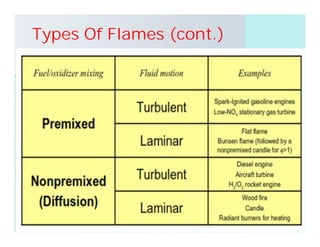
There are two types of flames:
1. Premixed flame.
2. Diffusion flame.
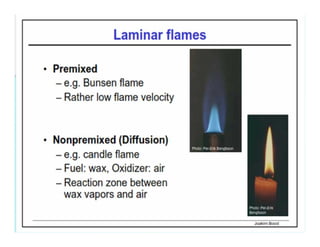
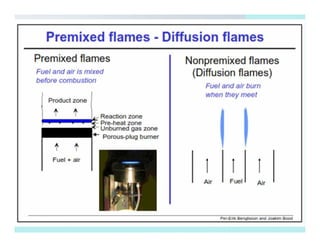
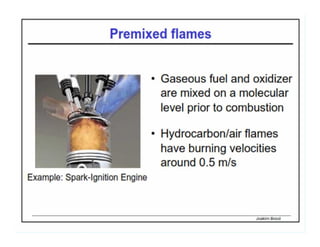
Premixed Flame
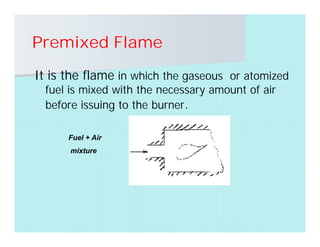
It is the flame in which the gaseous or atomized
fuel is mixed with the necessary amount of air
before issuing to the burner.
Fuel + Air
mixture
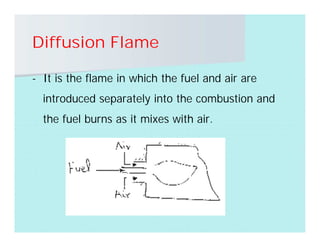
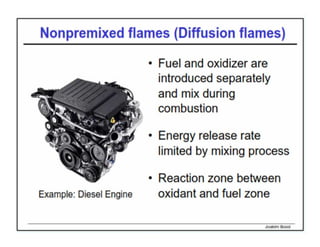
Diffusion Flame
- It is the flame in which the fuel and air are
introduced separately into the combustion and
the fuel burns as it mixes with air.
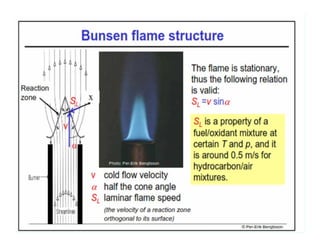
Flame Velocity
or burning velocity su
The flame velocity is the velocity at which the
unburned gases move through the combustion
wave in a direction normal to the wave surface.
The flame velocity depends on:
1. Initial temperature.
2. Pressure.
3. Composition of the gases, ”combustible mixture”.
Premixed
and Diffusion
Flames
Types Of Flames (cont.)
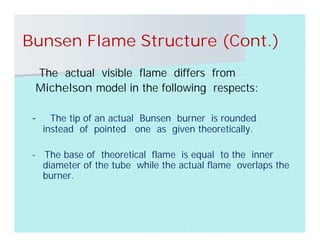
Bunsen Flame Structure (Cont.)
The actual visible flame differs from
Michelson model in the following respects:
- The tip of an actual Bunsen burner is rounded
instead of pointed one as given theoretically.
- The base of theoretical flame is equal to the inner
diameter of the tube while the actual flame overlaps the
burner.
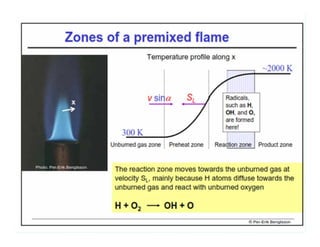
Preheat zone :
•The mass element gains heat by conduction from the
hoter elements down stream faster than it losses heat
to cooler elements up stream.
• little heat evolved.
Reaction zone :
• increased rate of chemical reaction .
• more energy is evolved due to
chemical reaction.
The Structure Of A Laminar
Premixed Flame
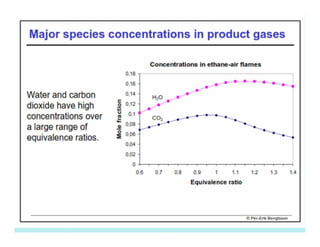
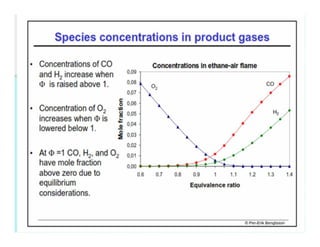
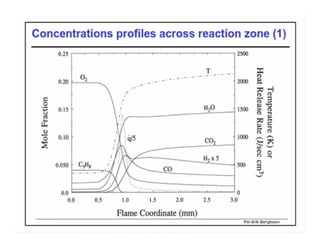
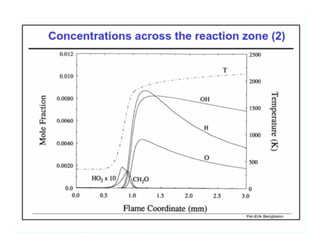
1. Microscopic structure.
Temperature and concentration gradients
across the combustion wave.
2. Macroscopic structure
flame shape.
Factors Affecting The Flame
Shape
The shape of a flame is mainly governed
by two factors :
 The flow pattern of the mixture or
products.
 The quenching effect of the solid
surface.
Theories Of Laminar Flame
Propagation
- The factors which control the rate of
flame propagation :
1. Rate of heat transfer . (from reaction zone to the
adjucent heating zone) .
2. Diffusion of radicals or chain corriers (from the reaction
zone to unburnt gases).
3. Mechanism of reacion.
4. Chemical kinetics.(of individ reacions in the mechanism).
Current theories:
-thermal -diffusion -comprehensive
THERMAL THEORIES
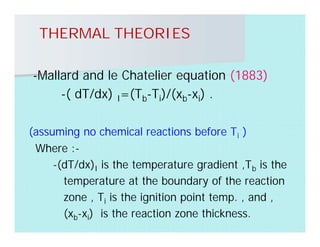
-Mallard and le Chatelier equation (1883)
-( dT/dx) I=(Tb-Ti)/(xb-xi) .
(assuming no chemical reactions before Ti )
Where :-
-(dT/dx)I is the temperature gradient ,Tb is the
temperature at the boundary of the reaction
zone , Ti is the ignition point temp. , and ,
(xb-xi) is the reaction zone thickness.
MALLARD AND LE CHATELIER
EQUATION (CONT..)
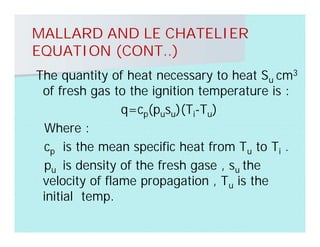
The quantity of heat necessary to heat Su cm3
of fresh gas to the ignition temperature is :
q=cp(pusu)(Ti-Tu)
Where :
cp is the mean specific heat from Tu to Ti .
pu is density of the fresh gase , su the
velocity of flame propagation , Tu is the
initial temp.
MALLARD AND LE CHATELIER
EQUATION (CONT..)
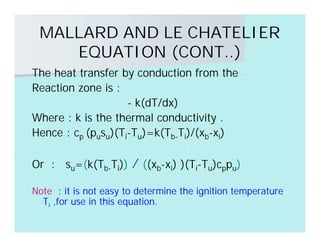
The heat transfer by conduction from the
Reaction zone is :
- k(dT/dx)
Where : k is the thermal conductivity .
Hence : cp (pusu)(Ti-Tu)=k(Tb-Ti)/(xb-xi)
Or : su=(k(Tb-Ti)) / ((xb-xi) )(Ti-Tu)cppu)
Note : it is not easy to determine the ignition temperature
Ti ,for use in this equation.
JOUGUET AND NUSSELT
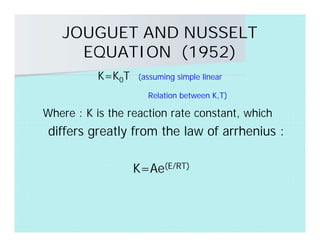
EQUATION (1952)
K=K0T (assuming simple linear
Relation between K,T)
Where : K is the reaction rate constant, which
differs greatly from the law of arrhenius :
K=Ae(E/RT)
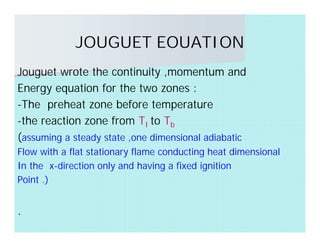
JOUGUET EOUATION
Jouguet wrote the continuity ,momentum and
Energy equation for the two zones :
-The preheat zone before temperature
-the reaction zone from TI to Tb
(assuming a steady state ,one dimensional adiabatic
Flow with a flat stationary flame conducting heat dimensional
In the x-direction only and having a fixed ignition
Point .)
.
JOUGUET EOUATION
(CONT..)
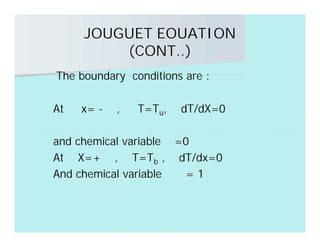
The boundary conditions are :
At x= -∞ , T=Tu, dT/dX=0
and chemical variable α=0
At X=+∞ , T=Tb , dT/dx=0
And chemical variable α = 1
JOUGUET EQUATION
(CONT..1)
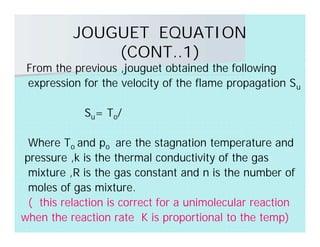
From the previous ,jouguet obtained the following
expression for the velocity of the flame propagation Su
Su= To/
Where To and po are the stagnation temperature and
pressure ,k is the thermal conductivity of the gas
mixture ,R is the gas constant and n is the number of
moles of gas mixture.
( this relaction is correct for a unimolecular reaction
when the reaction rate K is proportional to the temp)
CHARACTEARISTIC OF
DIFFUSION FLAME
Burning rate : is determined by the rate at
which the fuel and oxidizer are brought
together in proper proportion for the reaction.
diffusion flame are used more frequently in
industry.
in diffusion flames the reaction occurs mainly in the
maximum temperature region
Of the flame , but in the premixed flame the reaction
occurs before the maximum temperature is reached.
GASEOUS DIFFUSION
FLAME
Burke and solumann studied the gaseous
diffusion flame in a tube in which the fuel
stream was surrownded by an annular
stream of air , the two streams have the
same initial velocity.
Flame boundary is defined as the
surface at which combustion is complete.
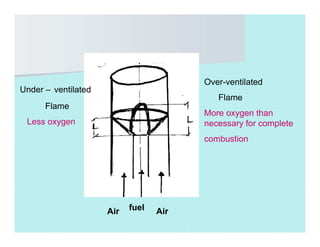
Under – ventilated
Flame
Less oxygen
Over-ventilated
Flame
More oxygen than
necessary for complete
combustion
Air fuel Air
EFFECT OF GASF LOW ON
DIFFUSION FLAME SHAPE
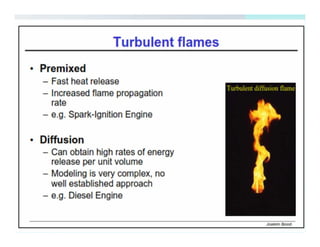
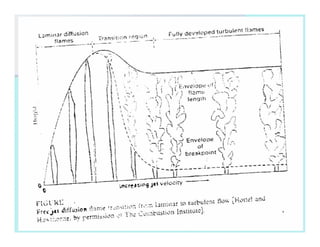
The laminar characteristic of the diffusion
flame changes with increasing the gas flow.
Break point : is defined as the point
where
the laminar stream changes to turbulent .
DIFFRANCE BETWEEN
DIFFUSION FLAMES AND
PREMIXED FLAMES
1- Combustion occurs at the interface between
the fuel gas and oxidant gas .
2- The burning process depends more upon
the rate of mixing than on the rate of chemical
Reactions involved .
SLOW BURNING
DIFFUSION FLAMES
(such as candle flame ; main reaction zone,
c2&cH, and luminous zone)
1-fuel rises slowly and laminar flow ensures.
2-The mixing process occurs solely by
molecular diffusion.
INDUSTRIAL BURNERS
AND GAS TURBINES
CHARATARISTIC
1-Burning is rapid.
2-Flow speeds are high.
3-Mixing process is associated with the
turbulence of the flow.
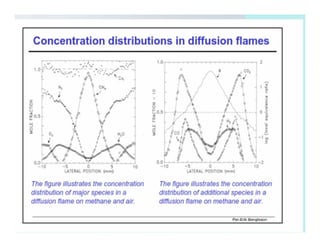
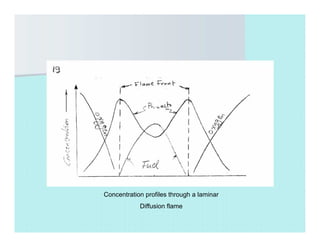
Concentration profiles through a laminar
Diffusion flame
Any Questions
7 flames

7 flames

  • 1.
  • 2.
    1. Definitions. 2. Premixedand diffusion flames. 3. The structure of a laminar flame. Presentation Outline
  • 3.
  • 4.
    Flame  It isa thermal wave in which rapid exothermic chemical reaction occurs and travels with subsonic velocities.  Subsonic flame propagation is also called; deflagration wave.  Luminosity in a flame is not essential but is almost always present.
  • 5.
    Combustible Mixture  Acombustible mixture is one which is capable of propagation a flame indefinitely away from the ignition source.
  • 7.
    Types Of Flames Thereare two types of flames: 1. Premixed flame. 2. Diffusion flame.
  • 8.
    Premixed Flame It isthe flame in which the gaseous or atomized fuel is mixed with the necessary amount of air before issuing to the burner. Fuel + Air mixture
  • 9.
    Diffusion Flame - Itis the flame in which the fuel and air are introduced separately into the combustion and the fuel burns as it mixes with air.
  • 10.
    Flame Velocity or burningvelocity su The flame velocity is the velocity at which the unburned gases move through the combustion wave in a direction normal to the wave surface. The flame velocity depends on: 1. Initial temperature. 2. Pressure. 3. Composition of the gases, ”combustible mixture”.
  • 13.
  • 15.
  • 19.
    Bunsen Flame Structure(Cont.) The actual visible flame differs from Michelson model in the following respects: - The tip of an actual Bunsen burner is rounded instead of pointed one as given theoretically. - The base of theoretical flame is equal to the inner diameter of the tube while the actual flame overlaps the burner.
  • 21.
    Preheat zone : •Themass element gains heat by conduction from the hoter elements down stream faster than it losses heat to cooler elements up stream. • little heat evolved. Reaction zone : • increased rate of chemical reaction . • more energy is evolved due to chemical reaction.
  • 22.
    The Structure OfA Laminar Premixed Flame 1. Microscopic structure. Temperature and concentration gradients across the combustion wave. 2. Macroscopic structure flame shape.
  • 31.
    Factors Affecting TheFlame Shape The shape of a flame is mainly governed by two factors :  The flow pattern of the mixture or products.  The quenching effect of the solid surface.
  • 32.
    Theories Of LaminarFlame Propagation - The factors which control the rate of flame propagation : 1. Rate of heat transfer . (from reaction zone to the adjucent heating zone) . 2. Diffusion of radicals or chain corriers (from the reaction zone to unburnt gases). 3. Mechanism of reacion. 4. Chemical kinetics.(of individ reacions in the mechanism). Current theories: -thermal -diffusion -comprehensive
  • 33.
    THERMAL THEORIES -Mallard andle Chatelier equation (1883) -( dT/dx) I=(Tb-Ti)/(xb-xi) . (assuming no chemical reactions before Ti ) Where :- -(dT/dx)I is the temperature gradient ,Tb is the temperature at the boundary of the reaction zone , Ti is the ignition point temp. , and , (xb-xi) is the reaction zone thickness.
  • 34.
    MALLARD AND LECHATELIER EQUATION (CONT..) The quantity of heat necessary to heat Su cm3 of fresh gas to the ignition temperature is : q=cp(pusu)(Ti-Tu) Where : cp is the mean specific heat from Tu to Ti . pu is density of the fresh gase , su the velocity of flame propagation , Tu is the initial temp.
  • 35.
    MALLARD AND LECHATELIER EQUATION (CONT..) The heat transfer by conduction from the Reaction zone is : - k(dT/dx) Where : k is the thermal conductivity . Hence : cp (pusu)(Ti-Tu)=k(Tb-Ti)/(xb-xi) Or : su=(k(Tb-Ti)) / ((xb-xi) )(Ti-Tu)cppu) Note : it is not easy to determine the ignition temperature Ti ,for use in this equation.
  • 36.
    JOUGUET AND NUSSELT EQUATION(1952) K=K0T (assuming simple linear Relation between K,T) Where : K is the reaction rate constant, which differs greatly from the law of arrhenius : K=Ae(E/RT)
  • 37.
    JOUGUET EOUATION Jouguet wrotethe continuity ,momentum and Energy equation for the two zones : -The preheat zone before temperature -the reaction zone from TI to Tb (assuming a steady state ,one dimensional adiabatic Flow with a flat stationary flame conducting heat dimensional In the x-direction only and having a fixed ignition Point .) .
  • 38.
    JOUGUET EOUATION (CONT..) The boundaryconditions are : At x= -∞ , T=Tu, dT/dX=0 and chemical variable α=0 At X=+∞ , T=Tb , dT/dx=0 And chemical variable α = 1
  • 39.
    JOUGUET EQUATION (CONT..1) From theprevious ,jouguet obtained the following expression for the velocity of the flame propagation Su Su= To/ Where To and po are the stagnation temperature and pressure ,k is the thermal conductivity of the gas mixture ,R is the gas constant and n is the number of moles of gas mixture. ( this relaction is correct for a unimolecular reaction when the reaction rate K is proportional to the temp)
  • 40.
    CHARACTEARISTIC OF DIFFUSION FLAME Burningrate : is determined by the rate at which the fuel and oxidizer are brought together in proper proportion for the reaction. diffusion flame are used more frequently in industry. in diffusion flames the reaction occurs mainly in the maximum temperature region Of the flame , but in the premixed flame the reaction occurs before the maximum temperature is reached.
  • 41.
    GASEOUS DIFFUSION FLAME Burke andsolumann studied the gaseous diffusion flame in a tube in which the fuel stream was surrownded by an annular stream of air , the two streams have the same initial velocity. Flame boundary is defined as the surface at which combustion is complete.
  • 42.
    Under – ventilated Flame Lessoxygen Over-ventilated Flame More oxygen than necessary for complete combustion Air fuel Air
  • 44.
    EFFECT OF GASFLOW ON DIFFUSION FLAME SHAPE The laminar characteristic of the diffusion flame changes with increasing the gas flow. Break point : is defined as the point where the laminar stream changes to turbulent .
  • 45.
    DIFFRANCE BETWEEN DIFFUSION FLAMESAND PREMIXED FLAMES 1- Combustion occurs at the interface between the fuel gas and oxidant gas . 2- The burning process depends more upon the rate of mixing than on the rate of chemical Reactions involved .
  • 46.
    SLOW BURNING DIFFUSION FLAMES (suchas candle flame ; main reaction zone, c2&cH, and luminous zone) 1-fuel rises slowly and laminar flow ensures. 2-The mixing process occurs solely by molecular diffusion.
  • 47.
    INDUSTRIAL BURNERS AND GASTURBINES CHARATARISTIC 1-Burning is rapid. 2-Flow speeds are high. 3-Mixing process is associated with the turbulence of the flow.
  • 48.
    Concentration profiles througha laminar Diffusion flame
  • 49.