PREPARED BY
AFAQ WAJID
+923417288543
The Molecular Origin of Surface
Tension
Imbalance of
intermolecular
forces exists at
the liquid-air
interface
γ la= the surface
tension that
exists at the
liquid-air
interface
Surface Tensions of Pure Liquids
at 293 K
Substance γ / (10-3
N/m)
Acetone 23.7
Benzene 28.8
Carbon
Tetrachloride 27.0
Methylene Iodide 50.8
Water 72.8
Methanol 22.6
n-Hexane 18.4
Alternative Explanation of
Surface Tension
Suppose we have a thin liquid film
suspended on a wire loop as follows
liquid film
expanded
liquid film
dx
dA
f = force needed to move wire
dw = dG = γ dA
l = length
of wire
Measurement of Surface Tension
Early measurements – even pure liquids has been
described as a ‘comedy of errors’
Today – possible to routinely measure the surface
tension of liquids and solutions to an accuracy of +
0.05 mN/m
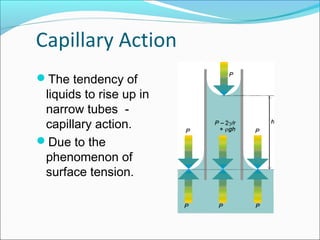
Capillary Action
The tendency of
liquids to rise up in
narrow tubes -
capillary action.
Due to the
phenomenon of
surface tension.
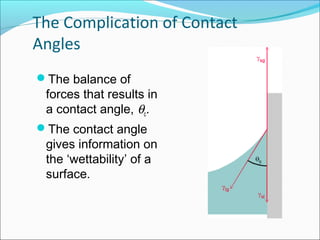
The Complication of Contact
Angles
The balance of
forces that results in
a contact angle, θc.
The contact angle
gives information on
the ‘wettability’ of a
surface.
Capillary Rise
The pressure exerted
by a column of liquid is
balanced by the
hydrostatic pressure.
This gives us one of
the best ways to
measure the surface
tension of pure liquids
and solutions.
r2
gh
ghr2
ρ
=γ
ρ=γ
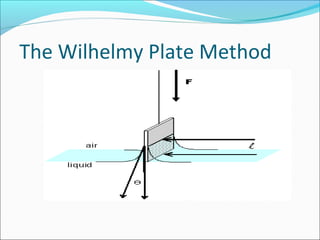
The Wilhelmy Plate Method
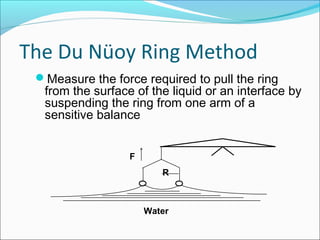
The Du Nüoy Ring Method
Measure the force required to pull the ring
from the surface of the liquid or an interface by
suspending the ring from one arm of a
sensitive balance
Water
F
R
The Correction Factor
The correction factor takes into account of the small
droplets that are pulled up by the ring when it
detaches from the surface
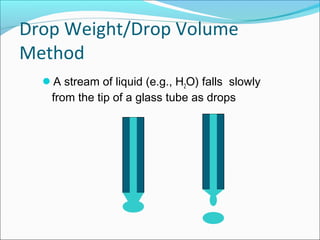
Drop Weight/Drop Volume
Method
A stream of liquid (e.g., H2O) falls slowly
from the tip of a glass tube as drops
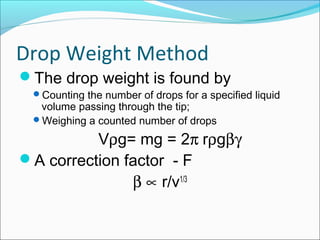
Drop Weight Method
The drop weight is found by
Counting the number of drops for a specified liquid
volume passing through the tip;
Weighing a counted number of drops
Vρg= mg = 2π rρgβγ
A correction factor - F
β ∝ r/v1/3
Sessile Drop Method
The surface tension of a liquid may be
obtained from the shape and size of a sessile
drop resting on a horizontal surface
θe
Surface
Sessile Drop
h
Sessile Drop Method (Cont’d)
Three techniques for obtaining the surface tension
from the image of the sessile drop
Measure the height of the top of a large sessile drop
above its maximum diameter.
Estimate the shape factor of the drop from the
coordinates of the drop profile.
Fit the drop profile to ones that are generated
theoretically.
Drop Profiles
The sessile drop method may also be used to obtain
the value of the equilibrium contact angle.
Contact angle, θe < 90°
θe
The Maximum Bubble Pressure
Method
The maximum pressure required to force a
bubble through a tube is related to the surface
tension of the liquid.
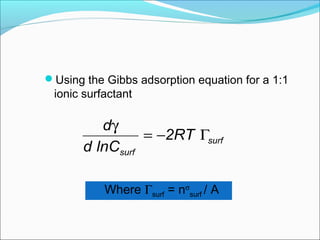
gas stream
b
l
The Bubble Pressure Technique
The maximum bubble pressure is related to
the surface tension of the liquid as follows
P = g l ∆ρ + 2γ / b
∆ρ = the density difference between the liquid and
the vapour
b = radius of curvature at the apex of the bubble
l = hydrostatic height to the bottom of the bubble
g = 9.807 m / s2
The Differential Maximum Bubble
Pressure Method
Two probes of different diameters.
A differential pressure is generated, ∆P.
b2
gas stream
b1
z2
z1
t
The Differential Bubble Pressure
Equations
The maximum bubble pressure is related to the
surface tension of the liquid as follows
∆P = g z1 ∆ρ1 + 2γ / b1 - g z2 ∆ρ2 + 2γ / b2
∆ρ1 = the density difference between the liquid and the
vapour of the first bubble
∆ρ2 = the density difference between the liquid and the
vapour of the second bubble
z1 = the distance from the tip to the bottom, of the first
bubble
z2 = the distance from the tip to the bottom, of the
second bubble
Methods of Measuring Surface
Tension
Method Pure Liquids Solutions
Wilhelmy
Plate
quick and
easy to
operate
Good, suitable
when ageing
occurs
Du Nuöy Ring Satisfactory n/a
Sessile Drop Very Good Good when
surface
ageing occurs
Drop Weight Suitable Poor when
surface
ageing occurs
Capillary
Height
Very Good n/a if θ≠0
Bubble
pressure
Very Good Good when
ageing occurs
Molecular Contributions to an Oil-
water Interfacial Tension
= Oil = water
Oil Phase
Water Phase
γ oil
γwater
(γ oil x γ d
water)1/2
(γ oil x γ d
water)1/2
The Work of Adhesion
Energy required to reversibly pull apart to
form unit surface areas of each of the two
substances.
1221 γγγ −+=adhW
γ 12
γ 1
γ 2
γ 1
γ 1
Wcoh =2 1γ
The Work of Cohesion
 Defined in terms of the energy required to
reversibly separate a column of a pure liquid
to form two (2) new unit surface areas of the
liquid.
The Spreading Coefficient
Substance (usually liquid) already in contact with
another liquid (or solid) spreads
increases the interfacial contact between the first and
second liquid (or the liquid and the solid)
decreases the liquid-vapour interfacial area
Wetting Ability and Contact Angles
Wetting - the displacement of a fluid (e.G., A gas
or a liquid) from one surface by another fluid
Wetting agent - a surfactant which promotes
wetting
Three types of wetting
Spreading wetting
Immersional wetting
Adhesional wetting
A spreading drop → θe < 90°
θe
Solid Surfaces/Different Contact
Angles
Examine the following two surfaces.
A drop with a contact angle << 90°
θe
The Derivation of Young’s
Equation
γ la
γ sa
γ lsθe
change in the liquid-solid
interfacial area = dA
dA
θe
change in the solid-air
interfacial area = - dA
change in the liquid-air
interfacial area = dA Cos θe
Young’s Equation
For a liquid (as a drop or at at the surface of a
capillary) making a contact angle θc with the solid
surface
claslsa Cosθγ+γ=γ
=Cos
la
slsa
c
γ
γ−γ
θ
Immersional Wetting
Immerse a solid substance in a pure liquid or
solution
area of the solid-air interface decreases
interfacial contact between solid and liquid is
increased
solid particle
Water
γ sa
immersed
solid particle
γ sl
Surfactants
What is a surfactant?
Surface active agent
Headgroup Tail
Heads or Tails?
Headgroup – hydrophilic functional group(s)
Tail – hydrocarbon or fluorocarbon chain
Typical headgroups (charged or uncharged)
Sulfate
Sulfonate
Trimethylammonium
Ethylene oxide
carboxybetaine
Properties of Surfactant
Molecules
Aggregate at various interfaces due to the
hydrophobic effect
Air-water interface
Oil-water interface
Form aggregates in solution called micelles at a
specific concentration of surfactant called the
critical micelle concentration (the cmc)
Micellar aggregates are known as association colloids
Applications of Surfactants
Surfactants are an integral part of everyday life;
they are formulated into a wide variety of
consumer products
Shampoos
Dish detergents
Laundry detergents
Conditioners
Fabric softeners
Diapers
Contact lens cleaners
Applications of Surfactants
(Cont’d)
Surfactants are also widely used in industry due
to their ability to lower surface and interfacial
tensions and act as wetting agents and
detergents
Heavy and tertiary oil recovery
Ore flotation
Dry cleaning
Pesticide and herbicide applications
Water repellency
Interfacial Properties of Surfactant
Molecules
Surfactants – used in a large number of applications
due to their ability to lower the surface and interfacial
tension
Gibbs energy change to create a surface of area dA
dG = γ dA
Using the Gibbs adsorption equation for a 1:1
ionic surfactant
surf
surf
2RT
lnCd
d
Γ−=
γ
Where Γsurf = nσ
surf / A
Surfactants and Detergents
Detergency - the theory and practice of soil
removal from solid surfaces by chemical means
Early detergents
Ancient Egypt - boiled animal fat and wood ashes to
make soap
Past thirty years
Made significant progress in our understanding of
detergency on a molecular level

surface tension

  • 1.
  • 2.
    The Molecular Originof Surface Tension Imbalance of intermolecular forces exists at the liquid-air interface γ la= the surface tension that exists at the liquid-air interface
  • 3.
    Surface Tensions ofPure Liquids at 293 K Substance γ / (10-3 N/m) Acetone 23.7 Benzene 28.8 Carbon Tetrachloride 27.0 Methylene Iodide 50.8 Water 72.8 Methanol 22.6 n-Hexane 18.4
  • 4.
    Alternative Explanation of SurfaceTension Suppose we have a thin liquid film suspended on a wire loop as follows liquid film expanded liquid film dx dA f = force needed to move wire dw = dG = γ dA l = length of wire
  • 5.
    Measurement of SurfaceTension Early measurements – even pure liquids has been described as a ‘comedy of errors’ Today – possible to routinely measure the surface tension of liquids and solutions to an accuracy of + 0.05 mN/m
  • 6.
    Capillary Action The tendencyof liquids to rise up in narrow tubes - capillary action. Due to the phenomenon of surface tension.
  • 7.
    The Complication ofContact Angles The balance of forces that results in a contact angle, θc. The contact angle gives information on the ‘wettability’ of a surface.
  • 8.
    Capillary Rise The pressureexerted by a column of liquid is balanced by the hydrostatic pressure. This gives us one of the best ways to measure the surface tension of pure liquids and solutions. r2 gh ghr2 ρ =γ ρ=γ
  • 9.
  • 10.
    The Du NüoyRing Method Measure the force required to pull the ring from the surface of the liquid or an interface by suspending the ring from one arm of a sensitive balance Water F R
  • 11.
    The Correction Factor Thecorrection factor takes into account of the small droplets that are pulled up by the ring when it detaches from the surface
  • 12.
    Drop Weight/Drop Volume Method Astream of liquid (e.g., H2O) falls slowly from the tip of a glass tube as drops
  • 13.
    Drop Weight Method Thedrop weight is found by Counting the number of drops for a specified liquid volume passing through the tip; Weighing a counted number of drops Vρg= mg = 2π rρgβγ A correction factor - F β ∝ r/v1/3
  • 14.
    Sessile Drop Method Thesurface tension of a liquid may be obtained from the shape and size of a sessile drop resting on a horizontal surface θe Surface Sessile Drop h
  • 15.
    Sessile Drop Method(Cont’d) Three techniques for obtaining the surface tension from the image of the sessile drop Measure the height of the top of a large sessile drop above its maximum diameter. Estimate the shape factor of the drop from the coordinates of the drop profile. Fit the drop profile to ones that are generated theoretically.
  • 16.
    Drop Profiles The sessiledrop method may also be used to obtain the value of the equilibrium contact angle. Contact angle, θe < 90° θe
  • 17.
    The Maximum BubblePressure Method The maximum pressure required to force a bubble through a tube is related to the surface tension of the liquid. gas stream b l
  • 18.
    The Bubble PressureTechnique The maximum bubble pressure is related to the surface tension of the liquid as follows P = g l ∆ρ + 2γ / b ∆ρ = the density difference between the liquid and the vapour b = radius of curvature at the apex of the bubble l = hydrostatic height to the bottom of the bubble g = 9.807 m / s2
  • 19.
    The Differential MaximumBubble Pressure Method Two probes of different diameters. A differential pressure is generated, ∆P. b2 gas stream b1 z2 z1 t
  • 20.
    The Differential BubblePressure Equations The maximum bubble pressure is related to the surface tension of the liquid as follows ∆P = g z1 ∆ρ1 + 2γ / b1 - g z2 ∆ρ2 + 2γ / b2 ∆ρ1 = the density difference between the liquid and the vapour of the first bubble ∆ρ2 = the density difference between the liquid and the vapour of the second bubble z1 = the distance from the tip to the bottom, of the first bubble z2 = the distance from the tip to the bottom, of the second bubble
  • 21.
    Methods of MeasuringSurface Tension Method Pure Liquids Solutions Wilhelmy Plate quick and easy to operate Good, suitable when ageing occurs Du Nuöy Ring Satisfactory n/a Sessile Drop Very Good Good when surface ageing occurs Drop Weight Suitable Poor when surface ageing occurs Capillary Height Very Good n/a if θ≠0 Bubble pressure Very Good Good when ageing occurs
  • 22.
    Molecular Contributions toan Oil- water Interfacial Tension = Oil = water Oil Phase Water Phase γ oil γwater (γ oil x γ d water)1/2 (γ oil x γ d water)1/2
  • 23.
    The Work ofAdhesion Energy required to reversibly pull apart to form unit surface areas of each of the two substances. 1221 γγγ −+=adhW γ 12 γ 1 γ 2
  • 24.
    γ 1 γ 1 Wcoh=2 1γ The Work of Cohesion  Defined in terms of the energy required to reversibly separate a column of a pure liquid to form two (2) new unit surface areas of the liquid.
  • 25.
    The Spreading Coefficient Substance(usually liquid) already in contact with another liquid (or solid) spreads increases the interfacial contact between the first and second liquid (or the liquid and the solid) decreases the liquid-vapour interfacial area
  • 26.
    Wetting Ability andContact Angles Wetting - the displacement of a fluid (e.G., A gas or a liquid) from one surface by another fluid Wetting agent - a surfactant which promotes wetting Three types of wetting Spreading wetting Immersional wetting Adhesional wetting
  • 27.
    A spreading drop→ θe < 90° θe Solid Surfaces/Different Contact Angles Examine the following two surfaces.
  • 28.
    A drop witha contact angle << 90° θe
  • 29.
    The Derivation ofYoung’s Equation γ la γ sa γ lsθe change in the liquid-solid interfacial area = dA dA θe change in the solid-air interfacial area = - dA change in the liquid-air interfacial area = dA Cos θe
  • 30.
    Young’s Equation For aliquid (as a drop or at at the surface of a capillary) making a contact angle θc with the solid surface claslsa Cosθγ+γ=γ =Cos la slsa c γ γ−γ θ
  • 31.
    Immersional Wetting Immerse asolid substance in a pure liquid or solution area of the solid-air interface decreases interfacial contact between solid and liquid is increased solid particle Water γ sa immersed solid particle γ sl
  • 32.
    Surfactants What is asurfactant? Surface active agent Headgroup Tail
  • 33.
    Heads or Tails? Headgroup– hydrophilic functional group(s) Tail – hydrocarbon or fluorocarbon chain Typical headgroups (charged or uncharged) Sulfate Sulfonate Trimethylammonium Ethylene oxide carboxybetaine
  • 34.
    Properties of Surfactant Molecules Aggregateat various interfaces due to the hydrophobic effect Air-water interface Oil-water interface Form aggregates in solution called micelles at a specific concentration of surfactant called the critical micelle concentration (the cmc) Micellar aggregates are known as association colloids
  • 35.
    Applications of Surfactants Surfactantsare an integral part of everyday life; they are formulated into a wide variety of consumer products Shampoos Dish detergents Laundry detergents Conditioners Fabric softeners Diapers Contact lens cleaners
  • 36.
    Applications of Surfactants (Cont’d) Surfactantsare also widely used in industry due to their ability to lower surface and interfacial tensions and act as wetting agents and detergents Heavy and tertiary oil recovery Ore flotation Dry cleaning Pesticide and herbicide applications Water repellency
  • 37.
    Interfacial Properties ofSurfactant Molecules Surfactants – used in a large number of applications due to their ability to lower the surface and interfacial tension Gibbs energy change to create a surface of area dA dG = γ dA
  • 38.
    Using the Gibbsadsorption equation for a 1:1 ionic surfactant surf surf 2RT lnCd d Γ−= γ Where Γsurf = nσ surf / A
  • 39.
    Surfactants and Detergents Detergency- the theory and practice of soil removal from solid surfaces by chemical means Early detergents Ancient Egypt - boiled animal fat and wood ashes to make soap Past thirty years Made significant progress in our understanding of detergency on a molecular level