Slide 1
Radiation-Driven Flame Extinction in Fires
Praveen Narayanan, Vivien Lecoustre
& Arnaud Trouvé
Department of Fire Protection Engineering
University of Maryland, College Park, MD 20742
• Sponsors: National Science Foundation Office of
Cyberinfrastructure (PetaApps Program); and DOE Office of
Science (INCITE - Innovative and Novel Computational Impact
on Theory and Experiment – Program).
Slide 2
• Motivation:
Combustion science
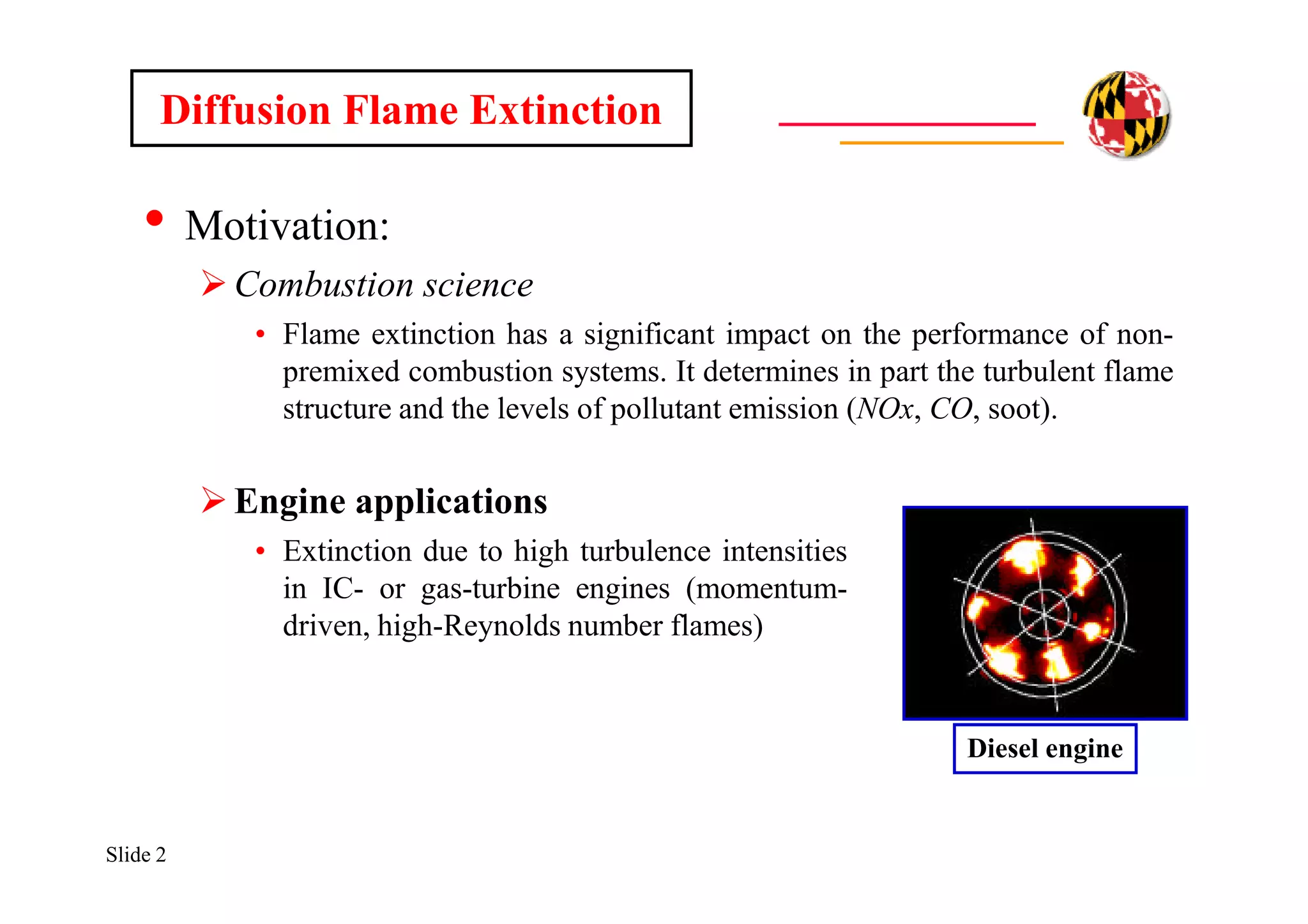
• Flame extinction has a significant impact on the performance of non-
premixed combustion systems. It determines in part the turbulent flame
structure and the levels of pollutant emission (NOx, CO, soot).
Diesel engine
Engine applications
• Extinction due to high turbulence intensities
in IC- or gas-turbine engines (momentum-
driven, high-Reynolds number flames)
Diffusion Flame Extinction
Slide 3
• Motivation:
Fire applications
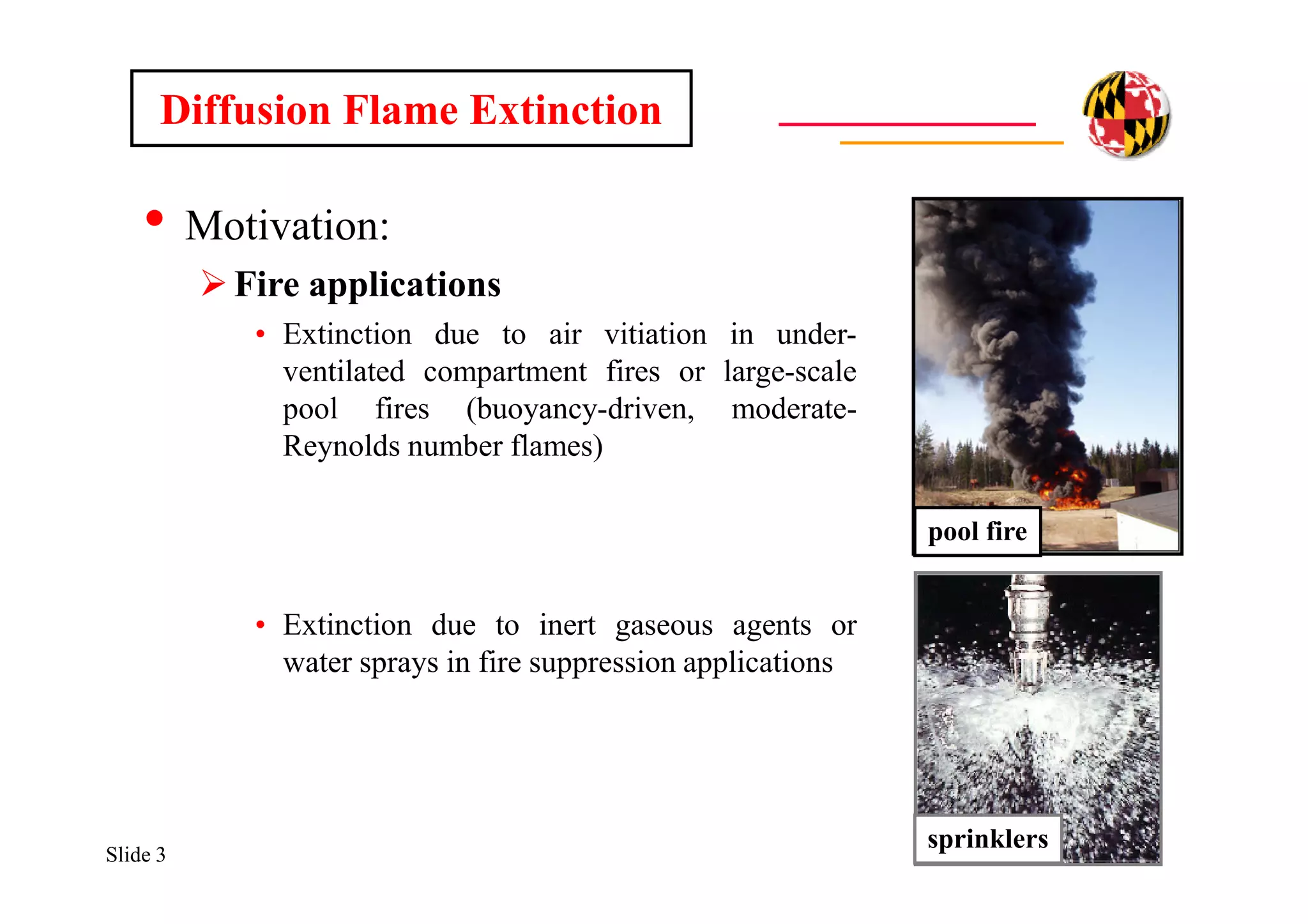
• Extinction due to air vitiation in under-
ventilated compartment fires or large-scale
pool fires (buoyancy-driven, moderate-
Reynolds number flames)
• Extinction due to inert gaseous agents or
water sprays in fire suppression applications
pool fire
sprinklers
Diffusion Flame Extinction
Slide 4
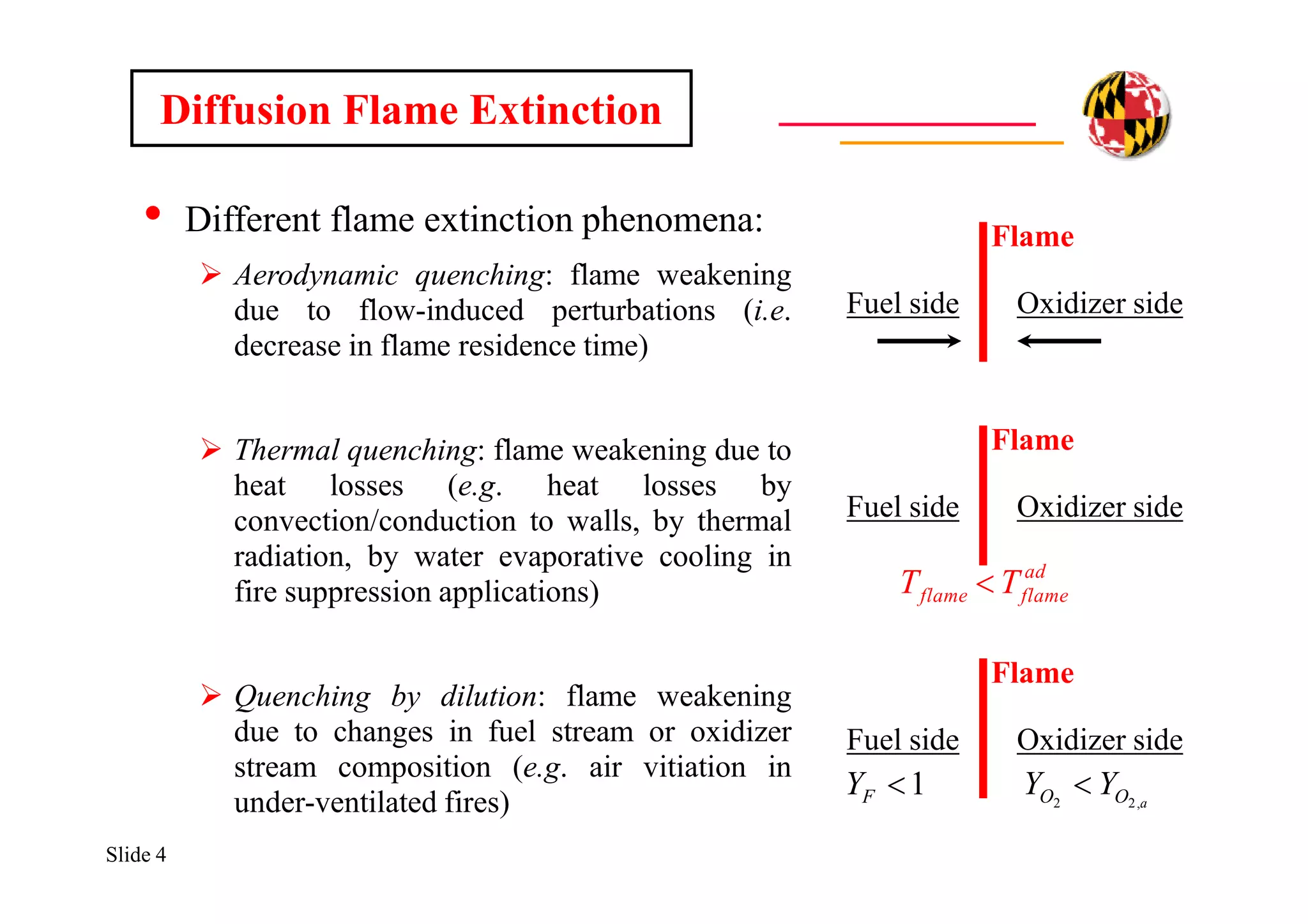
• Different flame extinction phenomena:
 Aerodynamic quenching: flame weakening
due to flow-induced perturbations (i.e.
decrease in flame residence time)
 Thermal quenching: flame weakening due to
heat losses (e.g. heat losses by
convection/conduction to walls, by thermal
radiation, by water evaporative cooling in
fire suppression applications)
 Quenching by dilution: flame weakening
due to changes in fuel stream or oxidizer
stream composition (e.g. air vitiation in
under-ventilated fires)
Diffusion Flame Extinction
Fuel side Oxidizer side
Flame
aOO YY ,22
1FY
Fuel side Oxidizer side
Flame
ad
flameflame TT 
Fuel side Oxidizer side
Flame
Slide 5
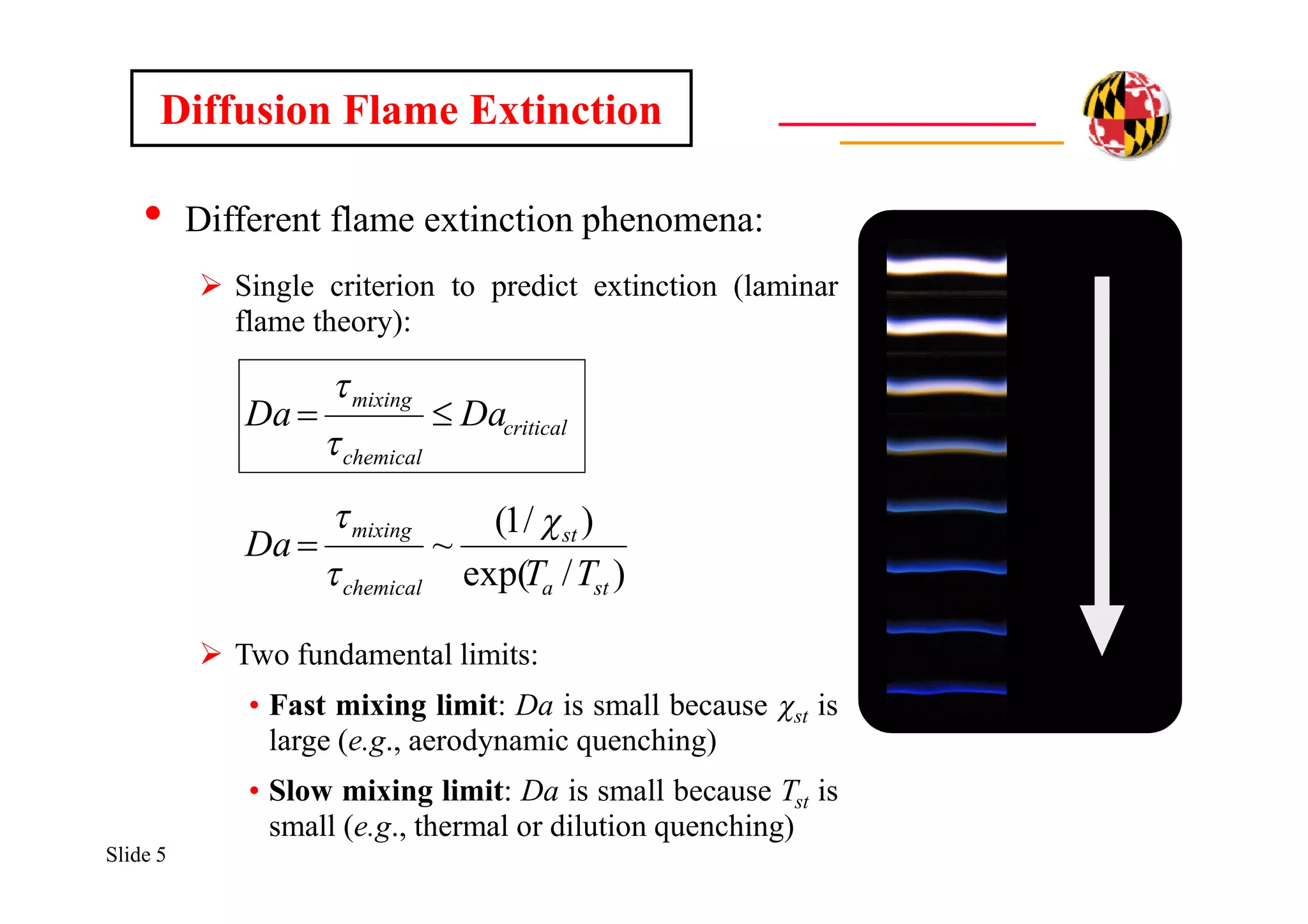
• Different flame extinction phenomena:
 Single criterion to predict extinction (laminar
flame theory):
 Two fundamental limits:
• Fast mixing limit: Da is small because cst is
large (e.g., aerodynamic quenching)
• Slow mixing limit: Da is small because Tst is
small (e.g., thermal or dilution quenching)
Diffusion Flame Extinction
critical
chemical
mixing
DaDa 


)/exp(
)/1(
~
sta
st
chemical
mixing
TT
Da




Slide 6
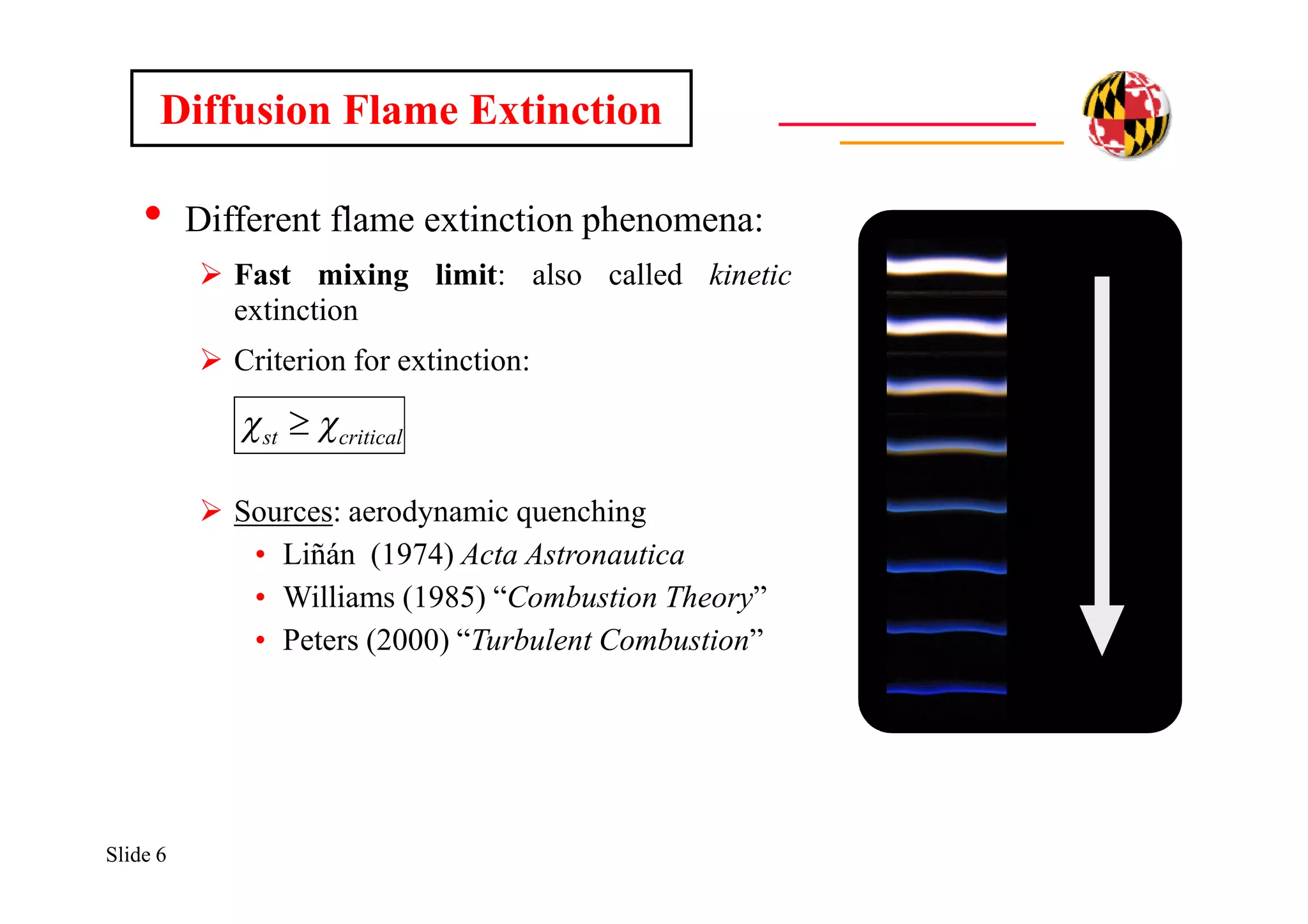
• Different flame extinction phenomena:
 Fast mixing limit: also called kinetic
extinction
 Criterion for extinction:
 Sources: aerodynamic quenching
• Liñán (1974) Acta Astronautica
• Williams (1985) “Combustion Theory”
• Peters (2000) “Turbulent Combustion”
Diffusion Flame Extinction
criticalst  
Slide 7
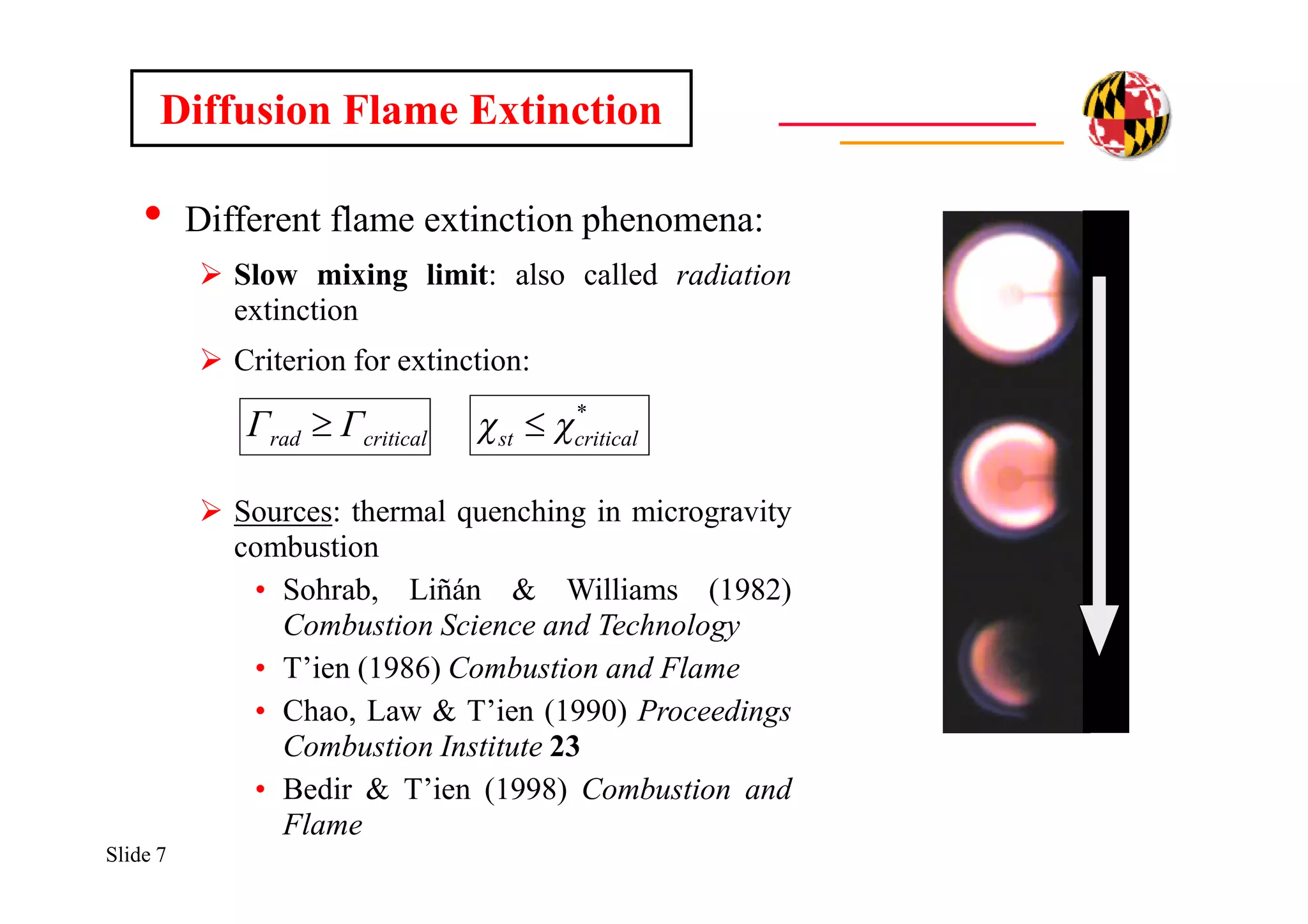
• Different flame extinction phenomena:
 Slow mixing limit: also called radiation
extinction
 Criterion for extinction:
 Sources: thermal quenching in microgravity
combustion
• Sohrab, Liñán & Williams (1982)
Combustion Science and Technology
• T’ien (1986) Combustion and Flame
• Chao, Law & T’ien (1990) Proceedings
Combustion Institute 23
• Bedir & T’ien (1998) Combustion and
Flame
Diffusion Flame Extinction
criticalrad ΓΓ  *
criticalst  
Slide 8
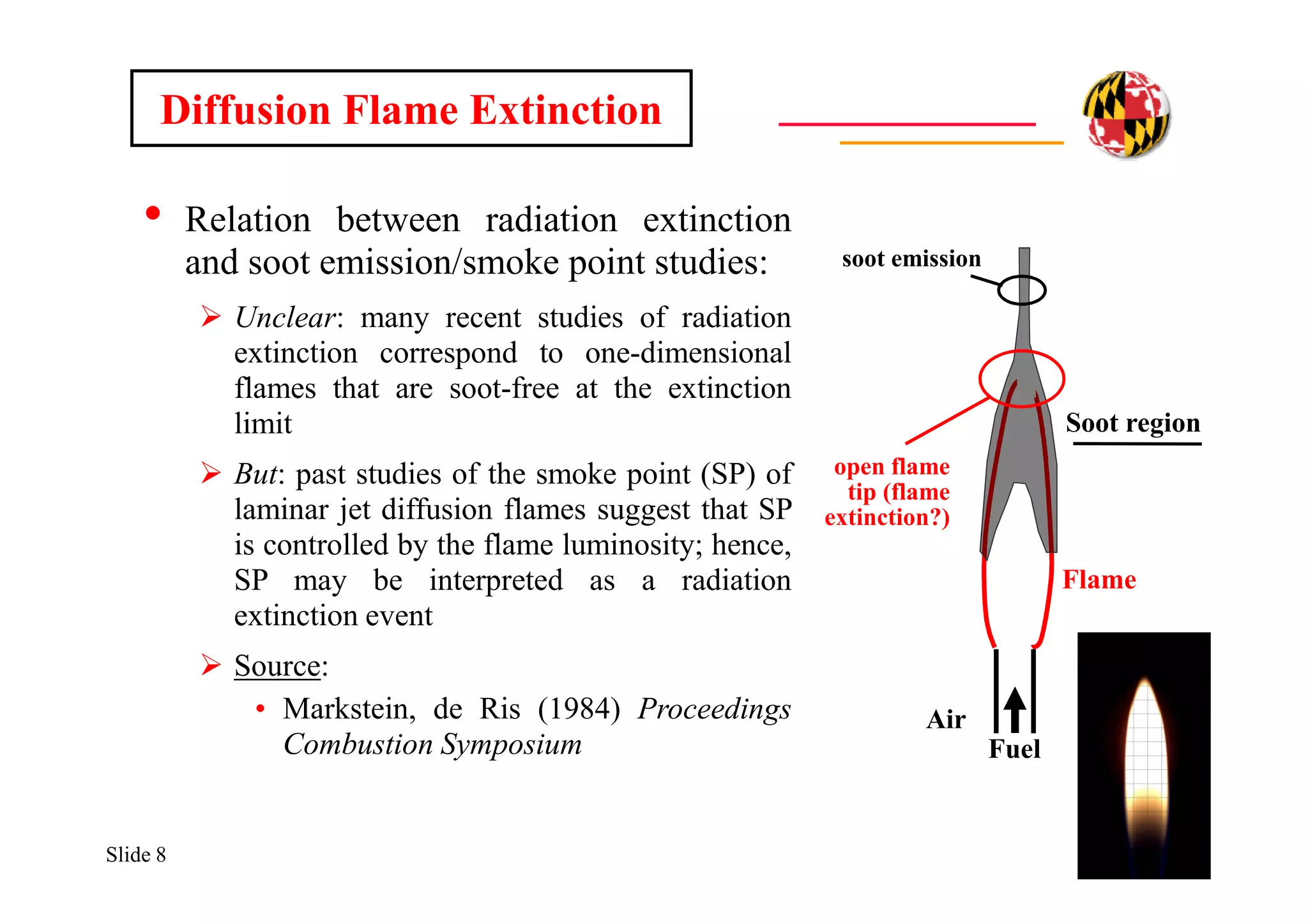
• Relation between radiation extinction
and soot emission/smoke point studies:
 Unclear: many recent studies of radiation
extinction correspond to one-dimensional
flames that are soot-free at the extinction
limit
 But: past studies of the smoke point (SP) of
laminar jet diffusion flames suggest that SP
is controlled by the flame luminosity; hence,
SP may be interpreted as a radiation
extinction event
 Source:
• Markstein, de Ris (1984) Proceedings
Combustion Symposium
Diffusion Flame Extinction
Fuel
Air Air
Flame
Soot region
open flame
tip (flame
extinction?)
soot emission
Slide 9
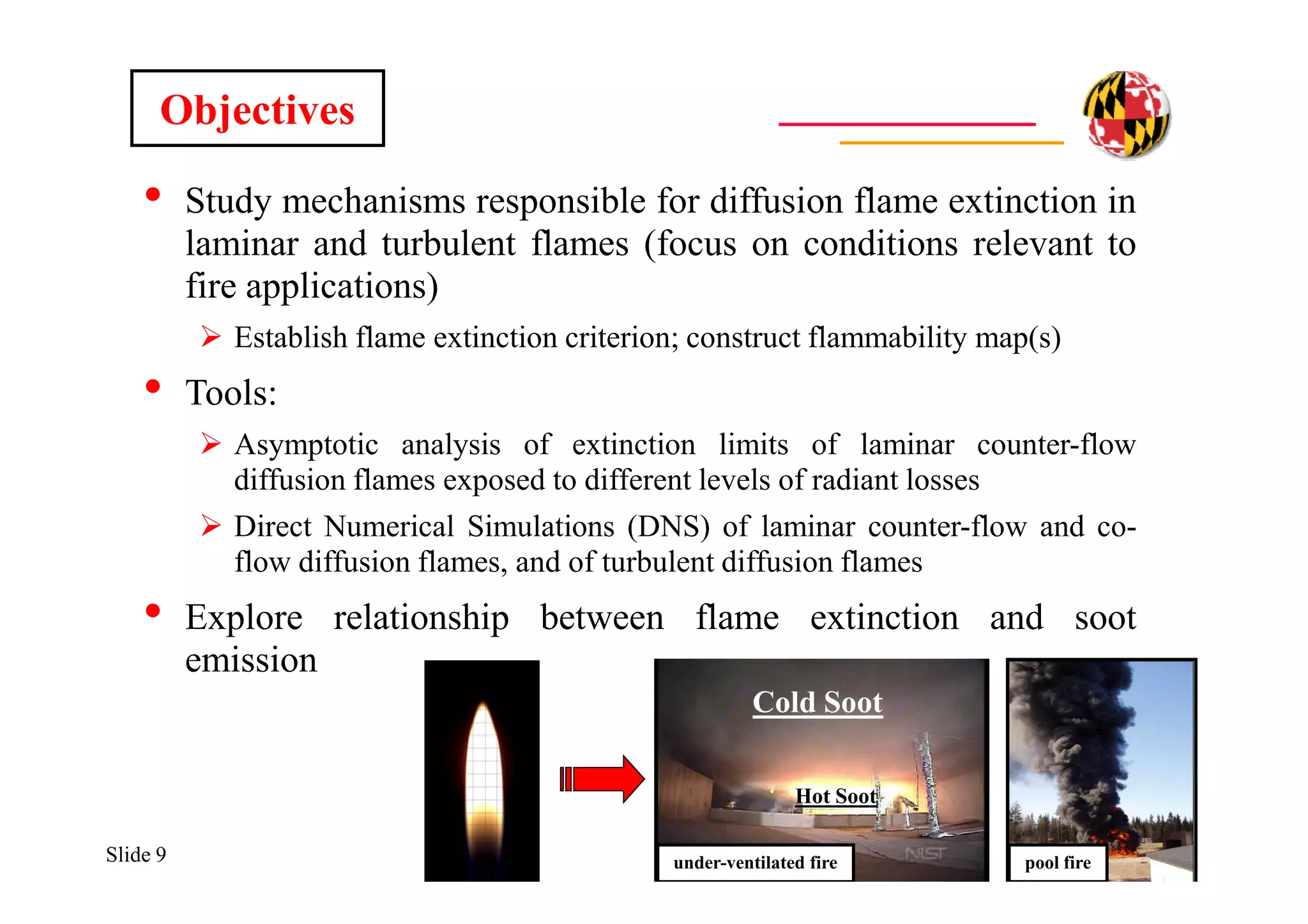
• Study mechanisms responsible for diffusion flame extinction in
laminar and turbulent flames (focus on conditions relevant to
fire applications)
 Establish flame extinction criterion; construct flammability map(s)
• Tools:
 Asymptotic analysis of extinction limits of laminar counter-flow
diffusion flames exposed to different levels of radiant losses
 Direct Numerical Simulations (DNS) of laminar counter-flow and co-
flow diffusion flames, and of turbulent diffusion flames
• Explore relationship between flame extinction and soot
emission
Objectives
pool fire
Cold Soot
Hot Soot
under-ventilated fire
Slide 10
• Use direct numerical simulation (DNS)
 Leverage DOE-sponsored SciDAC collaboration on DNS solver called
S3D – Sandia Ntl. Laboratories (J.H. Chen), Univ. Michigan (H.G. Im)
• DNS solver S3D
 Navier-Stokes solver; fully compressible flow formulation
 High-order methods: 8th order finite difference; 4th order explicit
Runge-Kutta time integrator
 Characteristic-based boundary condition treatment (NSCBC)
 Structured Cartesian grids
 Parallel (MPI-based, excellent scalability)
 Flame modeling: detailed fuel-air chemistry (CHEMKIN-compatible);
simplified soot formation model; thermal radiation model (Discrete
Ordinate/Discrete Transfer Methods); Lagrangian particle model to
describe dilute liquid sprays
Numerical approach
Slide 11
Flame Modeling
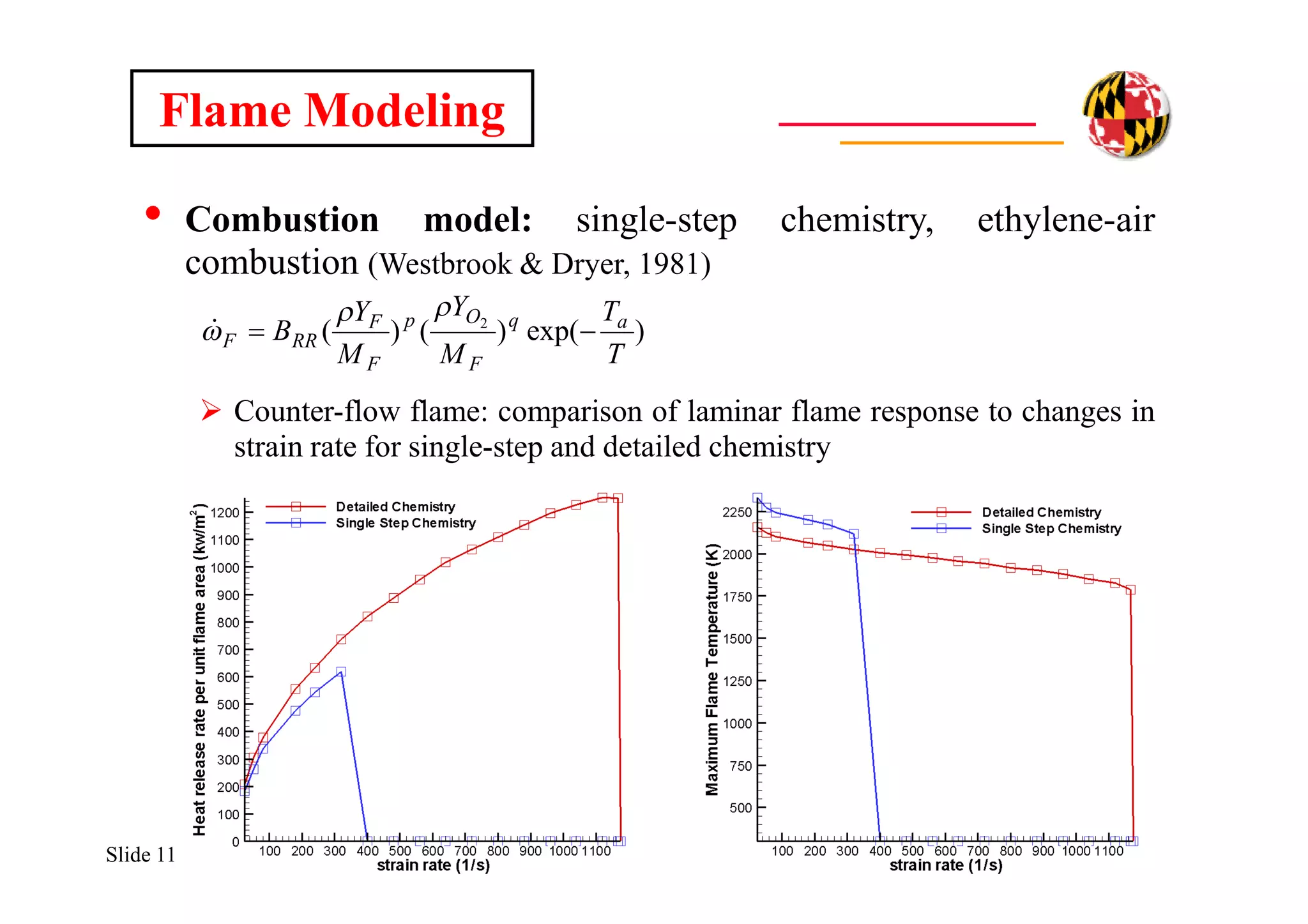
• Combustion model: single-step chemistry, ethylene-air
combustion (Westbrook & Dryer, 1981)
 Counter-flow flame: comparison of laminar flame response to changes in
strain rate for single-step and detailed chemistry
)exp()()( 2
T
T
M
Y
M
Y
B aq
F
Op
F
F
RRF 


Slide 12
Flame Modeling
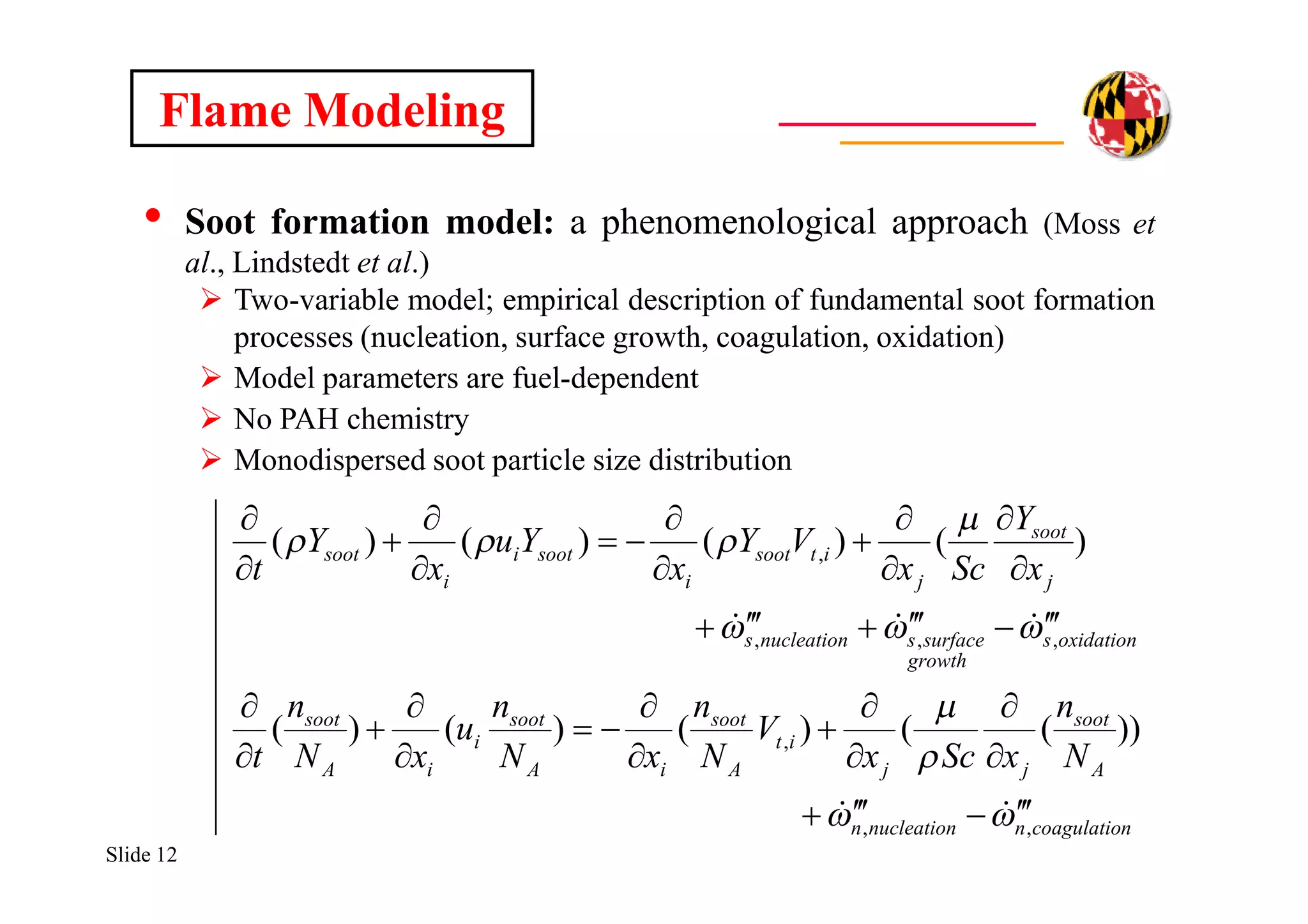
• Soot formation model: a phenomenological approach (Moss et
al., Lindstedt et al.)
 Two-variable model; empirical description of fundamental soot formation
processes (nucleation, surface growth, coagulation, oxidation)
 Model parameters are fuel-dependent
 No PAH chemistry
 Monodispersed soot particle size distribution
ncoagulationnucleationn
A
soot
jj
it
A
soot
iA
soot
i
iA
soot
oxidations
growth
surfacesnucleations
j
soot
j
itsoot
i
sooti
i
soot
N
n
xScx
V
N
n
xN
n
u
xN
n
t
x
Y
Scx
VY
x
Yu
x
Y
t
,,
,
,,,
,
))(()()()(
)()()()(




































Slide 13
Flame Modeling
• Thermal radiation transport model: non-scattering, gray gas
assumption; Discrete Transfer Method (Lockwood & Shah, 1981)
 Radiative transfer equation
 Mean absorption coefficient [m-1]
• ap,i is the Planck mean absorption coefficient for species i [m-1 atm-1]
and is obtained from tabulated data (TNF Workshop web site)
• ksoot is the soot mean absorption coefficient [m-1]

AbsorptionEmission
4
)/( IT
ds
dI
 

sootCOCOOHOH axaxp   )( 2222
-1-1
Km1817sootCTYCTfC sootsootsootvsootsoot )/(  
Slide 14
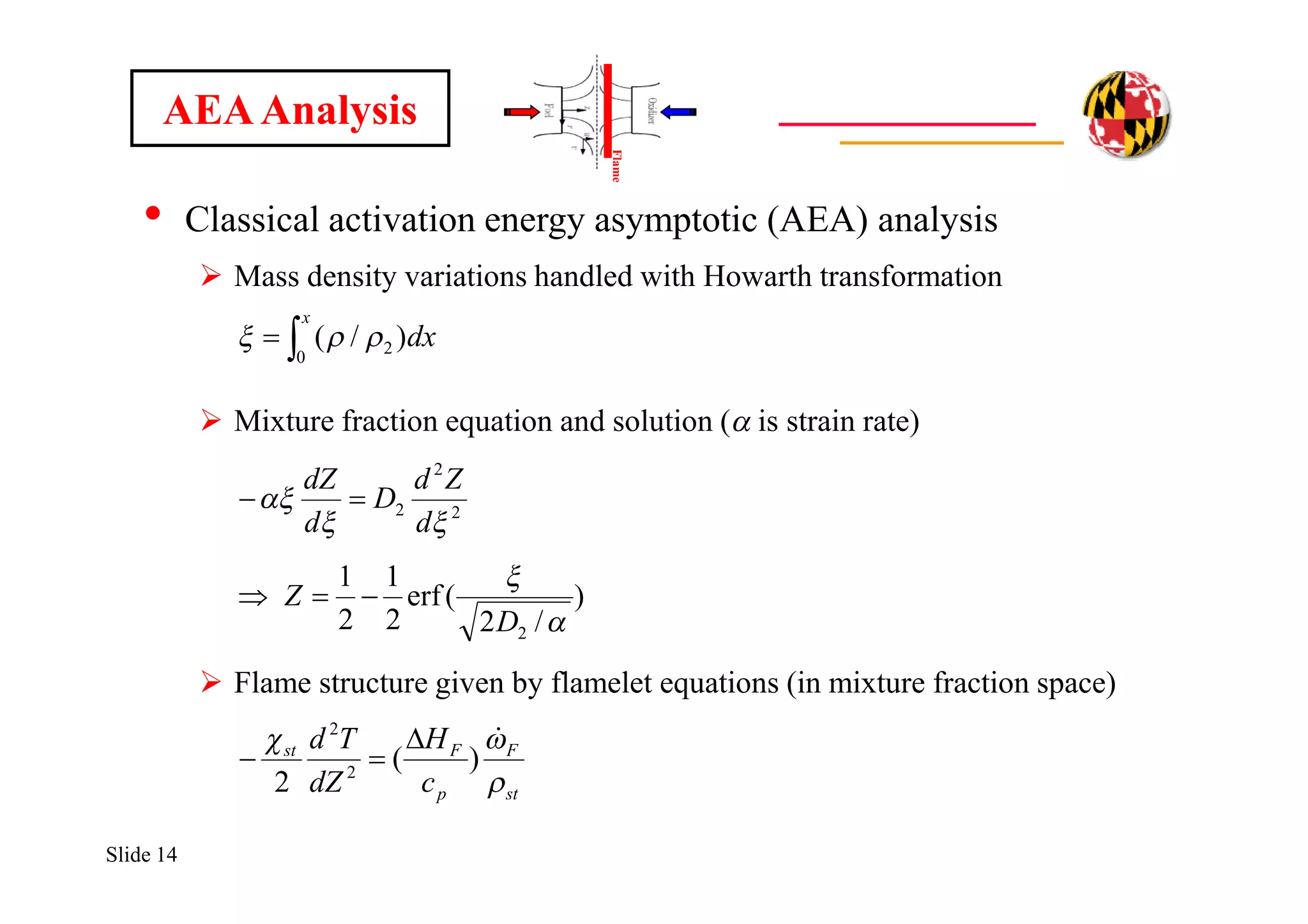
• Classical activation energy asymptotic (AEA) analysis
 Mass density variations handled with Howarth transformation
 Mixture fraction equation and solution (a is strain rate)
 Flame structure given by flamelet equations (in mixture fraction space)

x
dx
0
2 )/( 
st
F
p
Fst
c
H
dZ
Td

 
)(
2 2
2


AEAAnalysis
)
/2
(erf
2
1
2
1
2 

D
Z 
2
2
2


d
Zd
D
d
dZ

Flame
Slide 15
• Classical decomposition into inner/outer layers
 Perform asymptotic expansion in terms of small parameter e
 Inner layer problem
AEAAnalysis
)exp(]
)1(
[][
)(;)()(
2
2
221,












q
st
stp
st
p
FF
st
Z
Z
d
d
OZZO
c
YH
TT
(d is a reduced Damkohler number)
)(
)(1
1,
2
FF
p
a
st
YH
c
T
T
Ze 

)1/()/(;1)/( stst ZZdddd    
Slide 16
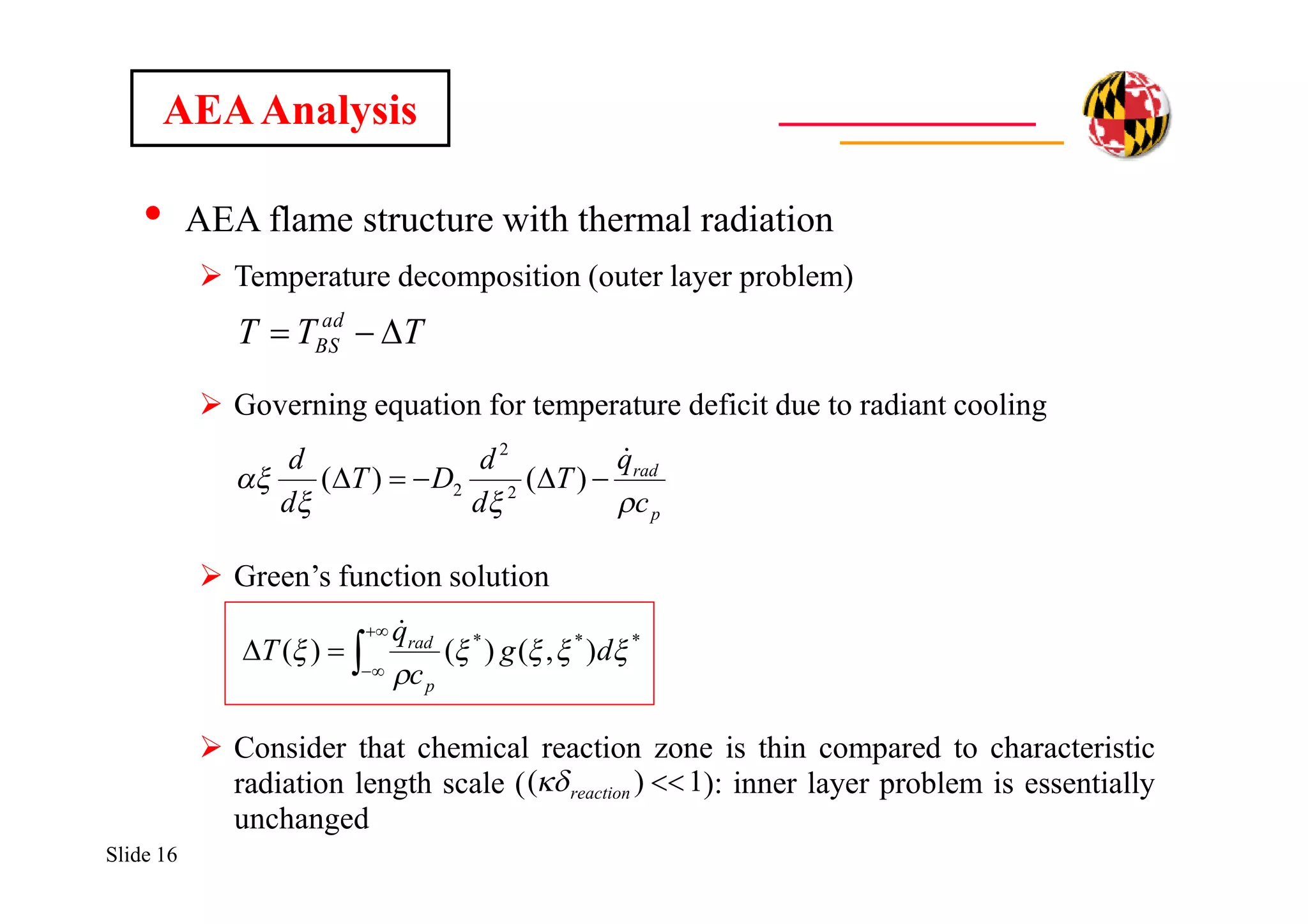
• AEA flame structure with thermal radiation
 Temperature decomposition (outer layer problem)
 Governing equation for temperature deficit due to radiant cooling
 Green’s function solution
 Consider that chemical reaction zone is thin compared to characteristic
radiation length scale ( ): inner layer problem is essentially
unchanged
AEAAnalysis
TTT ad
BS 
p
rad
c
q
T
d
d
DT
d
d



 )()( 2
2
2
1)( reaction



 ***
),()()( 

 dg
c
q
T
p
rad

Slide 17
• AEA flame structure with thermal radiation
 Green’s function solution
 Emitting/absorbing medium (spectrally-averaged gray)
Planck mean aborption coefficient:
Analytical expression for G (as a function of optical depth t):
AEAAnalysis
)4( 4
GTqrad  



 ***
),()()( 

 dg
c
q
T
p
rad

TfCaxaxp vsootOHOHCOCO  )( 2222

]')'()'(')'()'(
)()([2
1
0
1
22,21,
 

R
dEIdEI
EIEIG
bb
Rbb





Slide 18
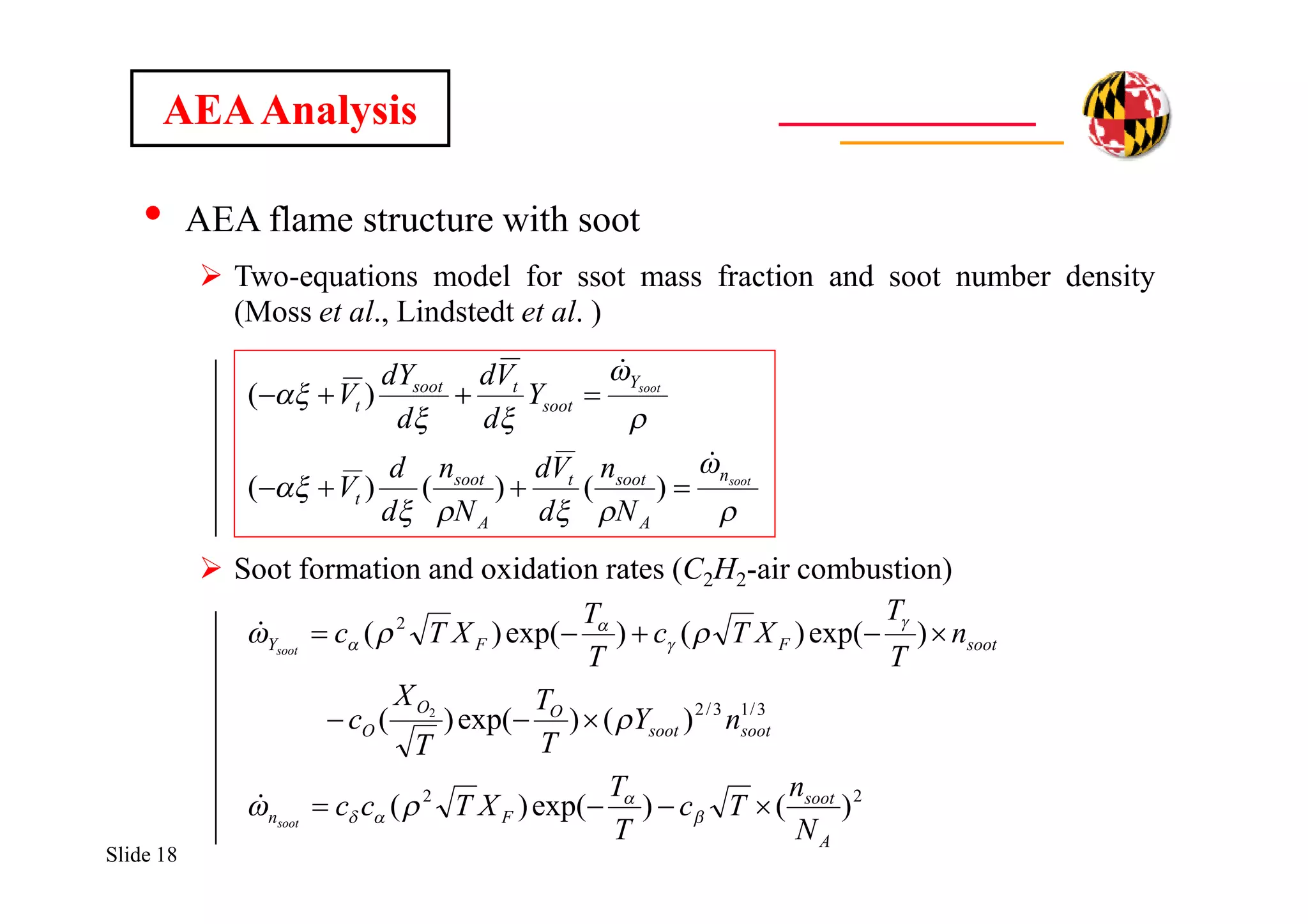
• AEA flame structure with soot
 Two-equations model for ssot mass fraction and soot number density
(Moss et al., Lindstedt et al. )
 Soot formation and oxidation rates (C2H2-air combustion)
AEAAnalysis








soot
soot
n
A
soott
A
soot
t
Y
soot
tsoot
t
N
n
d
Vd
N
n
d
d
V
Y
d
Vd
d
dY
V




)()()(
)(
22
3/13/2
2
)()exp()(
)()exp()(
)exp()()exp()(
2
A
soot
Fn
sootsoot
OO
O
sootFFY
N
n
Tc
T
T
XTcc
nY
T
T
T
X
c
n
T
T
XTc
T
T
XTc
soot
soot















Slide 19
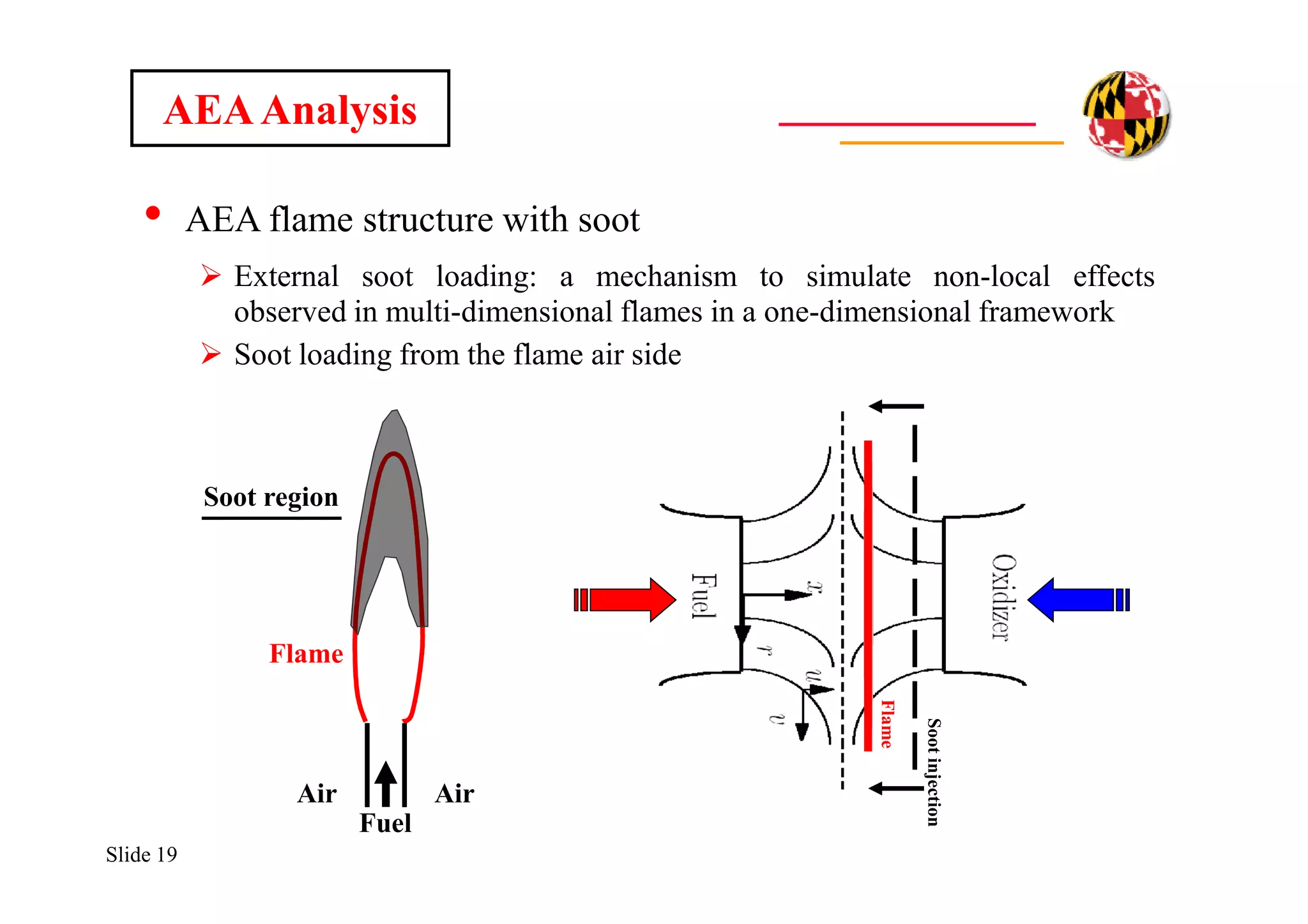
• AEA flame structure with soot
 External soot loading: a mechanism to simulate non-local effects
observed in multi-dimensional flames in a one-dimensional framework
 Soot loading from the flame air side
AEAAnalysis
Flame
Sootinjection
Fuel
Air Air
Flame
Soot region
Slide 20
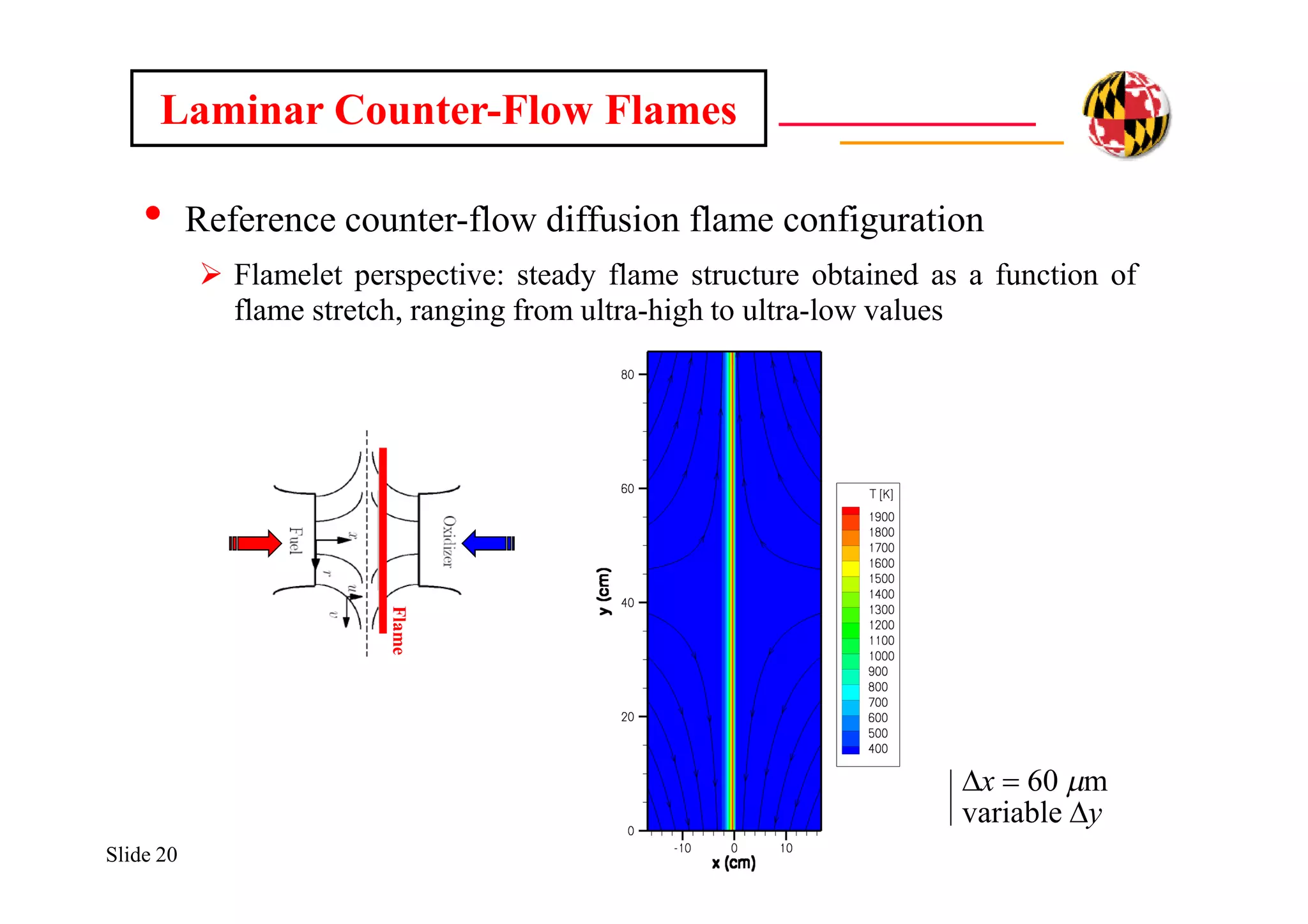
Laminar Counter-Flow Flames
Flame
Dx = 60 mm
variable Dy
• Reference counter-flow diffusion flame configuration
 Flamelet perspective: steady flame structure obtained as a function of
flame stretch, ranging from ultra-high to ultra-low values
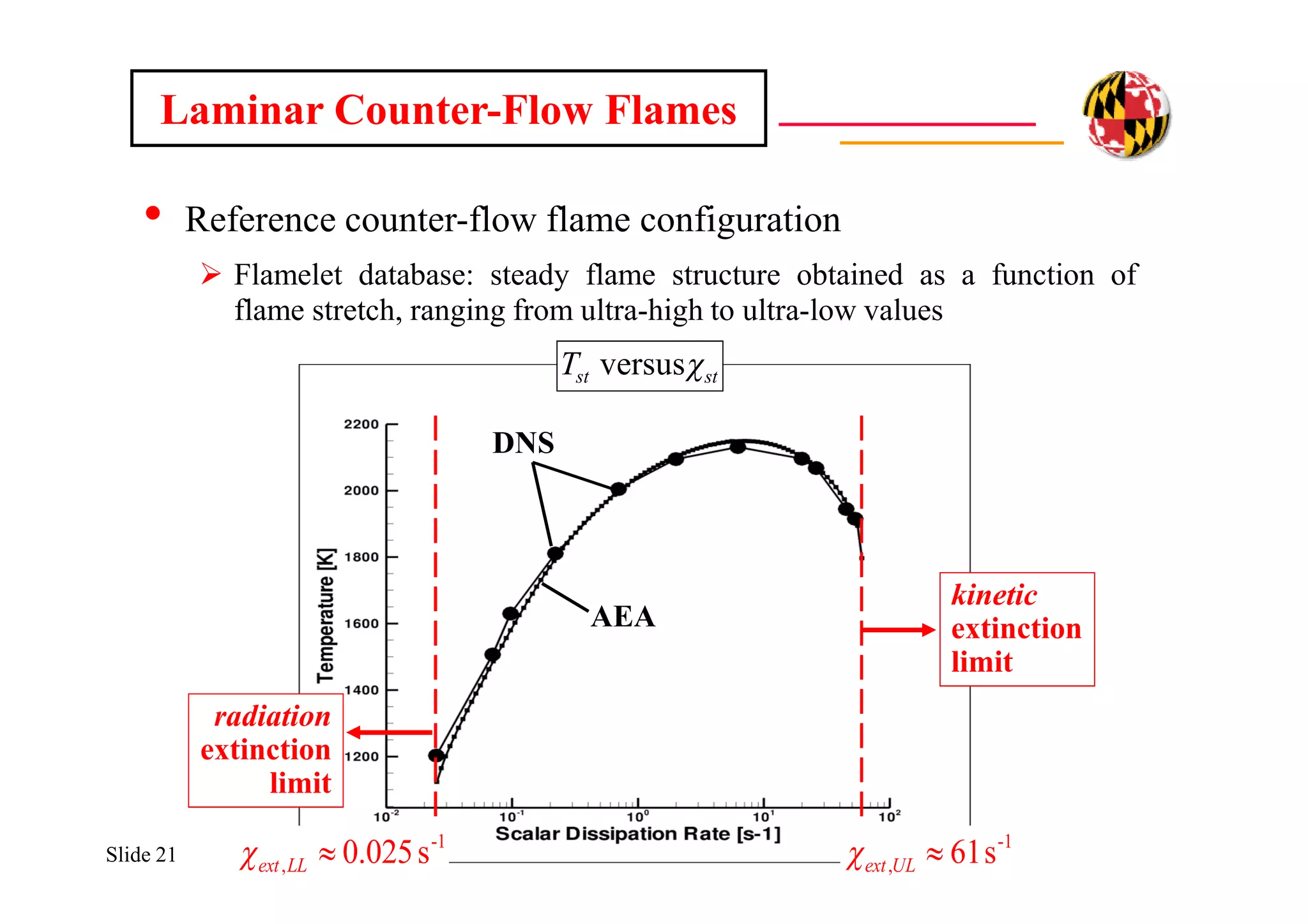
Slide 21
• Reference counter-flow flame configuration
 Flamelet database: steady flame structure obtained as a function of
flame stretch, ranging from ultra-high to ultra-low values
kinetic
extinction
limit
radiation
extinction
limit
ststT versus
-1
, s61ULext-1
, s025.0LLext
Laminar Counter-Flow Flames
DNS
AEA
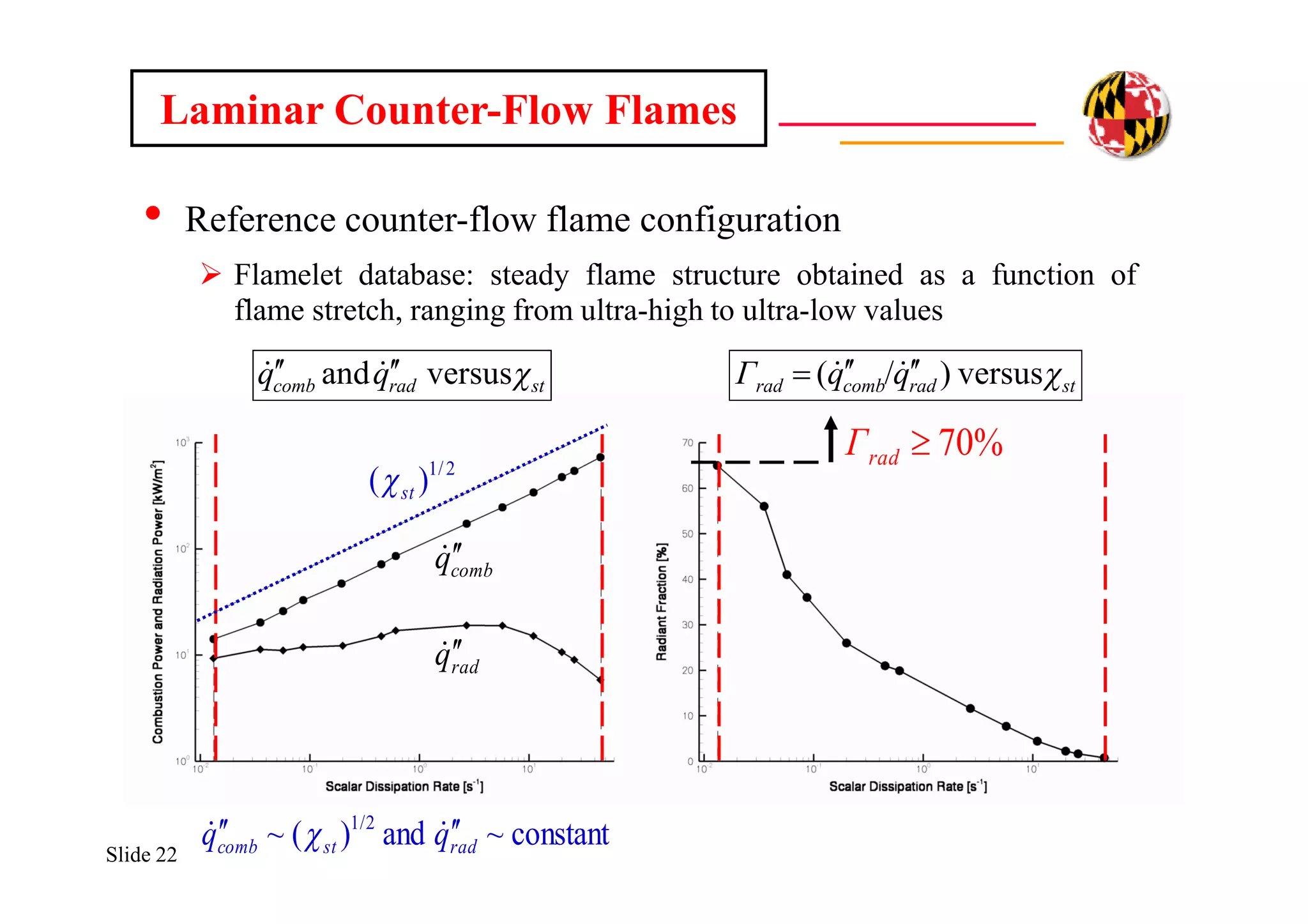
Slide 22
• Reference counter-flow flame configuration
 Flamelet database: steady flame structure obtained as a function of
flame stretch, ranging from ultra-high to ultra-low values
Laminar Counter-Flow Flames
stradcomb qq versusand   stradcombrad qqΓ versus)/(  
%70radΓ
2/1
)( st
constant~and)(~ 1/2
radstcomb qq   
radq
combq
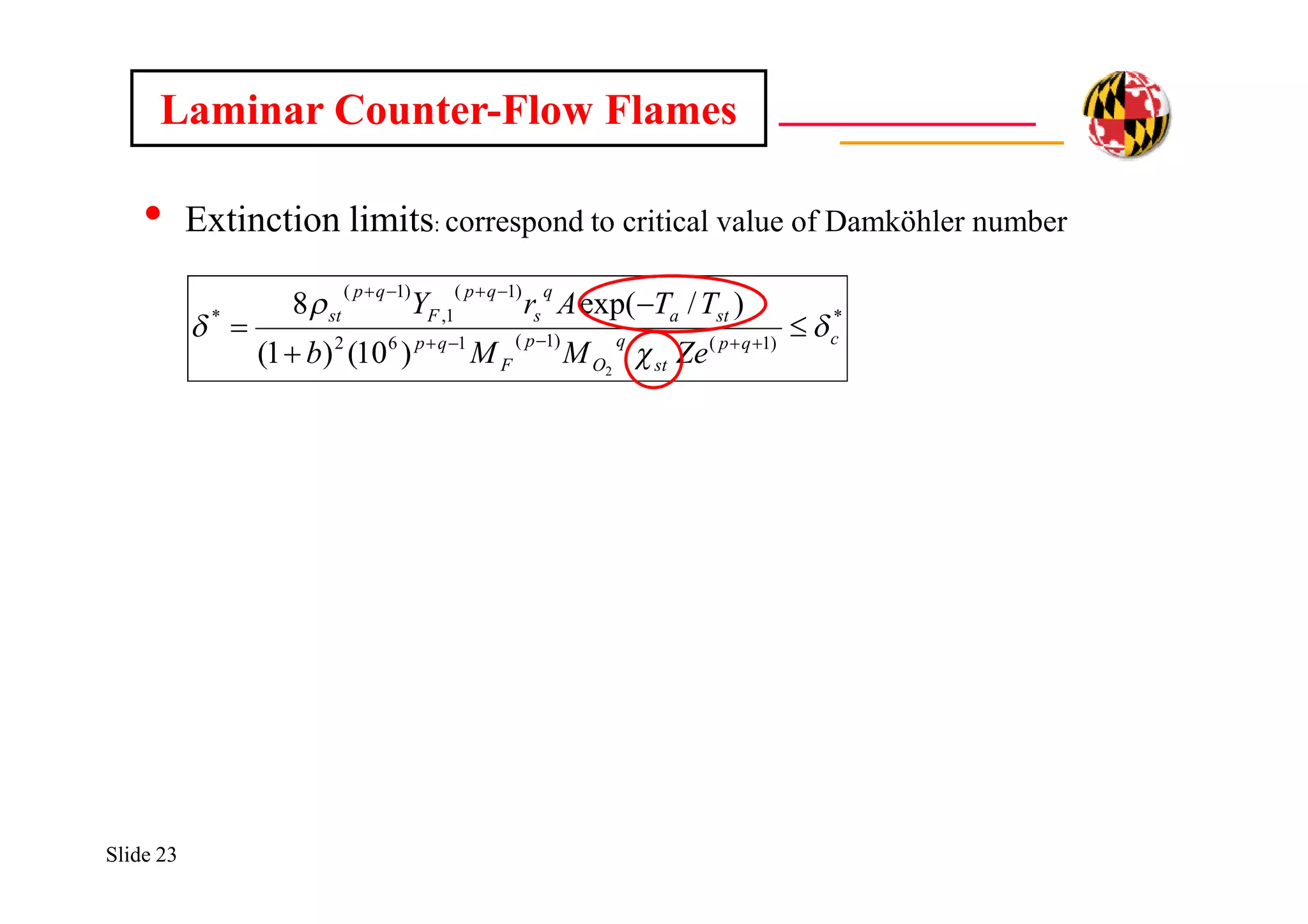
Slide 23
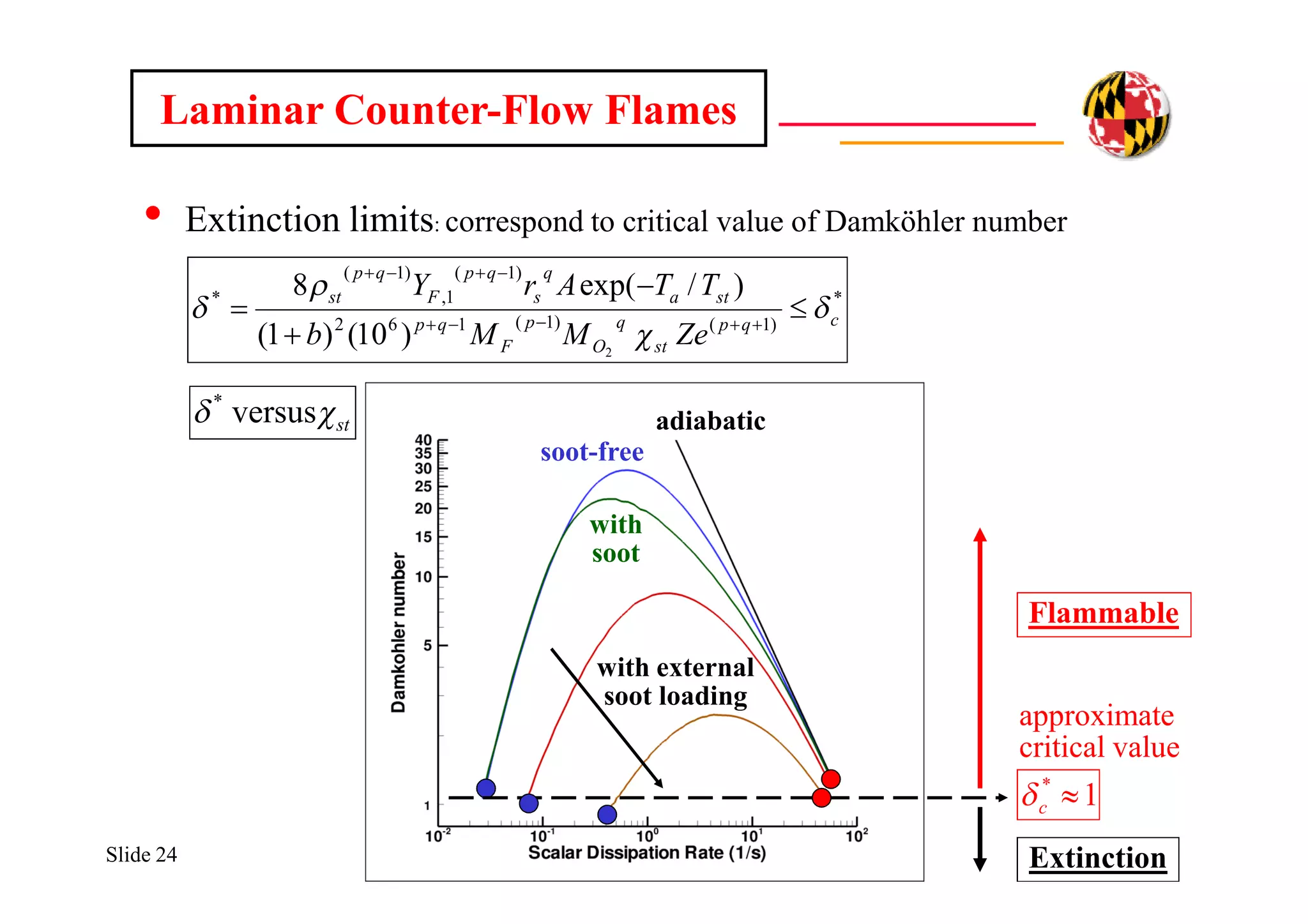
• Extinction limits: correspond to critical value of Damköhler number
*
)1()1(162
)1(
1,
)1(
*
2
)10()1(
)/exp(8
cqp
st
q
O
p
F
qp
sta
q
s
qp
F
qp
st
ZeMMb
TTArY



 


 

Laminar Counter-Flow Flames
Slide 24
• Extinction limits: correspond to critical value of Damköhler number
*
)1()1(162
)1(
1,
)1(
*
2
)10()1(
)/exp(8
cqp
st
q
O
p
F
qp
sta
q
s
qp
F
qp
st
ZeMMb
TTArY



 


 

Laminar Counter-Flow Flames
st versus*
adiabatic
soot-free
with
soot
with external
soot loading
approximate
critical value
1*
c
Extinction
Flammable
Slide 25
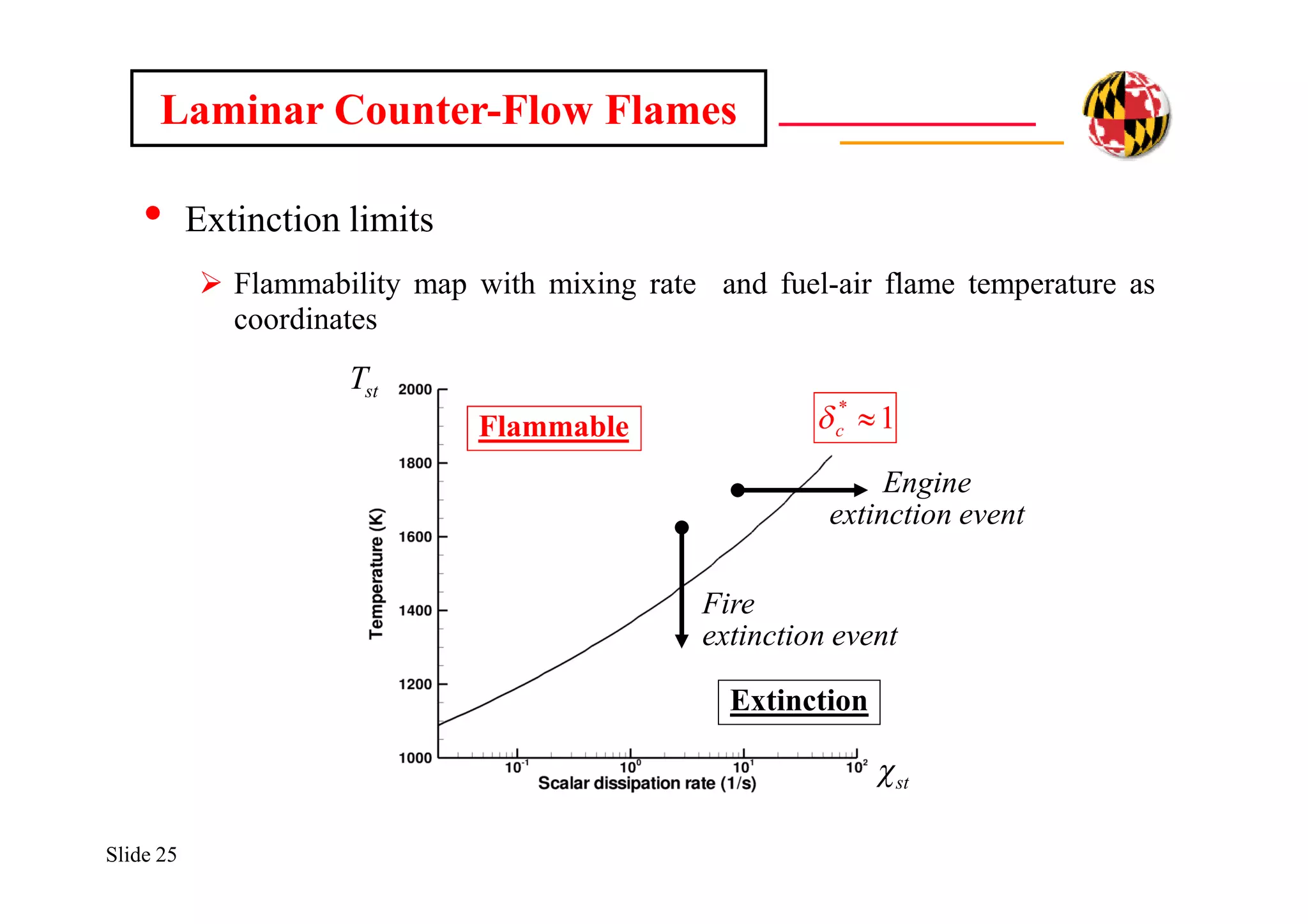
• Extinction limits
 Flammability map with mixing rate and fuel-air flame temperature as
coordinates
Laminar Counter-Flow Flames
stT
Extinction
st
1*
cFlammable
Engine
extinction event
Fire
extinction event
Slide 26
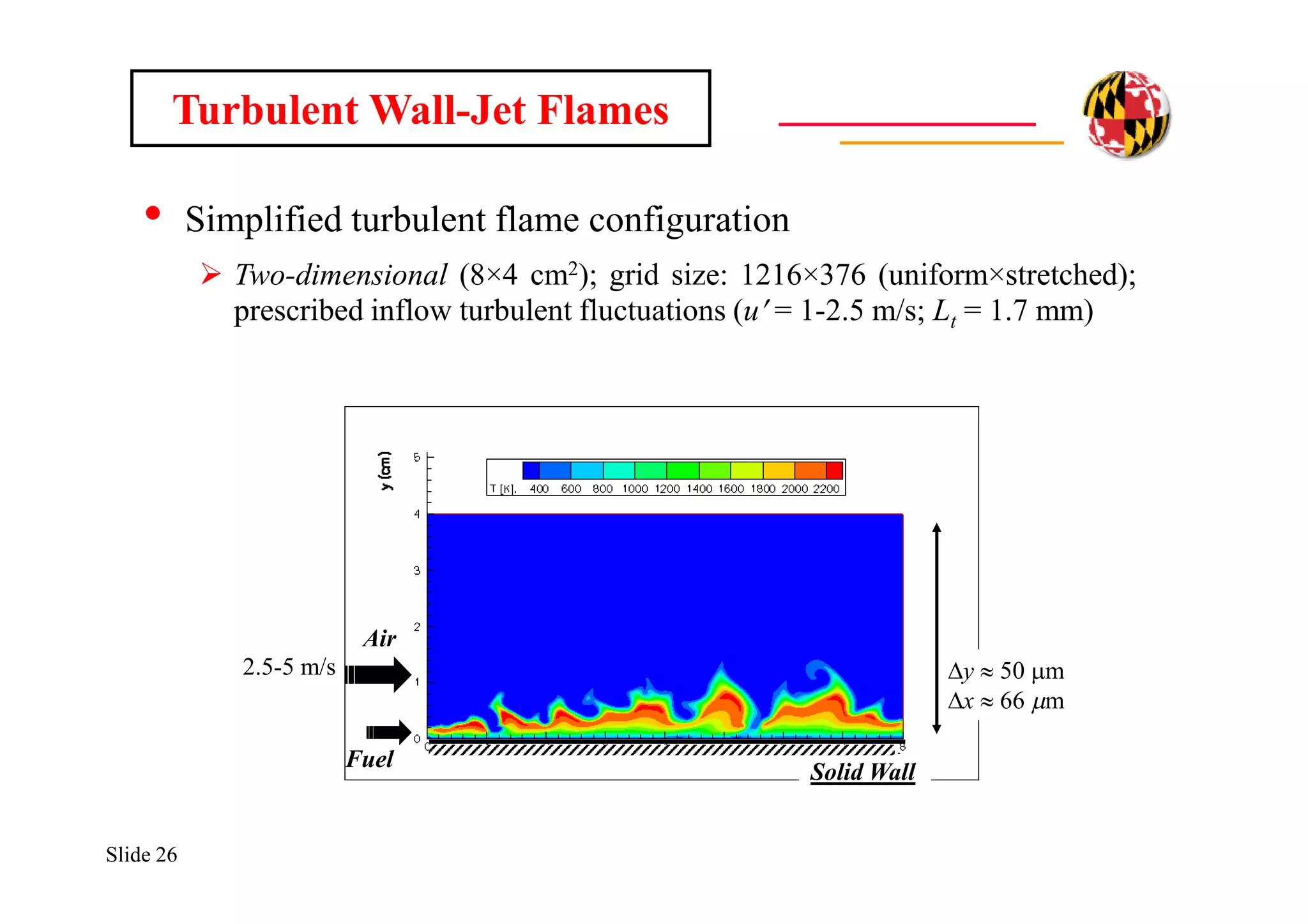
• Simplified turbulent flame configuration
 Two-dimensional (8×4 cm2); grid size: 1216×376 (uniform×stretched);
prescribed inflow turbulent fluctuations (u = 1-2.5 m/s; Lt = 1.7 mm)
Turbulent Wall-Jet Flames
Air
Fuel
Solid Wall
2.5-5 m/s Dy  50 mm
Dx  66 mm
Slide 27
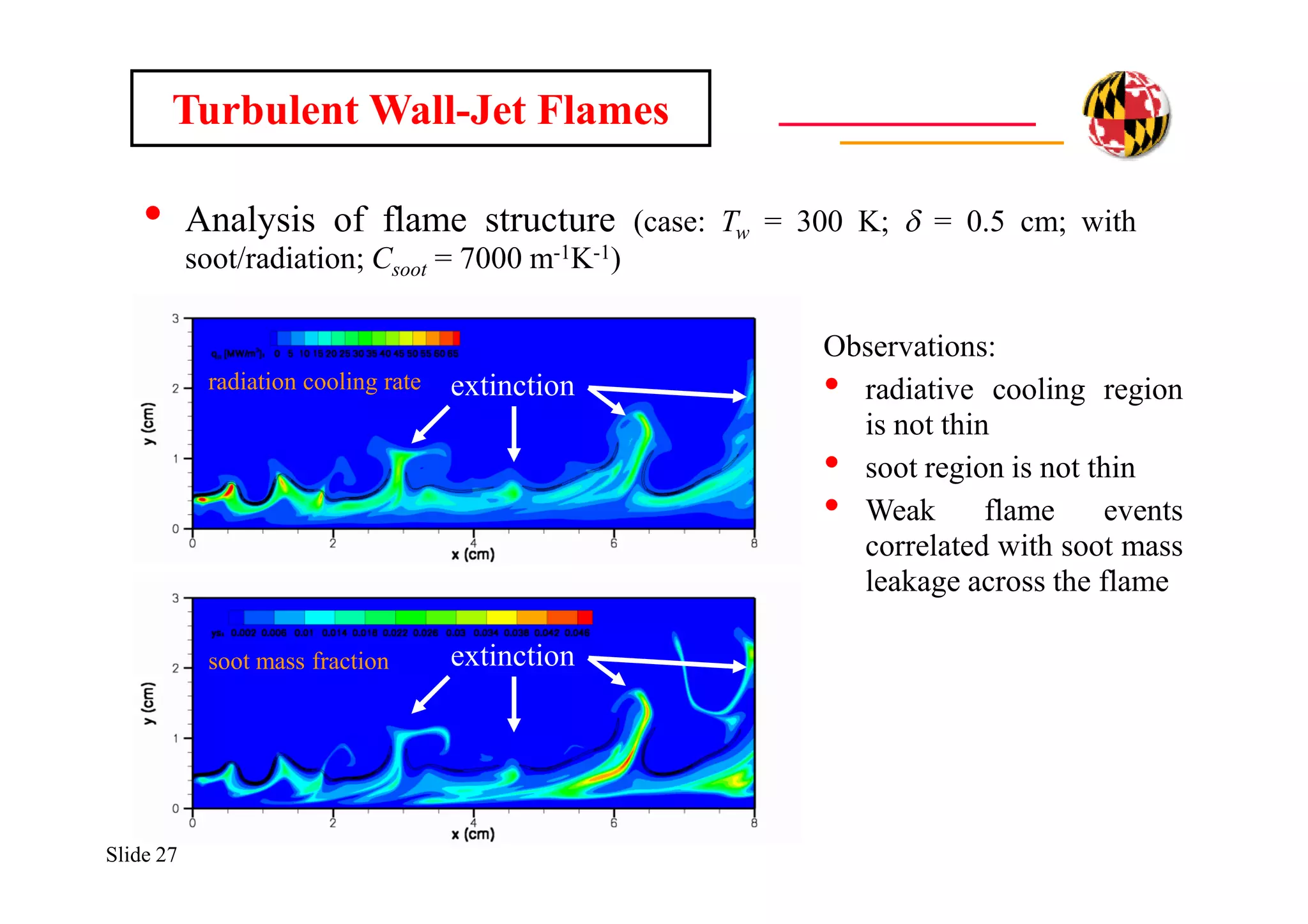
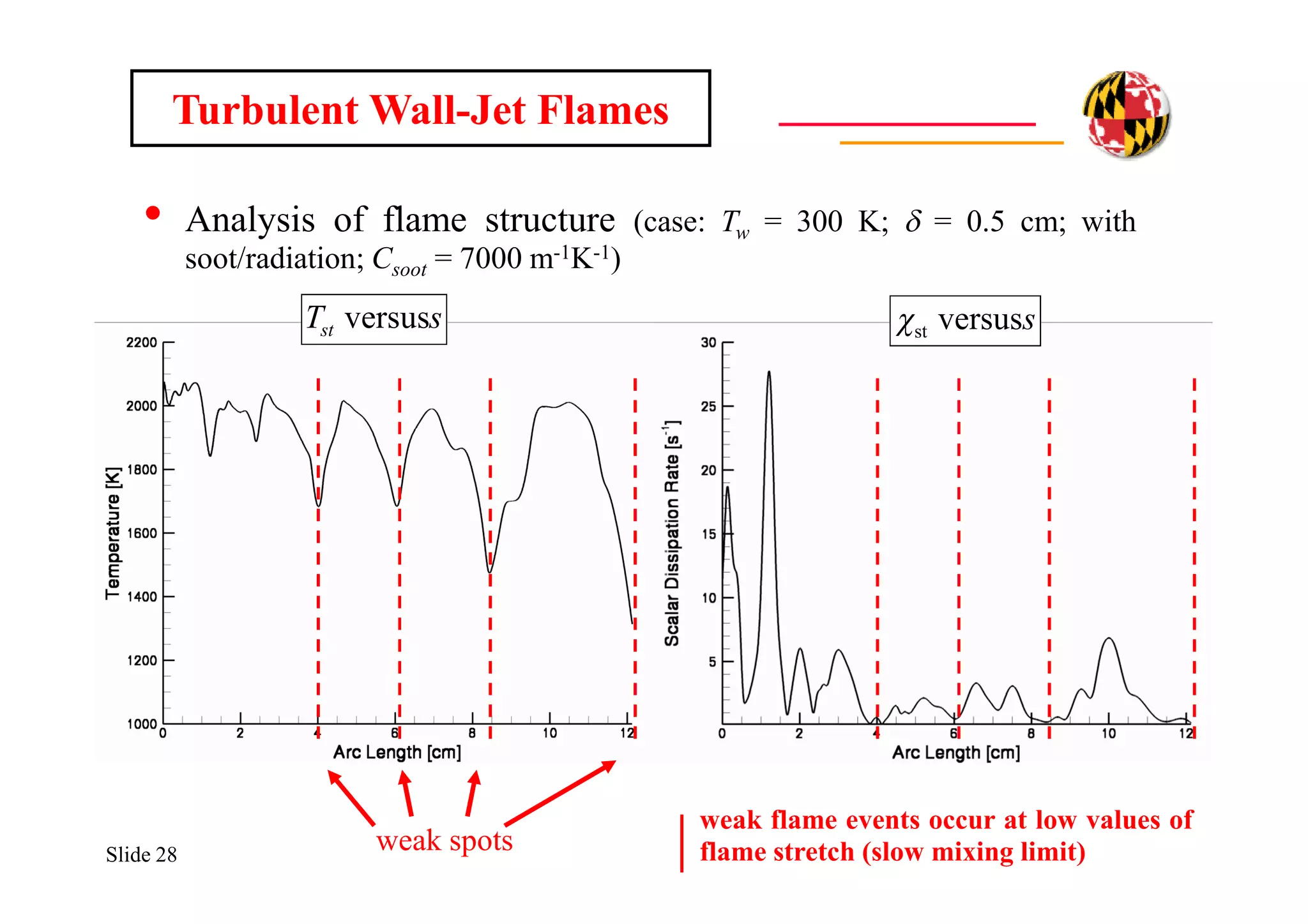
• Analysis of flame structure (case: Tw = 300 K; d = 0.5 cm; with
soot/radiation; Csoot = 7000 m-1K-1)
Turbulent Wall-Jet Flames
radiation cooling rate
soot mass fraction
Observations:
• radiative cooling region
is not thin
• soot region is not thin
• Weak flame events
correlated with soot mass
leakage across the flame
extinction
extinction
Slide 28
• Analysis of flame structure (case: Tw = 300 K; d = 0.5 cm; with
soot/radiation; Csoot = 7000 m-1K-1)
Turbulent Wall-Jet Flames
weak spots
sTst versus sversusst
weak flame events occur at low values of
flame stretch (slow mixing limit)
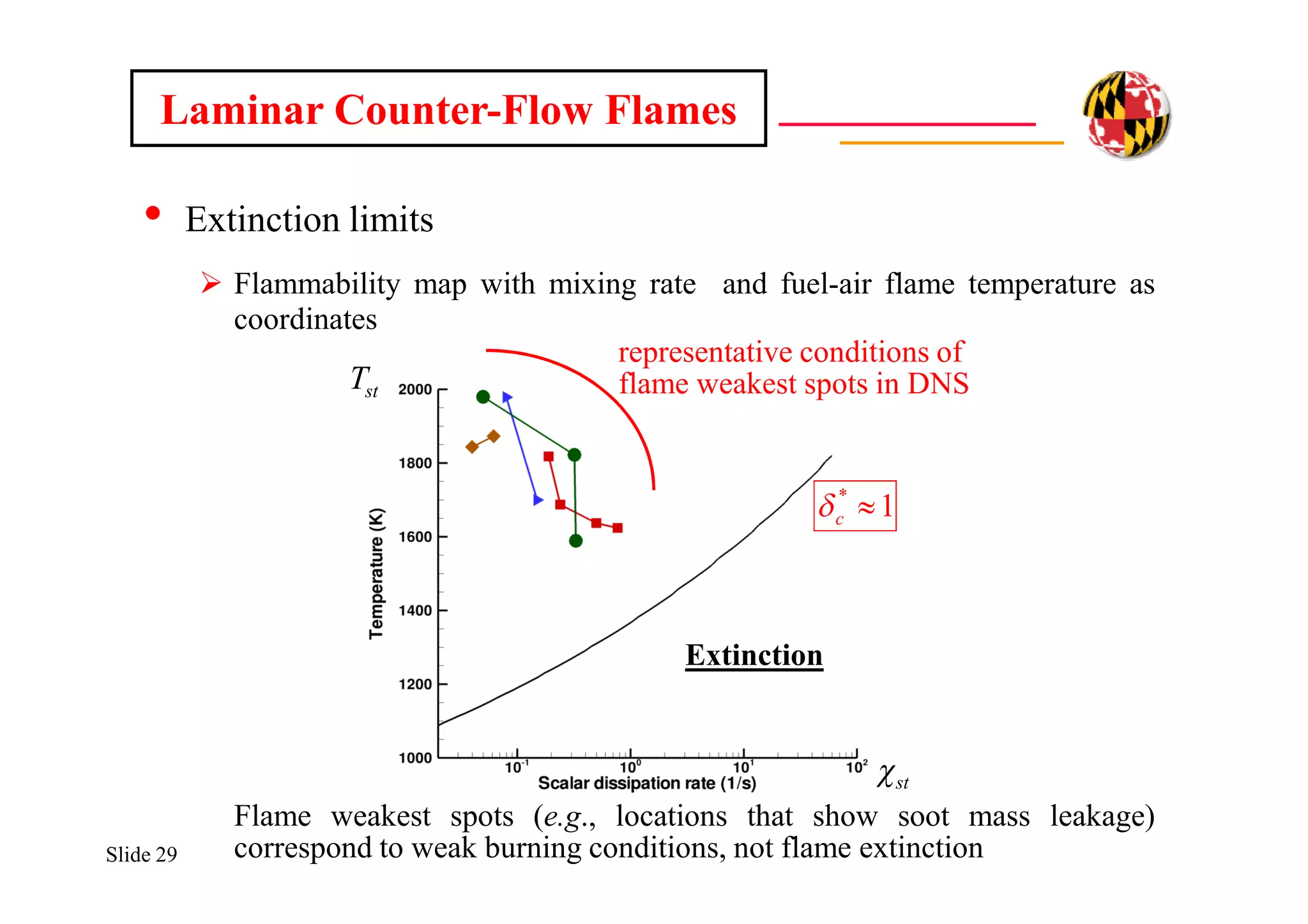
Slide 29
• Extinction limits
 Flammability map with mixing rate and fuel-air flame temperature as
coordinates
Flame weakest spots (e.g., locations that show soot mass leakage)
correspond to weak burning conditions, not flame extinction
Laminar Counter-Flow Flames
stT
Extinction
st
1*
c
representative conditions of
flame weakest spots in DNS
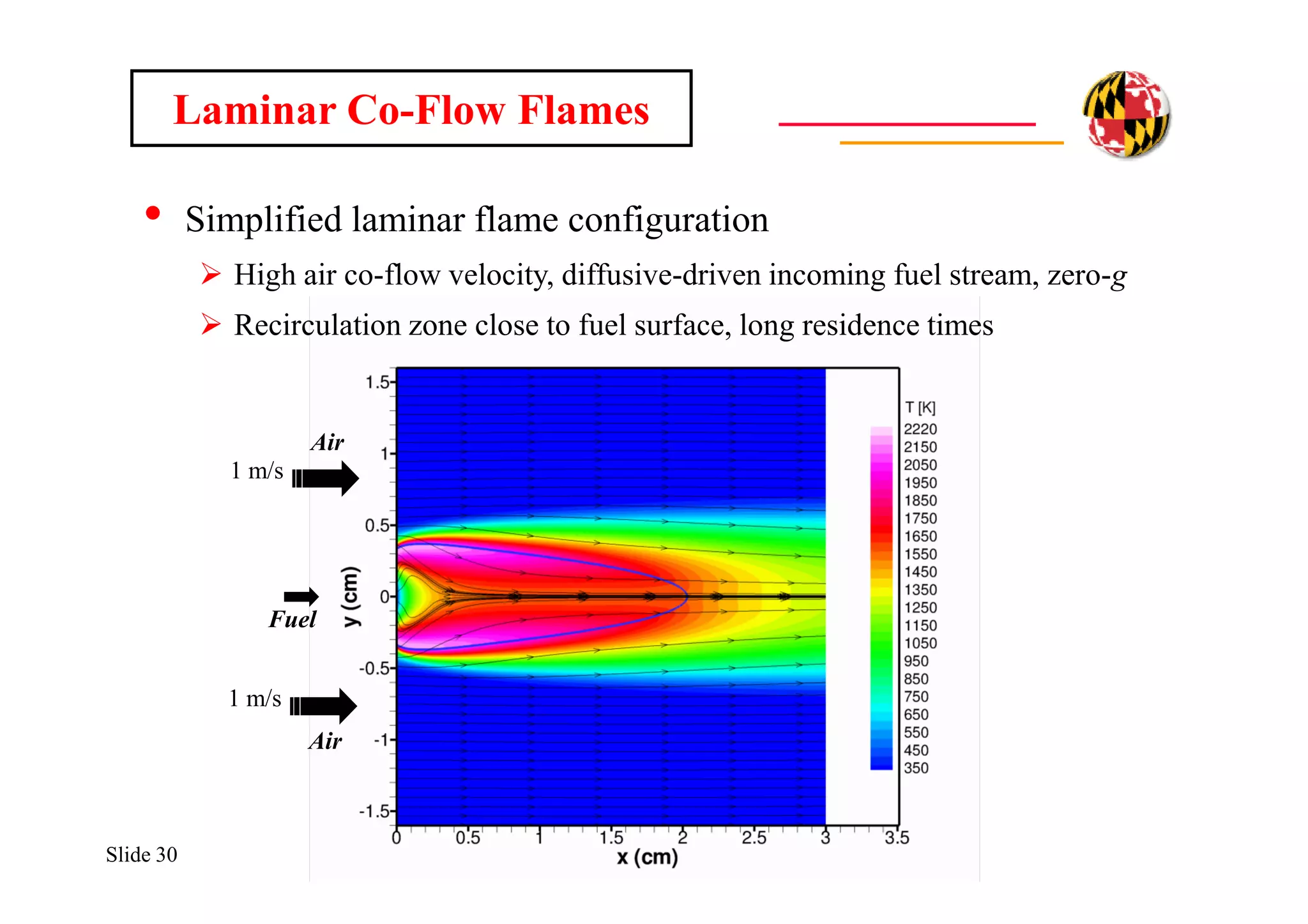
Slide 30
• Simplified laminar flame configuration
 High air co-flow velocity, diffusive-driven incoming fuel stream, zero-g
 Recirculation zone close to fuel surface, long residence times
Laminar Co-Flow Flames
Fuel
Air
1 m/s
Air
1 m/s
Slide 31
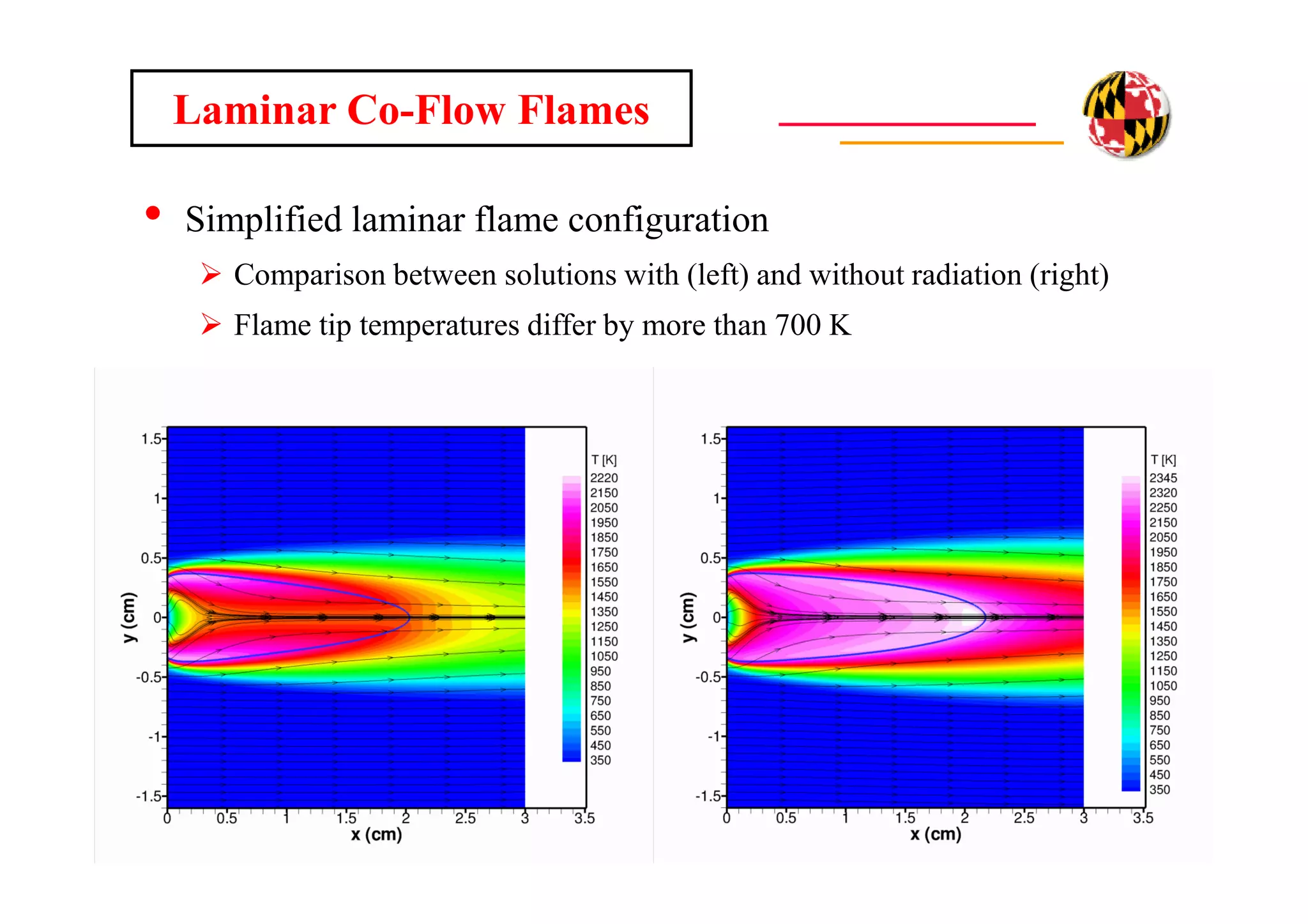
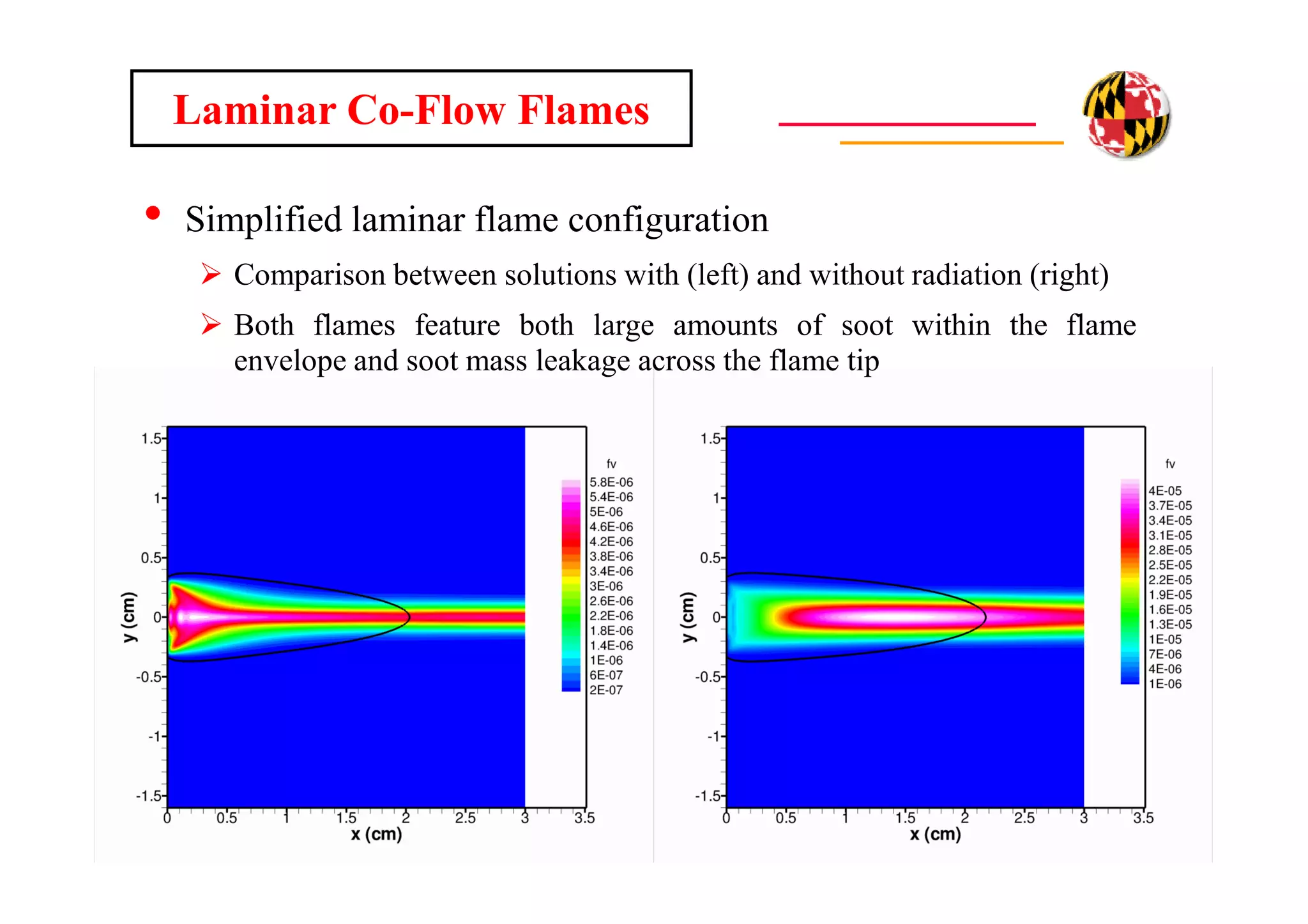
• Simplified laminar flame configuration
 Comparison between solutions with (left) and without radiation (right)
 Flame tip temperatures differ by more than 700 K
Laminar Co-Flow Flames
Slide 32
• Simplified laminar flame configuration
 Comparison between solutions with (left) and without radiation (right)
 Both flames feature both large amounts of soot within the flame
envelope and soot mass leakage across the flame tip
Laminar Co-Flow Flames
Slide 33
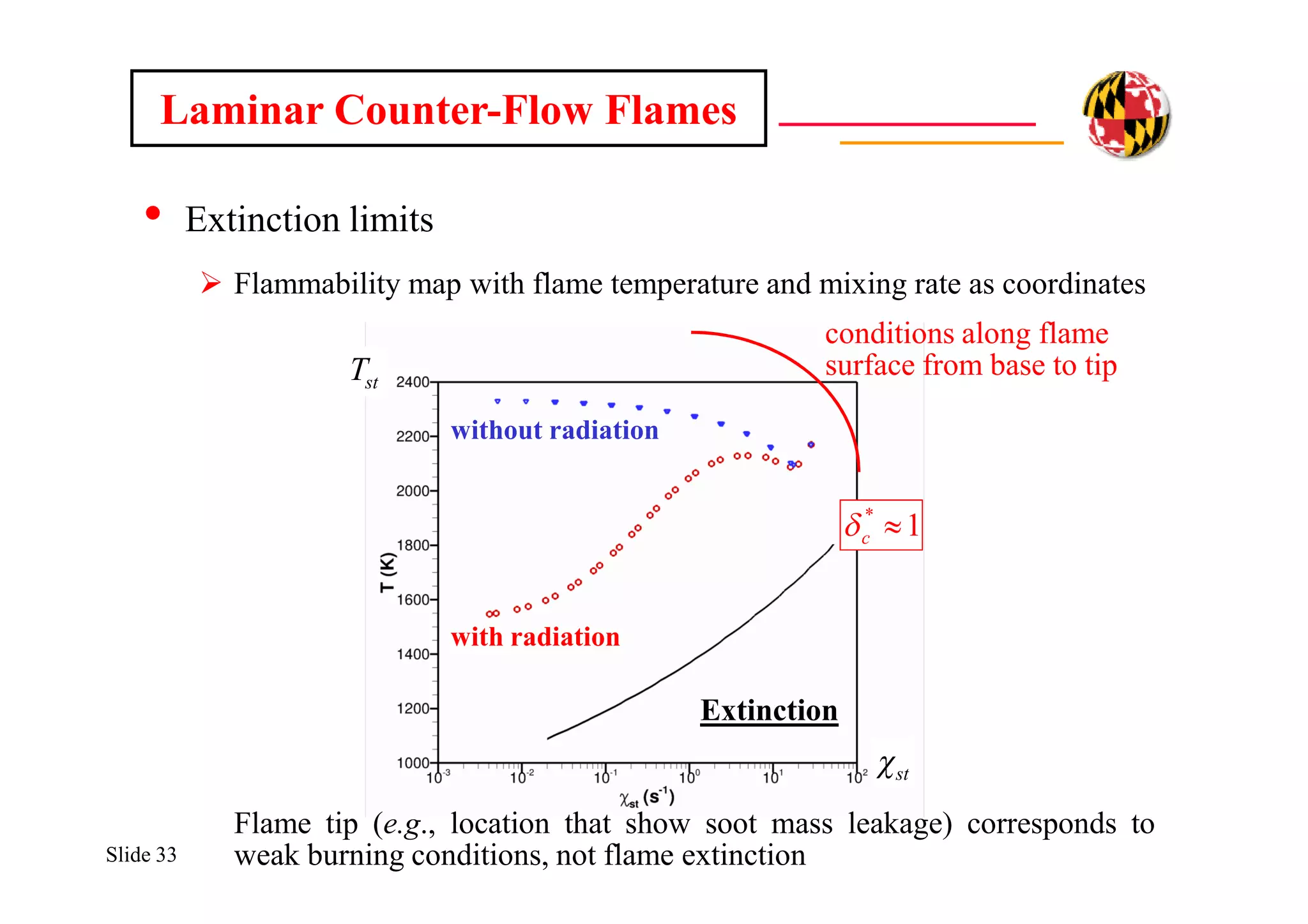
• Extinction limits
 Flammability map with flame temperature and mixing rate as coordinates
Flame tip (e.g., location that show soot mass leakage) corresponds to
weak burning conditions, not flame extinction
Laminar Counter-Flow Flames
stT
Extinction
st
1*
c
conditions along flame
surface from base to tip
with radiation
without radiation
Slide 34
• AEA theory and DNS are used to make fundamental
observations of extinction phenomena in non-adiabatic turbulent
diffusion flames
• In laminar counter-flow flames, two different sets of flame
extinction conditions are observed:
 Kinetic extinction occurring under fast mixing conditions
 Radiation extinction occurring under slow mixing conditions
• These 2 different modes correspond to the same extinction limit:
 AEA analysis suggests that all extinction limits may be described by a
single criterion corresponding to a critical value of the Damköhler number
 Soot has a significant impact on the extinction limit
• In laminar co-flow flames and in turbulent flames, it is found that
soot mass leakage events do not correspond to radiation
extinction events
Conclusions
Slide 35
Slide 36
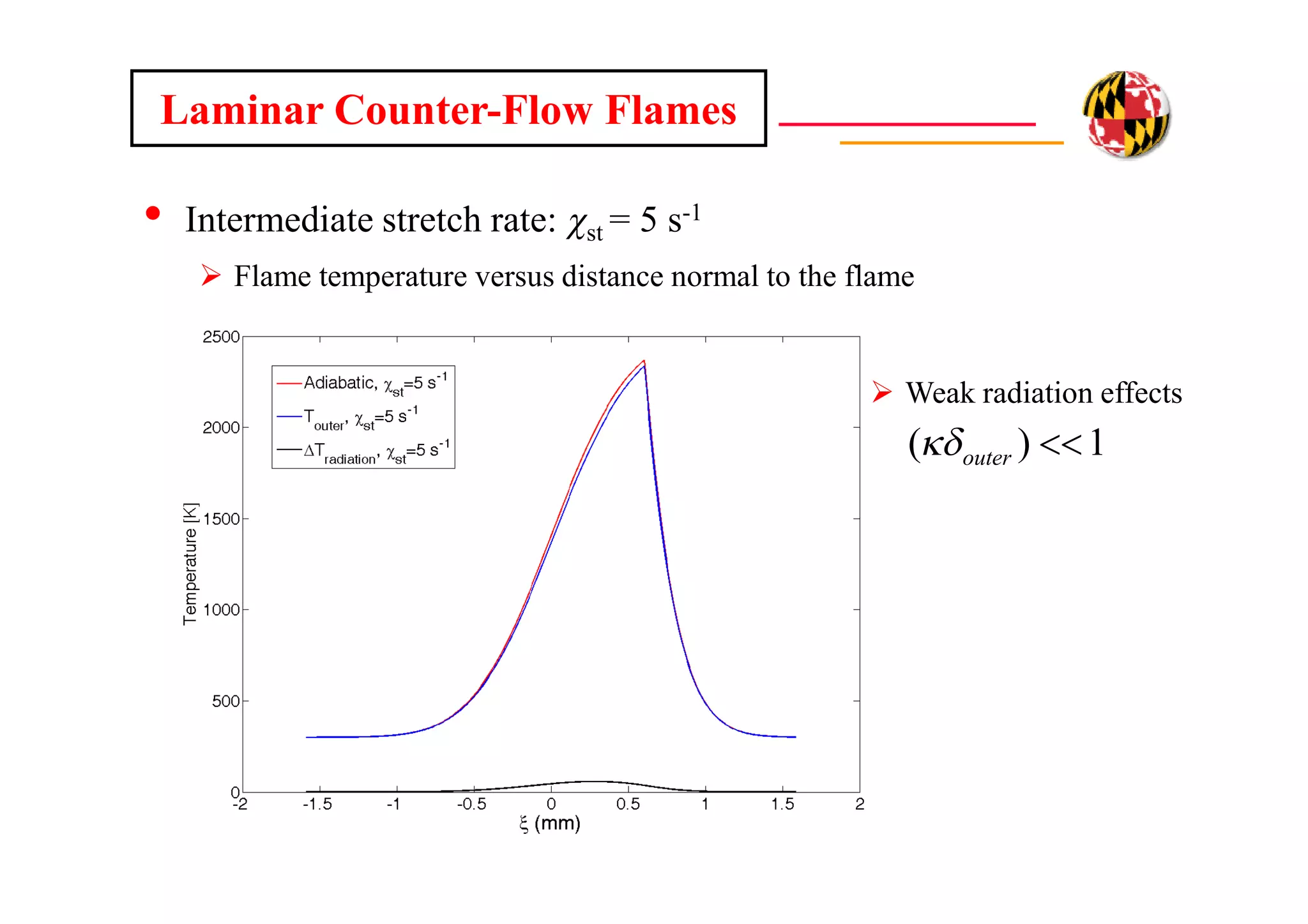
• Intermediate stretch rate: cst = 5 s-1
 Flame temperature versus distance normal to the flame
 Weak radiation effects
1)( outer
Laminar Counter-Flow Flames
Slide 37
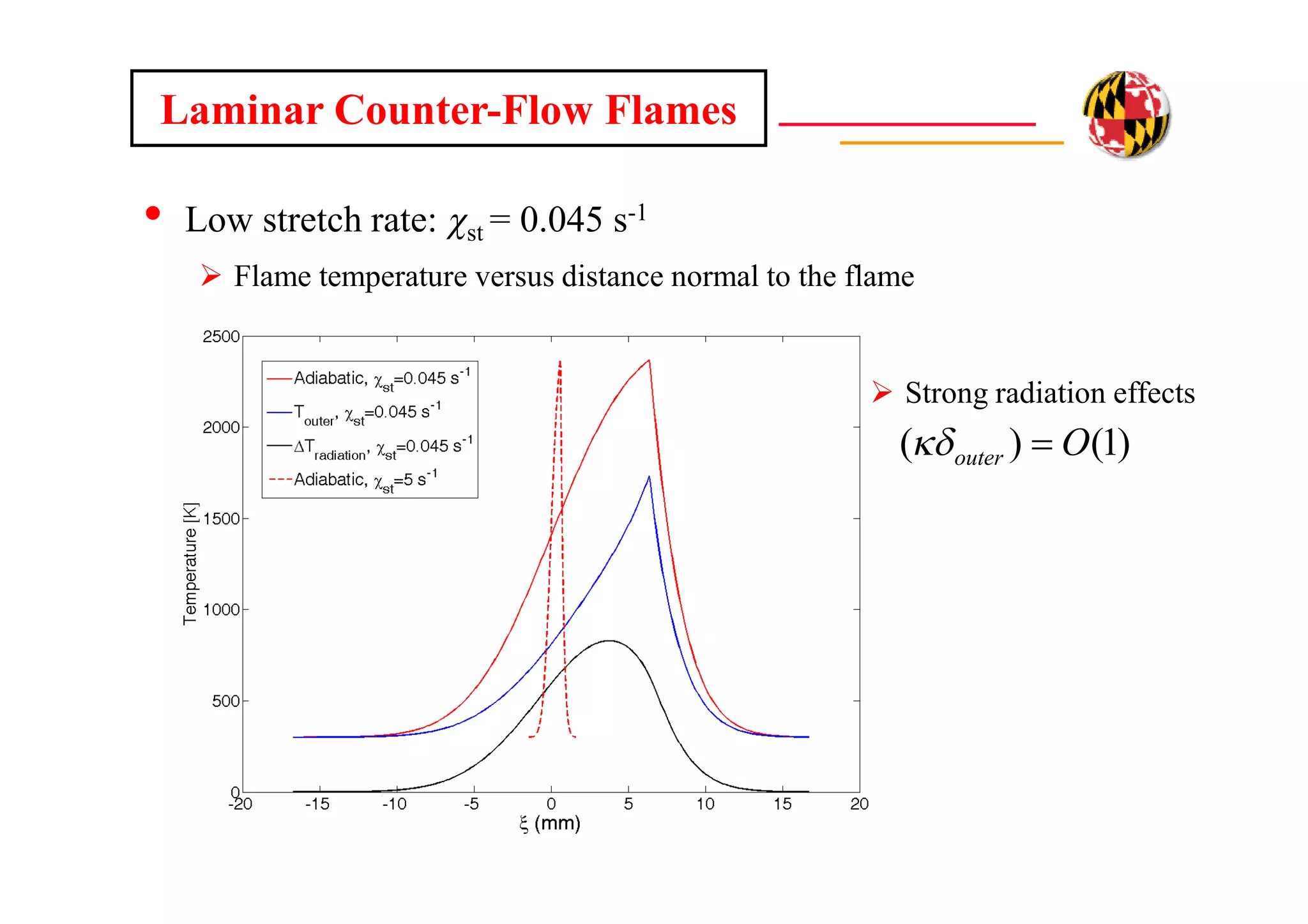
• Low stretch rate: cst = 0.045 s-1
 Flame temperature versus distance normal to the flame
 Strong radiation effects
)1()( Oouter 
Laminar Counter-Flow Flames

RadiationDrivenExtinctionInFires

  • 1.
    Slide 1 Radiation-Driven FlameExtinction in Fires Praveen Narayanan, Vivien Lecoustre & Arnaud Trouvé Department of Fire Protection Engineering University of Maryland, College Park, MD 20742 • Sponsors: National Science Foundation Office of Cyberinfrastructure (PetaApps Program); and DOE Office of Science (INCITE - Innovative and Novel Computational Impact on Theory and Experiment – Program).
  • 2.
    Slide 2 • Motivation: Combustionscience • Flame extinction has a significant impact on the performance of non- premixed combustion systems. It determines in part the turbulent flame structure and the levels of pollutant emission (NOx, CO, soot). Diesel engine Engine applications • Extinction due to high turbulence intensities in IC- or gas-turbine engines (momentum- driven, high-Reynolds number flames) Diffusion Flame Extinction
  • 3.
    Slide 3 • Motivation: Fireapplications • Extinction due to air vitiation in under- ventilated compartment fires or large-scale pool fires (buoyancy-driven, moderate- Reynolds number flames) • Extinction due to inert gaseous agents or water sprays in fire suppression applications pool fire sprinklers Diffusion Flame Extinction
  • 4.
    Slide 4 • Differentflame extinction phenomena:  Aerodynamic quenching: flame weakening due to flow-induced perturbations (i.e. decrease in flame residence time)  Thermal quenching: flame weakening due to heat losses (e.g. heat losses by convection/conduction to walls, by thermal radiation, by water evaporative cooling in fire suppression applications)  Quenching by dilution: flame weakening due to changes in fuel stream or oxidizer stream composition (e.g. air vitiation in under-ventilated fires) Diffusion Flame Extinction Fuel side Oxidizer side Flame aOO YY ,22 1FY Fuel side Oxidizer side Flame ad flameflame TT  Fuel side Oxidizer side Flame
  • 5.
    Slide 5 • Differentflame extinction phenomena:  Single criterion to predict extinction (laminar flame theory):  Two fundamental limits: • Fast mixing limit: Da is small because cst is large (e.g., aerodynamic quenching) • Slow mixing limit: Da is small because Tst is small (e.g., thermal or dilution quenching) Diffusion Flame Extinction critical chemical mixing DaDa    )/exp( )/1( ~ sta st chemical mixing TT Da    
  • 6.
    Slide 6 • Differentflame extinction phenomena:  Fast mixing limit: also called kinetic extinction  Criterion for extinction:  Sources: aerodynamic quenching • Liñán (1974) Acta Astronautica • Williams (1985) “Combustion Theory” • Peters (2000) “Turbulent Combustion” Diffusion Flame Extinction criticalst  
  • 7.
    Slide 7 • Differentflame extinction phenomena:  Slow mixing limit: also called radiation extinction  Criterion for extinction:  Sources: thermal quenching in microgravity combustion • Sohrab, Liñán & Williams (1982) Combustion Science and Technology • T’ien (1986) Combustion and Flame • Chao, Law & T’ien (1990) Proceedings Combustion Institute 23 • Bedir & T’ien (1998) Combustion and Flame Diffusion Flame Extinction criticalrad ΓΓ  * criticalst  
  • 8.
    Slide 8 • Relationbetween radiation extinction and soot emission/smoke point studies:  Unclear: many recent studies of radiation extinction correspond to one-dimensional flames that are soot-free at the extinction limit  But: past studies of the smoke point (SP) of laminar jet diffusion flames suggest that SP is controlled by the flame luminosity; hence, SP may be interpreted as a radiation extinction event  Source: • Markstein, de Ris (1984) Proceedings Combustion Symposium Diffusion Flame Extinction Fuel Air Air Flame Soot region open flame tip (flame extinction?) soot emission
  • 9.
    Slide 9 • Studymechanisms responsible for diffusion flame extinction in laminar and turbulent flames (focus on conditions relevant to fire applications)  Establish flame extinction criterion; construct flammability map(s) • Tools:  Asymptotic analysis of extinction limits of laminar counter-flow diffusion flames exposed to different levels of radiant losses  Direct Numerical Simulations (DNS) of laminar counter-flow and co- flow diffusion flames, and of turbulent diffusion flames • Explore relationship between flame extinction and soot emission Objectives pool fire Cold Soot Hot Soot under-ventilated fire
  • 10.
    Slide 10 • Usedirect numerical simulation (DNS)  Leverage DOE-sponsored SciDAC collaboration on DNS solver called S3D – Sandia Ntl. Laboratories (J.H. Chen), Univ. Michigan (H.G. Im) • DNS solver S3D  Navier-Stokes solver; fully compressible flow formulation  High-order methods: 8th order finite difference; 4th order explicit Runge-Kutta time integrator  Characteristic-based boundary condition treatment (NSCBC)  Structured Cartesian grids  Parallel (MPI-based, excellent scalability)  Flame modeling: detailed fuel-air chemistry (CHEMKIN-compatible); simplified soot formation model; thermal radiation model (Discrete Ordinate/Discrete Transfer Methods); Lagrangian particle model to describe dilute liquid sprays Numerical approach
  • 11.
    Slide 11 Flame Modeling •Combustion model: single-step chemistry, ethylene-air combustion (Westbrook & Dryer, 1981)  Counter-flow flame: comparison of laminar flame response to changes in strain rate for single-step and detailed chemistry )exp()()( 2 T T M Y M Y B aq F Op F F RRF   
  • 12.
    Slide 12 Flame Modeling •Soot formation model: a phenomenological approach (Moss et al., Lindstedt et al.)  Two-variable model; empirical description of fundamental soot formation processes (nucleation, surface growth, coagulation, oxidation)  Model parameters are fuel-dependent  No PAH chemistry  Monodispersed soot particle size distribution ncoagulationnucleationn A soot jj it A soot iA soot i iA soot oxidations growth surfacesnucleations j soot j itsoot i sooti i soot N n xScx V N n xN n u xN n t x Y Scx VY x Yu x Y t ,, , ,,, , ))(()()()( )()()()(                                    
  • 13.
    Slide 13 Flame Modeling •Thermal radiation transport model: non-scattering, gray gas assumption; Discrete Transfer Method (Lockwood & Shah, 1981)  Radiative transfer equation  Mean absorption coefficient [m-1] • ap,i is the Planck mean absorption coefficient for species i [m-1 atm-1] and is obtained from tabulated data (TNF Workshop web site) • ksoot is the soot mean absorption coefficient [m-1]  AbsorptionEmission 4 )/( IT ds dI    sootCOCOOHOH axaxp   )( 2222 -1-1 Km1817sootCTYCTfC sootsootsootvsootsoot )/(  
  • 14.
    Slide 14 • Classicalactivation energy asymptotic (AEA) analysis  Mass density variations handled with Howarth transformation  Mixture fraction equation and solution (a is strain rate)  Flame structure given by flamelet equations (in mixture fraction space)  x dx 0 2 )/(  st F p Fst c H dZ Td    )( 2 2 2   AEAAnalysis ) /2 (erf 2 1 2 1 2   D Z  2 2 2   d Zd D d dZ  Flame
  • 15.
    Slide 15 • Classicaldecomposition into inner/outer layers  Perform asymptotic expansion in terms of small parameter e  Inner layer problem AEAAnalysis )exp(] )1( [][ )(;)()( 2 2 221,             q st stp st p FF st Z Z d d OZZO c YH TT (d is a reduced Damkohler number) )( )(1 1, 2 FF p a st YH c T T Ze   )1/()/(;1)/( stst ZZdddd    
  • 16.
    Slide 16 • AEAflame structure with thermal radiation  Temperature decomposition (outer layer problem)  Governing equation for temperature deficit due to radiant cooling  Green’s function solution  Consider that chemical reaction zone is thin compared to characteristic radiation length scale ( ): inner layer problem is essentially unchanged AEAAnalysis TTT ad BS  p rad c q T d d DT d d     )()( 2 2 2 1)( reaction     *** ),()()(    dg c q T p rad 
  • 17.
    Slide 17 • AEAflame structure with thermal radiation  Green’s function solution  Emitting/absorbing medium (spectrally-averaged gray) Planck mean aborption coefficient: Analytical expression for G (as a function of optical depth t): AEAAnalysis )4( 4 GTqrad       *** ),()()(    dg c q T p rad  TfCaxaxp vsootOHOHCOCO  )( 2222  ]')'()'(')'()'( )()([2 1 0 1 22,21,    R dEIdEI EIEIG bb Rbb     
  • 18.
    Slide 18 • AEAflame structure with soot  Two-equations model for ssot mass fraction and soot number density (Moss et al., Lindstedt et al. )  Soot formation and oxidation rates (C2H2-air combustion) AEAAnalysis         soot soot n A soott A soot t Y soot tsoot t N n d Vd N n d d V Y d Vd d dY V     )()()( )( 22 3/13/2 2 )()exp()( )()exp()( )exp()()exp()( 2 A soot Fn sootsoot OO O sootFFY N n Tc T T XTcc nY T T T X c n T T XTc T T XTc soot soot               
  • 19.
    Slide 19 • AEAflame structure with soot  External soot loading: a mechanism to simulate non-local effects observed in multi-dimensional flames in a one-dimensional framework  Soot loading from the flame air side AEAAnalysis Flame Sootinjection Fuel Air Air Flame Soot region
  • 20.
    Slide 20 Laminar Counter-FlowFlames Flame Dx = 60 mm variable Dy • Reference counter-flow diffusion flame configuration  Flamelet perspective: steady flame structure obtained as a function of flame stretch, ranging from ultra-high to ultra-low values
  • 21.
    Slide 21 • Referencecounter-flow flame configuration  Flamelet database: steady flame structure obtained as a function of flame stretch, ranging from ultra-high to ultra-low values kinetic extinction limit radiation extinction limit ststT versus -1 , s61ULext-1 , s025.0LLext Laminar Counter-Flow Flames DNS AEA
  • 22.
    Slide 22 • Referencecounter-flow flame configuration  Flamelet database: steady flame structure obtained as a function of flame stretch, ranging from ultra-high to ultra-low values Laminar Counter-Flow Flames stradcomb qq versusand   stradcombrad qqΓ versus)/(   %70radΓ 2/1 )( st constant~and)(~ 1/2 radstcomb qq    radq combq
  • 23.
    Slide 23 • Extinctionlimits: correspond to critical value of Damköhler number * )1()1(162 )1( 1, )1( * 2 )10()1( )/exp(8 cqp st q O p F qp sta q s qp F qp st ZeMMb TTArY           Laminar Counter-Flow Flames
  • 24.
    Slide 24 • Extinctionlimits: correspond to critical value of Damköhler number * )1()1(162 )1( 1, )1( * 2 )10()1( )/exp(8 cqp st q O p F qp sta q s qp F qp st ZeMMb TTArY           Laminar Counter-Flow Flames st versus* adiabatic soot-free with soot with external soot loading approximate critical value 1* c Extinction Flammable
  • 25.
    Slide 25 • Extinctionlimits  Flammability map with mixing rate and fuel-air flame temperature as coordinates Laminar Counter-Flow Flames stT Extinction st 1* cFlammable Engine extinction event Fire extinction event
  • 26.
    Slide 26 • Simplifiedturbulent flame configuration  Two-dimensional (8×4 cm2); grid size: 1216×376 (uniform×stretched); prescribed inflow turbulent fluctuations (u = 1-2.5 m/s; Lt = 1.7 mm) Turbulent Wall-Jet Flames Air Fuel Solid Wall 2.5-5 m/s Dy  50 mm Dx  66 mm
  • 27.
    Slide 27 • Analysisof flame structure (case: Tw = 300 K; d = 0.5 cm; with soot/radiation; Csoot = 7000 m-1K-1) Turbulent Wall-Jet Flames radiation cooling rate soot mass fraction Observations: • radiative cooling region is not thin • soot region is not thin • Weak flame events correlated with soot mass leakage across the flame extinction extinction
  • 28.
    Slide 28 • Analysisof flame structure (case: Tw = 300 K; d = 0.5 cm; with soot/radiation; Csoot = 7000 m-1K-1) Turbulent Wall-Jet Flames weak spots sTst versus sversusst weak flame events occur at low values of flame stretch (slow mixing limit)
  • 29.
    Slide 29 • Extinctionlimits  Flammability map with mixing rate and fuel-air flame temperature as coordinates Flame weakest spots (e.g., locations that show soot mass leakage) correspond to weak burning conditions, not flame extinction Laminar Counter-Flow Flames stT Extinction st 1* c representative conditions of flame weakest spots in DNS
  • 30.
    Slide 30 • Simplifiedlaminar flame configuration  High air co-flow velocity, diffusive-driven incoming fuel stream, zero-g  Recirculation zone close to fuel surface, long residence times Laminar Co-Flow Flames Fuel Air 1 m/s Air 1 m/s
  • 31.
    Slide 31 • Simplifiedlaminar flame configuration  Comparison between solutions with (left) and without radiation (right)  Flame tip temperatures differ by more than 700 K Laminar Co-Flow Flames
  • 32.
    Slide 32 • Simplifiedlaminar flame configuration  Comparison between solutions with (left) and without radiation (right)  Both flames feature both large amounts of soot within the flame envelope and soot mass leakage across the flame tip Laminar Co-Flow Flames
  • 33.
    Slide 33 • Extinctionlimits  Flammability map with flame temperature and mixing rate as coordinates Flame tip (e.g., location that show soot mass leakage) corresponds to weak burning conditions, not flame extinction Laminar Counter-Flow Flames stT Extinction st 1* c conditions along flame surface from base to tip with radiation without radiation
  • 34.
    Slide 34 • AEAtheory and DNS are used to make fundamental observations of extinction phenomena in non-adiabatic turbulent diffusion flames • In laminar counter-flow flames, two different sets of flame extinction conditions are observed:  Kinetic extinction occurring under fast mixing conditions  Radiation extinction occurring under slow mixing conditions • These 2 different modes correspond to the same extinction limit:  AEA analysis suggests that all extinction limits may be described by a single criterion corresponding to a critical value of the Damköhler number  Soot has a significant impact on the extinction limit • In laminar co-flow flames and in turbulent flames, it is found that soot mass leakage events do not correspond to radiation extinction events Conclusions
  • 35.
  • 36.
    Slide 36 • Intermediatestretch rate: cst = 5 s-1  Flame temperature versus distance normal to the flame  Weak radiation effects 1)( outer Laminar Counter-Flow Flames
  • 37.
    Slide 37 • Lowstretch rate: cst = 0.045 s-1  Flame temperature versus distance normal to the flame  Strong radiation effects )1()( Oouter  Laminar Counter-Flow Flames