BOHR’S ATOMIC
MODEL & ITS
APPLICATIONS
Chapter # 2
Atomic Structure
Prepared by: Sidra Javed
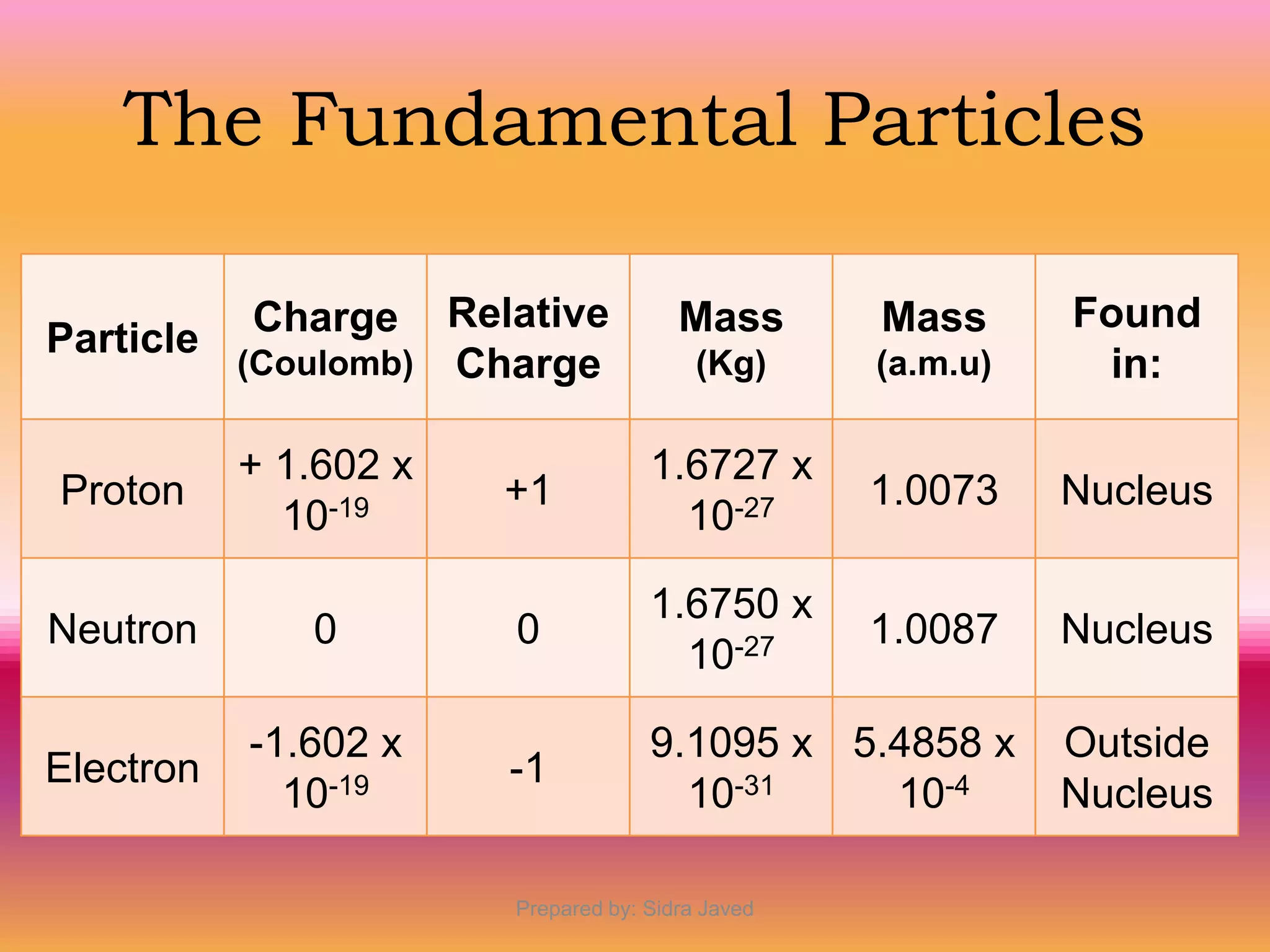
The Fundamental Particles
Particle
Charge
(Coulomb)
Relative
Charge
Mass
(Kg)
Mass
(a.m.u)
Found
in:
Proton
+ 1.602 x
10-19 +1
1.6727 x
10-27 1.0073 Nucleus
Neutron 0 0
1.6750 x
10-27 1.0087 Nucleus
Electron
-1.602 x
10-19 -1
9.1095 x
10-31
5.4858 x
10-4
Outside
Nucleus
Prepared by: Sidra Javed
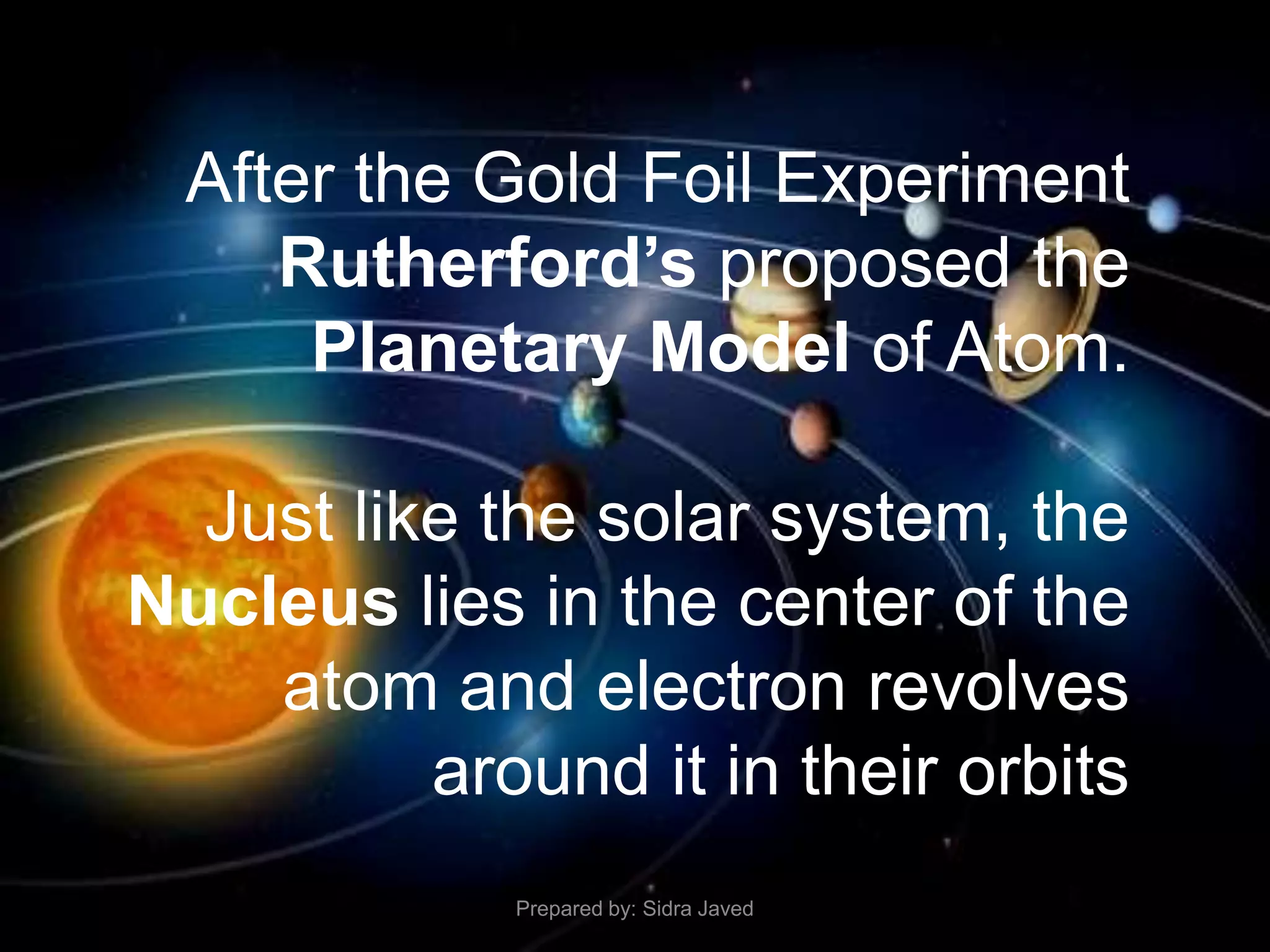
After the Gold Foil Experiment
Rutherford’s proposed the
Planetary Model of Atom.
Just like the solar system, the
Nucleus lies in the center of the
atom and electron revolves
around it in their orbits
Prepared by: Sidra Javed
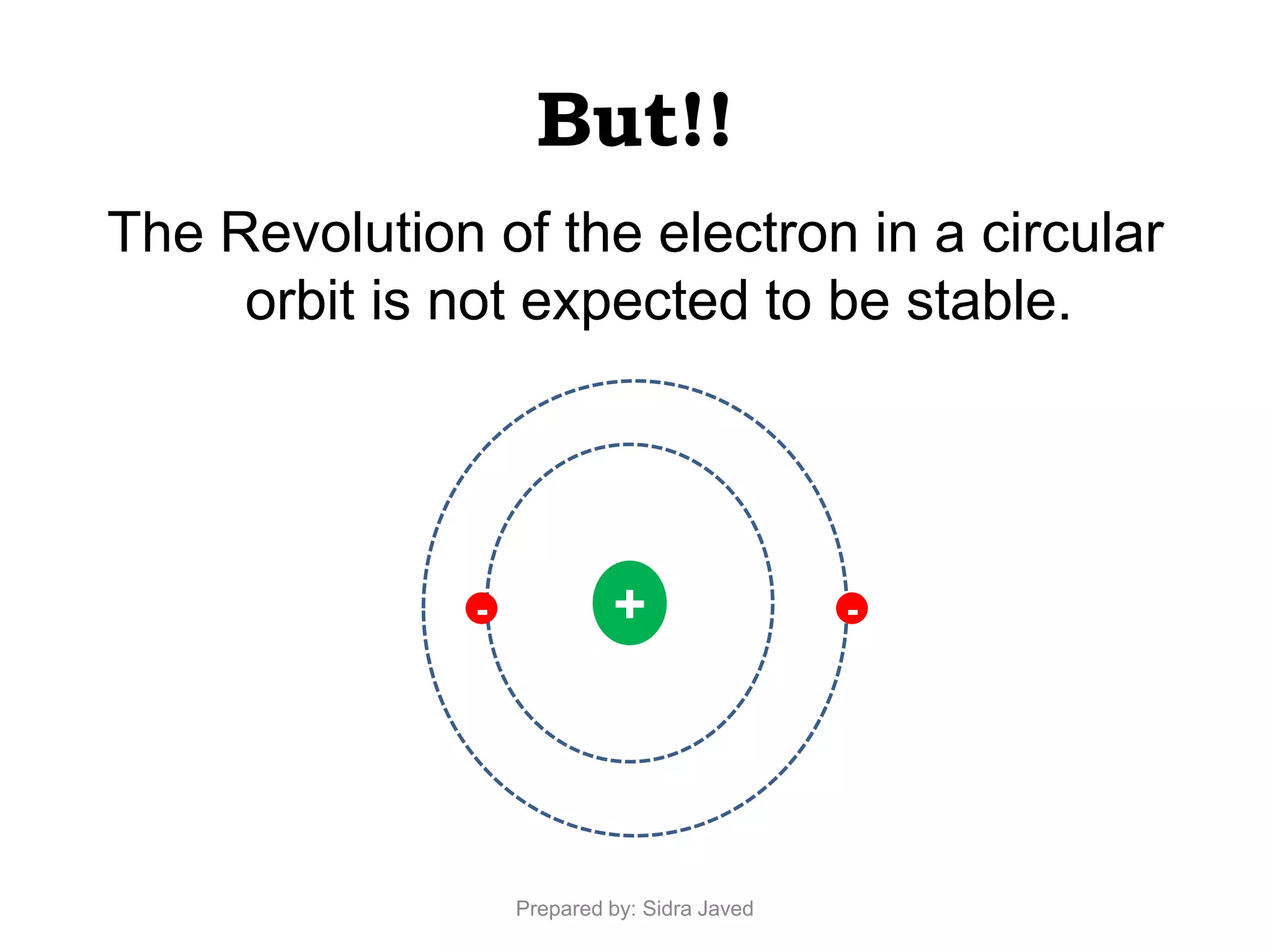
But!!
The Revolution of the electron in a circular
orbit is not expected to be stable.
+ --
Prepared by: Sidra Javed
Any particle in a circular orbit would undergo
acceleration.
During acceleration, charged particles would
radiate energy (hν).
+ --
Prepared by: Sidra Javed
-
+
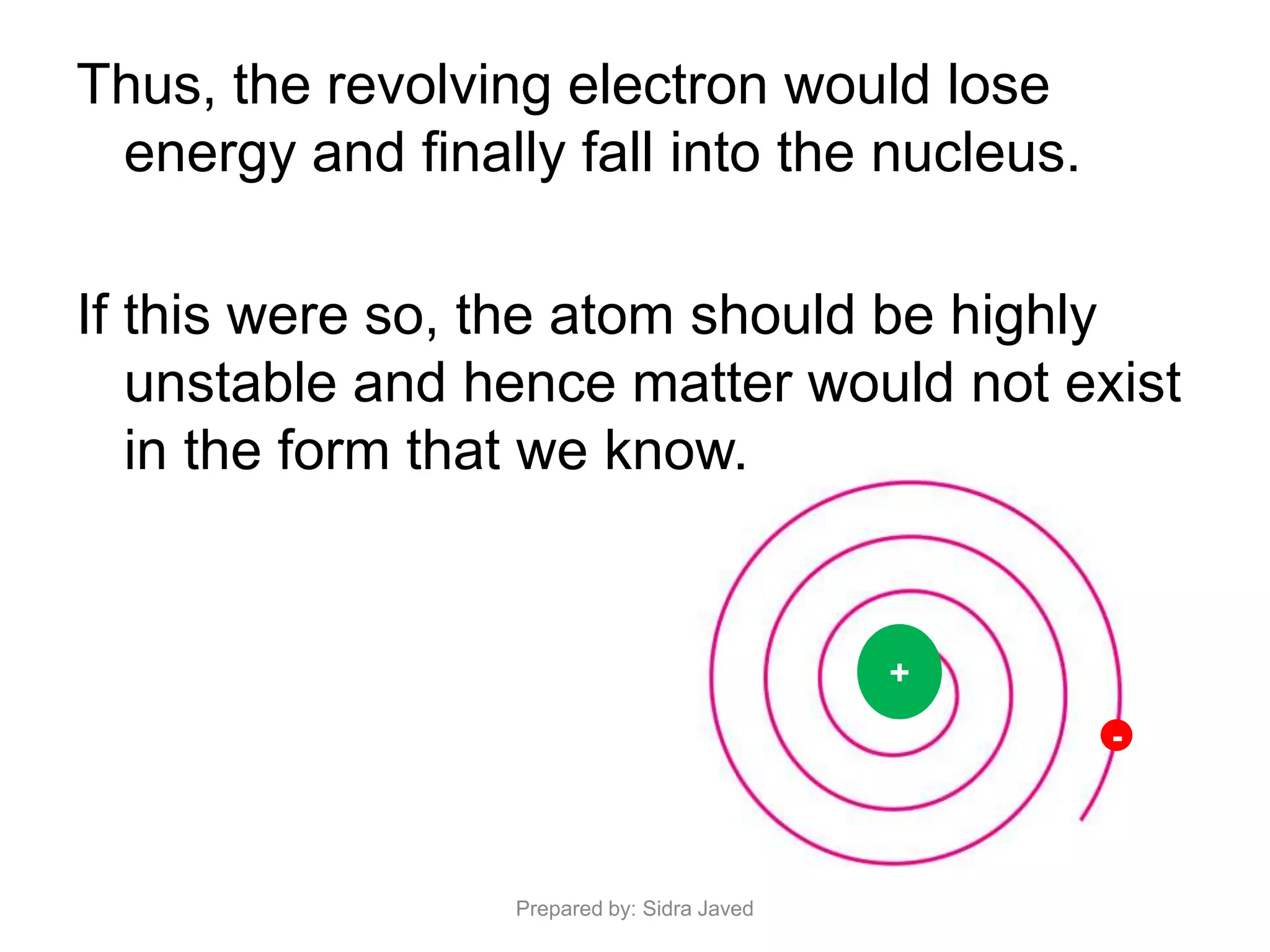
Thus, the revolving electron would lose
energy and finally fall into the nucleus.
If this were so, the atom should be highly
unstable and hence matter would not exist
in the form that we know.
Prepared by: Sidra Javed
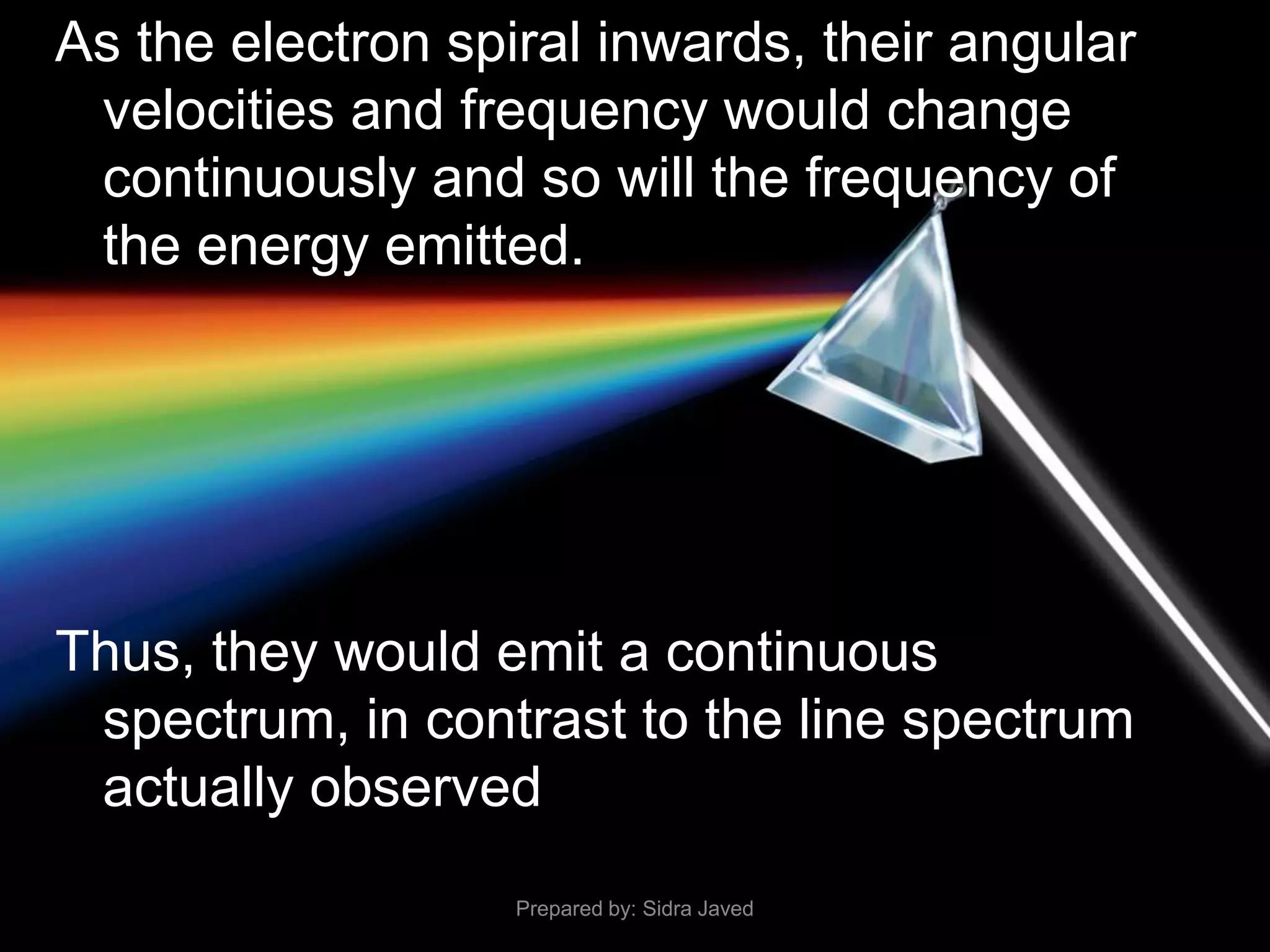
As the electron spiral inwards, their angular
velocities and frequency would change
continuously and so will the frequency of
the energy emitted.
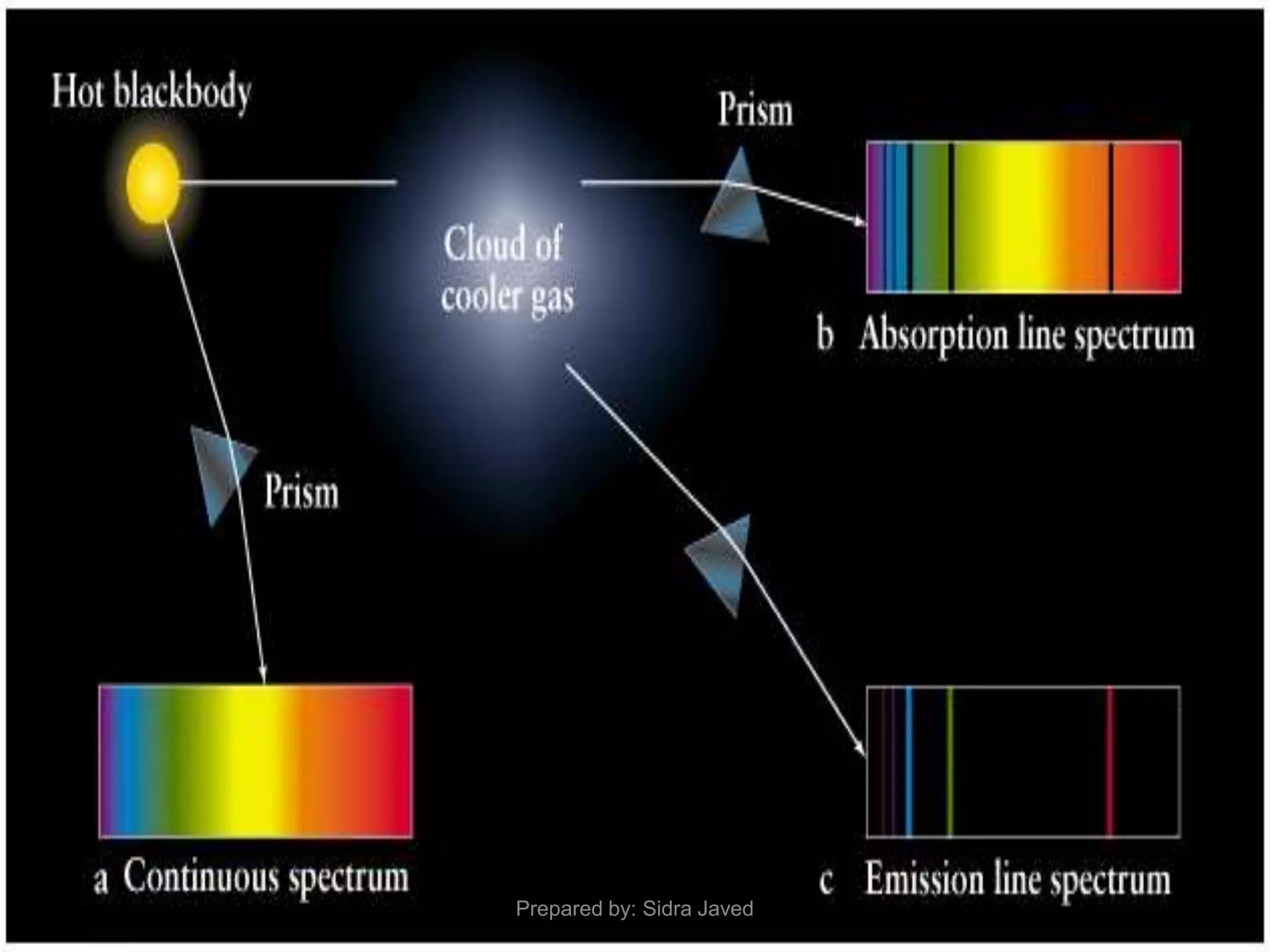
Thus, they would emit a continuous
spectrum, in contrast to the line spectrum
actually observed.
Prepared by: Sidra Javed
Neil Bohr, a Danish Physicist studied
in Rutherford Laboratory since
1912.
He successfully explained the
spectrum of hydrogen atom
and presented Bohr’s
Atomic model.
He was awarded Nobel
Prize in 1922
Prepared by: Sidra Javed
Bohr’s Model of Atom
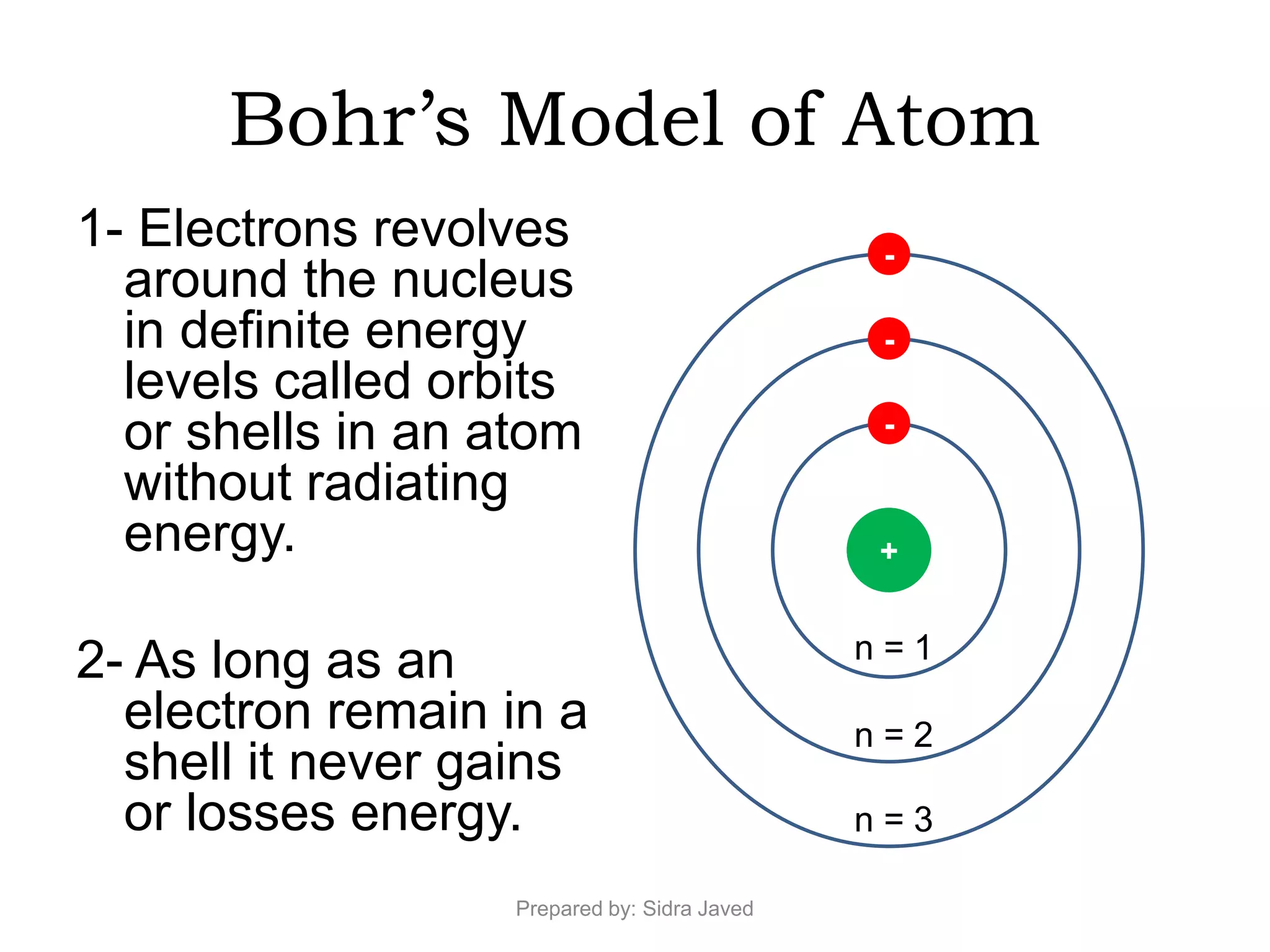
1- Electrons revolves
around the nucleus
in definite energy
levels called orbits
or shells in an atom
without radiating
energy.
2- As long as an
electron remain in a
shell it never gains
or losses energy.
+
-
-
-
n = 3
n = 2
n = 1
Prepared by: Sidra Javed
3- The gain or loss of energy occurs within
orbits only due to jumping of electrons
from one energy level to another energy
level.
+
-
-
Prepared by: Sidra Javed
e
+hν
(Energy )
e
-hν
(Energy )
n=1
n=2
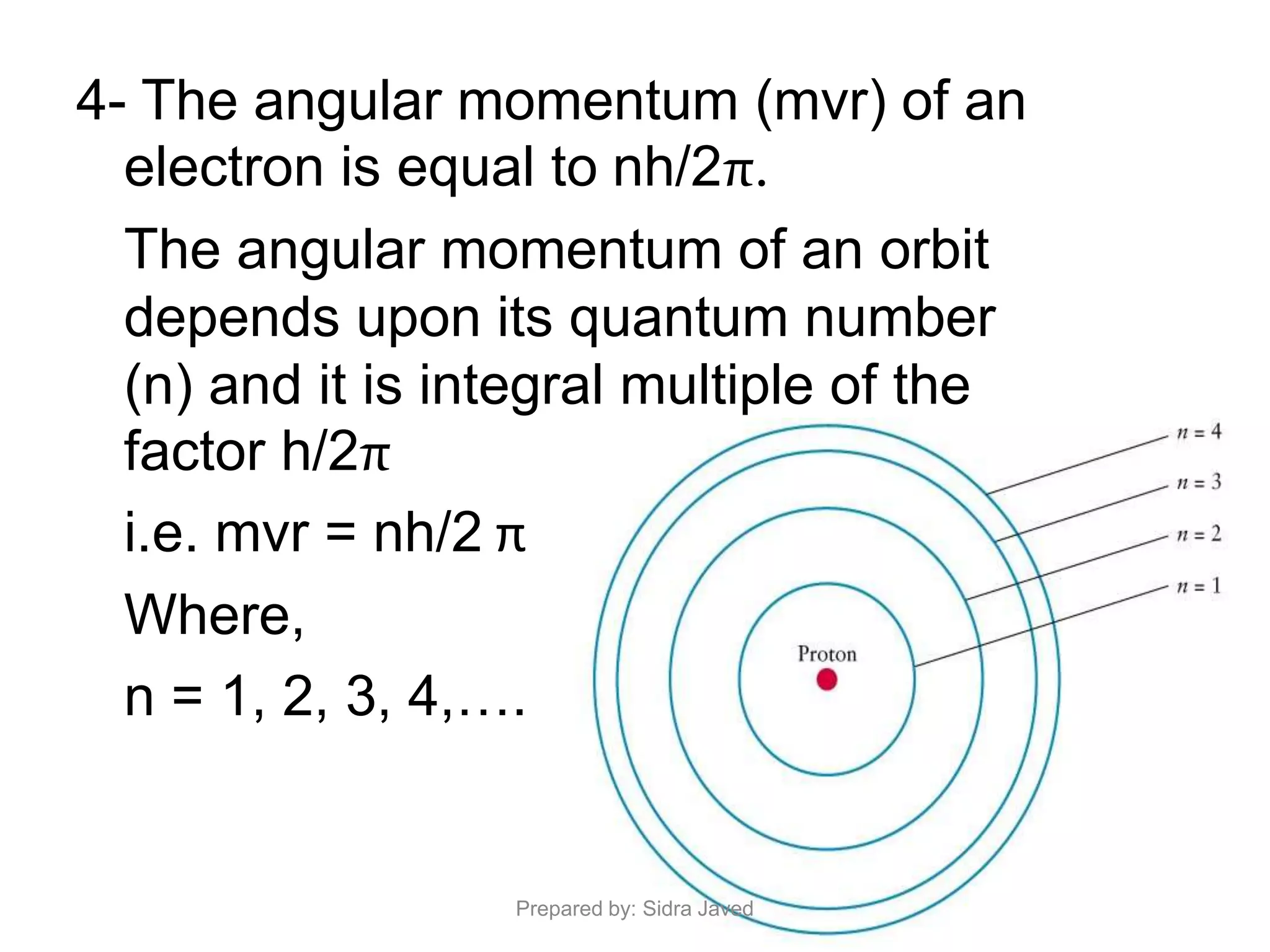
4- The angular momentum (mvr) of an
electron is equal to nh/2π.
The angular momentum of an orbit
depends upon its quantum number
(n) and it is integral multiple of the
factor h/2π
i.e. mvr = nh/2 π
Where,
n = 1, 2, 3, 4,….
Prepared by: Sidra Javed
Applications Of Bohr’s
Atomic Model
• Derivation of Radius of an Orbit of an
atom
• Derivation of Energy of an Orbit
• Derivation of Wave Number (ū)
Prepared by: Sidra Javed
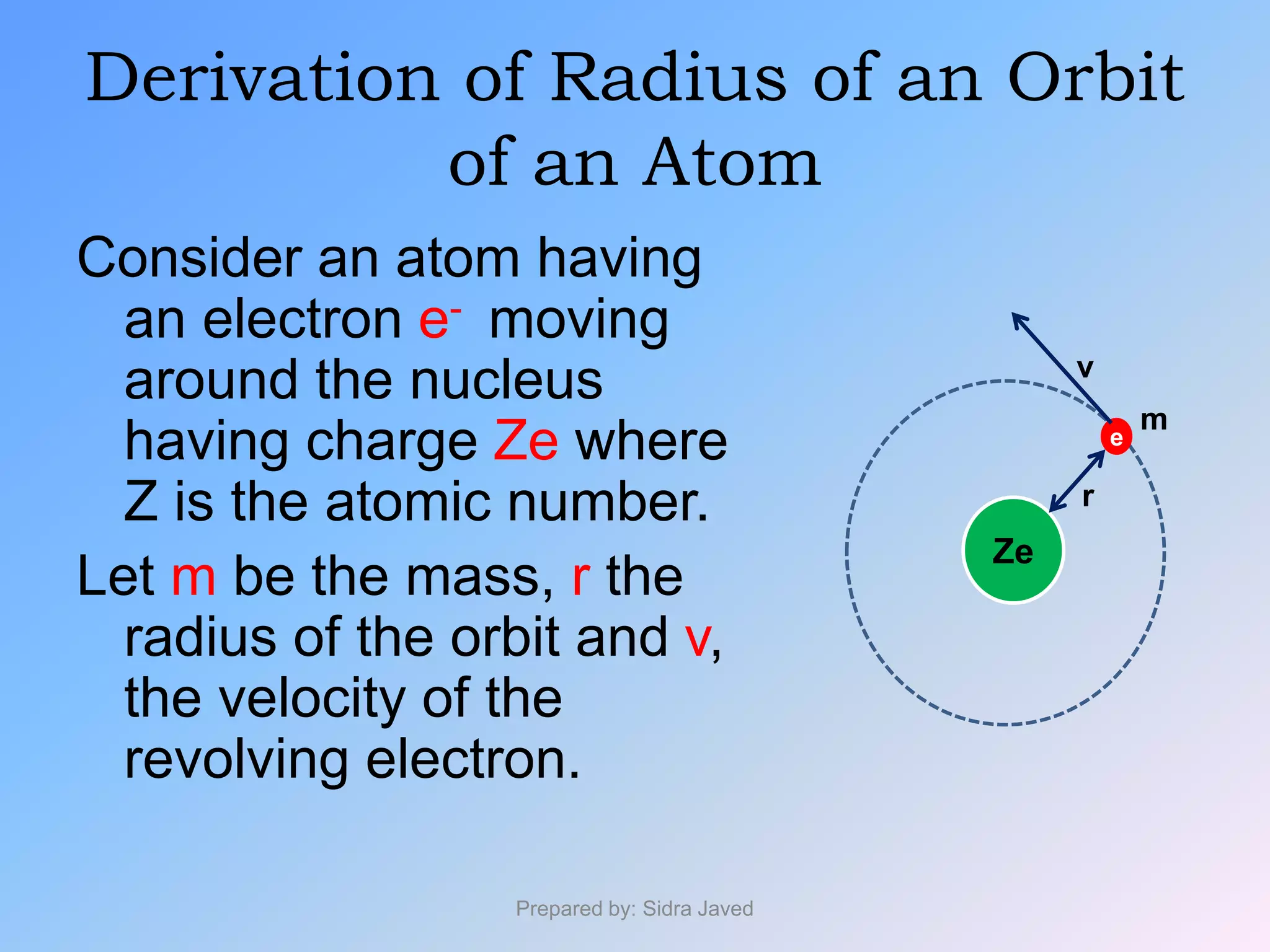
Derivation of Radius of an Orbit
of an Atom
Consider an atom having
an electron e- moving
around the nucleus
having charge Ze where
Z is the atomic number.
Let m be the mass, r the
radius of the orbit and v,
the velocity of the
revolving electron.
Ze
e
r
v
m
Prepared by: Sidra Javed
According to Coloumb’s law, the
electrostatic force of attraction b/w nucleus
and electron :
Where is the vacuum permittivity
constant ( = 8.84 x 10⁻¹² C2/J.m)
22
21
4
.
4 r
eZe
r
qq
F
oo
c


2
2
4 r
Ze
o

o
o
Prepared by: Sidra Javed
Centrifugal force acting on the electron =
The two forces are equal and balance each
other
r
mv2
)2..(..........
4
)1.(..........
4
4
2
2
2
2
2
22
mv
Ze
r
r
Ze
mv
r
Ze
r
mv
o
o
o






Prepared by: Sidra Javed
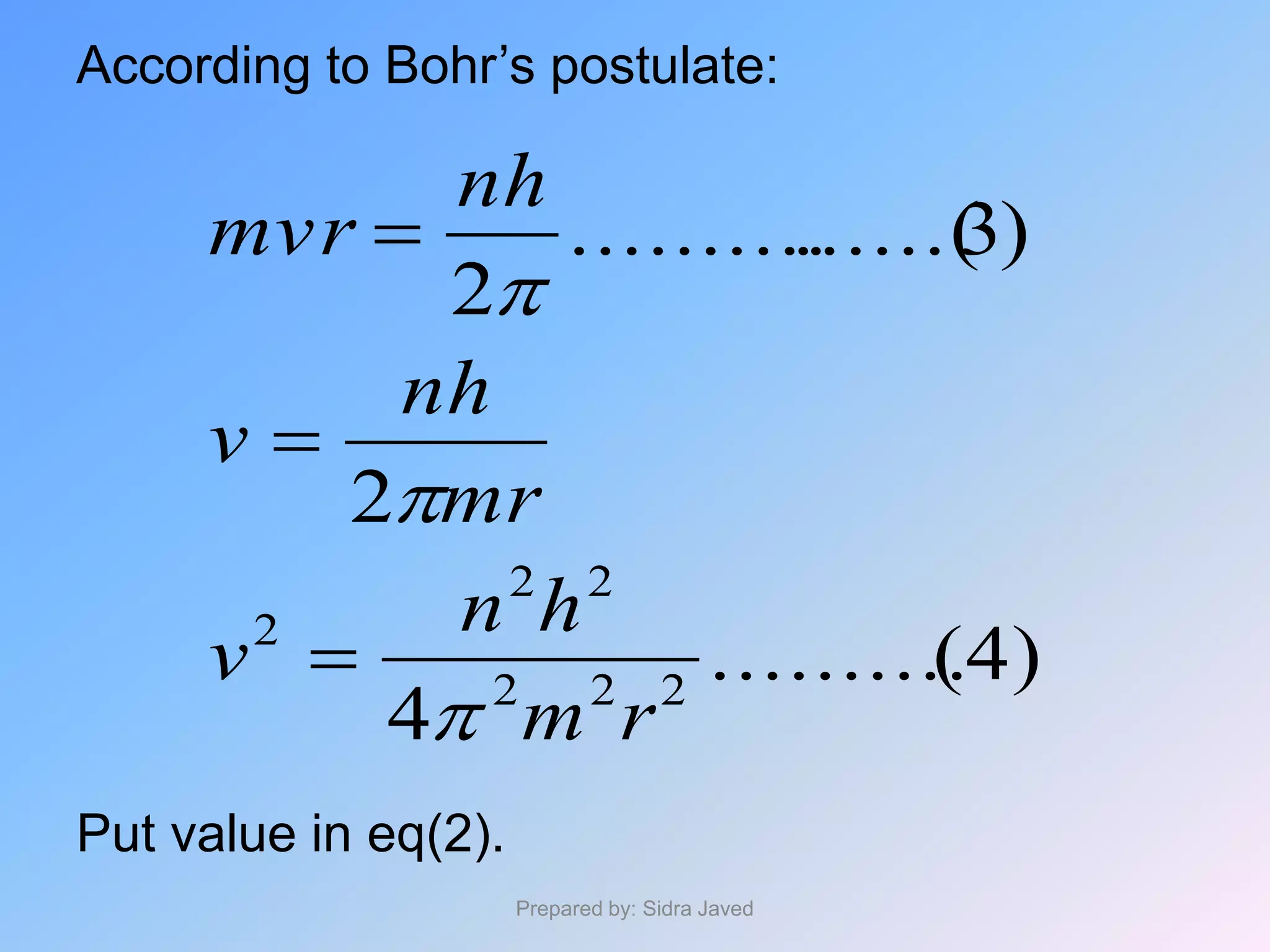
According to Bohr’s postulate:
Put value in eq(2).
)4(..........
4
2
)3......(..........
2
222
22
2
rm
hn
v
mr
nh
v
nh
mvr






Prepared by: Sidra Javed
)5...(..........
1
1
4
4
2
22
222
22
2
22
2222
mZe
hn
r
hnmrZe
hn
mrZe
hn
rm
m
Ze
r















Prepared by: Sidra Javed
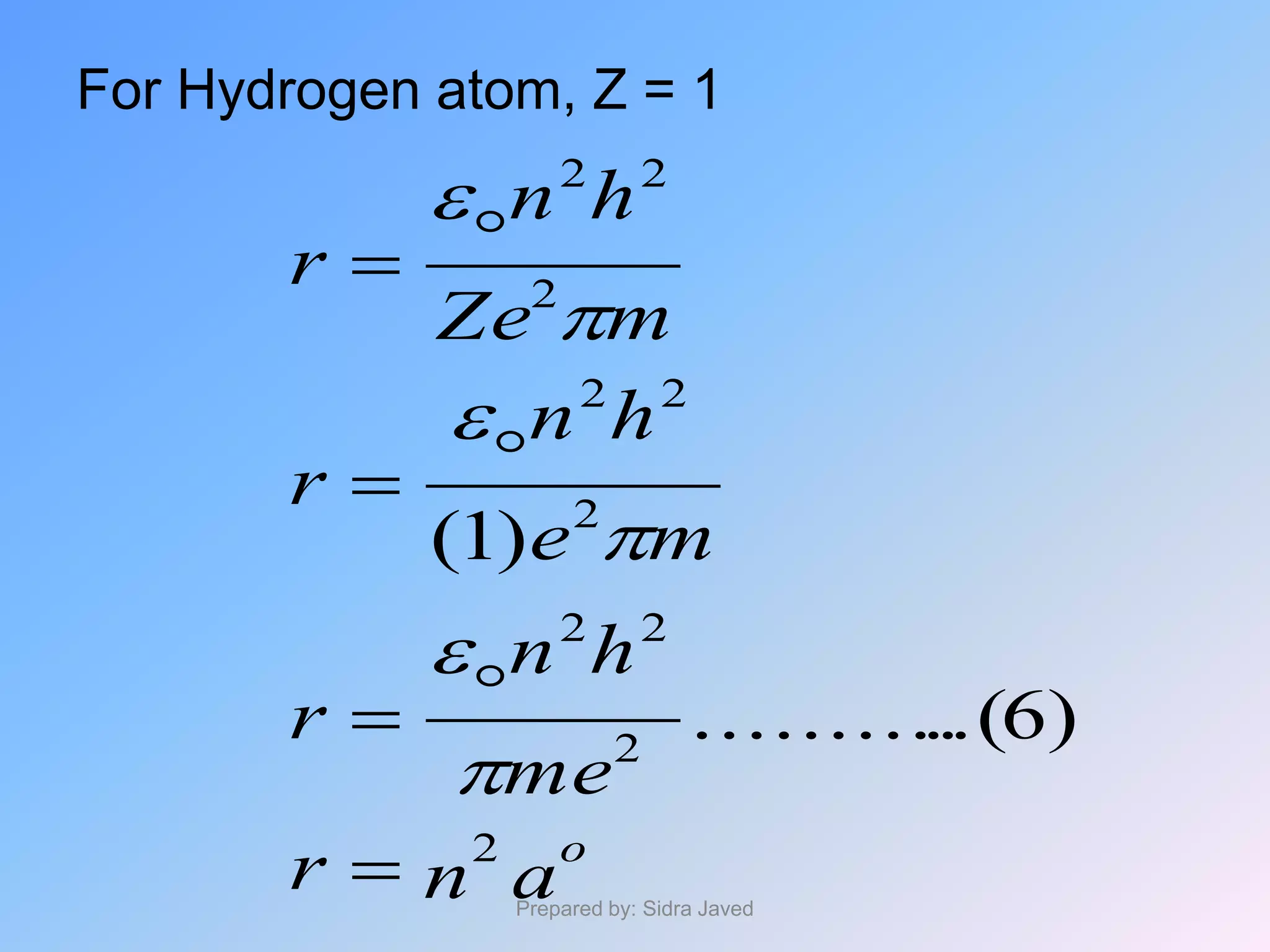
For Hydrogen atom, Z = 1
anr
me
hn
r
me
hn
r
mZe
hn
r
o2
2
22
2
22
2
22
)6..(..........
)1(










Prepared by: Sidra Javed
Where is a constant quantity,
o
o
o
o
anr
a
mxa
me
h
a
.
529.0
10529.0
2
10
2
2









a
o
Prepared by: Sidra Javed
So,
Therefore radius of orbits having n = 1, 2,
3… are as follows:
When n=1:
When n=2:
When n=3:
When n=4:
ο
2
4 A4.8529.0)4( r
o
nr A529.02

Prepared by: Sidra Javed
ο
2
3 A75.4529.0)3( r
ο
2
2 A11.2529.0)2( r

A529.0529.0)1( 2
1 r
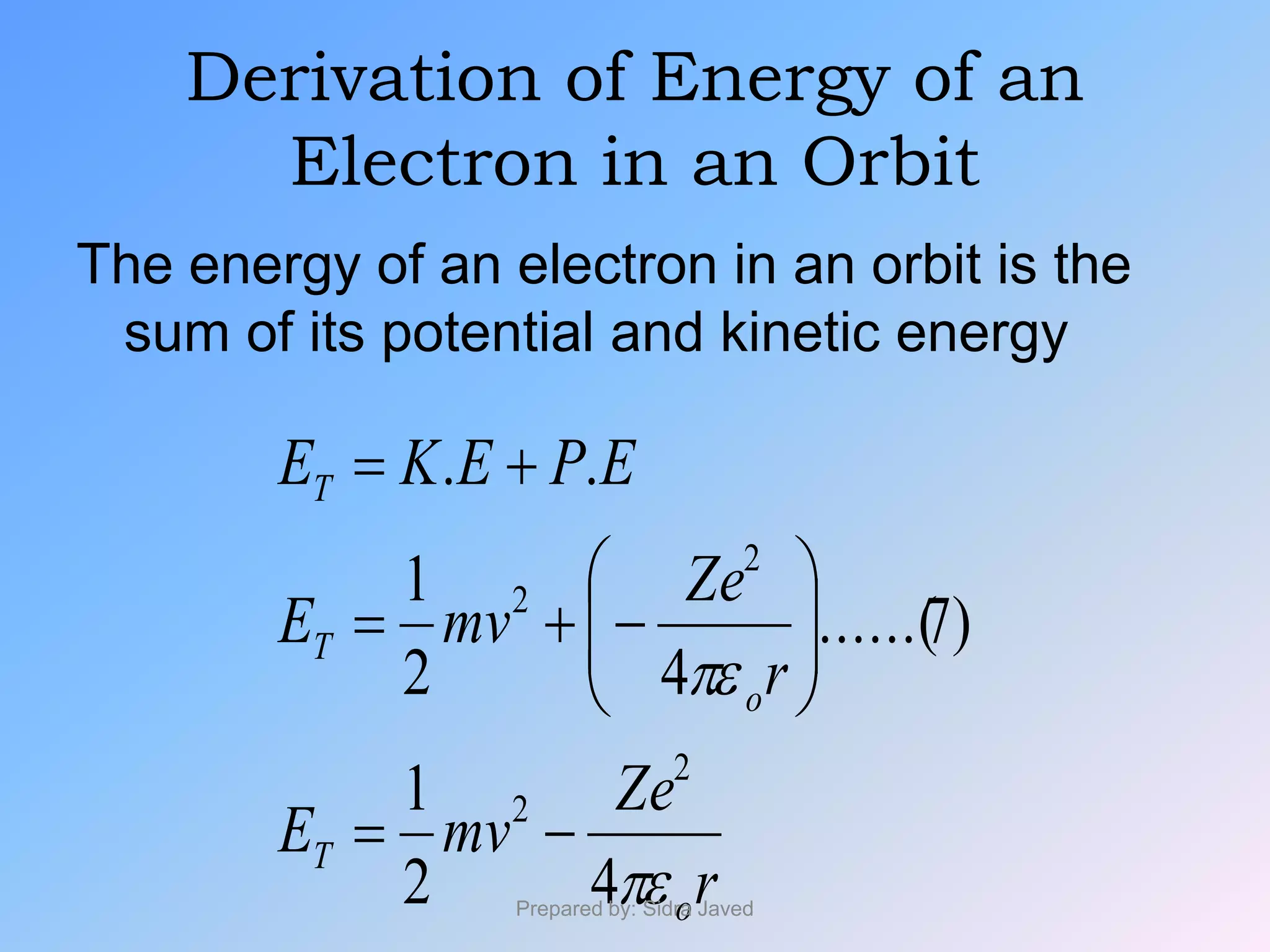
Derivation of Energy of an
Electron in an Orbit
The energy of an electron in an orbit is the
sum of its potential and kinetic energy
r
Ze
mvE
r
Ze
mvE
EPEKE
o
T
o
T
T


42
1
)7......(
42
1
..
2
2
2
2









Prepared by: Sidra Javed
From eq(1)
Putting value in eq (7)
r
Ze
mv 
4
2
2

)8.....(..........
8
1
2
1
4
48
44.2
2
2
22
22
r
Ze
E
r
Ze
E
r
Ze
r
Ze
E
r
Ze
r
Ze
E
n
n
n
T



















Prepared by: Sidra Javed
Now putting the value of r from eq(5) into
eq(8),
For Hydrogen atom; Z=1
)9.(..........
8
8
222
42
22
22
hn
meZ
E
hn
mZeZe
E
o
n
n

















222
4
222
4
1
8
8
nh
me
E
hn
me
E
o
n
o
n


Prepared by: Sidra Javed
But
The negative sign indicated Decrease in
energy of the electron.
18
2
2
18
18
22
4
10178.2where
..(10)J.........
1
10178.2
J10178.2
8













k
n
k
E
n
E
h
me
n
n
o
Prepared by: Sidra Javed
For 1 mol of electron, multiply by Avogadro’s
No.
This energy is associated with 1.008 gram-
atoms of hydrogen.
KJ/mol
1
315.1313
KJ/mol
1000
1002.6
J/mol1002.6
2
23
2
23
2






















n
nE
n
k
nE
n
k
nE
Prepared by: Sidra Javed
If n=1, 2, 3,…. then;
The first energy level when n=1 is called
Ground state of H atom. All others are called
Excited states.
1
2
2
1 315.1313
1
1
315.1313 






 kJmolE
1
2
2
2 32.328
2
1
315.1313 






 kJmolE
1
2
2
3 92.145
3
1
315.1313 






 kJmolE
1
2
2
4 08.82
4
1
315.1313 






 kJmolE
1
2
2
5 53.52
5
1
315.1313 






 kJmolE
Prepared by: Sidra Javed
The first energy level when n=1 is called
Ground state of H atom. All others are
called Excited states.
1
1 315.1313 
 kJmolE
1
2 32.328 
 kJmolE
1
3 92.145 
 kJmolE
1
4 08.82 
 kJmolE
1
5 53.52 
 kJmolE
Prepared by: Sidra Javed
n=1
n=4
n=5
n=2
n=3
Frequency of Radiation emitted
by an Electron
From eq(9)
Let,
E1=energy of orbit n1
E2=energy of orbit n2
Prepared by: Sidra Javed
)9.(..........
8 222
42
hn
meZ
E
o
n



22
2
2
42
2
8 hn
meZ
E
o


22
1
2
42
1
8 hn
meZ
E
o


For H atom, Z=1
Prepared by: Sidra Javed












 




2
2
2
1
22
42
22
1
2
42
22
2
2
42
12
11
8
88
nnh
meZ
E
hn
meZ
hn
meZ
E
EEE
o
oo


)11(..........
11
8 2
2
2
1
22
4







nnh
me
E
o
Here,
But according to Planck’s Quantum Theory,
Prepared by: Sidra Javed
)12.(..........
11
1018.2
J1018.2
8
2
2
2
1
18
18
22
4










nn
E
h
me
o









2
2
2
1
18 11
1018.2
nn
h
hE


Again
or,
Prepared by: Sidra Javed






 2
2
2
1
22
4
11
8 nnh
me
h
o

)13........(secCycles.orHz
11
8
1
2
2
2
1
32
4








nnh
me
o

Hz
11
1029.3 2
2
2
1
15







nn
x
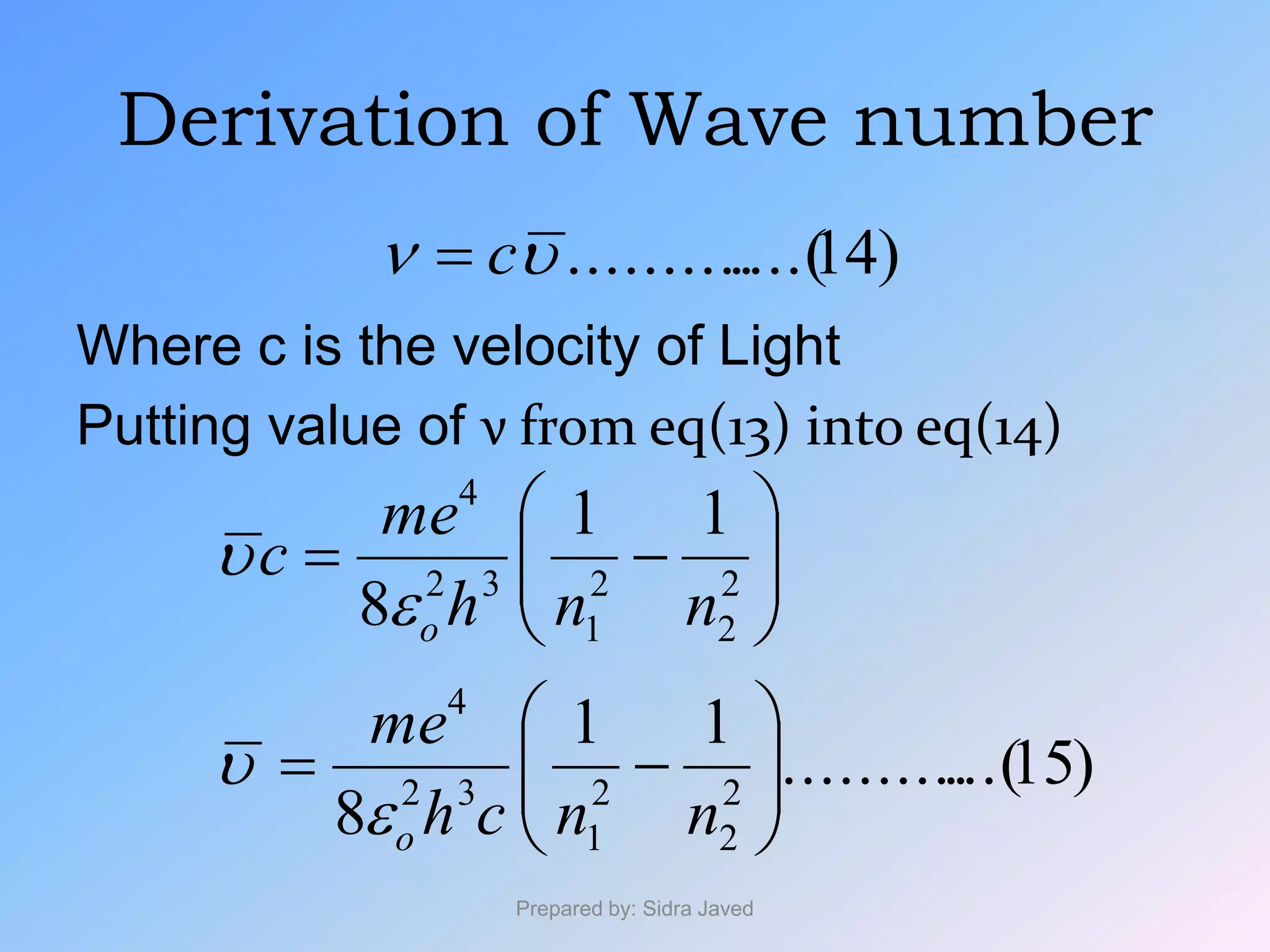
Derivation of Wave number
Where c is the velocity of Light
Putting value of ν from eq(13) into eq(14)
Prepared by: Sidra Javed
)14....(.......... c
)15...(..........
11
8
11
8
2
2
2
1
32
4
2
2
2
1
32
4














nnch
me
nnh
me
c
o
o




Putting values of constants, we get a factor
called Rydberg’s Constant, R.
Prepared by: Sidra Javed
17
32
4
m1009678.1
8

 R
ch
me
o
)16...(..........
11
2
2
2
1







nn
R
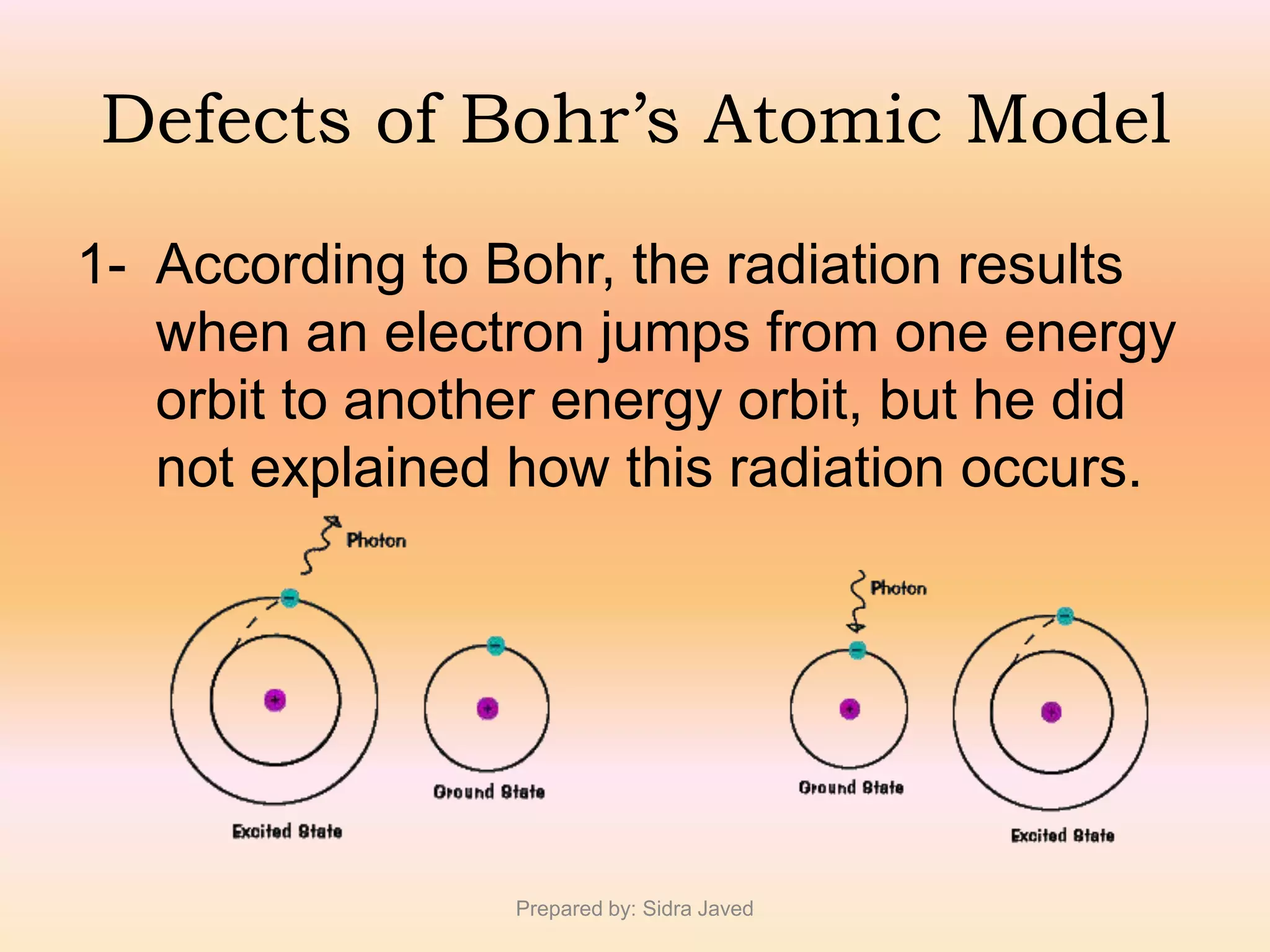
Defects of Bohr’s Atomic Model
1- According to Bohr, the radiation results
when an electron jumps from one energy
orbit to another energy orbit, but he did
not explained how this radiation occurs.
Prepared by: Sidra Javed
2- Bohr’s theory explained the existence of
various lines in H-spectrum, but it
predicted that only a series of lines exist.
Later on it was realized that the spectral
lines that had been thought to be a
single line was actually a collection of
several lines very close to each other.
Prepared by: Sidra Javed
3- Bohr’s theory successfully explained
the observed spectra for H – atom and
similar ions (He+1 , Li+2 , Be+3 etc) but it
can not explained the spectra for poly
electron atoms.
Prepared by: Sidra Javed
Hydrogen
1p, 1e
Helium
ion
2p, 1e
+1
Beryllium
Ion
4p, 1e
+3
Lithium
Ion
3p, 1e
+2
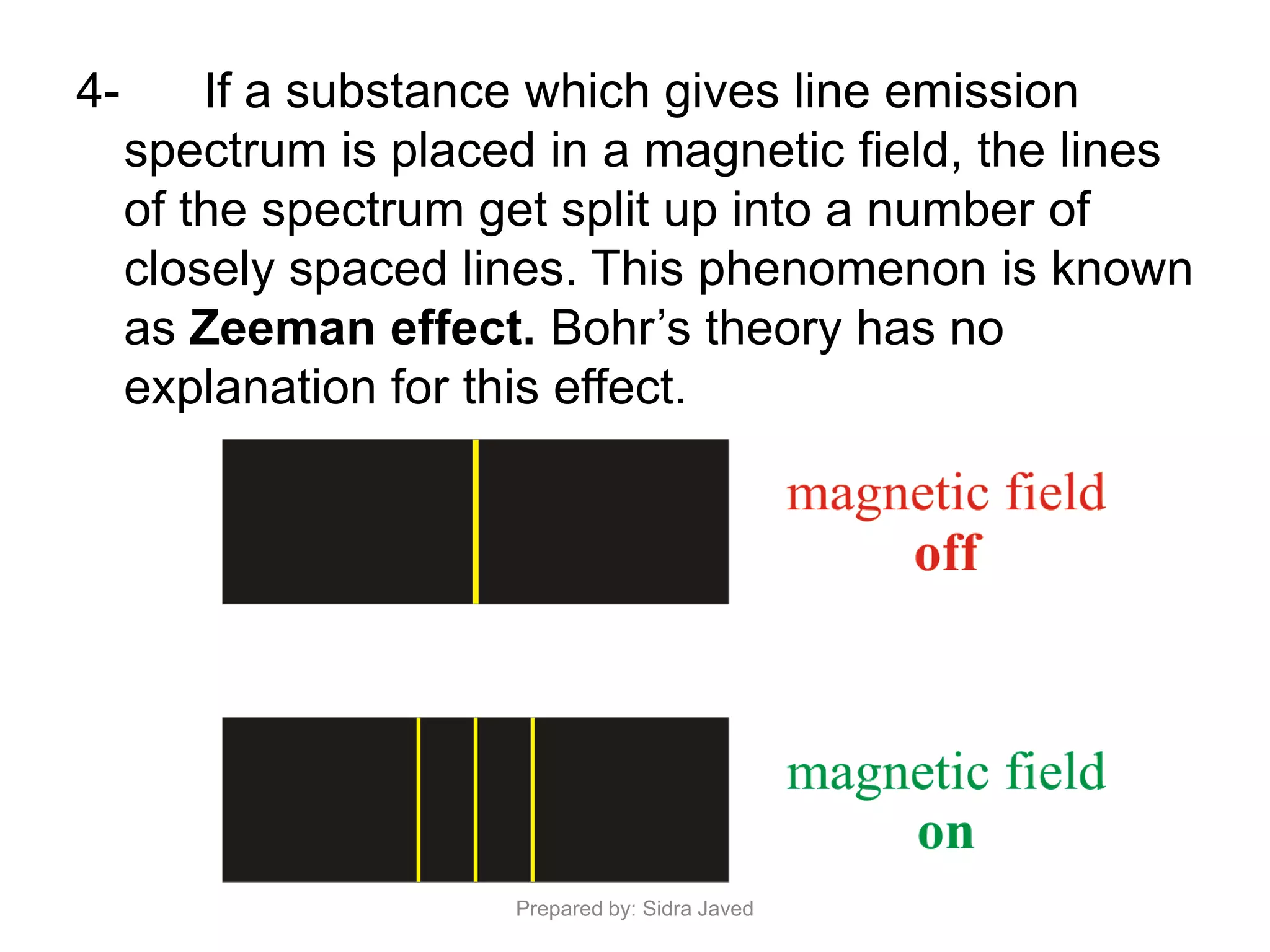
4- If a substance which gives line emission
spectrum is placed in a magnetic field, the lines
of the spectrum get split up into a number of
closely spaced lines. This phenomenon is known
as Zeeman effect. Bohr’s theory has no
explanation for this effect.
Prepared by: Sidra Javed
5- If a substance which gives line
emission spectrum is placed in an external
electric field, the lines of the spectrum get
split up into a number of closely spaced
lines. This phenomenon is known as Stark
effect. Bohr’s theory has no explanation
for this effect as well.
Prepared by: Sidra Javed
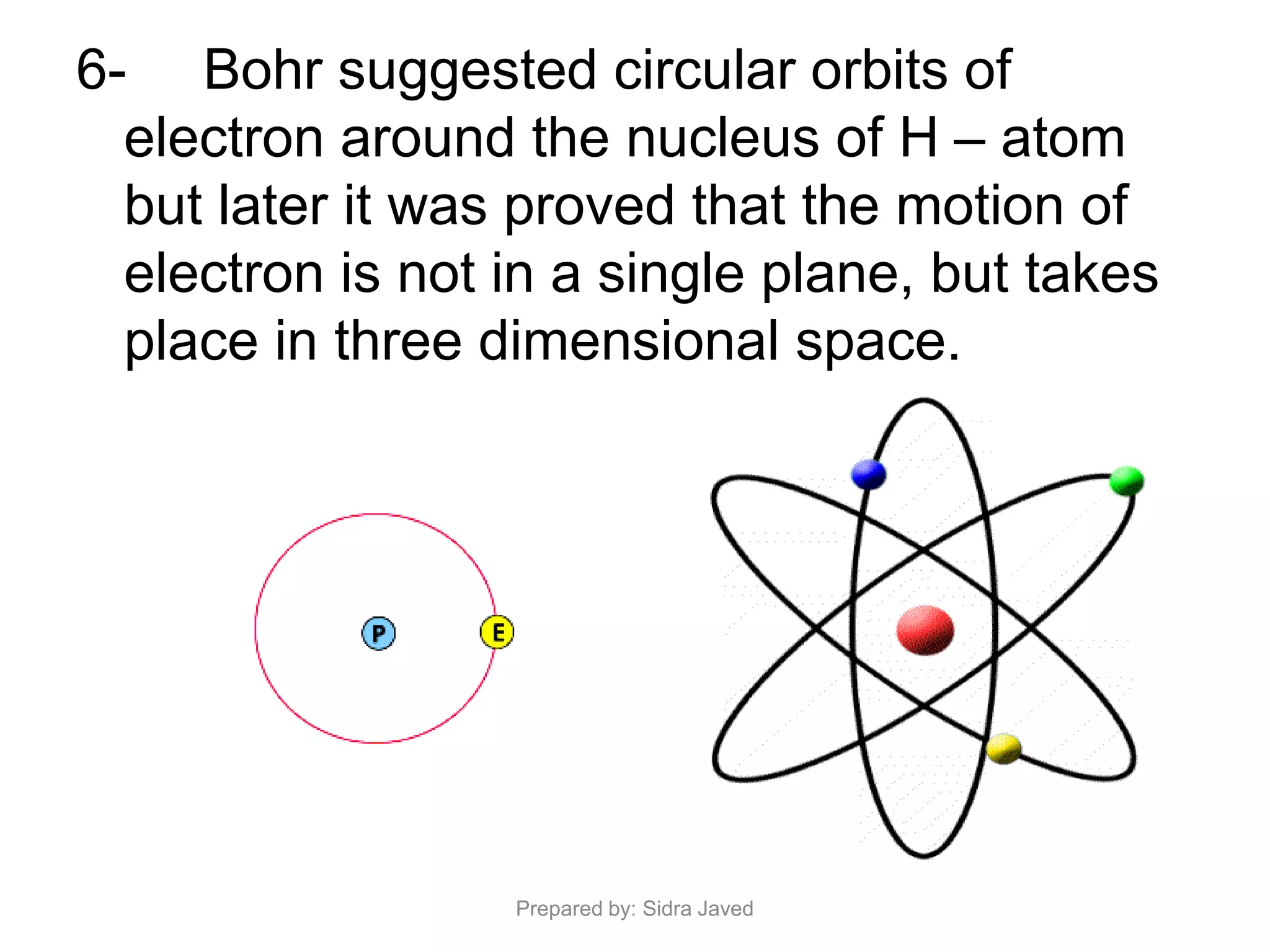
6- Bohr suggested circular orbits of
electron around the nucleus of H – atom
but later it was proved that the motion of
electron is not in a single plane, but takes
place in three dimensional space.
Prepared by: Sidra Javed
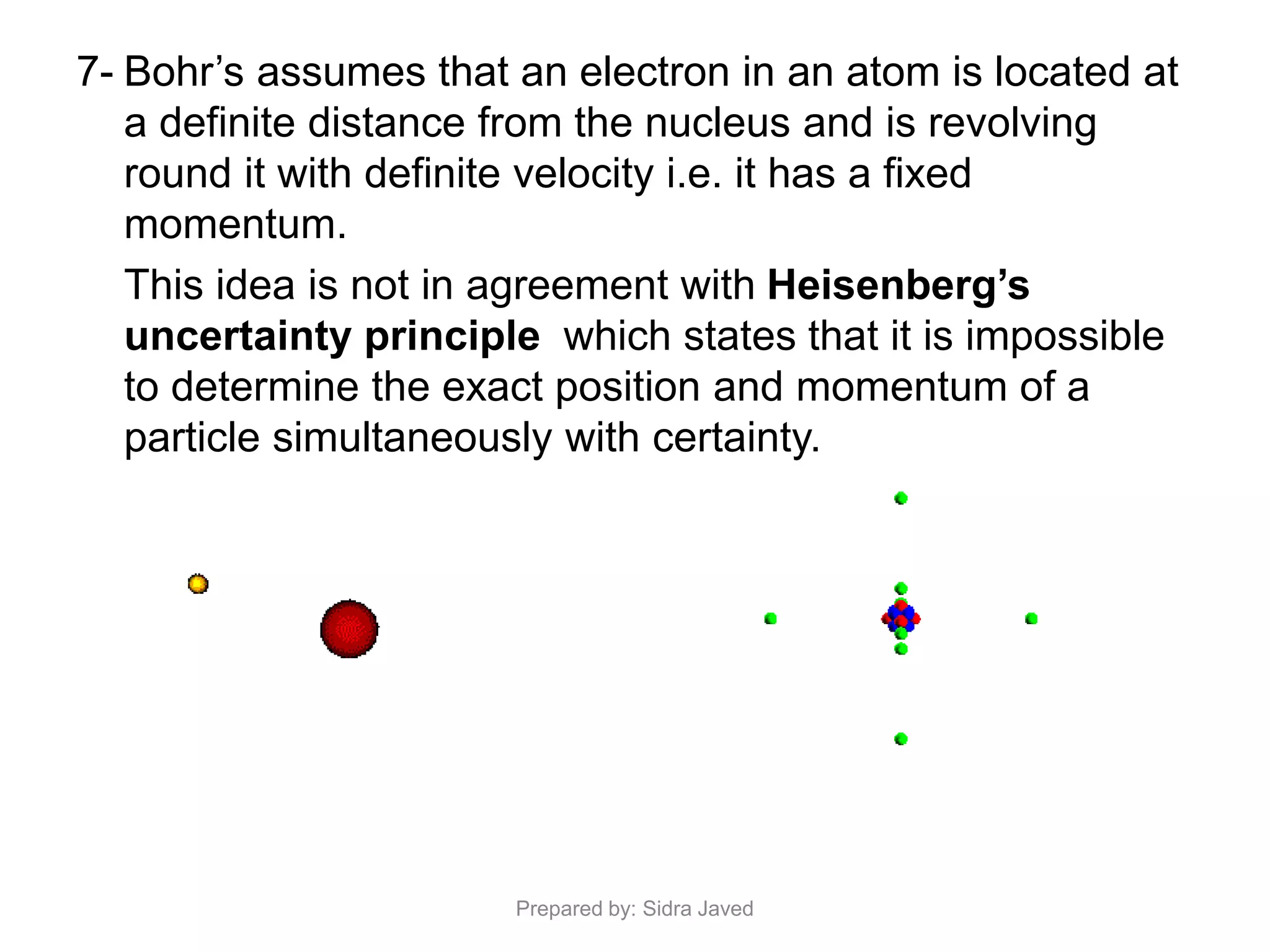
7- Bohr’s assumes that an electron in an atom is located at
a definite distance from the nucleus and is revolving
round it with definite velocity i.e. it has a fixed
momentum.
This idea is not in agreement with Heisenberg’s
uncertainty principle which states that it is impossible
to determine the exact position and momentum of a
particle simultaneously with certainty.
Prepared by: Sidra Javed
The End
Prepared by: Sidra Javed

Bohr's model

  • 1.
    BOHR’S ATOMIC MODEL &ITS APPLICATIONS Chapter # 2 Atomic Structure Prepared by: Sidra Javed
  • 2.
    The Fundamental Particles Particle Charge (Coulomb) Relative Charge Mass (Kg) Mass (a.m.u) Found in: Proton +1.602 x 10⁻¹⁹ +1 1.6727 x 10⁻²⁷ 1.0073 Nucleus Neutron 0 0 1.6750 x 10⁻²⁷ 1.0087 Nucleus Electron -1.602 x 10⁻¹⁹ -1 9.1095 x 10⁻³¹ 5.4858 x 10⁻⁴ Outside Nucleus Prepared by: Sidra Javed
  • 3.
    After the GoldFoil Experiment Rutherford’s proposed the Planetary Model of Atom. Just like the solar system, the Nucleus lies in the center of the atom and electron revolves around it in their orbits Prepared by: Sidra Javed
  • 4.
  • 5.
    But!! The Revolution ofthe electron in a circular orbit is not expected to be stable. + -- Prepared by: Sidra Javed
  • 6.
    Any particle ina circular orbit would undergo acceleration. During acceleration, charged particles would radiate energy (hν). + -- Prepared by: Sidra Javed
  • 7.
    - + Thus, the revolvingelectron would lose energy and finally fall into the nucleus. If this were so, the atom should be highly unstable and hence matter would not exist in the form that we know. Prepared by: Sidra Javed
  • 8.
  • 9.
    As the electronspiral inwards, their angular velocities and frequency would change continuously and so will the frequency of the energy emitted. Thus, they would emit a continuous spectrum, in contrast to the line spectrum actually observed. Prepared by: Sidra Javed
  • 10.
  • 11.
    Neil Bohr, aDanish Physicist studied in Rutherford Laboratory since 1912. He successfully explained the spectrum of hydrogen atom and presented Bohr’s Atomic model. He was awarded Nobel Prize in 1922 Prepared by: Sidra Javed
  • 12.
    Bohr’s Model ofAtom 1- Electrons revolves around the nucleus in definite energy levels called orbits or shells in an atom without radiating energy. 2- As long as an electron remain in a shell it never gains or losses energy. + - - - n = 3 n = 2 n = 1 Prepared by: Sidra Javed
  • 13.
    3- The gainor loss of energy occurs within orbits only due to jumping of electrons from one energy level to another energy level. + - - Prepared by: Sidra Javed e +hν (Energy ) e -hν (Energy ) n=1 n=2
  • 14.
    4- The angularmomentum (mvr) of an electron is equal to nh/2π. The angular momentum of an orbit depends upon its quantum number (n) and it is integral multiple of the factor h/2π i.e. mvr = nh/2 π Where, n = 1, 2, 3, 4,…. Prepared by: Sidra Javed
  • 15.
    Applications Of Bohr’s AtomicModel • Derivation of Radius of an Orbit of an atom • Derivation of Energy of an Orbit • Derivation of Wave Number (ū) Prepared by: Sidra Javed
  • 16.
    Derivation of Radiusof an Orbit of an Atom Consider an atom having an electron e- moving around the nucleus having charge Ze where Z is the atomic number. Let m be the mass, r the radius of the orbit and v, the velocity of the revolving electron. Ze e r v m Prepared by: Sidra Javed
  • 17.
    According to Coloumb’slaw, the electrostatic force of attraction b/w nucleus and electron : Where is the vacuum permittivity constant ( = 8.84 x 10⁻¹² C2/J.m) 22 21 4 . 4 r eZe r qq F oo c   2 2 4 r Ze o  o o Prepared by: Sidra Javed
  • 18.
    Centrifugal force actingon the electron = The two forces are equal and balance each other r mv2 )2..(.......... 4 )1.(.......... 4 4 2 2 2 2 2 22 mv Ze r r Ze mv r Ze r mv o o o       Prepared by: Sidra Javed
  • 19.
    According to Bohr’spostulate: Put value in eq(2). )4(.......... 4 2 )3......(.......... 2 222 22 2 rm hn v mr nh v nh mvr       Prepared by: Sidra Javed
  • 20.
  • 21.
    For Hydrogen atom,Z = 1 anr me hn r me hn r mZe hn r o2 2 22 2 22 2 22 )6..(.......... )1(           Prepared by: Sidra Javed
  • 22.
    Where is aconstant quantity, o o o o anr a mxa me h a . 529.0 10529.0 2 10 2 2          a o Prepared by: Sidra Javed
  • 23.
    So, Therefore radius oforbits having n = 1, 2, 3… are as follows: When n=1: When n=2: When n=3: When n=4: ο 2 4 A4.8529.0)4( r o nr A529.02  Prepared by: Sidra Javed ο 2 3 A75.4529.0)3( r ο 2 2 A11.2529.0)2( r  A529.0529.0)1( 2 1 r
  • 24.
    Derivation of Energyof an Electron in an Orbit The energy of an electron in an orbit is the sum of its potential and kinetic energy r Ze mvE r Ze mvE EPEKE o T o T T   42 1 )7......( 42 1 .. 2 2 2 2          Prepared by: Sidra Javed
  • 25.
    From eq(1) Putting valuein eq (7) r Ze mv  4 2 2  )8.....(.......... 8 1 2 1 4 48 44.2 2 2 22 22 r Ze E r Ze E r Ze r Ze E r Ze r Ze E n n n T                    Prepared by: Sidra Javed
  • 26.
    Now putting thevalue of r from eq(5) into eq(8), For Hydrogen atom; Z=1 )9.(.......... 8 8 222 42 22 22 hn meZ E hn mZeZe E o n n                  222 4 222 4 1 8 8 nh me E hn me E o n o n   Prepared by: Sidra Javed
  • 27.
    But The negative signindicated Decrease in energy of the electron. 18 2 2 18 18 22 4 10178.2where ..(10)J......... 1 10178.2 J10178.2 8              k n k E n E h me n n o Prepared by: Sidra Javed
  • 28.
    For 1 molof electron, multiply by Avogadro’s No. This energy is associated with 1.008 gram- atoms of hydrogen. KJ/mol 1 315.1313 KJ/mol 1000 1002.6 J/mol1002.6 2 23 2 23 2                       n nE n k nE n k nE Prepared by: Sidra Javed
  • 29.
    If n=1, 2,3,…. then; The first energy level when n=1 is called Ground state of H atom. All others are called Excited states. 1 2 2 1 315.1313 1 1 315.1313         kJmolE 1 2 2 2 32.328 2 1 315.1313         kJmolE 1 2 2 3 92.145 3 1 315.1313         kJmolE 1 2 2 4 08.82 4 1 315.1313         kJmolE 1 2 2 5 53.52 5 1 315.1313         kJmolE Prepared by: Sidra Javed
  • 30.
    The first energylevel when n=1 is called Ground state of H atom. All others are called Excited states. 1 1 315.1313   kJmolE 1 2 32.328   kJmolE 1 3 92.145   kJmolE 1 4 08.82   kJmolE 1 5 53.52   kJmolE Prepared by: Sidra Javed n=1 n=4 n=5 n=2 n=3
  • 31.
    Frequency of Radiationemitted by an Electron From eq(9) Let, E1=energy of orbit n1 E2=energy of orbit n2 Prepared by: Sidra Javed )9.(.......... 8 222 42 hn meZ E o n    22 2 2 42 2 8 hn meZ E o   22 1 2 42 1 8 hn meZ E o  
  • 32.
    For H atom,Z=1 Prepared by: Sidra Javed                   2 2 2 1 22 42 22 1 2 42 22 2 2 42 12 11 8 88 nnh meZ E hn meZ hn meZ E EEE o oo   )11(.......... 11 8 2 2 2 1 22 4        nnh me E o
  • 33.
    Here, But according toPlanck’s Quantum Theory, Prepared by: Sidra Javed )12.(.......... 11 1018.2 J1018.2 8 2 2 2 1 18 18 22 4           nn E h me o          2 2 2 1 18 11 1018.2 nn h hE  
  • 34.
    Again or, Prepared by: SidraJaved        2 2 2 1 22 4 11 8 nnh me h o  )13........(secCycles.orHz 11 8 1 2 2 2 1 32 4         nnh me o  Hz 11 1029.3 2 2 2 1 15        nn x
  • 35.
    Derivation of Wavenumber Where c is the velocity of Light Putting value of ν from eq(13) into eq(14) Prepared by: Sidra Javed )14....(.......... c )15...(.......... 11 8 11 8 2 2 2 1 32 4 2 2 2 1 32 4               nnch me nnh me c o o    
  • 36.
    Putting values ofconstants, we get a factor called Rydberg’s Constant, R. Prepared by: Sidra Javed 17 32 4 m1009678.1 8   R ch me o )16...(.......... 11 2 2 2 1        nn R
  • 37.
    Defects of Bohr’sAtomic Model 1- According to Bohr, the radiation results when an electron jumps from one energy orbit to another energy orbit, but he did not explained how this radiation occurs. Prepared by: Sidra Javed
  • 38.
    2- Bohr’s theoryexplained the existence of various lines in H-spectrum, but it predicted that only a series of lines exist. Later on it was realized that the spectral lines that had been thought to be a single line was actually a collection of several lines very close to each other. Prepared by: Sidra Javed
  • 39.
    3- Bohr’s theorysuccessfully explained the observed spectra for H – atom and similar ions (He+1 , Li+2 , Be+3 etc) but it can not explained the spectra for poly electron atoms. Prepared by: Sidra Javed Hydrogen 1p, 1e Helium ion 2p, 1e +1 Beryllium Ion 4p, 1e +3 Lithium Ion 3p, 1e +2
  • 40.
    4- If asubstance which gives line emission spectrum is placed in a magnetic field, the lines of the spectrum get split up into a number of closely spaced lines. This phenomenon is known as Zeeman effect. Bohr’s theory has no explanation for this effect. Prepared by: Sidra Javed
  • 41.
    5- If asubstance which gives line emission spectrum is placed in an external electric field, the lines of the spectrum get split up into a number of closely spaced lines. This phenomenon is known as Stark effect. Bohr’s theory has no explanation for this effect as well. Prepared by: Sidra Javed
  • 42.
    6- Bohr suggestedcircular orbits of electron around the nucleus of H – atom but later it was proved that the motion of electron is not in a single plane, but takes place in three dimensional space. Prepared by: Sidra Javed
  • 43.
    7- Bohr’s assumesthat an electron in an atom is located at a definite distance from the nucleus and is revolving round it with definite velocity i.e. it has a fixed momentum. This idea is not in agreement with Heisenberg’s uncertainty principle which states that it is impossible to determine the exact position and momentum of a particle simultaneously with certainty. Prepared by: Sidra Javed
  • 44.