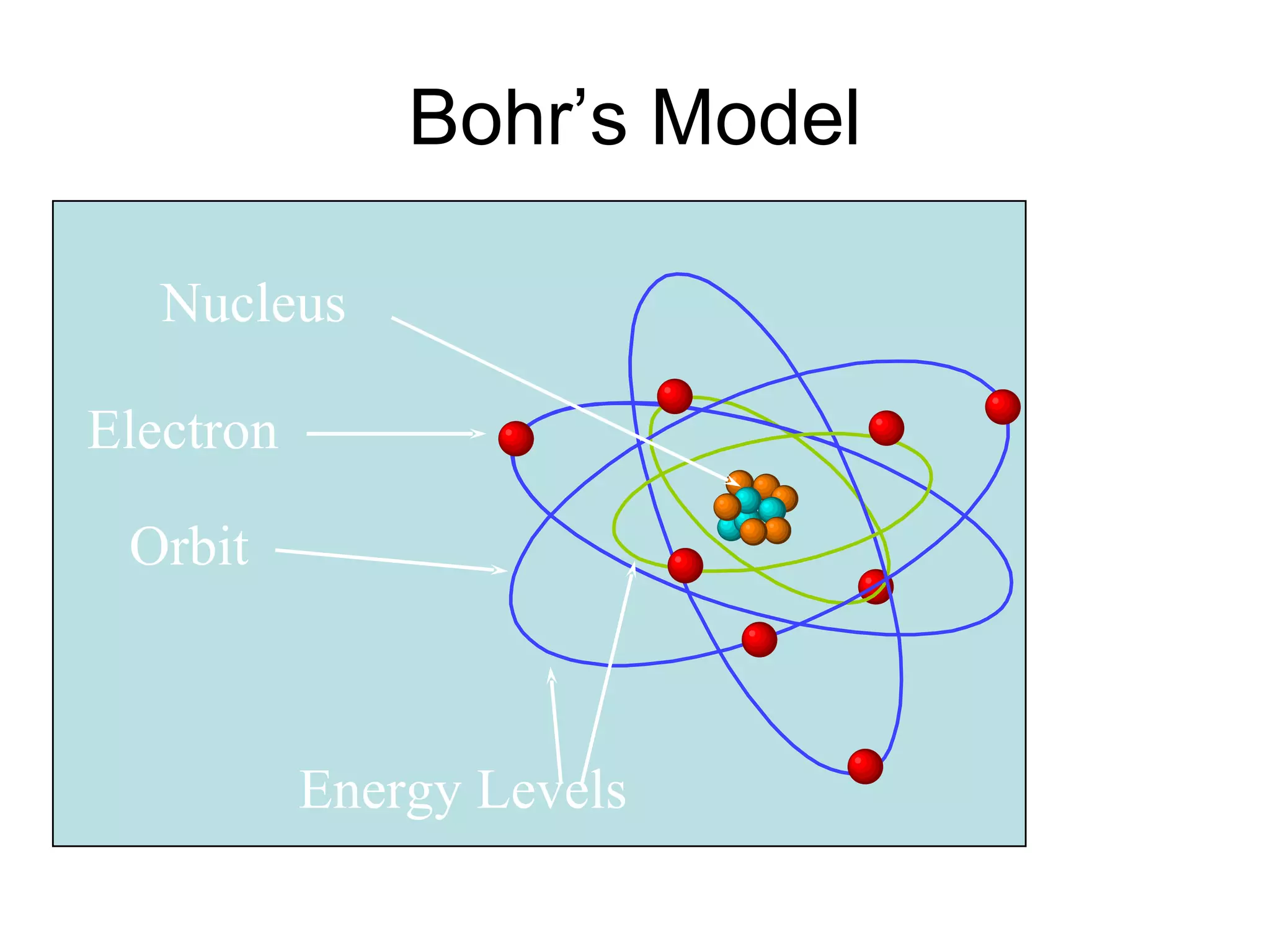
Bohr’s Model Nucleus Electron Orbit Energy Levels Nucleus Electron Orbit Energy Levels
The Bohr Model In 1913 Bohr provided an explanation of atomic spectra His model includes both classical and non-classical ideas His model included an attempt to explain why the atom was stable
Bohr said classical view is wrong.  Need a new theory — now called  QUANTUM  or  WAVE MECHANICS . Bohr Model
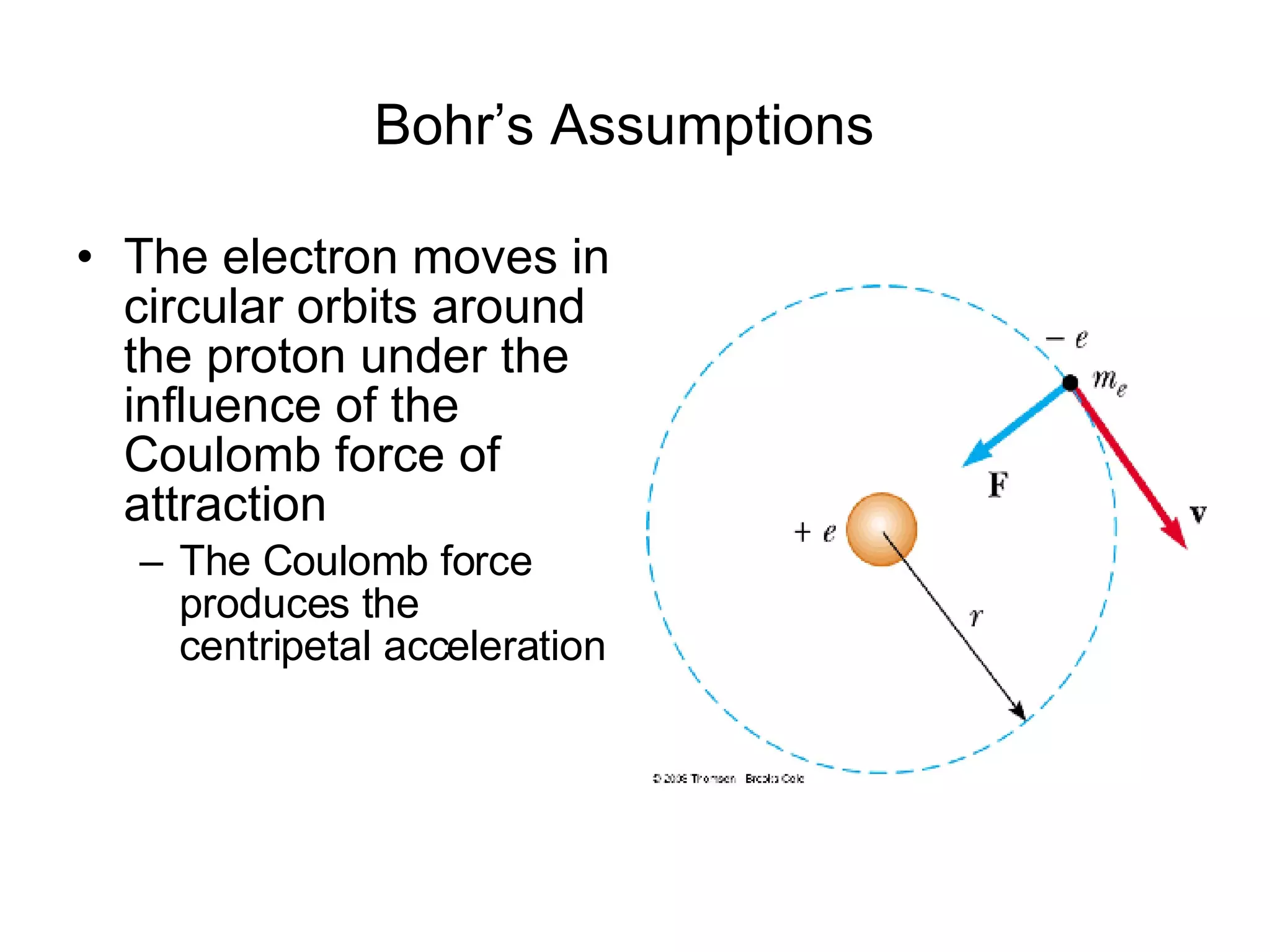
Bohr’s Assumptions   The electron moves in circular orbits around the proton under the influence of the Coulomb force of attraction The Coulomb force produces the centripetal acceleration
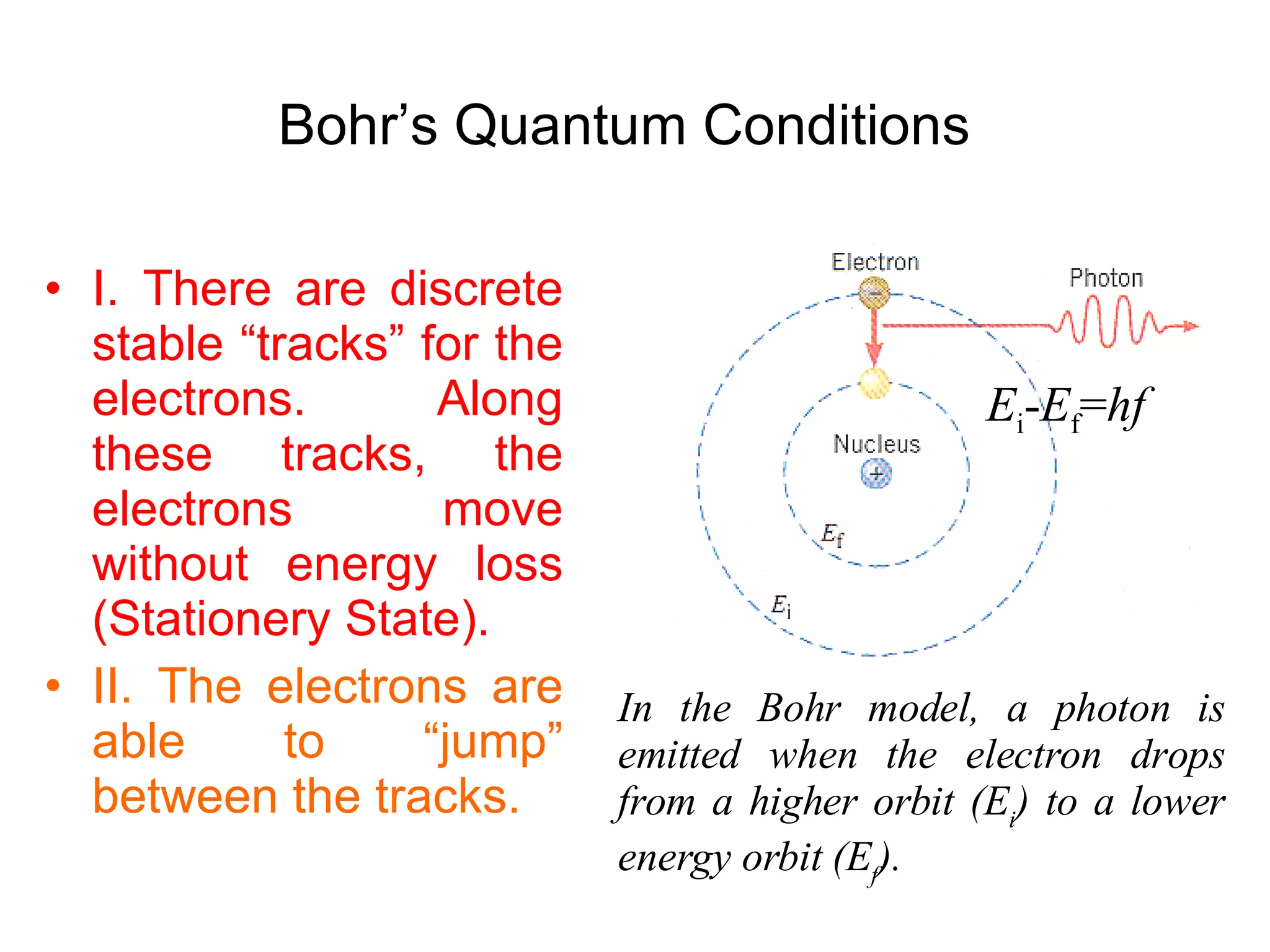
Bohr’s Quantum Conditions   I. There are discrete stable “tracks” for the electrons. Along these tracks, the electrons move without energy loss (Stationery State). II. The electrons are able to “jump” between the tracks. In the Bohr model, a photon is emitted when the electron drops from a higher orbit (E i ) to a lower energy orbit (E f ).   E i - E f = hf
Bohr Model: Orbit Radius Bohr assumed that the angular momentum of the electron was quantized and could have only discrete values that were integral multiples of  h /2  , where  h  is Plank’s constant m e vr = nh /(2  );  n =1, 2, 3,… v = nh /(2    m e r )
Bohr Model: Energy of electron in orbit In each orbit, the energy of the electron is restricted to a certain value -  E = - R H /n 2 R H  is a constant in energy units:  = 2.179 X  10 -18  J/atom  = 13.6eV/atom  = 1312 KJ/mole Number of orbit = n = 1, 2, 3, etc.
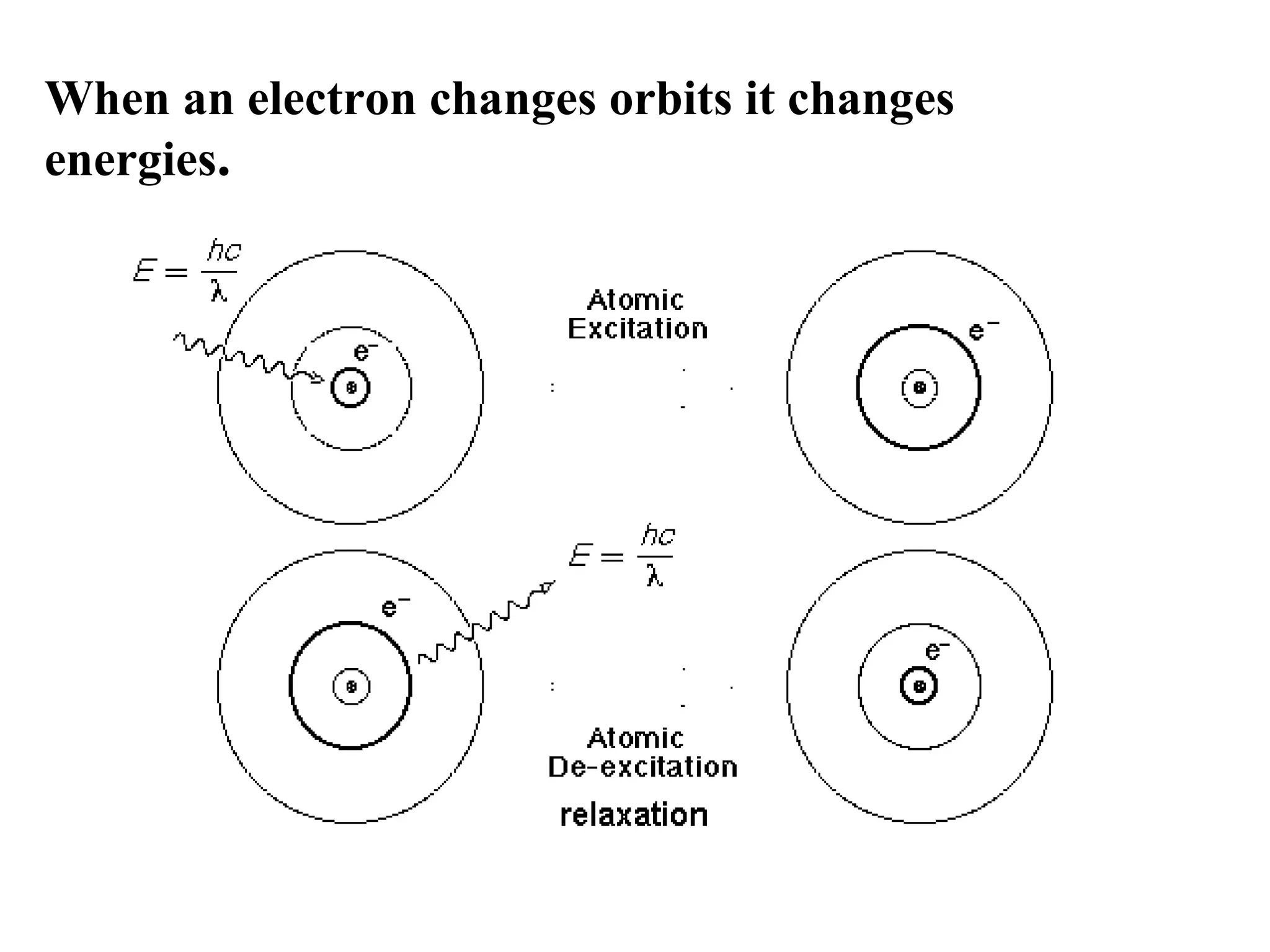
When an electron changes orbits it changes energies .
Energy is emitted in the form of light (electromagnetic radiation as the electron moves from a higher orbit to a lower one (from a higher energy level to a lower one). Energy is absorbed as electricity or heat  as the electron moves from a lower to a higher orbit (energy level).
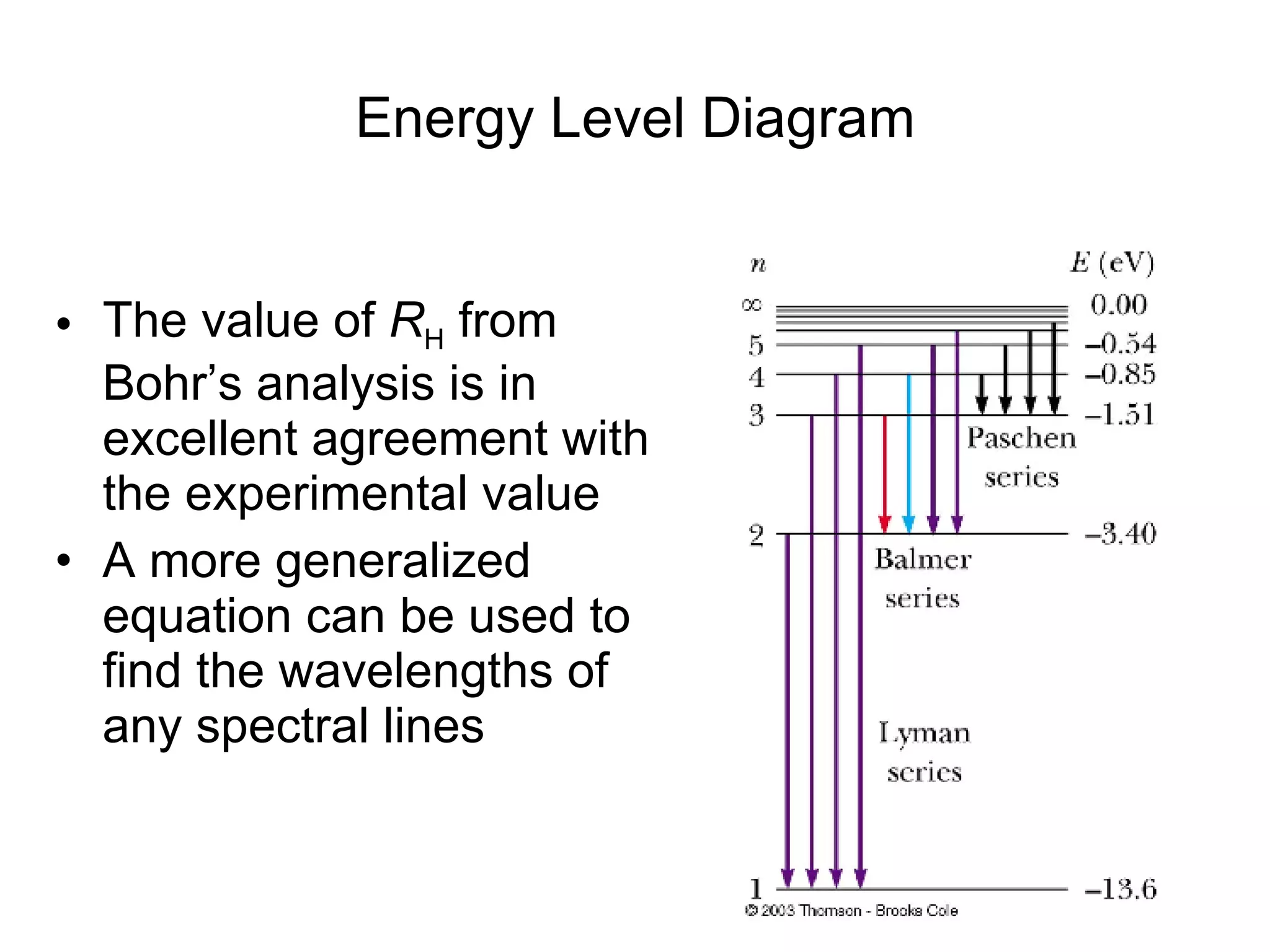
Specific Energy Levels The lowest energy state is called the  ground state This corresponds to  n  = 1 Energy is –13.6 eV The next energy level has an energy of –3.40 eV The energies can be compiled in an  energy level diagram The  ionization energy  is the energy needed to completely remove the electron from the atom The ionization energy for hydrogen is 13.6 eV
Energy Level Diagram The value of  R H  from Bohr’s analysis is in excellent agreement with the experimental value A more generalized equation can be used to find the wavelengths of any spectral lines
Orbit Radii and Energies r n =0.0529  n 2   (nm) E n =-13.6/ n 2   (eV) Energy difference between the levels   E =13.6(1/ n f 2 -1/ n i 2 ) For example, between  n =1 and  n =2 (as drawn in the picture)   E =13.6(1/ n f 2 -1/ n i 2 )=13.6(1/1 2 -1/2 2 )=10.2 eV        E= 10.2 eV Final state,  n f Initial State,  n i
PROBLEMS WITH THE BOHR ATOM A) It is only successful with the Hydrogen atom B) It could not account for extra lines in the H emission spectrum when a magnetic field was applied to the gas:  Zeeman Effect  : Splitting of Spectral lines under the external magnetic fields Stark Effect  :  Splitting of Spectral lines under the external electric field
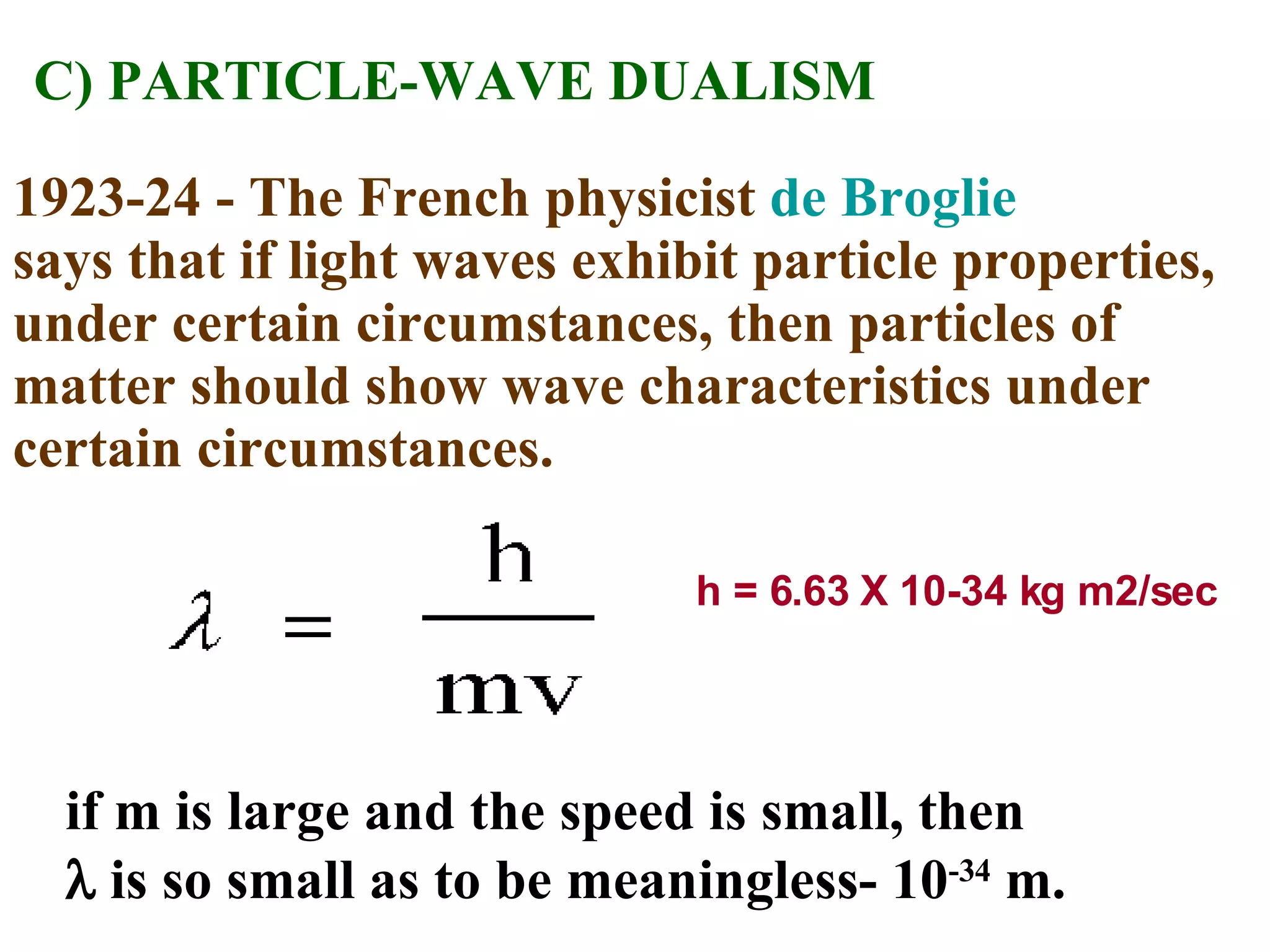
C) PARTICLE-WAVE DUALISM 1923-24 - The French physicist  de Broglie   says that if light waves exhibit particle properties, under certain circumstances, then particles of matter should show wave characteristics under certain circumstances. h = 6.63 X 10⁻³⁴ kg m2/sec if m is large and the speed is small, then    is so small as to be meaningless- 10 -34  m.
D)  The idea of circular orbits and knowing where the electron is located is impossible:   In 1927  Werner Heisenberg  showed from quantum mechanics that it is impossible to know simultaneously, with absolute precision, both the position and the momentum of a particle such as an  electron. The  Heisenberg Uncertainty Principle! ▲ x  * m ▲ v  ≥   h/4 

Bohr 2

  • 1.
    Bohr’s Model NucleusElectron Orbit Energy Levels Nucleus Electron Orbit Energy Levels
  • 2.
    The Bohr ModelIn 1913 Bohr provided an explanation of atomic spectra His model includes both classical and non-classical ideas His model included an attempt to explain why the atom was stable
  • 3.
    Bohr said classicalview is wrong. Need a new theory — now called QUANTUM or WAVE MECHANICS . Bohr Model
  • 4.
    Bohr’s Assumptions The electron moves in circular orbits around the proton under the influence of the Coulomb force of attraction The Coulomb force produces the centripetal acceleration
  • 5.
    Bohr’s Quantum Conditions I. There are discrete stable “tracks” for the electrons. Along these tracks, the electrons move without energy loss (Stationery State). II. The electrons are able to “jump” between the tracks. In the Bohr model, a photon is emitted when the electron drops from a higher orbit (E i ) to a lower energy orbit (E f ). E i - E f = hf
  • 6.
    Bohr Model: OrbitRadius Bohr assumed that the angular momentum of the electron was quantized and could have only discrete values that were integral multiples of h /2  , where h is Plank’s constant m e vr = nh /(2  ); n =1, 2, 3,… v = nh /(2  m e r )
  • 7.
    Bohr Model: Energyof electron in orbit In each orbit, the energy of the electron is restricted to a certain value - E = - R H /n 2 R H is a constant in energy units: = 2.179 X 10 -18 J/atom = 13.6eV/atom = 1312 KJ/mole Number of orbit = n = 1, 2, 3, etc.
  • 8.
    When an electronchanges orbits it changes energies .
  • 9.
    Energy is emittedin the form of light (electromagnetic radiation as the electron moves from a higher orbit to a lower one (from a higher energy level to a lower one). Energy is absorbed as electricity or heat as the electron moves from a lower to a higher orbit (energy level).
  • 10.
    Specific Energy LevelsThe lowest energy state is called the ground state This corresponds to n = 1 Energy is –13.6 eV The next energy level has an energy of –3.40 eV The energies can be compiled in an energy level diagram The ionization energy is the energy needed to completely remove the electron from the atom The ionization energy for hydrogen is 13.6 eV
  • 11.
    Energy Level DiagramThe value of R H from Bohr’s analysis is in excellent agreement with the experimental value A more generalized equation can be used to find the wavelengths of any spectral lines
  • 12.
    Orbit Radii andEnergies r n =0.0529  n 2 (nm) E n =-13.6/ n 2 (eV) Energy difference between the levels  E =13.6(1/ n f 2 -1/ n i 2 ) For example, between n =1 and n =2 (as drawn in the picture)  E =13.6(1/ n f 2 -1/ n i 2 )=13.6(1/1 2 -1/2 2 )=10.2 eV        E= 10.2 eV Final state, n f Initial State, n i
  • 13.
    PROBLEMS WITH THEBOHR ATOM A) It is only successful with the Hydrogen atom B) It could not account for extra lines in the H emission spectrum when a magnetic field was applied to the gas: Zeeman Effect : Splitting of Spectral lines under the external magnetic fields Stark Effect : Splitting of Spectral lines under the external electric field
  • 14.
    C) PARTICLE-WAVE DUALISM1923-24 - The French physicist de Broglie says that if light waves exhibit particle properties, under certain circumstances, then particles of matter should show wave characteristics under certain circumstances. h = 6.63 X 10⁻³⁴ kg m2/sec if m is large and the speed is small, then  is so small as to be meaningless- 10 -34 m.
  • 15.
    D) Theidea of circular orbits and knowing where the electron is located is impossible: In 1927 Werner Heisenberg showed from quantum mechanics that it is impossible to know simultaneously, with absolute precision, both the position and the momentum of a particle such as an electron. The Heisenberg Uncertainty Principle! ▲ x * m ▲ v ≥ h/4 