Chapter 2 
Radar Equations
Introduction 
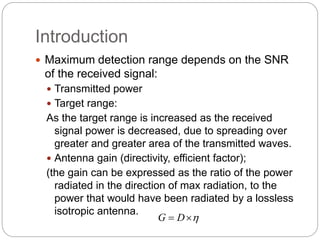
 Maximum detection range depends on the SNR 
of the received signal: 
 Transmitted power 
 Target range: 
As the target range is increased as the received 
signal power is decreased, due to spreading over 
greater and greater area of the transmitted waves. 
 Antenna gain (directivity, efficient factor); 
(the gain can be expressed as the ratio of the power 
radiated in the direction of max radiation, to the 
power that would have been radiated by a lossless 
isotropic antenna. 
G  D
Introduction 
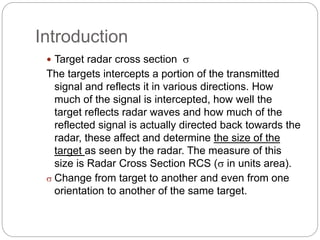
 Target radar cross section  
The targets intercepts a portion of the transmitted 
signal and reflects it in various directions. How 
much of the signal is intercepted, how well the 
target reflects radar waves and how much of the 
reflected signal is actually directed back towards the 
radar, these affect and determine the size of the 
target as seen by the radar. The measure of this 
size is Radar Cross Section RCS ( in units area). 
 Change from target to another and even from one 
orientation to another of the same target.
RCS 
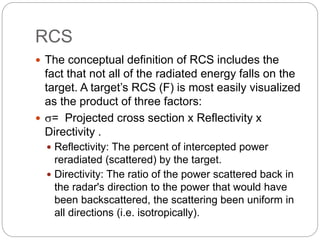
 The conceptual definition of RCS includes the 
fact that not all of the radiated energy falls on the 
target. A target’s RCS (F) is most easily visualized 
as the product of three factors: 
 = Projected cross section x Reflectivity x 
Directivity . 
 Reflectivity: The percent of intercepted power 
reradiated (scattered) by the target. 
 Directivity: The ratio of the power scattered back in 
the radar's direction to the power that would have 
been backscattered, the scattering been uniform in 
all directions (i.e. isotropically).
Introduction 
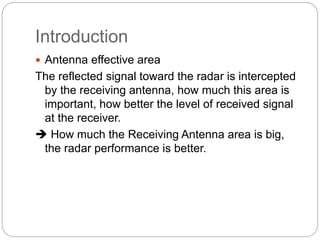
 Antenna effective area 
The reflected signal toward the radar is intercepted 
by the receiving antenna, how much this area is 
important, how better the level of received signal 
at the receiver. 
 How much the Receiving Antenna area is big, 
the radar performance is better.
Derivation of radar equation 
(monostatic radar) 
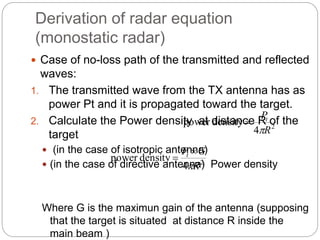
 Case of no-loss path of the transmitted and reflected 
waves: 
1. The transmitted wave from the TX antenna has as 
power Pt and it is propagated toward the target. 
Pt 
 
2. Calculate the Power density at distance R of the 
target 
power density 
 (in the case of isotropic antenna) 
4 
R 
2  
power density 
P  
G t 
 
 
 (in the case of directive antenna) Power density 
4 
R 
2 Where G is the maximun gain of the antenna (supposing 
that the target is situated at distance R inside the 
main beam )
Derivation of radar equation 
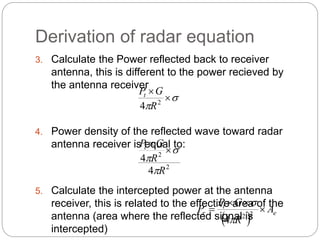
3. Calculate the Power reflected back to receiver 
antenna, this is different to the power recieved by 
the antenna receiver 
 
 
P  
G t 
4  
R 
2 4. Power density of the reflected wave toward radar 
P  
G t 
antenna receiver is equal to: 
 
2 
2 
R 
 
4 
4 
R 
 
 
5. Calculate the intercepted power at the antenna 
P G 
  
receiver, this is related to the effective t 
area of the 
P   
A 
antenna (area where the reflected r signal  2 e 
4 
R 
2 is 
 intercepted) 

Study of the Radar equation 
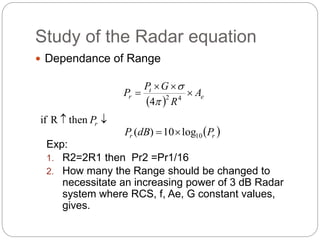
 Dependance of Range 
P G 
t 
  
 
P  
r A 
 e 
4 
 2 R 
4  
if R  then  r P 
  r r P dB P 10 ( ) 10log 
Exp: 
1. R2=2R1 then Pr2 =Pr1/16 
2. How many the Range should be changed to 
necessitate an increasing power of 3 dB Radar 
system where RCS, f, Ae, G constant values, 
gives.
Study of the Radar equation 
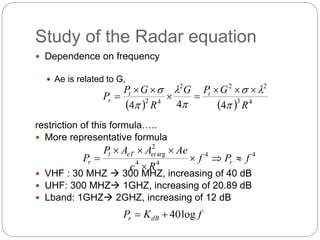
 Dependence on frequency 
 Ae is related to G, 
2 2 2 
G P G 
P G 
 
P t t 
r 
2 4 4 4 4 R 
  R 
  3 4 
restriction of this formula….. 
 More representative formula 
2 
arg f P f 
4 4 
P  A  A  
Ae 
t eT et 
P r 
r    
4 4 
c  
R 
 
 VHF : 30 MHZ  300 MHZ, increasing of 40 dB 
 UHF: 300 MHZ 1GHZ, increasing of 20.89 dB 
 Lband: 1GHZ 2GHZ, increasing of 12 dB 
P K f r dB   40log 
 
  
 
 
    
  
  

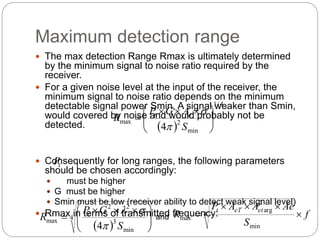
Maximum detection range 
 The max detection Range Rmax is ultimately determined 
by the minimum signal to noise ratio required by the 
receiver. 
 For a given noise level at the input of the receiver, the 
minimum signal to noise ratio depends on the minimum 
detectable signal power Smin, A signal  
weaker than Smin, 
would covered by noise and would probably not be 
detected. 
 
 P  G  A 
 
 
R t e 
 
4  
 
 
max 2 
  
1/ 4 
min 
 
 
S 
 
 Consequently for long ranges, the following parameters 
t P 
should be chosen accordingly: 
 must be higher 
 G must be higher 
 Smin must be low (receiver ability to detect weak signal level) 
2 
arg 
P  A  A  
Ae 
R t eT et  
2 2 
 
    
 Rmax in terms of transmitted frequency: 
f 
S 
 4 
min 
max 
  
4 
min 
3 
max 
4   
 
  
 
 
S 
P G 
R t 
 
  
and
Radar equation with Losses 
introduced 
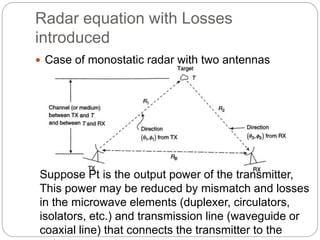
 Case of monostatic radar with two antennas 
Suppose Pt is the output power of the transmitter, 
This power may be reduced by mismatch and losses 
in the microwave elements (duplexer, circulators, 
isolators, etc.) and transmission line (waveguide or 
coaxial line) that connects the transmitter to the 
antenna.
Radar equation with Losses 
introduced 
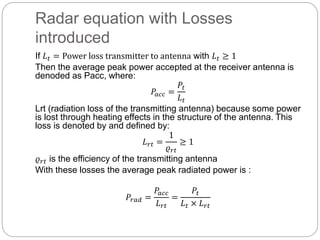
If 퐿푡 = Power loss transmitter to antenna with 퐿푡 ≥ 1 
Then the average peak power accepted at the receiver antenna is 
denoded as Pacc, where: 
푃푎푐푐 = 
푃푡 
퐿푡 
Lrt (radiation loss of the transmitting antenna) because some power 
is lost through heating effects in the structure of the antenna. This 
loss is denoted by and defined by: 
퐿푟푡 = 
1 
휚푟푡 
≥ 1 
휚푟푡 is the efficiency of the transmitting antenna 
With these losses the average peak radiated power is : 
푃푟푎푑 = 
푃푎푐푐 
퐿푟푡 
= 
푃푡 
퐿푡 × 퐿푟푡
Radar equation with Losses 
introduced 
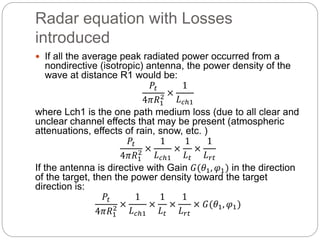
 If all the average peak radiated power occurred from a 
nondirective (isotropic) antenna, the power density of the 
wave at distance R1 would be: 
푃푡 
4휋푅1 
2 × 
1 
퐿푐ℎ1 
where Lch1 is the one path medium loss (due to all clear and 
unclear channel effects that may be present (atmospheric 
attenuations, effects of rain, snow, etc. ) 
푃푡 
4휋푅1 
2 × 
1 
퐿푐ℎ1 
× 
1 
퐿푡 
× 
1 
퐿푟푡 
If the antenna is directive with Gain 퐺(휃1, 휑1) in the direction 
of the target, then the power density toward the target 
direction is: 
푃푡 
4휋푅1 
2 × 
1 
퐿푐ℎ1 
× 
1 
퐿푡 
× 
1 
퐿푟푡 
× 퐺(휃1, 휑1)
Radar equation with Losses 
introduced 
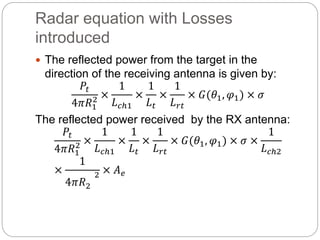
 The reflected power from the target in the 
direction of the receiving antenna is given by: 
푃푡 
4휋푅1 
2 × 
1 
퐿푐ℎ1 
× 
1 
퐿푡 
× 
1 
퐿푟푡 
× 퐺(휃1, 휑1) × 휎 
The reflected power received by the RX antenna: 
푃푡 
4휋푅1 
2 × 
1 
퐿푐ℎ1 
× 
1 
퐿푡 
× 
1 
퐿푟푡 
× 퐺(휃1, 휑1) × 휎 × 
1 
퐿푐ℎ2 
× 
1 
4휋푅2 
2 × 퐴푒
Radar equation with Losses 
introduced 
 The received power is then equal to: 
푆푟 = 
푃푡 × 퐺 휃1, 휑1 × 휎 × 퐴푒 
2푅2 
4휋푅1 
2 × 
1 
퐿푐ℎ1퐿푐ℎ2퐿푡퐿푟푡퐿푟푟 
Where Lrr is the antenna receiving loss : 
퐿푟푟 = 
1 
휚푟푟 
≥ 1 
And also, 
푆푟 
= 
푃푡 × 퐺 휃1, 휑1 × 휎 × 퐺(휃3, 휑3) × 휆2 
2푅2 
(4휋)3 × 푅1 
2 × 
1 
퐿푐ℎ1퐿푐ℎ2퐿푡퐿푟푡퐿푟푟
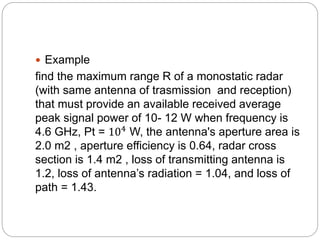
 Example 
find the maximum range R of a monostatic radar 
(with same antenna of trasmission and reception) 
that must provide an available received average 
peak signal power of 10- 12 W when frequency is 
4.6 GHz, Pt = 104 W, the antenna's aperture area is 
2.0 m2 , aperture efficiency is 0.64, radar cross 
section is 1.4 m2 , loss of transmitting antenna is 
1.2, loss of antenna’s radiation = 1.04, and loss of 
path = 1.43.

Chapter 2-radar equation

  • 1.
    Chapter 2 RadarEquations
  • 2.
    Introduction  Maximumdetection range depends on the SNR of the received signal:  Transmitted power  Target range: As the target range is increased as the received signal power is decreased, due to spreading over greater and greater area of the transmitted waves.  Antenna gain (directivity, efficient factor); (the gain can be expressed as the ratio of the power radiated in the direction of max radiation, to the power that would have been radiated by a lossless isotropic antenna. G  D
  • 3.
    Introduction  Targetradar cross section  The targets intercepts a portion of the transmitted signal and reflects it in various directions. How much of the signal is intercepted, how well the target reflects radar waves and how much of the reflected signal is actually directed back towards the radar, these affect and determine the size of the target as seen by the radar. The measure of this size is Radar Cross Section RCS ( in units area).  Change from target to another and even from one orientation to another of the same target.
  • 4.
    RCS  Theconceptual definition of RCS includes the fact that not all of the radiated energy falls on the target. A target’s RCS (F) is most easily visualized as the product of three factors:  = Projected cross section x Reflectivity x Directivity .  Reflectivity: The percent of intercepted power reradiated (scattered) by the target.  Directivity: The ratio of the power scattered back in the radar's direction to the power that would have been backscattered, the scattering been uniform in all directions (i.e. isotropically).
  • 5.
    Introduction  Antennaeffective area The reflected signal toward the radar is intercepted by the receiving antenna, how much this area is important, how better the level of received signal at the receiver.  How much the Receiving Antenna area is big, the radar performance is better.
  • 6.
    Derivation of radarequation (monostatic radar)  Case of no-loss path of the transmitted and reflected waves: 1. The transmitted wave from the TX antenna has as power Pt and it is propagated toward the target. Pt  2. Calculate the Power density at distance R of the target power density  (in the case of isotropic antenna) 4 R 2  power density P  G t    (in the case of directive antenna) Power density 4 R 2 Where G is the maximun gain of the antenna (supposing that the target is situated at distance R inside the main beam )
  • 7.
    Derivation of radarequation 3. Calculate the Power reflected back to receiver antenna, this is different to the power recieved by the antenna receiver   P  G t 4  R 2 4. Power density of the reflected wave toward radar P  G t antenna receiver is equal to:  2 2 R  4 4 R   5. Calculate the intercepted power at the antenna P G   receiver, this is related to the effective t area of the P   A antenna (area where the reflected r signal  2 e 4 R 2 is  intercepted) 
  • 8.
    Study of theRadar equation  Dependance of Range P G t    P  r A  e 4  2 R 4  if R  then  r P   r r P dB P 10 ( ) 10log Exp: 1. R2=2R1 then Pr2 =Pr1/16 2. How many the Range should be changed to necessitate an increasing power of 3 dB Radar system where RCS, f, Ae, G constant values, gives.
  • 9.
    Study of theRadar equation  Dependence on frequency  Ae is related to G, 2 2 2 G P G P G  P t t r 2 4 4 4 4 R   R   3 4 restriction of this formula…..  More representative formula 2 arg f P f 4 4 P  A  A  Ae t eT et P r r    4 4 c  R   VHF : 30 MHZ  300 MHZ, increasing of 40 dB  UHF: 300 MHZ 1GHZ, increasing of 20.89 dB  Lband: 1GHZ 2GHZ, increasing of 12 dB P K f r dB   40log              
  • 10.
    Maximum detection range  The max detection Range Rmax is ultimately determined by the minimum signal to noise ratio required by the receiver.  For a given noise level at the input of the receiver, the minimum signal to noise ratio depends on the minimum detectable signal power Smin, A signal  weaker than Smin, would covered by noise and would probably not be detected.   P  G  A   R t e  4    max 2   1/ 4 min   S   Consequently for long ranges, the following parameters t P should be chosen accordingly:  must be higher  G must be higher  Smin must be low (receiver ability to detect weak signal level) 2 arg P  A  A  Ae R t eT et  2 2       Rmax in terms of transmitted frequency: f S  4 min max   4 min 3 max 4        S P G R t    and
  • 11.
    Radar equation withLosses introduced  Case of monostatic radar with two antennas Suppose Pt is the output power of the transmitter, This power may be reduced by mismatch and losses in the microwave elements (duplexer, circulators, isolators, etc.) and transmission line (waveguide or coaxial line) that connects the transmitter to the antenna.
  • 12.
    Radar equation withLosses introduced If 퐿푡 = Power loss transmitter to antenna with 퐿푡 ≥ 1 Then the average peak power accepted at the receiver antenna is denoded as Pacc, where: 푃푎푐푐 = 푃푡 퐿푡 Lrt (radiation loss of the transmitting antenna) because some power is lost through heating effects in the structure of the antenna. This loss is denoted by and defined by: 퐿푟푡 = 1 휚푟푡 ≥ 1 휚푟푡 is the efficiency of the transmitting antenna With these losses the average peak radiated power is : 푃푟푎푑 = 푃푎푐푐 퐿푟푡 = 푃푡 퐿푡 × 퐿푟푡
  • 13.
    Radar equation withLosses introduced  If all the average peak radiated power occurred from a nondirective (isotropic) antenna, the power density of the wave at distance R1 would be: 푃푡 4휋푅1 2 × 1 퐿푐ℎ1 where Lch1 is the one path medium loss (due to all clear and unclear channel effects that may be present (atmospheric attenuations, effects of rain, snow, etc. ) 푃푡 4휋푅1 2 × 1 퐿푐ℎ1 × 1 퐿푡 × 1 퐿푟푡 If the antenna is directive with Gain 퐺(휃1, 휑1) in the direction of the target, then the power density toward the target direction is: 푃푡 4휋푅1 2 × 1 퐿푐ℎ1 × 1 퐿푡 × 1 퐿푟푡 × 퐺(휃1, 휑1)
  • 14.
    Radar equation withLosses introduced  The reflected power from the target in the direction of the receiving antenna is given by: 푃푡 4휋푅1 2 × 1 퐿푐ℎ1 × 1 퐿푡 × 1 퐿푟푡 × 퐺(휃1, 휑1) × 휎 The reflected power received by the RX antenna: 푃푡 4휋푅1 2 × 1 퐿푐ℎ1 × 1 퐿푡 × 1 퐿푟푡 × 퐺(휃1, 휑1) × 휎 × 1 퐿푐ℎ2 × 1 4휋푅2 2 × 퐴푒
  • 15.
    Radar equation withLosses introduced  The received power is then equal to: 푆푟 = 푃푡 × 퐺 휃1, 휑1 × 휎 × 퐴푒 2푅2 4휋푅1 2 × 1 퐿푐ℎ1퐿푐ℎ2퐿푡퐿푟푡퐿푟푟 Where Lrr is the antenna receiving loss : 퐿푟푟 = 1 휚푟푟 ≥ 1 And also, 푆푟 = 푃푡 × 퐺 휃1, 휑1 × 휎 × 퐺(휃3, 휑3) × 휆2 2푅2 (4휋)3 × 푅1 2 × 1 퐿푐ℎ1퐿푐ℎ2퐿푡퐿푟푡퐿푟푟
  • 16.
     Example findthe maximum range R of a monostatic radar (with same antenna of trasmission and reception) that must provide an available received average peak signal power of 10- 12 W when frequency is 4.6 GHz, Pt = 104 W, the antenna's aperture area is 2.0 m2 , aperture efficiency is 0.64, radar cross section is 1.4 m2 , loss of transmitting antenna is 1.2, loss of antenna’s radiation = 1.04, and loss of path = 1.43.

Editor's Notes

  • #3 Directivity of the antenna means how much the antenna is able to concentrate the transmitted signal into a narrow beam,
  • #17 20 Km