Radar OUTLINE History Applications Basic Principles of Radar Components of a Pulse Radar System The Radar equation Moving Target Indicator (MTI) radar
Radar History Invented in 1900s (patented in 1904) and reinvented in the 1920s and 1930s Applied to help defend England at the beginning of World War II (Battle of Britain) Provided advance warning of air raids Allowed fighters to stay on ground until needed Adapted for airborne use in night fighters Installed on ships for detecting enemy in bad weather (Bismarck)
Radar-Applications Air Traffic Control Air Navigation Remote Sensing Marine Law Enforcement and highway safety Space Military
Radar-Applications Air Traffic Control Monitor the location of aircraft in flight Monitor the location of aircraft/vehicles on surface of airports PAR (precision approach radar) Guidance for landing in poor weather
Radar-Applications Air Navigation Weather radar Terrain avoidance and terrain following Radar altimeter Doppler Navigator
Radar-Applications Remote Sensing Weather observation Planetary observation (Venus probe) Mapping Ground Penetration radar
Radar-Applications Marine Detecting other ships, buoys, land Shore-based radar for harbour surveillance and traffic control Law Enforcement and highway safety Traffic speed radar Collision warning Blind area surveillance for cars and school buses Intrusion alarms
Radar-Applications Space Rendezvous and docking Moon landing Remote Sensing (RADARSAT)
Radar Basic Principles Transmits an electromagnetic signal modulated with  particular type of waveform. (modulation depends on requirements of application) Signal is reflected from target Reflected signal is detected by radar receiver and analyzed to extract desired information
Radar Modulation Types Simple Pulse; one or more repetition frequencies Frequency Modulation FM (radar altimeters) Pulse with Chirp (pulse compression) CW (continuous wave) - police radar (Doppler) Pseudorandom code
Radar Basic Principles Distance can be determined by measuring the time difference between transmission and reception Angle (or relative bearing) can be determined by measuring the angle of arrival (AOA) of the signal (usually by highly directive antenna) If there is a radial component of relative velocity between radar and target it can be determined from the Doppler shift of the carrier
Radar Basic Principles Two types of radar: Monostatic - transmitter and receiver use same antenna Bistatic - transmitter and receiver antennas are separated, sometimes by large distances
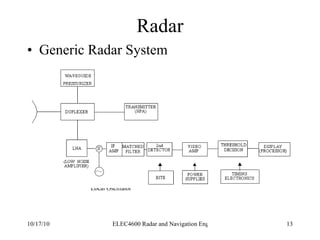
Radar Generic Radar System Local Oscillator
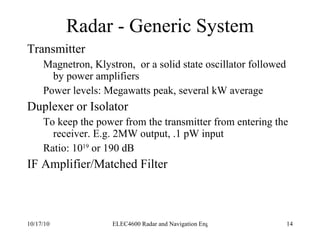
Radar - Generic System Transmitter Magnetron, Klystron,  or a solid state oscillator followed by power amplifiers Power levels: Megawatts peak, several kW average Duplexer or Isolator To keep the power from the transmitter from entering the receiver. E.g. 2MW output, .1 pW input Ratio: 10 19  or 190 dB IF Amplifier/Matched Filter
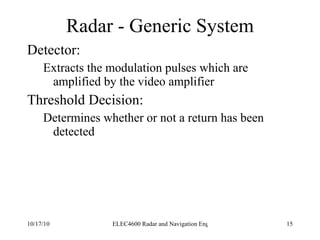
Radar - Generic System Detector: Extracts the modulation pulses which are amplified by the video amplifier Threshold Decision: Determines whether or not a return has been detected
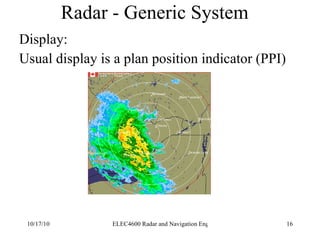
Radar - Generic System Display: Usual display is a plan position indicator (PPI)
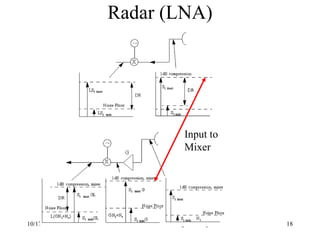
Radar The Influence of LNA (low noise amplifier) an LNA is not always beneficial since it decreases the dynamic range (DR) of the receiver DR is the difference between the maximum signal which can be processed (usually determined by the compression level of the mixer) The minimum detectable level determined by the noise power The tradeoff is between sensitivity and dynamic range
Radar (LNA) Input to Mixer
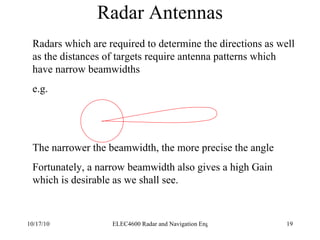
Radar Antennas Radars which are required to determine the directions as well as the distances of targets require antenna patterns which have narrow beamwidths e.g. The narrower the beamwidth, the more precise the angle Fortunately, a narrow beamwidth also gives a high Gain which is desirable as we shall see.
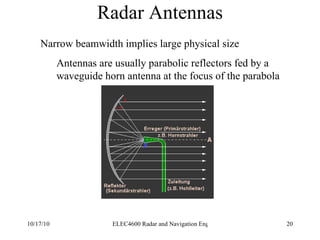
Radar Antennas Narrow beamwidth implies large physical size Antennas are usually parabolic reflectors fed by a waveguide horn antenna at the focus of the parabola
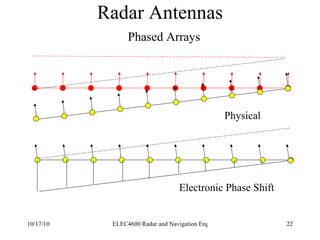
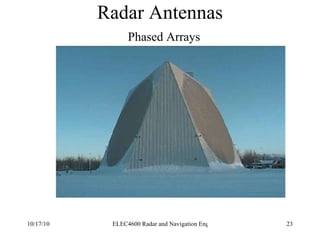
Radar Antennas Phased Arrays One of the big disadvantages of the parabolic antennas is that they have to be physically rotated in order to cover their area of responsibility. Also, military uses sometimes require the beam to be  moved quickly from one direction to another. For these applications Phased Array antennas are used
Radar Antennas Phased Arrays Physical Electronic Phase Shift
Radar Antennas Phased Arrays
Radar Basic Radar Range Equation RF energy transmitted with power P t If transmitted equally in all directions (isotropically)  the power density of the signal at distance R will be P t /4 π R 2   If the antenna is directional it will have “GAIN” (G) in any particular direction. Gain is simply the power density produced in a particular direction RELATIVE to the power density produced by an isotropic antenna
Radar Basic Radar Range Equation - Gain The gain of an antenna usually refers to the  maximum  gain Thus, if the radar antenna has gain the power density at distance R becomes P t G /4 π R 2
Radar Basic Radar Range Equation - Cross Section When the signal reaches a target some of the energy is reflected back towards the transmitter. Assume for now that the target has an area  ρ  and that it reflects the intercepted energy equally in all directions. NOTE: This is obviously not true and we shall have to make allowances for this later on
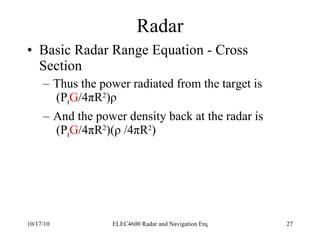
Radar Basic Radar Range Equation - Cross Section Thus the power radiated from the target is   (P t G /4 π R 2 ) ρ And the power density back at the radar is   (P t G /4 π R 2 )( ρ  /4 π R 2 )
Radar Basic Radar Range Equation - Maximum Range The radar antenna has a effective are A e  and thus the power passed on to the receiver is P r = (P t G /4 π R 2 )( ρ  /4 π R 2 ) A e   The minimum signal detectable by the receiver is S min  and this occurs at the maximum range R MAX Thus S min  = (P t G /4 π R MAX 2 )( ρ  /4 π R MAX 2 ) A e or R MAX  =[P t G A e /(4 π) 2  S min ] ¼
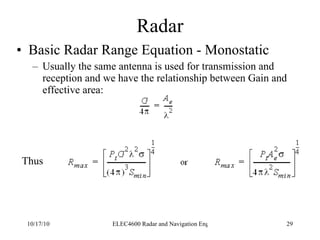
Radar Basic Radar Range Equation - Monostatic Usually the same antenna is used for transmission and reception and we have the relationship between Gain and effective area: Thus
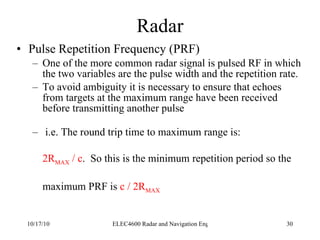
Radar Pulse Repetition Frequency (PRF) One of the more common radar signal is pulsed RF in which the two variables are the pulse width and the repetition rate. To avoid ambiguity it is necessary to ensure that echoes from targets at the maximum range have been received before transmitting another pulse i.e. The round trip time to maximum range is: 2R MAX  / c .  So this is the minimum repetition period so the  maximum PRF is  c / 2R MAX
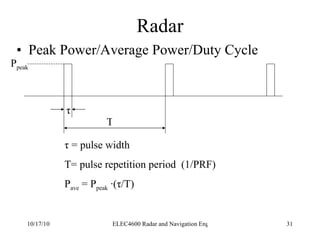
Radar Peak Power/Average Power/Duty Cycle τ T τ  = pulse width T= pulse repetition period  (1/PRF) P ave  =  P peak   ·( τ /T) P peak
Radar Pulse width determines range resolution ΔR=cτ/2 Narrow pulse width    High Peak Power For solid state transmitters we would like low peak power
Radar Example  TRACS (Terminal Radar and Control System): Min signal: -130dBW (10 -13  Watts) G: 2000 λ: 0.23 m (f=1.44GHz) PRF: 524 Hz σ :  2m 2 What power output is required?
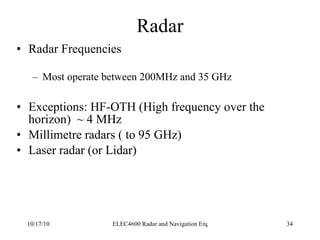
Radar Radar Frequencies Most operate between 200MHz and 35 GHz Exceptions: HF-OTH (High frequency over the horizon)  ~ 4 MHz Millimetre radars ( to 95 GHz) Laser radar (or Lidar)
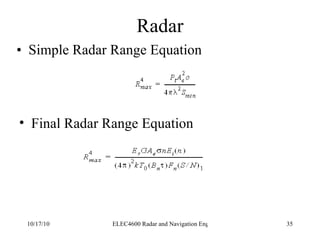
Radar Simple Radar Range Equation Final Radar Range Equation
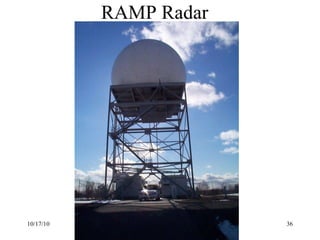
RAMP Radar
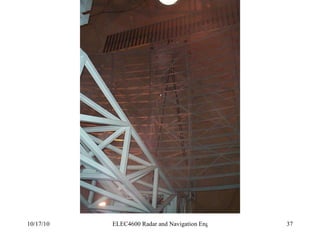
RAMP Radar
RAMP Radar Final Radar Range Equation
RAMP Radar
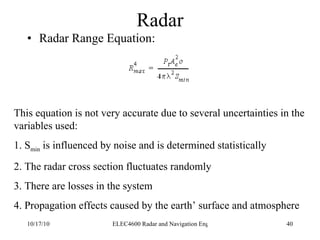
Radar Radar Range Equation: This equation is not very accurate due to several uncertainties in the variables used: 1. S min  is influenced by noise and is determined statistically 2. The radar cross section fluctuates randomly 3. There are losses in the system 4. Propagation effects caused by the earth’ surface and atmosphere
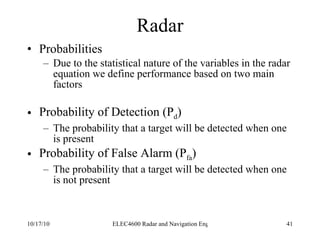
Radar Probabilities Due to the statistical nature of the variables in the radar equation we define performance based on two main factors Probability of Detection (P d ) The probability that a target will be detected when one is present Probability of False Alarm (P fa ) The probability that a target will be detected when one is not present
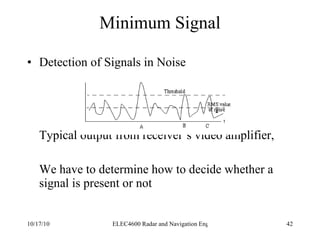
Minimum Signal Detection of Signals in Noise Typical output from receiver’s video amplifier, We have to determine how to decide whether a signal is present or not
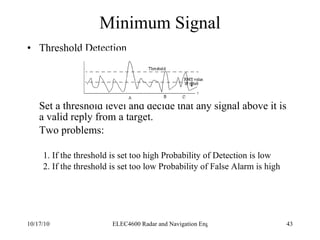
Minimum Signal Threshold Detection Set a threshold level and decide that any signal above it is a valid reply from a target. Two problems: 1. If the threshold is set too high Probability of Detection is low 2. If the threshold is set too low Probability of False Alarm is high
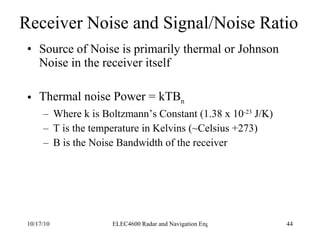
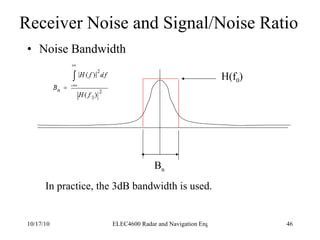
Receiver Noise and Signal/Noise Ratio Source of Noise is primarily thermal or Johnson Noise in the receiver itself Thermal noise Power = kTB n Where k is Boltzmann’s Constant (1.38 x 10 -23  J/K) T is the temperature in Kelvins (~Celsius +273) B is the Noise Bandwidth of the receiver
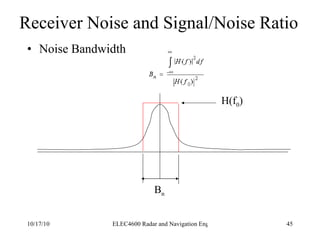
Receiver Noise and Signal/Noise Ratio Noise Bandwidth B n H(f 0 )
Receiver Noise and Signal/Noise Ratio Noise Bandwidth In practice, the 3dB bandwidth is used. B n H(f 0 )
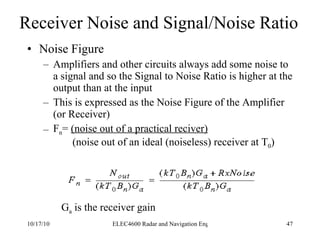
Receiver Noise and Signal/Noise Ratio Noise Figure Amplifiers and other circuits always add some noise to a signal and so the Signal to Noise Ratio is higher at the output than at the input This is expressed as the Noise Figure of the Amplifier (or Receiver) F n =  (noise out of a practical reciver)   (noise out of an ideal (noiseless) receiver at T 0 ) G a  is the receiver gain
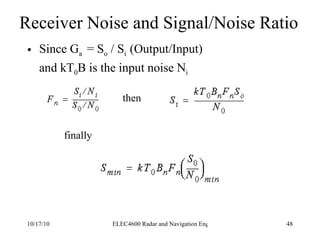
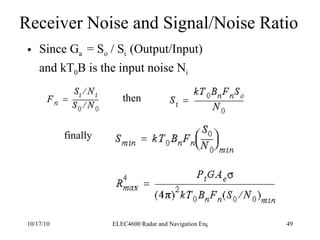
Receiver Noise and Signal/Noise Ratio Since G a  = S o  / S i  (Output/Input) and kT 0 B is the input noise N i then finally
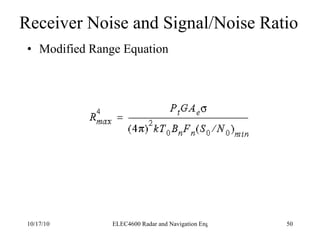
Receiver Noise and Signal/Noise Ratio Modified Range Equation
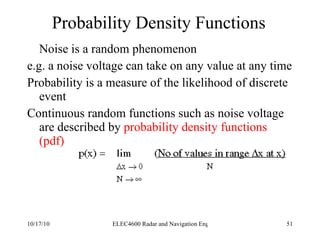
Probability Density Functions Noise is a random phenomenon e.g. a noise voltage can take on any value at any time Probability is a measure of the likelihood of discrete event Continuous random functions such as noise voltage are described by  probability density functions (pdf)
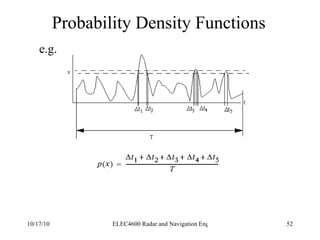
Probability Density Functions e.g.
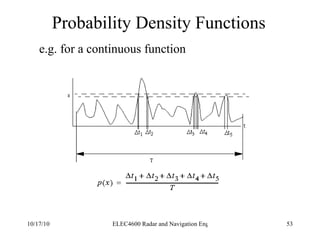
Probability Density Functions e.g. for a continuous function
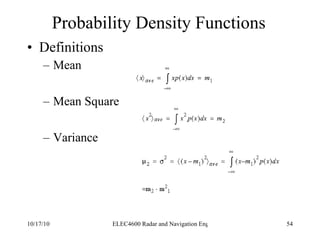
Probability Density Functions Definitions Mean Mean Square Variance
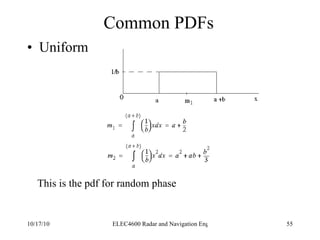
Common PDFs Uniform This is the pdf for random phase
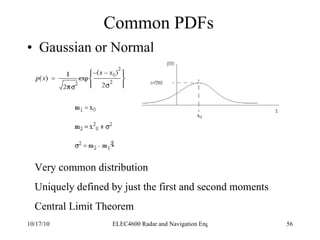
Common PDFs Gaussian or Normal Very common distribution Uniquely defined by just the first and second moments Central Limit Theorem
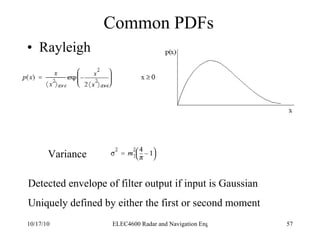
Common PDFs Rayleigh Detected envelope of filter output if input is Gaussian Uniquely defined by either the first or second moment Variance
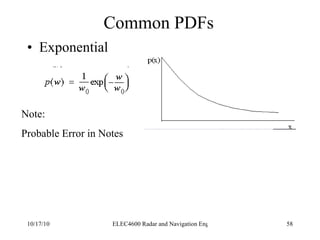
Common PDFs Exponential Note: Probable Error in Notes
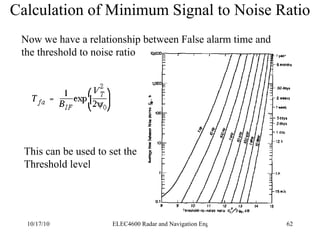
Calculation of Minimum Signal to Noise Ratio First we will determine the threshold level required to give the specified average time to false alarm (T fa ). This is done assuming no signal input. We shall also get a relationship between T fa  and P fa  . Then we add the signal and determine what signal to noise ratio we need to give us the specified probability of detection (P d )
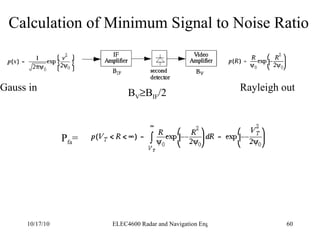
Calculation of Minimum Signal to Noise Ratio B V  B IF /2 Gauss in Rayleigh out P fa =
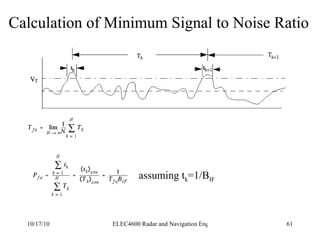
Calculation of Minimum Signal to Noise Ratio assuming t k =1/B IF
Calculation of Minimum Signal to Noise Ratio Now we have a relationship between False alarm time and the threshold to noise ratio This can be used to set the Threshold level
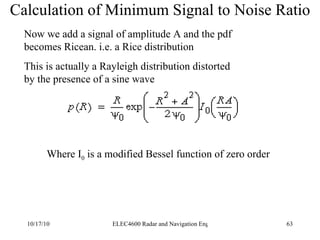
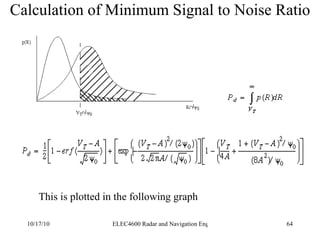
Calculation of Minimum Signal to Noise Ratio Now we add a signal of amplitude A and the pdf becomes Ricean. i.e. a Rice distribution This is actually a Rayleigh distribution distorted by the presence of a sine wave Where I 0  is a modified Bessel function of zero order
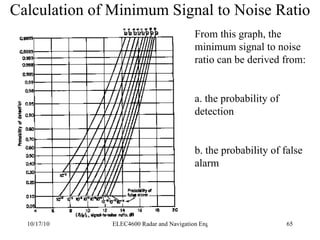
Calculation of Minimum Signal to Noise Ratio This is plotted in the following graph
Calculation of Minimum Signal to Noise Ratio From this graph, the minimum signal to noise ratio can be derived from: a. the probability of detection b. the probability of false alarm
Integration of Radar Pulses Note that the previous calculation for signal to noise ratio is based on the detection of a single pulse In practice a target produces several pulses each time the antenna beam sweeps through its position Thus it is possible to enhance the signal to noise ratio by integrating (summing ) the pulse outputs. Note that integration is equivalent to low pass filtering. The more samples integrated, the narrower the bandwidth and the lower the noise power
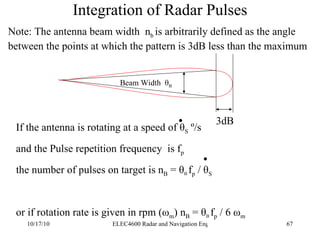
Integration of Radar Pulses Note: The antenna beam width  n b  is arbitrarily defined as the angle between the points at which the pattern is 3dB less than the maximum 3dB Beam Width  θ B If the antenna is rotating at a speed of  θ S  º/s and the Pulse repetition frequency  is f p the number of pulses on target is n B  = θ B  f p  / θ S or if rotation rate is given in rpm (ω m ) n B  = θ B  f p  / 6 ω m
Integration of Radar Pulses integration before detection is called predetection or coherent detection integration after detection is called post detection or noncoherent detection If predetection is used SNR integrated  = n SNR 1 If postdetection is used, SNR integrated    n SNR 1  due to losses in the detector
Integration of Radar Pulses Predetection integration is difficult because it requires maintaining the phase of the pulse returns Postdetection is relatively easy especially using digital processing techniques by which digitized versions of all returns can be recorded and manipulated
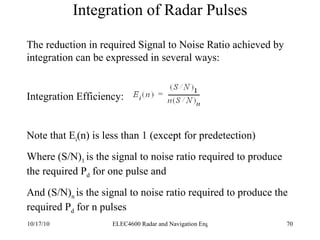
Integration of Radar Pulses The reduction in required Signal to Noise Ratio achieved by integration can be expressed in several ways: Integration Efficiency: Note that E i (n) is less than 1 (except for predetection) Where (S/N) 1  is the signal to noise ratio required to produce the required P d  for one pulse and And (S/N) n  is the signal to noise ratio required to produce the required P d  for n pulses
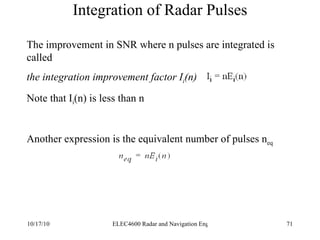
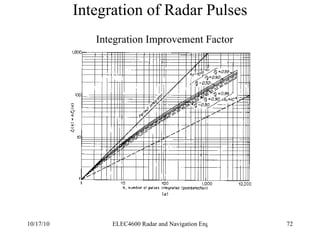
Integration of Radar Pulses The improvement in SNR where n pulses are integrated is called the integration improvement factor I i (n) Note that I i (n) is less than n Another expression is the equivalent number of pulses n eq
Integration of Radar Pulses Integration Improvement Factor
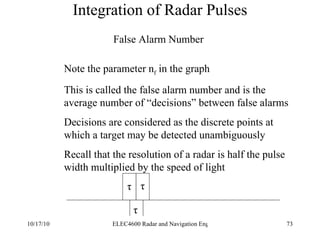
Integration of Radar Pulses False Alarm Number Note the parameter n f  in the graph This is called the false alarm number and is the average number of “decisions” between false alarms Decisions are considered as the discrete points at which a target may be detected unambiguously Recall that the resolution of a radar is half the pulse width multiplied by the speed of light τ τ τ
Integration of Radar Pulses False Alarm Number Thus the total number of unambiguous targets for each transmitted pulse is  T/ τ where T is the pulse repetition period (1/f P ) We multiply this by the number of pulses per second (f P ) to get the number of decisions per second Finally we multiply by the False alarm rate (T fa ) to get the number of decisions per false alarm. n f  = [ T/ τ][f P ][T fa ]
Integration of Radar Pulses False Alarm Number But T x  f P  =1 and τ    1/B where B is the IF bandwidth so  n f    T fa  B     1/P fa n f  = [ T/ τ][f P ][T fa ]
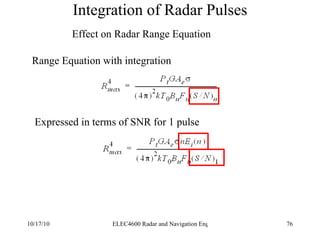
Integration of Radar Pulses Effect on Radar Range Equation Range Equation with integration Expressed in terms of SNR for 1 pulse
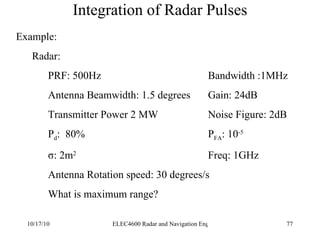
Integration of Radar Pulses Example: Radar: PRF: 500Hz Bandwidth :1MHz Antenna Beamwidth: 1.5 degrees Gain: 24dB Transmitter Power 2 MW Noise Figure: 2dB P d :  80% P FA : 10 -5 σ: 2m 2 Freq: 1GHz Antenna Rotation speed: 30 degrees/s What is maximum range?
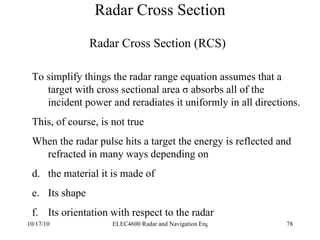
Radar Cross Section To simplify things the radar range equation assumes that a target with cross sectional area  σ absorbs all of the incident power and reradiates it uniformly in all directions. This, of course, is not true When the radar pulse hits a target the energy is reflected and refracted in many ways depending on the material it is made of Its shape Its orientation with respect to the radar  Radar Cross Section (RCS)
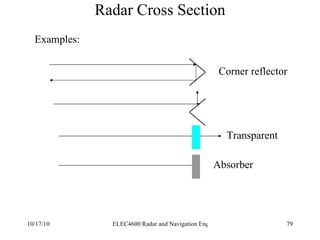
Radar Cross Section Examples: Corner reflector Transparent Absorber
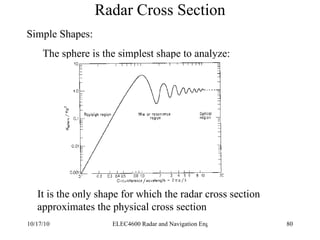
Radar Cross Section Simple Shapes: The sphere is the simplest shape to analyze: It is the only shape for which the radar cross section approximates the physical cross section
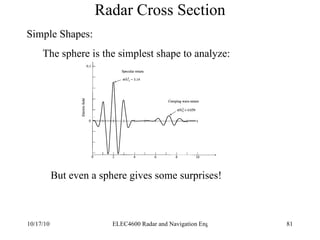
Radar Cross Section Simple Shapes: The sphere is the simplest shape to analyze: But even a sphere gives some surprises!
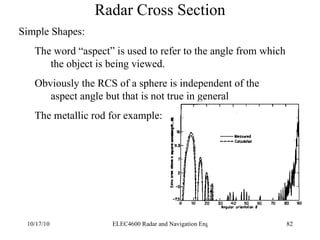
Radar Cross Section Simple Shapes: The word “aspect” is used to refer to the angle from which the object is being viewed. Obviously the RCS of a sphere is independent of the aspect angle but that is not true in general The metallic rod for example:
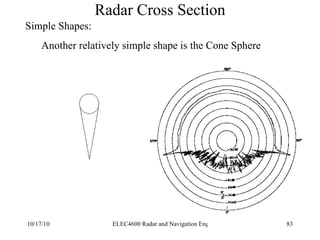
Radar Cross Section Simple Shapes: Another relatively simple shape is the Cone Sphere
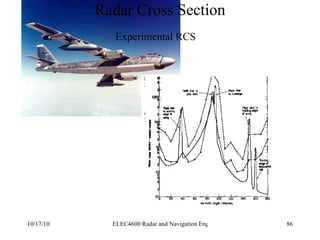
Radar Cross Section Real life targets are much more complicated: a large number of independent objects scattering energy in all directions scattered energy may combine in-phase or out of phase depending on the aspect angle (scintillation) All techniques for determining RCS have severe limitations; Calculation: GTD (geometric theory of diffraction) Experimental: Full scale: very expensive Scale models: lose detail
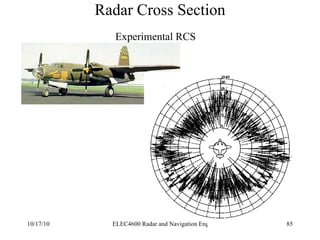
Radar Cross Section Experimental RCS
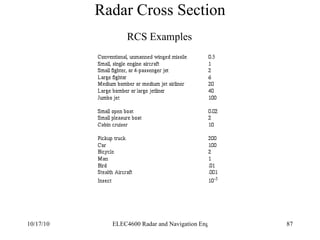
Radar Cross Section RCS Examples
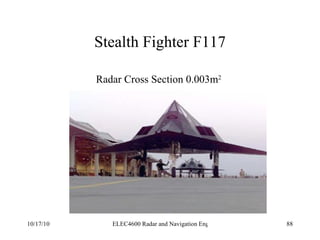
Stealth Fighter F117 Radar Cross Section 0.003m 2
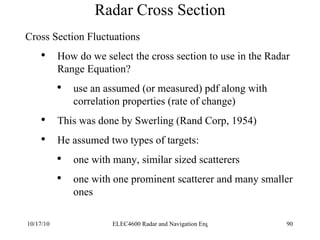
Radar Cross Section Cross Section Fluctuations Cross sections fluctuate for several reasons  meteorological conditions lobe structure of antenna varying aspect angle of target How do we select the cross section to use in the Radar Range Equation? choose a lower bound that is exceeded 90-95% of time? conservative - possibly excessive power
Radar Cross Section Cross Section Fluctuations How do we select the cross section to use in the Radar Range Equation? use an assumed (or measured) pdf along with correlation properties (rate of change) This was done by Swerling (Rand Corp, 1954) He assumed two types of targets: one with many, similar sized scatterers one with one prominent scatterer and many smaller ones
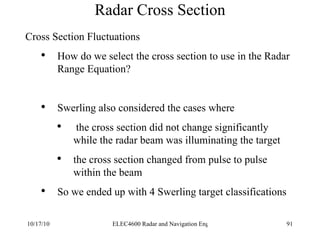
Radar Cross Section Cross Section Fluctuations How do we select the cross section to use in the Radar Range Equation? Swerling also considered the cases where the cross section did not change significantly while the radar beam was illuminating the target the cross section changed from pulse to pulse within the beam  So we ended up with 4 Swerling target classifications
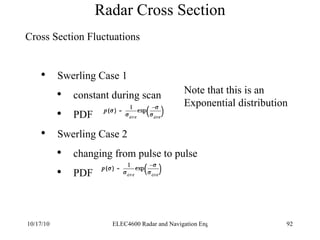
Radar Cross Section Cross Section Fluctuations Swerling Case 1 constant during scan PDF  Swerling Case 2 changing from pulse to pulse PDF  Note that this is an Exponential distribution
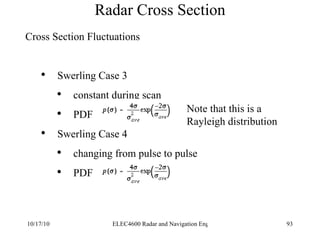
Radar Cross Section Cross Section Fluctuations Swerling Case 3 constant during scan PDF  Swerling Case 4 changing from pulse to pulse PDF  Note that this is a Rayleigh distribution
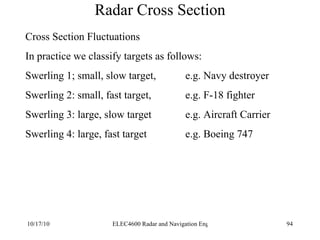
Radar Cross Section Cross Section Fluctuations In practice we classify targets as follows: Swerling 1; small, slow target,  e.g. Navy destroyer  Swerling 2: small, fast target, e.g. F-18 fighter Swerling 3: large, slow target e.g. Aircraft Carrier Swerling 4: large, fast target e.g. Boeing 747
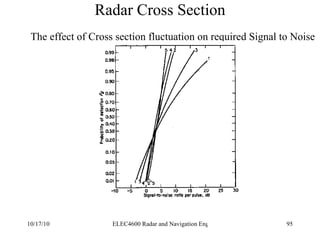
Radar Cross Section The effect of Cross section fluctuation on required Signal to Noise
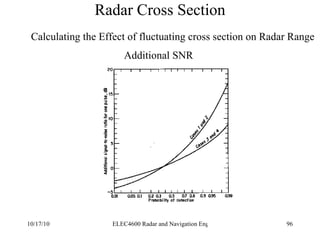
Radar Cross Section Calculating the Effect of fluctuating cross section on Radar Range Additional SNR
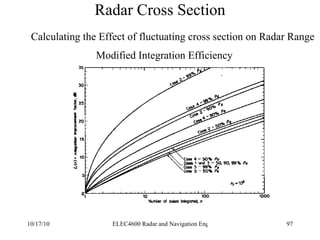
Radar Cross Section Calculating the Effect of fluctuating cross section on Radar Range Modified Integration Efficiency
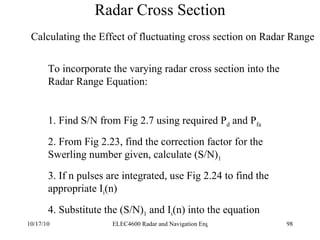
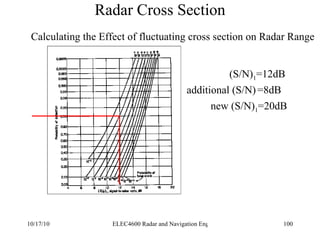
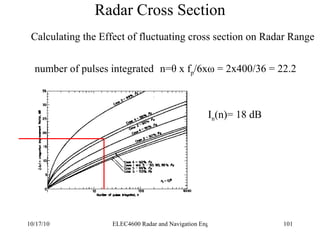
Radar Cross Section Calculating the Effect of fluctuating cross section on Radar Range To incorporate the varying radar cross section into the  Radar Range Equation: 1. Find S/N from Fig 2.7 using required P d  and P fa 2. From Fig 2.23, find the correction factor for the Swerling number given, calculate (S/N) 1 3. If n pulses are integrated, use Fig 2.24 to find the appropriate I i (n) 4. Substitute the (S/N) 1  and I i (n) into the equation
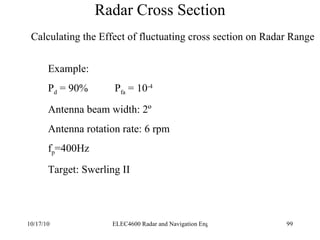
Radar Cross Section Calculating the Effect of fluctuating cross section on Radar Range Example: P d  = 90%  P fa  = 10 -4 Antenna beam width: 2 º Antenna rotation rate: 6 rpm f p =400Hz Target: Swerling II
Radar Cross Section Calculating the Effect of fluctuating cross section on Radar Range (S/N) 1 =12dB additional (S/N)   =8dB new (S/N) 1 =20dB
Radar Cross Section Calculating the Effect of fluctuating cross section on Radar Range number of pulses integrated n= θ x f p /6xω = 2x400/36 = 22.2 I n (n)= 18 dB
Radar Cross Section Calculating the Effect of fluctuating cross section on Radar Range Note that the Swerling Cases are only very crude approximations Swerling himself has since modified his ideas on this and has extended his models to include a range of distributions based on the Chi-square (or Gamma) distribution
Radar Cross Section Radar Cross Section The objective is to obtain the specified probability of detection with the minimum Transmitter power This is because the size, cost and development time for a radar are a function of the maximum transmitter power Thus it is important to develop a correct model for the expected targets
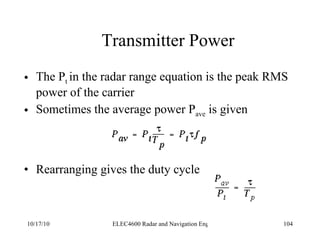
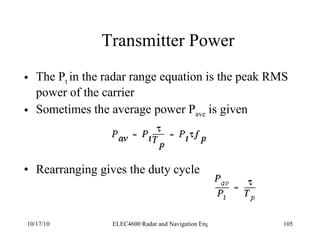
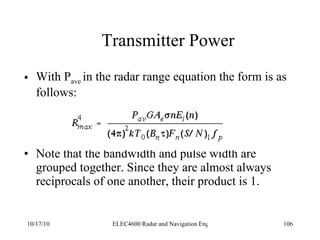
Transmitter Power The P t  in the radar range equation is the peak RMS power of the carrier Sometimes the average power P ave  is given  Rearranging gives the duty cycle
Transmitter Power With P ave  in the radar range equation the form is as follows: Note that the bandwidth and pulse width are grouped together. Since they are almost always reciprocals of one another, their product is 1.
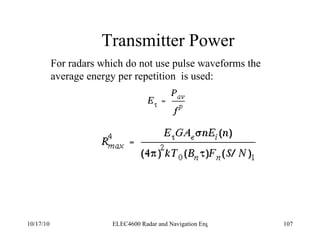
Transmitter Power For radars which do not use pulse waveforms the average energy per repetition  is used:
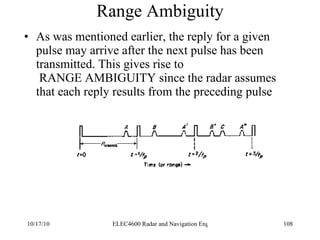
Range Ambiguity As was mentioned earlier, the reply for a given pulse may arrive after the next pulse has been transmitted. This gives rise to  RANGE AMBIGUITY since the radar assumes that each reply results from the preceding pulse
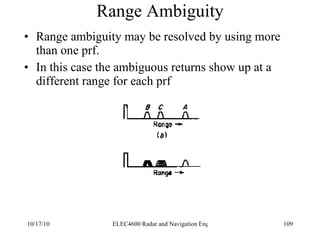
Range Ambiguity Range ambiguity may be resolved by using more than one prf.  In this case the ambiguous returns show up at a different range for each prf
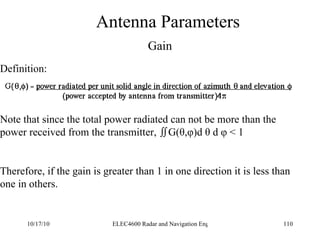
Antenna Parameters Gain Definition: Note that since the total power radiated can not be more than the power received from the transmitter,   G( θ,φ)d θ d φ < 1 Therefore, if the gain is greater than 1 in one direction it is less than one in others.
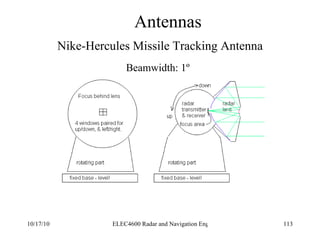
Antennas Types There are two main types: pencil beam and fan beam The pencil beam is narrow in both axes and is usually symmetrical it is usually used in tracking radars.
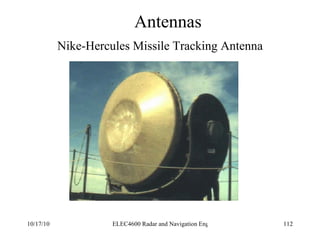
Antennas Nike-Hercules Missile Tracking Antenna
Antennas Nike-Hercules Missile Tracking Antenna Beamwidth: 1 º
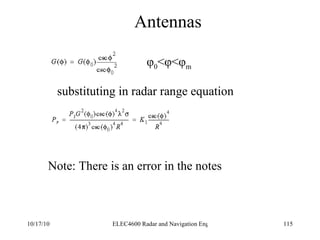
Antennas Pencil beams are not good for searching large areas of sky. Search radars usually use fan beams which are narrow in azimuth and wide in elevation The elevation pattern is normally designed to be of “cosecant squared” pattern which gives the characteristic that a target at constant altitude will give a constant signal level.
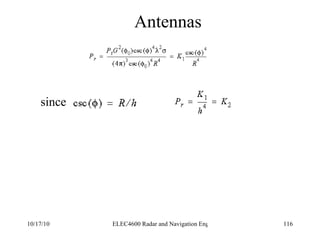
Antennas φ 0 <φ<φ m substituting in radar range equation Note: There is an error in the notes
Antennas since
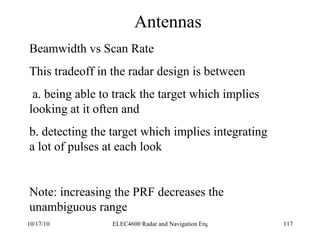
Antennas Beamwidth vs Scan Rate This tradeoff in the radar design is between a. being able to track the target which implies looking at it often and b. detecting the target which implies integrating a lot of pulses at each look Note: increasing the PRF decreases the unambiguous range
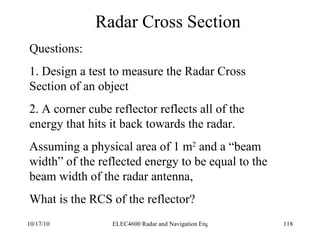
Radar Cross Section Questions: 1. Design a test to measure the Radar Cross Section of an object 2. A corner cube reflector reflects all of the energy that hits it back towards the radar. Assuming a physical area of 1 m 2  and a “beam width” of the reflected energy to be equal to the beam width of the radar antenna, What is the RCS of the reflector?
Losses Controllable losses fall into three categories: a. Antenna Beam shape b. Plumbing Loss b. Collapsing Loss
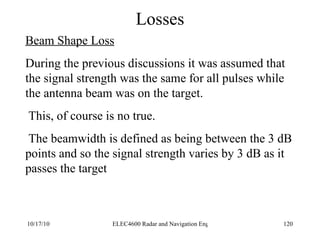
Losses Beam Shape Loss During the previous discussions it was assumed that the signal strength was the same for all pulses while the antenna beam was on the target. This, of course is no true. The beamwidth is defined as being between the 3 dB points and so the signal strength varies by 3 dB as it passes the target
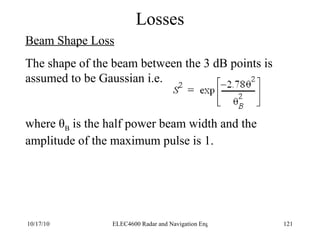
Losses Beam Shape Loss The shape of the beam between the 3 dB points is assumed to be Gaussian i.e.  where  θ B  is the half power beam width and the amplitude of the maximum pulse is 1.
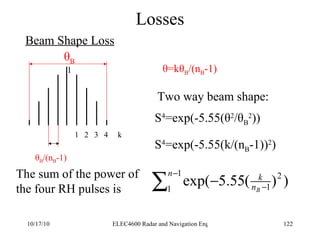
Losses Beam Shape Loss θ =k θ B /(n B -1) Two way beam shape: S 4 =exp(-5.55( θ 2 /θ B 2 )) S 4 =exp(-5.55( k/(n B -1)) 2 ) 1 The sum of the power of the four RH pulses is  θ B θ B /(n B -1) 1 2 3 4 k
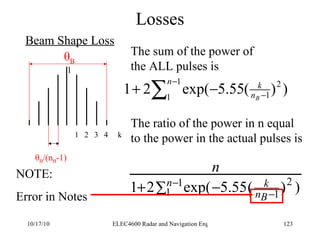
Losses Beam Shape Loss 1 The sum of the power of the ALL pulses is  The ratio of the power in n equal to the power in the actual pulses is NOTE: Error in Notes θ B θ B /(n B -1) 1 2 3 4 k
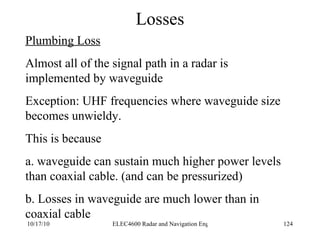
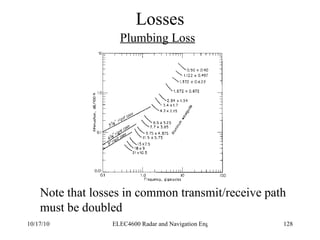
Losses Plumbing Loss Almost all of the signal path in a radar is implemented by waveguide Exception: UHF frequencies where waveguide size becomes unwieldy. This is because  a. waveguide can sustain much higher power levels than coaxial cable. (and can be pressurized) b. Losses in waveguide are much lower than in coaxial cable
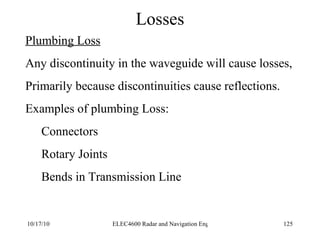
Losses Plumbing Loss Any discontinuity in the waveguide will cause losses, Primarily because discontinuities cause reflections. Examples of plumbing Loss: Connectors Rotary Joints Bends in Transmission Line
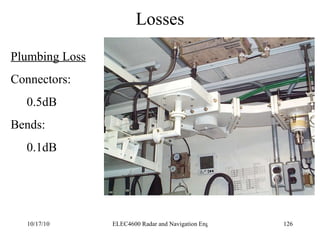
Losses Plumbing Loss Connectors: 0.5dB Bends: 0.1dB
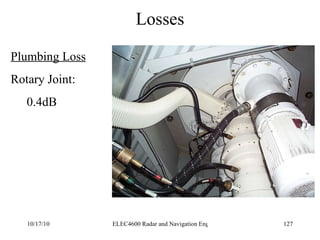
Losses Plumbing Loss Rotary Joint: 0.4dB
Losses Plumbing Loss Note that losses in common transmit/receive path must be doubled
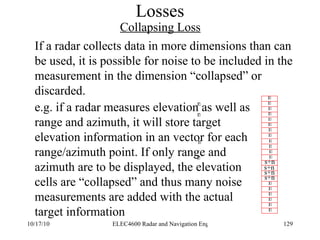
Losses Collapsing Loss If a radar collects data in more dimensions than can be used, it is possible for noise to be included in the measurement in the dimension “collapsed” or discarded. n n n n e.g. if a radar measures elevation as well as range and azimuth, it will store target elevation information in an vector for each range/azimuth point. If only range and azimuth are to be displayed, the elevation cells are “collapsed” and thus many noise measurements are added with the actual target information  n s+n n n n n n n n n n n n s+n s+n s+n n n n n n n
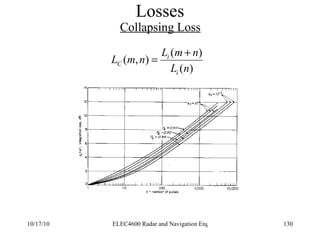
Losses Collapsing Loss n n n n
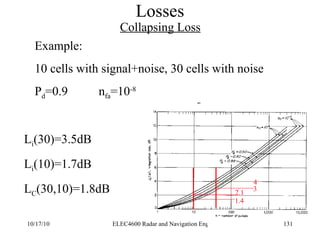
Losses Collapsing Loss n n n n Example: 10 cells with signal+noise, 30 cells with noise P d =0.9 n fa =10 -8 3 4 2.1 1.4 L i (30)=3.5dB L i (10)=1.7dB L C (30,10)=1.8dB
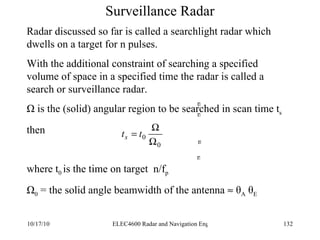
Surveillance Radar n n n n Radar discussed so far is called a searchlight radar which dwells on a target for n pulses. With the additional constraint of searching a specified volume of space in a specified time the radar is called a search or surveillance radar. Ω is the (solid) angular region to be searched in scan time t s then  where t 0  is the time on target  n/f p Ω 0  = the solid angle beamwidth of the antenna    θ A  θ E
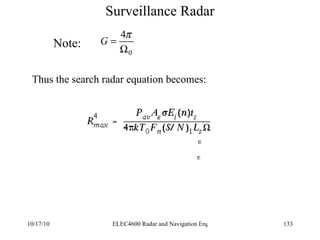
Surveillance Radar n n n n Note:  Thus the search radar equation becomes:

Radarsurvbw 1232267772428796-3

  • 1.
    Radar OUTLINE HistoryApplications Basic Principles of Radar Components of a Pulse Radar System The Radar equation Moving Target Indicator (MTI) radar
  • 2.
    Radar History Inventedin 1900s (patented in 1904) and reinvented in the 1920s and 1930s Applied to help defend England at the beginning of World War II (Battle of Britain) Provided advance warning of air raids Allowed fighters to stay on ground until needed Adapted for airborne use in night fighters Installed on ships for detecting enemy in bad weather (Bismarck)
  • 3.
    Radar-Applications Air TrafficControl Air Navigation Remote Sensing Marine Law Enforcement and highway safety Space Military
  • 4.
    Radar-Applications Air TrafficControl Monitor the location of aircraft in flight Monitor the location of aircraft/vehicles on surface of airports PAR (precision approach radar) Guidance for landing in poor weather
  • 5.
    Radar-Applications Air NavigationWeather radar Terrain avoidance and terrain following Radar altimeter Doppler Navigator
  • 6.
    Radar-Applications Remote SensingWeather observation Planetary observation (Venus probe) Mapping Ground Penetration radar
  • 7.
    Radar-Applications Marine Detectingother ships, buoys, land Shore-based radar for harbour surveillance and traffic control Law Enforcement and highway safety Traffic speed radar Collision warning Blind area surveillance for cars and school buses Intrusion alarms
  • 8.
    Radar-Applications Space Rendezvousand docking Moon landing Remote Sensing (RADARSAT)
  • 9.
    Radar Basic PrinciplesTransmits an electromagnetic signal modulated with particular type of waveform. (modulation depends on requirements of application) Signal is reflected from target Reflected signal is detected by radar receiver and analyzed to extract desired information
  • 10.
    Radar Modulation TypesSimple Pulse; one or more repetition frequencies Frequency Modulation FM (radar altimeters) Pulse with Chirp (pulse compression) CW (continuous wave) - police radar (Doppler) Pseudorandom code
  • 11.
    Radar Basic PrinciplesDistance can be determined by measuring the time difference between transmission and reception Angle (or relative bearing) can be determined by measuring the angle of arrival (AOA) of the signal (usually by highly directive antenna) If there is a radial component of relative velocity between radar and target it can be determined from the Doppler shift of the carrier
  • 12.
    Radar Basic PrinciplesTwo types of radar: Monostatic - transmitter and receiver use same antenna Bistatic - transmitter and receiver antennas are separated, sometimes by large distances
  • 13.
    Radar Generic RadarSystem Local Oscillator
  • 14.
    Radar - GenericSystem Transmitter Magnetron, Klystron, or a solid state oscillator followed by power amplifiers Power levels: Megawatts peak, several kW average Duplexer or Isolator To keep the power from the transmitter from entering the receiver. E.g. 2MW output, .1 pW input Ratio: 10 19 or 190 dB IF Amplifier/Matched Filter
  • 15.
    Radar - GenericSystem Detector: Extracts the modulation pulses which are amplified by the video amplifier Threshold Decision: Determines whether or not a return has been detected
  • 16.
    Radar - GenericSystem Display: Usual display is a plan position indicator (PPI)
  • 17.
    Radar The Influenceof LNA (low noise amplifier) an LNA is not always beneficial since it decreases the dynamic range (DR) of the receiver DR is the difference between the maximum signal which can be processed (usually determined by the compression level of the mixer) The minimum detectable level determined by the noise power The tradeoff is between sensitivity and dynamic range
  • 18.
  • 19.
    Radar Antennas Radarswhich are required to determine the directions as well as the distances of targets require antenna patterns which have narrow beamwidths e.g. The narrower the beamwidth, the more precise the angle Fortunately, a narrow beamwidth also gives a high Gain which is desirable as we shall see.
  • 20.
    Radar Antennas Narrowbeamwidth implies large physical size Antennas are usually parabolic reflectors fed by a waveguide horn antenna at the focus of the parabola
  • 21.
    Radar Antennas PhasedArrays One of the big disadvantages of the parabolic antennas is that they have to be physically rotated in order to cover their area of responsibility. Also, military uses sometimes require the beam to be moved quickly from one direction to another. For these applications Phased Array antennas are used
  • 22.
    Radar Antennas PhasedArrays Physical Electronic Phase Shift
  • 23.
  • 24.
    Radar Basic RadarRange Equation RF energy transmitted with power P t If transmitted equally in all directions (isotropically) the power density of the signal at distance R will be P t /4 π R 2 If the antenna is directional it will have “GAIN” (G) in any particular direction. Gain is simply the power density produced in a particular direction RELATIVE to the power density produced by an isotropic antenna
  • 25.
    Radar Basic RadarRange Equation - Gain The gain of an antenna usually refers to the maximum gain Thus, if the radar antenna has gain the power density at distance R becomes P t G /4 π R 2
  • 26.
    Radar Basic RadarRange Equation - Cross Section When the signal reaches a target some of the energy is reflected back towards the transmitter. Assume for now that the target has an area ρ and that it reflects the intercepted energy equally in all directions. NOTE: This is obviously not true and we shall have to make allowances for this later on
  • 27.
    Radar Basic RadarRange Equation - Cross Section Thus the power radiated from the target is (P t G /4 π R 2 ) ρ And the power density back at the radar is (P t G /4 π R 2 )( ρ /4 π R 2 )
  • 28.
    Radar Basic RadarRange Equation - Maximum Range The radar antenna has a effective are A e and thus the power passed on to the receiver is P r = (P t G /4 π R 2 )( ρ /4 π R 2 ) A e The minimum signal detectable by the receiver is S min and this occurs at the maximum range R MAX Thus S min = (P t G /4 π R MAX 2 )( ρ /4 π R MAX 2 ) A e or R MAX =[P t G A e /(4 π) 2 S min ] ¼
  • 29.
    Radar Basic RadarRange Equation - Monostatic Usually the same antenna is used for transmission and reception and we have the relationship between Gain and effective area: Thus
  • 30.
    Radar Pulse RepetitionFrequency (PRF) One of the more common radar signal is pulsed RF in which the two variables are the pulse width and the repetition rate. To avoid ambiguity it is necessary to ensure that echoes from targets at the maximum range have been received before transmitting another pulse i.e. The round trip time to maximum range is: 2R MAX / c . So this is the minimum repetition period so the maximum PRF is c / 2R MAX
  • 31.
    Radar Peak Power/AveragePower/Duty Cycle τ T τ = pulse width T= pulse repetition period (1/PRF) P ave = P peak ·( τ /T) P peak
  • 32.
    Radar Pulse widthdetermines range resolution ΔR=cτ/2 Narrow pulse width  High Peak Power For solid state transmitters we would like low peak power
  • 33.
    Radar Example TRACS (Terminal Radar and Control System): Min signal: -130dBW (10 -13 Watts) G: 2000 λ: 0.23 m (f=1.44GHz) PRF: 524 Hz σ : 2m 2 What power output is required?
  • 34.
    Radar Radar FrequenciesMost operate between 200MHz and 35 GHz Exceptions: HF-OTH (High frequency over the horizon) ~ 4 MHz Millimetre radars ( to 95 GHz) Laser radar (or Lidar)
  • 35.
    Radar Simple RadarRange Equation Final Radar Range Equation
  • 36.
  • 37.
  • 38.
    RAMP Radar FinalRadar Range Equation
  • 39.
  • 40.
    Radar Radar RangeEquation: This equation is not very accurate due to several uncertainties in the variables used: 1. S min is influenced by noise and is determined statistically 2. The radar cross section fluctuates randomly 3. There are losses in the system 4. Propagation effects caused by the earth’ surface and atmosphere
  • 41.
    Radar Probabilities Dueto the statistical nature of the variables in the radar equation we define performance based on two main factors Probability of Detection (P d ) The probability that a target will be detected when one is present Probability of False Alarm (P fa ) The probability that a target will be detected when one is not present
  • 42.
    Minimum Signal Detectionof Signals in Noise Typical output from receiver’s video amplifier, We have to determine how to decide whether a signal is present or not
  • 43.
    Minimum Signal ThresholdDetection Set a threshold level and decide that any signal above it is a valid reply from a target. Two problems: 1. If the threshold is set too high Probability of Detection is low 2. If the threshold is set too low Probability of False Alarm is high
  • 44.
    Receiver Noise andSignal/Noise Ratio Source of Noise is primarily thermal or Johnson Noise in the receiver itself Thermal noise Power = kTB n Where k is Boltzmann’s Constant (1.38 x 10 -23 J/K) T is the temperature in Kelvins (~Celsius +273) B is the Noise Bandwidth of the receiver
  • 45.
    Receiver Noise andSignal/Noise Ratio Noise Bandwidth B n H(f 0 )
  • 46.
    Receiver Noise andSignal/Noise Ratio Noise Bandwidth In practice, the 3dB bandwidth is used. B n H(f 0 )
  • 47.
    Receiver Noise andSignal/Noise Ratio Noise Figure Amplifiers and other circuits always add some noise to a signal and so the Signal to Noise Ratio is higher at the output than at the input This is expressed as the Noise Figure of the Amplifier (or Receiver) F n = (noise out of a practical reciver) (noise out of an ideal (noiseless) receiver at T 0 ) G a is the receiver gain
  • 48.
    Receiver Noise andSignal/Noise Ratio Since G a = S o / S i (Output/Input) and kT 0 B is the input noise N i then finally
  • 49.
    Receiver Noise andSignal/Noise Ratio Since G a = S o / S i (Output/Input) and kT 0 B is the input noise N i then finally
  • 50.
    Receiver Noise andSignal/Noise Ratio Modified Range Equation
  • 51.
    Probability Density FunctionsNoise is a random phenomenon e.g. a noise voltage can take on any value at any time Probability is a measure of the likelihood of discrete event Continuous random functions such as noise voltage are described by probability density functions (pdf)
  • 52.
  • 53.
    Probability Density Functionse.g. for a continuous function
  • 54.
    Probability Density FunctionsDefinitions Mean Mean Square Variance
  • 55.
    Common PDFs UniformThis is the pdf for random phase
  • 56.
    Common PDFs Gaussianor Normal Very common distribution Uniquely defined by just the first and second moments Central Limit Theorem
  • 57.
    Common PDFs RayleighDetected envelope of filter output if input is Gaussian Uniquely defined by either the first or second moment Variance
  • 58.
    Common PDFs ExponentialNote: Probable Error in Notes
  • 59.
    Calculation of MinimumSignal to Noise Ratio First we will determine the threshold level required to give the specified average time to false alarm (T fa ). This is done assuming no signal input. We shall also get a relationship between T fa and P fa . Then we add the signal and determine what signal to noise ratio we need to give us the specified probability of detection (P d )
  • 60.
    Calculation of MinimumSignal to Noise Ratio B V  B IF /2 Gauss in Rayleigh out P fa =
  • 61.
    Calculation of MinimumSignal to Noise Ratio assuming t k =1/B IF
  • 62.
    Calculation of MinimumSignal to Noise Ratio Now we have a relationship between False alarm time and the threshold to noise ratio This can be used to set the Threshold level
  • 63.
    Calculation of MinimumSignal to Noise Ratio Now we add a signal of amplitude A and the pdf becomes Ricean. i.e. a Rice distribution This is actually a Rayleigh distribution distorted by the presence of a sine wave Where I 0 is a modified Bessel function of zero order
  • 64.
    Calculation of MinimumSignal to Noise Ratio This is plotted in the following graph
  • 65.
    Calculation of MinimumSignal to Noise Ratio From this graph, the minimum signal to noise ratio can be derived from: a. the probability of detection b. the probability of false alarm
  • 66.
    Integration of RadarPulses Note that the previous calculation for signal to noise ratio is based on the detection of a single pulse In practice a target produces several pulses each time the antenna beam sweeps through its position Thus it is possible to enhance the signal to noise ratio by integrating (summing ) the pulse outputs. Note that integration is equivalent to low pass filtering. The more samples integrated, the narrower the bandwidth and the lower the noise power
  • 67.
    Integration of RadarPulses Note: The antenna beam width n b is arbitrarily defined as the angle between the points at which the pattern is 3dB less than the maximum 3dB Beam Width θ B If the antenna is rotating at a speed of θ S º/s and the Pulse repetition frequency is f p the number of pulses on target is n B = θ B f p / θ S or if rotation rate is given in rpm (ω m ) n B = θ B f p / 6 ω m
  • 68.
    Integration of RadarPulses integration before detection is called predetection or coherent detection integration after detection is called post detection or noncoherent detection If predetection is used SNR integrated = n SNR 1 If postdetection is used, SNR integrated  n SNR 1 due to losses in the detector
  • 69.
    Integration of RadarPulses Predetection integration is difficult because it requires maintaining the phase of the pulse returns Postdetection is relatively easy especially using digital processing techniques by which digitized versions of all returns can be recorded and manipulated
  • 70.
    Integration of RadarPulses The reduction in required Signal to Noise Ratio achieved by integration can be expressed in several ways: Integration Efficiency: Note that E i (n) is less than 1 (except for predetection) Where (S/N) 1 is the signal to noise ratio required to produce the required P d for one pulse and And (S/N) n is the signal to noise ratio required to produce the required P d for n pulses
  • 71.
    Integration of RadarPulses The improvement in SNR where n pulses are integrated is called the integration improvement factor I i (n) Note that I i (n) is less than n Another expression is the equivalent number of pulses n eq
  • 72.
    Integration of RadarPulses Integration Improvement Factor
  • 73.
    Integration of RadarPulses False Alarm Number Note the parameter n f in the graph This is called the false alarm number and is the average number of “decisions” between false alarms Decisions are considered as the discrete points at which a target may be detected unambiguously Recall that the resolution of a radar is half the pulse width multiplied by the speed of light τ τ τ
  • 74.
    Integration of RadarPulses False Alarm Number Thus the total number of unambiguous targets for each transmitted pulse is T/ τ where T is the pulse repetition period (1/f P ) We multiply this by the number of pulses per second (f P ) to get the number of decisions per second Finally we multiply by the False alarm rate (T fa ) to get the number of decisions per false alarm. n f = [ T/ τ][f P ][T fa ]
  • 75.
    Integration of RadarPulses False Alarm Number But T x f P =1 and τ  1/B where B is the IF bandwidth so n f  T fa B  1/P fa n f = [ T/ τ][f P ][T fa ]
  • 76.
    Integration of RadarPulses Effect on Radar Range Equation Range Equation with integration Expressed in terms of SNR for 1 pulse
  • 77.
    Integration of RadarPulses Example: Radar: PRF: 500Hz Bandwidth :1MHz Antenna Beamwidth: 1.5 degrees Gain: 24dB Transmitter Power 2 MW Noise Figure: 2dB P d : 80% P FA : 10 -5 σ: 2m 2 Freq: 1GHz Antenna Rotation speed: 30 degrees/s What is maximum range?
  • 78.
    Radar Cross SectionTo simplify things the radar range equation assumes that a target with cross sectional area σ absorbs all of the incident power and reradiates it uniformly in all directions. This, of course, is not true When the radar pulse hits a target the energy is reflected and refracted in many ways depending on the material it is made of Its shape Its orientation with respect to the radar Radar Cross Section (RCS)
  • 79.
    Radar Cross SectionExamples: Corner reflector Transparent Absorber
  • 80.
    Radar Cross SectionSimple Shapes: The sphere is the simplest shape to analyze: It is the only shape for which the radar cross section approximates the physical cross section
  • 81.
    Radar Cross SectionSimple Shapes: The sphere is the simplest shape to analyze: But even a sphere gives some surprises!
  • 82.
    Radar Cross SectionSimple Shapes: The word “aspect” is used to refer to the angle from which the object is being viewed. Obviously the RCS of a sphere is independent of the aspect angle but that is not true in general The metallic rod for example:
  • 83.
    Radar Cross SectionSimple Shapes: Another relatively simple shape is the Cone Sphere
  • 84.
    Radar Cross SectionReal life targets are much more complicated: a large number of independent objects scattering energy in all directions scattered energy may combine in-phase or out of phase depending on the aspect angle (scintillation) All techniques for determining RCS have severe limitations; Calculation: GTD (geometric theory of diffraction) Experimental: Full scale: very expensive Scale models: lose detail
  • 85.
    Radar Cross SectionExperimental RCS
  • 86.
    Radar Cross SectionExperimental RCS
  • 87.
    Radar Cross SectionRCS Examples
  • 88.
    Stealth Fighter F117Radar Cross Section 0.003m 2
  • 89.
    Radar Cross SectionCross Section Fluctuations Cross sections fluctuate for several reasons meteorological conditions lobe structure of antenna varying aspect angle of target How do we select the cross section to use in the Radar Range Equation? choose a lower bound that is exceeded 90-95% of time? conservative - possibly excessive power
  • 90.
    Radar Cross SectionCross Section Fluctuations How do we select the cross section to use in the Radar Range Equation? use an assumed (or measured) pdf along with correlation properties (rate of change) This was done by Swerling (Rand Corp, 1954) He assumed two types of targets: one with many, similar sized scatterers one with one prominent scatterer and many smaller ones
  • 91.
    Radar Cross SectionCross Section Fluctuations How do we select the cross section to use in the Radar Range Equation? Swerling also considered the cases where the cross section did not change significantly while the radar beam was illuminating the target the cross section changed from pulse to pulse within the beam So we ended up with 4 Swerling target classifications
  • 92.
    Radar Cross SectionCross Section Fluctuations Swerling Case 1 constant during scan PDF Swerling Case 2 changing from pulse to pulse PDF Note that this is an Exponential distribution
  • 93.
    Radar Cross SectionCross Section Fluctuations Swerling Case 3 constant during scan PDF Swerling Case 4 changing from pulse to pulse PDF Note that this is a Rayleigh distribution
  • 94.
    Radar Cross SectionCross Section Fluctuations In practice we classify targets as follows: Swerling 1; small, slow target, e.g. Navy destroyer Swerling 2: small, fast target, e.g. F-18 fighter Swerling 3: large, slow target e.g. Aircraft Carrier Swerling 4: large, fast target e.g. Boeing 747
  • 95.
    Radar Cross SectionThe effect of Cross section fluctuation on required Signal to Noise
  • 96.
    Radar Cross SectionCalculating the Effect of fluctuating cross section on Radar Range Additional SNR
  • 97.
    Radar Cross SectionCalculating the Effect of fluctuating cross section on Radar Range Modified Integration Efficiency
  • 98.
    Radar Cross SectionCalculating the Effect of fluctuating cross section on Radar Range To incorporate the varying radar cross section into the Radar Range Equation: 1. Find S/N from Fig 2.7 using required P d and P fa 2. From Fig 2.23, find the correction factor for the Swerling number given, calculate (S/N) 1 3. If n pulses are integrated, use Fig 2.24 to find the appropriate I i (n) 4. Substitute the (S/N) 1 and I i (n) into the equation
  • 99.
    Radar Cross SectionCalculating the Effect of fluctuating cross section on Radar Range Example: P d = 90% P fa = 10 -4 Antenna beam width: 2 º Antenna rotation rate: 6 rpm f p =400Hz Target: Swerling II
  • 100.
    Radar Cross SectionCalculating the Effect of fluctuating cross section on Radar Range (S/N) 1 =12dB additional (S/N) =8dB new (S/N) 1 =20dB
  • 101.
    Radar Cross SectionCalculating the Effect of fluctuating cross section on Radar Range number of pulses integrated n= θ x f p /6xω = 2x400/36 = 22.2 I n (n)= 18 dB
  • 102.
    Radar Cross SectionCalculating the Effect of fluctuating cross section on Radar Range Note that the Swerling Cases are only very crude approximations Swerling himself has since modified his ideas on this and has extended his models to include a range of distributions based on the Chi-square (or Gamma) distribution
  • 103.
    Radar Cross SectionRadar Cross Section The objective is to obtain the specified probability of detection with the minimum Transmitter power This is because the size, cost and development time for a radar are a function of the maximum transmitter power Thus it is important to develop a correct model for the expected targets
  • 104.
    Transmitter Power TheP t in the radar range equation is the peak RMS power of the carrier Sometimes the average power P ave is given Rearranging gives the duty cycle
  • 105.
    Transmitter Power TheP t in the radar range equation is the peak RMS power of the carrier Sometimes the average power P ave is given Rearranging gives the duty cycle
  • 106.
    Transmitter Power WithP ave in the radar range equation the form is as follows: Note that the bandwidth and pulse width are grouped together. Since they are almost always reciprocals of one another, their product is 1.
  • 107.
    Transmitter Power Forradars which do not use pulse waveforms the average energy per repetition is used:
  • 108.
    Range Ambiguity Aswas mentioned earlier, the reply for a given pulse may arrive after the next pulse has been transmitted. This gives rise to RANGE AMBIGUITY since the radar assumes that each reply results from the preceding pulse
  • 109.
    Range Ambiguity Rangeambiguity may be resolved by using more than one prf. In this case the ambiguous returns show up at a different range for each prf
  • 110.
    Antenna Parameters GainDefinition: Note that since the total power radiated can not be more than the power received from the transmitter,  G( θ,φ)d θ d φ < 1 Therefore, if the gain is greater than 1 in one direction it is less than one in others.
  • 111.
    Antennas Types Thereare two main types: pencil beam and fan beam The pencil beam is narrow in both axes and is usually symmetrical it is usually used in tracking radars.
  • 112.
  • 113.
    Antennas Nike-Hercules MissileTracking Antenna Beamwidth: 1 º
  • 114.
    Antennas Pencil beamsare not good for searching large areas of sky. Search radars usually use fan beams which are narrow in azimuth and wide in elevation The elevation pattern is normally designed to be of “cosecant squared” pattern which gives the characteristic that a target at constant altitude will give a constant signal level.
  • 115.
    Antennas φ 0<φ<φ m substituting in radar range equation Note: There is an error in the notes
  • 116.
  • 117.
    Antennas Beamwidth vsScan Rate This tradeoff in the radar design is between a. being able to track the target which implies looking at it often and b. detecting the target which implies integrating a lot of pulses at each look Note: increasing the PRF decreases the unambiguous range
  • 118.
    Radar Cross SectionQuestions: 1. Design a test to measure the Radar Cross Section of an object 2. A corner cube reflector reflects all of the energy that hits it back towards the radar. Assuming a physical area of 1 m 2 and a “beam width” of the reflected energy to be equal to the beam width of the radar antenna, What is the RCS of the reflector?
  • 119.
    Losses Controllable lossesfall into three categories: a. Antenna Beam shape b. Plumbing Loss b. Collapsing Loss
  • 120.
    Losses Beam ShapeLoss During the previous discussions it was assumed that the signal strength was the same for all pulses while the antenna beam was on the target. This, of course is no true. The beamwidth is defined as being between the 3 dB points and so the signal strength varies by 3 dB as it passes the target
  • 121.
    Losses Beam ShapeLoss The shape of the beam between the 3 dB points is assumed to be Gaussian i.e. where θ B is the half power beam width and the amplitude of the maximum pulse is 1.
  • 122.
    Losses Beam ShapeLoss θ =k θ B /(n B -1) Two way beam shape: S 4 =exp(-5.55( θ 2 /θ B 2 )) S 4 =exp(-5.55( k/(n B -1)) 2 ) 1 The sum of the power of the four RH pulses is θ B θ B /(n B -1) 1 2 3 4 k
  • 123.
    Losses Beam ShapeLoss 1 The sum of the power of the ALL pulses is The ratio of the power in n equal to the power in the actual pulses is NOTE: Error in Notes θ B θ B /(n B -1) 1 2 3 4 k
  • 124.
    Losses Plumbing LossAlmost all of the signal path in a radar is implemented by waveguide Exception: UHF frequencies where waveguide size becomes unwieldy. This is because a. waveguide can sustain much higher power levels than coaxial cable. (and can be pressurized) b. Losses in waveguide are much lower than in coaxial cable
  • 125.
    Losses Plumbing LossAny discontinuity in the waveguide will cause losses, Primarily because discontinuities cause reflections. Examples of plumbing Loss: Connectors Rotary Joints Bends in Transmission Line
  • 126.
    Losses Plumbing LossConnectors: 0.5dB Bends: 0.1dB
  • 127.
    Losses Plumbing LossRotary Joint: 0.4dB
  • 128.
    Losses Plumbing LossNote that losses in common transmit/receive path must be doubled
  • 129.
    Losses Collapsing LossIf a radar collects data in more dimensions than can be used, it is possible for noise to be included in the measurement in the dimension “collapsed” or discarded. n n n n e.g. if a radar measures elevation as well as range and azimuth, it will store target elevation information in an vector for each range/azimuth point. If only range and azimuth are to be displayed, the elevation cells are “collapsed” and thus many noise measurements are added with the actual target information n s+n n n n n n n n n n n n s+n s+n s+n n n n n n n
  • 130.
  • 131.
    Losses Collapsing Lossn n n n Example: 10 cells with signal+noise, 30 cells with noise P d =0.9 n fa =10 -8 3 4 2.1 1.4 L i (30)=3.5dB L i (10)=1.7dB L C (30,10)=1.8dB
  • 132.
    Surveillance Radar nn n n Radar discussed so far is called a searchlight radar which dwells on a target for n pulses. With the additional constraint of searching a specified volume of space in a specified time the radar is called a search or surveillance radar. Ω is the (solid) angular region to be searched in scan time t s then where t 0 is the time on target n/f p Ω 0 = the solid angle beamwidth of the antenna  θ A θ E
  • 133.
    Surveillance Radar nn n n Note: Thus the search radar equation becomes: