Radar and Navigation Systems
Lecture 1
Learning Objectives
• Know the application of radar system
• Comprehend basic operation of a simple pulse radar system
• Know the following terms: pulse width, pulse repetition frequency,
carrier frequency, peak power, average power, and duty cycle
• Know the block diagram of a simple pulse radar system
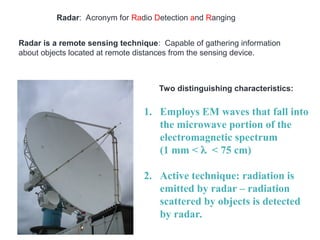
Radar: Acronym for Radio Detection and Ranging
Radar is a remote sensing technique: Capable of gathering information
about objects located at remote distances from the sensing device.
Two distinguishing characteristics:
1. Employs EM waves that fall into
the microwave portion of the
electromagnetic spectrum
(1 mm < < 75 cm)
2. Active technique: radiation is
emitted by radar – radiation
scattered by objects is detected
by radar.
Why microwaves?
Microwaves can penetrate haze, fog and snow readily, and rain and hail
less readily, so radar can “see through” these conditions.
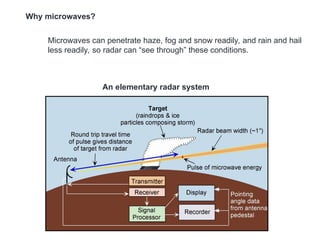
An elementary radar system
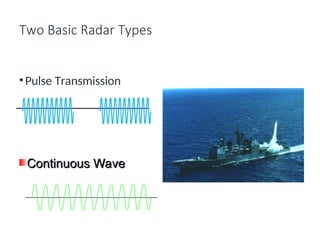
Two Basic Radar Types
•Pulse Transmission
Continuous Wave
Continuous Wave
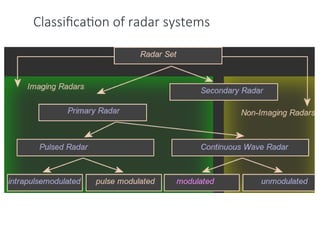
Classification of radar systems
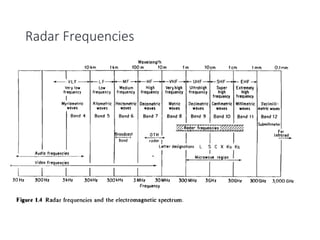
Radar Frequencies
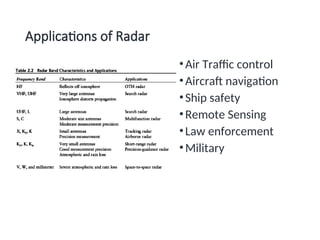
Applications of Radar
•Air Traffic control
•Aircraft navigation
•Ship safety
•Remote Sensing
•Law enforcement
•Military
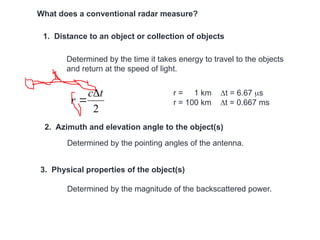
What does a conventional radar measure?
1. Distance to an object or collection of objects
Determined by the time it takes energy to travel to the objects
and return at the speed of light.
2
t
c
r


2. Azimuth and elevation angle to the object(s)
Determined by the pointing angles of the antenna.
3. Physical properties of the object(s)
Determined by the magnitude of the backscattered power.
r = 1 km t = 6.67 s
r = 100 km t = 0.667 ms
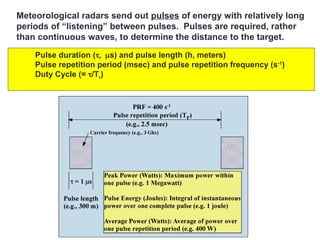
Pulse duration (s) and pulse length (h, meters)
Pulse repetition period (msec) and pulse repetition frequency (s-1
)
Duty Cycle (= Tr)
Meteorological radars send out pulses of energy with relatively long
periods of “listening” between pulses. Pulses are required, rather
than continuous waves, to determine the distance to the target.
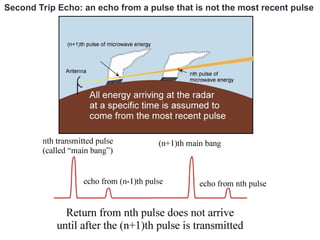
Second Trip Echo: an echo from a pulse that is not the most recent pulse
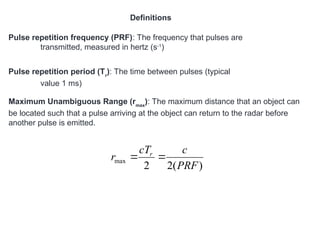
Pulse repetition frequency (PRF): The frequency that pulses are
transmitted, measured in hertz (s-1
)
Pulse repetition period (Tr
): The time between pulses (typical
value 1 ms)
Maximum Unambiguous Range (rmax
): The maximum distance that an object can
be located such that a pulse arriving at the object can return to the radar before
another pulse is emitted.
Definitions
)
(
2
2
max
PRF
c
cT
r r


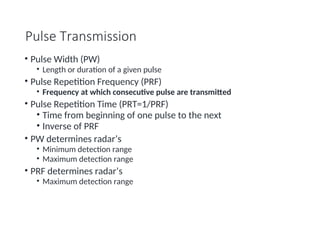
Pulse Transmission
• Pulse Width (PW)
• Length or duration of a given pulse
• Pulse Repetition Frequency (PRF)
• Frequency at which consecutive pulse are transmitted
• Pulse Repetition Time (PRT=1/PRF)
• Time from beginning of one pulse to the next
• Inverse of PRF
• PW determines radar’s
• Minimum detection range
• Maximum detection range
• PRF determines radar’s
• Maximum detection range
 Radar- RAdio Detection
And Ranging
 Transmits microwaves
 Elevation position, ∅
 Azimuth Position, Ѳ
National Weather Service
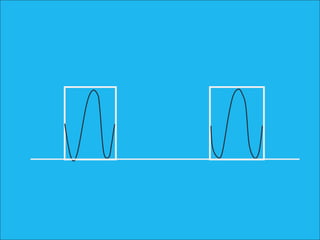
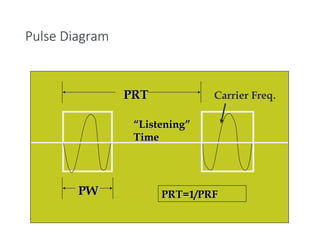
Pulse Diagram
PRT
PRT
PW
PW
“
“Listening”
Listening”
Time
Time
PRT=1/PRF
PRT=1/PRF
Carrier Freq.
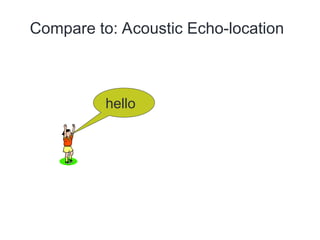
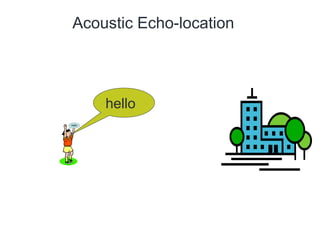
hello
Compare to: Acoustic Echo-location
hello
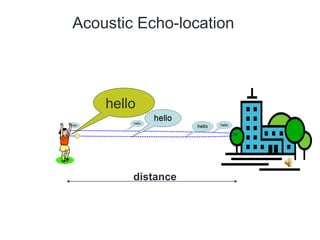
Acoustic Echo-location
hello
distance
Acoustic Echo-location
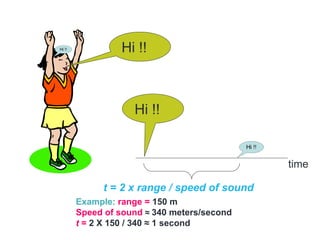
Hi !!
Hi !!
time
t = 2 x range / speed of sound
Example: range = 150 m
Speed of sound ≈ 340 meters/second
t = 2 X 150 / 340 ≈ 1 second
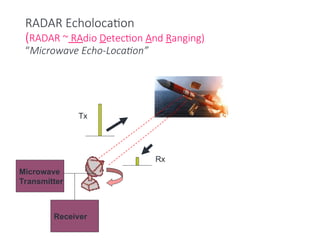
RADAR Echolocation
(RADAR ~ RAdio Detection And Ranging)
“Microwave Echo-Location”
Microwave
Transmitter
Receiver
Tx
Rx
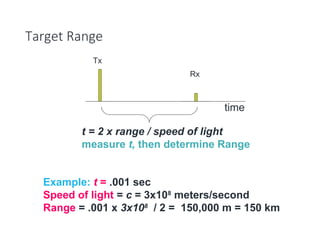
Target Range
time
t = 2 x range / speed of light
measure t, then determine Range
Example: t = .001 sec
Speed of light = c = 3x10⁸
meters/second
Range = .001 x 3x108
/ 2 = 150,000 m = 150 km
Tx
Rx
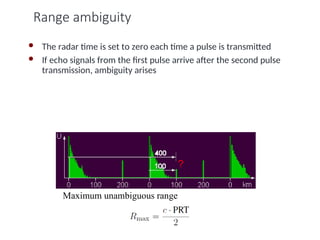
Range ambiguity
 The radar time is set to zero each time a pulse is transmitted
 If echo signals from the first pulse arrive after the second pulse
transmission, ambiguity arises
Maximum unambiguous range
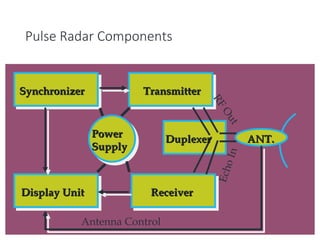
Pulse Radar Components
Synchronizer
Synchronizer Transmitter
Transmitter
Display Unit
Display Unit Receiver
Receiver
Power
Power
Supply
Supply
ANT.
ANT.
Duplexer
Duplexer
R
F
O
u
t
E
c
h
o
I
n
Antenna Control
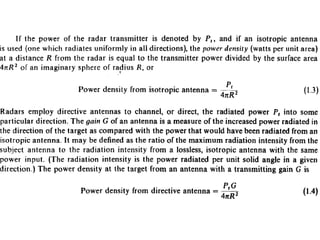
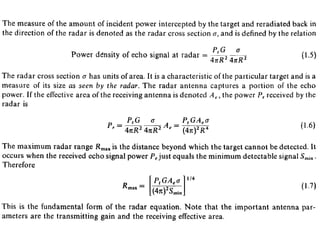
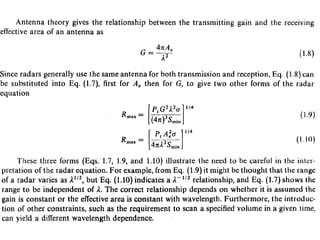
Radar Equation
• The radar equation relates the range of a radar to the
characteristics of the transmitter, receiver, antenna, target,
and environment.
• It is useful for determining the maximum distance from the
radar to the target
• it can serve both as a tool for understanding radar operation
and as a basis for radar design.
• However it cannot give the precise value. Why??
• Statistical nature of noise and signal
• Fluctuation & uncertainty of the target
• Propagation effect of the wave
• Losses
• Are affecting the calculation
• We will consider each one separately.
The Radar Equation- Considerations
of various parameters
• As I pointed out earlier there are many factors which we have
to consider in the range equation. They affect the calculation.
• But we can model them and mathematically find the model
and insert in the range equation.
• Noise is in the system and it is random. So we have to have
probability.
• If affects the detection. So we have to get SNR
• Pulse repetition frequency
• Cross section of the target exposed to the wave we send
Questions?

Radar Lecture 1.ppt in Telecomunication engineering

  • 1.
    Radar and NavigationSystems Lecture 1
  • 2.
    Learning Objectives • Knowthe application of radar system • Comprehend basic operation of a simple pulse radar system • Know the following terms: pulse width, pulse repetition frequency, carrier frequency, peak power, average power, and duty cycle • Know the block diagram of a simple pulse radar system
  • 3.
    Radar: Acronym forRadio Detection and Ranging Radar is a remote sensing technique: Capable of gathering information about objects located at remote distances from the sensing device. Two distinguishing characteristics: 1. Employs EM waves that fall into the microwave portion of the electromagnetic spectrum (1 mm < < 75 cm) 2. Active technique: radiation is emitted by radar – radiation scattered by objects is detected by radar.
  • 4.
    Why microwaves? Microwaves canpenetrate haze, fog and snow readily, and rain and hail less readily, so radar can “see through” these conditions. An elementary radar system
  • 5.
    Two Basic RadarTypes •Pulse Transmission Continuous Wave Continuous Wave
  • 6.
  • 7.
  • 8.
    Applications of Radar •AirTraffic control •Aircraft navigation •Ship safety •Remote Sensing •Law enforcement •Military
  • 9.
    What does aconventional radar measure? 1. Distance to an object or collection of objects Determined by the time it takes energy to travel to the objects and return at the speed of light. 2 t c r   2. Azimuth and elevation angle to the object(s) Determined by the pointing angles of the antenna. 3. Physical properties of the object(s) Determined by the magnitude of the backscattered power. r = 1 km t = 6.67 s r = 100 km t = 0.667 ms
  • 10.
    Pulse duration (s)and pulse length (h, meters) Pulse repetition period (msec) and pulse repetition frequency (s-1 ) Duty Cycle (= Tr) Meteorological radars send out pulses of energy with relatively long periods of “listening” between pulses. Pulses are required, rather than continuous waves, to determine the distance to the target.
  • 11.
    Second Trip Echo:an echo from a pulse that is not the most recent pulse
  • 12.
    Pulse repetition frequency(PRF): The frequency that pulses are transmitted, measured in hertz (s-1 ) Pulse repetition period (Tr ): The time between pulses (typical value 1 ms) Maximum Unambiguous Range (rmax ): The maximum distance that an object can be located such that a pulse arriving at the object can return to the radar before another pulse is emitted. Definitions ) ( 2 2 max PRF c cT r r  
  • 13.
    Pulse Transmission • PulseWidth (PW) • Length or duration of a given pulse • Pulse Repetition Frequency (PRF) • Frequency at which consecutive pulse are transmitted • Pulse Repetition Time (PRT=1/PRF) • Time from beginning of one pulse to the next • Inverse of PRF • PW determines radar’s • Minimum detection range • Maximum detection range • PRF determines radar’s • Maximum detection range
  • 15.
     Radar- RAdioDetection And Ranging  Transmits microwaves  Elevation position, ∅  Azimuth Position, Ѳ National Weather Service
  • 16.
  • 17.
  • 18.
  • 19.
  • 20.
    Hi !! Hi !! time t= 2 x range / speed of sound Example: range = 150 m Speed of sound ≈ 340 meters/second t = 2 X 150 / 340 ≈ 1 second
  • 21.
    RADAR Echolocation (RADAR ~RAdio Detection And Ranging) “Microwave Echo-Location” Microwave Transmitter Receiver Tx Rx
  • 22.
    Target Range time t =2 x range / speed of light measure t, then determine Range Example: t = .001 sec Speed of light = c = 3x10⁸ meters/second Range = .001 x 3x108 / 2 = 150,000 m = 150 km Tx Rx
  • 23.
    Range ambiguity  Theradar time is set to zero each time a pulse is transmitted  If echo signals from the first pulse arrive after the second pulse transmission, ambiguity arises Maximum unambiguous range
  • 24.
    Pulse Radar Components Synchronizer SynchronizerTransmitter Transmitter Display Unit Display Unit Receiver Receiver Power Power Supply Supply ANT. ANT. Duplexer Duplexer R F O u t E c h o I n Antenna Control
  • 25.
    Radar Equation • Theradar equation relates the range of a radar to the characteristics of the transmitter, receiver, antenna, target, and environment. • It is useful for determining the maximum distance from the radar to the target • it can serve both as a tool for understanding radar operation and as a basis for radar design. • However it cannot give the precise value. Why?? • Statistical nature of noise and signal • Fluctuation & uncertainty of the target • Propagation effect of the wave • Losses • Are affecting the calculation • We will consider each one separately.
  • 29.
    The Radar Equation-Considerations of various parameters • As I pointed out earlier there are many factors which we have to consider in the range equation. They affect the calculation. • But we can model them and mathematically find the model and insert in the range equation. • Noise is in the system and it is random. So we have to have probability. • If affects the detection. So we have to get SNR • Pulse repetition frequency • Cross section of the target exposed to the wave we send
  • 30.

Editor's Notes

  • #5 Pulse - RADAR transmits a series of pulses separated by non-transmission intervals during which the radar “listens” for a return. Continuous Wave - Constantly emitting radar. Relative motion of either the radar or the target is required to indicate target position. Frequency shift.
  • #13 1. The pulse width determines the minimum range that the target can be detected. a. If transmitter is still on when the pulse (echo)is returned then won’t see the return. b. Need short pulses to detect close targets. 2. Need long pulses to have sufficient power to reach targets that have long ranges. 3. Pulse Repetition Time, Frequency or Rate. a. The length of time the transmitter is off (longer PRF) the longer the radar’s maximum range will be. (Use the drawing to explain) KEY Points: 1. Varying the pulse width affects the range of the radar. 2. Need short pulses for short range targets. 3. PW determines radar’s minimum range resolution. 4. The slower the PRF the greater the radar’s maximum range. 5. The faster the PRF the greater the radar’s accuracy.
  • #16 Figure 8-2, pg. 90 in the book. PW - Minimum range and Maximum Range Minimum - PW determines when the radar begins listening for a target return Maximum - PW determines on time for average power, need power to look long distances. PRF - Maximum Range Quit listening for a return pulse and transmit again
  • #24 1. Make copies of graphic and distribute to class. (p. 91 in text) 2. Synchronizer: a. Coordinates the entire system b. Determines the timing of the transmitted pulse c. Includes timers, modulator and central control. 3. Transmitter: a. Generate the pulse (RF) at the proper frequency and amplify. 4. Antenna: A. Receives energy from the transmitter, radiates it in the form of a highly directional beam. B. Receives the echoes for pulse radars. 5. Duplexer: a. Allows one antenna to be used to transmit and receive. b. Prevents transmitted RF energy from going directly to the receiver. c. Tells the antenna to radiate or receive. 6. Receiver: receives incoming echoes from antenna, detects and amplifies the signal, and sends them to the display. 7. Display: Displays the received video to the operator. 8. Power Supply: Provides power to all the components of the system. 9. Discuss the antenna Bearing loop back to the display and its function.