Microwave Semiconductor Devices
Contents
• Characteristics of microwave bipolar transistors
and FET
• Schottky Diodes and Detectors
• Tunnel diodes
• PIN diodes and control circuits
• Gunn and IMPATT diodes
• Varactor diode.
Characteristics of microwave bipolar transistors and FET
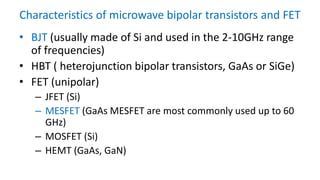
• BJT (usually made of Si and used in the 2-10GHz range
of frequencies)
• HBT ( heterojunction bipolar transistors, GaAs or SiGe)
• FET (unipolar)
– JFET (Si)
– MESFET (GaAs MESFET are most commonly used up to 60
GHz)
– MOSFET (Si)
– HEMT (GaAs, GaN)
Bipolar Junction Transistor
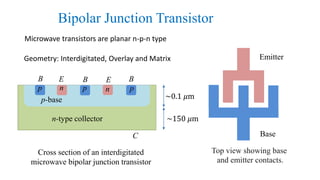
Cross section of an interdigitated
microwave bipolar junction transistor
p-base
p p pn n
BBB EE
n-type collector
C
~0.1 𝜇m
~150 𝜇m
Base
Emitter
Top view showing base
and emitter contacts.
Microwave transistors are planar n-p-n type
Geometry: Interdigitated, Overlay and Matrix
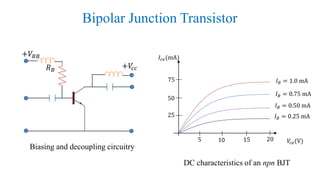
Bipolar Junction Transistor
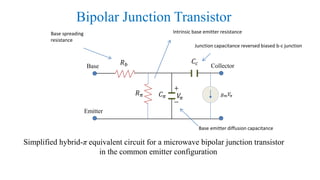
Simplified hybrid-π equivalent circuit for a microwave bipolar junction transistor
in the common emitter configuration
𝑅 𝑏
+
−
𝑅 𝜋 𝐶 𝜋 𝑉𝜋
𝐶𝑐
𝑔 𝑚 𝑉𝜋
CollectorBase
Emitter
Base spreading
resistance
Intrinsic base emitter resistance
Base emitter diffusion capacitance
Junction capacitance reversed biased b-c junction
Bipolar Junction Transistor
Biasing and decoupling circuitry
+𝑉𝐵𝐵
+𝑉𝑐𝑐
DC characteristics of an npn BJT
𝑉𝑐𝑒(V)155
50
75
25
𝐼𝑐𝑒(mA)
𝐼 𝐵 = 0.25 mA
𝐼 𝐵 = 0.50 mA
𝐼 𝐵 = 0.75 mA
𝐼 𝐵 = 1.0 mA
2010
𝑅 𝐵
Bipolar Junction Transistor
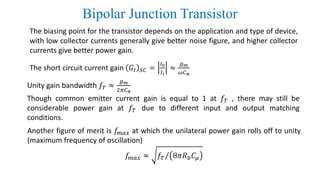
The biasing point for the transistor depends on the application and type of device,
with low collector currents generally give better noise figure, and higher collector
currents give better power gain.
The short circuit current gain 𝐺𝐼 𝑆𝐶 =
𝐼0
𝐼 𝑖
≈
𝑔 𝑚
𝜔𝐶 𝜋
Unity gain bandwidth 𝑓𝑇 ≈
𝑔 𝑚
2𝜋𝐶 𝜋
Another figure of merit is 𝑓𝑚𝑎𝑥 at which the unilateral power gain rolls off to unity
(maximum frequency of oscillation)
𝑓𝑚𝑎𝑥 ≈ Τ𝑓𝑇 8𝜋𝑅 𝑏 𝐶𝜇
Though common emitter current gain is equal to 1 at 𝑓𝑇 , there may still be
considerable power gain at 𝑓𝑇 due to different input and output matching
conditions.
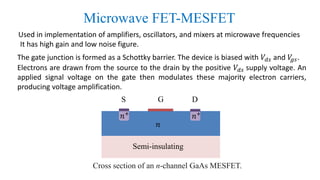
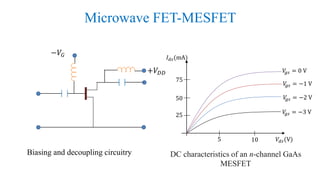
Microwave FET-MESFET
𝑛+
𝑛+
𝑛
S G D
Semi-insulating
Cross section of an n-channel GaAs MESFET.
Used in implementation of amplifiers, oscillators, and mixers at microwave frequencies
It has high gain and low noise figure.
The gate junction is formed as a Schottky barrier. The device is biased with 𝑉𝑑𝑠 and 𝑉𝑔𝑠.
Electrons are drawn from the source to the drain by the positive 𝑉𝑑𝑠 supply voltage. An
applied signal voltage on the gate then modulates these majority electron carriers,
producing voltage amplification.
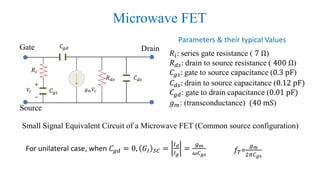
Microwave FET
Small Signal Equivalent Circuit of a Microwave FET (Common source configuration)
𝑅𝑖: series gate resistance ( 7 Ω)
𝑅 𝑑𝑠: drain to source resistance ( 400 Ω)
𝐶𝑔𝑠: gate to source capacitance (0.3 pF)
𝐶 𝑑𝑠: drain to source capacitance (0.12 pF)
𝐶𝑔𝑑: gate to drain capacitance (0.01 pF)
𝑔 𝑚: (transconductance) (40 mS)
𝑅𝑖
+
−
𝑉𝐶
𝑅 𝑑𝑠 𝐶 𝑑𝑠
𝑔 𝑚 𝑉𝐶
𝐶𝑔𝑑
𝐶𝑔𝑠
DrainGate
Source
Parameters & their typical Values
For unilateral case, when 𝐶𝑔𝑑 = 0, 𝐺𝐼 𝑆𝐶 =
𝐼 𝑑
𝐼 𝑔
=
𝑔 𝑚
𝜔𝐶 𝑔𝑠
𝑓𝑇=
𝑔 𝑚
2𝜋𝐶 𝑔𝑠
Microwave FET-MESFET
Biasing and decoupling circuitry DC characteristics of an n-channel GaAs
MESFET
𝑉𝑑𝑠(V)105
50
75
25
𝐼 𝑑𝑠(mA)
𝑉𝑔𝑠 = −3 V
𝑉𝑔𝑠 = −2 V
𝑉𝑔𝑠 = −1 V
𝑉𝑔𝑠 = 0 V+𝑉𝐷𝐷
−𝑉𝐺
Schottky Diodes and Detectors
PN junction diodes used at low frequencies have large
junction capacitance which makes such diodes unsuitable
for microwave frequencies
Schottky Diodes have semiconductor-metal junction
which results in a much lower junction capacitance
N-type GaAs is generally used. For lower frequency
application N-type silicon is also used
Schottky Diodes and Detectors
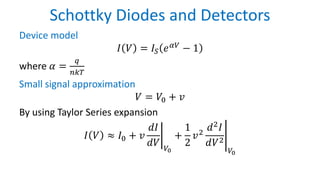
Device model
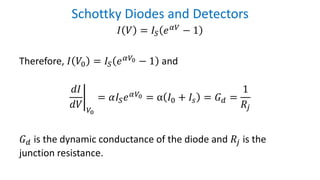
𝐼 𝑉 = 𝐼𝑆 𝑒 𝛼𝑉 − 1
where 𝛼 =
𝑞
𝑛𝑘𝑇
Small signal approximation
𝑉 = 𝑉0 + 𝑣
By using Taylor Series expansion
𝐼 𝑉 ≈ 𝐼0 + 𝑣 ቤ
𝑑𝐼
𝑑𝑉 𝑉0
+
1
2
𝑣2
อ
𝑑2 𝐼
𝑑𝑉2
𝑉0
Schottky Diodes and Detectors
𝐼 𝑉 = 𝐼𝑆 𝑒 𝛼𝑉
− 1
Therefore, 𝐼 𝑉0 = 𝐼𝑆 𝑒 𝛼𝑉0 − 1 and
ቤ
𝑑𝐼
𝑑𝑉 𝑉0
= 𝛼𝐼𝑆 𝑒 𝛼𝑉0 = α 𝐼0 + 𝐼𝑠 = 𝐺 𝑑 =
1
𝑅𝑗
𝐺 𝑑 is the dynamic conductance of the diode and 𝑅𝑗 is the
junction resistance.
Schottky Diodes and Detectors
อ
𝑑2 𝐼
𝑑𝑉2
𝑉0
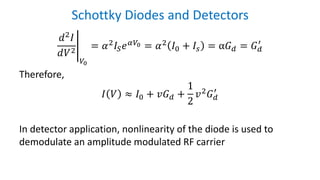
= 𝛼2 𝐼𝑆 𝑒 𝛼𝑉0 = 𝛼2 𝐼0 + 𝐼𝑠 = α𝐺 𝑑 = 𝐺 𝑑
′
Therefore,
𝐼 𝑉 ≈ 𝐼0 + 𝑣𝐺 𝑑 +
1
2
𝑣2 𝐺 𝑑
′
In detector application, nonlinearity of the diode is used to
demodulate an amplitude modulated RF carrier
Schottky Diodes and Detectors
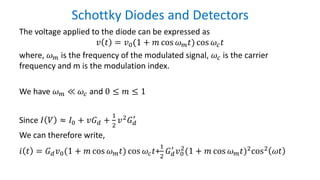
The voltage applied to the diode can be expressed as
𝑣 𝑡 = 𝑣0(1 + 𝑚 cos 𝜔 𝑚 𝑡) cos 𝜔𝑐 𝑡
where, 𝜔 𝑚 is the frequency of the modulated signal, 𝜔𝑐 is the carrier
frequency and m is the modulation index.
We have 𝜔 𝑚 ≪ 𝜔𝑐 and 0 ≤ 𝑚 ≤ 1
Since 𝐼 𝑉 ≈ 𝐼0 + 𝑣𝐺 𝑑 +
1
2
𝑣2 𝐺 𝑑
′
We can therefore write,
𝑖 𝑡 = 𝐺 𝑑 𝑣0(1 + 𝑚 cos 𝜔 𝑚 𝑡) cos 𝜔𝑐 𝑡+
1
2
𝐺 𝑑
′
𝑣0
2
(1 + 𝑚 cos 𝜔 𝑚 𝑡)2cos2 𝜔𝑡
Schottky Diodes and Detectors
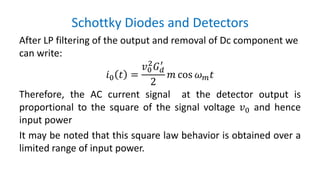
After LP filtering of the output and removal of Dc component we
can write:
𝑖0 𝑡 =
𝑣0
2
𝐺 𝑑
′
2
𝑚 cos 𝜔 𝑚 𝑡
Therefore, the AC current signal at the detector output is
proportional to the square of the signal voltage 𝑣0 and hence
input power
It may be noted that this square law behavior is obtained over a
limited range of input power.
Tunnel diode
Tunnel Diode
A tunnel diode is a PN junction diode with highly doped P and N materials (~1019
−
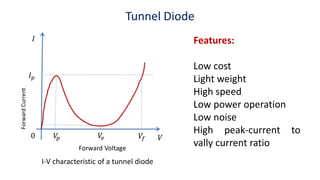
Tunnel Diode
Features:
Low cost
Light weight
High speed
Low power operation
Low noise
High peak-current to
vally current ratio
0
𝐼 𝑝
𝑉𝑝 𝑉𝑣 𝑉𝑓
𝐼
𝑉
Forward Voltage
ForwardCurrent
I-V characteristic of a tunnel diode
Tunnel diode operation
Tunnel diode has heavily doped PN
junction
In ordinary diode Fermi level lies in
the forbidden region
For a tunnel diode Fermi level is
inside valence band in P-type
material and inside conduction
band in N-type
For tunneling action, the depletion
region should be very thin and
there must be filled states on one
side and allowable vacant states
on the other side
𝐸 𝑣
𝐸𝑐
𝐸 𝐹
𝐸 𝑣
𝐸𝑐
𝐸 𝐹 Filled states
Empty states
𝐸 𝑔
𝑉0
Depletion Layer
NP
Forbidden
band
Conduction
band
Valence
band
Tunnel diode under zero- bias
Under zero-bias condition no current flows
Tunnel diode operation
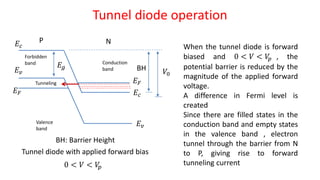
When the tunnel diode is forward
biased and 0 < 𝑉 < 𝑉𝑝 , the
potential barrier is reduced by the
magnitude of the applied forward
voltage.
A difference in Fermi level is
created
Since there are filled states in the
conduction band and empty states
in the valence band , electron
tunnel through the barrier from N
to P, giving rise to forward
tunneling current
𝐸 𝑣
𝐸𝑐
𝐸 𝐹
𝐸 𝑣
𝐸𝑐
𝐸 𝐹
Tunneling
𝐸𝑔
𝑉0
NP
Forbidden
band Conduction
band
Valence
band
BH
BH: Barrier Height
Tunnel diode with applied forward bias
0 < 𝑉 < 𝑉𝑝
Tunnel diode operation
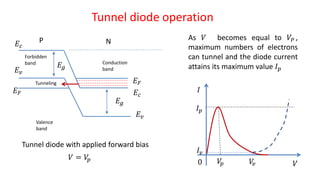
As 𝑉 becomes equal to 𝑉𝑃 ,
maximum numbers of electrons
can tunnel and the diode current
attains its maximum value 𝐼 𝑝
𝐸 𝑣
𝐸𝑐
𝐸 𝐹
𝐸 𝑣
𝐸𝑐
𝐸 𝐹
Tunneling
𝐸𝑔
NP
Forbidden
band Conduction
band
Valence
band
Tunnel diode with applied forward bias
𝑉 = 𝑉𝑝
𝐸 𝑔
𝐼𝑣
𝐼 𝑝
𝐼
𝑉𝑉𝑝 𝑉𝑣0
Tunnel diode operation
𝐼𝑣
𝐼 𝑝
𝐼
𝑉𝑉𝑝 𝑉𝑣0
𝐸 𝑣
𝐸𝑐
𝐸 𝐹
𝐸 𝑣
𝐸𝑐
𝐸 𝐹
Tunneling
𝐸 𝑔
NP
Forbidden
band Conduction
band
Valence
band
Tunnel diode with applied forward bias
𝐸 𝑔
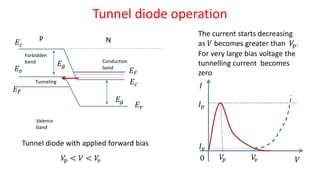
𝑉𝑝 < 𝑉 < 𝑉𝑣
The current starts decreasing
as 𝑉 becomes greater than 𝑉𝑝.
For very large bias voltage the
tunnelling current becomes
zero
Tunnel diode operation
𝐼𝑣
𝐼 𝑝
𝐼
𝑉𝑉𝑝 𝑉𝑣0
𝐸 𝑣
𝐸𝑐
𝐸 𝐹𝐸 𝑣
𝐸𝑐
𝐸 𝐹
𝐸 𝑔
NP
Forbidden
band
Conduction
band
Valence
band
Tunnel diode with applied forward bias
𝐸𝑔
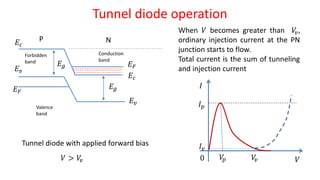
𝑉 > 𝑉𝑣
When 𝑉 becomes greater than 𝑉𝑣,
ordinary injection current at the PN
junction starts to flow.
Total current is the sum of tunneling
and injection current
Tunnel diode operation
𝐼𝑣
𝐼 𝑝
𝐼
𝑉𝑉𝑝 𝑉𝑣0
𝑏
𝑉𝑏
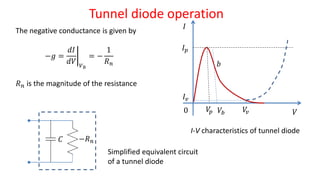
The negative conductance is given by
−𝑔 = ቤ
𝑑𝐼
𝑑𝑉 𝑉 𝑏
= −
1
𝑅 𝑛
𝑅 𝑛 is the magnitude of the resistance
−𝑅 𝑛𝐶
I-V characteristics of tunnel diode
Simplified equivalent circuit
of a tunnel diode
Tunnel diode operation
−𝑅 𝑛𝐶
+
−
𝑅 𝑔
𝑅 𝐿
𝑉𝑉𝑔
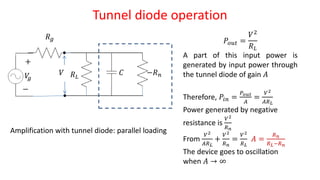
𝑃𝑜𝑢𝑡 =
𝑉2
𝑅 𝐿
A part of this input power is
generated by input power through
the tunnel diode of gain 𝐴
Therefore, 𝑃𝑖𝑛 =
𝑃𝑜𝑢𝑡
𝐴
=
𝑉2
𝐴𝑅 𝐿
Power generated by negative
resistance is
𝑉2
𝑅 𝑛
From
𝑉2
𝐴𝑅 𝐿
+
𝑉2
𝑅 𝑛
=
𝑉2
𝑅 𝐿
𝐴 =
𝑅 𝑛
𝑅 𝐿−𝑅 𝑛
The device goes to oscillation
when 𝐴 → ∞
Amplification with tunnel diode: parallel loading
PIN diode and its equivalent circuit
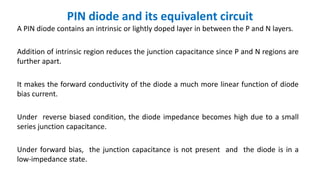
A PIN diode contains an intrinsic or lightly doped layer in between the P and N layers.
Addition of intrinsic region reduces the junction capacitance since P and N regions are
further apart.
It makes the forward conductivity of the diode a much more linear function of diode
bias current.
Under reverse biased condition, the diode impedance becomes high due to a small
series junction capacitance.
Under forward bias, the junction capacitance is not present and the diode is in a
low-impedance state.
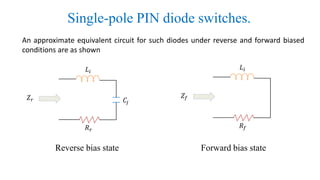
𝐿𝑖
𝐶𝑗
𝑅 𝑟
𝑍 𝑟
𝐿𝑖
𝑅𝑓
𝑍𝑓
Reverse bias state Forward bias state
Single-pole PIN diode switches.
An approximate equivalent circuit for such diodes under reverse and forward biased
conditions are as shown
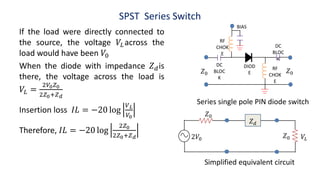
SPST Series Switch
If the load were directly connected to
the source, the voltage 𝑉𝐿 across the
load would have been 𝑉0
When the diode with impedance 𝑍 𝑑is
there, the voltage across the load is
𝑉𝐿 =
2𝑉0 𝑍0
2𝑍0+𝑍 𝑑
Insertion loss 𝐼𝐿 = −20 log
𝑉 𝐿
𝑉0
Therefore, 𝐼𝐿 = −20 log
2𝑍0
2𝑍0+𝑍 𝑑
Series single pole PIN diode switch
Simplified equivalent circuit
𝑍0
RF
CHOK
E
RF
CHOK
E
DC
BLOC
K
DC
BLOC
K
DIOD
E 𝑍0
BIAS
𝑍0
𝑍0
𝑍 𝑑
2𝑉0 𝑉𝐿
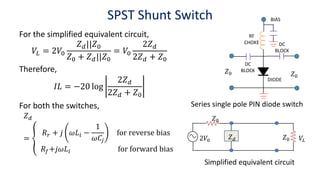
SPST Shunt Switch
For the simplified equivalent circuit,
𝑉𝐿 = 2𝑉0
𝑍 𝑑||𝑍0
𝑍0 + 𝑍 𝑑||𝑍0
= 𝑉0
2𝑍 𝑑
2𝑍 𝑑 + 𝑍0
Therefore,
𝐼𝐿 = −20 log
2𝑍 𝑑
2𝑍 𝑑 + 𝑍0
For both the switches,
𝑍 𝑑
= ൞
𝑅 𝑟 + 𝑗 𝜔𝐿𝑖 −
1
𝜔𝐶𝑗
for reverse bias
𝑅𝑓+𝑗𝜔𝐿𝑖 for forward bias
Series single pole PIN diode switch
Simplified equivalent circuit
𝑍0
RF
CHOKE DC
BLOCK
DC
BLOCK
DIODE
𝑍0
BIAS
𝑍0
𝑍0
2𝑉0 𝑉𝐿
𝑍 𝑑
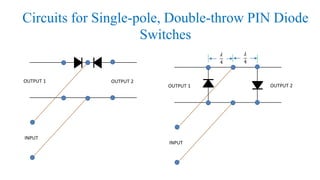
OUTPUT 1
INPUT
OUTPUT 2
OUTPUT 1
INPUT
OUTPUT 2
𝜆
4
𝜆
4
Circuits for Single-pole, Double-throw PIN Diode
Switches
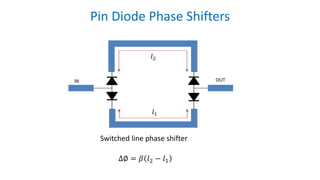
Pin Diode Phase Shifters
Switched line phase shifter
∆∅ = 𝛽 𝑙2 − 𝑙1
IN OUT
𝑙1
𝑙2
Gunn and IMPATT diodes
Varactor diode
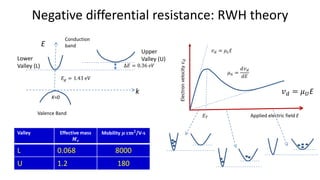
Gunn effect diode: background
Gunn effect diodes are named after J. B. Gunn
In 1963 , Gunn observed that when applied DC bias across an N-type GaAs
sample exceeds a threshold value, microwave oscillations can be obtained
whose frequency is approximately equal to reciprocal of the carrier transit
time across the sample.
The observed oscillations could be understood in terms of theory presented
by Ridley, Watkins and Hilsum (RWH) which is based on the field induced
transfer of conduction band electrons from a low energy high mobility valley
to a high energy low mobility satellite valley.
In 1964, Kroemer suggested that Gunn’s observations were in agreement with
RWH theory
Negative differential resistance: RWH theory
Valence Band
Conduction
band
k
E
∆𝐸 = 0.36 𝑒𝑉
Lower
Valley (L)
Upper
Valley (U)
𝐸𝑔 = 1.43 eV
K=0
Valley Effective mass
𝑴 𝒆
Mobility 𝝁 𝐜𝐦 𝟐
/V-s
L 0.068 8000
U 1.2 180
Electronvelocity𝑣𝑑
Applied electric field E𝐸 𝑇
𝑣 𝑑 = 𝜇 𝐿E
𝑣 𝑑 = 𝜇 𝑈E
𝜇 𝑛 =
𝑑𝑣 𝑑
𝑑𝐸
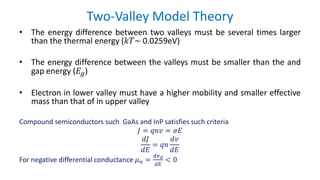
Two-Valley Model Theory
• The energy difference between two valleys must be several times larger
than the thermal energy (𝑘𝑇~ 0.0259eV)
• The energy difference between the valleys must be smaller than the and
gap energy (𝐸𝑔)
• Electron in lower valley must have a higher mobility and smaller effective
mass than that of in upper valley
Compound semiconductors such GaAs and InP satisfies such criteria
𝐽 = 𝑞𝑛𝑣 = 𝜎𝐸
𝑑𝐽
𝑑𝐸
= 𝑞𝑛
𝑑𝑣
𝑑𝐸
For negative differential conductance 𝜇 𝑛 =
𝑑𝑣 𝑑
𝑑𝐸
< 0
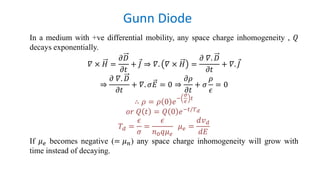
Gunn Diode
In a medium with +ve differential mobility, any space charge inhomogeneity , 𝑄
decays exponentially.
𝛻 × 𝐻 =
𝜕𝐷
𝜕𝑡
+ Ԧ𝐽 ⇒ 𝛻. 𝛻 × 𝐻 =
𝜕 𝛻. 𝐷
𝜕𝑡
+ 𝛻. Ԧ𝐽
⇒
𝜕 𝛻. 𝐷
𝜕𝑡
+ 𝛻. 𝜎𝐸 = 0 ⇒
𝜕𝜌
𝜕𝑡
+ 𝜎
𝜌
𝜖
= 0
∴ 𝜌 = 𝜌 0 𝑒
−
𝜎
𝜖 𝑡
𝑜𝑟 𝑄 𝑡 = 𝑄 0 𝑒−𝑡/𝑇 𝑑
𝑇𝑑 =
𝜖
𝜎
=
𝜖
𝑛0 𝑞𝜇 𝑒
𝜇 𝑒 =
𝑑𝑣 𝑑
𝑑𝐸
If 𝜇 𝑒 becomes negative (= 𝜇 𝑛) any space charge inhomogeneity will grow with
time instead of decaying.
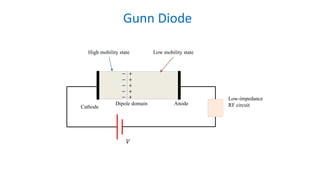
Gunn Diode
+
+
+
+
+
−
−
−
−
−
Cathode
AnodeDipole domain
High mobility state Low mobility state
Low-impedance
RF circuit
𝑉
Gunn Diode
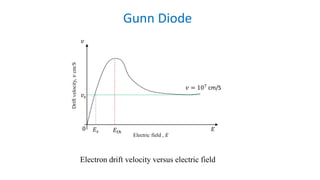
Electron drift velocity versus electric field
𝐸𝑠 𝐸𝑡ℎ
𝑣
𝐸
Electric field , 𝐸
Driftvelocity,𝑣cm/S
𝑣 = 107
cm/S
𝑣𝑠
0
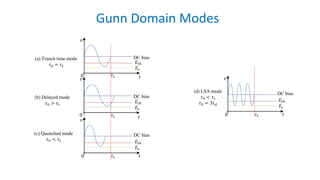
Gunn Domain Modes
𝐸𝑠
𝐸𝑡ℎ
𝐸𝑠
𝐸𝑡ℎ
𝐸𝑠
𝐸𝑡ℎ
DC bias
DC bias
DC bias
𝜏 𝑡
𝜏 𝑡
𝜏 𝑡
𝑡
𝑡
𝑡
0
0
0
𝑣
𝑣
𝑣
𝐸𝑠
𝐸𝑡ℎ
DC bias
𝜏 𝑡 𝑡0
𝑣
(d) LSA mode
𝜏0 < 𝜏 𝑡
𝜏0 = 3𝜏 𝑑
(c) Quenched mode
𝜏0 < 𝜏 𝑡
(b) Delayed mode
𝜏0 > 𝜏 𝑡
(a) Transit time mode
𝜏0 = 𝜏 𝑡
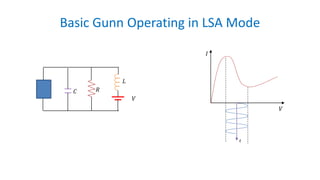
Basic Gunn Operating in LSA Mode
𝐶
𝐿
𝑅
𝑉
𝑡
𝑉
𝐼
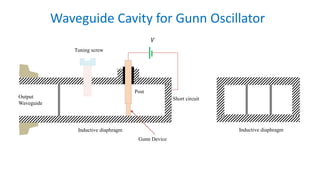
Waveguide Cavity for Gunn Oscillator
Tuning screw
Output
Waveguide
Short circuit
Post
Inductive diaphragm Inductive diaphragm
Gunn Device
𝑉
IMPATT Diode
IMPATT stands for Impact Ionization Avalanche Transit Time.
It describes the phenomenon associated with reverse voltage breakdown of a
P-N junction diode and transport or transit of charge carrier through a drift
region
In 1958 W.T. Read proposed that there would be a phase delay of more than
900 between the applied RF voltage and the avalanching current if the RF
voltage caused the total voltage to exceed the reverse breakdown voltage in
the diode.
Read’s prediction was verified by R. L. Johnson in 1965.
When current lags the RF voltage by more than 900, the diode exhibits
negative resistance. It can be used as source of microwave power in an
oscillator circuit.
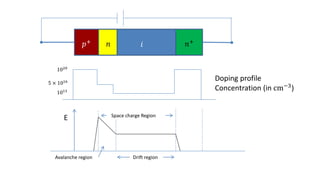
1020
5 × 10¹⁶
1013
Doping profile
Concentration (in cm−3)
Space charge Region
Drift regionAvalanche region
𝑝+
𝑛 𝑖 𝑛+
E
IMPATT Diode
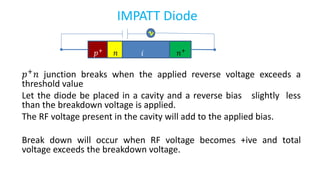
𝑝+ 𝑛 junction breaks when the applied reverse voltage exceeds a
threshold value
Let the diode be placed in a cavity and a reverse bias slightly less
than the breakdown voltage is applied.
The RF voltage present in the cavity will add to the applied bias.
Break down will occur when RF voltage becomes +ive and total
voltage exceeds the breakdown voltage.
𝑝+
𝑛 𝑖 𝑛+
IMPATT Diode
When breakdown is initiated, large number holes and electrons are created at
the 𝑝+ 𝑛 junction.
Electrons are swept across the 𝑛 region into the intrinsic semiconductor
constituting the drift region.
After a transit time delay, the electrons are collected at the 𝑛+ terminal.
When the time for the avalanche charge build up plus that for charge transit
through the drift region exceeds one-half of RF period, output current lags
the RF voltage by more than 900
The diode thus exhibits negative resistance for RF currents.
Once the oscillation starts in the cavity, it grows in amplitude until the
average negative resistance of the diode becomes equal to total equivalent
resistance of cavity and external load
Varactor Diode
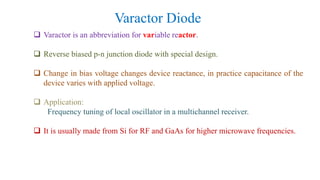
 Varactor is an abbreviation for variable reactor.
 Reverse biased p-n junction diode with special design.
 Change in bias voltage changes device reactance, in practice capacitance of the
device varies with applied voltage.
 Application:
Frequency tuning of local oscillator in a multichannel receiver.
 It is usually made from Si for RF and GaAs for higher microwave frequencies.
Varactor Diode
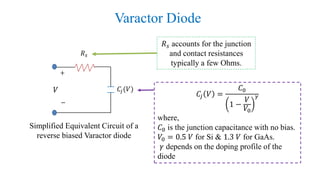
𝑅 𝑠
𝐶𝑗(𝑉)
+
−
𝑉
Simplified Equivalent Circuit of a
reverse biased Varactor diode
𝑅 𝑠 accounts for the junction
and contact resistances
typically a few Ohms.
𝐶𝑗 𝑉 =
𝐶0
1 −
𝑉
𝑉0
𝛾
where,
𝐶0 is the junction capacitance with no bias.
𝑉0 = 0.5 𝑉 for Si & 1.3 𝑉 for GaAs.
𝛾 depends on the doping profile of the
diode
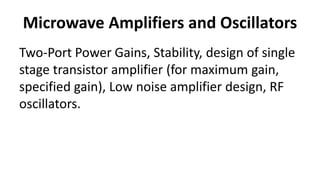
Microwave Amplifiers and Oscillators
Two-Port Power Gains, Stability, design of single
stage transistor amplifier (for maximum gain,
specified gain), Low noise amplifier design, RF
oscillators.

Microwave devices

  • 1.
  • 2.
    Contents • Characteristics ofmicrowave bipolar transistors and FET • Schottky Diodes and Detectors • Tunnel diodes • PIN diodes and control circuits • Gunn and IMPATT diodes • Varactor diode.
  • 3.
    Characteristics of microwavebipolar transistors and FET • BJT (usually made of Si and used in the 2-10GHz range of frequencies) • HBT ( heterojunction bipolar transistors, GaAs or SiGe) • FET (unipolar) – JFET (Si) – MESFET (GaAs MESFET are most commonly used up to 60 GHz) – MOSFET (Si) – HEMT (GaAs, GaN)
  • 4.
    Bipolar Junction Transistor Crosssection of an interdigitated microwave bipolar junction transistor p-base p p pn n BBB EE n-type collector C ~0.1 𝜇m ~150 𝜇m Base Emitter Top view showing base and emitter contacts. Microwave transistors are planar n-p-n type Geometry: Interdigitated, Overlay and Matrix
  • 5.
    Bipolar Junction Transistor Simplifiedhybrid-π equivalent circuit for a microwave bipolar junction transistor in the common emitter configuration 𝑅 𝑏 + − 𝑅 𝜋 𝐶 𝜋 𝑉𝜋 𝐶𝑐 𝑔 𝑚 𝑉𝜋 CollectorBase Emitter Base spreading resistance Intrinsic base emitter resistance Base emitter diffusion capacitance Junction capacitance reversed biased b-c junction
  • 6.
    Bipolar Junction Transistor Biasingand decoupling circuitry +𝑉𝐵𝐵 +𝑉𝑐𝑐 DC characteristics of an npn BJT 𝑉𝑐𝑒(V)155 50 75 25 𝐼𝑐𝑒(mA) 𝐼 𝐵 = 0.25 mA 𝐼 𝐵 = 0.50 mA 𝐼 𝐵 = 0.75 mA 𝐼 𝐵 = 1.0 mA 2010 𝑅 𝐵
  • 7.
    Bipolar Junction Transistor Thebiasing point for the transistor depends on the application and type of device, with low collector currents generally give better noise figure, and higher collector currents give better power gain. The short circuit current gain 𝐺𝐼 𝑆𝐶 = 𝐼0 𝐼 𝑖 ≈ 𝑔 𝑚 𝜔𝐶 𝜋 Unity gain bandwidth 𝑓𝑇 ≈ 𝑔 𝑚 2𝜋𝐶 𝜋 Another figure of merit is 𝑓𝑚𝑎𝑥 at which the unilateral power gain rolls off to unity (maximum frequency of oscillation) 𝑓𝑚𝑎𝑥 ≈ Τ𝑓𝑇 8𝜋𝑅 𝑏 𝐶𝜇 Though common emitter current gain is equal to 1 at 𝑓𝑇 , there may still be considerable power gain at 𝑓𝑇 due to different input and output matching conditions.
  • 8.
    Microwave FET-MESFET 𝑛+ 𝑛+ 𝑛 S GD Semi-insulating Cross section of an n-channel GaAs MESFET. Used in implementation of amplifiers, oscillators, and mixers at microwave frequencies It has high gain and low noise figure. The gate junction is formed as a Schottky barrier. The device is biased with 𝑉𝑑𝑠 and 𝑉𝑔𝑠. Electrons are drawn from the source to the drain by the positive 𝑉𝑑𝑠 supply voltage. An applied signal voltage on the gate then modulates these majority electron carriers, producing voltage amplification.
  • 9.
    Microwave FET Small SignalEquivalent Circuit of a Microwave FET (Common source configuration) 𝑅𝑖: series gate resistance ( 7 Ω) 𝑅 𝑑𝑠: drain to source resistance ( 400 Ω) 𝐶𝑔𝑠: gate to source capacitance (0.3 pF) 𝐶 𝑑𝑠: drain to source capacitance (0.12 pF) 𝐶𝑔𝑑: gate to drain capacitance (0.01 pF) 𝑔 𝑚: (transconductance) (40 mS) 𝑅𝑖 + − 𝑉𝐶 𝑅 𝑑𝑠 𝐶 𝑑𝑠 𝑔 𝑚 𝑉𝐶 𝐶𝑔𝑑 𝐶𝑔𝑠 DrainGate Source Parameters & their typical Values For unilateral case, when 𝐶𝑔𝑑 = 0, 𝐺𝐼 𝑆𝐶 = 𝐼 𝑑 𝐼 𝑔 = 𝑔 𝑚 𝜔𝐶 𝑔𝑠 𝑓𝑇= 𝑔 𝑚 2𝜋𝐶 𝑔𝑠
  • 10.
    Microwave FET-MESFET Biasing anddecoupling circuitry DC characteristics of an n-channel GaAs MESFET 𝑉𝑑𝑠(V)105 50 75 25 𝐼 𝑑𝑠(mA) 𝑉𝑔𝑠 = −3 V 𝑉𝑔𝑠 = −2 V 𝑉𝑔𝑠 = −1 V 𝑉𝑔𝑠 = 0 V+𝑉𝐷𝐷 −𝑉𝐺
  • 11.
  • 12.
    Schottky Diodes andDetectors PN junction diodes used at low frequencies have large junction capacitance which makes such diodes unsuitable for microwave frequencies Schottky Diodes have semiconductor-metal junction which results in a much lower junction capacitance N-type GaAs is generally used. For lower frequency application N-type silicon is also used
  • 13.
    Schottky Diodes andDetectors Device model 𝐼 𝑉 = 𝐼𝑆 𝑒 𝛼𝑉 − 1 where 𝛼 = 𝑞 𝑛𝑘𝑇 Small signal approximation 𝑉 = 𝑉0 + 𝑣 By using Taylor Series expansion 𝐼 𝑉 ≈ 𝐼0 + 𝑣 ቤ 𝑑𝐼 𝑑𝑉 𝑉0 + 1 2 𝑣2 อ 𝑑2 𝐼 𝑑𝑉2 𝑉0
  • 14.
    Schottky Diodes andDetectors 𝐼 𝑉 = 𝐼𝑆 𝑒 𝛼𝑉 − 1 Therefore, 𝐼 𝑉0 = 𝐼𝑆 𝑒 𝛼𝑉0 − 1 and ቤ 𝑑𝐼 𝑑𝑉 𝑉0 = 𝛼𝐼𝑆 𝑒 𝛼𝑉0 = α 𝐼0 + 𝐼𝑠 = 𝐺 𝑑 = 1 𝑅𝑗 𝐺 𝑑 is the dynamic conductance of the diode and 𝑅𝑗 is the junction resistance.
  • 15.
    Schottky Diodes andDetectors อ 𝑑2 𝐼 𝑑𝑉2 𝑉0 = 𝛼2 𝐼𝑆 𝑒 𝛼𝑉0 = 𝛼2 𝐼0 + 𝐼𝑠 = α𝐺 𝑑 = 𝐺 𝑑 ′ Therefore, 𝐼 𝑉 ≈ 𝐼0 + 𝑣𝐺 𝑑 + 1 2 𝑣2 𝐺 𝑑 ′ In detector application, nonlinearity of the diode is used to demodulate an amplitude modulated RF carrier
  • 16.
    Schottky Diodes andDetectors The voltage applied to the diode can be expressed as 𝑣 𝑡 = 𝑣0(1 + 𝑚 cos 𝜔 𝑚 𝑡) cos 𝜔𝑐 𝑡 where, 𝜔 𝑚 is the frequency of the modulated signal, 𝜔𝑐 is the carrier frequency and m is the modulation index. We have 𝜔 𝑚 ≪ 𝜔𝑐 and 0 ≤ 𝑚 ≤ 1 Since 𝐼 𝑉 ≈ 𝐼0 + 𝑣𝐺 𝑑 + 1 2 𝑣2 𝐺 𝑑 ′ We can therefore write, 𝑖 𝑡 = 𝐺 𝑑 𝑣0(1 + 𝑚 cos 𝜔 𝑚 𝑡) cos 𝜔𝑐 𝑡+ 1 2 𝐺 𝑑 ′ 𝑣0 2 (1 + 𝑚 cos 𝜔 𝑚 𝑡)2cos2 𝜔𝑡
  • 17.
    Schottky Diodes andDetectors After LP filtering of the output and removal of Dc component we can write: 𝑖0 𝑡 = 𝑣0 2 𝐺 𝑑 ′ 2 𝑚 cos 𝜔 𝑚 𝑡 Therefore, the AC current signal at the detector output is proportional to the square of the signal voltage 𝑣0 and hence input power It may be noted that this square law behavior is obtained over a limited range of input power.
  • 18.
  • 19.
    Tunnel Diode A tunneldiode is a PN junction diode with highly doped P and N materials (~1019 −
  • 20.
    Tunnel Diode Features: Low cost Lightweight High speed Low power operation Low noise High peak-current to vally current ratio 0 𝐼 𝑝 𝑉𝑝 𝑉𝑣 𝑉𝑓 𝐼 𝑉 Forward Voltage ForwardCurrent I-V characteristic of a tunnel diode
  • 21.
    Tunnel diode operation Tunneldiode has heavily doped PN junction In ordinary diode Fermi level lies in the forbidden region For a tunnel diode Fermi level is inside valence band in P-type material and inside conduction band in N-type For tunneling action, the depletion region should be very thin and there must be filled states on one side and allowable vacant states on the other side 𝐸 𝑣 𝐸𝑐 𝐸 𝐹 𝐸 𝑣 𝐸𝑐 𝐸 𝐹 Filled states Empty states 𝐸 𝑔 𝑉0 Depletion Layer NP Forbidden band Conduction band Valence band Tunnel diode under zero- bias Under zero-bias condition no current flows
  • 22.
    Tunnel diode operation Whenthe tunnel diode is forward biased and 0 < 𝑉 < 𝑉𝑝 , the potential barrier is reduced by the magnitude of the applied forward voltage. A difference in Fermi level is created Since there are filled states in the conduction band and empty states in the valence band , electron tunnel through the barrier from N to P, giving rise to forward tunneling current 𝐸 𝑣 𝐸𝑐 𝐸 𝐹 𝐸 𝑣 𝐸𝑐 𝐸 𝐹 Tunneling 𝐸𝑔 𝑉0 NP Forbidden band Conduction band Valence band BH BH: Barrier Height Tunnel diode with applied forward bias 0 < 𝑉 < 𝑉𝑝
  • 23.
    Tunnel diode operation As𝑉 becomes equal to 𝑉𝑃 , maximum numbers of electrons can tunnel and the diode current attains its maximum value 𝐼 𝑝 𝐸 𝑣 𝐸𝑐 𝐸 𝐹 𝐸 𝑣 𝐸𝑐 𝐸 𝐹 Tunneling 𝐸𝑔 NP Forbidden band Conduction band Valence band Tunnel diode with applied forward bias 𝑉 = 𝑉𝑝 𝐸 𝑔 𝐼𝑣 𝐼 𝑝 𝐼 𝑉𝑉𝑝 𝑉𝑣0
  • 24.
    Tunnel diode operation 𝐼𝑣 𝐼𝑝 𝐼 𝑉𝑉𝑝 𝑉𝑣0 𝐸 𝑣 𝐸𝑐 𝐸 𝐹 𝐸 𝑣 𝐸𝑐 𝐸 𝐹 Tunneling 𝐸 𝑔 NP Forbidden band Conduction band Valence band Tunnel diode with applied forward bias 𝐸 𝑔 𝑉𝑝 < 𝑉 < 𝑉𝑣 The current starts decreasing as 𝑉 becomes greater than 𝑉𝑝. For very large bias voltage the tunnelling current becomes zero
  • 25.
    Tunnel diode operation 𝐼𝑣 𝐼𝑝 𝐼 𝑉𝑉𝑝 𝑉𝑣0 𝐸 𝑣 𝐸𝑐 𝐸 𝐹𝐸 𝑣 𝐸𝑐 𝐸 𝐹 𝐸 𝑔 NP Forbidden band Conduction band Valence band Tunnel diode with applied forward bias 𝐸𝑔 𝑉 > 𝑉𝑣 When 𝑉 becomes greater than 𝑉𝑣, ordinary injection current at the PN junction starts to flow. Total current is the sum of tunneling and injection current
  • 26.
    Tunnel diode operation 𝐼𝑣 𝐼𝑝 𝐼 𝑉𝑉𝑝 𝑉𝑣0 𝑏 𝑉𝑏 The negative conductance is given by −𝑔 = ቤ 𝑑𝐼 𝑑𝑉 𝑉 𝑏 = − 1 𝑅 𝑛 𝑅 𝑛 is the magnitude of the resistance −𝑅 𝑛𝐶 I-V characteristics of tunnel diode Simplified equivalent circuit of a tunnel diode
  • 27.
    Tunnel diode operation −𝑅𝑛𝐶 + − 𝑅 𝑔 𝑅 𝐿 𝑉𝑉𝑔 𝑃𝑜𝑢𝑡 = 𝑉2 𝑅 𝐿 A part of this input power is generated by input power through the tunnel diode of gain 𝐴 Therefore, 𝑃𝑖𝑛 = 𝑃𝑜𝑢𝑡 𝐴 = 𝑉2 𝐴𝑅 𝐿 Power generated by negative resistance is 𝑉2 𝑅 𝑛 From 𝑉2 𝐴𝑅 𝐿 + 𝑉2 𝑅 𝑛 = 𝑉2 𝑅 𝐿 𝐴 = 𝑅 𝑛 𝑅 𝐿−𝑅 𝑛 The device goes to oscillation when 𝐴 → ∞ Amplification with tunnel diode: parallel loading
  • 28.
    PIN diode andits equivalent circuit A PIN diode contains an intrinsic or lightly doped layer in between the P and N layers. Addition of intrinsic region reduces the junction capacitance since P and N regions are further apart. It makes the forward conductivity of the diode a much more linear function of diode bias current. Under reverse biased condition, the diode impedance becomes high due to a small series junction capacitance. Under forward bias, the junction capacitance is not present and the diode is in a low-impedance state.
  • 29.
    𝐿𝑖 𝐶𝑗 𝑅 𝑟 𝑍 𝑟 𝐿𝑖 𝑅𝑓 𝑍𝑓 Reversebias state Forward bias state Single-pole PIN diode switches. An approximate equivalent circuit for such diodes under reverse and forward biased conditions are as shown
  • 30.
    SPST Series Switch Ifthe load were directly connected to the source, the voltage 𝑉𝐿 across the load would have been 𝑉0 When the diode with impedance 𝑍 𝑑is there, the voltage across the load is 𝑉𝐿 = 2𝑉0 𝑍0 2𝑍0+𝑍 𝑑 Insertion loss 𝐼𝐿 = −20 log 𝑉 𝐿 𝑉0 Therefore, 𝐼𝐿 = −20 log 2𝑍0 2𝑍0+𝑍 𝑑 Series single pole PIN diode switch Simplified equivalent circuit 𝑍0 RF CHOK E RF CHOK E DC BLOC K DC BLOC K DIOD E 𝑍0 BIAS 𝑍0 𝑍0 𝑍 𝑑 2𝑉0 𝑉𝐿
  • 31.
    SPST Shunt Switch Forthe simplified equivalent circuit, 𝑉𝐿 = 2𝑉0 𝑍 𝑑||𝑍0 𝑍0 + 𝑍 𝑑||𝑍0 = 𝑉0 2𝑍 𝑑 2𝑍 𝑑 + 𝑍0 Therefore, 𝐼𝐿 = −20 log 2𝑍 𝑑 2𝑍 𝑑 + 𝑍0 For both the switches, 𝑍 𝑑 = ൞ 𝑅 𝑟 + 𝑗 𝜔𝐿𝑖 − 1 𝜔𝐶𝑗 for reverse bias 𝑅𝑓+𝑗𝜔𝐿𝑖 for forward bias Series single pole PIN diode switch Simplified equivalent circuit 𝑍0 RF CHOKE DC BLOCK DC BLOCK DIODE 𝑍0 BIAS 𝑍0 𝑍0 2𝑉0 𝑉𝐿 𝑍 𝑑
  • 32.
    OUTPUT 1 INPUT OUTPUT 2 OUTPUT1 INPUT OUTPUT 2 𝜆 4 𝜆 4 Circuits for Single-pole, Double-throw PIN Diode Switches
  • 33.
    Pin Diode PhaseShifters Switched line phase shifter ∆∅ = 𝛽 𝑙2 − 𝑙1 IN OUT 𝑙1 𝑙2
  • 34.
    Gunn and IMPATTdiodes Varactor diode
  • 35.
    Gunn effect diode:background Gunn effect diodes are named after J. B. Gunn In 1963 , Gunn observed that when applied DC bias across an N-type GaAs sample exceeds a threshold value, microwave oscillations can be obtained whose frequency is approximately equal to reciprocal of the carrier transit time across the sample. The observed oscillations could be understood in terms of theory presented by Ridley, Watkins and Hilsum (RWH) which is based on the field induced transfer of conduction band electrons from a low energy high mobility valley to a high energy low mobility satellite valley. In 1964, Kroemer suggested that Gunn’s observations were in agreement with RWH theory
  • 36.
    Negative differential resistance:RWH theory Valence Band Conduction band k E ∆𝐸 = 0.36 𝑒𝑉 Lower Valley (L) Upper Valley (U) 𝐸𝑔 = 1.43 eV K=0 Valley Effective mass 𝑴 𝒆 Mobility 𝝁 𝐜𝐦 𝟐 /V-s L 0.068 8000 U 1.2 180 Electronvelocity𝑣𝑑 Applied electric field E𝐸 𝑇 𝑣 𝑑 = 𝜇 𝐿E 𝑣 𝑑 = 𝜇 𝑈E 𝜇 𝑛 = 𝑑𝑣 𝑑 𝑑𝐸
  • 37.
    Two-Valley Model Theory •The energy difference between two valleys must be several times larger than the thermal energy (𝑘𝑇~ 0.0259eV) • The energy difference between the valleys must be smaller than the and gap energy (𝐸𝑔) • Electron in lower valley must have a higher mobility and smaller effective mass than that of in upper valley Compound semiconductors such GaAs and InP satisfies such criteria 𝐽 = 𝑞𝑛𝑣 = 𝜎𝐸 𝑑𝐽 𝑑𝐸 = 𝑞𝑛 𝑑𝑣 𝑑𝐸 For negative differential conductance 𝜇 𝑛 = 𝑑𝑣 𝑑 𝑑𝐸 < 0
  • 38.
    Gunn Diode In amedium with +ve differential mobility, any space charge inhomogeneity , 𝑄 decays exponentially. 𝛻 × 𝐻 = 𝜕𝐷 𝜕𝑡 + Ԧ𝐽 ⇒ 𝛻. 𝛻 × 𝐻 = 𝜕 𝛻. 𝐷 𝜕𝑡 + 𝛻. Ԧ𝐽 ⇒ 𝜕 𝛻. 𝐷 𝜕𝑡 + 𝛻. 𝜎𝐸 = 0 ⇒ 𝜕𝜌 𝜕𝑡 + 𝜎 𝜌 𝜖 = 0 ∴ 𝜌 = 𝜌 0 𝑒 − 𝜎 𝜖 𝑡 𝑜𝑟 𝑄 𝑡 = 𝑄 0 𝑒−𝑡/𝑇 𝑑 𝑇𝑑 = 𝜖 𝜎 = 𝜖 𝑛0 𝑞𝜇 𝑒 𝜇 𝑒 = 𝑑𝑣 𝑑 𝑑𝐸 If 𝜇 𝑒 becomes negative (= 𝜇 𝑛) any space charge inhomogeneity will grow with time instead of decaying.
  • 39.
    Gunn Diode + + + + + − − − − − Cathode AnodeDipole domain Highmobility state Low mobility state Low-impedance RF circuit 𝑉
  • 40.
    Gunn Diode Electron driftvelocity versus electric field 𝐸𝑠 𝐸𝑡ℎ 𝑣 𝐸 Electric field , 𝐸 Driftvelocity,𝑣cm/S 𝑣 = 107 cm/S 𝑣𝑠 0
  • 41.
    Gunn Domain Modes 𝐸𝑠 𝐸𝑡ℎ 𝐸𝑠 𝐸𝑡ℎ 𝐸𝑠 𝐸𝑡ℎ DCbias DC bias DC bias 𝜏 𝑡 𝜏 𝑡 𝜏 𝑡 𝑡 𝑡 𝑡 0 0 0 𝑣 𝑣 𝑣 𝐸𝑠 𝐸𝑡ℎ DC bias 𝜏 𝑡 𝑡0 𝑣 (d) LSA mode 𝜏0 < 𝜏 𝑡 𝜏0 = 3𝜏 𝑑 (c) Quenched mode 𝜏0 < 𝜏 𝑡 (b) Delayed mode 𝜏0 > 𝜏 𝑡 (a) Transit time mode 𝜏0 = 𝜏 𝑡
  • 42.
    Basic Gunn Operatingin LSA Mode 𝐶 𝐿 𝑅 𝑉 𝑡 𝑉 𝐼
  • 43.
    Waveguide Cavity forGunn Oscillator Tuning screw Output Waveguide Short circuit Post Inductive diaphragm Inductive diaphragm Gunn Device 𝑉
  • 44.
    IMPATT Diode IMPATT standsfor Impact Ionization Avalanche Transit Time. It describes the phenomenon associated with reverse voltage breakdown of a P-N junction diode and transport or transit of charge carrier through a drift region In 1958 W.T. Read proposed that there would be a phase delay of more than 900 between the applied RF voltage and the avalanching current if the RF voltage caused the total voltage to exceed the reverse breakdown voltage in the diode. Read’s prediction was verified by R. L. Johnson in 1965. When current lags the RF voltage by more than 900, the diode exhibits negative resistance. It can be used as source of microwave power in an oscillator circuit.
  • 45.
    1020 5 × 10¹⁶ 1013 Dopingprofile Concentration (in cm−3) Space charge Region Drift regionAvalanche region 𝑝+ 𝑛 𝑖 𝑛+ E
  • 46.
    IMPATT Diode 𝑝+ 𝑛junction breaks when the applied reverse voltage exceeds a threshold value Let the diode be placed in a cavity and a reverse bias slightly less than the breakdown voltage is applied. The RF voltage present in the cavity will add to the applied bias. Break down will occur when RF voltage becomes +ive and total voltage exceeds the breakdown voltage. 𝑝+ 𝑛 𝑖 𝑛+
  • 47.
    IMPATT Diode When breakdownis initiated, large number holes and electrons are created at the 𝑝+ 𝑛 junction. Electrons are swept across the 𝑛 region into the intrinsic semiconductor constituting the drift region. After a transit time delay, the electrons are collected at the 𝑛+ terminal. When the time for the avalanche charge build up plus that for charge transit through the drift region exceeds one-half of RF period, output current lags the RF voltage by more than 900 The diode thus exhibits negative resistance for RF currents. Once the oscillation starts in the cavity, it grows in amplitude until the average negative resistance of the diode becomes equal to total equivalent resistance of cavity and external load
  • 48.
    Varactor Diode  Varactoris an abbreviation for variable reactor.  Reverse biased p-n junction diode with special design.  Change in bias voltage changes device reactance, in practice capacitance of the device varies with applied voltage.  Application: Frequency tuning of local oscillator in a multichannel receiver.  It is usually made from Si for RF and GaAs for higher microwave frequencies.
  • 49.
    Varactor Diode 𝑅 𝑠 𝐶𝑗(𝑉) + − 𝑉 SimplifiedEquivalent Circuit of a reverse biased Varactor diode 𝑅 𝑠 accounts for the junction and contact resistances typically a few Ohms. 𝐶𝑗 𝑉 = 𝐶0 1 − 𝑉 𝑉0 𝛾 where, 𝐶0 is the junction capacitance with no bias. 𝑉0 = 0.5 𝑉 for Si & 1.3 𝑉 for GaAs. 𝛾 depends on the doping profile of the diode
  • 50.
    Microwave Amplifiers andOscillators Two-Port Power Gains, Stability, design of single stage transistor amplifier (for maximum gain, specified gain), Low noise amplifier design, RF oscillators.