Dr. Cuong HuynhTelecommunications DepartmentHCMUT 1
Huynh Phu Minh Cuong
hpmcuong@hcmut.edu.vn
Department of Telecommunications
Faculty of Electrical and Electronics Engineering
Ho Chi Minh city University of Technology
ELECTRONICS AND COMMUNICATIONS
Chapter 1
Introduction to RF Communication Systems
ELECTRONIC CIRCUITS FOR COMMUNICATIONS
Cuong Huynh, Ph.D.Telecommunications DepartmentHCMUT
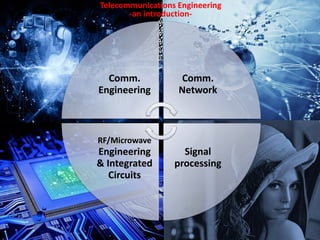
Comm.
Engineering
Comm.
Network
Signal
processing
RF/Microwave
Engineering
& Integrated
Circuits
Telecommunications Engineering
-an introduction-
Cuong Huynh, Ph.D.Telecommunications DepartmentHCMUT
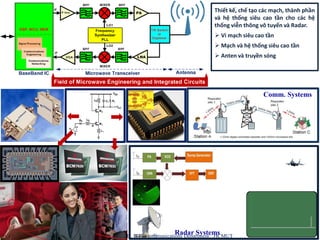
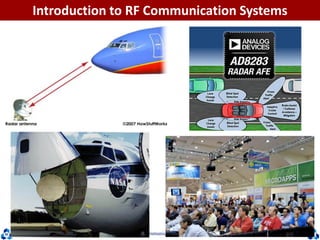
Radar Systems
Thiết kế, chế tạo các mạch, thành phần
và hệ thống siêu cao tần cho các hệ
thống viễn thông vô tuyến và Radar.
 Vi mạch siêu cao tần
 Mạch và hệ thống siêu cao tần
 Anten và truyền sóng
Comm. Systems
Dr. Cuong HuynhTelecommunications DepartmentHCMUT
Introduction to RF Communication Systems
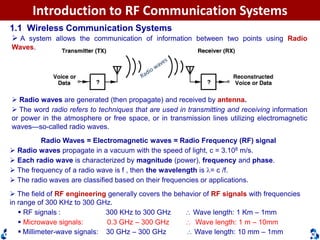
1.1 Wireless Communication Systems
 A system allows the communication of information between two points using Radio
Waves.
 Radio waves are generated (then propagate) and received by antenna.
 The word radio refers to techniques that are used in transmitting and receiving information
or power in the atmosphere or free space, or in transmission lines utilizing electromagnetic
waves—so-called radio waves.
Radio Waves = Electromagnetic waves = Radio Frequency (RF) signal
 Radio waves propagate in a vacuum with the speed of light, c = 3.108 m/s.
 Each radio wave is characterized by magnitude (power), frequency and phase.
 The frequency of a radio wave is f , then the wavelength is = c /f.
 The radio waves are classified based on their frequencies or applications.
 The field of RF engineering generally covers the behavior of RF signals with frequencies
in range of 300 KHz to 300 GHz.
 RF signals : 300 KHz to 300 GHz  Wave length: 1 Km – 1mm
 Microwave signals: 0.3 GHz – 300 GHz  Wave length: 1 m – 10mm
 Millimeter-wave signals: 30 GHz – 300 GHz  Wave length: 10 mm – 1mm
Dr. Cuong HuynhTelecommunications DepartmentHCMUT
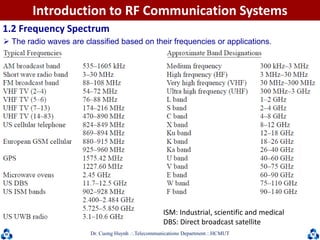
ISM: Industrial, scientific and medical
DBS: Direct broadcast satellite
1.2 Frequency Spectrum
Introduction to RF Communication Systems
 The radio waves are classified based on their frequencies or applications.
Dr. Cuong HuynhTelecommunications DepartmentHCMUT
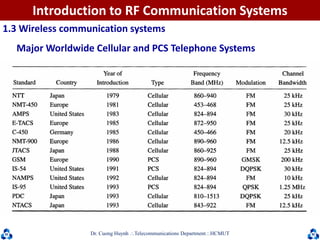
Major Worldwide Cellular and PCS Telephone Systems
Introduction to RF Communication Systems
1.3 Wireless communication systems
Dr. Cuong HuynhTelecommunications DepartmentHCMUT
Introduction to RF Communication Systems
Dr. Cuong HuynhTelecommunications DepartmentHCMUT
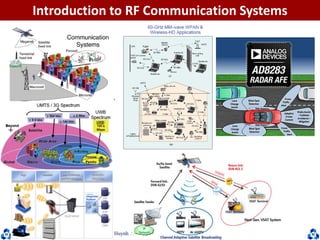
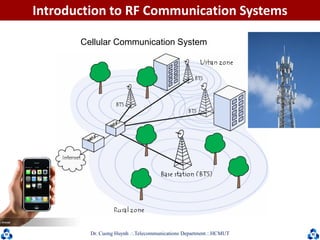
Cellular Communication System
Introduction to RF Communication Systems
Dr. Cuong HuynhTelecommunications DepartmentHCMUT
Introduction to RF Communication Systems
Dr. Cuong HuynhTelecommunications DepartmentHCMUT 10
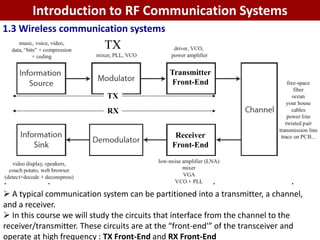
 A typical communication system can be partitioned into a transmitter, a channel,
and a receiver.
 In this course we will study the circuits that interface from the channel to the
receiver/transmitter. These circuits are at the “front-end'” of the transceiver and
operate at high frequency : TX Front-End and RX Front-End
Transmitter
Front-End
Receiver
Front-End
TX
RX
TX
Introduction to RF Communication Systems
1.3 Wireless communication systems
Dr. Cuong HuynhTelecommunications DepartmentHCMUT
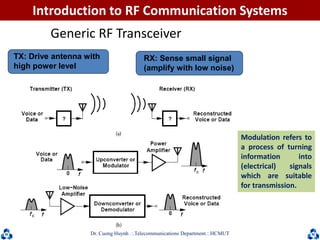
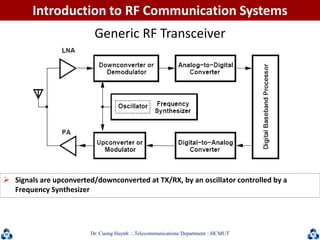
TX: Drive antenna with
high power level
RX: Sense small signal
(amplify with low noise)
Introduction to RF Communication Systems
Generic RF Transceiver
Modulation refers to
a process of turning
information into
(electrical) signals
which are suitable
for transmission.
Dr. Cuong HuynhTelecommunications DepartmentHCMUT
Generic RF Transceiver
 Signals are upconverted/downconverted at TX/RX, by an oscillator controlled by a
Frequency Synthesizer
Introduction to RF Communication Systems
Dr. Cuong HuynhTelecommunications DepartmentHCMUT 13
Introduction to RF Communication Systems
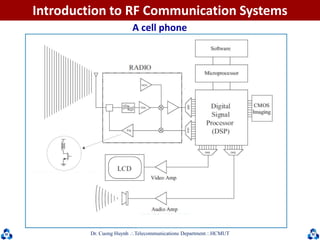
A cell phone
Dr. Cuong HuynhTelecommunications DepartmentHCMUT 14
Introduction to RF Communication Systems
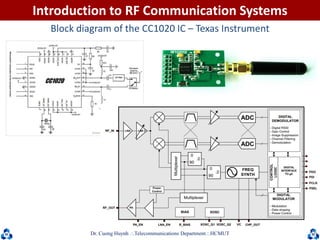
Block diagram of the CC1020 IC – Texas Instrument
Dr. Cuong HuynhTelecommunications DepartmentHCMUT 15
Introduction to RF Communication Systems
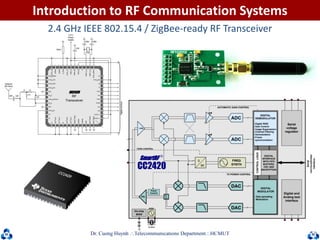
2.4 GHz IEEE 802.15.4 / ZigBee-ready RF Transceiver
Dr. Cuong HuynhTelecommunications DepartmentHCMUT 16
1.4 Fabrication Technologies for RF Circuits
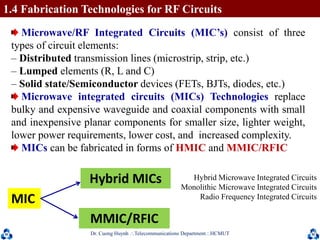
Microwave/RF Integrated Circuits (MIC’s) consist of three
types of circuit elements:
– Distributed transmission lines (microstrip, strip, etc.)
– Lumped elements (R, L and C)
– Solid state/Semiconductor devices (FETs, BJTs, diodes, etc.)
Microwave integrated circuits (MICs) Technologies replace
bulky and expensive waveguide and coaxial components with small
and inexpensive planar components for smaller size, lighter weight,
lower power requirements, lower cost, and increased complexity.
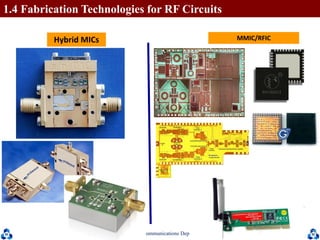
MICs can be fabricated in forms of HMIC and MMIC/RFIC
Hybrid MICs
MIC
MMIC/RFIC
Hybrid Microwave Integrated Circuits
Monolithic Microwave Integrated Circuits
Radio Frequency Integrated Circuits
Dr. Cuong HuynhTelecommunications DepartmentHCMUT 17
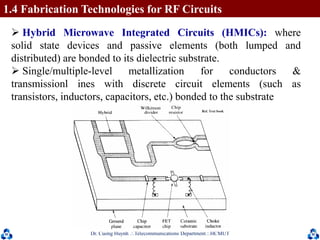
 Hybrid Microwave Integrated Circuits (HMICs): where
solid state devices and passive elements (both lumped and
distributed) are bonded to its dielectric substrate.
 Single/multiple-level metallization for conductors &
transmissionl ines with discrete circuit elements (such as
transistors, inductors, capacitors, etc.) bonded to the substrate
1.4 Fabrication Technologies for RF Circuits
Dr. Cuong HuynhTelecommunications DepartmentHCMUT 18
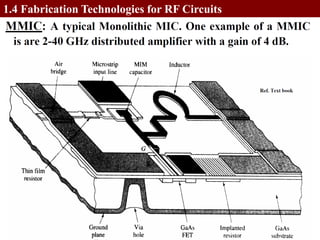
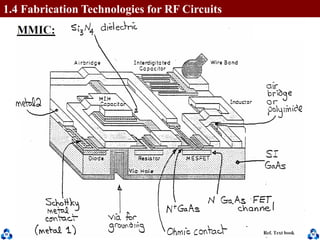
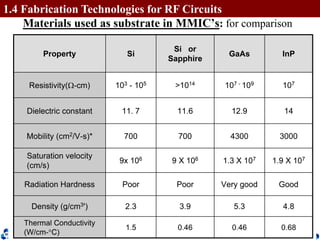
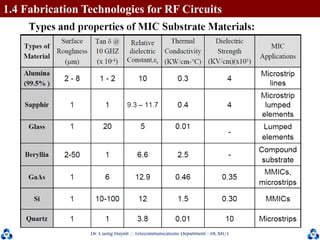
 Monolithic Microwave Integrated Circuits (MMICs): is a
type of circuit in which all active and passive elements as well as
transmission lines are integrated into a bulk or onto the surface of a
substance by some special processes such as: deposition, epitaxy,
ion implantation, sputtering, evaporation, diffusion.
1.4 Fabrication Technologies for RF Circuits
Dr. Cuong HuynhTelecommunications DepartmentHCMUT 19
1.4 Fabrication Technologies for RF Circuits
Dr. Cuong HuynhTelecommunications DepartmentHCMUT 20
1.4 Fabrication Technologies for RF Circuits
Dr. Cuong HuynhTelecommunications DepartmentHCMUT 21
1.4 Fabrication Technologies for RF Circuits
Dr. Cuong HuynhTelecommunications DepartmentHCMUT 22
1.4 Fabrication Technologies for RF Circuits
Dr. Cuong HuynhTelecommunications DepartmentHCMUT 23
Hybrid MICs MMIC/RFIC
Designed by
Cuong Huynh
1.4 Fabrication Technologies for RF Circuits
Dr. Cuong HuynhTelecommunications DepartmentHCMUT 24
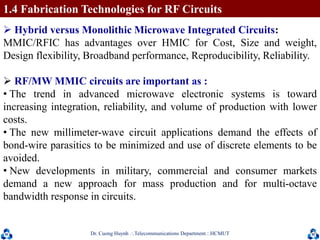
 Hybrid versus Monolithic Microwave Integrated Circuits:
MMIC/RFIC has advantages over HMIC for Cost, Size and weight,
Design flexibility, Broadband performance, Reproducibility, Reliability.
 RF/MW MMIC circuits are important as :
• The trend in advanced microwave electronic systems is toward
increasing integration, reliability, and volume of production with lower
costs.
• The new millimeter-wave circuit applications demand the effects of
bond-wire parasitics to be minimized and use of discrete elements to be
avoided.
• New developments in military, commercial and consumer markets
demand a new approach for mass production and for multi-octave
bandwidth response in circuits.
1.4 Fabrication Technologies for RF Circuits
Dr. Cuong HuynhTelecommunications DepartmentHCMUT 25
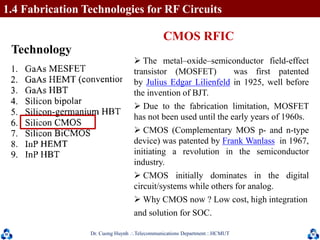
 The metal–oxide–semiconductor field-effect
transistor (MOSFET) was first patented
by Julius Edgar Lilienfeld in 1925, well before
the invention of BJT.
 Due to the fabrication limitation, MOSFET
has not been used until the early years of 1960s.
 CMOS (Complementary MOS p- and n-type
device) was patented by Frank Wanlass in 1967,
initiating a revolution in the semiconductor
industry.
 CMOS initially dominates in the digital
circuit/systems while others for analog.
 Why CMOS now ? Low cost, high integration
and solution for SOC.
Technology
CMOS RFIC
1.4 Fabrication Technologies for RF Circuits
Dr. Cuong HuynhTelecommunications DepartmentHCMUT 26
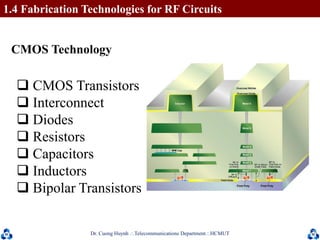
CMOS Technology
 CMOS Transistors
 Interconnect
 Diodes
 Resistors
 Capacitors
 Inductors
 Bipolar Transistors
1.4 Fabrication Technologies for RF Circuits
Dr. Cuong HuynhTelecommunications DepartmentHCMUT 27
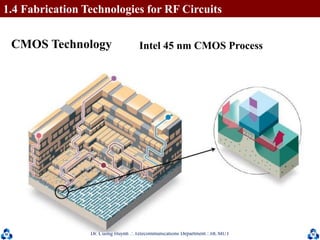
CMOS Technology Intel 45 nm CMOS Process
1.4 Fabrication Technologies for RF Circuits
Dr. Cuong HuynhTelecommunications DepartmentHCMUT
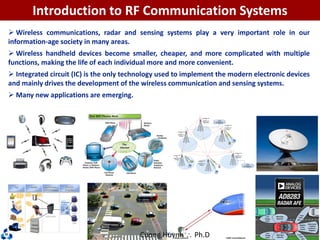
 Wireless communications, radar and sensing systems play a very important role in our
information-age society in many areas.
 Wireless handheld devices become smaller, cheaper, and more complicated with multiple
functions, making the life of each individual more and more convenient.
 Integrated circuit (IC) is the only technology used to implement the modern electronic devices
and mainly drives the development of the wireless communication and sensing systems.
 Many new applications are emerging.
Cuong Huynh  Ph.D
Introduction to RF Communication Systems
Dr. Cuong HuynhTelecommunications DepartmentHCMUT
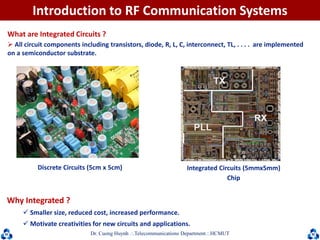
What are Integrated Circuits ?
 All circuit components including transistors, diode, R, L, C, interconnect, TL, . . . . are implemented
on a semiconductor substrate.
Discrete Circuits (5cm x 5cm) Integrated Circuits (5mmx5mm)
Chip
Why Integrated ?
 Smaller size, reduced cost, increased performance.
 Motivate creativities for new circuits and applications.
Introduction to RF Communication Systems
Dr. Cuong HuynhTelecommunications DepartmentHCMUT 30
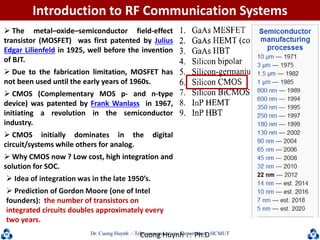
 The metal–oxide–semiconductor field-effect
transistor (MOSFET) was first patented by Julius
Edgar Lilienfeld in 1925, well before the invention
of BJT.
 Due to the fabrication limitation, MOSFET has
not been used until the early years of 1960s.
 CMOS (Complementary MOS p- and n-type
device) was patented by Frank Wanlass in 1967,
initiating a revolution in the semiconductor
industry.
 CMOS initially dominates in the digital
circuit/systems while others for analog.
 Why CMOS now ? Low cost, high integration and
solution for SOC.
 Idea of integration was in the late 1950’s.
 Prediction of Gordon Moore (one of Intel
founders): the number of transistors on
integrated circuits doubles approximately every
two years.
Cuong Huynh  Ph.D
Introduction to RF Communication Systems
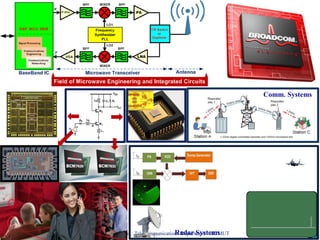
Dr. Cuong HuynhTelecommunications DepartmentHCMUTRadar Systems
Comm. Systems
Dr. Cuong HuynhTelecommunications DepartmentHCMUT 32
PLL
LNA
PA
T/R
Switch
ADC
DAC
VGA
RF/Analog IC
BaseBandIC
CPU,DSP,Mem..
SPI
LNA
PA
T/R
Switch
VGARX Mixer
ADC
DAC
TX Mixer VGA
SPI
RF Analog
.

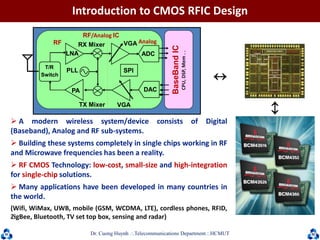
 A modern wireless system/device consists of Digital
(Baseband), Analog and RF sub-systems.
 Building these systems completely in single chips working in RF
and Microwave frequencies has been a reality.
 RF CMOS Technology: low-cost, small-size and high-integration
for single-chip solutions.
 Many applications have been developed in many countries in
the world.
(Wifi, WiMax, UWB, mobile (GSM, WCDMA, LTE), cordless phones, RFID,
ZigBee, Bluetooth, TV set top box, sensing and radar)

Introduction to CMOS RFIC Design
Dr. Cuong HuynhTelecommunications DepartmentHCMUT 33
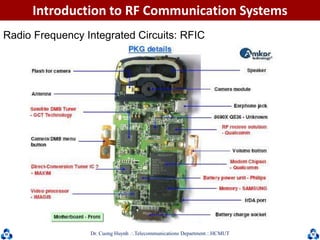
Radio Frequency Integrated Circuits: RFIC
Introduction to RF Communication Systems
Dr. Cuong HuynhTelecommunications DepartmentHCMUT 34
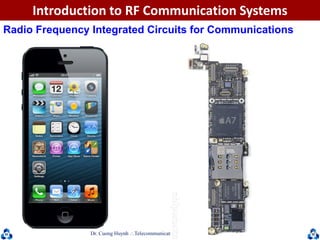
Radio Frequency Integrated Circuits for Communications
Introduction to RF Communication Systems
Dr. Cuong HuynhTelecommunications DepartmentHCMUT
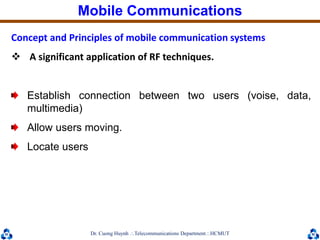
Concept and Principles of mobile communication systems
 A significant application of RF techniques.
Establish connection between two users (voise, data,
multimedia)
Allow users moving.
Locate users
Mobile Communications
Dr. Cuong HuynhTelecommunications DepartmentHCMUT
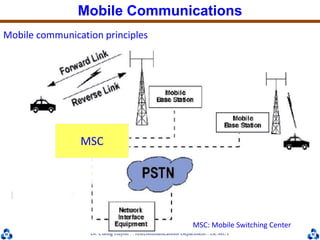
Mobile communication principles
MSC
MSC: Mobile Switching Center
Mobile Communications
Dr. Cuong HuynhTelecommunications DepartmentHCMUT
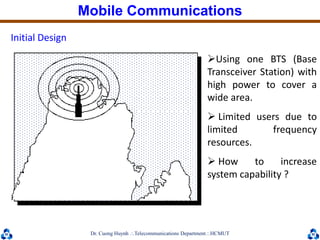
Initial Design
Using one BTS (Base
Transceiver Station) with
high power to cover a
wide area.
 Limited users due to
limited frequency
resources.
 How to increase
system capability ?
Mobile Communications
Dr. Cuong HuynhTelecommunications DepartmentHCMUT
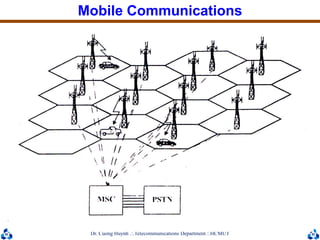
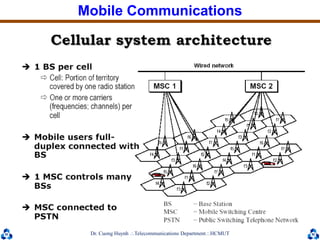
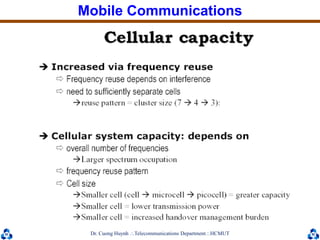
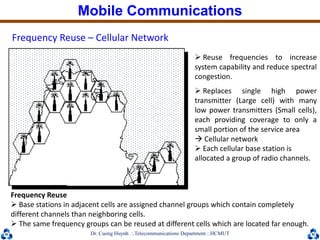
Frequency Reuse – Cellular Network
 Reuse frequencies to increase
system capability and reduce spectral
congestion.
 Replaces single high power
transmitter (Large cell) with many
low power transmitters (Small cells),
each providing coverage to only a
small portion of the service area
 Cellular network
 Each cellular base station is
allocated a group of radio channels.
Frequency Reuse
 Base stations in adjacent cells are assigned channel groups which contain completely
different channels than neighboring cells.
 The same frequency groups can be reused at different cells which are located far enough.
Mobile Communications
Dr. Cuong HuynhTelecommunications DepartmentHCMUT
Mobile Communications
Dr. Cuong HuynhTelecommunications DepartmentHCMUT
Mobile Communications
Dr. Cuong HuynhTelecommunications DepartmentHCMUT
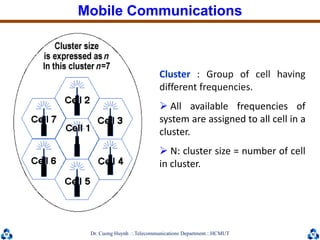
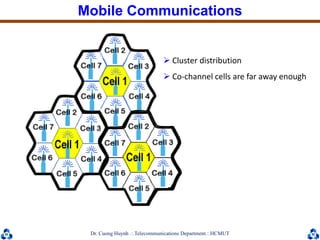
Cluster : Group of cell having
different frequencies.
 All available frequencies of
system are assigned to all cell in a
cluster.
 N: cluster size = number of cell
in cluster.
Mobile Communications
Dr. Cuong HuynhTelecommunications DepartmentHCMUT
 Cluster distribution
 Co-channel cells are far away enough
Mobile Communications
Dr. Cuong HuynhTelecommunications DepartmentHCMUT
Mobile Communications
Dr. Cuong HuynhTelecommunications DepartmentHCMUT
Mobile Communications
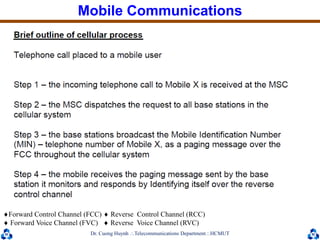
Forward Control Channel (FCC)  Reverse Control Channel (RCC)
 Forward Voice Channel (FVC)  Reverse Voice Channel (RVC)
Dr. Cuong HuynhTelecommunications DepartmentHCMUT
Mobile Communications
Dr. Cuong HuynhTelecommunications DepartmentHCMUT
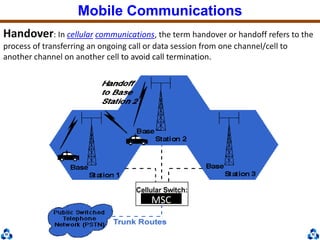
Mobile Communications
MSC
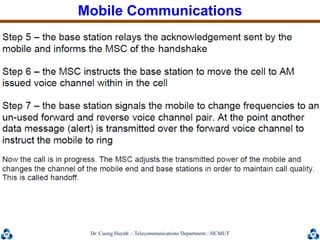
Handover: In cellular communications, the term handover or handoff refers to the
process of transferring an ongoing call or data session from one channel/cell to
another channel on another cell to avoid call termination.
Dr. Cuong HuynhTelecommunications DepartmentHCMUT
Mobile Communications
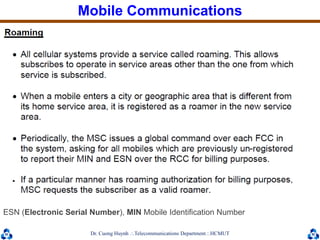
ESN (Electronic Serial Number), MIN Mobile Identification Number
Dr. Cuong HuynhTelecommunications DepartmentHCMUT
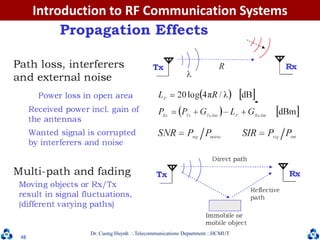
48
Introduction to RF Communication Systems
Dr. Cuong HuynhTelecommunications DepartmentHCMUT
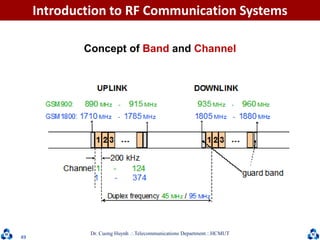
49
Concept of Band and Channel
Introduction to RF Communication Systems
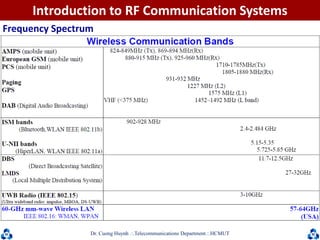
Dr. Cuong HuynhTelecommunications DepartmentHCMUT
Frequency Spectrum
Introduction to RF Communication Systems
Dr. Cuong HuynhTelecommunications DepartmentHCMUT
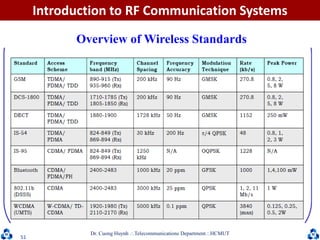
51
Overview of Wireless Standards
Introduction to RF Communication Systems
Dr. Cuong HuynhTelecommunications DepartmentHCMUT
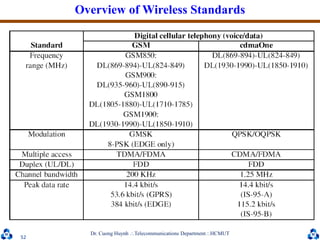
52
Overview of Wireless Standards
Dr. Cuong HuynhTelecommunications DepartmentHCMUT
53
Overview of Wireless Standards
Dr. Cuong HuynhTelecommunications DepartmentHCMUT
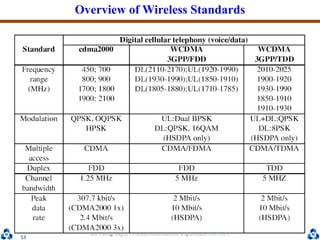
54
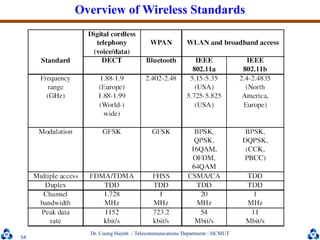
Overview of Wireless Standards
Dr. Cuong HuynhTelecommunications DepartmentHCMUT
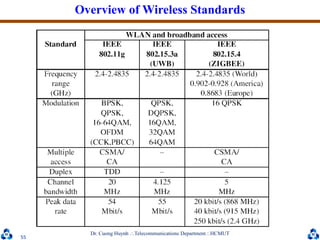
55
Overview of Wireless Standards

Chapter 1 introduction to radio communication systems

  • 1.
    Dr. Cuong HuynhTelecommunicationsDepartmentHCMUT 1 Huynh Phu Minh Cuong hpmcuong@hcmut.edu.vn Department of Telecommunications Faculty of Electrical and Electronics Engineering Ho Chi Minh city University of Technology ELECTRONICS AND COMMUNICATIONS Chapter 1 Introduction to RF Communication Systems ELECTRONIC CIRCUITS FOR COMMUNICATIONS
  • 2.
    Cuong Huynh, Ph.D.TelecommunicationsDepartmentHCMUT Comm. Engineering Comm. Network Signal processing RF/Microwave Engineering & Integrated Circuits Telecommunications Engineering -an introduction-
  • 3.
    Cuong Huynh, Ph.D.TelecommunicationsDepartmentHCMUT Radar Systems Thiết kế, chế tạo các mạch, thành phần và hệ thống siêu cao tần cho các hệ thống viễn thông vô tuyến và Radar.  Vi mạch siêu cao tần  Mạch và hệ thống siêu cao tần  Anten và truyền sóng Comm. Systems
  • 4.
    Dr. Cuong HuynhTelecommunicationsDepartmentHCMUT Introduction to RF Communication Systems 1.1 Wireless Communication Systems  A system allows the communication of information between two points using Radio Waves.  Radio waves are generated (then propagate) and received by antenna.  The word radio refers to techniques that are used in transmitting and receiving information or power in the atmosphere or free space, or in transmission lines utilizing electromagnetic waves—so-called radio waves. Radio Waves = Electromagnetic waves = Radio Frequency (RF) signal  Radio waves propagate in a vacuum with the speed of light, c = 3.108 m/s.  Each radio wave is characterized by magnitude (power), frequency and phase.  The frequency of a radio wave is f , then the wavelength is = c /f.  The radio waves are classified based on their frequencies or applications.  The field of RF engineering generally covers the behavior of RF signals with frequencies in range of 300 KHz to 300 GHz.  RF signals : 300 KHz to 300 GHz  Wave length: 1 Km – 1mm  Microwave signals: 0.3 GHz – 300 GHz  Wave length: 1 m – 10mm  Millimeter-wave signals: 30 GHz – 300 GHz  Wave length: 10 mm – 1mm
  • 5.
    Dr. Cuong HuynhTelecommunicationsDepartmentHCMUT ISM: Industrial, scientific and medical DBS: Direct broadcast satellite 1.2 Frequency Spectrum Introduction to RF Communication Systems  The radio waves are classified based on their frequencies or applications.
  • 6.
    Dr. Cuong HuynhTelecommunicationsDepartmentHCMUT Major Worldwide Cellular and PCS Telephone Systems Introduction to RF Communication Systems 1.3 Wireless communication systems
  • 7.
    Dr. Cuong HuynhTelecommunicationsDepartmentHCMUT Introduction to RF Communication Systems
  • 8.
    Dr. Cuong HuynhTelecommunicationsDepartmentHCMUT Cellular Communication System Introduction to RF Communication Systems
  • 9.
    Dr. Cuong HuynhTelecommunicationsDepartmentHCMUT Introduction to RF Communication Systems
  • 10.
    Dr. Cuong HuynhTelecommunicationsDepartmentHCMUT 10  A typical communication system can be partitioned into a transmitter, a channel, and a receiver.  In this course we will study the circuits that interface from the channel to the receiver/transmitter. These circuits are at the “front-end'” of the transceiver and operate at high frequency : TX Front-End and RX Front-End Transmitter Front-End Receiver Front-End TX RX TX Introduction to RF Communication Systems 1.3 Wireless communication systems
  • 11.
    Dr. Cuong HuynhTelecommunicationsDepartmentHCMUT TX: Drive antenna with high power level RX: Sense small signal (amplify with low noise) Introduction to RF Communication Systems Generic RF Transceiver Modulation refers to a process of turning information into (electrical) signals which are suitable for transmission.
  • 12.
    Dr. Cuong HuynhTelecommunicationsDepartmentHCMUT Generic RF Transceiver  Signals are upconverted/downconverted at TX/RX, by an oscillator controlled by a Frequency Synthesizer Introduction to RF Communication Systems
  • 13.
    Dr. Cuong HuynhTelecommunicationsDepartmentHCMUT 13 Introduction to RF Communication Systems A cell phone
  • 14.
    Dr. Cuong HuynhTelecommunicationsDepartmentHCMUT 14 Introduction to RF Communication Systems Block diagram of the CC1020 IC – Texas Instrument
  • 15.
    Dr. Cuong HuynhTelecommunicationsDepartmentHCMUT 15 Introduction to RF Communication Systems 2.4 GHz IEEE 802.15.4 / ZigBee-ready RF Transceiver
  • 16.
    Dr. Cuong HuynhTelecommunicationsDepartmentHCMUT 16 1.4 Fabrication Technologies for RF Circuits Microwave/RF Integrated Circuits (MIC’s) consist of three types of circuit elements: – Distributed transmission lines (microstrip, strip, etc.) – Lumped elements (R, L and C) – Solid state/Semiconductor devices (FETs, BJTs, diodes, etc.) Microwave integrated circuits (MICs) Technologies replace bulky and expensive waveguide and coaxial components with small and inexpensive planar components for smaller size, lighter weight, lower power requirements, lower cost, and increased complexity. MICs can be fabricated in forms of HMIC and MMIC/RFIC Hybrid MICs MIC MMIC/RFIC Hybrid Microwave Integrated Circuits Monolithic Microwave Integrated Circuits Radio Frequency Integrated Circuits
  • 17.
    Dr. Cuong HuynhTelecommunicationsDepartmentHCMUT 17  Hybrid Microwave Integrated Circuits (HMICs): where solid state devices and passive elements (both lumped and distributed) are bonded to its dielectric substrate.  Single/multiple-level metallization for conductors & transmissionl ines with discrete circuit elements (such as transistors, inductors, capacitors, etc.) bonded to the substrate 1.4 Fabrication Technologies for RF Circuits
  • 18.
    Dr. Cuong HuynhTelecommunicationsDepartmentHCMUT 18  Monolithic Microwave Integrated Circuits (MMICs): is a type of circuit in which all active and passive elements as well as transmission lines are integrated into a bulk or onto the surface of a substance by some special processes such as: deposition, epitaxy, ion implantation, sputtering, evaporation, diffusion. 1.4 Fabrication Technologies for RF Circuits
  • 19.
    Dr. Cuong HuynhTelecommunicationsDepartmentHCMUT 19 1.4 Fabrication Technologies for RF Circuits
  • 20.
    Dr. Cuong HuynhTelecommunicationsDepartmentHCMUT 20 1.4 Fabrication Technologies for RF Circuits
  • 21.
    Dr. Cuong HuynhTelecommunicationsDepartmentHCMUT 21 1.4 Fabrication Technologies for RF Circuits
  • 22.
    Dr. Cuong HuynhTelecommunicationsDepartmentHCMUT 22 1.4 Fabrication Technologies for RF Circuits
  • 23.
    Dr. Cuong HuynhTelecommunicationsDepartmentHCMUT 23 Hybrid MICs MMIC/RFIC Designed by Cuong Huynh 1.4 Fabrication Technologies for RF Circuits
  • 24.
    Dr. Cuong HuynhTelecommunicationsDepartmentHCMUT 24  Hybrid versus Monolithic Microwave Integrated Circuits: MMIC/RFIC has advantages over HMIC for Cost, Size and weight, Design flexibility, Broadband performance, Reproducibility, Reliability.  RF/MW MMIC circuits are important as : • The trend in advanced microwave electronic systems is toward increasing integration, reliability, and volume of production with lower costs. • The new millimeter-wave circuit applications demand the effects of bond-wire parasitics to be minimized and use of discrete elements to be avoided. • New developments in military, commercial and consumer markets demand a new approach for mass production and for multi-octave bandwidth response in circuits. 1.4 Fabrication Technologies for RF Circuits
  • 25.
    Dr. Cuong HuynhTelecommunicationsDepartmentHCMUT 25  The metal–oxide–semiconductor field-effect transistor (MOSFET) was first patented by Julius Edgar Lilienfeld in 1925, well before the invention of BJT.  Due to the fabrication limitation, MOSFET has not been used until the early years of 1960s.  CMOS (Complementary MOS p- and n-type device) was patented by Frank Wanlass in 1967, initiating a revolution in the semiconductor industry.  CMOS initially dominates in the digital circuit/systems while others for analog.  Why CMOS now ? Low cost, high integration and solution for SOC. Technology CMOS RFIC 1.4 Fabrication Technologies for RF Circuits
  • 26.
    Dr. Cuong HuynhTelecommunicationsDepartmentHCMUT 26 CMOS Technology  CMOS Transistors  Interconnect  Diodes  Resistors  Capacitors  Inductors  Bipolar Transistors 1.4 Fabrication Technologies for RF Circuits
  • 27.
    Dr. Cuong HuynhTelecommunicationsDepartmentHCMUT 27 CMOS Technology Intel 45 nm CMOS Process 1.4 Fabrication Technologies for RF Circuits
  • 28.
    Dr. Cuong HuynhTelecommunicationsDepartmentHCMUT  Wireless communications, radar and sensing systems play a very important role in our information-age society in many areas.  Wireless handheld devices become smaller, cheaper, and more complicated with multiple functions, making the life of each individual more and more convenient.  Integrated circuit (IC) is the only technology used to implement the modern electronic devices and mainly drives the development of the wireless communication and sensing systems.  Many new applications are emerging. Cuong Huynh  Ph.D Introduction to RF Communication Systems
  • 29.
    Dr. Cuong HuynhTelecommunicationsDepartmentHCMUT What are Integrated Circuits ?  All circuit components including transistors, diode, R, L, C, interconnect, TL, . . . . are implemented on a semiconductor substrate. Discrete Circuits (5cm x 5cm) Integrated Circuits (5mmx5mm) Chip Why Integrated ?  Smaller size, reduced cost, increased performance.  Motivate creativities for new circuits and applications. Introduction to RF Communication Systems
  • 30.
    Dr. Cuong HuynhTelecommunicationsDepartmentHCMUT 30  The metal–oxide–semiconductor field-effect transistor (MOSFET) was first patented by Julius Edgar Lilienfeld in 1925, well before the invention of BJT.  Due to the fabrication limitation, MOSFET has not been used until the early years of 1960s.  CMOS (Complementary MOS p- and n-type device) was patented by Frank Wanlass in 1967, initiating a revolution in the semiconductor industry.  CMOS initially dominates in the digital circuit/systems while others for analog.  Why CMOS now ? Low cost, high integration and solution for SOC.  Idea of integration was in the late 1950’s.  Prediction of Gordon Moore (one of Intel founders): the number of transistors on integrated circuits doubles approximately every two years. Cuong Huynh  Ph.D Introduction to RF Communication Systems
  • 31.
    Dr. Cuong HuynhTelecommunicationsDepartmentHCMUTRadar Systems Comm. Systems
  • 32.
    Dr. Cuong HuynhTelecommunicationsDepartmentHCMUT 32 PLL LNA PA T/R Switch ADC DAC VGA RF/Analog IC BaseBandIC CPU,DSP,Mem.. SPI LNA PA T/R Switch VGARX Mixer ADC DAC TX Mixer VGA SPI RF Analog .   A modern wireless system/device consists of Digital (Baseband), Analog and RF sub-systems.  Building these systems completely in single chips working in RF and Microwave frequencies has been a reality.  RF CMOS Technology: low-cost, small-size and high-integration for single-chip solutions.  Many applications have been developed in many countries in the world. (Wifi, WiMax, UWB, mobile (GSM, WCDMA, LTE), cordless phones, RFID, ZigBee, Bluetooth, TV set top box, sensing and radar)  Introduction to CMOS RFIC Design
  • 33.
    Dr. Cuong HuynhTelecommunicationsDepartmentHCMUT 33 Radio Frequency Integrated Circuits: RFIC Introduction to RF Communication Systems
  • 34.
    Dr. Cuong HuynhTelecommunicationsDepartmentHCMUT 34 Radio Frequency Integrated Circuits for Communications Introduction to RF Communication Systems
  • 35.
    Dr. Cuong HuynhTelecommunicationsDepartmentHCMUT Concept and Principles of mobile communication systems  A significant application of RF techniques. Establish connection between two users (voise, data, multimedia) Allow users moving. Locate users Mobile Communications
  • 36.
    Dr. Cuong HuynhTelecommunicationsDepartmentHCMUT Mobile communication principles MSC MSC: Mobile Switching Center Mobile Communications
  • 37.
    Dr. Cuong HuynhTelecommunicationsDepartmentHCMUT Initial Design Using one BTS (Base Transceiver Station) with high power to cover a wide area.  Limited users due to limited frequency resources.  How to increase system capability ? Mobile Communications
  • 38.
    Dr. Cuong HuynhTelecommunicationsDepartmentHCMUT Frequency Reuse – Cellular Network  Reuse frequencies to increase system capability and reduce spectral congestion.  Replaces single high power transmitter (Large cell) with many low power transmitters (Small cells), each providing coverage to only a small portion of the service area  Cellular network  Each cellular base station is allocated a group of radio channels. Frequency Reuse  Base stations in adjacent cells are assigned channel groups which contain completely different channels than neighboring cells.  The same frequency groups can be reused at different cells which are located far enough. Mobile Communications
  • 39.
    Dr. Cuong HuynhTelecommunicationsDepartmentHCMUT Mobile Communications
  • 40.
    Dr. Cuong HuynhTelecommunicationsDepartmentHCMUT Mobile Communications
  • 41.
    Dr. Cuong HuynhTelecommunicationsDepartmentHCMUT Cluster : Group of cell having different frequencies.  All available frequencies of system are assigned to all cell in a cluster.  N: cluster size = number of cell in cluster. Mobile Communications
  • 42.
    Dr. Cuong HuynhTelecommunicationsDepartmentHCMUT  Cluster distribution  Co-channel cells are far away enough Mobile Communications
  • 43.
    Dr. Cuong HuynhTelecommunicationsDepartmentHCMUT Mobile Communications
  • 44.
    Dr. Cuong HuynhTelecommunicationsDepartmentHCMUT Mobile Communications Forward Control Channel (FCC)  Reverse Control Channel (RCC)  Forward Voice Channel (FVC)  Reverse Voice Channel (RVC)
  • 45.
    Dr. Cuong HuynhTelecommunicationsDepartmentHCMUT Mobile Communications
  • 46.
    Dr. Cuong HuynhTelecommunicationsDepartmentHCMUT Mobile Communications MSC Handover: In cellular communications, the term handover or handoff refers to the process of transferring an ongoing call or data session from one channel/cell to another channel on another cell to avoid call termination.
  • 47.
    Dr. Cuong HuynhTelecommunicationsDepartmentHCMUT Mobile Communications ESN (Electronic Serial Number), MIN Mobile Identification Number
  • 48.
    Dr. Cuong HuynhTelecommunicationsDepartmentHCMUT 48 Introduction to RF Communication Systems
  • 49.
    Dr. Cuong HuynhTelecommunicationsDepartmentHCMUT 49 Concept of Band and Channel Introduction to RF Communication Systems
  • 50.
    Dr. Cuong HuynhTelecommunicationsDepartmentHCMUT Frequency Spectrum Introduction to RF Communication Systems
  • 51.
    Dr. Cuong HuynhTelecommunicationsDepartmentHCMUT 51 Overview of Wireless Standards Introduction to RF Communication Systems
  • 52.
    Dr. Cuong HuynhTelecommunicationsDepartmentHCMUT 52 Overview of Wireless Standards
  • 53.
    Dr. Cuong HuynhTelecommunicationsDepartmentHCMUT 53 Overview of Wireless Standards
  • 54.
    Dr. Cuong HuynhTelecommunicationsDepartmentHCMUT 54 Overview of Wireless Standards
  • 55.
    Dr. Cuong HuynhTelecommunicationsDepartmentHCMUT 55 Overview of Wireless Standards