Ground Penetrating Radar

       Gonzalo Gallo
        CEE 498KM
Outline
•   Introduction
•   Principle
•   Instrumentation
•   Data Analysis
•   Advantages and Limitations
•   Manufacturers and costs
Introduction
•   RADAR → Radio Detection and Ranging
    –   Detect target in free space
    –   Determine the range
•   Civil engineering applications
    –   Probing into soil to detect pipelines and tanks
    –   Cavities
    –   Thickness determination
    –   Locating reinforcement
    –   Identifying deterioration
Principle
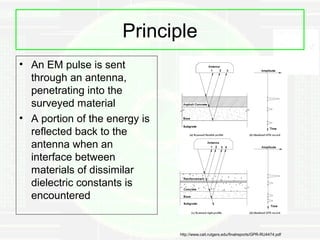
• An EM pulse is sent
  through an antenna,
  penetrating into the
  surveyed material
• A portion of the energy is
  reflected back to the
  antenna when an
  interface between
  materials of dissimilar
  dielectric constants is
  encountered


                               http://www.cait.rutgers.edu/finalreports/GPR-RU4474.pdf
Principle
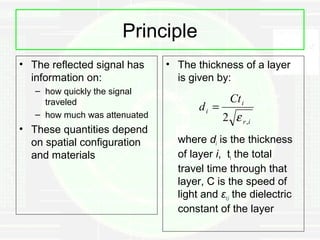
• The reflected signal has     • The thickness of a layer
  information on:                is given by:
   – how quickly the signal
     traveled                                  Ct i
                                      di =
   – how much was attenuated                 2 ε r ,i
• These quantities depend
  on spatial configuration       where di is the thickness
  and materials                  of layer i, ti the total
                                 travel time through that
                                 layer, C is the speed of
                                 light and εr,i the dielectric
                                 constant of the layer
Principle
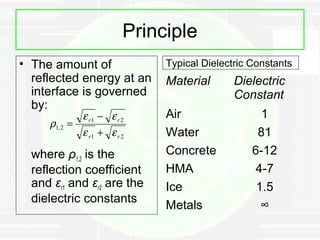
• The amount of                Typical Dielectric Constants
  reflected energy at an       Material       Dielectric
  interface is governed                       Constant
  by:
               ε r1 − ε r 2    Air                  1
     ρ1, 2 =
               ε r1 + ε r 2    Water               81
  where ρ1,2 is the            Concrete           6-12
  reflection coefficient       HMA                 4-7
  and εr1 and εr2 are the      Ice                 1.5
  dielectric constants
                               Metals               ∞
Instrumentation
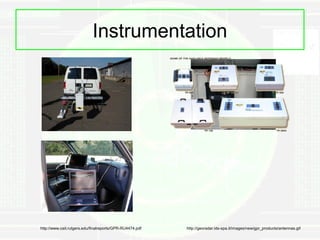
• The typical instrumentation for GPR
  includes the following:
  – Antenna
    • Air-couple
    • Ground-coupled
  – Control Unit
  – Display device
  – Storage device
Instrumentation


http://www.cait.rutgers.edu/finalreports/GPR-RU4474.pdf   http://georadar.ids-spa.it/images/new/gpr_products/antennas.gif
Instrumentation
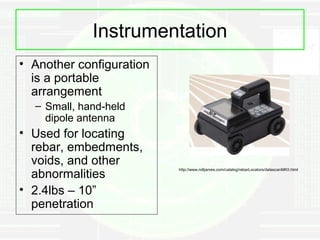
• Another configuration
  is a portable
  arrangement
  – Small, hand-held
    dipole antenna
• Used for locating
  rebar, embedments,
  voids, and other
  abnormalities
                          http://www.ndtjames.com/catalog/rebarLocators/datascanMKII.html


• 2.4lbs – 10”
  penetration
Data Analysis
• Before using calibrate
  – Copper plate → Complete reflection
  – Air          → Complete transmission


• Establish dielectric constant of test surface
  with reflected energy equation
Data Analysis
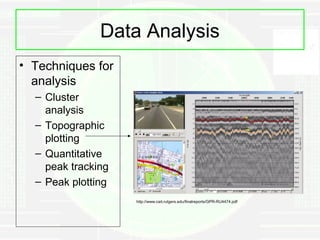
• Techniques for
  analysis
  – Cluster
    analysis
  – Topographic
    plotting
  – Quantitative
    peak tracking
  – Peak plotting
                    http://www.cait.rutgers.edu/finalreports/GPR-RU4474.pdf
Advantages and Limitations
• Advantages                     • Limitations
  – Fast speed scanning with        – Rebar reflects as arch
    non-contact antennas              patterns – if dense,
  – Very sensitive to presence        individual bars are no
    of embedded metal objects         longer discerned
  – Sensitive to the presence       – Limitations if dielectric
    of moisture                       properties are similar
                                    – Dielectric properties
                                      unknown
                                    – Material “loss”
                                    – Difficult in thin layers
    In general, fast scanning
    and saves money                 – Extensive data
                                    – Operator dependant
Manufacturers and costs
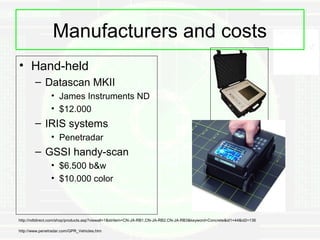
• Hand-held
        – Datascan MKII
                • James Instruments ND
                • $12.000
        – IRIS systems
                • Penetradar
        – GSSI handy-scan
                • $6.500 b&w
                • $10.000 color


http://ndtdirect.com/shop/products.asp?viewall=1&stritem=CN-JA-RB1,CN-JA-RB2,CN-JA-RB3&keyword=Concrete&id1=44&id2=136

http://www.penetradar.com/GPR_Vehicles.htm
Manufacturers and costs
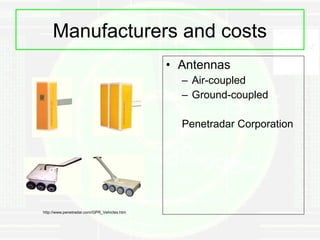
                                             • Antennas
                                               – Air-coupled
                                               – Ground-coupled

                                               Penetradar Corporation


http://www.penetradar.com/GPR_Vehicles.htm
Manufacturers and costs
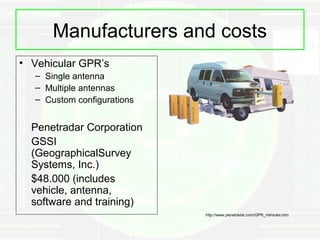
• Vehicular GPR’s
   – Single antenna
   – Multiple antennas
   – Custom configurations


  Penetradar Corporation
  GSSI
  (GeographicalSurvey
  Systems, Inc.)
  $48.000 (includes
  vehicle, antenna,
  software and training)
                             http://www.penetradar.com/GPR_Vehicles.htm
Links and References
• http://www.geophysical.com/
• http://www.penetradar.com/
• http://ndtdirect.com/
• http://www.ndtjames.com/
• http://www.cait.rutgers.edu/finalreports/GPR-RU4474.pdf
• Al-Qadi, I.L. and Lahouar (2005). “Measuring layer
  thickness with GPR –Theory to practice”. Construction
  and Building Materials, 19, 763-772
• ACI Committee 228, (2003). “In-place methods to
  estimate concrete strength (ACI 228.1R-03).”
  Farmington Hills: American Concrete Institute.

Ground penetrating radar

  • 1.
    Ground Penetrating Radar Gonzalo Gallo CEE 498KM
  • 2.
    Outline • Introduction • Principle • Instrumentation • Data Analysis • Advantages and Limitations • Manufacturers and costs
  • 3.
    Introduction • RADAR → Radio Detection and Ranging – Detect target in free space – Determine the range • Civil engineering applications – Probing into soil to detect pipelines and tanks – Cavities – Thickness determination – Locating reinforcement – Identifying deterioration
  • 4.
    Principle • An EMpulse is sent through an antenna, penetrating into the surveyed material • A portion of the energy is reflected back to the antenna when an interface between materials of dissimilar dielectric constants is encountered http://www.cait.rutgers.edu/finalreports/GPR-RU4474.pdf
  • 5.
    Principle • The reflectedsignal has • The thickness of a layer information on: is given by: – how quickly the signal traveled Ct i di = – how much was attenuated 2 ε r ,i • These quantities depend on spatial configuration where di is the thickness and materials of layer i, ti the total travel time through that layer, C is the speed of light and εr,i the dielectric constant of the layer
  • 6.
    Principle • The amountof Typical Dielectric Constants reflected energy at an Material Dielectric interface is governed Constant by: ε r1 − ε r 2 Air 1 ρ1, 2 = ε r1 + ε r 2 Water 81 where ρ1,2 is the Concrete 6-12 reflection coefficient HMA 4-7 and εr1 and εr2 are the Ice 1.5 dielectric constants Metals ∞
  • 7.
    Instrumentation • The typicalinstrumentation for GPR includes the following: – Antenna • Air-couple • Ground-coupled – Control Unit – Display device – Storage device
  • 8.
    Instrumentation http://www.cait.rutgers.edu/finalreports/GPR-RU4474.pdf http://georadar.ids-spa.it/images/new/gpr_products/antennas.gif
  • 9.
    Instrumentation • Another configuration is a portable arrangement – Small, hand-held dipole antenna • Used for locating rebar, embedments, voids, and other abnormalities http://www.ndtjames.com/catalog/rebarLocators/datascanMKII.html • 2.4lbs – 10” penetration
  • 10.
    Data Analysis • Beforeusing calibrate – Copper plate → Complete reflection – Air → Complete transmission • Establish dielectric constant of test surface with reflected energy equation
  • 11.
    Data Analysis • Techniquesfor analysis – Cluster analysis – Topographic plotting – Quantitative peak tracking – Peak plotting http://www.cait.rutgers.edu/finalreports/GPR-RU4474.pdf
  • 12.
    Advantages and Limitations •Advantages • Limitations – Fast speed scanning with – Rebar reflects as arch non-contact antennas patterns – if dense, – Very sensitive to presence individual bars are no of embedded metal objects longer discerned – Sensitive to the presence – Limitations if dielectric of moisture properties are similar – Dielectric properties unknown – Material “loss” – Difficult in thin layers In general, fast scanning and saves money – Extensive data – Operator dependant
  • 13.
    Manufacturers and costs •Hand-held – Datascan MKII • James Instruments ND • $12.000 – IRIS systems • Penetradar – GSSI handy-scan • $6.500 b&w • $10.000 color http://ndtdirect.com/shop/products.asp?viewall=1&stritem=CN-JA-RB1,CN-JA-RB2,CN-JA-RB3&keyword=Concrete&id1=44&id2=136 http://www.penetradar.com/GPR_Vehicles.htm
  • 14.
    Manufacturers and costs • Antennas – Air-coupled – Ground-coupled Penetradar Corporation http://www.penetradar.com/GPR_Vehicles.htm
  • 15.
    Manufacturers and costs •Vehicular GPR’s – Single antenna – Multiple antennas – Custom configurations Penetradar Corporation GSSI (GeographicalSurvey Systems, Inc.) $48.000 (includes vehicle, antenna, software and training) http://www.penetradar.com/GPR_Vehicles.htm
  • 16.
    Links and References •http://www.geophysical.com/ • http://www.penetradar.com/ • http://ndtdirect.com/ • http://www.ndtjames.com/ • http://www.cait.rutgers.edu/finalreports/GPR-RU4474.pdf • Al-Qadi, I.L. and Lahouar (2005). “Measuring layer thickness with GPR –Theory to practice”. Construction and Building Materials, 19, 763-772 • ACI Committee 228, (2003). “In-place methods to estimate concrete strength (ACI 228.1R-03).” Farmington Hills: American Concrete Institute.