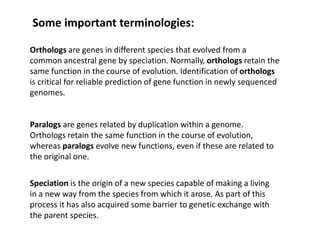
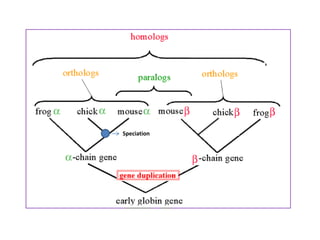
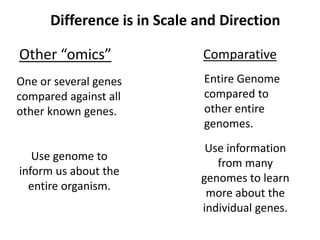
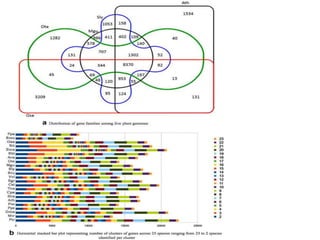
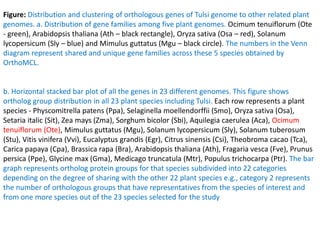
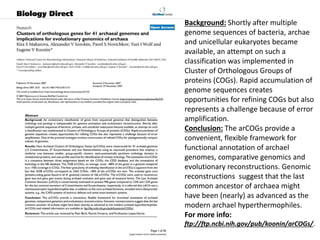
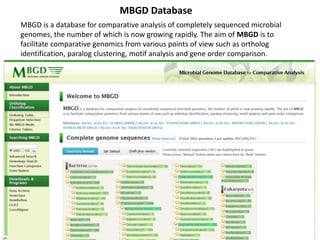
This document discusses key concepts in comparative genomics including orthologs, paralogs, speciation, and clusters of orthologous genes (COGs). It defines orthologs as genes evolved from a common ancestor through speciation that retain the same function, while paralogs are related through duplication and may evolve new functions. COGs are groups of orthologous genes from different species that are more similar to each other than to other genes within individual genomes. The document notes that COGs can be used to predict gene function and track evolutionary divergence. It provides an example of the NCBI COG database containing over 136,000 proteins from 50 bacteria, 13 archaea and 3 eukaryotes classified into CO