Submitted by: Ashish Thakur
B.Sc (hons.) bioinformatics
Jaipur National University

Database
Database management system
DBMS features
DBMS architecture
Overview

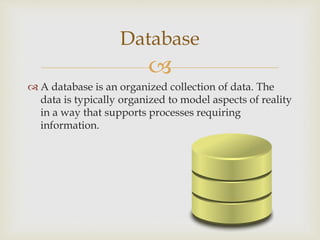
 A database is an organized collection of data. The
data is typically organized to model aspects of reality
in a way that supports processes requiring
information.
Database

 Database management systems are computer
software applications that interact with the user,
other applications, and the database itself to capture
and analyze data. A general-purpose DBMS is
designed to allow the definition, creation, querying,
update, and administration of databases.
DBMS

 Well-known DBMSs include MySQL, PostgreSQL,
Microsoft SQL Server, Oracle, SAP and IBM DB2
Examples

 The DBMS must be able to accept data definition
(external schema, conceptual schema, the internal
schema and all associate mappings) in source form
and convert them into appropriate object form.
 In other words, the DBMS must include DDL
processor or DDL compiler.
Data definition (DDL)

 The DBMS must be able to handle requests to
retrieve, update or delete existing data in the
database or add new data to the database.
Data manipulation (DML)

 DML requests must be processed by the optimizer,
component whose purpose is to determining an
efficient of implementing the request.
 The optimizer requests are then executed under the
control of the run-time manager.
Optimization and Execution

 DBMS must monitor user request and reject any
attempt to violate the security and integrity constant
defined by the DBA.
Data security and Integrity

 The DBMS must enforce certain recovery and
concurrency controls. DBMS software components
which handles these is basically known as transition
manager or TPC Transaction Processing monitor.
 Backup and Restore
Data Recovery and
Concurrency

 The data dictionary can be regarded as a database in
its own right (but a system database rather than a
user database).
 It contains “DATA ABOUT THE DATA” (sometimes
called as metadata or descriptors).
Data Dictionary

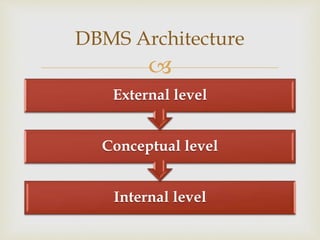
Internal level
Conceptual level
External level
DBMS Architecture

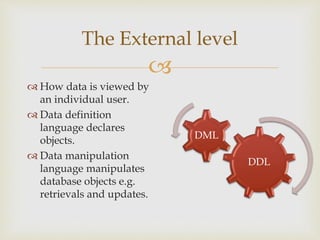
The External level
 How data is viewed by
an individual user.
 Data definition
language declares
objects.
 Data manipulation
language manipulates
database objects e.g.
retrievals and updates.
DDL
DML

 A representation of the entire information content of
the database.
 The conceptual schema is a definition of the view of
the total database content.
 One can add : security and integrity checks, sematic
models and data dictionary.
The Conceptual level

 The internal level is a low-level representation of the
entire database.
 Internal record or stored record is built upon
physical records or pages and blocks.
The Internal level

References


Database management system

  • 1.
    Submitted by: AshishThakur B.Sc (hons.) bioinformatics Jaipur National University
  • 2.
     Database Database management system DBMSfeatures DBMS architecture Overview
  • 3.
      A databaseis an organized collection of data. The data is typically organized to model aspects of reality in a way that supports processes requiring information. Database
  • 4.
      Database managementsystems are computer software applications that interact with the user, other applications, and the database itself to capture and analyze data. A general-purpose DBMS is designed to allow the definition, creation, querying, update, and administration of databases. DBMS
  • 5.
      Well-known DBMSsinclude MySQL, PostgreSQL, Microsoft SQL Server, Oracle, SAP and IBM DB2 Examples
  • 6.
      The DBMSmust be able to accept data definition (external schema, conceptual schema, the internal schema and all associate mappings) in source form and convert them into appropriate object form.  In other words, the DBMS must include DDL processor or DDL compiler. Data definition (DDL)
  • 7.
      The DBMSmust be able to handle requests to retrieve, update or delete existing data in the database or add new data to the database. Data manipulation (DML)
  • 8.
      DML requestsmust be processed by the optimizer, component whose purpose is to determining an efficient of implementing the request.  The optimizer requests are then executed under the control of the run-time manager. Optimization and Execution
  • 9.
      DBMS mustmonitor user request and reject any attempt to violate the security and integrity constant defined by the DBA. Data security and Integrity
  • 10.
      The DBMSmust enforce certain recovery and concurrency controls. DBMS software components which handles these is basically known as transition manager or TPC Transaction Processing monitor.  Backup and Restore Data Recovery and Concurrency
  • 11.
      The datadictionary can be regarded as a database in its own right (but a system database rather than a user database).  It contains “DATA ABOUT THE DATA” (sometimes called as metadata or descriptors). Data Dictionary
  • 12.
  • 13.
     The External level How data is viewed by an individual user.  Data definition language declares objects.  Data manipulation language manipulates database objects e.g. retrievals and updates. DDL DML
  • 14.
      A representationof the entire information content of the database.  The conceptual schema is a definition of the view of the total database content.  One can add : security and integrity checks, sematic models and data dictionary. The Conceptual level
  • 15.
      The internallevel is a low-level representation of the entire database.  Internal record or stored record is built upon physical records or pages and blocks. The Internal level
  • 16.
  • 17.