A
Presentation
on
KEGG Database
in
Biotechnology
By
Rashi Srivastava
Roll no.: 1900520545007
Institute of Engineering & Technology
An Autonomous Constituent Institute of Dr A.P.J. Abdul
Kalam Technical University ,
Lucknow, U.P.
February, 2020
Introduction
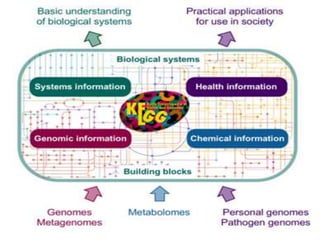
• KEGG is a database resource for understanding high-
level functions and utilities of the biological system,
such as the cell, the organism and the ecosystem, from
genomic and molecular-level information
• It is a computer representation of the biological
system, consisting of molecular building blocks of genes
and proteins (genomic information) and chemical
substances (chemical information) that are integrated
with the knowledge on molecular wiring diagrams of
interaction, reaction and relation networks (systems
information).
• It also contains disease and drug information (health
information) as perturbations to the biological system.
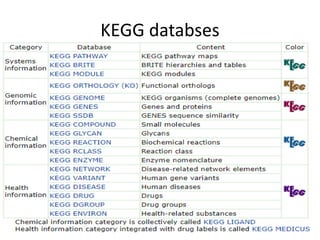
KEGG databses
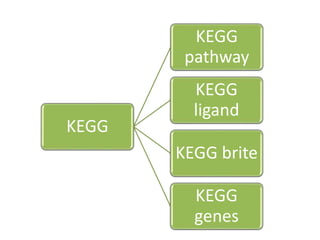
KEGG
KEGG
pathway
KEGG
ligand
KEGG brite
KEGG
genes
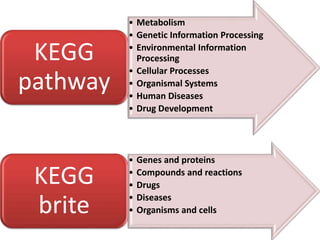
• Metabolism
• Genetic Information Processing
• Environmental Information
Processing
• Cellular Processes
• Organismal Systems
• Human Diseases
• Drug Development
KEGG
pathway
• Genes and proteins
• Compounds and reactions
• Drugs
• Diseases
• Organisms and cells
KEGG
brite
Searching KEGG
The KEGG database is made accessible in two
formats.
One is the flat-file format for use in simple
searches by the DBGET database retrieval
system.
The other is the relational database format for
more sophisticated queries in selected
databases.
DBGET
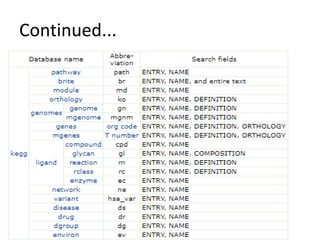
• DBGET has been developed as the backbone
retrieval system for the GenomeNet and KEGG
services .
• It is based on a flat-file view of molecular biology
databases, where the database is considered as a
collection of entries.
• Thus, any entry of any database can be retrieved
by the combination of the database name and the
entry name in the form of:db:entryDBGET has two
basic commands:bget - to retrieve 'db:entry'
bfind - to find 'db:entry's by keyword search
Continued...
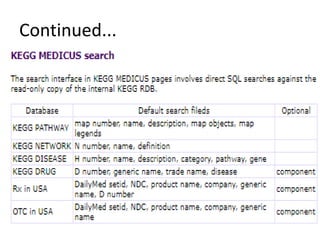
KEGG medicus
• The KEGG MEDICUS search is made against
relevant KEGG databases including PATHWAY,
NETWORK, DISEASE, DRUG, and ENVIRON, as
well as outside databases for drug labels.
• Currently, the Japanese drug labels obtained
from JAPIC are fully integrated in the KEGG
Relational Database (RDB), while only the
search indices created from FDA's National
Drug Code Directory (NDC) are stored in the
KEGG RDB and actual contents are linked to
NLM's DailyMed.
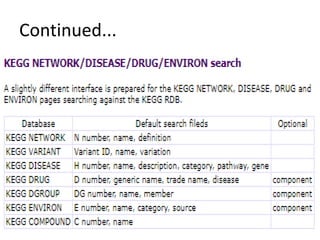
Continued...
Continued...
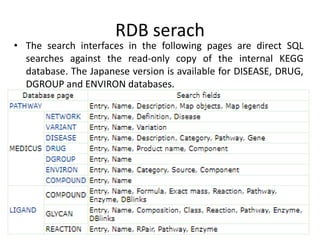
RDB serach
• The search interfaces in the following pages are direct SQL
searches against the read-only copy of the internal KEGG
database. The Japanese version is available for DISEASE, DRUG,
DGROUP and ENVIRON databases.
Kegg databse

Kegg databse

  • 1.
    A Presentation on KEGG Database in Biotechnology By Rashi Srivastava Rollno.: 1900520545007 Institute of Engineering & Technology An Autonomous Constituent Institute of Dr A.P.J. Abdul Kalam Technical University , Lucknow, U.P. February, 2020
  • 2.
    Introduction • KEGG isa database resource for understanding high- level functions and utilities of the biological system, such as the cell, the organism and the ecosystem, from genomic and molecular-level information • It is a computer representation of the biological system, consisting of molecular building blocks of genes and proteins (genomic information) and chemical substances (chemical information) that are integrated with the knowledge on molecular wiring diagrams of interaction, reaction and relation networks (systems information). • It also contains disease and drug information (health information) as perturbations to the biological system.
  • 4.
  • 5.
  • 6.
    • Metabolism • GeneticInformation Processing • Environmental Information Processing • Cellular Processes • Organismal Systems • Human Diseases • Drug Development KEGG pathway • Genes and proteins • Compounds and reactions • Drugs • Diseases • Organisms and cells KEGG brite
  • 8.
    Searching KEGG The KEGGdatabase is made accessible in two formats. One is the flat-file format for use in simple searches by the DBGET database retrieval system. The other is the relational database format for more sophisticated queries in selected databases.
  • 9.
    DBGET • DBGET hasbeen developed as the backbone retrieval system for the GenomeNet and KEGG services . • It is based on a flat-file view of molecular biology databases, where the database is considered as a collection of entries. • Thus, any entry of any database can be retrieved by the combination of the database name and the entry name in the form of:db:entryDBGET has two basic commands:bget - to retrieve 'db:entry' bfind - to find 'db:entry's by keyword search
  • 10.
  • 11.
    KEGG medicus • TheKEGG MEDICUS search is made against relevant KEGG databases including PATHWAY, NETWORK, DISEASE, DRUG, and ENVIRON, as well as outside databases for drug labels. • Currently, the Japanese drug labels obtained from JAPIC are fully integrated in the KEGG Relational Database (RDB), while only the search indices created from FDA's National Drug Code Directory (NDC) are stored in the KEGG RDB and actual contents are linked to NLM's DailyMed.
  • 12.
  • 13.
  • 14.
    RDB serach • Thesearch interfaces in the following pages are direct SQL searches against the read-only copy of the internal KEGG database. The Japanese version is available for DISEASE, DRUG, DGROUP and ENVIRON databases.