Ins to FOR-IAN V. SANDOVAL
   truc r:
               ls u_it@ ya o o
                 p        ho .c m
           fvs nd va ya o o
              a o l@ ho .c m
 An object database (also object-oriented database)
 is a database model in which information is
 represented in the form of objects as used in
 object-oriented programming.
 Object databases are generally recommended
 when there is a business need for             high
 performance processing on complex data.
 Some object-oriented databases are designed to
 work well     with   object-oriented   programming
 languages.
 A programming paradigm that uses "objects" —
 data structures consisting of data fields and
 methods — and their interactions to design
 applications and computer programs.
 Many   modern    programming     languages    now
 support OOP.
 The methodology focuses on data rather than
 processes, with programs composed of self-
 sufficient modules (objects) each containing all the
 information needed to manipulate its own data
 structure.
 An object-oriented program may thus be viewed as
 a collection of cooperating objects, as opposed to
 the conventional model, in which a program is seen
 as a list of tasks (subroutines) to perform.
 In OOP, each object is capable of receiving
 messages, processing data, and sending
 messages to other objects and can be viewed as
 an independent 'machine' with a distinct role or
 responsibility.
 The actions (or "operators") on these objects are
 closely associated with the object.
 The Simula programming language was the first to
 introduce the concepts underlying object-oriented
 programming (objects, classes, subclasses, virtual
 methods,     coroutines,    and     discrete event
 simulation) as a superset of Algol.
 Simula also used automatic garbage collection
 which had been invented earlier for the functional
 programming language Lisp.
 Simula was used for physical modeling, such as
 models to study and improve the movement of
 ships and their content through cargo ports.
 Smalltalk was the first programming language to be
 called "object-oriented".
 Python
 Perl
 Java
 C#
 Visual Basic.Net
 C++
 Objective-C
 Sometimes   shortened to ODBMS for object
 database management system) or OODBMS for
 Object-Oriented Database Management System.
 A database management system (DBMS) that
 supports the modeling and creation of data as
 objects.
 It includes some kind of support for classes of
 objects and the inheritance of class properties and
 methods by subclasses and their objects.
 Sometimes   shortened to ODBMS for object
 database management system) or OODBMS for
 Object-Oriented Database Management System.
 The    object-relational database management
 system (ORDBMS), the idea that object-oriented
 database concepts can be superimposed on
 relational    databases,   is   more commonly
 encountered in available products.
 The Object Data Management Group (ODMG) has
 already standardized an object-oriented data
 brokering interface between systems in a network.
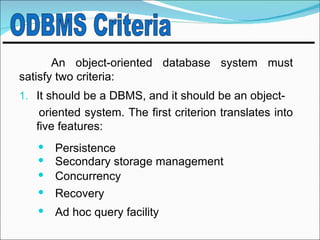
An object-oriented database system must
satisfy two criteria:
1. It should be a DBMS, and it should be an object-
    oriented system. The first criterion translates into
   five features:
    Persistence
    Secondary storage management
    Concurrency
    Recovery
      Ad hoc query facility
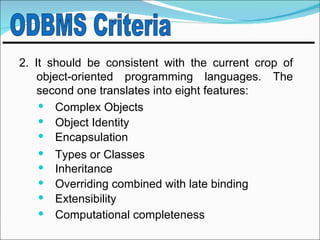
2. It should be consistent with the current crop of
    object-oriented programming languages. The
    second one translates into eight features:
     Complex Objects
     Object Identity
     Encapsulation
     Types or Classes
     Inheritance
     Overriding combined with late binding
     Extensibility
     Computational completeness
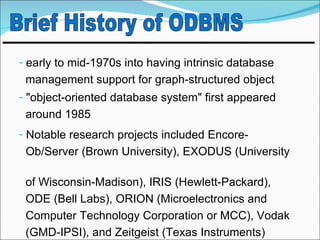
- early to mid-1970s into having intrinsic database
 management support for graph-structured object
- "object-oriented database system" first appeared
 around 1985
- Notable research projects included Encore-
 Ob/Server (Brown University), EXODUS (University

 of Wisconsin-Madison), IRIS (Hewlett-Packard),
 ODE (Bell Labs), ORION (Microelectronics and
 Computer Technology Corporation or MCC), Vodak
 (GMD-IPSI), and Zeitgeist (Texas Instruments)
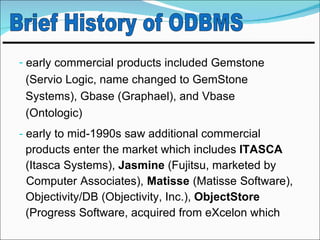
- early commercial products included Gemstone
 (Servio Logic, name changed to GemStone
 Systems), Gbase (Graphael), and Vbase
 (Ontologic)
- early to mid-1990s saw additional commercial
 products enter the market which includes ITASCA
 (Itasca Systems), Jasmine (Fujitsu, marketed by
 Computer Associates), Matisse (Matisse Software),
 Objectivity/DB (Objectivity, Inc.), ObjectStore
 (Progress Software, acquired from eXcelon which
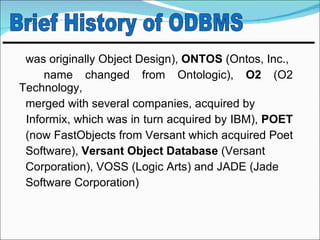
was originally Object Design), ONTOS (Ontos, Inc.,
     name changed from Ontologic), O2 (O2
Technology,
 merged with several companies, acquired by
 Informix, which was in turn acquired by IBM), POET
 (now FastObjects from Versant which acquired Poet
 Software), Versant Object Database (Versant
 Corporation), VOSS (Logic Arts) and JADE (Jade
 Software Corporation)
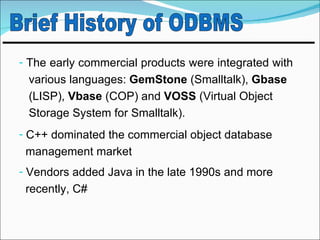
- The early commercial products were integrated with
 various languages: GemStone (Smalltalk), Gbase
 (LISP), Vbase (COP) and VOSS (Virtual Object
 Storage System for Smalltalk).
- C++ dominated the commercial object database
 management market
- Vendors added Java in the late 1990s and more
 recently, C#
- In 2004, object databases have seen a second
 growth period when open source object databases
 emerged that were widely affordable and easy to
 use, because they are entirely written in OOP
 languages
Object databases based on persistent
programming acquired a niche in application areas
such as:
1. Engineering and spatial database
2. Telecommunications
3. Scientific areas such as high energy physics and
   molecular biology
4. Commercial Data Processing
5. Financial Services
6. Embedded Systems
7. Packaged Software
8. Real-time Systems
Most object databases also offer some kind of
query language, allowing objects to be found by a
more declarative programming approach. An attempt
at standardization was made by the ODMG with the
Object Query Language, OQL.

1. Access to data can be faster because joins are
   often not needed;
2. The schema of a database is defined;
3. Multimedia applications are facilitated;
4. Many object databases support versioning.
5. The efficiency of such a database is also greatly
   improved
The Object Data Management Group (ODMG) was a
consortium of object database and object-relational
mapping vendors, members of the academic
community, and interested parties. Its goal was to
create a set of specifications that would allow for
portable applications that store objects in database
management systems. It published several versions
of its specification.
1. Use navigational rather than declarative interfaces
2. Pointer-based techniques are optimized for very
   specific "search routes" or viewpoints
3. General-purpose queries pointer-based
   techniques will tend to be slower
4. Direct object references may be maintained in
   addition to normalized, indexed aggregations,
   allowing both kinds of access
1. Lack of interoperability with a great number of
     tools/features that are taken for granted in the
   SQL world
2. Lack a formal mathematical foundation
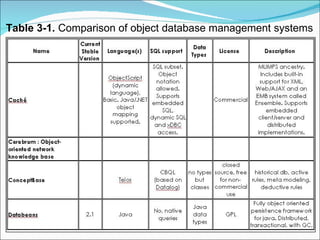
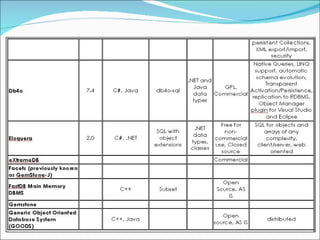
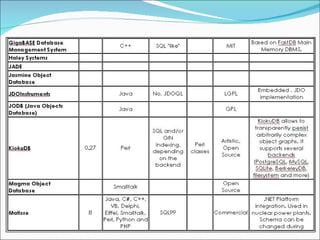
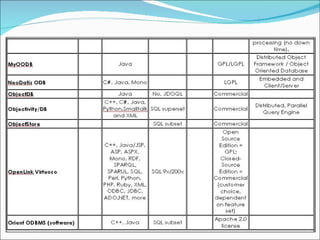
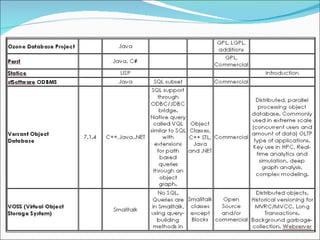
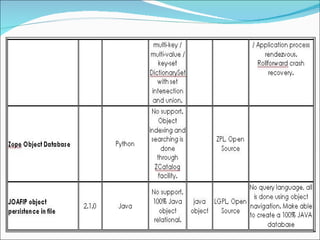
Table 3-1. Comparison of object database management systems
03 Object Dbms Technology

03 Object Dbms Technology

  • 1.
    Ins to FOR-IANV. SANDOVAL truc r: ls u_it@ ya o o p ho .c m fvs nd va ya o o a o l@ ho .c m
  • 2.
     An objectdatabase (also object-oriented database) is a database model in which information is represented in the form of objects as used in object-oriented programming.  Object databases are generally recommended when there is a business need for high performance processing on complex data.  Some object-oriented databases are designed to work well with object-oriented programming languages.
  • 3.
     A programmingparadigm that uses "objects" — data structures consisting of data fields and methods — and their interactions to design applications and computer programs.  Many modern programming languages now support OOP.  The methodology focuses on data rather than processes, with programs composed of self- sufficient modules (objects) each containing all the information needed to manipulate its own data structure.
  • 4.
     An object-orientedprogram may thus be viewed as a collection of cooperating objects, as opposed to the conventional model, in which a program is seen as a list of tasks (subroutines) to perform.  In OOP, each object is capable of receiving messages, processing data, and sending messages to other objects and can be viewed as an independent 'machine' with a distinct role or responsibility.  The actions (or "operators") on these objects are closely associated with the object.
  • 5.
     The Simulaprogramming language was the first to introduce the concepts underlying object-oriented programming (objects, classes, subclasses, virtual methods, coroutines, and discrete event simulation) as a superset of Algol.  Simula also used automatic garbage collection which had been invented earlier for the functional programming language Lisp.  Simula was used for physical modeling, such as models to study and improve the movement of ships and their content through cargo ports.
  • 6.
     Smalltalk wasthe first programming language to be called "object-oriented".
  • 7.
     Python  Perl Java  C#  Visual Basic.Net  C++  Objective-C
  • 8.
     Sometimes shortened to ODBMS for object database management system) or OODBMS for Object-Oriented Database Management System.  A database management system (DBMS) that supports the modeling and creation of data as objects.  It includes some kind of support for classes of objects and the inheritance of class properties and methods by subclasses and their objects.
  • 9.
     Sometimes shortened to ODBMS for object database management system) or OODBMS for Object-Oriented Database Management System.  The object-relational database management system (ORDBMS), the idea that object-oriented database concepts can be superimposed on relational databases, is more commonly encountered in available products.  The Object Data Management Group (ODMG) has already standardized an object-oriented data brokering interface between systems in a network.
  • 10.
    An object-oriented databasesystem must satisfy two criteria: 1. It should be a DBMS, and it should be an object- oriented system. The first criterion translates into five features:  Persistence  Secondary storage management  Concurrency  Recovery  Ad hoc query facility
  • 11.
    2. It shouldbe consistent with the current crop of object-oriented programming languages. The second one translates into eight features:  Complex Objects  Object Identity  Encapsulation  Types or Classes  Inheritance  Overriding combined with late binding  Extensibility  Computational completeness
  • 12.
    - early tomid-1970s into having intrinsic database management support for graph-structured object - "object-oriented database system" first appeared around 1985 - Notable research projects included Encore- Ob/Server (Brown University), EXODUS (University of Wisconsin-Madison), IRIS (Hewlett-Packard), ODE (Bell Labs), ORION (Microelectronics and Computer Technology Corporation or MCC), Vodak (GMD-IPSI), and Zeitgeist (Texas Instruments)
  • 13.
    - early commercialproducts included Gemstone (Servio Logic, name changed to GemStone Systems), Gbase (Graphael), and Vbase (Ontologic) - early to mid-1990s saw additional commercial products enter the market which includes ITASCA (Itasca Systems), Jasmine (Fujitsu, marketed by Computer Associates), Matisse (Matisse Software), Objectivity/DB (Objectivity, Inc.), ObjectStore (Progress Software, acquired from eXcelon which
  • 14.
    was originally ObjectDesign), ONTOS (Ontos, Inc., name changed from Ontologic), O2 (O2 Technology, merged with several companies, acquired by Informix, which was in turn acquired by IBM), POET (now FastObjects from Versant which acquired Poet Software), Versant Object Database (Versant Corporation), VOSS (Logic Arts) and JADE (Jade Software Corporation)
  • 15.
    - The earlycommercial products were integrated with various languages: GemStone (Smalltalk), Gbase (LISP), Vbase (COP) and VOSS (Virtual Object Storage System for Smalltalk). - C++ dominated the commercial object database management market - Vendors added Java in the late 1990s and more recently, C#
  • 16.
    - In 2004,object databases have seen a second growth period when open source object databases emerged that were widely affordable and easy to use, because they are entirely written in OOP languages
  • 17.
    Object databases basedon persistent programming acquired a niche in application areas such as: 1. Engineering and spatial database 2. Telecommunications 3. Scientific areas such as high energy physics and molecular biology 4. Commercial Data Processing 5. Financial Services
  • 18.
    6. Embedded Systems 7.Packaged Software 8. Real-time Systems
  • 19.
    Most object databasesalso offer some kind of query language, allowing objects to be found by a more declarative programming approach. An attempt at standardization was made by the ODMG with the Object Query Language, OQL. 1. Access to data can be faster because joins are often not needed; 2. The schema of a database is defined; 3. Multimedia applications are facilitated;
  • 20.
    4. Many objectdatabases support versioning. 5. The efficiency of such a database is also greatly improved
  • 21.
    The Object DataManagement Group (ODMG) was a consortium of object database and object-relational mapping vendors, members of the academic community, and interested parties. Its goal was to create a set of specifications that would allow for portable applications that store objects in database management systems. It published several versions of its specification.
  • 22.
    1. Use navigationalrather than declarative interfaces 2. Pointer-based techniques are optimized for very specific "search routes" or viewpoints 3. General-purpose queries pointer-based techniques will tend to be slower 4. Direct object references may be maintained in addition to normalized, indexed aggregations, allowing both kinds of access
  • 23.
    1. Lack ofinteroperability with a great number of tools/features that are taken for granted in the SQL world 2. Lack a formal mathematical foundation
  • 24.
    Table 3-1. Comparisonof object database management systems