Cognitivetheories
Personality Theories
Prepared By
Manu Melwin Joy
Research Scholar
School of Management Studies
CUSAT, Kerala, India.
Phone – 9744551114
Mail – manu_melwinjoy@yahoo.com
Kindly restrict the use of slides for personal purpose.
Please seek permission to reproduce the same in public
forms and presentations.
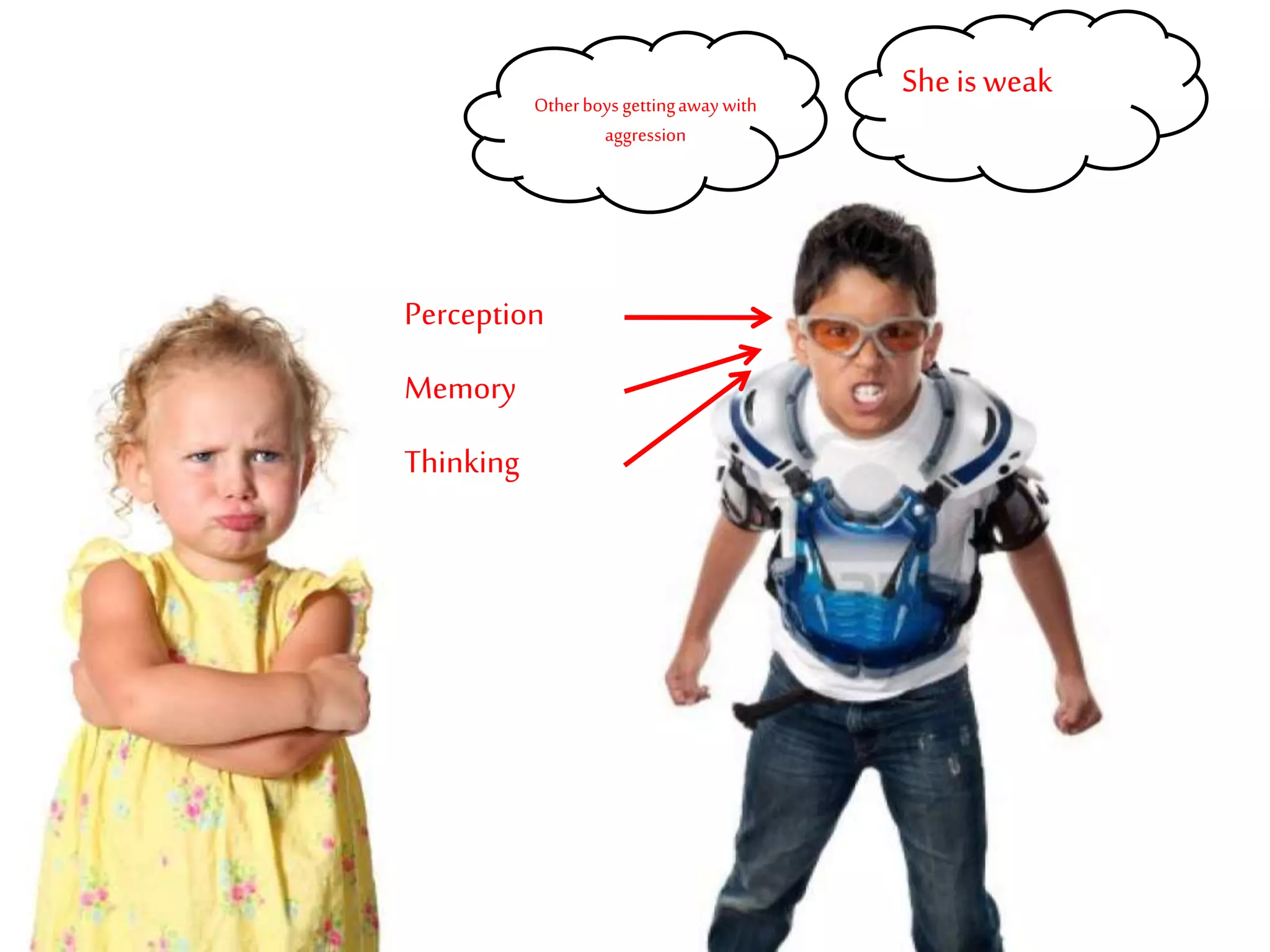
Sheis weakOtherboysgettingaway with
aggression
Perception
Memory
Thinking
1. The term "cognitive psychology" was first used in 1967 by American psychologist
UlricNeisser in his book Cognitive Psychology.
2. According to Neisser, cognition involves "all processes by which the sensory input is
transformed, reduced,elaborated, stored, recovered, and used.
3. It is concerned with these processes even when they operate in the absence of
relevant stimulation, as in images and hallucinations.
4. Given such a sweeping definition, it is apparent that cognition is involved in
everything a human being might possibly do; that every psychological
phenomenon is a cognitive phenomenon."
Cognitive theories
1. Unlike behaviorism, which focuses only on observable behaviors, cognitive
psychology is concerned with internal mental states.
2. Unlike psychoanalysis, which relies heavily on subjective perceptions, cognitive
psychology uses scientific research methods to study mental processes.
How is Cognitive Psychology Different?
Stages of Cognitive Development
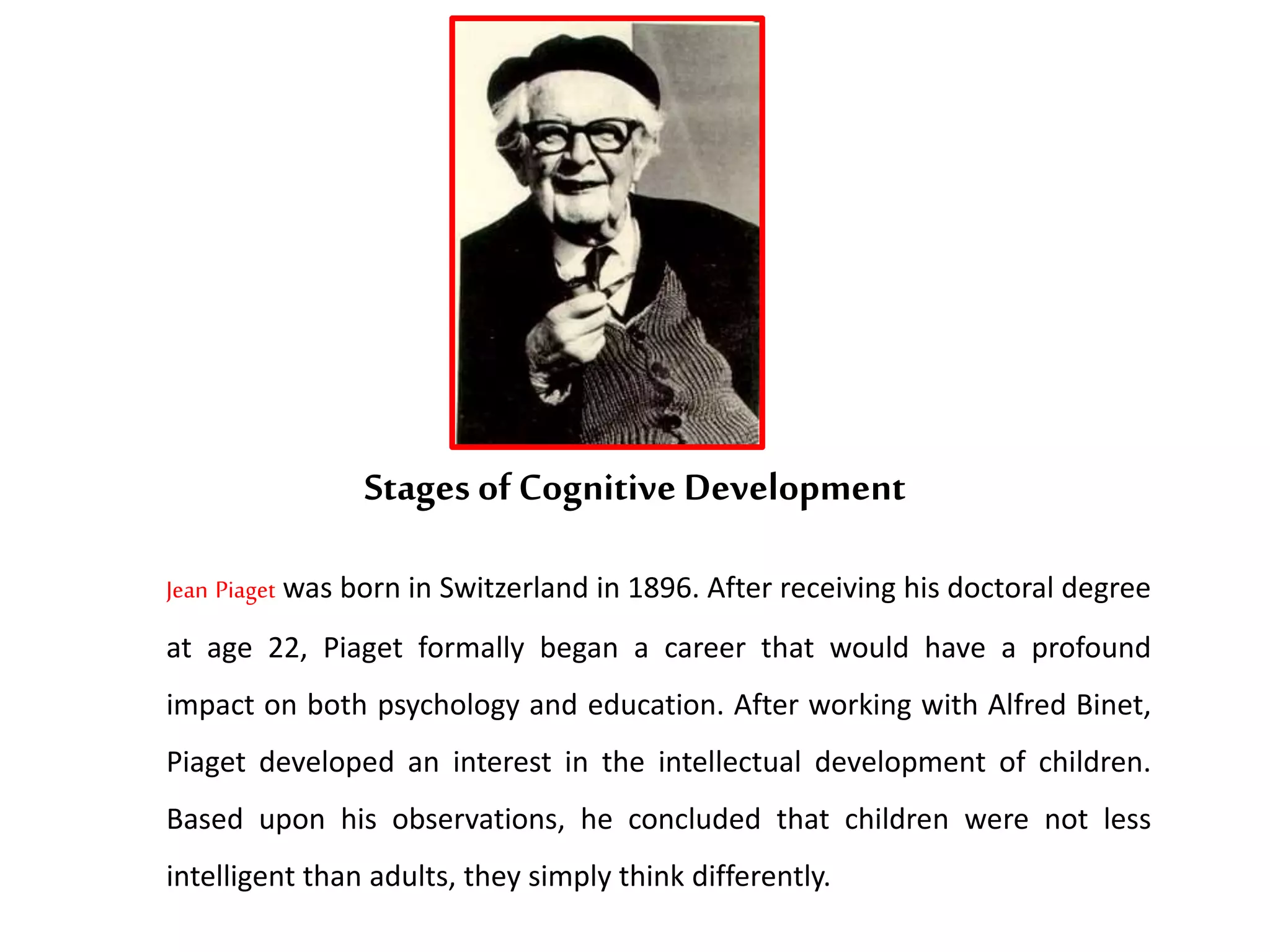
Jean Piaget was born in Switzerland in 1896. After receiving his doctoral degree
at age 22, Piaget formally began a career that would have a profound
impact on both psychology and education. After working with Alfred Binet,
Piaget developed an interest in the intellectual development of children.
Based upon his observations, he concluded that children were not less
intelligent than adults, they simply think differently.
Stages of Cognitive Development
1. Sensorimotor Stage - The first stage of Piaget's theory lasts from birth to
approximately age two and is centered on the infant trying to make sense of the
world. During the sensorimotor stage, an infant's knowledge of the world is
limited to his or her sensory perceptions and motor activities
2. Preoperational Stage - The preoperational stage occurs roughly between the ages two
and seven. Language development is one of the hallmarks of this period. During
the preoperational stage, children also become increasingly adept at using
symbols, as evidenced by the increase in playing and pretending.
3. Concrete Operational Stage - The concrete operational stage begins around age seven
and continues until approximately age eleven. During this time, children gain a
better understanding of mental operations. Children begin thinking logically
about concrete events, but have difficulty understanding abstract or hypothetical
concepts.
4. Formal Operational Stage - The formal operational stage begins at approximately age
twelve to and lasts into adulthood. During this time, people develop the ability to
think about abstract concepts. Skills such as logical thought, deductive reasoning,
and systematic planning also emerge during this stage.
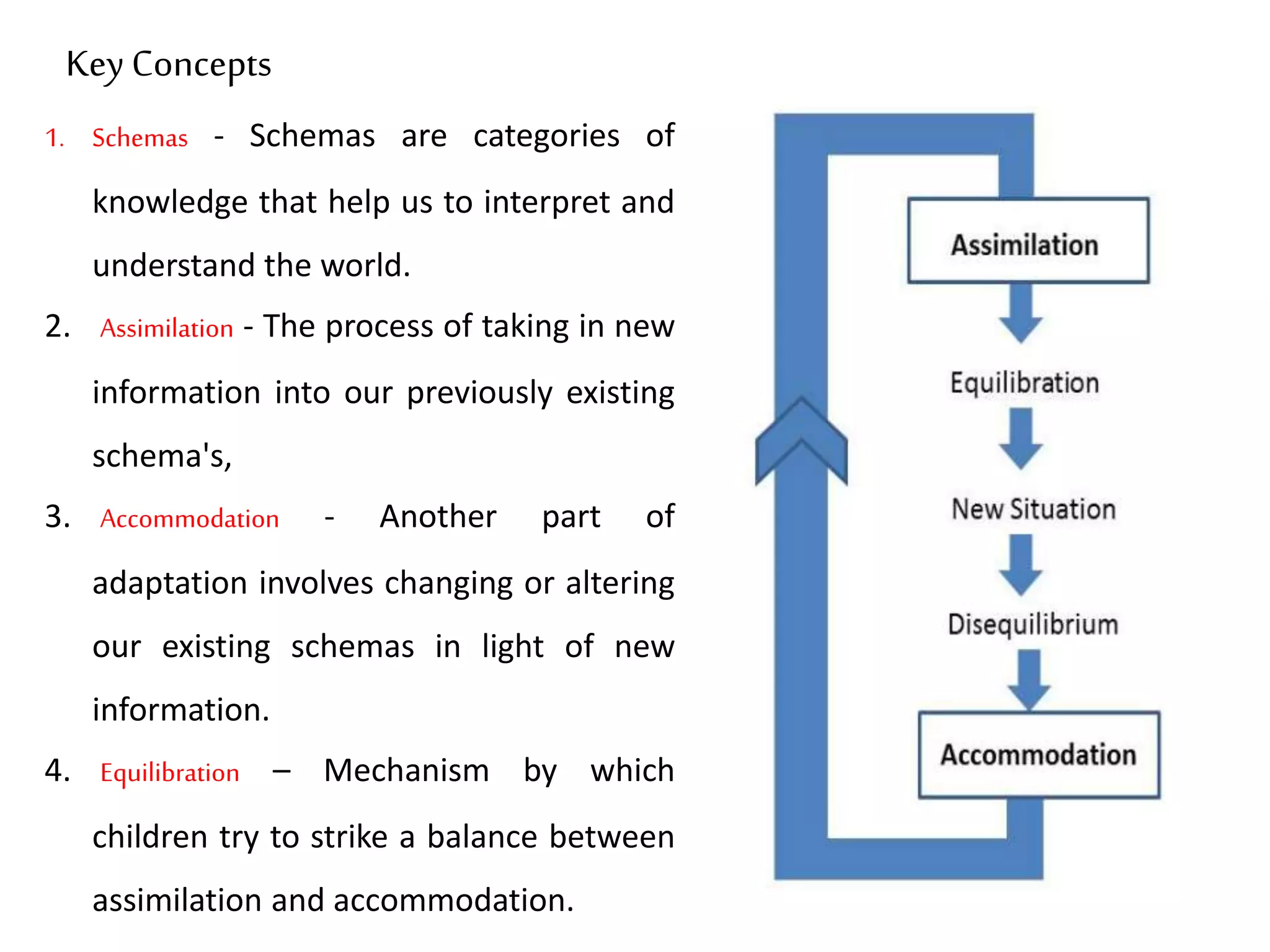
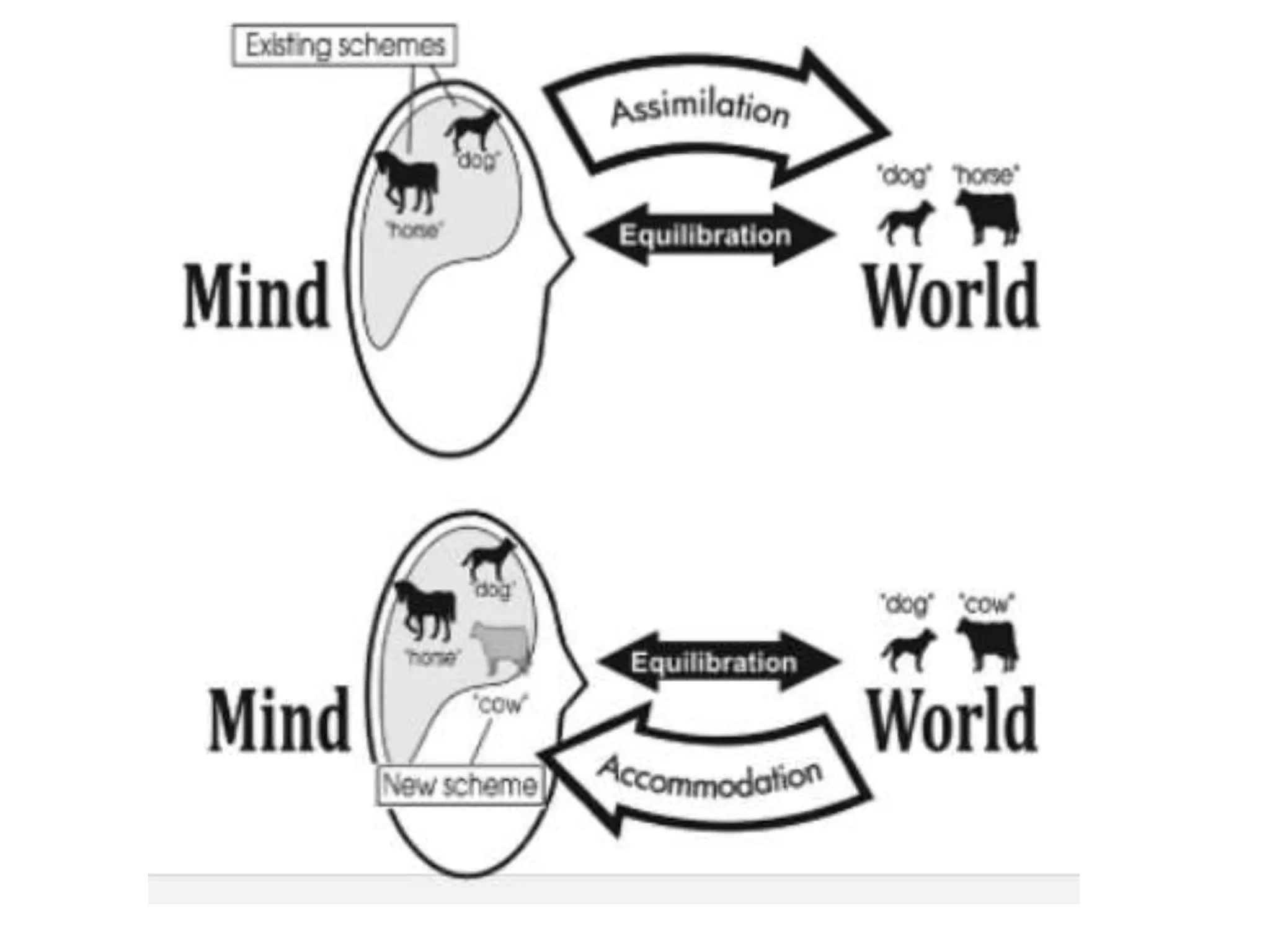
1. Schemas - Schemas are categories of
knowledge that help us to interpret and
understand the world.
2. Assimilation - The process of taking in new
information into our previously existing
schema's,
3. Accommodation - Another part of
adaptation involves changing or altering
our existing schemas in light of new
information.
4. Equilibration – Mechanism by which
children try to strike a balance between
assimilation and accommodation.
Key Concepts
1. Problems With Research Methods - A major source of inspiration for the theory was
Piaget's observations of his own three children. In addition to this, the
other children in Piaget's small research sample were all from well-
educated professionals of high socioeconomic status. Because of this
unrepresentative sample, it is difficult to generalize his findings to a larger
population.
2. Problems With Formal Operations - Research has disputed Piaget's argument that
all children will automatically move to the next stage of development as
they mature. Some data suggests that environmental factors may play a
role in the development of formal operations.
3. Underestimates Children's Abilities - Most researchers agree that children possess
many of the abilities at an earlier age than Piaget suspected. Recent theory
of mind research has found that 4- and 5-year-old children have a rather
sophisticated understanding of their own mental processes as well as those
of other people. For example, children of this age have some ability to take
the perspective of another person, meaning they are far less egocentric
than Piaget believed.
Criticisms
General Intelligence
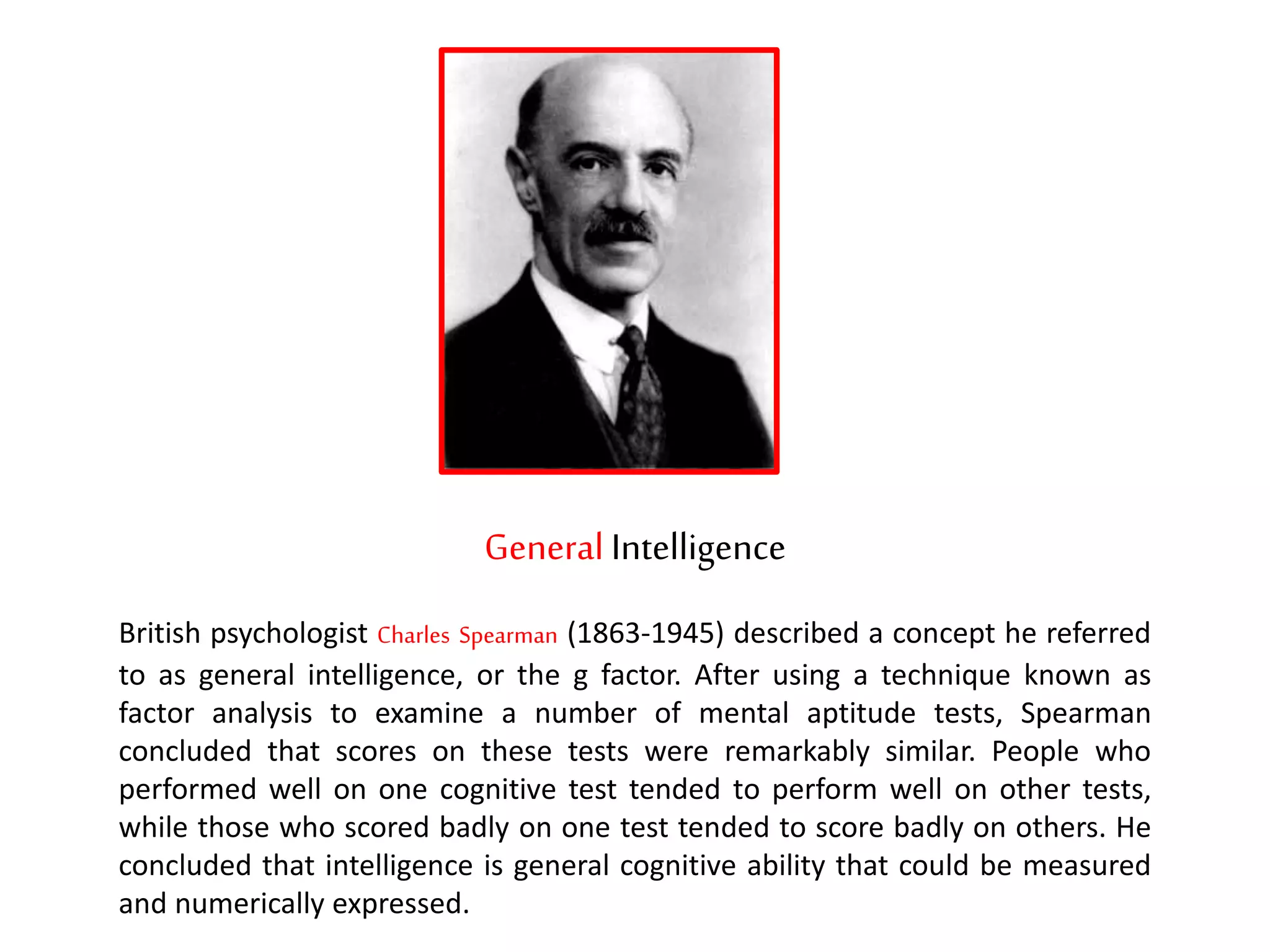
British psychologist Charles Spearman (1863-1945) described a concept he referred
to as general intelligence, or the g factor. After using a technique known as
factor analysis to examine a number of mental aptitude tests, Spearman
concluded that scores on these tests were remarkably similar. People who
performed well on one cognitive test tended to perform well on other tests,
while those who scored badly on one test tended to score badly on others. He
concluded that intelligence is general cognitive ability that could be measured
and numerically expressed.
Primary Mental Abilities
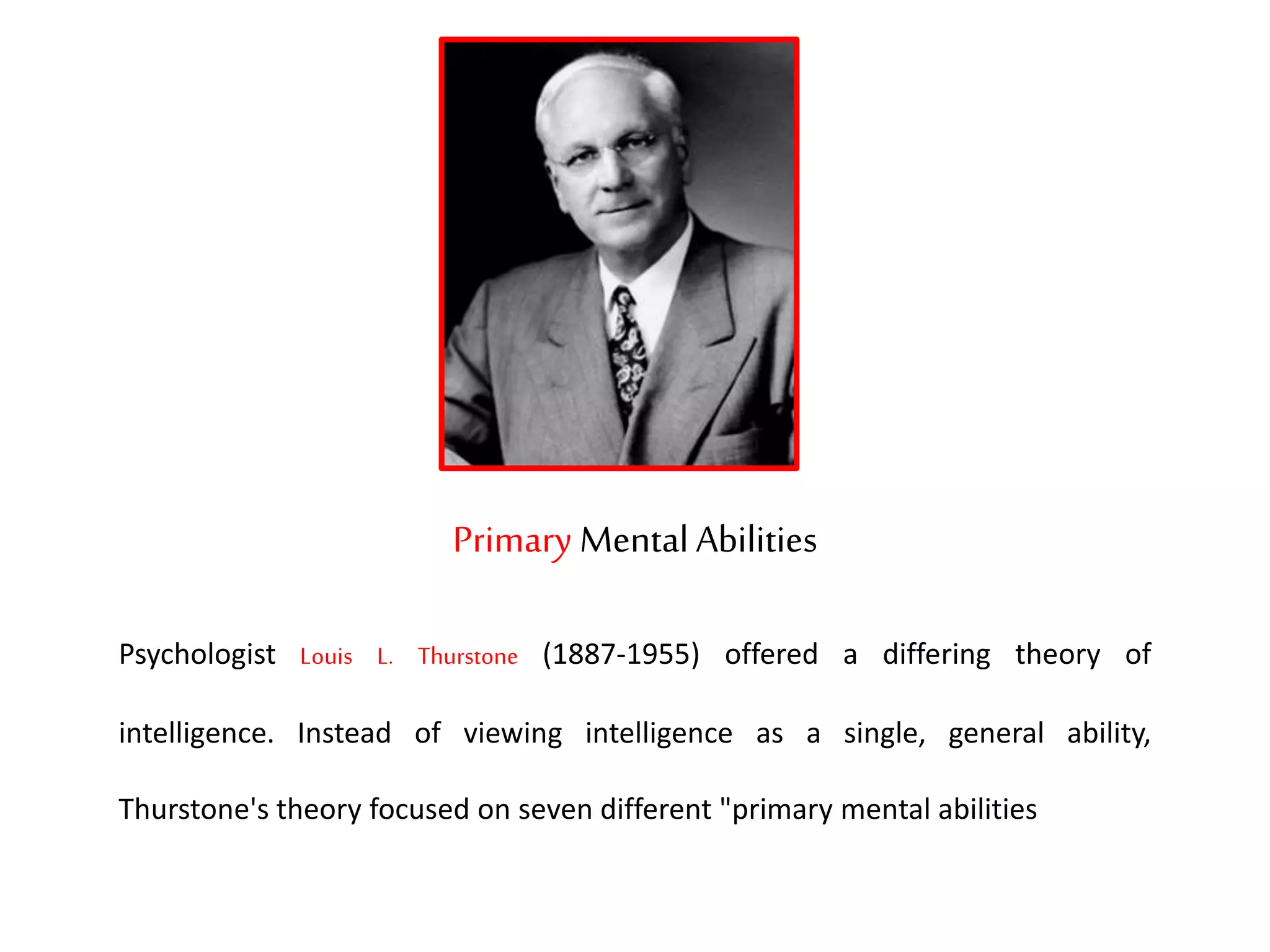
Psychologist Louis L. Thurstone (1887-1955) offered a differing theory of
intelligence. Instead of viewing intelligence as a single, general ability,
Thurstone's theory focused on seven different "primary mental abilities
Primary Mental Abilities
Thurstone's theory focused on seven different "primary mental abilities." The
abilities that he described were:
1. Verbal comprehension
2. Reasoning
3. Perceptual speed
4. Numerical ability
5. Word fluency
6. Associative memory
7. Spatial visualization
Multiple Intelligences
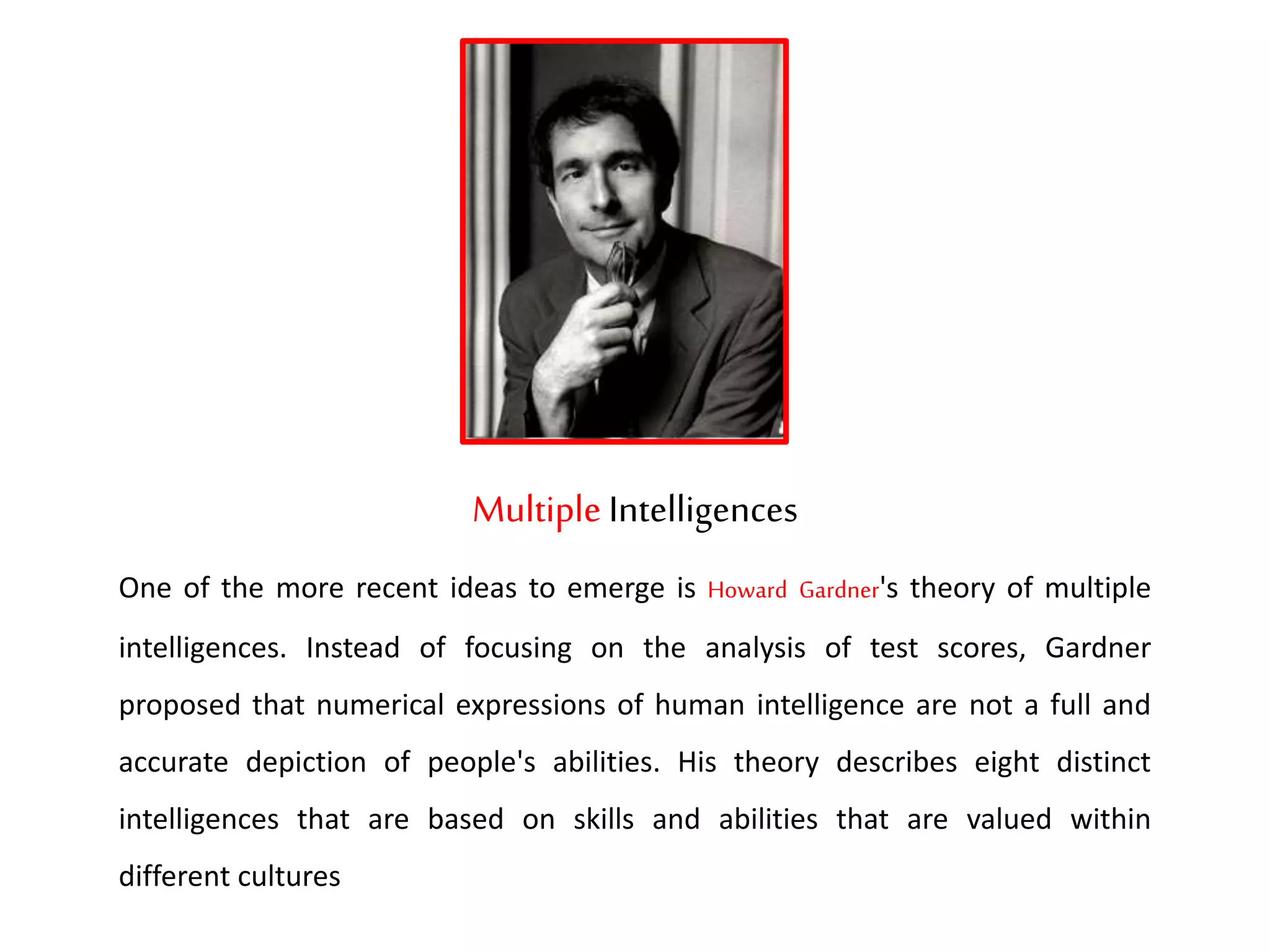
One of the more recent ideas to emerge is Howard Gardner's theory of multiple
intelligences. Instead of focusing on the analysis of test scores, Gardner
proposed that numerical expressions of human intelligence are not a full and
accurate depiction of people's abilities. His theory describes eight distinct
intelligences that are based on skills and abilities that are valued within
different cultures
MultipleIntelligences
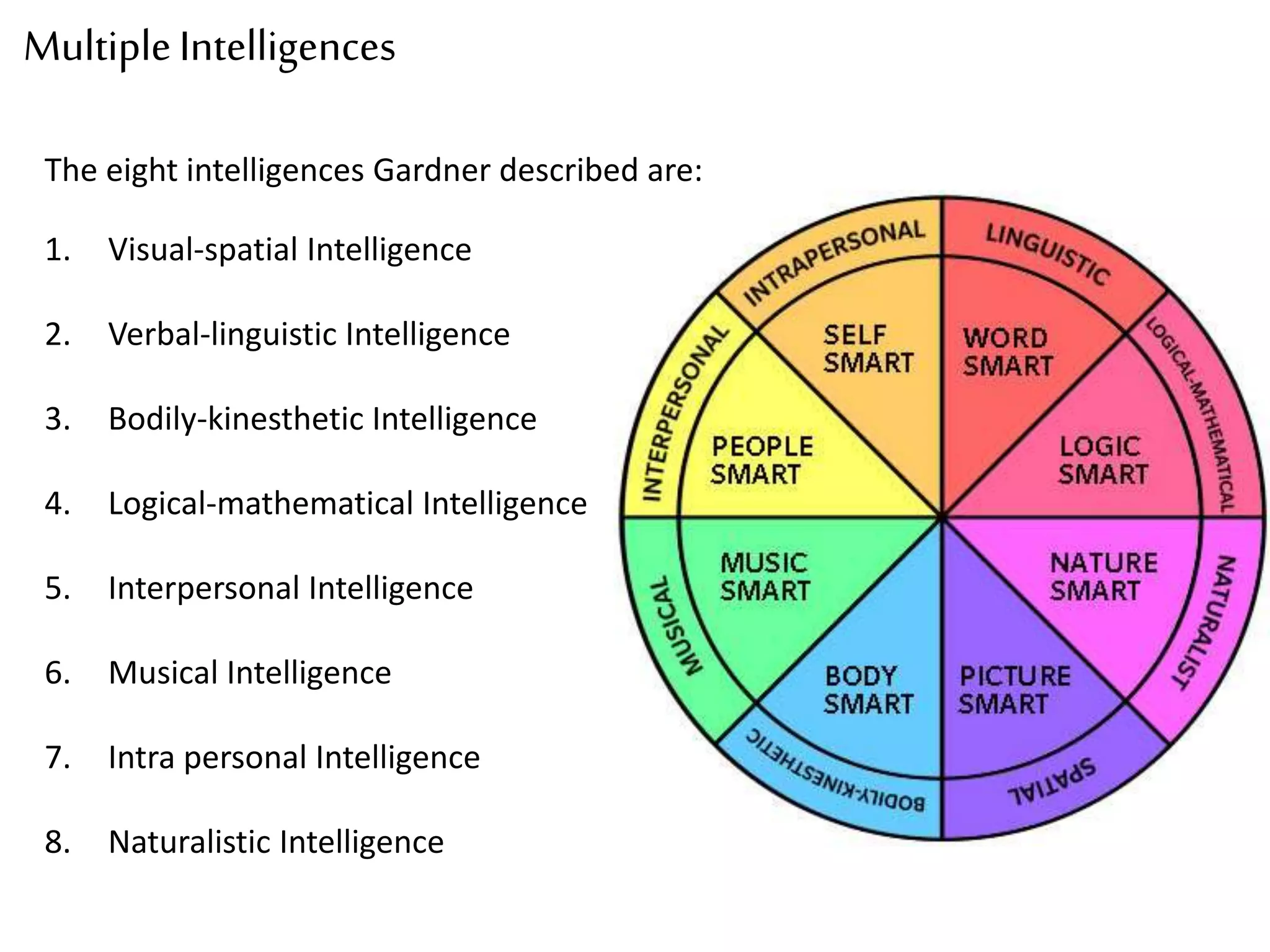
The eight intelligences Gardner described are:
1. Visual-spatial Intelligence
2. Verbal-linguistic Intelligence
3. Bodily-kinesthetic Intelligence
4. Logical-mathematical Intelligence
5. Interpersonal Intelligence
6. Musical Intelligence
7. Intra personal Intelligence
8. Naturalistic Intelligence
TriarchicTheory of Intelligence
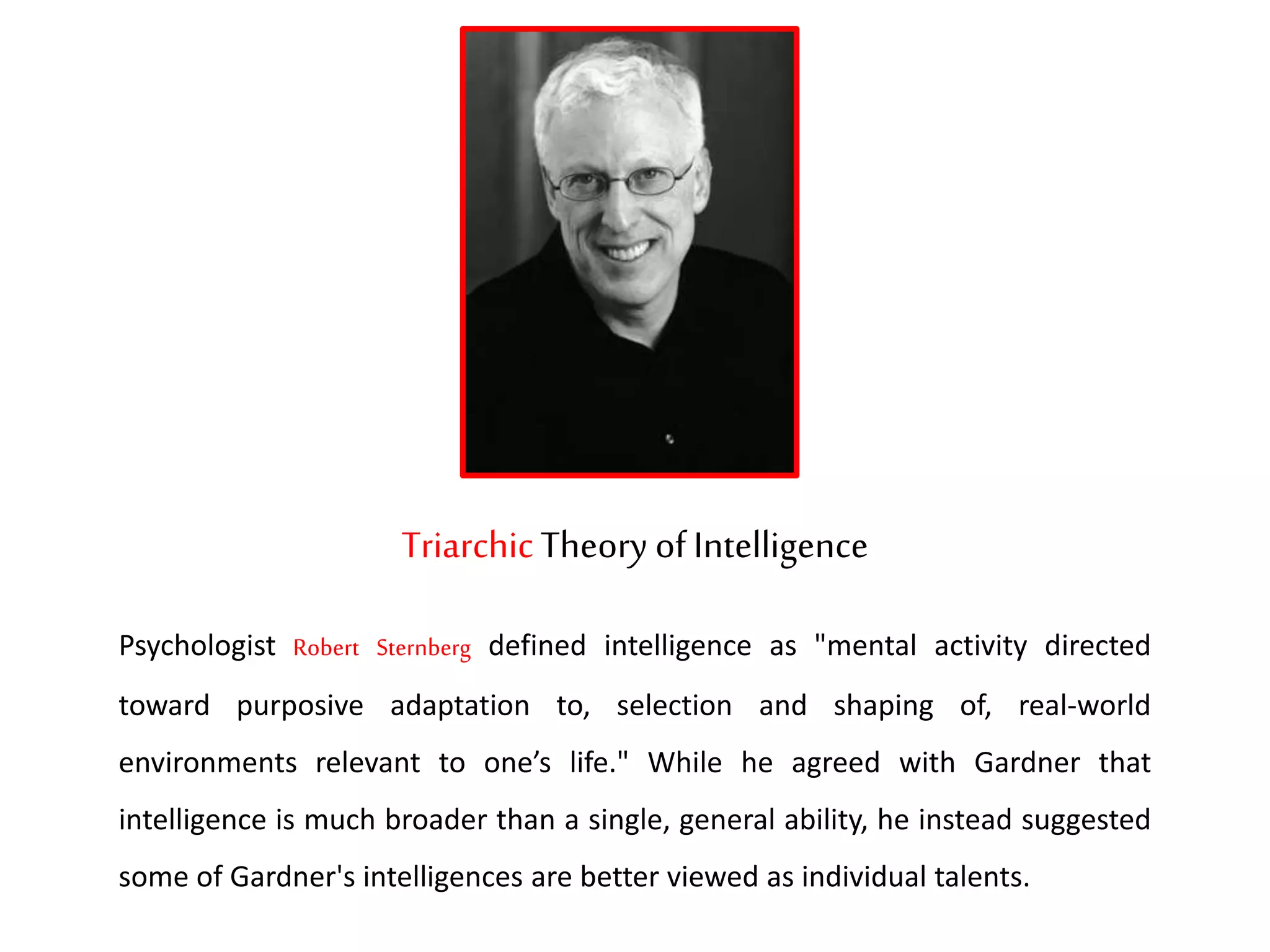
Psychologist Robert Sternberg defined intelligence as "mental activity directed
toward purposive adaptation to, selection and shaping of, real-world
environments relevant to one’s life." While he agreed with Gardner that
intelligence is much broader than a single, general ability, he instead suggested
some of Gardner's intelligences are better viewed as individual talents.
Triarchic Theory of Intelligence
Sternberg proposed what he refers to as 'successful intelligence,' which is
comprised of three different factors:
1. Analyticalintelligence: This component refers to problem-solving abilities.
2. Creative intelligence: This aspect of intelligence involves the ability to deal
with new situations using past experiences and current skills.
3. Practical intelligence: This element refers to the ability to adapt to a changing
environment.
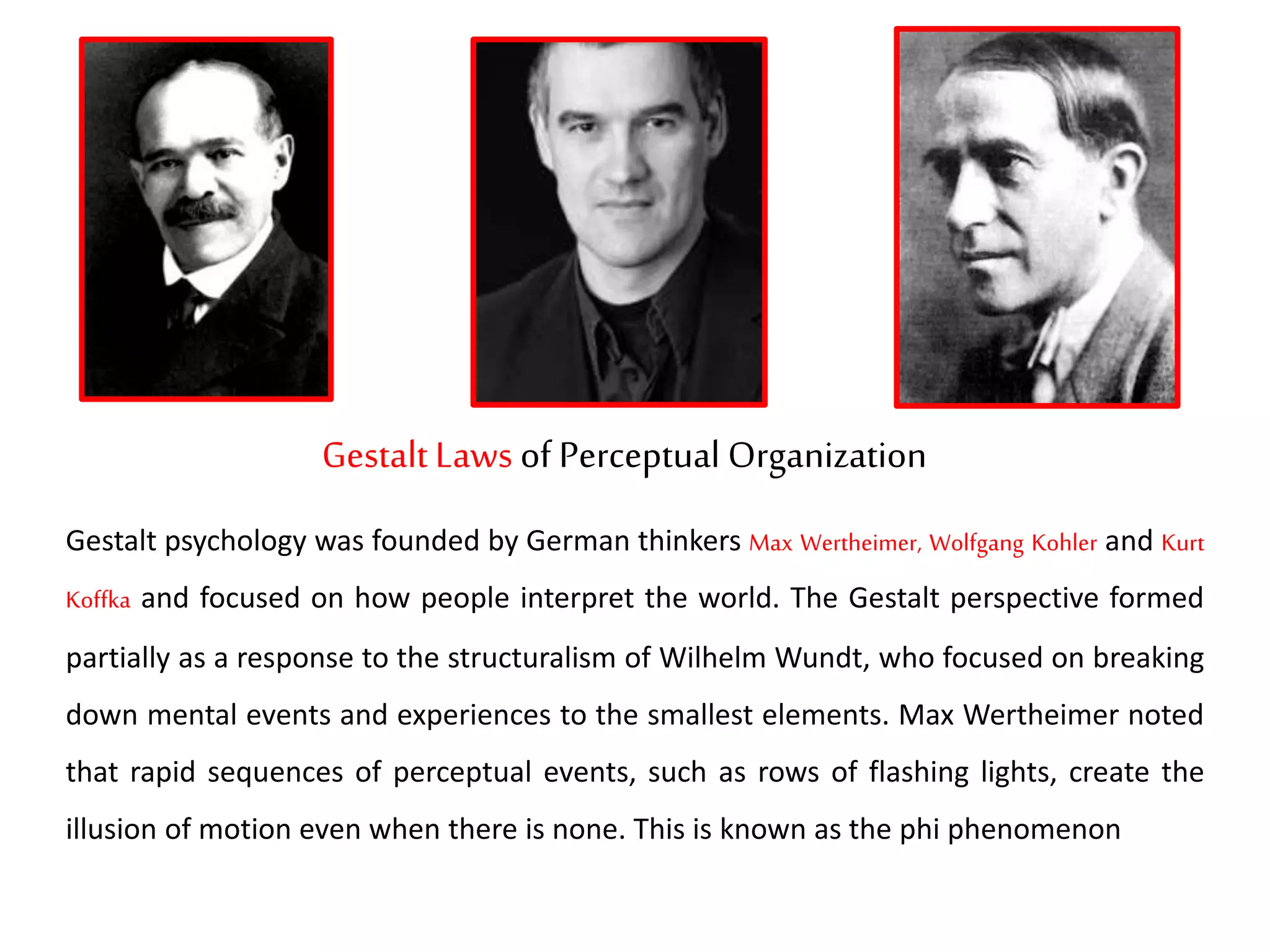
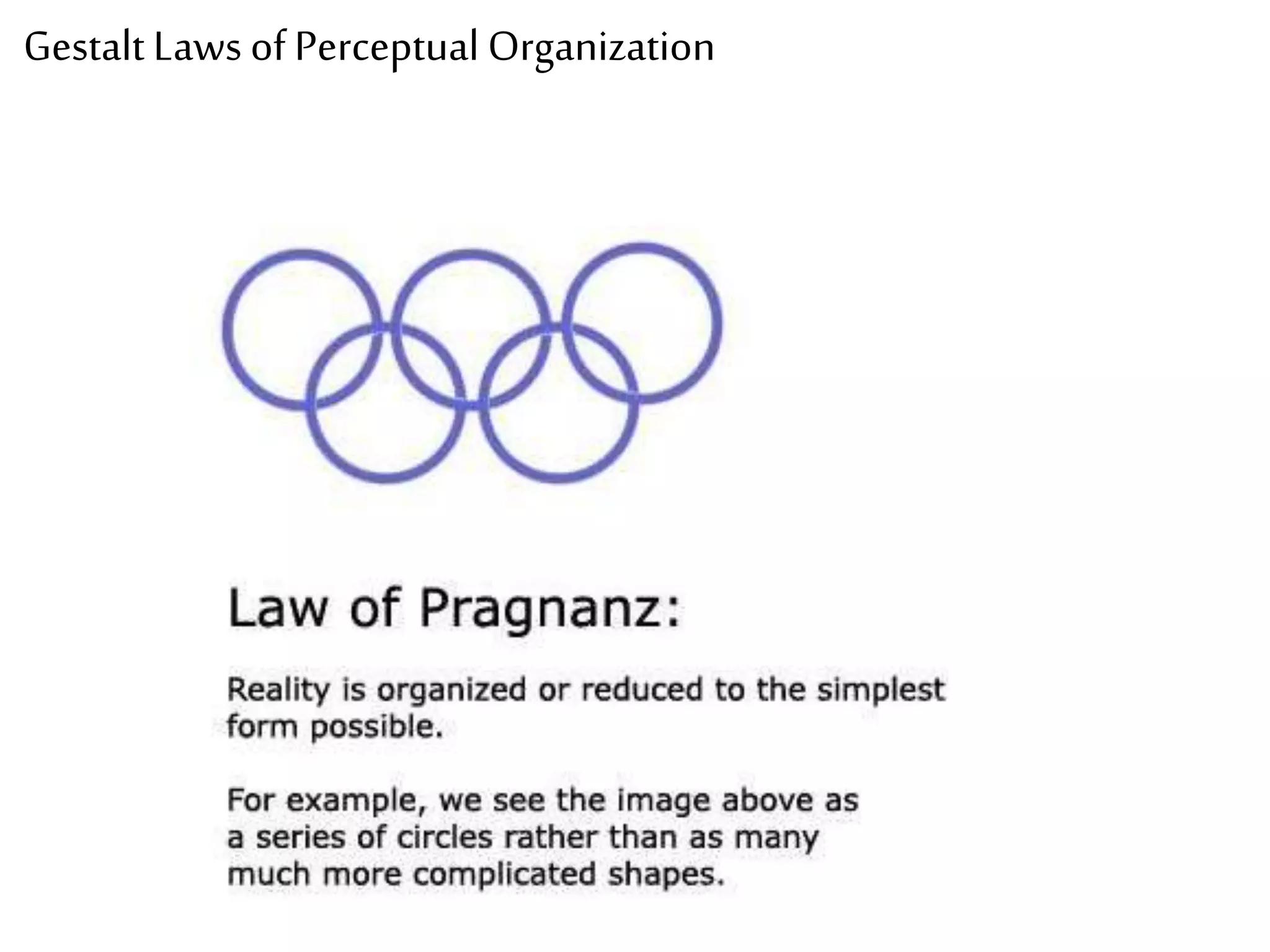
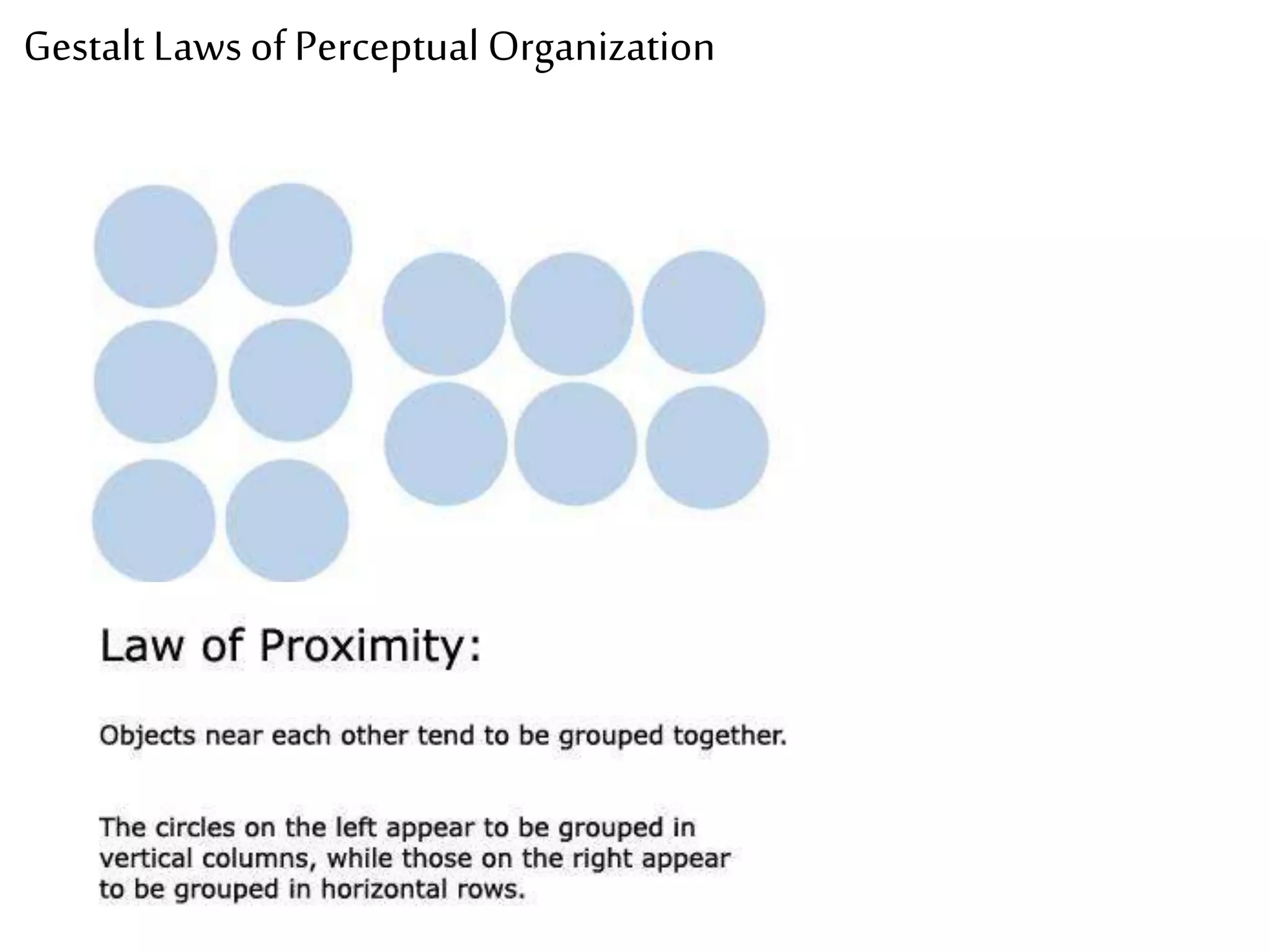
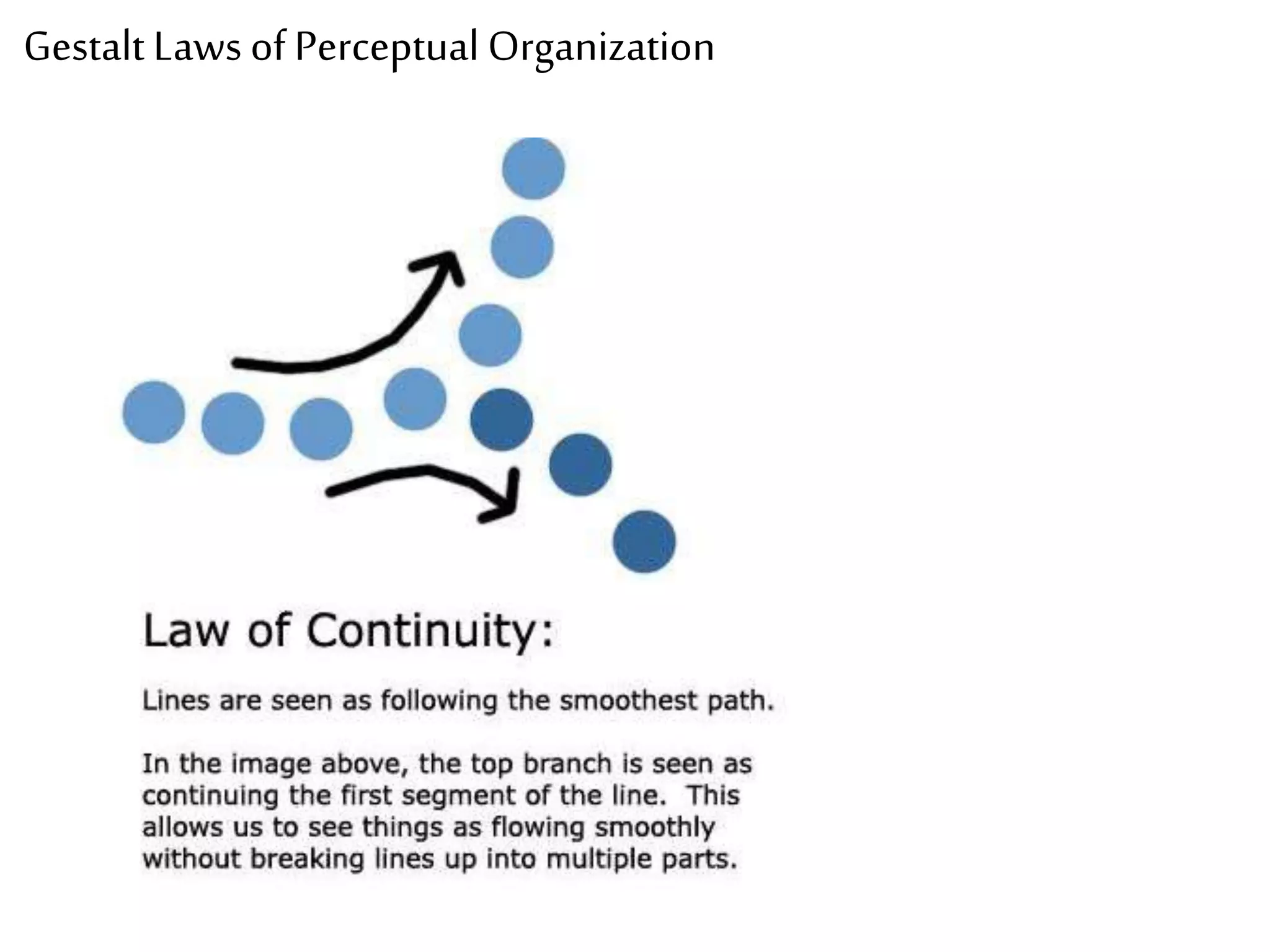
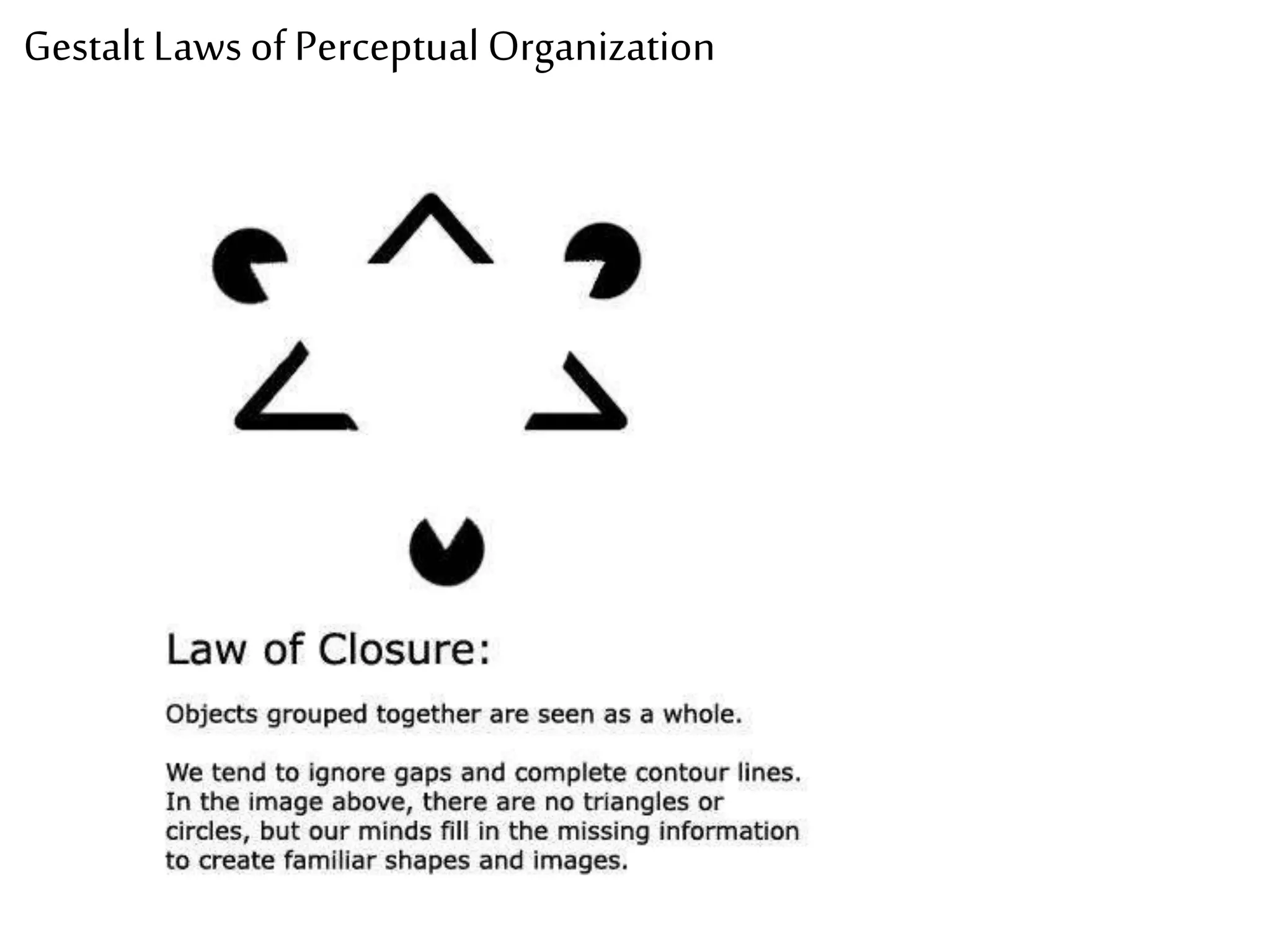
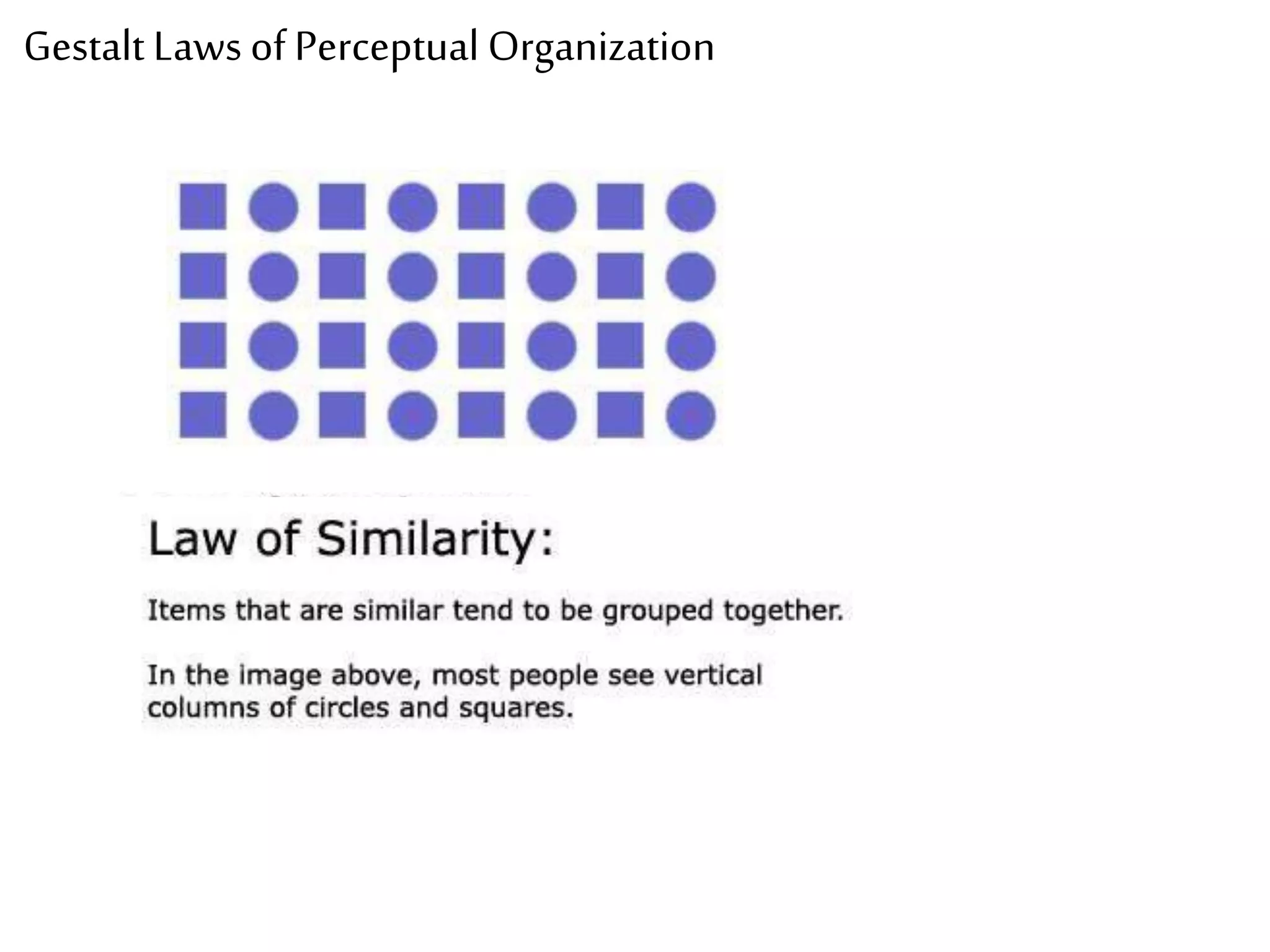
Gestalt Laws of Perceptual Organization
Gestalt psychology was founded by German thinkers Max Wertheimer, Wolfgang Kohler and Kurt
Koffka and focused on how people interpret the world. The Gestalt perspective formed
partially as a response to the structuralism of Wilhelm Wundt, who focused on breaking
down mental events and experiences to the smallest elements. Max Wertheimer noted
that rapid sequences of perceptual events, such as rows of flashing lights, create the
illusion of motion even when there is none. This is known as the phi phenomenon
Gestalt Laws of Perceptual Organization
Other TA topics available on slideshare
1. Strokes - http://www.slideshare.net/manumjoy/strokes-24081607.
2. Games People Play - http://www.slideshare.net/manumjoy/psychological-
games-people-play.
3. Structural Analysis - http://www.slideshare.net/manumjoy/the-ego-state-model.
4. What is TA? - http://www.slideshare.net/manumjoy/what-ta-is
5. Cycles of Development - http://www.slideshare.net/manumjoy/cycles-of-
developement-pamela-levin-transactional-analysis.
6. Stages of Cure - http://www.slideshare.net/manumjoy/stages-of-cure.
7. Transactions - http://www.slideshare.net/manumjoy/transactions-33677298.
8. Time Structuring - http://www.slideshare.net/manumjoy/time-structuring.
9. Life Position - http://www.slideshare.net/manumjoy/life-position.
10. Autonomy - http://www.slideshare.net/manumjoy/autonomy-33690557.
11. Structural Pathology - http://www.slideshare.net/manumjoy/structural-pathology.
12. Game Analysis - http://www.slideshare.net/manumjoy/game-analysis-33725636.
13. Integrated Adult - http://www.slideshare.net/manumjoy/integrated-adult.
14. Stroke Economy - http://www.slideshare.net/manumjoy/stroke-economy-
33826702.

Cognitive theories

  • 1.
  • 2.
    Prepared By Manu MelwinJoy Research Scholar School of Management Studies CUSAT, Kerala, India. Phone – 9744551114 Mail – manu_melwinjoy@yahoo.com Kindly restrict the use of slides for personal purpose. Please seek permission to reproduce the same in public forms and presentations.
  • 3.
  • 4.
    1. The term"cognitive psychology" was first used in 1967 by American psychologist UlricNeisser in his book Cognitive Psychology. 2. According to Neisser, cognition involves "all processes by which the sensory input is transformed, reduced,elaborated, stored, recovered, and used. 3. It is concerned with these processes even when they operate in the absence of relevant stimulation, as in images and hallucinations. 4. Given such a sweeping definition, it is apparent that cognition is involved in everything a human being might possibly do; that every psychological phenomenon is a cognitive phenomenon." Cognitive theories
  • 5.
    1. Unlike behaviorism,which focuses only on observable behaviors, cognitive psychology is concerned with internal mental states. 2. Unlike psychoanalysis, which relies heavily on subjective perceptions, cognitive psychology uses scientific research methods to study mental processes. How is Cognitive Psychology Different?
  • 6.
    Stages of CognitiveDevelopment Jean Piaget was born in Switzerland in 1896. After receiving his doctoral degree at age 22, Piaget formally began a career that would have a profound impact on both psychology and education. After working with Alfred Binet, Piaget developed an interest in the intellectual development of children. Based upon his observations, he concluded that children were not less intelligent than adults, they simply think differently.
  • 7.
    Stages of CognitiveDevelopment 1. Sensorimotor Stage - The first stage of Piaget's theory lasts from birth to approximately age two and is centered on the infant trying to make sense of the world. During the sensorimotor stage, an infant's knowledge of the world is limited to his or her sensory perceptions and motor activities 2. Preoperational Stage - The preoperational stage occurs roughly between the ages two and seven. Language development is one of the hallmarks of this period. During the preoperational stage, children also become increasingly adept at using symbols, as evidenced by the increase in playing and pretending. 3. Concrete Operational Stage - The concrete operational stage begins around age seven and continues until approximately age eleven. During this time, children gain a better understanding of mental operations. Children begin thinking logically about concrete events, but have difficulty understanding abstract or hypothetical concepts. 4. Formal Operational Stage - The formal operational stage begins at approximately age twelve to and lasts into adulthood. During this time, people develop the ability to think about abstract concepts. Skills such as logical thought, deductive reasoning, and systematic planning also emerge during this stage.
  • 8.
    1. Schemas -Schemas are categories of knowledge that help us to interpret and understand the world. 2. Assimilation - The process of taking in new information into our previously existing schema's, 3. Accommodation - Another part of adaptation involves changing or altering our existing schemas in light of new information. 4. Equilibration – Mechanism by which children try to strike a balance between assimilation and accommodation. Key Concepts
  • 10.
    1. Problems WithResearch Methods - A major source of inspiration for the theory was Piaget's observations of his own three children. In addition to this, the other children in Piaget's small research sample were all from well- educated professionals of high socioeconomic status. Because of this unrepresentative sample, it is difficult to generalize his findings to a larger population. 2. Problems With Formal Operations - Research has disputed Piaget's argument that all children will automatically move to the next stage of development as they mature. Some data suggests that environmental factors may play a role in the development of formal operations. 3. Underestimates Children's Abilities - Most researchers agree that children possess many of the abilities at an earlier age than Piaget suspected. Recent theory of mind research has found that 4- and 5-year-old children have a rather sophisticated understanding of their own mental processes as well as those of other people. For example, children of this age have some ability to take the perspective of another person, meaning they are far less egocentric than Piaget believed. Criticisms
  • 11.
    General Intelligence British psychologistCharles Spearman (1863-1945) described a concept he referred to as general intelligence, or the g factor. After using a technique known as factor analysis to examine a number of mental aptitude tests, Spearman concluded that scores on these tests were remarkably similar. People who performed well on one cognitive test tended to perform well on other tests, while those who scored badly on one test tended to score badly on others. He concluded that intelligence is general cognitive ability that could be measured and numerically expressed.
  • 12.
    Primary Mental Abilities PsychologistLouis L. Thurstone (1887-1955) offered a differing theory of intelligence. Instead of viewing intelligence as a single, general ability, Thurstone's theory focused on seven different "primary mental abilities
  • 13.
    Primary Mental Abilities Thurstone'stheory focused on seven different "primary mental abilities." The abilities that he described were: 1. Verbal comprehension 2. Reasoning 3. Perceptual speed 4. Numerical ability 5. Word fluency 6. Associative memory 7. Spatial visualization
  • 14.
    Multiple Intelligences One ofthe more recent ideas to emerge is Howard Gardner's theory of multiple intelligences. Instead of focusing on the analysis of test scores, Gardner proposed that numerical expressions of human intelligence are not a full and accurate depiction of people's abilities. His theory describes eight distinct intelligences that are based on skills and abilities that are valued within different cultures
  • 15.
    MultipleIntelligences The eight intelligencesGardner described are: 1. Visual-spatial Intelligence 2. Verbal-linguistic Intelligence 3. Bodily-kinesthetic Intelligence 4. Logical-mathematical Intelligence 5. Interpersonal Intelligence 6. Musical Intelligence 7. Intra personal Intelligence 8. Naturalistic Intelligence
  • 16.
    TriarchicTheory of Intelligence PsychologistRobert Sternberg defined intelligence as "mental activity directed toward purposive adaptation to, selection and shaping of, real-world environments relevant to one’s life." While he agreed with Gardner that intelligence is much broader than a single, general ability, he instead suggested some of Gardner's intelligences are better viewed as individual talents.
  • 17.
    Triarchic Theory ofIntelligence Sternberg proposed what he refers to as 'successful intelligence,' which is comprised of three different factors: 1. Analyticalintelligence: This component refers to problem-solving abilities. 2. Creative intelligence: This aspect of intelligence involves the ability to deal with new situations using past experiences and current skills. 3. Practical intelligence: This element refers to the ability to adapt to a changing environment.
  • 18.
    Gestalt Laws ofPerceptual Organization Gestalt psychology was founded by German thinkers Max Wertheimer, Wolfgang Kohler and Kurt Koffka and focused on how people interpret the world. The Gestalt perspective formed partially as a response to the structuralism of Wilhelm Wundt, who focused on breaking down mental events and experiences to the smallest elements. Max Wertheimer noted that rapid sequences of perceptual events, such as rows of flashing lights, create the illusion of motion even when there is none. This is known as the phi phenomenon
  • 19.
    Gestalt Laws ofPerceptual Organization
  • 20.
    Gestalt Laws ofPerceptual Organization
  • 21.
    Gestalt Laws ofPerceptual Organization
  • 22.
    Gestalt Laws ofPerceptual Organization
  • 23.
    Gestalt Laws ofPerceptual Organization
  • 25.
    Other TA topicsavailable on slideshare 1. Strokes - http://www.slideshare.net/manumjoy/strokes-24081607. 2. Games People Play - http://www.slideshare.net/manumjoy/psychological- games-people-play. 3. Structural Analysis - http://www.slideshare.net/manumjoy/the-ego-state-model. 4. What is TA? - http://www.slideshare.net/manumjoy/what-ta-is 5. Cycles of Development - http://www.slideshare.net/manumjoy/cycles-of- developement-pamela-levin-transactional-analysis. 6. Stages of Cure - http://www.slideshare.net/manumjoy/stages-of-cure. 7. Transactions - http://www.slideshare.net/manumjoy/transactions-33677298. 8. Time Structuring - http://www.slideshare.net/manumjoy/time-structuring. 9. Life Position - http://www.slideshare.net/manumjoy/life-position. 10. Autonomy - http://www.slideshare.net/manumjoy/autonomy-33690557. 11. Structural Pathology - http://www.slideshare.net/manumjoy/structural-pathology. 12. Game Analysis - http://www.slideshare.net/manumjoy/game-analysis-33725636. 13. Integrated Adult - http://www.slideshare.net/manumjoy/integrated-adult. 14. Stroke Economy - http://www.slideshare.net/manumjoy/stroke-economy- 33826702.