Cognitive Theory By
Mukesh Patel –
Samraiz Tejani –
Sheel Tikku –
Definition
• Psychological processes involved in acquisition and understanding of knowledge, formation of beliefs and attitudes,
and decision making and problem solving.
• They are distinct from emotional and volitional processes involved in wanting and intending.
• Cognitive capacity is measured generally with intelligence quotient (IQ) tests.
Cognitive psychology
• Cognitive psychology is the study of mental processes such as "attention, language use, memory, perception,
problem solving, creativity, and thinking
• Cognitive psychology is the branch of psychology that studies mental processes including how people think,
perceive, remember, and learn.
• The core focus of cognitive psychology is on how people acquire, process and store information. There are
numerous practical applications for cognitive research, such as improving memory, increasing decision-making
accuracy, and structuring educational curricula to enhance learning.
Everyday Examples of Cognitive Psychology
• Attention - Sometimes our cognitive processing systems get overloaded and we have to select information to
process further. This deals with how and why performance improves with attention.
• Formation of concepts - This aspect studies human’s ability to organize experiences into categories. Response to
stimulus is determined by the relevant category and the knowledge associated with that particular category.
• Judgment and decision - This is the study of decision making. Any behaviour, implicit or explicit, requires
judgment and then a decision or choice.
• Language processing - This is the study of how language is acquired, comprehended and produced. It also
focuses on the psychology of reading. This includes processing words, sentences, concepts, inferences and
semantic assumptions.
• Learning - This is the study of new cognitive or conceptual information that is taken in and how that process
occurs. It includes implicit learning that takes into account previous experience on performance.
• Memory - Studying human memory is a large part of cognitive psychology. It covers the process of acquiring,
storing and retrieving memory, including facts, skills and capacity.
• Perception - This includes the senses and the processing of what we sense. This also includes what we sense and
how it interacts with what we already know.
• Problem solving - Solving problems is a way that humans achieve goals.
• Achieving goals - Moving to a goal can include different kinds of reasoning, perception, memory, attention and
other brain functions.
• Reasoning - This is the process of formulating logical arguments. It involves making deductions and inferences
and why some people value certain deductions over others. This can be affected by educated intuitive guesses,
fallacies or stereotypes.
Real Life Example of Cognitive Psychology
Stand up on one leg...
Now pat your head and rub your belly while singing “Mary Had a Little Lamb.”
Seems pretty hard doesn't it? Your hand might want to rub your head, and you're likely to forget the lyrics to the
song after a few lines. But try practicing it a few times, and it almost becomes an easy, normal feeling. Why is this?
Theory of cognitive development
• Theory of cognitive development is a comprehensive theory about the nature and development of
human intelligence.
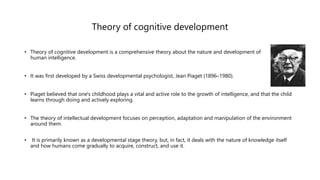
• It was first developed by a Swiss developmental psychologist, Jean Piaget (1896–1980).
• Piaget believed that one's childhood plays a vital and active role to the growth of intelligence, and that the child
learns through doing and actively exploring.
• The theory of intellectual development focuses on perception, adaptation and manipulation of the environment
around them.
• It is primarily known as a developmental stage theory, but, in fact, it deals with the nature of knowledge itself
and how humans come gradually to acquire, construct, and use it.
Theory Differs From Others In Several Ways:
• It is concerned with children, rather than all learners.
• It focuses on development, rather than learning per se, so it does not address learning of information or
specific behaviours.
• It proposes discrete stages of development, marked by qualitative differences, rather than a gradual
increase in number and complexity of behaviours, concepts, ideas, etc.
• The goal of the theory is to explain the mechanisms and processes by which the infant, and then the child,
develops into an individual who can reason and think using hypotheses.
There Are Three Basic Components To Piaget's Cognitive Theory
1.Schemas(building blocks of knowledge).
2.Adaptation processes that enable the transition from one stage to another (equilibrium, assimilation and accommodation).
3.Stages of Development:
•Sensorimotor,
•Preoperational,
•Concrete operational,
•Formal operational.
Schemas(Building blocks of knowledge).
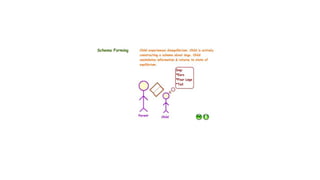
• In more simple terms Piaget called the schema the basic building block of intelligent behavior – a way of
organizing knowledge. Indeed, it is useful to think of schemas as “units” of knowledge, each relating to one
aspect of the world, including objects, actions and abstract (i.e. theoretical) concepts.
• Wadsworth (2004) suggests that schemata (the plural of schema) be though of as 'index cards' filed in the brain,
each one telling an individual how to react to incoming stimuli or information.
• When Piaget talked about the development of a person's mental processes, he was referring to increases in the
number and complexity of the schemata that a person had learned.
• When a child's existing schemas are capable of explaining what it can perceive around it, it is said to be in a state
of equilibrium, i.e. a state of cognitive (i.e. mental) balance.
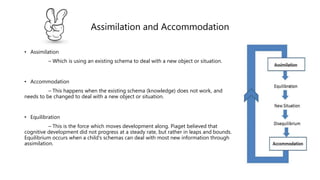
Assimilation and Accommodation
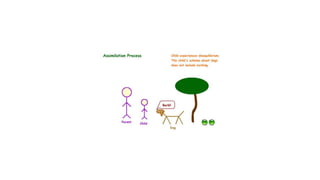
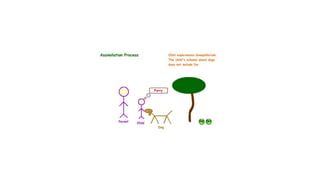
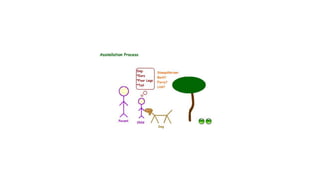
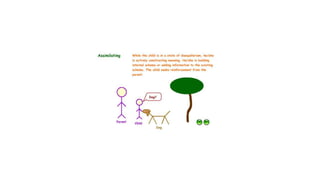
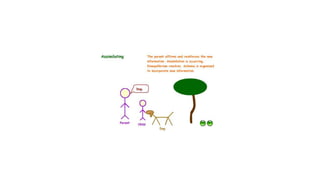
• Assimilation
– Which is using an existing schema to deal with a new object or situation.
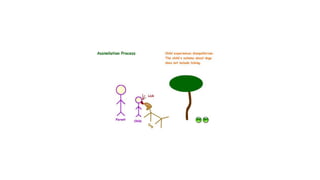
• Accommodation
– This happens when the existing schema (knowledge) does not work, and
needs to be changed to deal with a new object or situation.
• Equilibration
– This is the force which moves development along. Piaget believed that
cognitive development did not progress at a steady rate, but rather in leaps and bounds.
Equilibrium occurs when a child's schemas can deal with most new information through
assimilation.
Example
Stages of Cognitive Development
Sensorimotor Stage
The first stage of Piaget's theory lasts from birth to approximately age two and is centered on
the infant trying to make sense of the world. During the sensorimotor stage, an infant's knowledge of the world is
limited to his or her sensory perceptions and motor activities
Preoperational Stage
The preoperational stage occurs roughly between the ages two and seven. Language
development is one of the hallmarks of this period. During the preoperational stage, children also become
increasingly adept at using symbols, as evidenced by the increase in playing and pretending.
Concrete Operational Stage
The concrete operational stage begins around age seven and continues until
approximately age eleven. During this time, children gain a better understanding of mental operations. Children
begin thinking logically about concrete events, but have difficulty understanding abstract or hypothetical concepts.
Formal Operational Stage
The formal operational stage begins at approximately age twelve to and lasts into
adulthood. During this time, people develop the ability to think about abstract concepts. Skills such as logical
thought, deductive reasoning, and systematic planning also emerge during this stage.
Conclusion
• Cognitivism is a study of how learning occurs from a change in mental state. Cognitive psychologists contend
that learning cannot be described in terms of a change in behaviour.
• Learning occurs whether or not there is an observable change in the learner.
• Cognitive theorists also believe that an instructor can produce learning by transferring information to the learner
and helping them to organize it in such a way that they are able to recall it later.

Cognitive theory

  • 1.
    Cognitive Theory By MukeshPatel – Samraiz Tejani – Sheel Tikku –
  • 2.
    Definition • Psychological processesinvolved in acquisition and understanding of knowledge, formation of beliefs and attitudes, and decision making and problem solving. • They are distinct from emotional and volitional processes involved in wanting and intending. • Cognitive capacity is measured generally with intelligence quotient (IQ) tests.
  • 3.
    Cognitive psychology • Cognitivepsychology is the study of mental processes such as "attention, language use, memory, perception, problem solving, creativity, and thinking • Cognitive psychology is the branch of psychology that studies mental processes including how people think, perceive, remember, and learn. • The core focus of cognitive psychology is on how people acquire, process and store information. There are numerous practical applications for cognitive research, such as improving memory, increasing decision-making accuracy, and structuring educational curricula to enhance learning.
  • 4.
    Everyday Examples ofCognitive Psychology • Attention - Sometimes our cognitive processing systems get overloaded and we have to select information to process further. This deals with how and why performance improves with attention. • Formation of concepts - This aspect studies human’s ability to organize experiences into categories. Response to stimulus is determined by the relevant category and the knowledge associated with that particular category. • Judgment and decision - This is the study of decision making. Any behaviour, implicit or explicit, requires judgment and then a decision or choice. • Language processing - This is the study of how language is acquired, comprehended and produced. It also focuses on the psychology of reading. This includes processing words, sentences, concepts, inferences and semantic assumptions. • Learning - This is the study of new cognitive or conceptual information that is taken in and how that process occurs. It includes implicit learning that takes into account previous experience on performance.
  • 5.
    • Memory -Studying human memory is a large part of cognitive psychology. It covers the process of acquiring, storing and retrieving memory, including facts, skills and capacity. • Perception - This includes the senses and the processing of what we sense. This also includes what we sense and how it interacts with what we already know. • Problem solving - Solving problems is a way that humans achieve goals. • Achieving goals - Moving to a goal can include different kinds of reasoning, perception, memory, attention and other brain functions. • Reasoning - This is the process of formulating logical arguments. It involves making deductions and inferences and why some people value certain deductions over others. This can be affected by educated intuitive guesses, fallacies or stereotypes.
  • 6.
    Real Life Exampleof Cognitive Psychology Stand up on one leg... Now pat your head and rub your belly while singing “Mary Had a Little Lamb.” Seems pretty hard doesn't it? Your hand might want to rub your head, and you're likely to forget the lyrics to the song after a few lines. But try practicing it a few times, and it almost becomes an easy, normal feeling. Why is this?
  • 7.
    Theory of cognitivedevelopment • Theory of cognitive development is a comprehensive theory about the nature and development of human intelligence. • It was first developed by a Swiss developmental psychologist, Jean Piaget (1896–1980). • Piaget believed that one's childhood plays a vital and active role to the growth of intelligence, and that the child learns through doing and actively exploring. • The theory of intellectual development focuses on perception, adaptation and manipulation of the environment around them. • It is primarily known as a developmental stage theory, but, in fact, it deals with the nature of knowledge itself and how humans come gradually to acquire, construct, and use it.
  • 8.
    Theory Differs FromOthers In Several Ways: • It is concerned with children, rather than all learners. • It focuses on development, rather than learning per se, so it does not address learning of information or specific behaviours. • It proposes discrete stages of development, marked by qualitative differences, rather than a gradual increase in number and complexity of behaviours, concepts, ideas, etc. • The goal of the theory is to explain the mechanisms and processes by which the infant, and then the child, develops into an individual who can reason and think using hypotheses.
  • 9.
    There Are ThreeBasic Components To Piaget's Cognitive Theory 1.Schemas(building blocks of knowledge). 2.Adaptation processes that enable the transition from one stage to another (equilibrium, assimilation and accommodation). 3.Stages of Development: •Sensorimotor, •Preoperational, •Concrete operational, •Formal operational.
  • 10.
    Schemas(Building blocks ofknowledge). • In more simple terms Piaget called the schema the basic building block of intelligent behavior – a way of organizing knowledge. Indeed, it is useful to think of schemas as “units” of knowledge, each relating to one aspect of the world, including objects, actions and abstract (i.e. theoretical) concepts. • Wadsworth (2004) suggests that schemata (the plural of schema) be though of as 'index cards' filed in the brain, each one telling an individual how to react to incoming stimuli or information. • When Piaget talked about the development of a person's mental processes, he was referring to increases in the number and complexity of the schemata that a person had learned. • When a child's existing schemas are capable of explaining what it can perceive around it, it is said to be in a state of equilibrium, i.e. a state of cognitive (i.e. mental) balance.
  • 11.
    Assimilation and Accommodation •Assimilation – Which is using an existing schema to deal with a new object or situation. • Accommodation – This happens when the existing schema (knowledge) does not work, and needs to be changed to deal with a new object or situation. • Equilibration – This is the force which moves development along. Piaget believed that cognitive development did not progress at a steady rate, but rather in leaps and bounds. Equilibrium occurs when a child's schemas can deal with most new information through assimilation.
  • 12.
  • 23.
    Stages of CognitiveDevelopment Sensorimotor Stage The first stage of Piaget's theory lasts from birth to approximately age two and is centered on the infant trying to make sense of the world. During the sensorimotor stage, an infant's knowledge of the world is limited to his or her sensory perceptions and motor activities Preoperational Stage The preoperational stage occurs roughly between the ages two and seven. Language development is one of the hallmarks of this period. During the preoperational stage, children also become increasingly adept at using symbols, as evidenced by the increase in playing and pretending.
  • 24.
    Concrete Operational Stage Theconcrete operational stage begins around age seven and continues until approximately age eleven. During this time, children gain a better understanding of mental operations. Children begin thinking logically about concrete events, but have difficulty understanding abstract or hypothetical concepts. Formal Operational Stage The formal operational stage begins at approximately age twelve to and lasts into adulthood. During this time, people develop the ability to think about abstract concepts. Skills such as logical thought, deductive reasoning, and systematic planning also emerge during this stage.
  • 25.
    Conclusion • Cognitivism isa study of how learning occurs from a change in mental state. Cognitive psychologists contend that learning cannot be described in terms of a change in behaviour. • Learning occurs whether or not there is an observable change in the learner. • Cognitive theorists also believe that an instructor can produce learning by transferring information to the learner and helping them to organize it in such a way that they are able to recall it later.