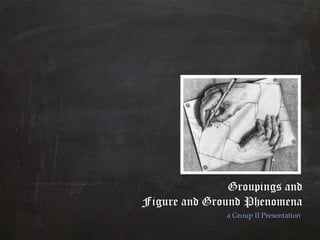
Groupings and
Figure and Ground Phenomena
              a Group II Presentation
On Grouping
• The Principles of grouping (or Gestalt laws of grouping) are a
  set of principles in psychology, first proposed by Gestalt
  psychologists to account for the observation that humans
  naturally perceive objects as organized patterns and objects.
  Gestalt psychologists argued that these principles exist
  because the mind has an innate disposition to perceive
  patterns in the stimulus based on certain rules.
On Grouping
• It is a psychological fact that things do not
  always appear as they actually are, and that
  perceptual illusions are real phenomena. The
  basic problem of the psychology of
  perception, then, is to explain why things
  appear as they do.

“Phenomena of Perception”. Nijhoff, Martinus. Philosophic foundations of genetic
   psychology and gestalt psychology. Netherlands. The Hague. 1968
On Grouping
• A gestalt (configuration) is to be described as a
  psychological structure, being constituted out of
  a set of elements and relations, and displaying a
  quality not possessed by its constituents. The old
  formula, to the effect “the whole is something
  more than the sum of its parts”, may be stated
  more as follows: The whole is something more,
  as a combinatorial proportion, than the additive
  aggregate of its elements.

“Phenomena of Perception”. Nijhoff, Martinus. Philosophic foundations of genetic
   psychology and gestalt psychology. Netherlands. The Hague. 1968
Gestalt Principles
• Continuity |This law holds that points that
  are connected by straight or curving lines are
  seen in a way that follows the smoothest
  path. Rather than seeing separate lines and
  angles, lines are seen as belonging together.
• Similarity | Suggests that things similar
  things tend to appear grouped together.
  Grouping can occur in both visual and
  auditory stimuli.
• Proximity | According to the law of
  proximity, things that are near each other
  seem to be grouped together.
• Closure | Things are grouped together if
  they seem to complete some entity. Our
  brains often ignore contradictory
  information and fill in gaps in information.
Gestalt Perception and Art
• Cubism | In cubist artworks,
  objects are broken up, analyzed,
  and re-assembled in an abstracted
  form—instead of depicting objects
  from one viewpoint, the artist
  depicts the subject from a
  multitude of viewpoints to
  represent the subject in a greater
  context. Often the surfaces
  intersect at seemingly random
  angles, removing a coherent sense
  of depth. The background and
  object planes interpenetrate one
  another to create the shallow
  ambiguous space, one of cubism's
  distinct characteristics.
Gestalt Perception and Art
• Pointillism | is a technique of
  painting in which small, distinct
  dots of pure color are applied in
  patterns to form an image.
  Georges Seurat developed the
  technique in 1886, branching
  from Impressionism. The term
  Pointillism was first coined by
  art critics in the late 1880s to
  ridicule the works of these
  artists, and is now used without
  its earlier mocking connotation.
Figure and Ground
• According to Gestalt theory, one of the most
  important principles organizing our perception
  is the figure–ground relationship. It is an
  automatic feature of the visual system in
  which the focus of attention becomes the
  figure and all other visual input becomes the
  ground. For any given image, the same visual
  stimulus can trigger multiple perspectives,
  depending on what is taken to be figure and
  what is taken to be ground.
Figure and Ground


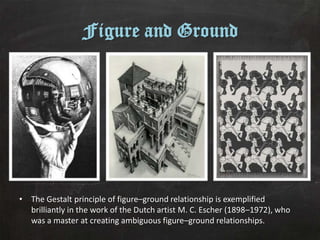
• The Gestalt principle of figure–ground relationship is exemplified
  brilliantly in the work of the Dutch artist M. C. Escher (1898–1972), who
  was a master at creating ambiguous figure–ground relationships.
The ‘Figure-Ground’ Hypothesis
• The first step of the perceptual process is
  characterized by a vague impression of
  ‘something there’, which passed on to the
  stage of the generic object when there is a
  general impression that the visual stimulus is
  connected with some kind of object existing in
  the field.

“The ‘Figure-Ground’ Hypothesis”. Vernon, Magdalen Dorothea, M.A., Sc.D. A further study of visual
   perception. Second Edition. New York. The Syndics of the Cambridge University Press. 1954
The ‘Figure-Ground’ Hypothesis
• It is thus apparent that, at these stages, there
  is a differentiation of one part of the field
  from the rest, and that the one part which
  becomes the main percept is discriminated
  from what remains in the background.

“The ‘Figure-Ground’ Hypothesis”. Vernon, Magdalen Dorothea, M.A., Sc.D. A further
   study of visual perception. Second Edition. New York. The Syndics of the Cambridge
   University Press. 1954
Figure VS Ground
Figure
• Has form
• Appears solid
• Highly structured
• Has surface color
• Color is localized on its surface and is resistant to
   penetration

“The ‘Figure-Ground’ Hypothesis”. Vernon, Magdalen Dorothea, M.A., Sc.D. A further
   study of visual perception. Second Edition. New York. The Syndics of the Cambridge
   University Press. 1954
Figure VS Ground
Ground
• Has no form
• Is in the nature of ‘substance’
• Color is ‘filmy’ or soft and yielding
• Color is ill-defined and not definitely localized


“The ‘Figure-Ground’ Hypothesis”. Vernon, Magdalen Dorothea, M.A., Sc.D. A further
   study of visual perception. Second Edition. New York. The Syndics of the Cambridge
   University Press. 1954
Figure VS Ground
• In general, the FIGURE has ‘thing character’, is more
  insistent and usually central in awareness, and is more
  likely to have connected with it various meanings,
  feelings, and aesthetic values; it is thus named sooner
  and remembered better. Thus we see that the FIGURE is
  the important and striking part of the field, and the
  GROUND is the background provided by the remainder of
  the field.


“The ‘Figure-Ground’ Hypothesis”. Vernon, Magdalen Dorothea, M.A., Sc.D. A
   further study of visual perception. Second Edition. New York. The Syndics of
   the Cambridge University Press. 1954
Figure VS Ground
     E.G. Wever (1927) has studied the process of the arising ‘figure’ from the ‘ground’.
     He describes a series of stages which occur in the gradual emergence of the
     ‘figure’ from the ‘ground’ as perception takes place:

1.    Heterogeneity between the ‘figure’ and the ‘ground’, each of which forms a unit;
2.    A minimum brightness difference between the two which gradually increases—
      this stage is simultaneous with (1);
3.    A region of separation which appears when (2) has reached a certain magnitude,
      and eventually narrows down to become the contour;
4.    Shape, however, appears before the contour is definite;


“The ‘Figure-Ground’ Hypothesis”. Vernon, Magdalen Dorothea, M.A., Sc.D. A further
   study of visual perception. Second Edition. New York. The Syndics of the Cambridge
   University Press. 1954
Figure VS Ground
     According to Wever, for good ‘figure-ground’ experience,
     certain further stages may occur:

5.    Protrusion of the ‘figure’ out and away from the ‘ground’;
6.    Definite depth localization of the ‘figure’;
7.    Surface texture of the ‘figure’, filmy texture of the ‘ground’;
8.    Halo around the ‘figure’—a simultaneous contrast effect.


“The ‘Figure-Ground’ Hypothesis”. Vernon, Magdalen Dorothea, M.A., Sc.D. A further
  study of visual perception. Second Edition. New York. The Syndics of the Cambridge
  University Press. 1954
Patterns | Figure and Ground Phenomenon

• Ambiguous Figures | A
  picture of a subject which
  the viewer may see as
  either of two different
  subjects or as the same
  subject from either of two
  different viewpoints
  depending on his
  interpretation of the total
  configuration.
Patterns | Figure and Ground Phenomenon

• Alternating Figures |
  Ambiguous images
  which serve in the
  psychology of
  perception to
  demonstrate the way
  the mind habitually
  tries to achieve a
  coherent Gestalt.
  These are often seen
  as optical illusions.
Patterns | Figure and Ground Phenomenon

• Alternating Figure and
  Ground |Patterns that
  are achieved when the
  parameters that
  distinguish figure from
  ground are of almost
  equal prominence which
  in effect produces a
  duality of perception for
  both figure and ground.
Patterns | Figure and Ground Phenomenon


• Embedded Figures | Figures that are at first obscure because of
  very little dissonance between figure and ground.
Patterns | Figure and Ground Phenomenon


• Impossible Figures | A type of optical illusion consisting of a two-
  dimensional figure which is instantly and subconsciously interpreted by
  the visual system as representing a projection of a three-dimensional
  object although it is not actually possible for such an object to exist (at
  least not in the form interpreted by the visual system).
Patterns | Figure and Ground Phenomenon

•   Moiré patterns | Often an undesired
    artifact of images produced by
    various digital imaging and computer
    graphics techniques, for example
    when scanning a halftone picture or
    ray tracing a checkered plane. Moiré
    patterns revealing complex shapes,
    or sequences of symbols embedded
    in one of the layers (in form of
    periodically repeated compressed
    shapes) are created with shape
    moiré, otherwise called band moiré
    patterns. One of the most important
    properties of shape moiré is its ability
    to magnify tiny shapes along either
    one or both axes, that is, stretching.
Practical Application of
       Figure and Ground Phenomenon


Rorschach Inkblot Test
   A psychological test in which subjects' perceptions of inkblots are recorded and
   then analyzed using psychological interpretation, complex algorithms, or both.
   Some psychologists use this test to examine a person's personality characteristics
   and emotional functioning.
Practical Application of
      Figure and Ground Phenomenon


Color Vision Testing
   The Ishihara color test, which consists of a series of pictures of colored spots, is the
   test most often used to diagnose red–green color deficiencies. A figure is
   embedded in the picture as a number of spots in a slightly different color, and can
   be seen with normal color vision, but not with a particular color defect. The full set
   of tests has a variety of figure/background color combinations, and enable
   diagnosis of which particular visual defect is present.
Practical Application of
      Figure and Ground Phenomenon


Subliminal Messaging
     Subliminal messaging makes use of embedded images that are usually too subtle to be notices right away.
                          Check out the palm trees on the far right of the image... notice anything odd about the palm leaves?

Groups and Figure and Ground Phenomena

  • 1.
    Groupings and Figure andGround Phenomena a Group II Presentation
  • 2.
    On Grouping • ThePrinciples of grouping (or Gestalt laws of grouping) are a set of principles in psychology, first proposed by Gestalt psychologists to account for the observation that humans naturally perceive objects as organized patterns and objects. Gestalt psychologists argued that these principles exist because the mind has an innate disposition to perceive patterns in the stimulus based on certain rules.
  • 3.
    On Grouping • Itis a psychological fact that things do not always appear as they actually are, and that perceptual illusions are real phenomena. The basic problem of the psychology of perception, then, is to explain why things appear as they do. “Phenomena of Perception”. Nijhoff, Martinus. Philosophic foundations of genetic psychology and gestalt psychology. Netherlands. The Hague. 1968
  • 4.
    On Grouping • Agestalt (configuration) is to be described as a psychological structure, being constituted out of a set of elements and relations, and displaying a quality not possessed by its constituents. The old formula, to the effect “the whole is something more than the sum of its parts”, may be stated more as follows: The whole is something more, as a combinatorial proportion, than the additive aggregate of its elements. “Phenomena of Perception”. Nijhoff, Martinus. Philosophic foundations of genetic psychology and gestalt psychology. Netherlands. The Hague. 1968
  • 5.
    Gestalt Principles • Continuity|This law holds that points that are connected by straight or curving lines are seen in a way that follows the smoothest path. Rather than seeing separate lines and angles, lines are seen as belonging together. • Similarity | Suggests that things similar things tend to appear grouped together. Grouping can occur in both visual and auditory stimuli. • Proximity | According to the law of proximity, things that are near each other seem to be grouped together. • Closure | Things are grouped together if they seem to complete some entity. Our brains often ignore contradictory information and fill in gaps in information.
  • 6.
    Gestalt Perception andArt • Cubism | In cubist artworks, objects are broken up, analyzed, and re-assembled in an abstracted form—instead of depicting objects from one viewpoint, the artist depicts the subject from a multitude of viewpoints to represent the subject in a greater context. Often the surfaces intersect at seemingly random angles, removing a coherent sense of depth. The background and object planes interpenetrate one another to create the shallow ambiguous space, one of cubism's distinct characteristics.
  • 7.
    Gestalt Perception andArt • Pointillism | is a technique of painting in which small, distinct dots of pure color are applied in patterns to form an image. Georges Seurat developed the technique in 1886, branching from Impressionism. The term Pointillism was first coined by art critics in the late 1880s to ridicule the works of these artists, and is now used without its earlier mocking connotation.
  • 8.
    Figure and Ground •According to Gestalt theory, one of the most important principles organizing our perception is the figure–ground relationship. It is an automatic feature of the visual system in which the focus of attention becomes the figure and all other visual input becomes the ground. For any given image, the same visual stimulus can trigger multiple perspectives, depending on what is taken to be figure and what is taken to be ground.
  • 9.
    Figure and Ground •The Gestalt principle of figure–ground relationship is exemplified brilliantly in the work of the Dutch artist M. C. Escher (1898–1972), who was a master at creating ambiguous figure–ground relationships.
  • 10.
    The ‘Figure-Ground’ Hypothesis •The first step of the perceptual process is characterized by a vague impression of ‘something there’, which passed on to the stage of the generic object when there is a general impression that the visual stimulus is connected with some kind of object existing in the field. “The ‘Figure-Ground’ Hypothesis”. Vernon, Magdalen Dorothea, M.A., Sc.D. A further study of visual perception. Second Edition. New York. The Syndics of the Cambridge University Press. 1954
  • 11.
    The ‘Figure-Ground’ Hypothesis •It is thus apparent that, at these stages, there is a differentiation of one part of the field from the rest, and that the one part which becomes the main percept is discriminated from what remains in the background. “The ‘Figure-Ground’ Hypothesis”. Vernon, Magdalen Dorothea, M.A., Sc.D. A further study of visual perception. Second Edition. New York. The Syndics of the Cambridge University Press. 1954
  • 12.
    Figure VS Ground Figure •Has form • Appears solid • Highly structured • Has surface color • Color is localized on its surface and is resistant to penetration “The ‘Figure-Ground’ Hypothesis”. Vernon, Magdalen Dorothea, M.A., Sc.D. A further study of visual perception. Second Edition. New York. The Syndics of the Cambridge University Press. 1954
  • 13.
    Figure VS Ground Ground •Has no form • Is in the nature of ‘substance’ • Color is ‘filmy’ or soft and yielding • Color is ill-defined and not definitely localized “The ‘Figure-Ground’ Hypothesis”. Vernon, Magdalen Dorothea, M.A., Sc.D. A further study of visual perception. Second Edition. New York. The Syndics of the Cambridge University Press. 1954
  • 14.
    Figure VS Ground •In general, the FIGURE has ‘thing character’, is more insistent and usually central in awareness, and is more likely to have connected with it various meanings, feelings, and aesthetic values; it is thus named sooner and remembered better. Thus we see that the FIGURE is the important and striking part of the field, and the GROUND is the background provided by the remainder of the field. “The ‘Figure-Ground’ Hypothesis”. Vernon, Magdalen Dorothea, M.A., Sc.D. A further study of visual perception. Second Edition. New York. The Syndics of the Cambridge University Press. 1954
  • 15.
    Figure VS Ground E.G. Wever (1927) has studied the process of the arising ‘figure’ from the ‘ground’. He describes a series of stages which occur in the gradual emergence of the ‘figure’ from the ‘ground’ as perception takes place: 1. Heterogeneity between the ‘figure’ and the ‘ground’, each of which forms a unit; 2. A minimum brightness difference between the two which gradually increases— this stage is simultaneous with (1); 3. A region of separation which appears when (2) has reached a certain magnitude, and eventually narrows down to become the contour; 4. Shape, however, appears before the contour is definite; “The ‘Figure-Ground’ Hypothesis”. Vernon, Magdalen Dorothea, M.A., Sc.D. A further study of visual perception. Second Edition. New York. The Syndics of the Cambridge University Press. 1954
  • 16.
    Figure VS Ground According to Wever, for good ‘figure-ground’ experience, certain further stages may occur: 5. Protrusion of the ‘figure’ out and away from the ‘ground’; 6. Definite depth localization of the ‘figure’; 7. Surface texture of the ‘figure’, filmy texture of the ‘ground’; 8. Halo around the ‘figure’—a simultaneous contrast effect. “The ‘Figure-Ground’ Hypothesis”. Vernon, Magdalen Dorothea, M.A., Sc.D. A further study of visual perception. Second Edition. New York. The Syndics of the Cambridge University Press. 1954
  • 17.
    Patterns | Figureand Ground Phenomenon • Ambiguous Figures | A picture of a subject which the viewer may see as either of two different subjects or as the same subject from either of two different viewpoints depending on his interpretation of the total configuration.
  • 18.
    Patterns | Figureand Ground Phenomenon • Alternating Figures | Ambiguous images which serve in the psychology of perception to demonstrate the way the mind habitually tries to achieve a coherent Gestalt. These are often seen as optical illusions.
  • 19.
    Patterns | Figureand Ground Phenomenon • Alternating Figure and Ground |Patterns that are achieved when the parameters that distinguish figure from ground are of almost equal prominence which in effect produces a duality of perception for both figure and ground.
  • 20.
    Patterns | Figureand Ground Phenomenon • Embedded Figures | Figures that are at first obscure because of very little dissonance between figure and ground.
  • 21.
    Patterns | Figureand Ground Phenomenon • Impossible Figures | A type of optical illusion consisting of a two- dimensional figure which is instantly and subconsciously interpreted by the visual system as representing a projection of a three-dimensional object although it is not actually possible for such an object to exist (at least not in the form interpreted by the visual system).
  • 22.
    Patterns | Figureand Ground Phenomenon • Moiré patterns | Often an undesired artifact of images produced by various digital imaging and computer graphics techniques, for example when scanning a halftone picture or ray tracing a checkered plane. Moiré patterns revealing complex shapes, or sequences of symbols embedded in one of the layers (in form of periodically repeated compressed shapes) are created with shape moiré, otherwise called band moiré patterns. One of the most important properties of shape moiré is its ability to magnify tiny shapes along either one or both axes, that is, stretching.
  • 23.
    Practical Application of Figure and Ground Phenomenon Rorschach Inkblot Test A psychological test in which subjects' perceptions of inkblots are recorded and then analyzed using psychological interpretation, complex algorithms, or both. Some psychologists use this test to examine a person's personality characteristics and emotional functioning.
  • 24.
    Practical Application of Figure and Ground Phenomenon Color Vision Testing The Ishihara color test, which consists of a series of pictures of colored spots, is the test most often used to diagnose red–green color deficiencies. A figure is embedded in the picture as a number of spots in a slightly different color, and can be seen with normal color vision, but not with a particular color defect. The full set of tests has a variety of figure/background color combinations, and enable diagnosis of which particular visual defect is present.
  • 25.
    Practical Application of Figure and Ground Phenomenon Subliminal Messaging Subliminal messaging makes use of embedded images that are usually too subtle to be notices right away. Check out the palm trees on the far right of the image... notice anything odd about the palm leaves?