NATURE OF COGNITIVE
PSYCHOLOGY
& CURRENT TRENDS
•RICHA DHINGRA
WHAT IS COGNITIVE PSYCHOLOGY ?
•According to Neisser(1967),Cognitive Psychology
is the branch of psychology concerned with how
people acquire, store, transform, use and
communicate information.
•Cognitive Psychology deals with our mental life;
what goes inside our heads when we perceive,
attend ,remember, think, categorize, reason, decide,
and so forth.
.
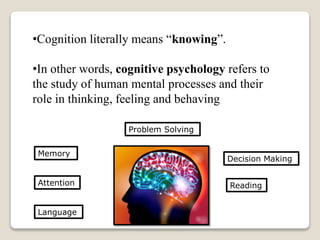
•Cognition literally means “knowing”.
•In other words, cognitive psychology refers to
the study of human mental processes and their
role in thinking, feeling and behaving
Problem Solving
Memory
Attention
Language
Decision Making
Reading
•Cognitive processes can be studied how physical
energy is converted in neural energy.
•Some of these processes are:
Attention
Perception
Memory
Probem Solving
Reasoning
Concept Formation
Decision Making
and so on.
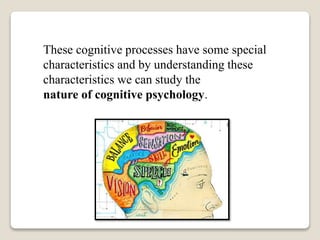
These cognitive processes have some special
characteristics and by understanding these
characteristics we can study the
nature of cognitive psychology.
NATURE OF COGNITIVE PSYCHOLOGY
•These cognitive processes are all interrelated
with one another rather than existing in isolation.
•These cognitive processes are active rather than
passive.
•These cognitive processes are efficient and
accurate.
•These cognitive processes handles positive
information better than negative.
•These cognitive processes are generally not
directly observable.
CURRENT TRENDS IN COGNITIVE
PSYCHOLOGY
Brain Scanning Technology is continuing to
improve, with more powerful fMRI machines and
other technologies such as TMS and near-infrared
spectroscopy proving new experimental findings
how brains produce thoughts.
Increasing prominence of statistical models based
on Bayesian Probability theory. These models have
been applied to many phenomena and also had
impressive applications in robotics.
Artificial Intelligence which is exhibited by
machines and associating cognitive functions such as
learning or problem solving as humans do.
Example: Virtual Reality Settings.
Neuroscience which is an interdisciplinary that
works closely with maths, linguistic, engineering,
computer sciences, psychology, chemistry, etc. It
contributes to understand wide range of conditions
like tumors, etc.
REFERENCES
•Neisser, U. (1967). Cognitive Psychology.
Meredith Publishing Company.
•Sternberg, R. (2003). Cognitive Psychology.
Belmont, CA: Wadsworth.
• "American Psychological Association (2013).
Glossary of psychological terms". Apa.org.
Retrieved 2014-08-13.
What is Cognitive Psychology?

What is Cognitive Psychology?

  • 1.
    NATURE OF COGNITIVE PSYCHOLOGY &CURRENT TRENDS •RICHA DHINGRA
  • 2.
    WHAT IS COGNITIVEPSYCHOLOGY ? •According to Neisser(1967),Cognitive Psychology is the branch of psychology concerned with how people acquire, store, transform, use and communicate information. •Cognitive Psychology deals with our mental life; what goes inside our heads when we perceive, attend ,remember, think, categorize, reason, decide, and so forth. .
  • 3.
    •Cognition literally means“knowing”. •In other words, cognitive psychology refers to the study of human mental processes and their role in thinking, feeling and behaving Problem Solving Memory Attention Language Decision Making Reading
  • 4.
    •Cognitive processes canbe studied how physical energy is converted in neural energy. •Some of these processes are: Attention Perception Memory Probem Solving Reasoning Concept Formation Decision Making and so on.
  • 5.
    These cognitive processeshave some special characteristics and by understanding these characteristics we can study the nature of cognitive psychology.
  • 6.
    NATURE OF COGNITIVEPSYCHOLOGY •These cognitive processes are all interrelated with one another rather than existing in isolation. •These cognitive processes are active rather than passive. •These cognitive processes are efficient and accurate. •These cognitive processes handles positive information better than negative. •These cognitive processes are generally not directly observable.
  • 7.
    CURRENT TRENDS INCOGNITIVE PSYCHOLOGY Brain Scanning Technology is continuing to improve, with more powerful fMRI machines and other technologies such as TMS and near-infrared spectroscopy proving new experimental findings how brains produce thoughts. Increasing prominence of statistical models based on Bayesian Probability theory. These models have been applied to many phenomena and also had impressive applications in robotics.
  • 8.
    Artificial Intelligence whichis exhibited by machines and associating cognitive functions such as learning or problem solving as humans do. Example: Virtual Reality Settings. Neuroscience which is an interdisciplinary that works closely with maths, linguistic, engineering, computer sciences, psychology, chemistry, etc. It contributes to understand wide range of conditions like tumors, etc.
  • 9.
    REFERENCES •Neisser, U. (1967).Cognitive Psychology. Meredith Publishing Company. •Sternberg, R. (2003). Cognitive Psychology. Belmont, CA: Wadsworth. • "American Psychological Association (2013). Glossary of psychological terms". Apa.org. Retrieved 2014-08-13.