Gestalt Principles
(Gestalt Laws)
Visual Perception
Gestalt Principles of Visual Perception
 Gestalt – Movement in experimental psychology
which began prior to WWI.
 We perceive objects as well-organized patterns
rather than separate components.
 “The whole is greater than the sum of it’s parts.”
 Based on the concept of “grouping”.
Gestalt Principles of Visual Perception
We impose visual organization on stimuli
W.E. Hill, 1915 German postcard, 1880
Gestalt Principles of Visual Perception
Illusory
Contours
The Kanisza triangle as figure-ground illusory contours
Gestalt Principles of Visual Perception
Three Main Principles:
Grouping (proximity, similarity,
continuity, closure)
Goodness of figures
Figure/ground relationships
Law of Equilibrium
 Items in a visual field strive for
balance with other items in the field
Gestalt Principles of Visual Perception
Grouping:
Law of Proximity
Law of Similarity
 Suggests that units which resemble each
other in shape, size, color, or direction will
be seen together as a homogenous
grouping (of the same kind)
Gestalt Principles of Visual Perception
Grouping:
Law of Similarity
Gestalt/Visual Perception
 A look closer at Gestalt Laws
Gestalt Principles of Visual Perception
Grouping: Law of Similarity: Shape, Scale, Color
Law of Continuation
 (or good figure) visual perception works to
pull figures out of the background to give
them definition against the undistinguished
field in which they are located. . .
Gestalt Principles of Visual Perception
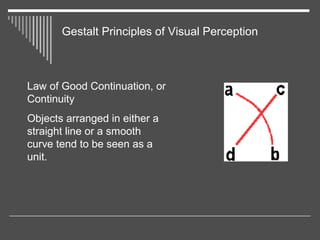
Law of Good Continuation, or
Continuity
Objects arranged in either a
straight line or a smooth
curve tend to be seen as a
unit.
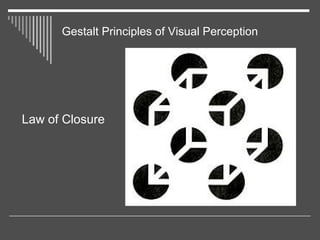
Law of Closure
 Each chunk should be self-contained
(provide closure)—without good
continuation a reader will fill in the gaps
Gestalt Principles of Visual Perception
Law of Closure
Gestalt Principles of Visual Perception
Law of Common Fate
Gestalt Principles of Visual Perception
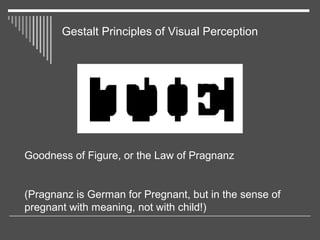
Goodness of Figure, or the Law of Pragnanz
(Pragnanz is German for Pregnant, but in the sense of
pregnant with meaning, not with child!)
Gestalt Principles of Visual Perception
Figure/Ground relationships
Figure – seen as the foreground
Ground – seen as the background
Contours – “belong” to the figure
Gestalt Principles of Visual Perception
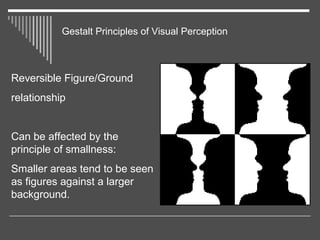
Reversible Figure/Ground
relationship
Gestalt Principles of Visual Perception
Reversible Figure/Ground
relationship
Can be affected by the
principle of smallness:
Smaller areas tend to be seen
as figures against a larger
background.
Gestalt Principles of Visual Perception
Reversible Figure/Ground
Relationship:
Tessellation – interlocking
figure/ground
M.C. Escher
Gestalt Principles of Visual Perception
 Gestalt laws of Grouping organize the
visual scene into units
 The Law of Pragnanz, or Goodness of
Figure creates the simplest most meaningful
pattern
 Figure/Ground relationships define
important parts of the scene
Gestalt Principles of Visual Perception
Problems with Gestalt theory:
It is a phenomenological approach
Some of the terms are vague
(e.g. what is the “simplest” organization?)

Gestalt Laws

  • 1.
  • 2.
    Gestalt Principles ofVisual Perception  Gestalt – Movement in experimental psychology which began prior to WWI.  We perceive objects as well-organized patterns rather than separate components.  “The whole is greater than the sum of it’s parts.”  Based on the concept of “grouping”.
  • 3.
    Gestalt Principles ofVisual Perception We impose visual organization on stimuli W.E. Hill, 1915 German postcard, 1880
  • 4.
    Gestalt Principles ofVisual Perception Illusory Contours The Kanisza triangle as figure-ground illusory contours
  • 5.
    Gestalt Principles ofVisual Perception Three Main Principles: Grouping (proximity, similarity, continuity, closure) Goodness of figures Figure/ground relationships
  • 6.
    Law of Equilibrium Items in a visual field strive for balance with other items in the field Gestalt Principles of Visual Perception
  • 7.
    Gestalt Principles ofVisual Perception Grouping: Law of Proximity
  • 8.
    Law of Similarity Suggests that units which resemble each other in shape, size, color, or direction will be seen together as a homogenous grouping (of the same kind) Gestalt Principles of Visual Perception
  • 9.
    Gestalt Principles ofVisual Perception Grouping: Law of Similarity
  • 10.
    Gestalt/Visual Perception  Alook closer at Gestalt Laws
  • 11.
    Gestalt Principles ofVisual Perception Grouping: Law of Similarity: Shape, Scale, Color
  • 12.
    Law of Continuation (or good figure) visual perception works to pull figures out of the background to give them definition against the undistinguished field in which they are located. . . Gestalt Principles of Visual Perception
  • 13.
    Gestalt Principles ofVisual Perception Law of Good Continuation, or Continuity Objects arranged in either a straight line or a smooth curve tend to be seen as a unit.
  • 14.
    Law of Closure Each chunk should be self-contained (provide closure)—without good continuation a reader will fill in the gaps Gestalt Principles of Visual Perception
  • 15.
    Gestalt Principles ofVisual Perception Law of Closure
  • 16.
    Gestalt Principles ofVisual Perception Law of Common Fate
  • 17.
    Gestalt Principles ofVisual Perception Goodness of Figure, or the Law of Pragnanz (Pragnanz is German for Pregnant, but in the sense of pregnant with meaning, not with child!)
  • 18.
    Gestalt Principles ofVisual Perception Figure/Ground relationships Figure – seen as the foreground Ground – seen as the background Contours – “belong” to the figure
  • 19.
    Gestalt Principles ofVisual Perception Reversible Figure/Ground relationship
  • 20.
    Gestalt Principles ofVisual Perception Reversible Figure/Ground relationship Can be affected by the principle of smallness: Smaller areas tend to be seen as figures against a larger background.
  • 21.
    Gestalt Principles ofVisual Perception Reversible Figure/Ground Relationship: Tessellation – interlocking figure/ground M.C. Escher
  • 22.
    Gestalt Principles ofVisual Perception  Gestalt laws of Grouping organize the visual scene into units  The Law of Pragnanz, or Goodness of Figure creates the simplest most meaningful pattern  Figure/Ground relationships define important parts of the scene
  • 23.
    Gestalt Principles ofVisual Perception Problems with Gestalt theory: It is a phenomenological approach Some of the terms are vague (e.g. what is the “simplest” organization?)