FERTILIZATION
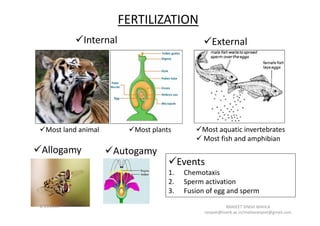
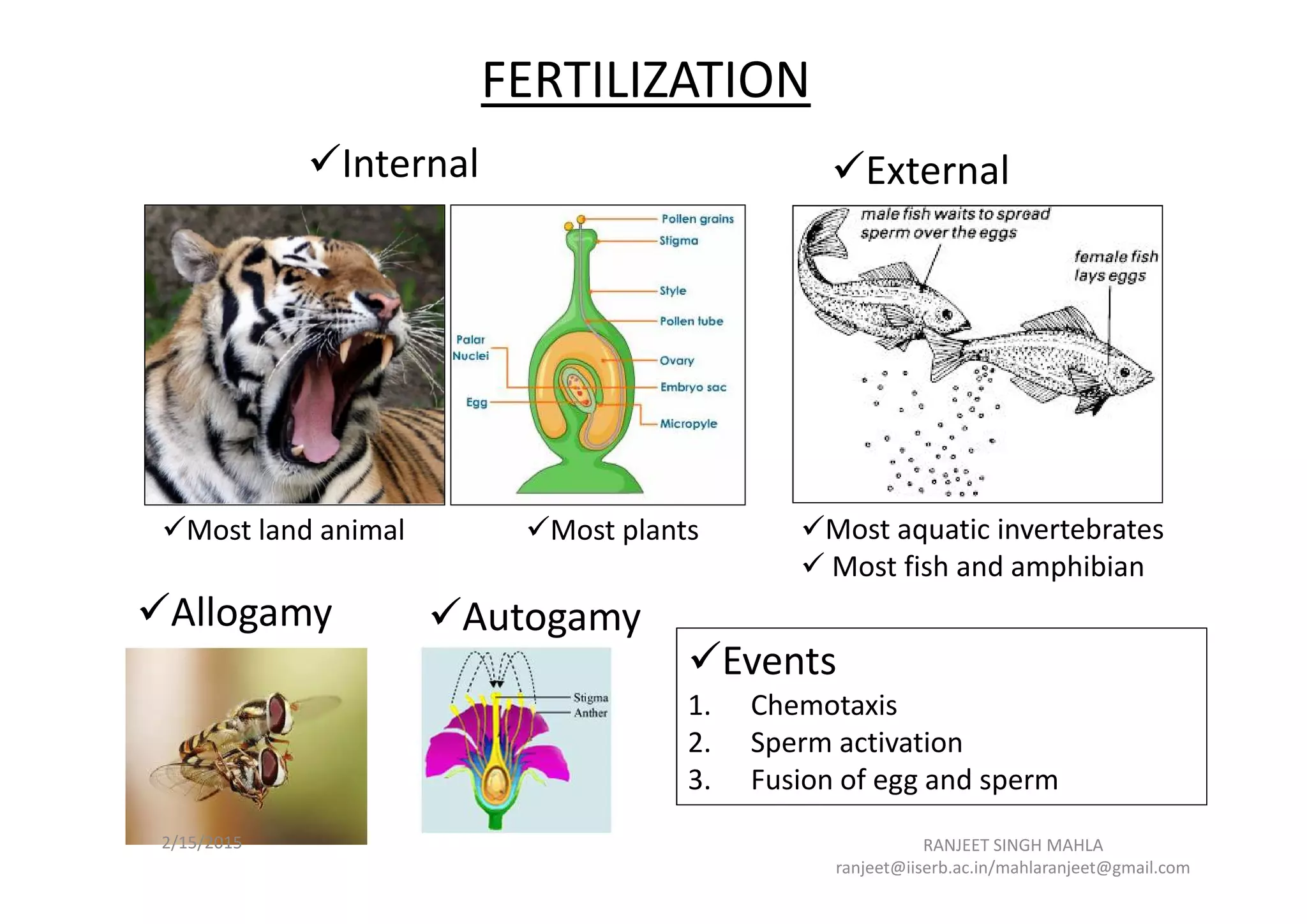
Internal External
Most aquatic invertebrates
 Most fish and amphibian
Most land animal Most plants
Allogamy Autogamy
Events
1. Chemotaxis
2. Sperm activation
3. Fusion of egg and sperm
2/17/2015 RANJEET SINGH MAHLA
ranjeet@iiserb.ac.in/mahlaranjeet@gmail.com
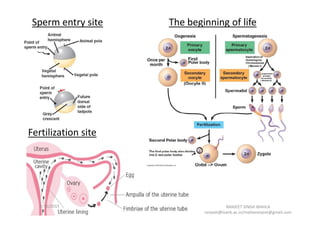
Sperm entry site The beginning of life
Fertilization site
2/17/2015 RANJEET SINGH MAHLA
ranjeet@iiserb.ac.in/mahlaranjeet@gmail.com
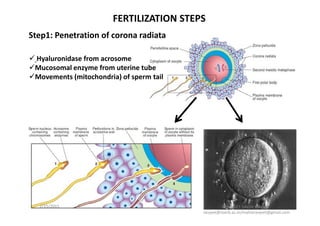
FERTILIZATION STEPS
 Hyaluronidase from acrosome
Mucosomal enzyme from uterine tube
Movements (mitochondria) of sperm tail
Step1: Penetration of corona radiata
The protective walls of oocyte
2/17/2015
RANJEET SINGH MAHLA
ranjeet@iiserb.ac.in/mahlaranjeet@gmail.com
The Mahabharata Chakravyuh
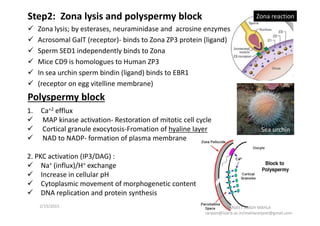
Step2: Zona lysis and polyspermy block
 Zona lysis; by esterases, neuraminidase and acrosine enzymes.
 Acrosomal GalT (receptor)- binds to Zona ZP3 protein (ligand)
 Sperm SED1 independently binds to Zona
 Mice CD9 is homologues to Human ZP3
 In sea urchin sperm bindin (ligand) binds to EBR1
 (receptor on egg vitelline membrane)
1. Ca+2 efflux
 MAP kinase activation- Restoration of mitotic cell cycle
 Cortical granule exocytosis-Fromation of hyaline layer
 NAD to NADP- formation of plasma membrane
2. PKC activation (IP3/DAG) :
 Na+ (influx)/H+ exchange
 Increase in cellular pH
 Cytoplasmic movement of morphogenetic content
 DNA replication and protein synthesis
Polyspermy block
Zona reaction
1. Ca+2 efflux
 MAP kinase activation- Restoration of mitotic cell cycle
 Cortical granule exocytosis-Fromation of hyaline layer
 NAD to NADP- formation of plasma membrane
2. PKC activation (IP3/DAG) :
 Na+ (influx)/H+ exchange
 Increase in cellular pH
 Cytoplasmic movement of morphogenetic content
 DNA replication and protein synthesis
2/17/2015 RANJEET SINGH MAHLA
ranjeet@iiserb.ac.in/mahlaranjeet@gmail.com
Sea urchin
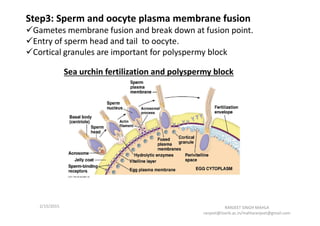
Step3: Sperm and oocyte plasma membrane fusion
Gametes membrane fusion and break down at fusion point.
Entry of sperm head and tail to oocyte.
Cortical granules are important for polyspermy block
Sperm is not selfish like bacteriophage
2/17/2015 RANJEET SINGH MAHLA
ranjeet@iiserb.ac.in/mahlaranjeet@gmail.com
Fertilization in sea urchin T4 phage entry
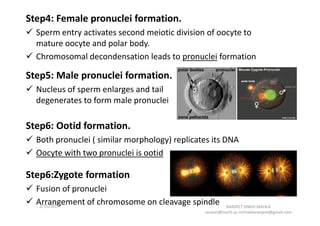
Step5: Male pronuclei formation.
 Nucleus of sperm enlarges and tail
degenerates to form male pronuclei
Step4: Female pronuclei formation.
 Sperm entry activates second meiotic division of oocyte to
mature oocyte and polar body.
 Chromosomal decondensation leads to pronuclei formation
Step6: Ootid formation.
 Both pronuclei ( similar morphology) replicates its DNA
 Oocyte with two pronuclei is ootid
Step6:Zygote formation
 Fusion of pronuclei
 Arrangement of chromosome on cleavage spindle2/17/2015 RANJEET SINGH MAHLA
ranjeet@iiserb.ac.in/mahlaranjeet@gmail.com
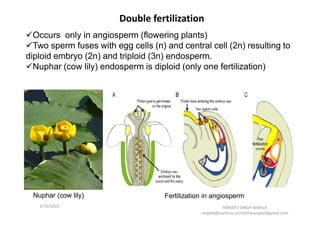
Double fertilization
Occurs only in angiosperm (flowering plants)
Two sperm fuses with egg cells (n) and central cell (2n) resulting to
diploid embryo (2n) and triploid (3n) endosperm.
Nuphar (cow lily) endosperm is diploid (only one fertilization)
2/17/2015 RANJEET SINGH MAHLA
ranjeet@iiserb.ac.in/mahlaranjeet@gmail.com
Nuphar (cow lily) Fertilization in angiosperm

Fertilization

  • 1.
    FERTILIZATION Internal External Most aquaticinvertebrates  Most fish and amphibian Most land animal Most plants Allogamy Autogamy Events 1. Chemotaxis 2. Sperm activation 3. Fusion of egg and sperm 2/17/2015 RANJEET SINGH MAHLA ranjeet@iiserb.ac.in/mahlaranjeet@gmail.com
  • 2.
    Sperm entry siteThe beginning of life Fertilization site 2/17/2015 RANJEET SINGH MAHLA ranjeet@iiserb.ac.in/mahlaranjeet@gmail.com
  • 3.
    FERTILIZATION STEPS  Hyaluronidasefrom acrosome Mucosomal enzyme from uterine tube Movements (mitochondria) of sperm tail Step1: Penetration of corona radiata The protective walls of oocyte 2/17/2015 RANJEET SINGH MAHLA ranjeet@iiserb.ac.in/mahlaranjeet@gmail.com The Mahabharata Chakravyuh
  • 4.
    Step2: Zona lysisand polyspermy block  Zona lysis; by esterases, neuraminidase and acrosine enzymes.  Acrosomal GalT (receptor)- binds to Zona ZP3 protein (ligand)  Sperm SED1 independently binds to Zona  Mice CD9 is homologues to Human ZP3  In sea urchin sperm bindin (ligand) binds to EBR1  (receptor on egg vitelline membrane) 1. Ca+2 efflux  MAP kinase activation- Restoration of mitotic cell cycle  Cortical granule exocytosis-Fromation of hyaline layer  NAD to NADP- formation of plasma membrane 2. PKC activation (IP3/DAG) :  Na+ (influx)/H+ exchange  Increase in cellular pH  Cytoplasmic movement of morphogenetic content  DNA replication and protein synthesis Polyspermy block Zona reaction 1. Ca+2 efflux  MAP kinase activation- Restoration of mitotic cell cycle  Cortical granule exocytosis-Fromation of hyaline layer  NAD to NADP- formation of plasma membrane 2. PKC activation (IP3/DAG) :  Na+ (influx)/H+ exchange  Increase in cellular pH  Cytoplasmic movement of morphogenetic content  DNA replication and protein synthesis 2/17/2015 RANJEET SINGH MAHLA ranjeet@iiserb.ac.in/mahlaranjeet@gmail.com Sea urchin
  • 5.
    Step3: Sperm andoocyte plasma membrane fusion Gametes membrane fusion and break down at fusion point. Entry of sperm head and tail to oocyte. Cortical granules are important for polyspermy block Sperm is not selfish like bacteriophage 2/17/2015 RANJEET SINGH MAHLA ranjeet@iiserb.ac.in/mahlaranjeet@gmail.com Fertilization in sea urchin T4 phage entry
  • 6.
    Step5: Male pronucleiformation.  Nucleus of sperm enlarges and tail degenerates to form male pronuclei Step4: Female pronuclei formation.  Sperm entry activates second meiotic division of oocyte to mature oocyte and polar body.  Chromosomal decondensation leads to pronuclei formation Step6: Ootid formation.  Both pronuclei ( similar morphology) replicates its DNA  Oocyte with two pronuclei is ootid Step6:Zygote formation  Fusion of pronuclei  Arrangement of chromosome on cleavage spindle2/17/2015 RANJEET SINGH MAHLA ranjeet@iiserb.ac.in/mahlaranjeet@gmail.com
  • 7.
    Double fertilization Occurs onlyin angiosperm (flowering plants) Two sperm fuses with egg cells (n) and central cell (2n) resulting to diploid embryo (2n) and triploid (3n) endosperm. Nuphar (cow lily) endosperm is diploid (only one fertilization) 2/17/2015 RANJEET SINGH MAHLA ranjeet@iiserb.ac.in/mahlaranjeet@gmail.com Nuphar (cow lily) Fertilization in angiosperm