New GPIO interface for linux user space
Kernel Recipes 2018
Bartosz Golaszewski
About us
● Baylibre
○ Embedded Linux Engineering Firm
○ ~40 senior engineers, coming from the semiconductor world
○ HW and SW products: from concept to manufacturing
○ Upstream Linux kernel development and maintenance
○ Founding developers of kernelCI.org project
GPIO – overview
●
General-purpose input/output
●
Generic pin
●
Can be configured at run time
– Input (readable)/output (writable)
– Enabled/disabled
– IRQs
●
Simple applications:
– Buttons, LEDs, buzzers, power-switches/relays, stepper motors, level
detectors, thermostats, pumps, etc

●
Provided by SoCs, expanders or multifunction devices (I2C, SPI, ...)
GPIO in the kernel
●
Provider-consumer model
●
Two co-existing interfaces
– Based on GPIO numbers (legacy, deprecated)
– Based on GPIO descriptors (recommended)
●
Easy access to GPIOs associated with devices
●
More fine-grained control
●
Support for devres
●
GPIO chip drivers in drivers/gpio
●
Consumers all over the place
– Writing drivers for devices using GPIOs is encouraged wherever possible
GPIO in user space
●
Needed when no kernel device drivers provided/possible
– Power switches
– Relays
– GPS
– Bluetooth
●
Certain users prefer to toggle GPIOs from user space
– Intelligent home systems
– Robotics
/sys/class/gpio – legacy user API
●
d8f388d8 (“gpio: sysfs interface”)
●
State not tied to process
– Concurrent access to sysfs attributes
– If process crashes, the GPIOs remain exported
●
Cumbersome API
– Multiple attributes per GPIO: value, direction, active_low, edge
– Single sequence of GPIO numbers representing a two-level hierarchy -
necessary to calculate the number of the GPIO, numbers not stable
– Polling possible but complicated: need to lseek() or reopen ‘value’ on
events, need to open ‘value’ separately for every GPIO, events not queued
Character device – new user API
●
Merged in linux v4.8
●
One device file per gpiochip
– /dev/gpiochip0, /dev/gpiochip1, /dev/gpiochipX

●
Similar to other kernel interfaces: open() + ioctl() + poll() + read() + close()
●
Possible to request multiple lines at once (for reading/setting values)
●
Possible to find GPIO lines and chips by name
●
Open-source and open-drain flags
●
User/consumer strings
●
Uevents
●
Reliable polling
Character device – user API (linux/gpio.h)
●
Chip info
●
Line info
●
Line request for values
●
Reading values
●
Setting values
●
Line request for events
●
Polling for events
●
Reading events
Character device – chip info
struct gpiochip_info {
char name[32];
char label[32];
__u32 lines;
};
void get_chip_info(void)
{
struct gpiochip_info info;
int fd, rv;
fd = open("/dev/gpiochip0", O_RDWR);
rv = ioctl(fd, GPIO_GET_CHIPINFO_IOCTL, info);
}
Character device – line info
struct gpioline_info {
__u32 line_offset;
__u32 flags;
char name[32];
char consumer[32];
};
#define GPIOLINE_FLAG_KERNEL (1UL << 0)
#define GPIOLINE_FLAG_IS_OUT (1UL << 1)
#define GPIOLINE_FLAG_ACTIVE_LOW (1UL << 2)
#define GPIOLINE_FLAG_OPEN_DRAIN (1UL << 3)
#define GPIOLINE_FLAG_OPEN_SOURCE (1UL << 4)
void get_line_info(void)
{
struct gpioline_info info;
memset(&info, 0, sizeof(info));
info.line_offset = 3;
rv = ioctl(fd, GPIO_GET_LINEINFO_IOCTL, &info);
}
Character device – requesting lines
#define GPIOHANDLES_MAX 64
#define GPIOHANDLE_REQUEST_INPUT (1UL << 0)
#define GPIOHANDLE_REQUEST_OUTPUT (1UL << 1)
#define GPIOHANDLE_REQUEST_ACTIVE_LOW (1UL << 2)
#define GPIOHANDLE_REQUEST_OPEN_DRAIN (1UL << 3)
#define GPIOHANDLE_REQUEST_OPEN_SOURCE (1UL << 4)
struct gpiohandle_request {
__u32 lineoffsets[GPIOHANDLES_MAX];
__u32 flags;
__u8 default_values[GPIOHANDLES_MAX];
char consumer_label[32];
__u32 lines;
int fd;
};
void request_output(void)
{
struct gpiohandle_request req;
int rv;
req.flags |= GPIOHANDLE_REQUEST_OUTPUT;
req.lines = 2;
req.lineoffsets[0] = 3;
req.lineoffsets[1] = 5;
req.default_values[0] = 1;
req.default_values[1] = 0;
strcpy(req.consumer_label, "foobar");
rv = ioctl(fd, GPIO_GET_LINEHANDLE_IOCTL, &req);
}
Character device – reading/setting values
#define GPIOHANDLE_GET_LINE_VALUES_IOCTL _IOWR(0xB4, 0x08, struct gpiohandle_data)
#define GPIOHANDLE_SET_LINE_VALUES_IOCTL _IOWR(0xB4, 0x09, struct gpiohandle_data)
struct gpiohandle_data {
__u8 values[GPIOHANDLES_MAX];
};
void set_values(void)
{
struct gpiohandle_data data;
int rv;
data.values[0] = 0;
data.values[1] = 1;
rv = ioctl(req.fd, GPIOHANDLE_SET_LINE_VALUES_IOCTL, &data);
}
void get_values(void)
{
struct gpiohandle_data data;
int rv;
memset(&data, 0, sizeof(data));
rv = ioctl(req.fd, GPIOHANDLE_GET_LINE_VALUES_IOCTL, &data);
}
Character device – event requests
#define GPIOEVENT_REQUEST_RISING_EDGE (1UL << 0)
#define GPIOEVENT_REQUEST_FALLING_EDGE (1UL << 1)
#define GPIOEVENT_REQUEST_BOTH_EDGES ((1UL << 0) | (1UL << 1))
struct gpioevent_request {
__u32 lineoffset;
__u32 handleflags;
__u32 eventflags;
char consumer_label[32];
int fd;
};
void request_event(void)
{
struct gpioevent_request req;
int rv;
req.lineoffset = 4;
req.handleflags = GPIOHANDLE_REQUEST_INPUT;
req.eventflags = GPIOEVENT_REQUEST_BOTH_EDGES;
strcpy(req.consumer_label, "foobar");
rv = ioctl(fd, GPIO_GET_LINEEVENT_IOCTL, &req);
}
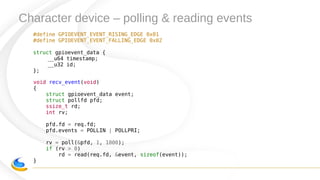
Character device – polling & reading events
#define GPIOEVENT_EVENT_RISING_EDGE 0x01
#define GPIOEVENT_EVENT_FALLING_EDGE 0x02
struct gpioevent_data {
__u64 timestamp;
__u32 id;
};
void recv_event(void)
{
struct gpioevent_data event;
struct pollfd pfd;
ssize_t rd;
int rv;
pfd.fd = req.fd;
pfd.events = POLLIN | POLLPRI;
rv = poll(&pfd, 1, 1000);
if (rv > 0)
rd = read(req.fd, &event, sizeof(event));
}
libgpiod – C library & tools for GPIO chardev
●
History
– Needed a solution for toggling power switches on BayLibre ACME
●
IIO attributes
●
Regulators controlled from user space
●
GPIO character device
– Version 0.1 released on January 18th 2017
– v1.0 released on February 7th 2018
– Current stable version is 1.1.1
– 1.2 coming soon
– 0.3 series still supported
libgpiod – C library & tools for GPIO chardev
●
Features
– C API, fully documented in doxygen
– Command-line tools: gpiodetect, gpioinfo, gpioset, gpioget, gpiofind &
gpiomon
– Custom test suite (working together with gpio-mockup kernel module
and irq_sim)
– C++ bindings
– Python 3 bindings
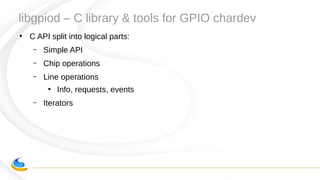
libgpiod – C library & tools for GPIO chardev
●
C API split into logical parts:
– Simple API
– Chip operations
– Line operations
●
Info, requests, events
– Iterators
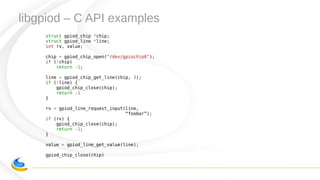
libgpiod – C API examples
struct gpiod_chip *chip;
struct gpiod_line *line;
int rv, value;
chip = gpiod_chip_open("/dev/gpiochip0");
if (!chip)
return -1;
line = gpiod_chip_get_line(chip, 3);
if (!line) {
gpiod_chip_close(chip);
return -1
}
rv = gpiod_line_request_input(line,
“foobar”);
if (rv) {
gpiod_chip_close(chip);
return -1;
}
value = gpiod_line_get_value(line);
gpiod_chip_close(chip)
libgpiod – C API examples
struct timespec ts = { 0, 1000000 };
struct gpiod_line_event event;
struct gpiod_chip *chip;
struct gpiod_line *line;
int rv, value;
chip = gpiod_chip_open("/dev/gpiochip0");
if (!chip)
return -1;
line = gpiod_chip_get_line(chip, 3);
if (!line) {
gpiod_chip_close(chip);
return -1
}
rv = gpiod_line_request_rising_edge_events(line, “foobar”);
if (rv) {
gpiod_chip_close(chip);
return -1;
}
do {
rv = gpiod_line_event_wait(line, &ts);
} while (rv <= 0);
rv = gpiod_line_event_read(line, &event);
if (!rv)
printf("event: %s timestamp: [%8ld.%09ld]n",
event.event_type, event.ts.tv_sec, event.ts.tv_nsec);
gpiod_chip_close(chip)
libgpiod tools - examples
$ gpiodetect
gpiochip0 [gpio-mockup-A] (8 lines)
gpiochip1 [gpio-mockup-B] (8 lines)
gpiochip2 [gpio-mockup-C] (8 lines)
$ gpioinfo gpiochip1
gpiochip1 - 8 lines:
line 0: "gpio-mockup-B-0" unused output active-high
line 1: "gpio-mockup-B-1" unused output active-high
line 2: "gpio-mockup-B-2" unused output active-high
line 3: "gpio-mockup-B-3" unused output active-high
line 4: "gpio-mockup-B-4" unused output active-high
line 5: "gpio-mockup-B-5" unused output active-high
line 6: "gpio-mockup-B-6" unused output active-high
line 7: "gpio-mockup-B-7" unused output active-high
libgpiod tools - examples
$ gpiofind gpio-mockup-B-3
gpiochip1 3
$ gpioget `gpiofind gpio-mockup-B-3`
0
$ gpioset gpiochip1 3=1
$ gpioget gpiochip1 1 2 3 4 5
0 0 1 0 0
$ gpioset --mode=wait gpiochip2 0=1
$ gpiomon gpiochip0 2
event: RISING EDGE offset: 2 timestamp: [1508094667.935877214]
$ gpiomon --format="%o %e %s.%n" gpiochip0 2
2 1 1508094729.895930484
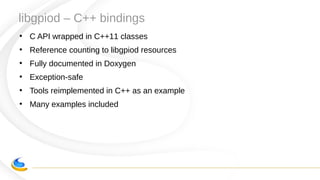
libgpiod – C++ bindings
●
C API wrapped in C++11 classes
●
Reference counting to libgpiod resources
●
Fully documented in Doxygen
●
Exception-safe
●
Tools reimplemented in C++ as an example
●
Many examples included
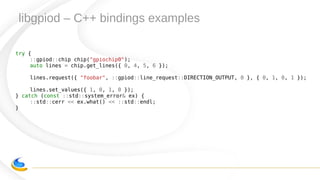
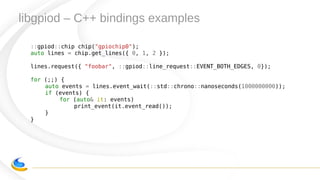
libgpiod – C++ bindings examples
try {
::gpiod::chip chip("gpiochip0");
auto lines = chip.get_lines({ 0, 4, 5, 6 });
lines.request({ "foobar", ::gpiod::line_request::DIRECTION_OUTPUT, 0 }, { 0, 1, 0, 1 });
lines.set_values({ 1, 0, 1, 0 });
} catch (const ::std::system_error& ex) {
::std::cerr << ex.what() << ::std::endl;
}
libgpiod – C++ bindings examples
::gpiod::chip chip("gpiochip0");
auto lines = chip.get_lines({ 0, 1, 2 });
lines.request({ "foobar", ::gpiod::line_request::EVENT_BOTH_EDGES, 0});
for (;;) {
auto events = lines.event_wait(::std::chrono::nanoseconds(1000000000));
if (events) {
for (auto& it: events)
print_event(it.event_read());
}
}
libgpiod – Python 3 bindings
●
C API wrapped in a set of Python 3 classes
●
Fully documented in pydoc
●
Native Python3 module written in C
●
Tools reimplemented in Python as an example
●
Many examples included
libgpiod – Python 3 bindings examples
with gpiod.Chip('gpiochip0') as chip:
lines = chip.get_lines([ 0, 2, 3, 4 ])
lines.request(consumer='foobar', type=gpiod.LINE_REQ_DIR_OUT, default_vals=[ 0, 1, 0, 1 ])
vals = lines.set_values([ 1, 0, 1, 0 ])
with gpiod.Chip(sys.argv[1]) as chip:
lines = chip.get_lines([ 0, 1, 2, 3 ])
lines.request(consumer='foobar', type=gpiod.LINE_REQ_EV_BOTH_EDGES)
try:
while True:
ev_lines = lines.event_wait(sec=1)
if ev_lines:
for line in ev_lines:
event = line.event_read()
print(event)
except KeyboardInterrupt:
sys.exit(130)
libgpiod – dbus bindings (coming soon)
●
Work-in-progress
●
git@github.com:brgl/libgpiod.git topic/gpio-dbus
●
Daemon written in C and based on GDBus and Gudev
●
Chip and line objects
●
Properties: name, label, offset etc.
●
Methods: request, set_value, get_value etc.
●
Signals: line events
libgpiod – future
●
Feature complete soon (after dbus bindings)
●
Proper tests for Python and C++ bindings
●
Support new user space features of future kernel versions
●
Run processes on events in gpiomon
libgpiod – C library & tools for GPIO chardev
●
Where to get it:
– Hosted at kernel.org
●
Source: https://git.kernel.org/pub/scm/libs/libgpiod/libgpiod.git/
●
Releases: https://www.kernel.org/pub/software/libs/libgpiod/
– Available in meta-openembedded & buildroot
– Packaged in Fedora, Arch, Debian linux and more
●
Contributions & bug reports:
– Send e-mails to linux-gpio@vger.kernel.org
– Use [libgpiod] prefix
Q & A
THANK YOU!

Kernel Recipes 2018 - New GPIO interface for linux user space - Bartosz Golaszewski

  • 1.
    New GPIO interfacefor linux user space Kernel Recipes 2018 Bartosz Golaszewski
  • 2.
    About us ● Baylibre ○Embedded Linux Engineering Firm ○ ~40 senior engineers, coming from the semiconductor world ○ HW and SW products: from concept to manufacturing ○ Upstream Linux kernel development and maintenance ○ Founding developers of kernelCI.org project
  • 3.
    GPIO – overview ● General-purposeinput/output ● Generic pin ● Can be configured at run time – Input (readable)/output (writable) – Enabled/disabled – IRQs ● Simple applications: – Buttons, LEDs, buzzers, power-switches/relays, stepper motors, level detectors, thermostats, pumps, etc
 ● Provided by SoCs, expanders or multifunction devices (I2C, SPI, ...)
  • 4.
    GPIO in thekernel ● Provider-consumer model ● Two co-existing interfaces – Based on GPIO numbers (legacy, deprecated) – Based on GPIO descriptors (recommended) ● Easy access to GPIOs associated with devices ● More fine-grained control ● Support for devres ● GPIO chip drivers in drivers/gpio ● Consumers all over the place – Writing drivers for devices using GPIOs is encouraged wherever possible
  • 5.
    GPIO in userspace ● Needed when no kernel device drivers provided/possible – Power switches – Relays – GPS – Bluetooth ● Certain users prefer to toggle GPIOs from user space – Intelligent home systems – Robotics
  • 6.
    /sys/class/gpio – legacyuser API ● d8f388d8 (“gpio: sysfs interface”) ● State not tied to process – Concurrent access to sysfs attributes – If process crashes, the GPIOs remain exported ● Cumbersome API – Multiple attributes per GPIO: value, direction, active_low, edge – Single sequence of GPIO numbers representing a two-level hierarchy - necessary to calculate the number of the GPIO, numbers not stable – Polling possible but complicated: need to lseek() or reopen ‘value’ on events, need to open ‘value’ separately for every GPIO, events not queued
  • 7.
    Character device –new user API ● Merged in linux v4.8 ● One device file per gpiochip – /dev/gpiochip0, /dev/gpiochip1, /dev/gpiochipX
 ● Similar to other kernel interfaces: open() + ioctl() + poll() + read() + close() ● Possible to request multiple lines at once (for reading/setting values) ● Possible to find GPIO lines and chips by name ● Open-source and open-drain flags ● User/consumer strings ● Uevents ● Reliable polling
  • 8.
    Character device –user API (linux/gpio.h) ● Chip info ● Line info ● Line request for values ● Reading values ● Setting values ● Line request for events ● Polling for events ● Reading events
  • 9.
    Character device –chip info struct gpiochip_info { char name[32]; char label[32]; __u32 lines; }; void get_chip_info(void) { struct gpiochip_info info; int fd, rv; fd = open("/dev/gpiochip0", O_RDWR); rv = ioctl(fd, GPIO_GET_CHIPINFO_IOCTL, info); }
  • 10.
    Character device –line info struct gpioline_info { __u32 line_offset; __u32 flags; char name[32]; char consumer[32]; }; #define GPIOLINE_FLAG_KERNEL (1UL << 0) #define GPIOLINE_FLAG_IS_OUT (1UL << 1) #define GPIOLINE_FLAG_ACTIVE_LOW (1UL << 2) #define GPIOLINE_FLAG_OPEN_DRAIN (1UL << 3) #define GPIOLINE_FLAG_OPEN_SOURCE (1UL << 4) void get_line_info(void) { struct gpioline_info info; memset(&info, 0, sizeof(info)); info.line_offset = 3; rv = ioctl(fd, GPIO_GET_LINEINFO_IOCTL, &info); }
  • 11.
    Character device –requesting lines #define GPIOHANDLES_MAX 64 #define GPIOHANDLE_REQUEST_INPUT (1UL << 0) #define GPIOHANDLE_REQUEST_OUTPUT (1UL << 1) #define GPIOHANDLE_REQUEST_ACTIVE_LOW (1UL << 2) #define GPIOHANDLE_REQUEST_OPEN_DRAIN (1UL << 3) #define GPIOHANDLE_REQUEST_OPEN_SOURCE (1UL << 4) struct gpiohandle_request { __u32 lineoffsets[GPIOHANDLES_MAX]; __u32 flags; __u8 default_values[GPIOHANDLES_MAX]; char consumer_label[32]; __u32 lines; int fd; }; void request_output(void) { struct gpiohandle_request req; int rv; req.flags |= GPIOHANDLE_REQUEST_OUTPUT; req.lines = 2; req.lineoffsets[0] = 3; req.lineoffsets[1] = 5; req.default_values[0] = 1; req.default_values[1] = 0; strcpy(req.consumer_label, "foobar"); rv = ioctl(fd, GPIO_GET_LINEHANDLE_IOCTL, &req); }
  • 12.
    Character device –reading/setting values #define GPIOHANDLE_GET_LINE_VALUES_IOCTL _IOWR(0xB4, 0x08, struct gpiohandle_data) #define GPIOHANDLE_SET_LINE_VALUES_IOCTL _IOWR(0xB4, 0x09, struct gpiohandle_data) struct gpiohandle_data { __u8 values[GPIOHANDLES_MAX]; }; void set_values(void) { struct gpiohandle_data data; int rv; data.values[0] = 0; data.values[1] = 1; rv = ioctl(req.fd, GPIOHANDLE_SET_LINE_VALUES_IOCTL, &data); } void get_values(void) { struct gpiohandle_data data; int rv; memset(&data, 0, sizeof(data)); rv = ioctl(req.fd, GPIOHANDLE_GET_LINE_VALUES_IOCTL, &data); }
  • 13.
    Character device –event requests #define GPIOEVENT_REQUEST_RISING_EDGE (1UL << 0) #define GPIOEVENT_REQUEST_FALLING_EDGE (1UL << 1) #define GPIOEVENT_REQUEST_BOTH_EDGES ((1UL << 0) | (1UL << 1)) struct gpioevent_request { __u32 lineoffset; __u32 handleflags; __u32 eventflags; char consumer_label[32]; int fd; }; void request_event(void) { struct gpioevent_request req; int rv; req.lineoffset = 4; req.handleflags = GPIOHANDLE_REQUEST_INPUT; req.eventflags = GPIOEVENT_REQUEST_BOTH_EDGES; strcpy(req.consumer_label, "foobar"); rv = ioctl(fd, GPIO_GET_LINEEVENT_IOCTL, &req); }
  • 14.
    Character device –polling & reading events #define GPIOEVENT_EVENT_RISING_EDGE 0x01 #define GPIOEVENT_EVENT_FALLING_EDGE 0x02 struct gpioevent_data { __u64 timestamp; __u32 id; }; void recv_event(void) { struct gpioevent_data event; struct pollfd pfd; ssize_t rd; int rv; pfd.fd = req.fd; pfd.events = POLLIN | POLLPRI; rv = poll(&pfd, 1, 1000); if (rv > 0) rd = read(req.fd, &event, sizeof(event)); }
  • 15.
    libgpiod – Clibrary & tools for GPIO chardev ● History – Needed a solution for toggling power switches on BayLibre ACME ● IIO attributes ● Regulators controlled from user space ● GPIO character device – Version 0.1 released on January 18th 2017 – v1.0 released on February 7th 2018 – Current stable version is 1.1.1 – 1.2 coming soon – 0.3 series still supported
  • 16.
    libgpiod – Clibrary & tools for GPIO chardev ● Features – C API, fully documented in doxygen – Command-line tools: gpiodetect, gpioinfo, gpioset, gpioget, gpiofind & gpiomon – Custom test suite (working together with gpio-mockup kernel module and irq_sim) – C++ bindings – Python 3 bindings
  • 17.
    libgpiod – Clibrary & tools for GPIO chardev ● C API split into logical parts: – Simple API – Chip operations – Line operations ● Info, requests, events – Iterators
  • 18.
    libgpiod – CAPI examples struct gpiod_chip *chip; struct gpiod_line *line; int rv, value; chip = gpiod_chip_open("/dev/gpiochip0"); if (!chip) return -1; line = gpiod_chip_get_line(chip, 3); if (!line) { gpiod_chip_close(chip); return -1 } rv = gpiod_line_request_input(line, “foobar”); if (rv) { gpiod_chip_close(chip); return -1; } value = gpiod_line_get_value(line); gpiod_chip_close(chip)
  • 19.
    libgpiod – CAPI examples struct timespec ts = { 0, 1000000 }; struct gpiod_line_event event; struct gpiod_chip *chip; struct gpiod_line *line; int rv, value; chip = gpiod_chip_open("/dev/gpiochip0"); if (!chip) return -1; line = gpiod_chip_get_line(chip, 3); if (!line) { gpiod_chip_close(chip); return -1 } rv = gpiod_line_request_rising_edge_events(line, “foobar”); if (rv) { gpiod_chip_close(chip); return -1; } do { rv = gpiod_line_event_wait(line, &ts); } while (rv <= 0); rv = gpiod_line_event_read(line, &event); if (!rv) printf("event: %s timestamp: [%8ld.%09ld]n", event.event_type, event.ts.tv_sec, event.ts.tv_nsec); gpiod_chip_close(chip)
  • 20.
    libgpiod tools -examples $ gpiodetect gpiochip0 [gpio-mockup-A] (8 lines) gpiochip1 [gpio-mockup-B] (8 lines) gpiochip2 [gpio-mockup-C] (8 lines) $ gpioinfo gpiochip1 gpiochip1 - 8 lines: line 0: "gpio-mockup-B-0" unused output active-high line 1: "gpio-mockup-B-1" unused output active-high line 2: "gpio-mockup-B-2" unused output active-high line 3: "gpio-mockup-B-3" unused output active-high line 4: "gpio-mockup-B-4" unused output active-high line 5: "gpio-mockup-B-5" unused output active-high line 6: "gpio-mockup-B-6" unused output active-high line 7: "gpio-mockup-B-7" unused output active-high
  • 21.
    libgpiod tools -examples $ gpiofind gpio-mockup-B-3 gpiochip1 3 $ gpioget `gpiofind gpio-mockup-B-3` 0 $ gpioset gpiochip1 3=1 $ gpioget gpiochip1 1 2 3 4 5 0 0 1 0 0 $ gpioset --mode=wait gpiochip2 0=1 $ gpiomon gpiochip0 2 event: RISING EDGE offset: 2 timestamp: [1508094667.935877214] $ gpiomon --format="%o %e %s.%n" gpiochip0 2 2 1 1508094729.895930484
  • 22.
    libgpiod – C++bindings ● C API wrapped in C++11 classes ● Reference counting to libgpiod resources ● Fully documented in Doxygen ● Exception-safe ● Tools reimplemented in C++ as an example ● Many examples included
  • 23.
    libgpiod – C++bindings examples try { ::gpiod::chip chip("gpiochip0"); auto lines = chip.get_lines({ 0, 4, 5, 6 }); lines.request({ "foobar", ::gpiod::line_request::DIRECTION_OUTPUT, 0 }, { 0, 1, 0, 1 }); lines.set_values({ 1, 0, 1, 0 }); } catch (const ::std::system_error& ex) { ::std::cerr << ex.what() << ::std::endl; }
  • 24.
    libgpiod – C++bindings examples ::gpiod::chip chip("gpiochip0"); auto lines = chip.get_lines({ 0, 1, 2 }); lines.request({ "foobar", ::gpiod::line_request::EVENT_BOTH_EDGES, 0}); for (;;) { auto events = lines.event_wait(::std::chrono::nanoseconds(1000000000)); if (events) { for (auto& it: events) print_event(it.event_read()); } }
  • 25.
    libgpiod – Python3 bindings ● C API wrapped in a set of Python 3 classes ● Fully documented in pydoc ● Native Python3 module written in C ● Tools reimplemented in Python as an example ● Many examples included
  • 26.
    libgpiod – Python3 bindings examples with gpiod.Chip('gpiochip0') as chip: lines = chip.get_lines([ 0, 2, 3, 4 ]) lines.request(consumer='foobar', type=gpiod.LINE_REQ_DIR_OUT, default_vals=[ 0, 1, 0, 1 ]) vals = lines.set_values([ 1, 0, 1, 0 ]) with gpiod.Chip(sys.argv[1]) as chip: lines = chip.get_lines([ 0, 1, 2, 3 ]) lines.request(consumer='foobar', type=gpiod.LINE_REQ_EV_BOTH_EDGES) try: while True: ev_lines = lines.event_wait(sec=1) if ev_lines: for line in ev_lines: event = line.event_read() print(event) except KeyboardInterrupt: sys.exit(130)
  • 27.
    libgpiod – dbusbindings (coming soon) ● Work-in-progress ● git@github.com:brgl/libgpiod.git topic/gpio-dbus ● Daemon written in C and based on GDBus and Gudev ● Chip and line objects ● Properties: name, label, offset etc. ● Methods: request, set_value, get_value etc. ● Signals: line events
  • 28.
    libgpiod – future ● Featurecomplete soon (after dbus bindings) ● Proper tests for Python and C++ bindings ● Support new user space features of future kernel versions ● Run processes on events in gpiomon
  • 29.
    libgpiod – Clibrary & tools for GPIO chardev ● Where to get it: – Hosted at kernel.org ● Source: https://git.kernel.org/pub/scm/libs/libgpiod/libgpiod.git/ ● Releases: https://www.kernel.org/pub/software/libs/libgpiod/ – Available in meta-openembedded & buildroot – Packaged in Fedora, Arch, Debian linux and more ● Contributions & bug reports: – Send e-mails to linux-gpio@vger.kernel.org – Use [libgpiod] prefix
  • 30.